Tag Archives: Louise Smith

SHIMMER AND HERRINGBONE

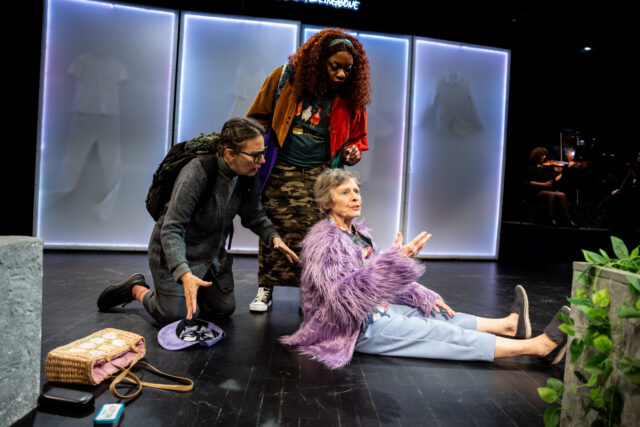
Fashion takes center stage at Talking Band’s Shimmer and Herringbone (photo by Maria Baranova)

SHIMMER AND HERRINGBONE
Mabou Mines@122CC
150 1st Ave. at Ninth St.
Wednesday – Sunday through May 19, $35
talkingband.org

Amid the flurry of Broadway openings — no fewer than nineteen between March 7 and April 25, the cutoff to be eligible for the Tonys — you may have missed the celebratory event of the season, the fiftieth anniversary of Talking Band, the independent downtown company founded by Ellen Maddow, Paul Zimet, and Tina Shepard in 1974. The avant-garde troupe has staged more than sixty productions since 1975’s The Kalevala, and this year it has treated us to three exquisite new shows in a span of three months.

In February, TB presented the moving and intimate The Following Evening at PAC NYC, a collaboration with 600 Highwaymen that explored personal and professional legacy, starring real-life couples Abigail Browde and Michael Silverstone of 600 Highwaymen and Maddow and Zimet of TB. In March, Maddow, in her mid-seventies, and Zimet, in his early eighties, teamed up for the brilliant Existentialism at La MaMa, a dazzling meditation on aging.

TB concludes its unofficial trilogy with the hilariously inventive and profound Shimmer and Herringbone, which opened last night at Mabou Mines@122CC for a limited run through May 19.

In his 1905 short story “The Czar’s Soliloquy,” Mark Twain wrote, “As Teufelsdröckh suggested, what would man be — what would any man be — without his clothes? As soon as one stops and thinks over that proposition, one realizes that without his clothes a man would be nothing at all; that the clothes do not merely make the man, the clothes are the man; that without them he is a cipher, a vacancy, a nobody, a nothing.”

The ninety-minute Shimmer and Herringbone takes place in the titular clothing store, where a handful of oddball characters across three generations — old friends, former lovers, not-so-strangers — shop with the help of eclectic dressing room attendant Rhonda (Maddow), who shares tidbits of carefully phrased philosophy as they seek to change their clothes, their style, and, in several cases, their lives, to not be a nobody or a nothing.

When Rhonda asks one customer, “Did you find what you were looking for?,” she’s referring to more than just a new scarf or jacket.

She says to another shopper, “Where are you going, if you don’t mind my asking?,” a question that requires a bigger answer than the shoe department.
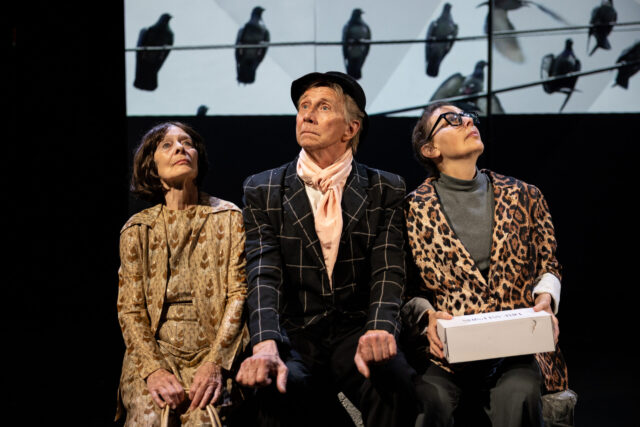
Melanie (Tina Shepard), Colin (Jack Wetherall), and Lilly (Lizzie Olesker) wonder about pigeons and life in world premiere play (photo by Maria Baranova)

At the beginning of the play, Lilly (Lizzie Olesker) and her daughter, the twentysomething Bree (Ebony Davis), find the elderly Melanie (Tina Shepard), who speaks in non sequiturs, facedown on the floor. Grace (Louise Smith) is a realtor who isn’t sure how she knows Colin (Jack Wetherall) and runs away when she sees Lilly, an ornithologist who is embarrassed that she doesn’t recognize Gus (James Tigger! Ferguson), who appears to know her very well.

As they slowly discover more about one another, the characters not only dig deep within themselves but try to understand how they are seen by others — and how they have changed over the years.

“I see this face and I wonder — could that be me?” Grace says, later adding, as only a real estate agent can, “My face is falling apart like an old house.”

Reaching out, Colin talks to Grace about the apartment where he’s lived for more than thirty years. “Suddenly, about a month ago, I woke up and everything looked drab, everything was in the wrong place. The rug that I inherited from my mother was tatty and raveled around the edges, the kitchen table was greasy, and my favorite chair looked like a toadstool with its undersides oozing toxins. It’s like I have changed, but my apartment is stubbornly, defiantly sitting in the past, and I can’t stand it,” he says. Grace responds, “That’s been happening to people a lot lately,” implicating the audience itself.

As the characters share stories from their past that often include details about what they were wearing at the time, Bree is having none of it. When Rhonda asks her, “Can I help you?,” the youngest member of the group quickly replies, “I don’t need help.” When her mother is considering whether she should return a shirt, Bree declares, “It’s just a blouse,” a phrase that sticks out like blasphemy.

Through it all, a string trio consisting of Rachel Feldhaus, Marija Kovacevic, and Agustin Uriburu performs in a far corner, sometimes adding soothing background music and sometimes playing to the characters, who sit down and watch them while having conversations.
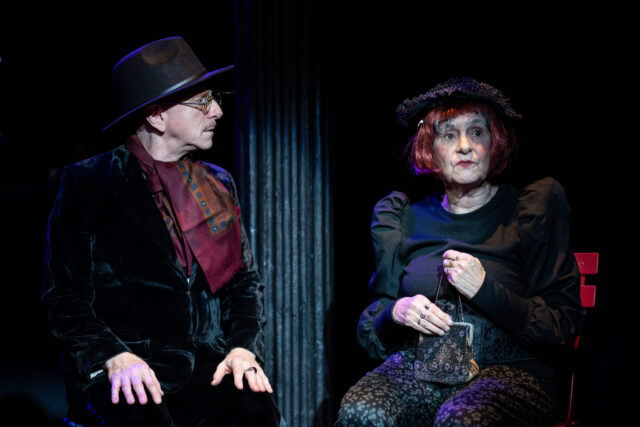
Gus (James Tigger! Ferguson) and Rhonda (Ellen Maddow) find common ground through dress in Shimmer and Herringbone (photo by Maria Baranova)

Shimmer and Herringbone is another delightful triumph from Talking Band, reminiscent of its 2022 production Lemon Girls or Art for the Artless, which also featured Olesker, Shepard, Smith, Wetherall, and writer and composer Maddow and was directed by Zimet. The new piece is cowritten by Maddow and Zimet and directed by Zimet, in collaboration with costume designer Olivera Gajic, whose outfits nearly steal the show, from black leather and leopard print to fluffy slippers and feathery hats.

The narrative unfolds on Anna Kiraly’s cozy set, which is centered by four lighted dressing-room doors that the shoppers enter and exit and is also used for Kiraly’s projections of social media posts, images of clothing and the moon, abstract shapes, birds on a wire, and a short film. The soft lighting is by Mary Ellen Stebbins, with sweet and touching choreography by Sean Donovan. A kind of angel at a way station, Rhonda is often pushing along a mannequin or a rack of clothes that were rejected. The characters occasionally sit on concrete slabs like park benches at the front, almost touching the audience.

In addition to the classical music played by the string trio, there are pop songs and poetry, from Samuel Taylor Coleridge and Blue “Gene” Tyranny to the combo of Bruce Springsteen and Patti Smith. Gus, who fashions himself a literary junkie, references Chekhov, Dostoevsky, Woolf, Borges, Hemingway, and Kerouac as he morphs into James Joyce, who once wrote, “Mother is packing my new secondhand clothes. She prays now, she says, that I may learn in my own life and away from home and friends what the heart is and what it feels. Amen. So be it. Welcome, O life!”

The centerpiece of the show is ornithologist Lilly’s spark bird, the New York City pigeon. Also known as the Columba livia and the rock dove, the bird is not only ubiquitous — it’s believed there are about four million in the city, compared with nine million people — but it is hard for the average person to tell them apart. Human beings have the ability to choose clothing that can assist in defining who they are, both outside and inside, but pigeons don’t have that option. It’s even difficult to identify their gender, as Lilly notes, which becomes relevant late in the play.

At one point, Grace explains that part of her job is “staging” a house, evoking the staging of a play: cleaning it out from top to bottom, then painting the walls white and adding cream carpets and innocuous artworks, allowing the buyer to make it their own home. Each character entering Shimmer and Herringbone is like that plain house, ready to redecorate themselves in their own personal style.

When Bree sees Melanie dragging a large garbage bag, she asks her what’s in there. “Nothing,” Melanie answers. “Stuff that’s been clogging up my closets, burdening my soul for half a century.” How many of us would love to go through our closets and get rid of old clothes that feel like a burden?

“So you want to find something that reflects who you are,” Rhonda says to Grace, who is worried about suffering buyer’s remorse, as if a new outfit is as important as a new home.

Isn’t it?

[Mark Rifkin is a Brooklyn-born, Manhattan-based writer and editor; you can follow him on Substack here.]
LAZARUS 1972–2022

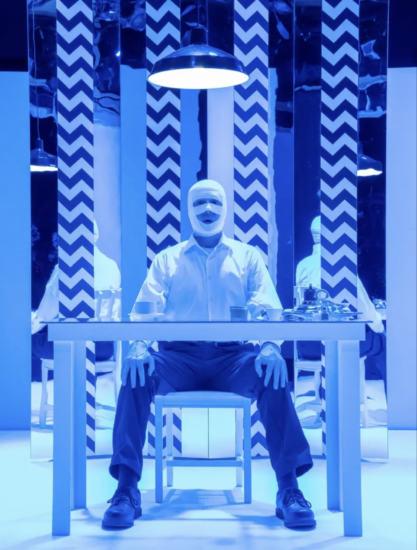
Christopher Caines stars as the title character in Ping Chong’s mesmerizing update of Lazarus

LAZARUS 1972–2022
La MaMa Downstairs Theater
66 East Fourth St. between Second & Third Aves.
Thursday – Sunday through October 16, $25-$30
www.lamama.org
www.pingchong.org

For his final work as artistic director for his troupe, Ping Chong revisits his past while looking to the future in Lazarus 1972–2022, a contemporary reimagining of his first independent piece. In 1972, Ping presented Lazarus at Meredith Monk’s loft studio; as part of Ping Chong and Company’s fiftieth anniversary, the thrilling update is running at La MaMa, just a few blocks from that studio, through October 16.

The evening begins with a film of the stars in the galaxy, followed by a video countdown of the Toronto-born Ping’s previous works. Then Watoko Ueno’s delicate, enchanting set is intricately put together by two women (Chaesong Kim and Nancy McArthur) dressed all in black who bring in a white glass table and a white chair and place dining items on them — a coffee cup and saucer, salt and pepper shakers, a serving tray, silverware in a napkin — arranging and rearranging them with great delicacy, each making a loud noise as they are put on the table. Behind the table is a backdrop with alternating vertical panels. A hanging lamp is occasionally set in motion, moving back and forth like a pendulum clock running out of time as it slows down. (The haunting lighting, which turns from white to red to blue to pitch-black, is by Hao Bai, with expert sound design by Ernesto Valenzuela.)

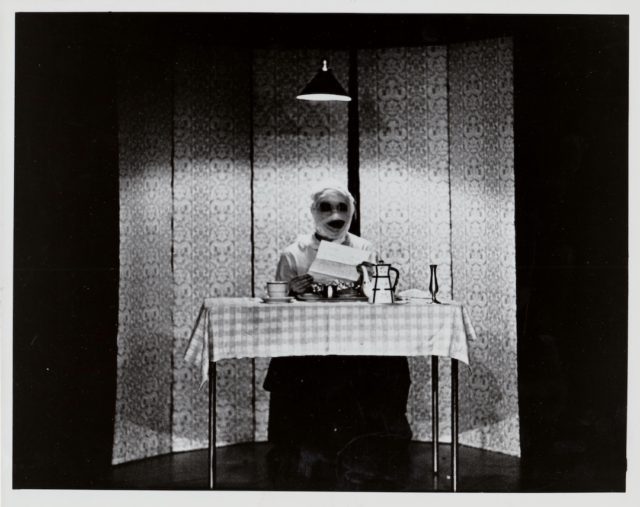
Eventually, Lazarus (Christopher Caines) enters the room; he is wearing black pants, a white button-down shirt, and black shoes, his face covered in white bandages except for his eyes and mouth. He evokes both Claude Rains in The Invisible Man and Edith Scob in Eyes without a Face, another character whose true self goes unseen by the world. In this case, Lazarus has risen to life in 2022 New York City and feels alienated from a society not so quick to welcome strangers, echoing Ping’s experience when he moved out of Chinatown, where he was raised. Lazarus deliberately repositions the items on the table and prepares to eat, but he is soon distracted.

Over the course of about an hour, Lazarus meets a mysterious lady in red (Jeannie Hutchins) and another young woman in black (Tiffany Tan), becomes a puppet, encounters a strange truck, and considers what is next for him in this unyielding city, which at one point flies past him on multiple screens. (The projections are by Kate Freer, with costumes by Stefani Mar.) The only words are spoken in voiceover by Louise Smith or Ping (“There is a room; there is nothing in the room.”); there is no dialogue, only sound, light, and movement in a mesmerizingly beautiful piece.

The Canadian-born Caines, who runs his own dance company, has performed previously with Ping and is hypnotic as Lazarus; you can feel his alienation and suspicion as his eyes and body shift to surprise noises or he just stands tall and still, waiting for something to happen to break him out of his loneliness. But don’t let me mislead you; the show is also very funny.

“Time passes, and with time passing the poignancy of loss multiplies, which is to say Lazarus has lived the fullness of life through time,” Ping writes in a program note. “By now, it must be obvious that I am Lazarus and Lazarus is me. The theme of Lazarus, the theme of Otherness, runs through all my work. Who could be more Other than Lazarus. . . . I have chosen to complete my life as an artist with this work that started it all. Coming full circle seemed appropriate.”

Lazarus 1972–2022 is a fitting finale for Ping, a longtime leader in the avant-garde theater that rose up in downtown New York City in the 1970s and who is now saying farewell having come full circle, for all our benefit.

LAZARUS 1972–2022

Ping Chong will revisit his 1972 work, Lazarus, at La MaMa (photo by Cathy Zimmerman)

Who: Ping Chong and Company
What: Reimagining of Ping Chong’s 1972 Lazarus
Where: La MaMa Downstairs Theater, 66 East Fourth St. between Second & Third Aves.
When: September 30 – October 16, $30 (panel discussion moderated by Sara Farrington on October 9 after 4:00 show)
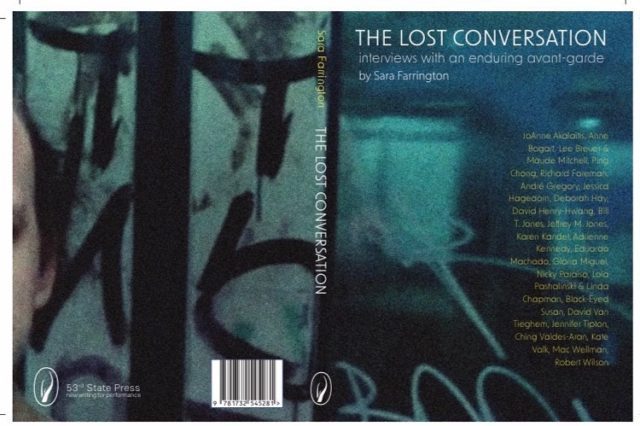
Why: “I’ve never thought of myself as a theater artist, I’ve thought of myself as an artist in the theater,” Ping Chong tells Sara Farrington in her new book, The Lost Conversation: Interviews with an Enduring Avant-Garde (53rd State Press, April 2022, $16). Asked how he first became involved in avant-garde theater around 1971, the Toronto-born Ping explains, “I graduated from the School of Visual Arts in film and I didn’t know what I was going to do. I mean, there were no filmmakers of color around. There was no role model and I wasn’t one of these go-getter aggressive kids. So I was just killing time, trying to figure out what to do next. And then a friend of a friend, an associate of mine from school, said, I’m taking some dance classes with Meredith Monk, do you want to go? So I took her classes — she was doing continuing education classes at NYU. And Meredith said to me, You’re talented, come to my workshop. But I didn’t.” He eventually did attend a workshop — Monk’s studio was only three blocks from his apartment — and even joined Monk’s company. His apartment was also only two blocks from La MaMa; he put on his first show there in 1979.

Ping is now back at La MaMa with what will be his final production as artistic director, Lazarus 1972–2022, a reimagining of his first independent work, which was staged at Meredith Monk’s loft studio half a century ago. It’s a nonlinear piece about cultural alienation in which the title biblical character is resurrected in 1972 New York City; it featured projections, puppets, voice-overs (by Ping and Andrea Goodman), sound effects, music, but no dialogue spoken by the two main characters, portrayed by Tony Jannetti and Catherine Zimmerman. The sixty-minute Lazarus 1972–2022 runs Thursdays through Sundays from September 30 to October 16 at La MaMa Downstairs Theater; Christopher Caines will be Lazarus and Jeannie Hutchins portrays Woman, with sets by Watoko Ueno, lighting by Hao Bai, costumes by Stefani Mar, sound by Ernesto Valenzuela, and projections by Kate Freer.

“Lazarus was a metaphor for my own experience, because I had just left my insular world of Chinatown, moving out of that limbo into figuring out how to exist in larger society,” Ping said in a statement. “The original show was 1972; New York City was nearly bankrupt at that time and the urban purgatory aspect of it was very surreal and real. Originally the work reflected that — but the work has changed: I’m a lifetime New Yorker, and Lazarus is now different than the show was at the time in the sense that New York is also different, and centrally, part of the character of the show. Lazarus 1972–2022 is my love for New York but it’s also my sadness for what it’s become. Lazarus may have left purgatory and come back into the world — but what kind of a world did he come back into in 2022?”

On October 9 following the 4:00 performance, playwright, theater artist, screenwriter, director, and Foxy Films cofounder Farrington will join Ping at La MaMa for the panel discussion “Time Passes: Ping Chong and Fiji Theater Company Then and Now,” accompanied by members of his company from the late-1970s and 1980s, including John Fleming, Brian Hallas, Louise Smith, and Jeannie Hutchins. In her book, Farrington, who has collaborated with her husband, Reid, on such experimental multimedia shows as The Passion Project, CasablancaBox, Tyson vs. Ali, and BrandoCapote in addition to writing and/or directing other works, also speaks with such legendary figures as JoAnne Akalaitis, Anne Bogart, Richard Foreman, André Gregory David Henry Hwang, Bill T. Jones, Adrienne Kennedy, David Van Tieghem, Kate Valk, Mac Wellman, and Robert Wilson, creating a fascinating oral history of avant-garde theater.

LEMON GIRLS OR ART FOR THE ARTLESS

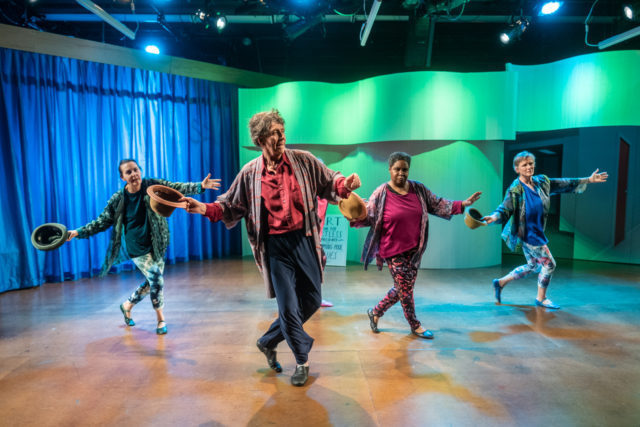
A quartet of senior women gets more than they bargained for in Lemon Girls or Art for Artless (photo by Andrew Bisdale)

LEMON GIRLS OR ART FOR THE ARTLESS
La MaMa Experimental Theatre Club, the Downstairs
66 East Fourth St. between Second Ave. & Bowery
Thursday – Sunday through March 27, $25-$30
212-475-7710
www.lamama.org
talkingband.org

Lemon Girls or Art for the Artless is a small show in a small space, but it’s one of the most exhilarating and inspiring shows I’ve seen since the pandemic interrupted in-person entertainment in March 2020. It’s an uproarious and touching celebration of aging and coming to terms with who you are and what you’ve accomplished, a kind of alternative to the wickedly fun Six on Broadway, where the six wives of Henry VIII battle it out to see who had it worst with the monarch.

Continuing in the Downstairs theater at La MaMa through March 27, Lemon Girls is about four senior women whose connection to life changes when they meet a stranger in their local café, appropriately called Solo, where the quartet, friends since attending the progressive Lemon Elementary school together, meet for coffee every Tuesday at 3:30. They sit at the same table each week, but they are surprised one afternoon to not only find a line to get in — the new pencil latte has become a thing — but also see that a stranger has taken their spot.

Urban historian Nivea (Patrena Murray), social worker Topo (Lizzie Olesker), retired civil servant Pinny (Louise Smith), and cookbook writer Lorca (Ellen Maddow) assume that the man, Sid Spitz (Jack Wetherall), will cede them the table, but instead he cheekily asks them to join him, in some ways becoming their fifth friend, painter Fran (Tina Shepard), who is not there. They recognize instantly that he’s not like the other males they know, who call themselves the Romeos: Retired Old Men Eating Out. (“They enjoy the turkey chili. It gives them gas,” Pinny points out.) An FIT librarian and performance artist, Sid invites the women to become part of a music theater workshop he leads in the basement of a rec center.

After some waffling, they do actually show up. Their skepticism of Sid’s earnest direction gives the rehearsal scenes brilliant, low-key comedy. “Keep on walking, fill in the spaces, curve through the people, use your arms. And STOP. And float. And STOP and float,” he advises, adding, “The floor is sand, your feet are hands, they squeeze the sand. They caress, they sink, they caress, they squeeze.”

Lorca says to Nivea, “What does he mean our feet are hands? Like monkeys? Does he mean monkeys? Is this the beach? Are we supposed to be at the beach, or the zoo?”

When Sid tells them to move underwater and “fill the empty spaces,” Lorca wonders, “Underwater? How do we breathe? People can’t breathe underwater.” And when he prompts them to glide like their hands are knives and the air is bread, slicing away, Lorca argues, “Suddenly it’s the kitchen?”

Sid Spitz (Jack Wetherall) leads rehearsals for upcoming show in charmer at La MaMa (photo by Andrew Bisdale)

But the four women are superb actors, able to play their characters, older women who are learning to perform, with skill and nuance as the quartet eventually enjoys adapting to Sid’s unique choreographic methods and come up with songs that share intimate details of their lives. As they prepare to put on a public show for an organization called Art for the Artless, there’s conflict: In order to keep the workshop funded, they need a fifth participant, and Nivea promises to bring Fran.

In addition, Sid needs to get paid so he can afford his rent to his landlord and best friend, Marvin; the unseen Marvin is about to turn ninety and is close with artist David Hockney, which excites the group, who rave about how Hockney’s recent show at the Met changed their lives.

At one point, Topo opines, “What I think I look like and what I look like don’t match. That gives me the creeps,” to which Lorca replies, “But it doesn’t matter. It doesn’t matter anymore.” Before the rehearsals, the women had resigned themselves to a plain existence, exemplified by some of Lorca’s bitter songs. Sitting outside the café, Lorca and Pinny remember one of Lorca’s schoolgirl ditties: “I sit on a bee because I am dumb / I scream at my teacher cuz she isn’t fair / I kick the doctor because he hurt me / I drown in the river because it is there.” But hope is on the way.

Lemon Girls or Art for the Artless is the latest from avant-garde mainstays Talking Band, which has staged more than fifty new works since 1974. The show is directed by four-time Obie winner Paul Zimet (The City of No Illusions, The Walk Across America for Mother Earth), who cofounded the troupe with Maddow (Fusiform Gyrus — A Septet for Two Scientists and Five Horns, Fat Skirt Big Nozzle), who wrote Lemon Girls and composed the wonderful songs, and Shepard. Sean Donovan (Cabin, The Reception) did the marvelous, often hysterical choreography, which is a character unto itself, helping define the four women and how they view the world. The fab costumes are by Kiki Smith.

Anna Kiraly’s set is anchored by the slightly raised Café Solo at the corner of stage right, covered by a blue curtain when the action is taking place in the central makeshift workshop space, where a door leads beyond. The characters open and close the curtain as scenes there begin and end; on the back wall of the café, Kiraly projects pixelated, abstracted black-and-white footage of younger people hanging out in the shop, which the four women ignore.

As we emerge from the coronavirus crisis, which hit senior citizens particularly hard, it is an absolute joy to watch Nivea, Topo, Pinny, Lorca, and Sid, portrayed by a supremely talented cast, meeting new people, trying new things, and finding renewed meaning in their everyday existence.

“That’s what’s changed!” Nivea suddenly declares. “That’s what I’ve gone back to, I mean. I’ve stopped watching myself. I used to always be watching myself watching myself. Did you ever do that?”

Lorca replies, “Oh yeah. Everything was such a ridiculous complication of layers. And finally I just got tired of it, really, really tired of it. I would watch myself reflected in store windows looking like a hobbling old hag. It was so sad and exhausting! So I just stopped looking. It’s like I went back to when I was eight or something. Whatever I feel like doing, I do it.”

Talking Band has been around for nearly a half century; if you haven’t seen them before, you’ll be thrilled that you’ve met them now and have finally been introduced to their intoxicating philosophy.