Tag Archives: lee friedlander

GARRY WINOGRAND: ALL THINGS ARE PHOTOGRAPHABLE

Portrait of Garry Winogrand. Credit: Judy Teller

New documentary paints a fascinating portrait of street photographer Garry Winogrand (photo by Judy Teller)

GARRY WINOGRAND: ALL THINGS ARE PHOTOGRAPHABLE (Sasha Waters Freyer, 2018)
Film Forum
209 West Houston St.
Opens Wednesday, September 19
212-727-8110
www.winograndmovie.com
filmforum.org

There’s an intrinsic challenge about making a documentary about a photographer: How to portray the artist’s work, silent, still pictures of a moment in time, in a medium based on sound and movement. In Garry Winogrand: All Things Are Photographable, producer, director, and editor Sasha Waters Freyer attacks that issue by delving deep into many of Winogrand’s photographs, lingering on them as friends, relatives, and colleagues rave about his glorious images. “Well, what is a photograph? I’ll tell you what a photograph is. It’s the illusion of a literal description of how a camera saw a piece of time in space,” Winogrand said in a 1975 lecture at the University of Texas Austin, later adding, “All it is is light on surface.” Of course, in Winogrand’s case, it is much more than that; the black-and-white pictures he took with his trusted Leica M4 inhale and exhale at the exciting pace of real life. “It’s this observation of human behavior, of human activity, human gesture, the relationships between people, whether they know each other or not, how we behave in the world,” curator Susan Kismaric says. Writer Geoff Dyer calls Winogrand’s work a “psychogestural ballet,” while photographer Matt Stuart looks at photo after photo, pointing out “the dance” in each one. “When things move, I get interested. I know that much,” Winogrand, who passed away in 1984 at the age of fifty-six, says in his gruff voice. “He had no ambition for fame or celebrity. He was totally obsessed and possessed by photography,” his good friend, photographer Tod Papageorge, says. “It was work work work work work.”

New York, 1968 [laughing woman with ice cream] Photographs by Garry Winogrand, Collection Center for Creative Photography, The University of Arizona. © The Estate of Garry Winogrand, courtesy of Fraenkel Gallery, San Francisco.

“New York, 1968” [laughing woman with ice cream] (photographs by Garry Winogrand, Collection Center for Creative Photography, the University of Arizona. © The Estate of Garry Winogrand, courtesy of Fraenkel Gallery, San Francisco)

Freyer traces the life of “a city hick from the Bronx,” from his boyhood, when he had polio, through three marriages and three children, from his fear of nuclear war to his love of the female form, from the streets of New York City to California and Texas. She weaves in audio and video from lectures and interviews, filmed and taped conversations with photographer Jay Maisel, and photos and home movies of Winogrand and his family. Freyer speaks with photographers Thomas Roma, Jeffrey Henson Scales, Leo Rubinfien, Laurie Simmons, and Michael Ernest Sweet, curator Erin O’Toole, gallery owner Jeffrey Fraenkel (who compares Winogrand to Norman Mailer), Mad Men creator Matthew Weiner, historian and critic Shelley Rice, and two of Winogrand’s ex-wives, Adrienne Lubeau and Judy Teller. There are also extensive quotes from legendary MoMA photography curator John Szarkowski. The film explores several turning points in his career, both good and bad, including the “New Documents” show with Lee Friedlander and Diane Arbus; his seminal work in 1964; “The Animals,” a series shot at the Central Park Zoo, where he would go with his kids; his color work; Public Relations, in which he examined the role and effect of the mass media; and his controversial Women Are Beautiful book, which was labeled as sexist and misogynistic.

Influenced by such photographers as Robert Frank, Walker Evans, and Dan Weiner, Winogrand could not stop taking pictures. He took so many — the thought of his working in the digital age is both thrilling and frightening — that he didn’t even develop thousands of rolls, leaving behind a treasure trove of material that Roma explains was misinterpreted by critics. “I would like not to exist,” Winogrand said. It’s a good thing for the rest of us that he did, sharing his unique view of the world, incorporating the chaos of his personal life into his remarkable pictures. Garry Winogrand: All Things Are Photographable, which features original music by Winogrand’s son, Ethan, and animation by Kelly Gallagher, opens September 19 at Film Forum, with Freyer participating in Q&As following the 7:00 shows on September 19 and 21. In her director’s statement, the Brooklyn-born Freyer writes, “In looking at Winogrand in all his multidimensional human complexity, I take aim at the ‘bad dad’ and ‘bad husband’ tropes in artist biography, seeking to undermine these as sources of triumph or artistic necessity. Winogrand was an artist whose rise and fall — from the 1950s to the mid-1980s — in acclaim mirrors not only that of American power and credibility in the second half of the twentieth century but also a vision of American masculinity whose limitations, toxicity, and inheritance we still struggle, culturally, to comprehend. The film ultimately invites a deeper consideration of Winogrand not only as a ‘man of his time,’ in the words of MoMA photography curator Susan Kismaric, but also as a man struggling to define himself simultaneously as an artist and a parent (as so many of us do).”
TICKET ALERT — LEE FRIEDLANDER WITH GIANCARLO T. ROMA: PASSION PROJECTS

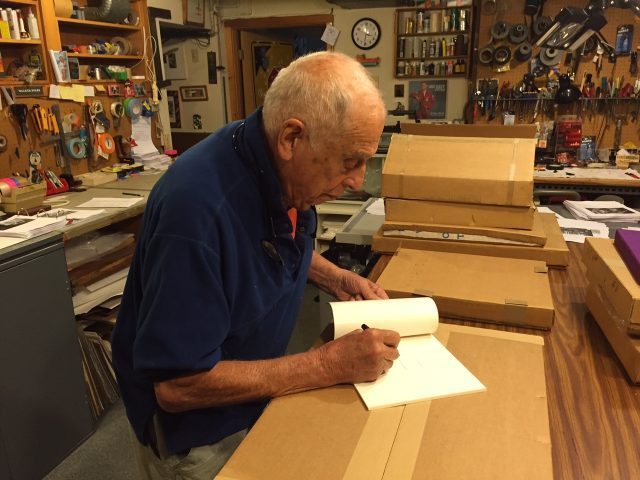
Lee Friedlander, who has revived his self-publishing company with his grandson,

Lee Friedlander, who has revived his self-publishing company with his grandson, Giancarlo T. Roma, will mare a rare public speaking appearance at the New York Public Library on June 20 (photo © Lee Friedlander)

Who: Lee Friedlander, Giancarlo T. Roma
What: Live from the NYPL
Where: New York Public Library, Stephen A. Schwarzman Building, 476 Fifth Ave. at 42nd St., 917-275-6975
When: Tuesday, June 20, $40, 7:00
Why: Legendary Washington-born photographer Lee Friedlander will make an extremely rare speaking appearance on June 20, his first in more than thirty years, when he comes to the New York Public Library, sharing the stage with his grandson, Giancarlo T. Roma, who describes himself on his Twitter page as a writer, stockbroker, business partner, guitar player, and more. Now eighty-two, Friedlander’s work over the last sixty years has included such series as “America by Car,” “Mannequin,” “Letters from the People,” and “Sticks & Stones,” capturing the social landscape of the country. Roma, whose mother is Friedlander’s daughter, has been collaborating with his father, photographer Thomas Roma, since the boy was in single digits, and he has now revived his grandfather’s self-publishing company, Haywire Press. The conversation, titled “Passion Projects,” will focus on Friedlander’s life and career, which he continues to do his way, not following any conventional methods.

REVOLUTION OF THE EYE: MODERN ART AND THE BIRTH OF AMERICAN TELEVISION

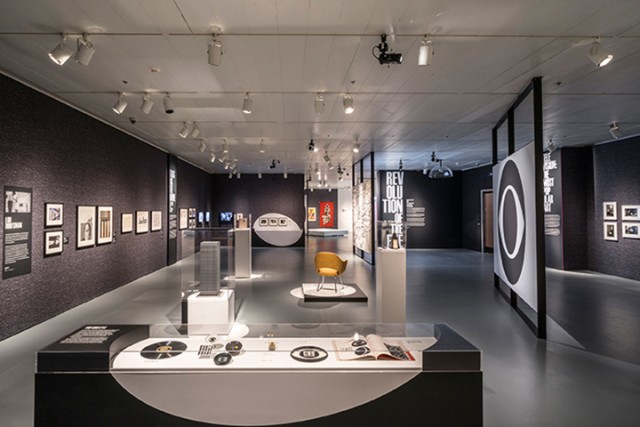
(photo by David Heald)

Jewish Museum show explores relationship between early television and modern art (photo by David Heald)

The Jewish Museum
1109 Fifth Ave. at 92nd St.
Thursday – Tuesday through September 27, $7.50-$15 (children eighteen and under free; free admission Saturday 11:00 am – 5:45 pm, pay-what-you-wish Thursday 5:00 – 8:00)
212-423-3200
thejewishmuseum.org

I am a proud TV baby, born into the first generation that treated television like a cherished member of the family. I actually took great offense that my bonus sibling — it was much more than a mere babysitter to me — was referred to as the boob tube and that many people claimed that watching too much of what I even as a kid considered a legitimate art form was bad for your physical and mental well-being. In Annie Hall, Alvy Singer (Woody Allen) famously explains to his actor pal, Rob (Tony Roberts), and girlfriend, Annie (Diane Keaton), why it’s so clean in California: “They don’t throw their garbage away. They make it into television shows.” Which leads me to the Jewish Museum’s fun and fascinating new look at the medium, the informative and entertaining exhibition “Revolution of the Eye: Modern Art and the Birth of American Television,” continuing through September 27. “Rarely is TV discussed in terms of art — and when it is, critics have usually focused on the ways television has influenced high art, or been critiqued and ridiculed by it,” UMBC Center for Art, Design, and Visual Culture executive director Symmes Gardner writes in his foreword to the catalog. “Yet as network television now shares the stage with other forms of broadcasting and video dissemination, we can see the ways in which this popular, commercial mechanism aided art, responded to art — and was, many times, itself art.”

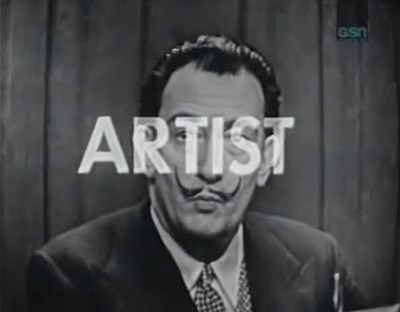
Exhibition includes clip of Salvador Dali appearance on WHATS MY LINE? (© Fremantle Media)

Exhibition includes clip of Salvador Dali appearance on WHAT’S MY LINE? (© Fremantle Media)

The multimedia show follows the development of television from the 1940s through the 1970s, tracing the impact that modern art had on the telly, which in turn influenced contemporary American society. Lovingly curated by Maurice Berger — although a bit noisy, with too many of the sounds bouncing off one another — the exhibition explores links between Rod Serling’s anthology series The Twilight Zone and surrealism (including a startling comparison of the opening title sequence to clips of short films by Marcel Duchamp, Fernand Léger, and René Clair), and Ernie Kovacs and Dada (and how the comic master was among the first to exploit the technology of the medium itself while playfully attacking the corporations that sponsored it). The development of television logos, advertising, and title sequences turns out to be quite a tale, involving such cutting-edge graphic designers as Saul Bass and established artists as Ben Shahn. Rowan and Martin’s Laugh-In is seen in conjunction with Pop, Op, and psychedelic art, while the tongue-in-cheek Batman series is compared to the comic-book Pop art of Roy Lichtenstein. Even Dinah Shore and Ed Sullivan make the cut, the latter’s mod sets matched with sculptures by Sol Lewitt, Donald Judd, and Robert Morris. The exhibit also has rare clips of artists on television, including Salvador Dali, Andy Warhol, Alexander Calder, Willem de Kooning, John Cage, Duchamp, Shahn, and Lichtenstein, although they are all far too short, but a segment of Aline Saarinen’s Sunday Show with Alberto Giacometti is a real treat. There are also works by Lee Friedlander (mocking the medium), Georgia O’Keeffe, Man Ray, Robert Motherwell, Eero Saarinen (Aline’s husband), Agnes Martin, and others, in addition to sections devoted to Winky Dink and You, which invited kids to be artists using the television screen, and the Museum of Modern Art’s Television Project, which sought to place the medium in a higher art form, something that the Jewish Museum has ably accomplished in this splendid exhibit that justifies my longtime love affair with the boob tube.

A COLLECTIVE INVENTION: PHOTOGRAPHS AT PLAY / THIRTY YEARS THIRTY-ONE PHOTOGRAPHERS

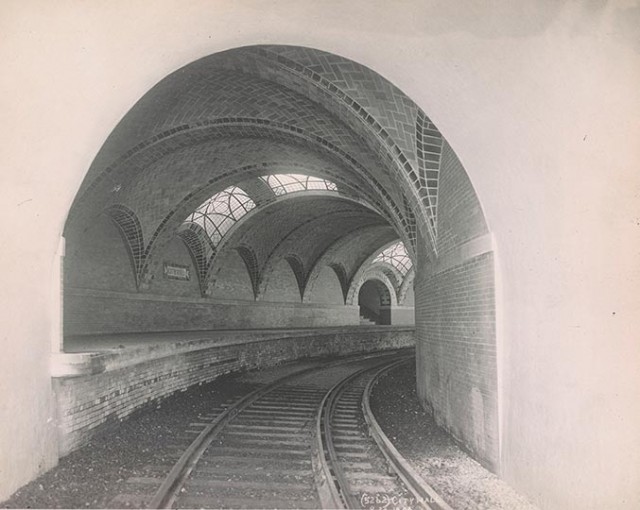
Attributed to Pierre Pullis, “City Hall Subway Station,” platinum print, 1904 (photo courtesy Morgan Library)

Attributed to Pierre Pullis, “City Hall Subway Station,” platinum print, 1904 (photo courtesy Morgan Library)

A COLLECTIVE INVENTION: PHOTOGRAPHS AT PLAY
Morgan Library & Museum
225 Madison Ave. at 36th St.
Daily through May 18, $12-$18 (free Fridays from 7:00 to 9:00)
212-685-0008
www.themorgan.org

THIRTY YEARS THIRTY-ONE PHOTOGRAPHERS
Laurence Miller Gallery
20 West 57th St. between Fifth & Sixth Aves.
Tuesday – Saturday through April 26, free, 11:00 am – 5:30 pm
212-397-3930
www.laurencemillergallery.com

A pair of current photography shows are both displaying a similar curatorial bent in celebratory exhibitions, but with significantly different results. For the first time in its ninety-year history, the Morgan Library has mounted a photography show, organized by Joel Smith, who became the institution’s inaugural photography curator in 2012. “A Collective Invention: Photographs at Play,” on view through May 18, brings together more than eighty works from the Morgan’s holdings and private collectors. The pictures are arranged in sequence, each linked by similarities to the previous photo and to the next one, in form, content, subject matter, geometrical patterns, or other elements. Some connections are easy to spot: Underwood & Underwood Studio’s 1908 photomontage of Theodore Roosevelt is next to George G. Rockwood’s 1898 portrait “Theodore Roosevelt in Rough Rider Uniform,” which is followed by the anonymous “Three-in-One Portrait of Johann Most, Peter Kropotkin, and Mikhail Bakunin” and Tomoko Sawada’s “ID400 (101-200),” multiple photographs Sawada took of herself in photobooths. But other combinations are not nearly as obvious, which is not necessarily a problem until you also realize that consecutive photos could have more than one similarity, and since the accompanying text identifies a single connection, visitors can get the feeling they are wrong if they see a different relationship. This aspect of the exhibition makes it a kind of guessing game and detracts from the overall impact of the show; however, Smith might have done it this way at least in part because the Morgan is relatively new to the world of photography and he didn’t have a lot to work with. I went back a second time to experience the show just focusing on the quality of the photographs themselves, and it still felt lacking. There are some gems here, including Acme Photography Bureau’s 1937 “Carving Lincoln on Rushmore Granite,” Heinz Hajek-Halke’s 1928-32 “Erotik—Ganz Groß! (Erotic—In a Big Way!),” Larry Sultan’s 1991 “Dad Looking into Pool,” and the anonymous 1963 “Montgomery Clift in Freud: The Secret Passion,” but not nearly enough for me to recommend the show. But hey, it’s only the Morgan’s first try. Hopefully they won’t take to heart the warnings of the final piece, Tim Davis’s 2013 “Photography Liberation Front,” an arrangement of found signs forbidding photography. (On April 15, the special program “Accumulated Wisdom: The Collector as Inventor” will feature talks and performances with Davis, Carrie Cooperider, Nina Katchadourian, Thomas Y. Levin, and others.)

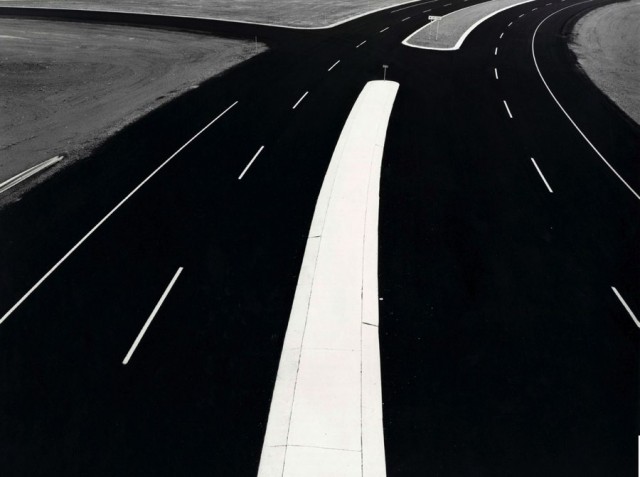
Burk Uzzle’s 1970 “New Mexico Highway” vintage gelatin silver print is part of Laurence Miller’s thirtieth anniversary exhibition

Burk Uzzle’s 1970 “New Mexico Highway” vintage gelatin silver print is part of Laurence Miller’s thirtieth anniversary exhibition (photo courtesy Laurence Miller Gallery)

Over in Midtown, Laurence Miller is celebrating his gallery’s thirtieth anniversary with “Thirty Years Thirty-One Photographers,” selecting works from approximately 250 exhibitions over the past three decades. Instead of just choosing its greatest hits, the gallery has put together an extremely well curated collection of photographs that subtly achieves precisely what the Morgan tried to do. Without announcing it or turning it into a game, Miller has organized the photos so that they organically flow one into another, both as a representation of the gallery’s sensibility as well as by theme, content, shape, subject, etc. Michael Spano’s 1978 “Vertical Subway” leads to Toshio Shibata’s 2008 “Okawa Village, Tosa County, Kochi Prefecture,” which is followed by Burk Uzzle’s 1970 “New Mexico Highway,” the thick white center line echoing Shibata’s horizontal bridge and Spano’s vertical composition in addition to the lights of the store and the road in the next photo, Uzzle’s 2007 “Desert Prada,” after which comes Lee Friedlander’s 1971 “Knoxville, Tennessee,” an empty street with a tilted triangular road sign in the middle. A rectangular light and title link Roger Mertin’s 1968 photo from his “Plastic Love Dream” series and Laurence Bach’s 1978 “Paros Dream Book #8,” while two photos each by Joan Colom and Helen Levitt depict anonymous people crowding the frame. But the connections alone are not what make the show, which runs through April 26, so successful; instead, it’s the high quality of the work — there are also photos by Emmet Gowin, Diane Arbus, Fred Herzog, Ray K. Metzker, Petah Coyne, Aaron Siskind, and Eadweard Muybridge, among others — arranged in such a way that you leave with an appreciation of the gallery’s unique identity, which centers on intriguing landscapes, street photography, fascinating experimentation, and a bold mix of black-and-white and color.

LEE FRIEDLANDER: AMERICA BY CAR

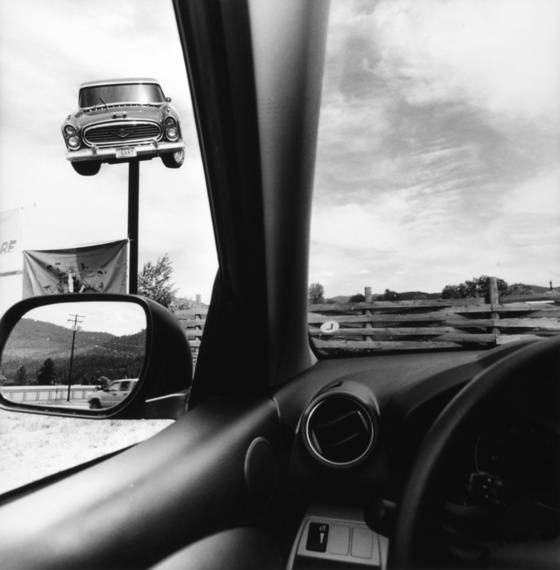
Lee Friedlander, “Montana, 2008,” gelatin silver print (collection of the artist, courtesy Fraenkel Gallery, © Lee Friedlander)

Whitney Museum of American Art
945 Madison Ave. at 75th St.
Wednesday – Sunday through November 28, $12-$18 (pay-what-you-wish Fridays 6:00 – 9:00)
212-570-3600
www.whitney.org

Since the late 1990s, Washington-born photographer Lee Friedlander has been taking pictures out rental-car windows using his Hasselblad Superwide as he drove through most of the fifty states. That extensive road trip is now documented in a thrilling exhibition at the Whitney, “America by Car” (through November 28), comprising 192 fifteen inches by fifteen inches square black-and-white images closely arranged in two rows in the museum’s mezzanine level. Identified only by city and/or state and year, the photos are packed with visual information yet work on their own as abstract geometric patterns, with the steering wheel, side and rearview mirrors, door handles, windows, and other automobile elements playing a part in Friedlander’s gorgeous framing. The show is arranged by subject matter, including shots of people, churches, stop signs, houses, industrial areas, trees, ice-cream stores, empty highways, and other cars, combining to form a snapshot of a primarily timeless America. Friedlander, now seventy-six, sometimes shows himself in the mirrors while other times uses them as a counterpoint to what can be seen through the front window, combining past, present, and future, the rearview showing where we’ve been, the inside of the car representing the here and now, and the road ahead outlining where we’re going, as individuals and as a country. He even gets fancy in one Magritte-like shot in which he lines up the rearview mirror with a tree outside the window, the mirror containing the trunk of another tree that stands in for the trunk of the tree right outside. It is almost impossible to identify where the vast majority of photos were taken, making this a display of contemporary America as a whole, not of individual states. “America by Car” is best seen in two ways: First, walk down the line of photos as if you were on your own road trip, looking out the window of your car as you traverse the country. Then circle back around and enjoy each photo as unique works of art, their architectural and, at times, painterly qualities beautiful in their own right.

Sara VanDerBeek, “Treme,” chromogenic print, 2010 (courtesy of Metro Pictures and Altman Siegel Gallery, © Sara VanDerBeek 2010)

Also at the Whitney

In the Anne & Joel Ehrenkranz Gallery on the first floor, Sara VanDerBeek takes another view of America in “To Think of Time” (through December 5). Using Walt Whitman’s LEAVES OF GRASS as inspiration, dividing the display into “Song of Myself,” “The Sleepers,” and the title section, the thirty-four-year-old VanDerBeek combines photos she took of abstract sculptures she made in her studio with exterior shots taken in her hometown of Baltimore as well as in the Lower Ninth Ward of post-Katrina New Orleans, resulting in evocative, meditative examinations of time and memory, finding artistic beauty in devastation. Also on view are “Collecting Biennials” (through November 28), “Paul Thek: Diver, a Retrospective” (through January 9), “Slater Bradley and Ed Lachman: Shadow” (through January 23), “Charles LeDray: workworkworkworkwork” (through February 13), and “Modern Life: Edward Hopper and His Time” (through April 10).