Tag Archives: la mama

PLAYING CHICKEN: KRYMOV LAB’S UNCLE VANYA AT LA MAMA

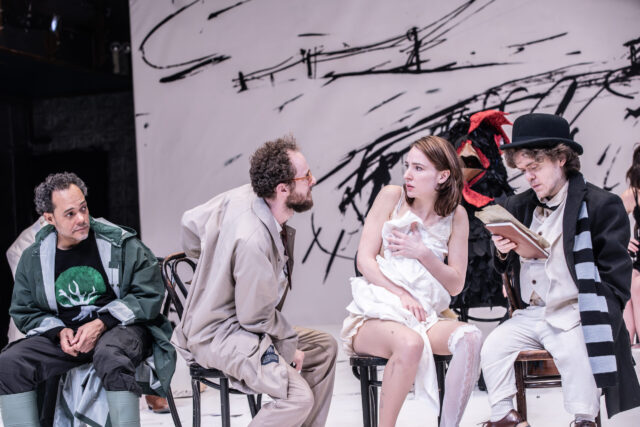
Vanya (Zach Fike Hodges) makes an appeal to Yelena (Shelby Flannery) as Waffles (Amen Igbinosun) watches and Professor Serebryakov (Colin Buckingham) reads in Krymov Lab NYC production at La MaMa (photo by Marina Levitskaya)

UNCLE VANYA, SCENES FROM COUNTRY LIFE
La MaMa Experimental Theatre Club
The Ellen Stewart Theatre
66 East Fourth St. between Second Ave. & Bowery
Tuesday – Sunday through April 12, $10-$60
212-475-7710
www.lamama.org

“When I was supposed to have a master class at Hunter College and I was preparing and I decided to look at Uncle Vanya, the scenes I was going to use for that master class, all of a sudden I felt nauseated,” Dmitry Krymov said at a talkback following the April 1 matinee of Uncle Vanya, scenes from country life at La MaMa, where he pointed out how everything had changed since Russia invaded Ukraine. He was in Philadelphia at the time, preparing The Cherry Orchard, and has been unable to return to his home country ever since. “I felt this is the food I put in the refrigerator many, many years ago, and I’m warming it up over and over again. I was so mad at myself for doing so that I decided to do what you just saw. That was the idea. I jumped in my bed. That’s what you were seeing right now. What you just saw was a work of my imagination at that particular moment.”

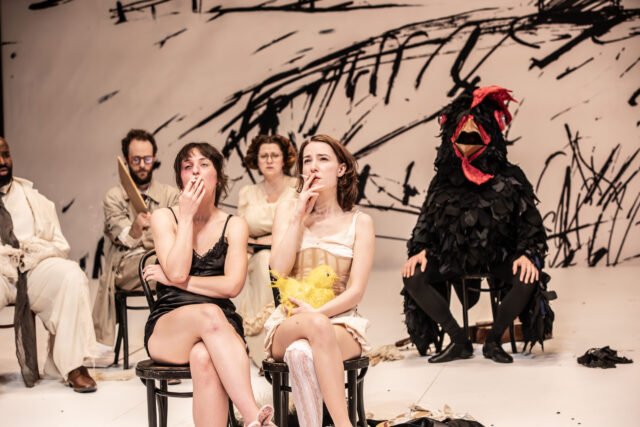
And what an imagination Krymov has. His new play is not a reimagination or a reinvention of Chekhov’s 1898 tragicomedy but a glorious explosion of its innards. Krymov shifts the focus to Yelena (Shelby Flannery), who spends most of the show sitting near the front of the stage in her knickers, the rest of the characters seated in a semicircle behind her. A city denizen, Yelena does not want to be in the country, instantly uncomfortable as she is harassed by flies and frightened by the sounds of wild animals nearby. Over the course of ninety inspired minutes, she is approached by Dr. Astrov (Javier Molina), an environmental activist who is in love with her; her husband, Professor Serebryakov (Colin Buckingham), who owns the family estate; Vanya (Zach Fike Hodges), the brother of the professor’s late wife who has no life outside the estate; Sonya (Natalie Battistone), daughter of the professor’s late wife who works with Vanya and is worried about becoming a spinster; Waffles (Amen Igbinosun), a simple-minded man who lives on the estate, faithful to the spouse who abandoned him years before for another man; Vanya’s controlling mother (Anya Zicer); the stern nanny (Tim Eliot) who makes a terrifying chicken soup; and a hen (MaryKate Glenn) wearing pink bunny slippers and a rooster (Sasha Drey) who plays the acoustic guitar.

The existence of the hen and rooster serves as a microcosm of Krymov’s approach to the narrative. In the original play, at one point the nanny calls out to the chickens on the estate and tells Sonya, “The speckled hen has disappeared with her chicks. I am afraid the crows have got her.” Krymov turns that brief mention into a heart-wrenching subplot. The two costumes are hilarious until they’re not, when the actors remove at least part of them. Meanwhile, the set is a long vertical rectangular slightly rising white platform that leads to a large horizontal canvas in the back on which designer Emona Stoykova has painted a rough black-and-white country scene inspired by Vincent Van Gogh’s last painting, “Wheatfield with Crows,” evoking not only the killer crows but the tragedy of Van Gogh’s suicide by gun — the firearm a mainstay of Chekhovian drama and something that Krymov also turns inside out and upside down.

Eventually, Vanya gets tired of not being the center of attention and screams out, “I am the main character of this play! . . . THIS PLAY IS ABOUT ME! IT’S CALLED UNCLE VANYA. NOT UNCLE PROFESSOR, NOT UNCLE DOCTOR, NOT UNCLE SONYA, NOT UNCLE WHAT’S HIS NAME OR WHATEVER YOUR NAME IS. NOT UNCLE MAMA, NOT UNCLE CHICKEN. IT’S UNCLE VANYA. ME!”

However, this is Dmitry Krymov’s Uncle Vanya, not Anton Chekhov’s, as evidenced most defiantly by an utterly brilliant finale.

A hen (MaryKate Glenn) and Yelena (Shelby Flannery) take a smoking break in Uncle Vanya, scenes from country life (photo by Marina Levitskaya)

Writer-director Krymov has assembled a terrific team to pull off this bewitching, circuslike production, every element pulling rabbits out of hats, with costumes by Luna Gomberg, puppets by Leah Ogawa, lighting by Krista Smith, sound by Denis Zabikaya, projections by Yana Biryukova, and impressive dramaturgy by Shari Perkins. The cast is exceptional, led by Flannery as a complex Yelena, who adds depth to a role often performed as a knowing seductress, and Glenn as the unforgettable Hen, who will break your heart.

The play is also heavily influenced by the pandemic and the Russian invasion of Ukraine as the characters search for their identity and place in an ever-more-dangerous world, where potential violence hovers around every corner and love and connection are not easy to come by. At the talkback, Krymov was near tears several times when he spoke fondly about his former home and answered questions from members of the audience watching from Russia (and other countries) on a livestream.

Krymov previously presented his unique takes on Ernest Hemingway and Eugene O’Neill in Three Love Stories Near the Railroad and Alexander Pushkin in Pushkin “Eugene Onegin” in our own words.

I can’t wait to see what magic he has in store for us next.

SOMETHING VERY GOOD IS ABOUT TO HAPPEN: GUS BIRNEY ON SEAGULL, NEW NETFLIX SERIES, AND HAILING FROM ACTING ROYALTY

Gus Birney stars as Nico in Eli Rarey and Sasha Molochinikov’s Seagull: True Story at the Public Theater (photo by Kir Simakov)

SEAGULL: TRUE STORY
LuEsther Hall, the Public Theater
425 Lafayette St. at Astor Pl.
Tuesday – Sunday through May 3, $109
publictheater.org

In Seagull: True Story, Eli Rarey and Alexander Molochnikov’s dark comedy about a Russian troupe trying to stage Anton Chekhov’s 1896 classic tragicomedy in the midst of Russia’s invasion of Ukraine, Masha, portraying Nina in the play-within-a-play, asks, “Why is it so dark?” The part is played by Gus Birney, and, for her, the future is nothing but bright.

At the age of twenty-six, Birney is a rising star, and not just because she was named one by Porter magazine. Best known for her roles as Jane Humphrey in Dickinson and Gaynor Phelps in Shining Vale, she is now creeping out horror fans as Portia in the Netflix series Something Very Bad Is Going to Happen. She excelled as a call girl in Anne Kaufman’s revival of Lorraine Hansberry’s The Sign in Sidney Brustein’s Window at BAM and on Broadway, was heartbreaking as Dora, a Russian Jew who dreams of becoming a movie star, in Igor Golyak’s brilliant Our Class at BAM. then played Jessica, Shylock’s daughter, in Golyak’s wild and woolly adaptation of Shakespeare’s The Merchant of Venice at Classic Stage.

Birney hails from acting royalty; her father is Tony and Drama Desk Award winner Reed Birney (The Humans, House of Cards), her mother is SAG Award nominee Constance Shulman (Orange Is the New Black, Well, I’ll Let You Go), and her older brother, Ephraim (Chester Bailey), is a writer and actor as well.

In The Seagull, Nina Zarechnaya is an ingenue who falls for writer Boris Trigorin while wannabe playwright and director Konstantin Treplev, the son of once-beloved actress Irina Arkadina, is desperately in love with her. A dreamer, Konstantin declares, “I am increasingly convinced that it’s not about old or new forms, but about the fact that what a person writes, not thinking about forms at all, they write because it flies freely from their soul!” That is the same attitude Rarey and Molochnikov bring to Seagull: True Story, a vastly entertaining, thrillingly unpredictable, and insightful exploration of theater, family, and war, running at the Public though May 3, inspired by real events that happened to Molochnikov. Birney shines as Masha and Nico, offering two different interpretations of Nina, opposite Eric Tabach as Kon, Zuzanna Szadkowski as Kon’s mother, Elan Zafir as the dramaturg Anton, and a “fantastic” Andrey Burkovskiy as the MC and other roles. (On April 12, Molochnikov will play Kon, his onstage alter ego, and participate in a postshow Q&A.) At one point, Nico, as Nina, says, “I’m the seagull. No, that’s not right, I’m an actress.”

An actress ready, willing, and able to take chances, Birney recently Zoomed with me from her parents’ New York City apartment, discussing Russian theater, her latest streaming venture, family, pets, and acting.

twi-ny: How are things? Because you’re really busy right now, aren’t you?

gus birney: Oh my gosh, I know! It’s been a really cool period of time, because I have this TV show that just came out right alongside doing this play. It’s been so exciting. This is like an alternate reality of my life where, Oh, there’s a lot going on, but it’s nice to be in a high for a second.

twi-ny: I wanted to start by delving right into Seagull: True Story. I remember speaking with you last May at the opening at La MaMa. It was an all-star opening; Igor Golyak was there, Mikhail Baryshnikov, and various Russian dignitaries. What were your thoughts about the play when you saw it that night? Did you have any inkling that you were going to be in it later?

gb: Well, to answer your first question, when I saw it I was incredibly jealous that I was not in it. I was like, this is so cool. Everyone up there looks like they’re having so much fun. It just felt like an explosion of color and life and passion. I think I hadn’t finished Our Class. I can’t remember if I was still doing it. It had finished, but Our Class was in that same world, but it was so heavy and depressing and dark.

And so it felt like the lighter version of Our Class where it was the same kind of colorfulness, but just so much dance and music, even though this play explores very heavy subjects as well. I had auditioned for a workshop of it with Sasha, and we kept having conversations about me doing it, but the timing never worked out for either of us.

And I saw Stella [Baker] do it and she’s fantastic in the show. And I thought, this is so great. I’m jealous that I’m not in it. And then, about a month ago, they called me and said Stella has a conflict, would you be willing to jump in? It was around the time that Something Very Bad was going to come out. So I knew I’d be limited on timing. And they were incredible because they made it work. I had seven days of rehearsal; I’d never done anything like that — it was so fast. But it’s been a blast. I really have had such a good time; I love it.
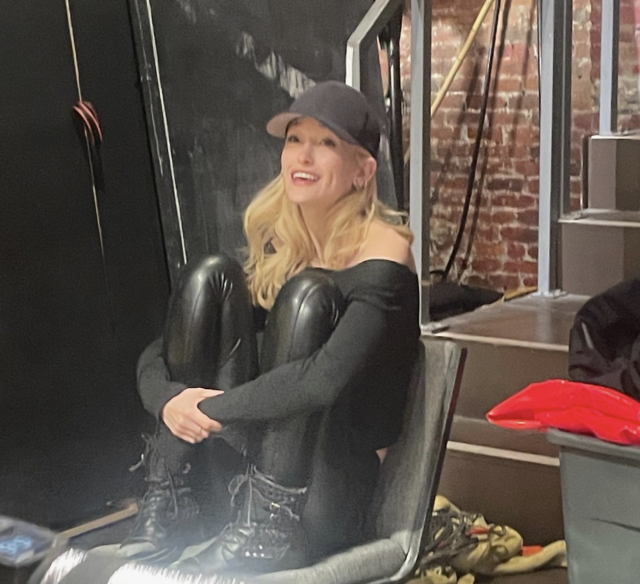
Gus Birney takes a break during rehearsals for The Merchant of Venice at Classic Stage (photo by twi-ny/mdr)

twi-ny: The rehearsal process sounds like the play itself, sort of all over the place, in a good way, fast and furious, nonstop.

gb: Yes, definitely.

twi-ny: Have you ever done Chekhov before?

gb: No, I’ve never done it, and now I’ve read The Seagull and I’m dying to be in the Chekhov Seagull; I would love to play Nina. But I do feel like this is great because I get a little touch of that and I’m exploring it in a totally different way.

twi-ny: In a November 2022 essay in Rolling Stone, Sasha wrote, “The world loves Russian theater.” It seems right now that Russian theater loves you. You’ve previously appeared in Igor’s Our Class and The Merchant of Venice. Both directors have unique visions of classic plays and how to adapt them to today’s world. I’m thinking also of Dmitry Krymov, another Russian émigré who’s doing a Vanya adaptation at La MaMa, which I don’t know if you’ll get to see because they’re running at the same time as Seagull. You’re of Polish descent, as we’ve talked about before, but how did you come to fit into this Russian theater niche in New York?

gb: You tell me; I don’t know what happened. Two and a half years ago, I got the audition for Our Class and had no idea what to expect. I read it. I thought it was a beautiful piece, but on paper, it is a completely different experience than what the outcome ended up being. I feel like that’s the same with Sasha’s Seagull. On paper, it looks like one thing, but then you see the finished product and it’s, like, whoa.

Honestly, I don’t know. I feel like I walked into this magical world that I had never thought I would be entering into and that now I never want to leave. I did Sidney Brustein right before I did Our Class, and I learned so much. I was also so terrified and felt way over my head with what I was doing because I didn’t go to acting school, and I felt I was, like, Oh my gosh, I’m entering into this world blind, and I felt like there was this right way and wrong way to do things.

Then I did Our Class and there was no such thing as a mistake. There was no such thing as a wrong move. What I love so much about this Russian world is that mess is right. Mistakes are correct. As someone who’s a very anxious performer, it’s given me this whole new sense of freedom. Like, Oh my gosh, the things you don’t like about yourself and the days that you’re, like, I was bad, or I screwed up this, or I said this line instead of this. No, that’s interesting. It’s different. It’s exciting. And it’s given me this whole newfound confidence in myself.

twi-ny: That’s a great way to put it, because being in the audience for these shows feels the same way. You’re from New York City acting royalty. You’ve been acting since you were three, when you were an elephant in a parade.

gb: Oh my gosh, you know this? Did I tell you this?

twi-ny: You did not tell me this, but I leave no stone unturned. By ten, you’re in Thoroughly Modern Millie, singing “Jimmy.” Your father is Reed Birney, your mother is Constance Shulman; I’ve seen them both many times onstage. I loved your mother in a play called Shhhh. I don’t know if you saw it.

gb: I loved her in that too! It’s one of my favorites!

twi-ny: I love that show. And I’ve also seen them many times in the audience. So when they’re not onstage or filming a movie or television series, they’re going to the theater. And your brother is also a terrific actor. Here’s something that you wrote a few years ago:

“The least interesting thing about my parents is the fact that they’re actors. They’re multifaceted, complicated, curious, hilarious, full of life human beings who also sometimes yell at me to be less self-involved.”

So what is the most interesting thing about your family, and what’s the most important lesson you’ve learned from them?

gb: Oh, wow.

twi-ny: Is that too big a question?

gb: No. I’m going to answer with a cliché answer, but my parents are genuinely extraordinarily kind human beings. And they really instilled that in us. Not to pat myself on the back, but I do think that, in my head, kindness and respect, from top to bottom on a set for whoever’s there, was always the number one priority in their heads. We’re an incredibly close family. I’m literally at their apartment right now, and I have my own, but I stay here almost every night. Yeah, we’re all best friends. My mom used to say, Treat every person in a conversation like they’re the only person in a room. And I hope and strive to do that. They do that constantly. Whether they quit acting tomorrow or they continue, it doesn’t matter. It’s about being a kind human being in this world, which I don’t think we have enough of sometimes.
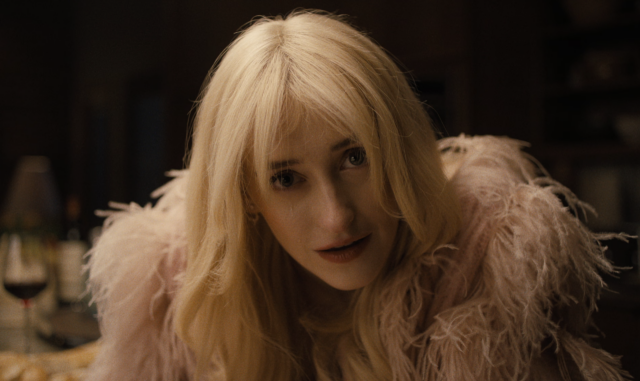
Gus Birney stars as Portia in Haley Z. Boston’s Something Very Bad Is Going to Happen (photo courtesy Netflix)

twi-ny: Definitely. The last time I spoke with you, you said that your father was considering retirement. Maybe it was after Lunar Eclipse.

gb: You know, he’s always saying that. I’m sure if you see him, he would be saying that to you, but he’s not going to.

twi-ny: Good. I’ve seen him and your brother, Ephraim, in Chester Bailey. Although I didn’t see it in Williamstown, you’ve acted with your mother in The Rose Tattoo. Which brings me to a favorite cult film of mine, Strawberry Mansion. Your cousin Albert makes this film and all the Birneys are in it except for you. Where are you?

gb: I don’t know! Why wasn’t I there! There wasn’t a part for me, I guess.

twi-ny: It’s a crazy movie.

gb: Yeah, it is crazy. Albert’s insane. He’s amazing, but he lives in his own crazy world.

twi-ny: Well, you’re in so many other things. At sixteen, you start doing TV, theater, and films. You’ve already amassed more than forty credits in ten years. So you’re incredibly busy. Now you’ve got Something Very Bad Is Going to Happen. What’s it like going from these three different media, at such a fast pace?

gb: Yes, yes. You know, I learn something through each medium. I have such a respect for theater because that’s how I was raised. I feel like it’s the best way to start out as an actor because it just rounds you in your body and your voice. I feel so lucky to be able to dive into each of these specific worlds of what it is to be an actor. They all feel so different.

I don’t know, you said forty credits and in my head I’m like, Really, have I done that much? But no, it’s so cool. I’m twenty-six now and I still feel like I’m thirteen so much of the time. But it’s good to have moments where I’m really proud of myself.

The show that just came out yesterday is one of the most exciting jobs I’ve ever had. I had such a good time doing it. I’m so happy that the world can see it now. And I feel a little protective over it, because who knows how it’s going to do? Who knows? It’s so crazy what catches on and what doesn’t. And I’m kind of just like, it doesn’t matter what happens with it. I’m so proud of the show. And I’m so happy that it’s out in the zeitgeist and anyone can see it.

twi-ny: Do you have a dream role?

gb: Oh, wow. I don’t know. Someone asked me the other day and I had such a strange answer. They asked, What role would you want adapted to screen from a book? And I said I’d want to play Sally in the live-action version of The Nightmare Before Christmas, because something I get a lot is that I look like a Tim Burton character. And so I would love to play a Tim Burton character. But in a play, definitely right now, the Nina thing is kind of forefront in my head; I would love to play this part and do my little spin on it.

I love The Glass Menagerie; I always talk about that play. I would love to be Laura in that. I did a reading of Who’s Afraid of Virginia Woolf? recently; I would love to be Honey. So we’ll see. There’s so many things I want to do.
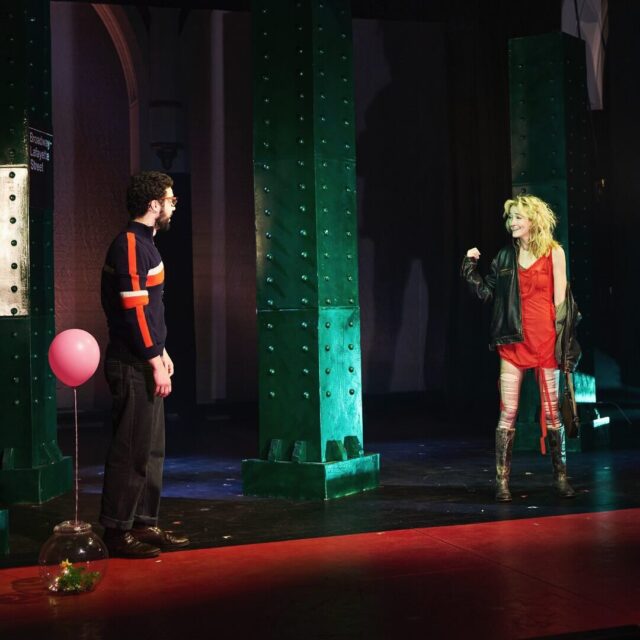
Kon (Eric Tabach) and Nico (Gus Birney) meet cute in Seagull: True Story (photo by Kir Simakov)

twi-ny: You’ve mentioned how anxious you get as an actress, but I have a feeling maybe a little bit in real life as well, and you used to describe yourself as shy and strange, particularly when thinking back on your childhood. Today, with all these things going on, can I ask how you feel about yourself, particularly about the confidence you’re building with each performance?

gb: Yeah! Definitely still shy and strange. I did an interview this morning on New York Live and I rewatched it before talking to you and I was, like, Oh my gosh, Gus, you’re so strange. But no, I think what’s happened is I am shy and strange and I also feel such confidence in what I am now.

Oh my gosh, who is this?

twi-ny: This is our kitty, Tuki. She gets in on every Zoom call.

gb: I’m so glad; she can stay for the rest of it. She’s the cutest. I feel like the world is trying to tell me to get an animal because I saw these puppies this morning and now I see this little sweetie and it’s like I just need to.

twi-ny: New York City apartments are not the same without an animal, but you’re not spending enough time in your own apartment to have an animal, a pet.

gb: It’s true. Yeah, that’s what will force me to grow up. Yes, but anyway, I feel like I have a whole other level of confidence in whatever I am at this point in my life, so yes.

twi-ny: One last thing. Having met you several times, seeing you onstage and television, and watching some of your interviews, I can’t help but notice that one of the words that comes up over and over again is fun. You just look like you are having the most fun time. Being in your presence brings happiness. That seems to be your approach to life.

gb: Yes, I think so. I try. I am definitely anxious. We’ve talked about this, but I do think I’m a really positive, optimistic person, and I really love that about myself. Yeah, like how cool is my job — or our job, because you’re also in this artistic crazy world.

You know, it is terrifying what is going on at this point in history, so let’s enjoy the moments where it’s light. In this play I get to dance, I get to sing, I get to run around, and it’s the coolest thing to just compartmentalize for two hours out of your day and just be free. So yes, I appreciate you saying that. That’s what I would strive to be: happy.

[Mark Rifkin is a Brooklyn-born, Manhattan-based writer; you can follow him on Substack here.]
SHIMMER AND HERRINGBONE

Fashion takes center stage at Talking Band’s Shimmer and Herringbone (photo by Maria Baranova)

SHIMMER AND HERRINGBONE
Mabou Mines@122CC
150 1st Ave. at Ninth St.
Wednesday – Sunday through May 19, $35
talkingband.org

Amid the flurry of Broadway openings — no fewer than nineteen between March 7 and April 25, the cutoff to be eligible for the Tonys — you may have missed the celebratory event of the season, the fiftieth anniversary of Talking Band, the independent downtown company founded by Ellen Maddow, Paul Zimet, and Tina Shepard in 1974. The avant-garde troupe has staged more than sixty productions since 1975’s The Kalevala, and this year it has treated us to three exquisite new shows in a span of three months.

In February, TB presented the moving and intimate The Following Evening at PAC NYC, a collaboration with 600 Highwaymen that explored personal and professional legacy, starring real-life couples Abigail Browde and Michael Silverstone of 600 Highwaymen and Maddow and Zimet of TB. In March, Maddow, in her mid-seventies, and Zimet, in his early eighties, teamed up for the brilliant Existentialism at La MaMa, a dazzling meditation on aging.

TB concludes its unofficial trilogy with the hilariously inventive and profound Shimmer and Herringbone, which opened last night at Mabou Mines@122CC for a limited run through May 19.

In his 1905 short story “The Czar’s Soliloquy,” Mark Twain wrote, “As Teufelsdröckh suggested, what would man be — what would any man be — without his clothes? As soon as one stops and thinks over that proposition, one realizes that without his clothes a man would be nothing at all; that the clothes do not merely make the man, the clothes are the man; that without them he is a cipher, a vacancy, a nobody, a nothing.”

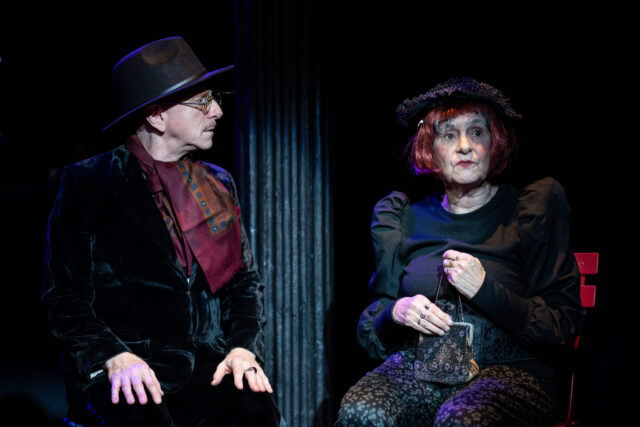
The ninety-minute Shimmer and Herringbone takes place in the titular clothing store, where a handful of oddball characters across three generations — old friends, former lovers, not-so-strangers — shop with the help of eclectic dressing room attendant Rhonda (Maddow), who shares tidbits of carefully phrased philosophy as they seek to change their clothes, their style, and, in several cases, their lives, to not be a nobody or a nothing.

When Rhonda asks one customer, “Did you find what you were looking for?,” she’s referring to more than just a new scarf or jacket.

She says to another shopper, “Where are you going, if you don’t mind my asking?,” a question that requires a bigger answer than the shoe department.

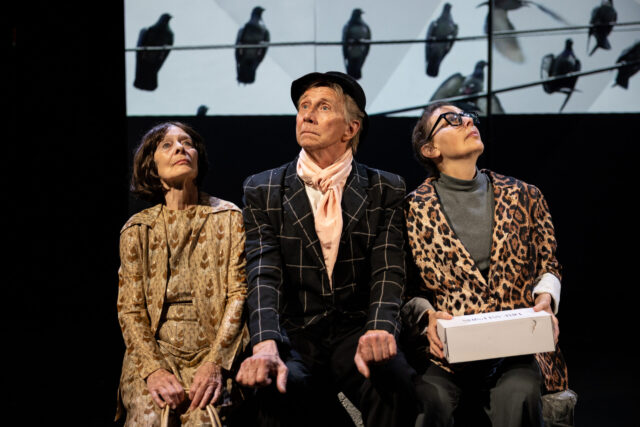
Melanie (Tina Shepard), Colin (Jack Wetherall), and Lilly (Lizzie Olesker) wonder about pigeons and life in world premiere play (photo by Maria Baranova)

At the beginning of the play, Lilly (Lizzie Olesker) and her daughter, the twentysomething Bree (Ebony Davis), find the elderly Melanie (Tina Shepard), who speaks in non sequiturs, facedown on the floor. Grace (Louise Smith) is a realtor who isn’t sure how she knows Colin (Jack Wetherall) and runs away when she sees Lilly, an ornithologist who is embarrassed that she doesn’t recognize Gus (James Tigger! Ferguson), who appears to know her very well.

As they slowly discover more about one another, the characters not only dig deep within themselves but try to understand how they are seen by others — and how they have changed over the years.

“I see this face and I wonder — could that be me?” Grace says, later adding, as only a real estate agent can, “My face is falling apart like an old house.”

Reaching out, Colin talks to Grace about the apartment where he’s lived for more than thirty years. “Suddenly, about a month ago, I woke up and everything looked drab, everything was in the wrong place. The rug that I inherited from my mother was tatty and raveled around the edges, the kitchen table was greasy, and my favorite chair looked like a toadstool with its undersides oozing toxins. It’s like I have changed, but my apartment is stubbornly, defiantly sitting in the past, and I can’t stand it,” he says. Grace responds, “That’s been happening to people a lot lately,” implicating the audience itself.

As the characters share stories from their past that often include details about what they were wearing at the time, Bree is having none of it. When Rhonda asks her, “Can I help you?,” the youngest member of the group quickly replies, “I don’t need help.” When her mother is considering whether she should return a shirt, Bree declares, “It’s just a blouse,” a phrase that sticks out like blasphemy.

Through it all, a string trio consisting of Rachel Feldhaus, Marija Kovacevic, and Agustin Uriburu performs in a far corner, sometimes adding soothing background music and sometimes playing to the characters, who sit down and watch them while having conversations.

Gus (James Tigger! Ferguson) and Rhonda (Ellen Maddow) find common ground through dress in Shimmer and Herringbone (photo by Maria Baranova)

Shimmer and Herringbone is another delightful triumph from Talking Band, reminiscent of its 2022 production Lemon Girls or Art for the Artless, which also featured Olesker, Shepard, Smith, Wetherall, and writer and composer Maddow and was directed by Zimet. The new piece is cowritten by Maddow and Zimet and directed by Zimet, in collaboration with costume designer Olivera Gajic, whose outfits nearly steal the show, from black leather and leopard print to fluffy slippers and feathery hats.

The narrative unfolds on Anna Kiraly’s cozy set, which is centered by four lighted dressing-room doors that the shoppers enter and exit and is also used for Kiraly’s projections of social media posts, images of clothing and the moon, abstract shapes, birds on a wire, and a short film. The soft lighting is by Mary Ellen Stebbins, with sweet and touching choreography by Sean Donovan. A kind of angel at a way station, Rhonda is often pushing along a mannequin or a rack of clothes that were rejected. The characters occasionally sit on concrete slabs like park benches at the front, almost touching the audience.

In addition to the classical music played by the string trio, there are pop songs and poetry, from Samuel Taylor Coleridge and Blue “Gene” Tyranny to the combo of Bruce Springsteen and Patti Smith. Gus, who fashions himself a literary junkie, references Chekhov, Dostoevsky, Woolf, Borges, Hemingway, and Kerouac as he morphs into James Joyce, who once wrote, “Mother is packing my new secondhand clothes. She prays now, she says, that I may learn in my own life and away from home and friends what the heart is and what it feels. Amen. So be it. Welcome, O life!”

The centerpiece of the show is ornithologist Lilly’s spark bird, the New York City pigeon. Also known as the Columba livia and the rock dove, the bird is not only ubiquitous — it’s believed there are about four million in the city, compared with nine million people — but it is hard for the average person to tell them apart. Human beings have the ability to choose clothing that can assist in defining who they are, both outside and inside, but pigeons don’t have that option. It’s even difficult to identify their gender, as Lilly notes, which becomes relevant late in the play.

At one point, Grace explains that part of her job is “staging” a house, evoking the staging of a play: cleaning it out from top to bottom, then painting the walls white and adding cream carpets and innocuous artworks, allowing the buyer to make it their own home. Each character entering Shimmer and Herringbone is like that plain house, ready to redecorate themselves in their own personal style.

When Bree sees Melanie dragging a large garbage bag, she asks her what’s in there. “Nothing,” Melanie answers. “Stuff that’s been clogging up my closets, burdening my soul for half a century.” How many of us would love to go through our closets and get rid of old clothes that feel like a burden?

“So you want to find something that reflects who you are,” Rhonda says to Grace, who is worried about suffering buyer’s remorse, as if a new outfit is as important as a new home.

Isn’t it?

[Mark Rifkin is a Brooklyn-born, Manhattan-based writer and editor; you can follow him on Substack here.]
TALKING BAND: EXISTENTIALISM

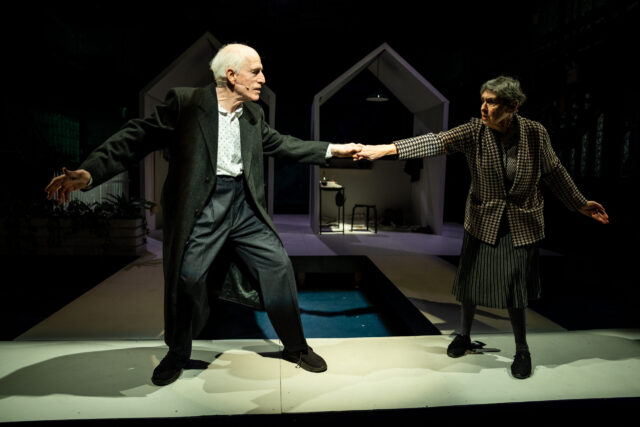
Husband-and-wife Ellen Maddow and Paul Zimet portray a married couple in Existentialism (photo by Maria Baranova)

EXISTENTIALISM
La MaMa Experimental Theatre Club
The Ellen Stewart Theatre
66 East Fourth St. between Second Ave. & Bowery
Wednesday – Sunday through March 10, $35-$40
212-475-7710
www.lamama.org
talkingband.org

Early on in Talking Band’s gorgeously poetic two-character play Existentialism, the man says, “Choice is possible. / What is impossible is not to choose. / If I decide not to choose, / That still constitutes a choice.”

It would be a mistake not to choose to see one of the best shows of the year.

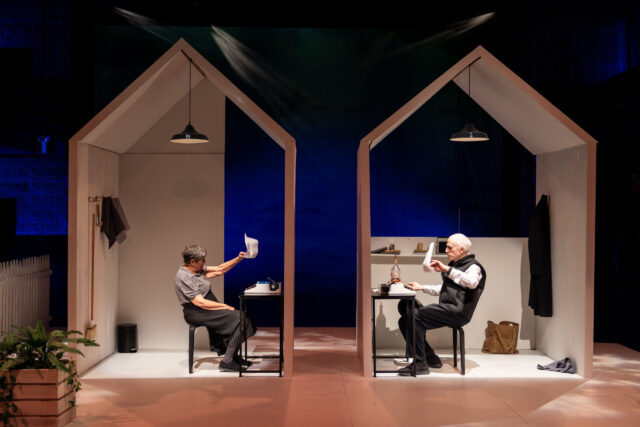
Existentialism is created and directed by former SITI Company head Anne Bogart specifically for Ellen Maddow and Paul Zimet in celebration of the fiftieth anniversary of Talking Band, the troupe Maddow and Zimet cofounded with Tina Shepard in 1974. The duo, who have been married since 1986, portray an unnamed woman and man living in a home on the beach. Anna Kiraly’s set features a pair of house-shaped structures, open in the front, each with the same overhead lamp and a small table with a backless chair and typewriter. Short walkways lead out of and around the rooms, with a small planting bed on the woman’s side. Brian Scott’s lighting casts warm red, yellow, orange, blue, and green glows on the structures, while Darron L West’s sound ranges from loud music to soft nature elements to the actors’ crystal-clear enunciations. Kiraly’s projections of waves on the shore and birds flying freely come and go on a large screen in the back.

The woman waters her plants with panache, raising the watering can high above her as the liquid drips out. She does the shopping and is agonized by a speck of dirt she cannot get clean on the path. The two sit at their respective desks on opposite sides of a wall and type in unison.

He saunters to the front of the stage and speaks directly to the audience: “There is a wall between us, but it is a wall we build together. Each of us puts a stone in the gap left by the other. / I’m going to smile, and my smile will sink down into your pupils, and heaven knows what it will become,” he says, sharing an intimate, funny smile. “I am no longer sure of anything. / Something has to snap. / Words are loaded pistols. / There may be more beautiful times, but this one is ours.” Throughout the show’s seventy minutes, we all fill the gaps with figurative stones (and smiles) of our own.

The dialogue is based on the writings of life partners Simone de Beauvoir and Jean-Paul Sartre in addition to Albert Camus, Martin Heidegger, Maurice Merleau-Ponty, Sarah Bakewell, Maggie Nelson, Octavia Butler, bell hooks, and Betty Friedan. The words form an enticing and gentle meditation on gender and aging, delivered in a soft, plain-spoken, but not dispassionate style. The text is all the more compelling because Maddow is seventy-five and Zimet eighty-one; however, they are imbued with an infectious youthfulness.

“My life is set within a given space of time: / It has a beginning and an end, / It evolves in given places, / Always retaining the same roots, / It spins an unchangeable past, / Its future is limited,” the woman says. “No one else is as old as I am. / How young everyone is!”

The man says, “I was young once.”

The man turns on the radio and listens to Dave Brubeck’s “Broadway Bossa Nova” and Beethoven’s “Moonlight Sonata.” The duo dances to the Jim Carroll Band’s punk anthem “People Who Died” blasting out of the speakers, a furious song about how more than a dozen men and women meet untimely ends. “They were all my friends and they died,” Carroll belts out. A New York City native, Carroll himself died of a heart attack in 2009 at the age of sixty; his most well known works include the novel The Basketball Diaries and the LP Catholic Boy.

Time moves on, but the man and the woman continue their daily existence, discussing life in abstract terms.

“No one will ever make sense of this mystery,” she says.

Paul Zimet and Ellen Maddow take a spin in Existentialism (photo by Maria Baranova)

Last month Maddow and Zimet appeared in The Following Evening at PAC NYC, a show written and directed specifically for them by Abigail Browde and Michael Silverstone of 600 Highwaymen, two married creators in their early forties paying tribute to the older couple and what they have accomplished both personally and professionally.

With Existentialism, Bogart is also celebrating Maddow and Zimet. Bogart last worked with Talking Band in 1988, winning the first of her three Obies for directing No Plays No Poetry but Philosophical Reflections Practical Instructions Provocative Prescriptions Opinions and Pointers from a Noted Critic and Playwright, incorporating the writings of Bertolt Brecht; Maddow and Zimet were part of an ensemble cast that also included Louise Smith and Shepard. Bogart has said that when Maddow and Zimet suggested they work together again, she instantly knew it would be called Existentialism; it’s a fitting title for the show, which has its own built-in meta.

Maddow and Zimet are utterly charming in this new piece, which continues at La MaMa through March 10. Although not much is revealed about their characters, you can’t help but fall in love with their relationship. They know they are in the sunset of their lives, but that isn’t stopping them from enjoying every moment. “Do you think that I count the days? There is only one day left, always starting over. It is given to us at dawn and taken away from us at dusk,” he says.

Bogart captures the essence of long-term love, with all its bumps and bruises. When the woman hides behind the wall, listening intently to the man typing away, you can feel how much they adore and need each other. It’s a tender moment that I won’t soon forget.

But right in front of the houses is a rectangular gap in the walkway, a small but constant threat, reminding us how easy it is to fall off one’s path, something Bogart, Maddow, and Zimet don’t have to worry about with this wonderful collaboration.

“Why do we even exist? Hahaha . . . ,” the woman asks. One reasonable answer could be so we could experience such shows as Existentialism.

[Mark Rifkin is a Brooklyn-born, Manhattan-based writer and editor; you can follow him on Substack here.]
UNDER THE RADAR: PUSHKIN “EUGENE ONEGIN” IN OUR OWN WORDS

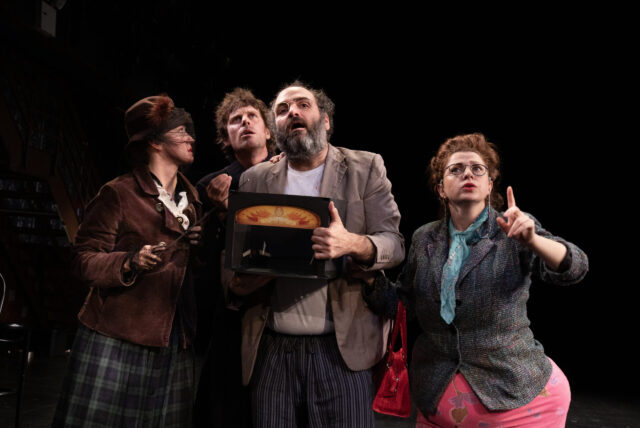
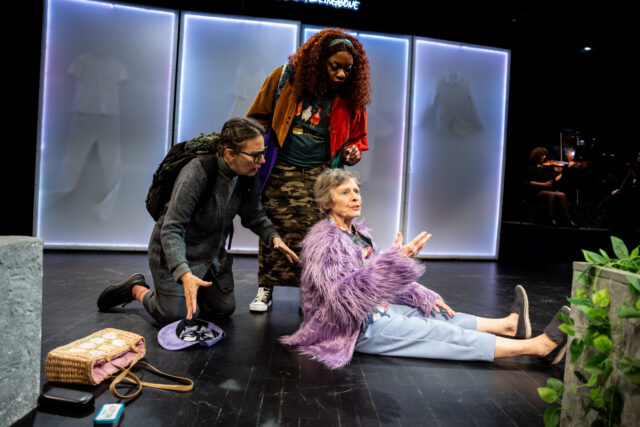
Four actors portray multiple characters in Pushkin “Eugene Onegin” in our own words (photo by Bronwen Sharp)

PUSHKIN “EUGENE ONEGIN” IN OUR OWN WORDS
BRIC Arts Media House
647 Fulton St., Brooklyn
Tuesday – Sunday through January 28, $52.11-$67.93
bricartsmedia.org
krymovlabnyc.com

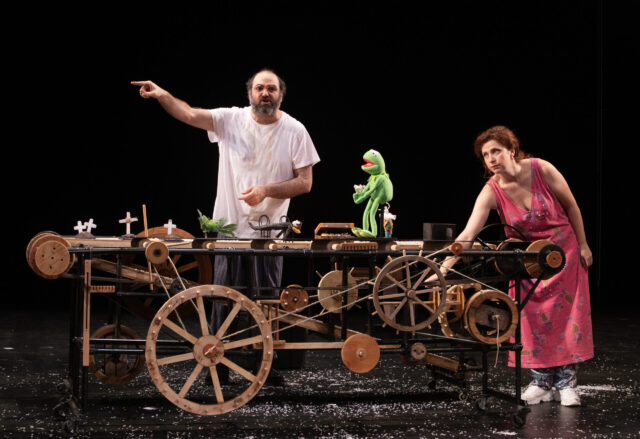
This past October, Moscow-born director, designer, and visual artist Dmitry Krymov made a smashing debut with his new company, Krymov Lab NYC, in Big Trip, two shows that ran in repertory at La MaMa. I saw Three Love Stories Near the Railroad, wild and woolly, wholly unpredictable retellings of Ernest Hemingway’s “Hills Like White Elephants” and “A Canary for One,” followed by a pair of scenes from Eugene O’Neill’s Desire under the Elms. The other presentation was the oddly titled Pushkin “Eugene Onegin” in our own words, another strange but clever and gratifying journey that is enjoying an encore run through January 28 at BRIC Arts Media House as part of the Under the Radar festival.

In the hallway, you are told that this is a children’s show and that, in order to gain entry to the BRIC Ballroom, you need to select a puppet from among the dozens and dozens scattered around what would have been the coat check room. The handmade puppets, created by Leah Ogawa and Luna Gomberg, are adorably grotesque, made of papier-mâché and assorted random items that serve as eyes, ears, or limbs. You are expected to hold on to your child-puppet throughout the wild and woolly, wholly unpredictable proceedings, a hilarious ninety minutes of meta-theatrics.

Four actors — Inna Natanovna (Anya Zicer), Pyotr Naomovich (Jeremy Radin), Oleg Lvovich (Jackson Scott), and Alla Borisovna (Elizabeth Stahlmann) — walk on Emona Stoykova’s sparse stage dragging bags of goofy props that they lay out on a table on one side and a row of chairs on the other. Addressing the audience directly, Pyotr says, “Hello. We come tonight to explain you about Evgeny Onegin, a very famous narrative poem. A novel, made of many little poems, written by Alexander Pushkin — the most great, most wonderful, amazing, fantastic poet in all history of Russia. Greatest poet of all time. Your parents ask us, four old Russian immigrants, to tell you story about Onegin and Pushkin.”

And so they do, but definitely not as you might expect.

Pyotr Naomovich (Jeremy Radin) and Inna Natanovna (Anya Zicer) move along the plot in unique ways at BRIC (photo by Bronwen Sharp)

Inna, Pyotr, Oleg, and Alla portray themselves and multiple characters from “Evgeny Onegin” and Pushkin’s personal life. Some require more significant costume changes than others, and many of the outfits look like they might have come from the performers’ own closets. (The costumes are by Gomberg, with lighting by Krista Smith, sound by Kate Marvin, and projections by Yana Biryukova, all of which are purposely low-tech.)

In the 1830s novel in verse, Pushkin introduces readers to the title character, a dandy who inherits a country estate. The landowner’s daughter, Tatyana Larina, falls in love with Onegin, who has become friendly with poet Vladimir Lensky, who is about to marry Olga Larina, Tatyana’s younger sister. When Onegin and Olga dance together at a celebration, Tatyana and Vladimir are none too happy, and things devolve from there as Pushkin explores class, gender, naïveté, and unrequited love.

The story is regularly interrupted by a heckler (Kwesiu Jones), logistical issues, literary arguments, and tangents about the art of theater itself, some of which involve “stage manager” Natalie Battistone. As Pyotr explains at one point, “From the traproom, you can rise and fall! This trick is often used in opera and ballet performances by devils! But we don’t talk about devils. Very superstitious people, theater people, ptew! No devils — we don’t want to give you nightmares, okay? We tell you, instead, about angels. . . .”

Several audience members in the first row are asked to participate. The actors keep a feather afloat by blowing on it for no apparent reason. Onegin’s spleen (depression) is examined. One of the men becomes the lower half of a ballerina’s body. A pair of oddball contraptions are employed to elucidate characters’ motivations. Onegin is compared to Pushkin. Clothes come off, revealing an unexpected surprise. A buxom nanny opens a window, then closes it, then opens it, then . . .

Writer-director Krymov was preparing a production of The Cherry Orchard in Philadelphia in February 2022 when Russia invaded Ukraine. Condemning Vladimir Putin’s actions, he became an exile, moving to New York City with his wife and starting Krymov Lab NYC. If these first two vastly inventive and entertaining shows are any indication of what is to come, Putin has cost Russia something very valuable indeed.

[Mark Rifkin is a Brooklyn-born, Manhattan-based writer and editor; you can follow him on Substack here.]
IVO DIMCHEV: IN HELL WITH JESUS / TOP 40

Get ready for the wildly unexpected in Ivo Dimchev’s In Hell with Jesus / Top 40 at La MaMa (photo by Krasimir Stoichkov)

Who: Ivo Dimchev and company
What: Interactive performance
Where: The Downstairs, La MaMa Experimental Theatre Club, 66 East Fourth St. between Second Ave. & Bowery
When: November 16-26, $10-$30
Why: Bulgarian theater director, performance artist, activist, choreographer, singer-songwriter, and visual artist brings his unique talents to La MaMa with 2022’s In Hell with Jesus and the US premiere of 2023’s Top 40. The former is a musical, centered around an audition, that challenges political correctness in theater and beyond, conceived and directed by Dimchev and performed by him and Andrew Fremont-Smith, Cassondra James, Louis Schwadron, Xavier Smith, and Chris Tanner in madcap costumes; it asks the question, “Big dick, big house, or great sense of humor?” Dimchev, the founder and director of Bulgaria’s Humarts Foundation, wrote and choreographed the latter, which features songs from previous shows of his and a hefty amount of audience participation.

[Mark Rifkin is a Brooklyn-born, Manhattan-based writer and editor; you can follow him on Substack here.]
UNDER THE RADAR 2023

A Thousand Ways (Part Three): Assembly brings strangers together at the New York Public Library (photo courtesy 600 Highwaymen)

UNDER THE RADAR FESTIVAL
Public Theater and other venues
January 4-22, free – $60
publictheater.org

The Public Theater’s Under the Radar Festival is back and in person for its eighteenth iteration, running January 4-22 at the Public as well as Chelsea Factory, NYU Skirball, La MaMa, BAM, and the New York Public Library’s Stavros Niarchos Foundation branch. As always, the works come from around the world, a mélange of disciplines that offers unique theatrical experiences. Among this year’s selections are Jasmine Lee-Jones’s seven methods of killing kylie jenner, Annie Saunders and Becca Wolff’s Our Country, Roger Guenveur Smith’s Otto Frank, Rachel Mars’s Your Sexts Are Shit: Older Better Letters, Kaneza Schaal’s KLII, and Timothy White Eagle and the Violet Triangle’s The Indigo Room.

In addition, “Incoming! — Works-in-Process” features early looks at pieces by Mia Rovegno, Miranda Haymon, Nile Harris, Mariana Valencia, Eric Lockley, Savon Bartley, Raelle Myrick-Hodges, and Justin Elizabeth Sayre, while Joe’s Pub will host performances by Eszter Balint, Negin Farsad, Julian Fleisher and his Rather Big Band, Salty Brine, and Migguel Anggelo.

Below is a look at four of the highlights.

600 HIGHWAYMEN: A THOUSAND WAYS (PART THREE): AN ASSEMBLY
The New York Public Library, Stavros Niarchos Foundation Library
455 Fifth Ave. at Fortieth St., seventh floor
January 4-22, free with advance RSVP
publictheater.org

At the January 2021 Under the Radar Festival, the Obie-winning 600 Highwaymen presented A Thousand Ways (Part One): A Phone Call, a free hourlong telephone conversation between you and another person, randomly put together and facilitated by an electronic voice that asks both general and intimate questions, from where you are sitting to what smells you are missing, structured around a dangerous and lonely fictional situation that is a metaphor for sheltering in place. The company followed that up with the second part, An Encounter, in which you and a stranger — not the same one — meet in person, sitting across a table, separated from one another by a clear glass panel, with no touching and no sharing of objects. In both sections, I bonded quickly with the other person, making for intimate and poignant moments when we were all keeping our distance from each other.

Now comes the grand finale, Assembly, where sixteen strangers at a time will come together to finish the story at the New York Public Library’s Stavros Niarchos Foundation branch in Midtown. Written and created by Abigail Browde and Michael Silverstone, A Thousand Ways innovatively tracks how the pandemic lockdown influenced the ways we interact with others as well as how critical connection and entertainment are.

Palindromic show makes US premiere at Under the Radar Festival (photo courtesy Ontroerend Goed)

ONTROEREND GOED: Are we not drawn onward to new erA
BAM Fishman Space
321 Ashland Pl.
January 4-8, $45
publictheater.org
www.bam.org

What do the following three statements have in common? “Dammit, I’m mad.” “Madam in Eden, I’m Adam.” “A man, a plan, a canal – Panama.” They are all palindromes, reading the same way backward and forward. They also, in their own way, relate to Ontroerend Goed’s Are we not drawn onward to new erA, running January 4-8 at BAM’s Fishman Space. Directed by Alexander Devriendt, the Belgian theater collective’s seventy-minute show features a title and a narrative that work both backward and forward as they explore climate change and the destruction wrought by humanity, which has set the Garden of Eden on the path toward armageddon. But maybe, just maybe, there is still time to save the planet if we come up with just the right plan.

PLEXUS POLAIRE: MOBY DICK
NYU Skirball
566 LaGuardia Pl.
January 12-14, $40
publictheater.org
nyuskirball.org

The world is obsessed with Moby-Dick much the way Captain Ahab is obsessed with the great white itself. Now it’s Norwegian theater company Plexus Polaire and artistic director Yngvild Aspeli’s turn to harpoon the story of one of the most grand quests in all of literature. Aspeli (Signaux, Opéra Opaque, Dracula) incorporates seven actors, fifty puppets, video projections, a drowned orchestra, and a giant whale to transform Herman Melville’s 1851 novel into a haunting ninety-minute multimedia production at NYU Skirball for four performances only, so get on board as soon as you can.

Brian Mendes and Jim Fletcher get ready for NYCP’s Field of Mars (photo courtesy New York City Players)

NEW YORK CITY PLAYERS: FIELD OF MARS
NYU Skirball
566 LaGuardia Pl.
January 19-22, 24-29, $60
publictheater.org
nyuskirball.org

I’ll follow Richard Maxwell and New York City Players anywhere, whether it’s on a boat past the Statue of Liberty (The Vessel), an existential journey inside relationships and theater itself (The Evening, Isolde) and outside time and space (Paradiso, Good Samaritans), or even to the Red Planet and beyond. Actually, his newest piece, Field of Mars, playing at NYU Skirball January 19-29, refers not to the fourth planet from the sun but to the ancient term for a large public space and military parade ground. Maxwell doesn’t like to share too much about upcoming shows, but we do know that this one features Lakpa Bhutia, Nicholas Elliott, Jim Fletcher, Eleanor Hutchins, Paige Martin, Brian Mendes, James Moore, Phil Moore, Steven Thompson, Tory Vazquez, and Gillian Walsh and that the limited audience will be seated on the stage.

Oh, and Maxwell noted in an email blast: “Field of Mars: A chain restaurant in Chapel Hill is used as a way to measure the progress of primates, from hunter/gatherer to fast casual dining experience. Topics covered: Music, Food, Nature, and Spirituality. . . . I also wanted to take this opportunity to tell parents regarding the content of Field of Mars: my kids (aged 11 and 15) will not be seeing this show.”