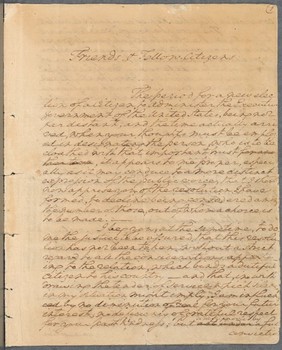
The final draft of George Washington’s 1796 farewell address is among the many amazing artifacts in NYPL exhibit (photo by Jonathan Blanc/New York Public Library)
New York Public Library
Stephen A. Schwarzman Building, Gottesman Exhibition Hall
Fifth Ave. at 41st St.
Through Sunday, March 4, free, 1:00 – 5:00
www.nypl.org
Today is your last chance to catch the New York Public Library exhibit “Celebrating 100 Years,” featuring a treasure trove of more than 250 items of literary paraphernalia. Divided into Observation, Contemplation, Creativity, and Society, the display honors the centennial of the landmark Beaux-Arts building on Fifth Ave. between 40th & 42nd Sts., built by Carrère and Hastings and dedicated by President William Howard Taft in 1911. Curated by Thomas Mellins, “Celebrating 100 Years” includes a bevy of fascinating memorabilia, from a Gutenberg Bible to a copy of Mein Kampf, from Jack Kerouac’s glasses and rolling paper to Charles Dickens’s letter opener, from a lock of Mary Shelley’s hair to Charlotte Brontë’s traveling writing desk, from Malcolm X’s briefcase and hat to Virginia Woolf’s walking stick and diary, showing a page she wrote just four days before her suicide. There are photographs, prints, and drawings by Diane Arbus, Man Ray, Faith Ringgold, Lewis Wickes Hine, Otto Dix, Francisco Goya, and Vik Muniz, marked-up manuscripts, speeches, and scores from Jorge Luis Borges, George Washington, Ernest Hemingway, John Coltrane, and T. S. Eliot, a copy of “The Star-Spangled Banner” with a bad typo, letters from Pablo Picasso, Harry Houdini, and Groucho Marx, and self-portraits by Kiki Smith, David Alfaro Siqueiros, Chuck Close, and Käthe Kollwitz. The exhibit, a kind of wonderful self-portrait of the library’s holdings, looks at the past, with cuneiforms dating back to the third century BCE, as well as aims forward, with a peek into their impressive digital archives.
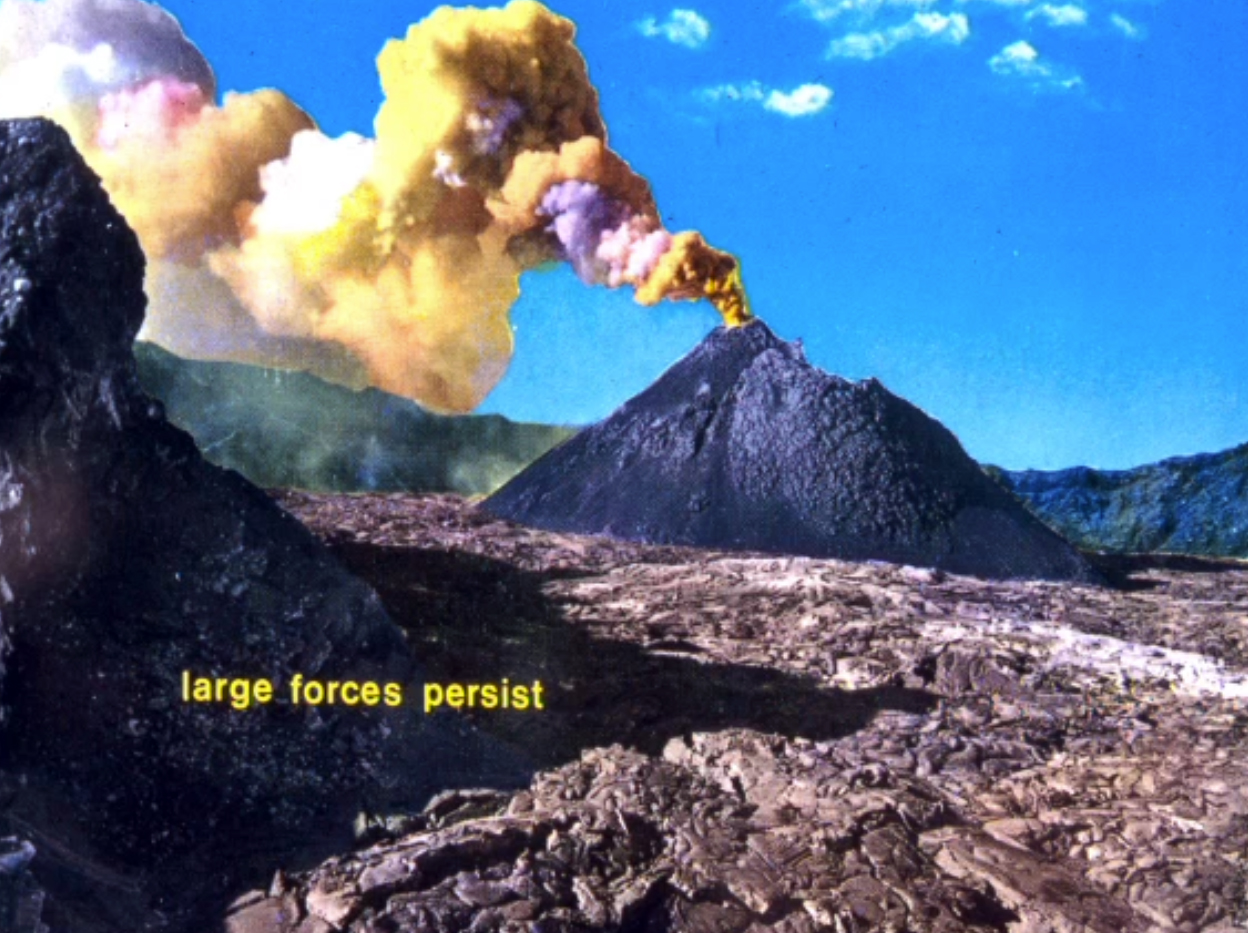
 In the late 1970s, Andrea Callard helped found a collective of artists that would come to be known as Colab, or Collaborative Projects, Inc. Among her fellow officers in the group were Coleen Fitzgibbons, Tom Otterness, and Ulli Rimkus. “Through a juicy and conflicted multi-year period of identity and structural definition,” she explains on her website, “there was experimentation in and rich discussion of accessible content, political forces, technology, equity, corporate versus union models, and material resources.” From February 13 to 19, the Maysles Institute will look back at Callard’s career by presenting the world premiere of her first feature-length film, Talking Landscape: Early Media Work, 1974-1984, which examines all those things and more in its eighty minutes. More a greatest-hits package than a narrative nonfiction film, Talking Landscape consists of several of Callard’s low-budget, low-tech Super 8 shorts, narrated in her steady deadpan, beginning with 11 thru 12, in which Callard humorously discusses “inspiration, information, transportation, the National Geographic, the Yellow Pages, and taxi cabs” while standing at an ironing board, trying to hail a cab out on the street, and walking on her hands in the ocean. In Notes on Ailanthus, she details the history of the tree that “grows abundantly in all the empty spaces around New York.” In Sound Windows, she has fun with her apartment windows. In Walking Outside, she sings a blues song while walking through green fields. Talking Landscape also includes a trio of slide shows of site-specific installations Callard was involved in. Commuting from Point to Point combines images shot in Paris, Italy, and New York with phrases lifted from books; for example a shot of cigarettes put out in a bowl of dirt on a newspaper is accompanied by the words “only time gets lost,” while a photo of the Spanish Steps features the phrase “worn by millions of feet.” The Customs House is a document of the 1979 Creative Time group show “Custom and Culture 2,” held inside the dilapidated Customs House by Bowling Green, now home to the National Museum of the American Indian. And finally, The Times Square Show takes viewers on a tour of the seminal art show held in June 1980, which sought to investigate “the need to communicate in a larger world”; the Colab exhibition comprised works by Keith Haring, Lee Quinones, Jean-Michel Basquiat, Jenny Holzer, Kenny Scharf, John Ahearn, Kiki Smith, Otterness, Callard, and others held in the then-still-seedy neighborhood. Throughout the film, Callard displays a wry sense of humor in these brief experimental works that were part of a major shift in the New York City art scene. Talking Landscape is being screened as part of the Maysles Institute’s continuing “Documentary in Bloom” series, curated by Livia Bloom, who will moderate Q&As with Callard following the February 16 and 19 showings.