Tag Archives: Khris Davis

NOT AS YOU LIKE IT: TWELFTH NIGHT AT THE DELACORTE

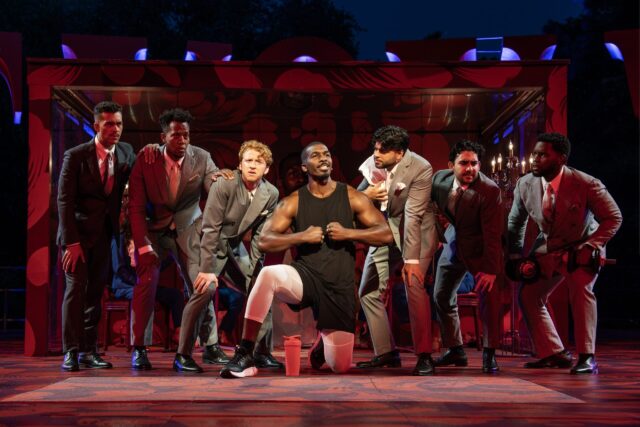
Duke Orsino (Khris Davis) and his minions get ready for action in Twelfth Night (photo by Joan Marcus)

TWELFTH NIGHT
Delacorte Theater, Central Park
Tuesday – Sunday through September 14, free with advance RSVP, 8:00
shakespeareinthepark.org

The confusion begins early in Saheem Ali’s inconsistent adaptation of William Shakespeare’s 1601–02 romantic comedy, Twelfth Night, which opens the newly revitalized Delacorte Theater in Central Park. As the audience enters the space — the majority of the $85 million upgrade went to technical operations, dressing rooms, bathrooms, accessibility, and signage, along with improvements to the facade and seats — a string quartet is playing on a red stage that features swirling patterns and, in giant, bold letters around the back, the subtitle of the play: What You Will. (The renovation did not rid the Delacorte of its famous raccoons, one of which ambled along atop the back wall moments before the play began, eliciting the adoring attention of the crowd.)

Then Ghanaian American singer-songwriter Moses Sumney, portraying the fool, Feste, walks onto the stage with a guitar and sings, “All the world’s a stage, / And all the men and women merely players. / They have their exits and their entrances, / And one man — or woman — in their time plays many parts.”

The line actually comes from the second act of As You Like It and seems like a cliché here taken out of context, even with its addition of “or woman.” Meanwhile, the musical shift from classical to Sumney’s alternative/indie R&B is jarring, and the character feels more like a demonic troubadour than one of Shakespeare’s fools.

Maria (Daphne Rubin-Vega) offers some intriguing news to Malvolio (Peter Dinklage) in Shakespeare production at revitalized Delacorte (photo by Joan Marcus)

Next, a sea captain (Joe Tapper) and Viola (Lupita Nyong’o) rise in a small boat from one of the Delacorte’s new modular trap doors. Emphasizing that they are strangers to this land, the first words they say to each other are in Swahili, although most of their conversation in in English. (Nyong’o was born in Mexico and raised in Kenya and speaks fluent English, Spanish, Luo, and Swahili.) The explicatory scene lets us know that there has been a shipwreck that has led the captain and Viola to Illyria, which is ruled by the duke Orsino (Khris Davis), who is in love with Olivia (Sandra Oh), a count’s daughter who is mourning the recent deaths of her father and brother and currently uninterested in suitors. Viola’s brother, Sebastian (Junior Nyong’o), was also on the ship, and Viola holds out hope that he has survived as well. She decides to disguise herself as a man named Cesario and serve the duke. (Sebastian has indeed survived and is on the island, with Antonio [b], an enemy of the duke’s, as his servant.) Only then do we meet Orsino as he declares to court gentleman Curio (Ariyan Kassam) and Feste, “If music be the food of love, play on,” which usually starts the play.

Thus, this Twelfth Night has a completely different atmosphere, which is not in itself a bad thing. I am not a Bard purist who insists that Shakespeare plays should not be messed with. Among the endless beauties of his work are the myriad possibilities it offers for reinterpretation. Over the last dozen years, I have seen three memorable productions of Twelfth Night: one on Broadway starring Mark Rylance as an Olivia who is light on her feet and a wickedly funny and towering Stephen Fry as her steward, the much-maligned Malvolio, in a delightful version that harkened back to the seventeenth century in form and style; one off Broadway by Axis that was dark and foreboding and utterly involving; and one at the Delacorte in 2018, an engaging musical comedy by Shaina Taub, who also portrayed Feste. (Twelfth Night is a favorite of the Public Theater’s Shakespeare in the Park presentations, having been staged six times previously, going back to 1969.)

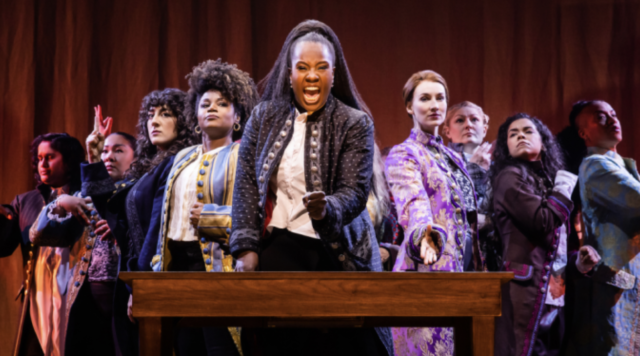
In 2021, I was disappointed in Jocelyn Bioh and Ali’s Merry Wives, which moved the location of the story from Windsor to South Harlem and felt too caught up in shtick, and the same is true here. Scenes move by too quickly as actors enter and leave down the aisles, via the traps, and through the “What You Will” wall like a one-ring circus, not allowing enough time for character development or actor chemistry. Attempts at amusement abound: Olivia’s uncle, the Falstaffian Sir Toby Belch (John Ellison Conlee), and his sidekick, the cheeky Sir Andrew Aguecheek (Jesse Tyler Ferguson), hang out in a hot tub doing lines of coke and whippets when they’re not plotting with Olivia’s chambermaid, Maria (Daphne Rubin-Vega), to publicly embarrass Malvolio (Peter Dinklage) in front of Olivia, whom he secretly pines for. Orsino asserts his strength and power by working out barechested at a gym and ordering his minions to drop and do pushups for punishment. Sir Toby, Sir Andrew, and Fabian (Kapil Talwalkar) hide from Malvolio behind four handheld letters, T, R, E, and E, instead of a tree, which is cute at first but goes on too long. A duel is transformed into a comic boxing match, with Sir Andrew in full boxing regalia.

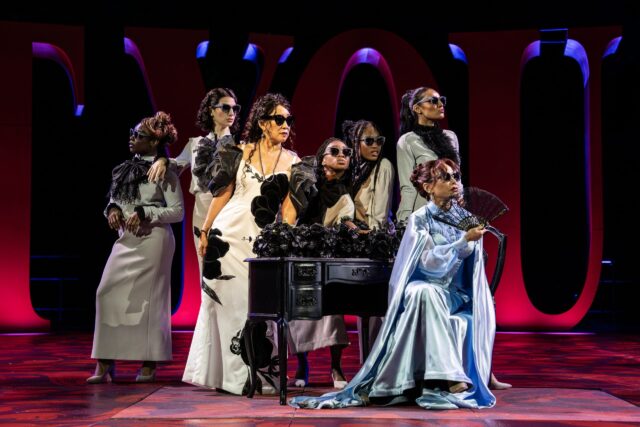
Olivia (Sandra Oh) and her minions get ready for action in Twelfth Night (photo by Joan Marcus)

Real-life siblings Lupita and Junior Nyong’o are dapper in their double-breasted suits. The inspired casting of Dinklage as Malvolio tails off when he is left doing too much voguing, particularly when trying to put a smile on his face. Davis has impressive abs. The actor known as b seems out of place whenever they’re onstage, although the part of Antonio can be a challenge to integrate in even the best of productions. Rubin-Vega looks fabulous, but it’s hard to remember she’s playing a maid. Conlee has fun as Sir Toby, but it’s Oh who steals the show as Olivia, wonderfully balancing comedy and pathos as her lust builds up, subduing her mourning with an elegant wit and grace, best capturing the spirit of Ali’s intentions.

The director has excelled in such non-Shakespeare plays as James Ijames’s Fat Ham, Bioh’s Nollywood Dreams, and Donja R. Love’s Fireflies, but I’ve found both Merry Wives and now Twelfth Night overwrought and scattershot, with too many scenes and characters appearing to come from different plays, lacking continuity despite individual moments that shine. It’s perhaps best exemplified by the Twelfth Night finale, a showcase for costume designer Oana Botez and set designer Maruti Evans; it looks fabulous, but it comes out of nowhere. It elicits wild applause from the audience, but it feels like a preening peacock that has arrived onstage, perhaps watching out for that raccoon.

[Mark Rifkin is a Brooklyn-born, Manhattan-based writer and editor; you can follow him on Substack here.]

MUCH ADO ABOUT SOMETHING: FREE SUMMER NYC THEATER 2025

The free summer theater season kicked off this month with Molière in the Park’s The Imaginary Invalid (photo by Russ Rowland)

The Public Theater is back presenting Shakespeare in the Park at the Delacorte after a yearlong revitalization, but there are plenty more places to catch the Bard and others for free as well, listed below. Note that some productions strongly suggest advance RSVP and involve moving to multiple locations during the performance.

Through May 25
Molière in the Park: Molière’s The Imaginary Invalid, starring Tony nominee Sahr Ngaujah, the LeFrak Center at Lakeside, Prospect Park, free with RSVP, 3:00 or 7:30

Thursday, May 29
through
Sunday, June 22

Hudson Classical Theater Company: Julius Caesar, Soldiers’ and Sailors’ Monument, West Eighty-Ninth St. & Riverside Dr., Riverside Park, 6:30

Thursday, May 29
through
Sunday, June 29

The Public Theater’s Mobile Unit: Much Ado About Nothing, directed by Rebecca Martínez, with music and lyrics by Julián Mesri, Astor Plaza (May 29-31), the New York Public Library & Bryant Park (June 3-8), Wolfe’s Pond Park (June 11), J. Hood Wright Park (June 12-14), the Cathedral Church of St. John The Divine (June 15), Sunset Park (June 17-18), A.R.R.O.W. Field House (June 20), Queens Night Market (June 21), Roy Wilkins Park (June 22), Maria Hernandez Park (June 25), St. Mary’s Park (June 26), Travers Park (June 27), the Peninsula in Prospect Park (June 28-29)

Saturday, May 31
Barefoot Shakespeare Company: Unrehearsed! The Comedy of Errors, Summit Rock, Central Park, 5:30

Tuesday, June 3
through
Sunday, July 6

NY Classical: All’s Well That Ends Well, Central Park (June 3-22), Carl Schurz Park (June 24-29), Battery Park (July 1-6), free with RSVP, 7:00

Wednesday, June 4
through
Sunday, June 29

Smith Street Stage: Shakespeare in Carroll Park: Henry V, Carroll Park

Thursday, June 12
through
Sunday, June 22

Shakespeare Downtown: Tennessee Williams’s Tiger Tail, Castle Clinton, Battery Park, 6:30

Saturday, June 21
through
Sunday, July 20

Boomerang Theatre Company: Richard II, Central Park West & Sixty-Ninth St., Central Park, $1.70, 2:00

Thursday, June 26
through
Sunday, July 20

Hudson Classical Theater Company: Jane Austen’s Sense and Sensibility, Soldiers’ and Sailors’ Monument, West Eighty-Ninth St. & Riverside Dr., Riverside Park, 6:30

Saturday, July 5
through
Sunday, July 27

The Classical Theatre of Harlem: Memnon, by Will Power, starring Eric Berryman, Richard Rodgers Amphitheater, Marcus Garvey Park

Thursday, July 17
through
Saturday, August 2

Shakespeare in the Parking Lot: A Midsummer Night’s Dream, by the Drilling Company, Lower East Side Prep parking lot, 145 Stanton St. (entrance on Rivington between Norfolk & Suffolk)

Thursday, July 24
through
Sunday, August 17

Hudson Classical Theater Company: Henrik Ibsen’s The Lady from the Sea, Soldiers’ and Sailors’ Monument, West Eighty-Ninth St. & Riverside Dr., Riverside Park, 6:30

Tuesday, August 5
through
Saturday, August 23

Hip to Hip Theater: Hamlet and The Tempest, preceded by children’s workshop, nine locations

Thursday, August 7
through
Sunday, September 14

Shakespeare in the Park: Twelfth Night, starring Lupita Nyong’o, Sandra Oh, Daphne Rubin-Vega, Peter Dinklage, Khris Davis, Junior Nyong’o, Moses Sumney, b, and Jesse Tyler Ferguson, Delacorte Theater, Central Park, 8:00

Saturday, August 23
Barefoot Shakespeare Company: Unrehearsed! The Comedy of Errors, Summit Rock, Central Park, 4:00

Friday, August 29
through
Tuesday, September 2

Pericles: A Public Works Concert Experience, the Cathedral Church of St. John the Divine, music and lyrics by Troy Anthony, directed by Carl Cofield

[Mark Rifkin is a Brooklyn-born, Manhattan-based writer and editor; you can follow him on Substack here.]

GOOD BONES AND FIRM FOUNDATIONS ON AND OFF BROADWAY

Mamoudou Athie, Susan Kelechi Watson, and Khris Davis star in Good Bones at the Public (photo by Joan Marcus)

GOOD BONES
Martinson Hall, the Public Theater
425 Lafayette St. at Astor Pl.
Tuesday through Sunday through October 27, $95
212-539-8500
publictheater.org

According to the Canadian website houseful, “‘Good bones’ refers to the core foundational elements of the home — a steady structure that can withstand time, wear, and elements. A home with good bones typically has a sturdy foundation, structural stability, and a strong roof. A well-staged home can hide imperfections with beautiful rugs, a fresh coat of paint, or features that pull your attention.”

Four current plays that take place primarily in a home struggle with the core foundational elements, with varying results.

Playwright James Ijames and director Saheem Ali follow up their Pulitzer Prize–winning Fat Ham, which ran at the Public’s Anspacher Theater before transferring to Broadway, with Good Bones, continuing at the Public’s Martinson Hall through October 27. Maruti Evans’s set is a skeletal house surrounded by plastic, undergoing renovation in an unidentified American city that itself is experiencing controversial gentrification.

Travis (Mamoudou Athie), who comes from money, and Aisha (Susan Kelechi Watson), who grew up in the projects, are a married couple who have moved back to her neighborhood and are considering having a baby. He is a chef preparing to open a restaurant, and she is working on a new sports complex she believes will vastly improve the community. Their contractor, Earl (Khris Davis), flirts with Aisha, who returns the interest, but when she shares the plans for the complex with him, he sees her as a traitor to her roots.

She explains, “We’re calling it the Jewel. It’s going to be kind of like a little village over there. This neighborhood has been abandoned to decay and atrophy. The Jewel will bring together the best of the old and the new. Will there be change? Yes. But change is the only thing consistent in this life. We have been sowing into this community. We have worked diligently to revitalize this neglected corner of the city. We’re changing this neighborhood for the better.” His quick response: “It’s the death star.”
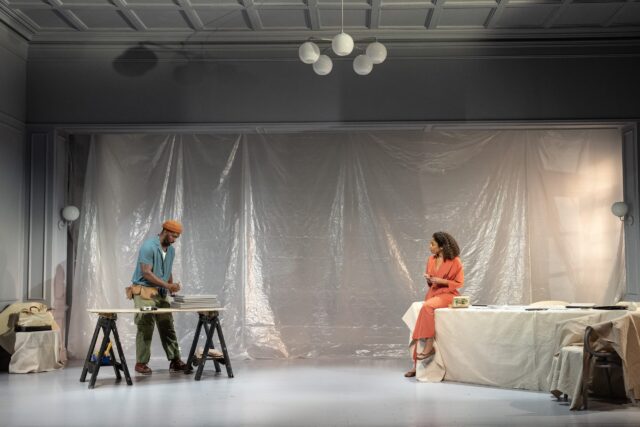
James Ijames’s Good Bones is in need of further renovation (photo by Joan Marcus)

Remembering how he used to play in the very house he is now working in, Earl tells Aisha, “These houses are sturdy. Shit’s built like a ribcage. The bones are so good. If . . . uh . . . you sit really still in here, you can feel the walls breathing and the floors lifting to meet your feet. That’s why I love these old houses. I get to spend time in a lot of haunted places.”

Good Bones follows in the lofty footsteps of Lorraine Hansberry’s A Raisin in the Sun and Bruce Norris’s Clybourne Park, but it lacks the character development and depth of those two award-winning works. Watson (Eureka Day, Merry Wives) and Athie (The Mystery of Love and Sex) have little chemistry; it might be the relationship between Travis and Aisha that requires renovating, but it’s hard to root for them because their marriage has no firm foundation.

Davis (Fireflies, Sweat) steals the show as the honest, hardworking, well-meaning contractor who has a more realistic view of the world, the only one who can see the ghost in the machine, and Téa Guarino (A Hundred Words for Snow, Antony and Cleopatra) is charming as his daughter, Carmen. But Good Bones needs more work, more than just a fresh coat of paint.
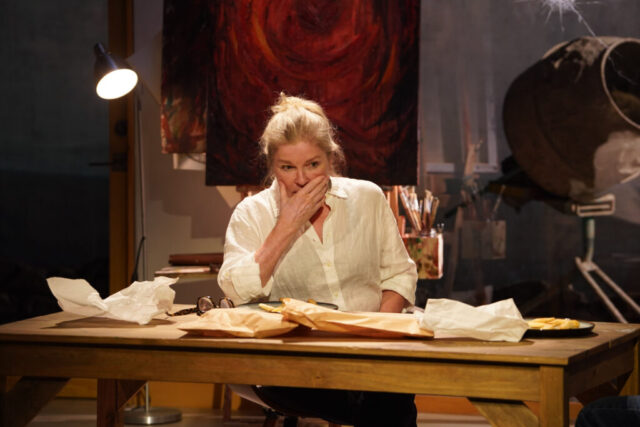
Kate Mulgrew outshines the material in Nancy Harris’s The Beacon at the Irish Rep (photo by Carol Rosegg)

THE BEACON
Irish Repertory Theatre, Francis J. Greenburger Mainstage
132 West Twenty-Second St. between Sixth & Seventh Aves.
Wednesday – Sunday through November 3, $60-$125
212-727-2737
irishrep.org

Obie winner and Emmy nominee Kate Mulgrew excels as an Irish abstract painter renovating her seaside home in Nancy Harris’s The Beacon, making its North American premiere at the Irish Rep through November 3. Mulgrew is Beiv (rhymes with gave), who is transforming her late husband’s cottage into a glass-enclosed space, as if she has nothing to hide — it has been long rumored that she might have had something to do with her spouse’s death.

She is surprised when her son, Colm (Zach Appelman), arrives with his new wife, Bonnie (Ayana Workman), who is a big fan of hers. Colm is surprised when he finds out that one of his old friends, Donal (Sean Bell), is helping with the renovation and has grown close to Beiv, who Colm always calls by her name, never “mom” or “mother.”

At the back of the room is Beiv’s most recent canvas, which is not quite finished yet. Examining it, Bonnie says, “You can really see the female rage. Like I’m instantly getting menstrual blood, the blood of childbirth, genital mutilation, hemorrhaging — pretty much all female suffering. Abortion is in there obviously . . . and repression and shame. But there’s also something really — tender too. Like there, in those softer shades, I see the vulva. And the clitoris, and this really female desire for pleasure, for sexual intimacy but also for like a really fucking explosive orgasm, you know. But yeah. No, it’s powerful. And brutal. And sad too.”

Beiv’s quick response: “It’s a blood orange.”

Of course, it’s actually something in between, and that “in between” is where the play, directed by Marc Atkinson Borrull, find itself stuck, unable to escape from its own trappings.
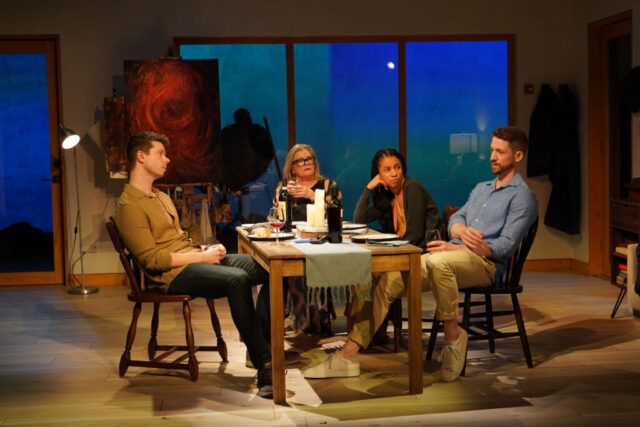
The Beacon is in need of more structure at the Irish Rep (photo by Carol Rosegg)

Beiv is a complex and fascinating character, superbly portrayed by Mulgrew (The Half-Life of Marie Curie, Tea at Five) with a compelling thread of intrigue. But when she’s not onstage, the narrative drags with didactic dialogue and meandering subplots, some of which feel completely unnecessary, such as the one involving Ray (David Mattar Merten) and Bonnie, although Ray overdramatizes things when he describes the house: “On one hand it looks like an idyllic little artist’s garret. Half-finished charcoal sketches sit scattered on a table. A large oil painting rests on an easel; there’s a huge glass window with sweeping views of the Atlantic. But the crack in the window from a recent break-in suggests another story. A darker story . . . a story of sex and violence and betrayal that’s hung around this cottage for over a decade.”

As always at the Irish Rep, the set, in this case by Colm McNally, is an impressive structure, but the story does not have the requisite good bones. It’s as if Harris and Borrull (Little Gem, Bedbound) knew where they wanted to end up but threw in too much as they get there.

Even the title is wasted on an unimaginative metaphor. Mulgrew herself is a beacon, but alas, in this production, she’s the only one who shines.
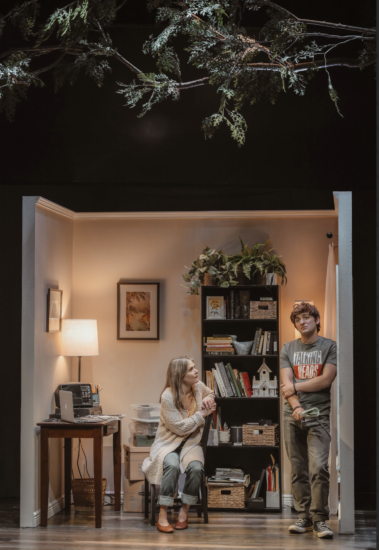
Martha Pichey’s Ashes & Ink trap the actors and characters in uncomfortable ways (photo by Thomas Mundell, Mundell Modern Pixels)

ASHES & INK
AMT Theater
354 West Forty-Fifth St. between Eighth & Ninth Aves.
Wednesday – Sunday through November 3, $39-$49
ashesink.ludus.com
www.amttheater.org

“‘Structure.’ Our lives need structure,” Molly (Kathryn Erbe) says early in the New York premiere of Martha Pichey’s Ashes & Ink. It’s a word that’s repeated several times in the play, which itself needs considerable rebuilding.

Running at the AMT Theater through November 3, Ashes & Ink moves between Molly’s apartment in New York City and her boyfriend Leo’s home in the country. Molly is a widow with a vast archive of birdsong she’s recorded and is categorizing with her sister, Bree (Tamara Flannagan); Molly’s teenage son, Quinn (Julian Shatkin), is an addict who has been in and out of rehab and is seeking a career in acting after having made an impact in a few movies. Leo is a widower raising his eight-year-old son, Felix (Rhylee Watson), by himself.

Quinn has once again left rehab, a place called Serenity House, so he can rehearse for his audition to get into the Royal Academy of Dramatic Arts in London. Prepared to do a monologue from Richard II — his father’s name was Richard — he instead does the classic, and obvious, “Tomorrow, and tomorrow, and tomorrow” soliloquy from MacBeth. The most important phrase is “signifying nothing,” to which he adds, “Nothing. Not a fucking thing.” That goes for the play as well, echoed later by Molly, who opines, “I am so deep inside my sucked dry bones sick and tired. I don’t know how to do this anymore. I don’t even know how to think anymore. I can’t remember anything.”

Tim McMath’s set switches from Molly’s cramped apartment, which resembles a psychiatrist’s office, where Quinn often sits in a chair complaining about his life, and the kitchen of Leo’s country house and under a tree on his property. The actors move the sets themselves; the first time they do it is fresh and exciting, but over the course of fifteen scenes, it grows tiresome, dragging down any pace the show is trying to achieve. For some reason, Molly leaves the window over the fire escape wide open, not the safest thing to do, especially when Quinn is running away from trouble.

Stagnantly directed by Alice Jankell, the play — Pichey’s debut — can’t get out of its own way as subplots turn ever-more ludicrous and the holes in the central story keep expanding. And I couldn’t help but cringe when Tony nominee Erbe (Something Clean, The Speed of Darkness, The Father) had to deliver the following lines: “If somebody told me my little boy would grow up to be an addict, I would’ve spat in their face. Aimed right for their mouth. . . . Take the lid off the pressure cooker, Molly! Watch it plaster the walls with all this gummy smelly stuff. Put your nose up to it, take a good whiff of this shit, this mix of ‘Could’ve done this,’ ‘Should’ve known that.’”

Without any kind of firm foundation, Ashes & Ink fails the smell test, among others.
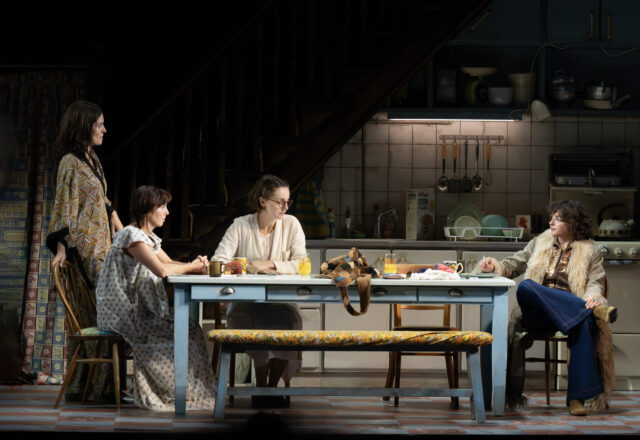
Sisters Gloria (Leanne Best), Ruby (Ophelia Lovibond), Jill (Helena Wilson), and Joan (Laura Donnelly) reunite as their mother lies on her deathbed in The Hills of California (photo by Joan Marcus)

THE HILLS OF CALIFORNIA
Broadhurst Theatre
235 West 44th St. between Broadway & Eighth Ave.
Tuesday – Sunday through December 22, $58-$351
thehillsofcalifornia.com

Rob Howell’s magnificent multilevel set for Jez Butterworth’s new play, The Hills of California, is a character unto itself, an Escher-like maze of rooms and staircases that rise into a mystical darkness. The main floor switches between 1955 and 1976 at a family-run Victorian guesthouse on the outskirts of the seaside resort town of Blackpool on the Irish Sea, providing a firm foundation for the gripping, if overburdened, narrative.

In 1976, sisters Gloria (Leanne Best), Ruby (Ophelia Lovibond), and Jill (Helena Wilson) have gathered at the fading Seaview Luxury Guesthouse and Spa because their mother, Veronica Webb, is dying in a room upstairs; they are waiting for their fourth sister, Joan (Laura Donnelly), who has not stepped foot in the house for twenty years, living in America. They are in what once was the private kitchen but is now a tiki bar with a one-armed bandit and broken jukebox that represent the siblings’ once-promising career. Their mother’s nurse, Penny (Ta’Rea Campbell), has offered the sisters the opportunity to bring in a doctor to end Veronica’s pain, but they don’t want to make any critical decisions until Joan arrives, something Gloria believes is highly unlikely.

“Times like these you find out who a body is. But go on. Stick up for her,” Gloria says sharply to Jill, who has spent her life taking care of the guesthouse and Veronica and is sure that Joan is on her way, exclaiming, “Well, I’m sorry. But it’s not Silly Jilly head-in-the-clouds, nor sticking up for no one. I know my sister. If Joan says she’s coming, she’s coming. There. I’ve said it.”

In 1955, single mother Veronica (Donnelly) is training young Gloria (Nancy Allsop), Ruby (Sophia Ally), Jill (Nicola Turner), and Joan (McDonnell) to become the next Andrews Sisters, rehearsing Johnny Mercer’s 1948 hit “The Hills of California,” which features the lines “The hills of California will give ya a start / I guess I better warn ya cuz you’ll lose your heart / You’ll settle down forever and never stray from the view / The hills of California are waiting for you.”

“What is a song?” Veronica asks, answering, “A song is a place to be. Somewhere you can live. And in that place, there are no walls. No boundaries. No locks. No keys. You can go anywhere.” A song is its own kind of structure, its own kind of home, meant to bring people together, but in The Hills of California, it tears a family apart.
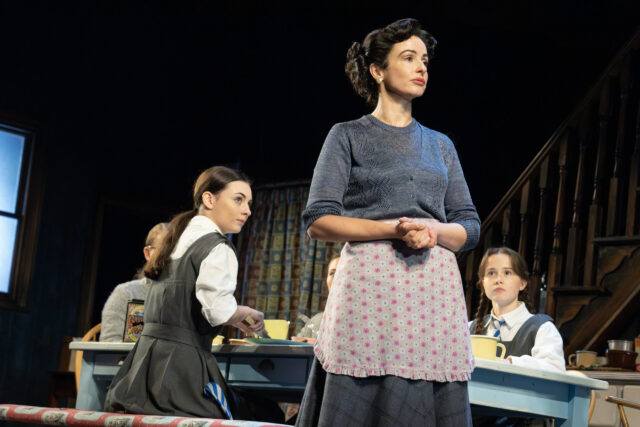
Veronica Webb (Laura Donnelly) is a controlling British stage mother in Jez Butterworth’s The Hills of California (photo by Joan Marcus)

Tony winner Butterworth (The River, Jerusalem) and Oscar, Tony, and Olivier-winning director Sam Mendes (The Lehman Trilogy, Cabaret) previously teamed up on The Ferryman, which won four Tonys and boasted an ensemble of nearly three dozen performers including covers. The Hills of California is overstocked with minor male characters who disappear into the woodwork, even Luther St. John (David Wilson Barnes), who is involved in a key scene that influences the girls’ future and their relationship with their mother.

About fifteen minutes have been cut from the original three-hour London production and the early previews on Broadway, leaving some gaps in the narrative, along with several moments that feel extraneous, such as when Veronica forces a lodger (Richard Short) to take the long way home, barring him from the shortcut through the kitchen. But when the story focuses on the mother and her daughters, in both time periods, the play finds its foundation, with sharp, poignant dialogue, lovely music by Nick Powell, and pinpoint choreography by Ellen Kane.

Donnelly, who has appeared in several plays written by Butterworth, her partner (they have two children together), is whip-smart as Veronica, a controlling stage mother who recalls Rose Hovick in Gypsy, currently played by Audra McDonald right next door at the Majestic. (On the other side is another show about a mother and daughter and music, Hell’s Kitchen.)

America is not referenced just in the song; the rooms in the guesthouse are named after such US states as Colorado, Alabama, Indiana, Minnesota, and Mississippi, where the critical event happens in 1955 and where Veronica is dying in 1976, reminding the audience that this kind of tale can happen anywhere.

In her 2016 poem “Good Bones,” British actress Maggie Smith, who passed away in September at the age of eighty-nine, writes, “Any decent realtor, / walking you through a real shithole, chirps on / about good bones: This place could be beautiful, / right? You could make this place beautiful.” Even with its occasional skeletal forays, The Hills of California has good bones, filled with a glorious beauty.

[Mark Rifkin is a Brooklyn-born, Manhattan-based writer and editor; you can follow him on Substack here.]

BROADWAY REVIVALS: THE PIANO LESSON / DEATH OF A SALESMAN / 1776

John David Washington plays the role Samuel L. Jackson originated in Broadway revival of August Wilson’s The Piano Lesson (photo by Julieta Cervantes)

THE PIANO LESSON
Ethel Barrymore Theatre
243 West 47th St. between Broadway & Eighth Ave.
Tuesday – Sunday through January 29, $74–$318
pianolessonplay.com

“We live in a recycled culture,” Stephen Sondheim told Frank Rich of the New York Times in March 2000. Sondheim explained that there are “two kinds of shows on Broadway — revivals and the same kind of musicals over and over again, all spectacles.”

Broadway revivals are a curious thing. They are often vehicles with built-in star power — Hugh Jackman in The Music Man, Bette Midler in Hello, Dolly! — offering new takes on beloved, household-name shows, for better or worse, something that is unique to theater. In pop music, artists cover hit songs but also do deep dives into another musician’s catalog, resurrecting little-known gems. In cinema, directors remake successful movies — there’s not a whole lotta interest in redoing bad films — but how many remakes were at least equal to or better than the original? (I’ll wait.) And in literature, well, you can’t rewrite a book that has already been written. “It has to do with seeing what is familiar,” Sondheim said to Rich. That’s why so many movies are made into Broadway musicals, generally packing in the crowds despite less-than-enthusiastic reviews.

Right now on Broadway you can see seven revivals on the Great White Way, with several more coming. There are currently four revivals in the fall season, only two of which are exemplary, honoring the spirit of the original. I’ve already raved about Kenny Leon’s adaptation of Suzan-Lori Parks’s superb Topdog/Underdog at the Golden.

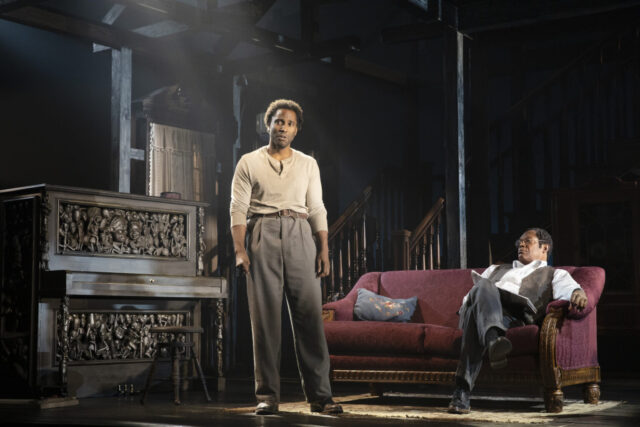
At the Ethel Barrymore, Tony nominee LaTanya Richardson Jackson’s version of August Wilson’s The Piano Lesson is exquisite, a stirring adaptation of the fourth play in Wilson’s ten-part Pittsburgh Cycle, this one set in in 1936. (Each play takes place in a different decade of the twentieth century.) It’s a truly American story of race, colonialism, slavery, family, and the ghosts of a shameful history; the play premiered at Yale in 1987 and on Broadway three years later, earning five Tony nominations including Best Play.

At Yale, Samuel L. Jackson starred as Boy Willie, a dreamer with a plan to sell a truckload of watermelons and the family heirloom piano in order to buy a hundred acres of land where his forebears had toiled for the Sutters first as slaves, then as sharecroppers. Thirty-five years later, Jackson, who is married to LaTanya Richardson Jackson, is Doaker Charles, Boy Willie’s (John David Washington) sensible uncle, who lives with Boy Willie’s widowed sister, Berniece (Danielle Brooks), and her young daughter, Maretha (Nadia Daniel or Jurnee Swan). Berniece, whose husband, Crawley, died several years before, is not about to sell the piano, into which her great-grandfather, Willie Boy, carved powerful images of their ancestors and stories from their lives.

Boy Willie has unexpectedly arrived with his friend Lymon (Ray Fisher), a shy ladies’ man who takes a liking to Berniece, who is being courted by the local preacher, the boring Avery Brown (Trai Byers). It’s Avery who delivers one of the most important points of the play when he tells Berniece, who refuses to play the piano anymore, “You got to put all of that behind you, Berniece. That’s the same thing like Crawley. Everybody got stones in their passway. You got to step over them or walk around them. You picking them up and carrying them with you. All you got to do is set them down by the side of the road. You ain’t got to carry them with you. You can walk over there right now and play that piano. You can walk over there right now and God will walk over there with you. Right now you can set that stack of stones down by the side of the road and walk away from it. You don’t have to carry it with you. You can do it right now. . . . You can walk over here right now and make it into a celebration.”

Another surprise arrival is Doaker’s older brother, Wining Boy (Michael Potts), who serves as the comic relief. Wining Boy is a gambler and former piano player who shows up only when he needs money. “That piano got so big and I’m carrying it around on my back. I don’t wish that on nobody,” he tells Boy Willie. “Now, there ain’t but so many places you can go. Only so many road wide enough for you and that piano. And that piano get heavier and heavier. . . . But that’s all you got. You can’t do nothing else. All you know how to do is play that piano. Now, who am I? Am I me? Or am I the piano player? Sometime it seem like the only thing to do is shoot the piano player cause he the cause of all the trouble I’m having.”

In the second act, a partying Boy Willie brings home Grace (April Matthis), who might be the most perceptive of the group. “Something ain’t right here,” she tells Boy Willie and Lymon.

Beowulf Boritt’s set features the kitchen and living room, with the upstairs open, without doors or walls, hinting that secrets are going to be exposed. The cast is outstanding, led by the confident and self-assured Jackson. I’ve seen several other productions, with Brandon J. Dirden as Boy Willie at the Signature in 2012, directed by Wilson mainstay Ruben Santiago-Hudson, and with a Tony-nominated Charles S. Dutton as Boy Willie at the Walter Kerr in 1990, directed by Wilson’s longtime cohort Lloyd Richards; it’s a testament to the writing that all three productions were excellent, staying true to Wilson’s words and story, which were inspired by onetime Pittsburgh resident Romare Bearden’s 1983 painting, which itself was inspired by Henri Matisse’s 1916 The Piano Lesson and 1917 The Music Lesson. The play might take place in 1936, but it has a timeless quality that still hits hard in 2022.

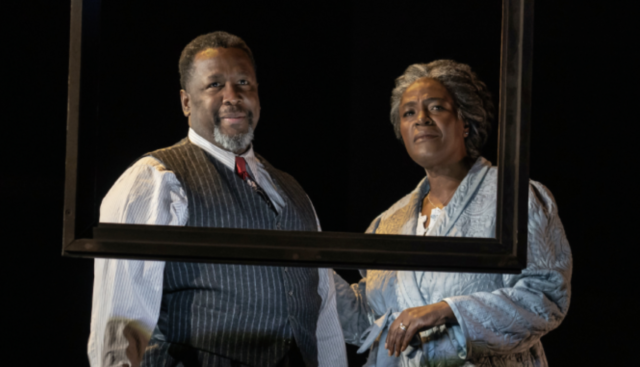
Wendell Pierce and Sharon D Clarke star in reimagined Death of a Salesman (photo by Joan Marcus

DEATH OF A SALESMAN
Hudson Theatre
141 West Forty-Fourth St. between Sixth & Seventh Aves.
Tuesday – Sunday through January 15, $58-$297
salesmanonbroadway.com

Unfortunately, the same cannot be said for Miranda Cromwell’s reimagining of Arthur Miller’s 1949 classic, Death of a Salesman, running at the Hudson Theatre through January 15. What seemed like a slam dunk turns out to be a forced, disjointed narrative despite the timelessness of the original.

The play still is set in Brooklyn in 1949, but the Loman family is Black: patriarch Willy (Wendell Pierce), his devoted wife, Linda (Sharon D Clarke), and their ne’er-do-well sons, former high school football star Biff (Khris Davis) and Happy (McKinley Belcher III), a womanizing dreamer not unlike Boy Willie in The Piano Lesson. The sixty-three-year-old Willy has been having difficulty on the road, losing customers and experiencing driving issues. We never learn exactly what it is he’s selling, but it’s not important; he represents hardworking Americans who toil down to the bone, rarely able to catch a break or get ahead in life.

As Willie slowly starts to realize that he’s not vital anywhere, his neighbor, Charley (Delaney Williams), keeps offering him a job closer to home, but Willy turns him down, instead relying on his boss, Howard (Blake DeLong), to honor his loyalty, but Howard has his eyes set to the future, one that does not include men like Willy.

Willy tries to find hope and solace in the words and wisdom of his late brother, Ben (the fabulously attired André De Shields), now only a ghost, and his despairing family starts to suspect something is seriously wrong.

One of the great characters in the American canon, Willy has been played onstage and -screen by Lee J. Cobb, Fredric March, George C. Scott, Dustin Hoffman, Brian Dennehy, and Philip Seymour Hoffman. Pierce is far too loud as Willy, nearly always shouting, bringing no nuance to the role. Clarke is terrific as his long-suffering wife, but Davis and Belcher III never firmly take control of their parts.

Crowell adds a strolling bluesman (Femi Temowo) who occasionally shows up to serenade the audience, but it feels too random. The dinner scene between Willy, Biff, and Happy is moved to a jazz club that seems out of place. Anna Fleischle’s set, primarily the interior of the Loman household, gets confusing with all its imaginary barriers. To me it was like everyone was trying too hard to put their own stamp on the tale, not trusting that the switch to making the family African American gave the play a new depth all by itself.

A casting gimmick tries to put 1776 into a different perspective (photo by Evan Zimmerman)

1776
American Airlines Theatre
227 West 42nd St. between Broadway & Eighth Ave.
Tuesday – Sunday through January 8, $56-$250
www.roundabouttheatre.org

When it comes to reinterpreting a hit, 1776 takes the cake — and hits the nadir. The 1969 Tony-winning Best Musical focuses on the debates leading up to the signing of the Declaration of Independence at the second Continental Congress, in Philadelphia. For this Roundabout revival at the American Airlines Theatre, directors Jeffrey L. Page and Diane Paulus have chosen a cast of women, transgender, and nonbinary actors portraying the Founding Fathers (and two of their wives). However, this is no Hamilton.

The show features music and lyrics by Sherman Edwards and a book by Peter Stone. It begins cleverly enough with a row of men’s shoes at the front of the stage, which the characters step into with a kind of feminist glee; it’s a lovely moment, but it’s all downhill from there as the casting becomes the point of the revival. Oh, look, Thomas Jefferson is played by a pregnant woman (Elizabeth A. Davis). Ben Franklin is portrayed by an actor who looks nothing like him (Patrena Murray). The casting feels like a gimmick that dominates everything else when it could have been so much more. It’s not that I’m averse to change; I loved Daniel Fish’s reinvention of Oklahoma! a few years ago. But the changes have to be pertinent, not just made for the sake of change.

At first, it’s engaging and relevant to what’s happening in the sociopolitical spectrum in 2022, as evidenced by John Adams’s (Crystal Lucas-Perry, later replaced by Kristolyn Lloyd) all-too-believable speech: “If you don’t want to see us hanging / On some far off British hill; / If you don’t want the voice of independency / Forever still, / Then, god, sir, get thee to it! / For Congress never will! / You see, we Congress / Piddle, twiddle, and resolve. Eh . . . / Not one damned thing do we solve. . . . Piddle, twiddle, and resolve, . . . / Nothing’s ever solved in Congress.”

Leading the fight against independence are the conservative John Dickinson of Pennsylvania (Carolee Carmello), George Read of Delaware (Nancy Anderson), and Edward Rutledge of South Carolina (Sara Porkalob). They argue about the rules of the vote, a clause involving slavery, and other elements, some of which are based on fact, others unverifiable, and others just plain inaccurate. The only two female characters, Abigail Adams (Allyson Kaye Daniel) and Martha Jefferson (Eryn LeCroy), were most likely not in Philadelphia at the time, although Adams’s “Compliments” is a standout, having more power than the more well known showstopper “Molasses to Rum,” performed by Rutledge.

There are also unnecessary projections that compare 1776 to today, particularly with regard to women in politics, something that did not need to be said but was clear from the rest of the show, which mostly falls flat. The televised January 6 Committee hearings were more interesting than this revival, which highlights the original’s many faults. The 1969 edition was nominated for five Tonys, winning three, while the 1997 revival earned three nominations, taking home none. I can’t imagine this one could top either of those come 2023 awards time.

There’s a reason why Sondheim won eight Tonys (as well as an Oscar, eight Grammys, a Pulitzer, and the Presidential Medal of Freedom) and so many of his shows are revived, on and off Broadway. As he told Rich in 2000, “‘Less is more’ is a lesson learned with difficulty. . . . Reduction releases power.” Just look at the current smash Broadway revival of Sondheim’s Into the Woods at the St. James.

SUMMER NIGHT

Summer Night

A group of friends experiences a wild and crazy day in Summer Night

SUMMER NIGHT (Joseph Cross, 2019)
Cinema Village
22 East 12th St. between University Pl. & Fifth Ave.
Opens Friday, July 12
212-529-6799
www.cinemavillage.com
www.samuelgoldwynfilms.com

Summer Night, actor Joseph Cross’s directorial debut, offers a twist on the standard ensemble coming-of-age flick: Its protagonists are not a bunch of high school teens looking to get stoned and laid before leaving for college (or not) but a group of older twenty-somethings facing more serious choices about their future. The film, which opens this weekend at Cinema Village, still has to fight genre clichés and mundane digressions as it tells the stories of close-knit friends gathering at a music bar appropriately called the Alamo in their small-town American community on the last night of summer. Jameson (Ellar Coltrane) is the film’s centerpiece, an all-around-good dude with a sound perspective on life who surprises everyone that night by arriving at the show with the impossibly hot, black-leather-clad Harmony (Victoria Justice), who’s not the kind of woman he usually dates. The less-flashy Corin (Elena Kampouris), who is working the door at the Alamo, is more his speed, but as we will learn, most of the characters are deeper than the usual genre stereotypes.

Summer Night

Vanessa (Melina Vidler) is not exactly having the night of her life in debut film from actor Joseph Cross

Longtime couple Seth (Ian Nelson) and Mel (Analeigh Tipton) reach a crossroads when she tells him she is pregnant, while Jack “Rabbit” (Bill Milner) is shocked to learn his best friend, and possible true-love romantic partner, Lexi (Lana Condor), has lost her virginity to someone else. Rugged musician Taylor (Callan McAuliffe) unexpectedly meets up with the very sweet, younger Dana (Ella Hunt) after he is mugged in the woods. Bass player Caleb (Hayden Szeto) is a nice guy who just wants to have fun, Vanessa (Melina Vidler) has a thing for Taylor, and Andy (Justin Chatwin), the most outgoing and boisterous among them, secretly wonders whether his time has already passed. Meanwhile, older bar patron Luke (Khris Davis) represents potential stability, having settled down with a wife and kids.

Written by first-time screenwriter Jordan Jolliff, Summer Night takes a while to kick into gear as you figure out whether you want to spend any time with these characters, and there’s too much live music (featuring real bands Ruby the RabbitFoot, Roadkill Ghost Choir, and Deep State) — “Is this, like, all you guys do? Sit around and talk about bands nobody cares about?” Vanessa asks — but Cross, who played Tom the barista in Big Little Lies and Augusten Burroughs in Running with Scissors, eventually finds his groove. The relationship between Caleb and Dana is sweet, and Coltrane (Boyhood, Blood Money) stands out as the group’s conscience as the characters realize there are consequences to their actions, and inactions. The key line just may be when Mel says, “This is not the plan,” with some adapting better than others.

FIREFLIES

(photo by Ahron R. Foster)

Reverend Charles Emmanuel Grace (Khris Davis) and his wife, Olivia (DeWanda Wise), take a hard look at their life in Fireflies (photo by Ahron R. Foster)

Atlantic Theater Company
Linda Gross Theater
336 West 20th St. between Eighth & Ninth Aves.
Tuesday – Sunday through November 11, $45-$65
866-811-4111
atlantictheater.org

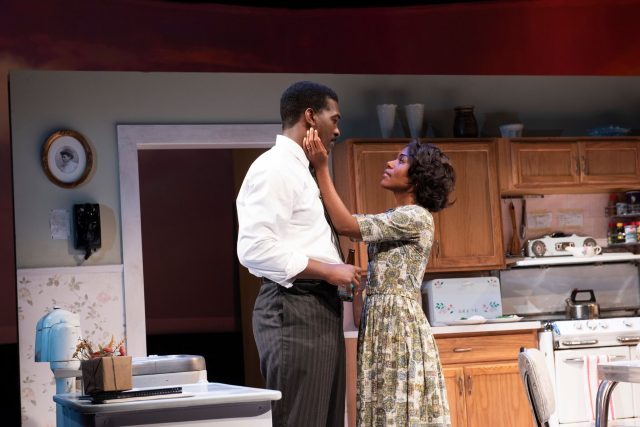
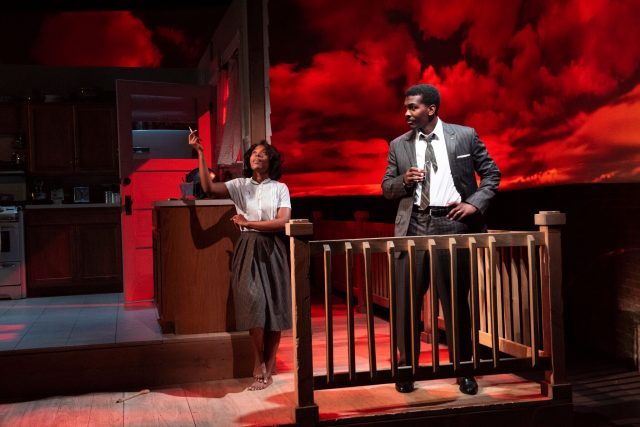
Donja R. Love’s Fireflies is a heartbreaking, eerily relevant drama about bigotry and hate, desire and passion. The second in the Afro-Queer playwright’s trilogy of the black experience in America — Sugar in Our Wounds dealt with slavery, while the forthcoming In the Middle takes place during the Black Lives Matter movement — Fireflies is set in the fall of 1963, at the rise of the civil rights movement. Reverend Charles Emmanuel Grace (Khris Davis) has just given a speech in Birmingham, Alabama, about the four black girls who were killed in the 16th St. Baptist Church bombing. (The preacher’s name, but not the character itself, was inspired by Harlem evangelist Charles Manuel “Sweet Daddy” Grace, who died in 1960.) A big, bold man, Charles comes home to his wife, Olivia Grace (DeWanda Wise), who was just sneaking a smoke. Olivia is deeply troubled by what’s happening in the world, her body suddenly shuddering at certain moments. “You still seeing fire and hearing bombs in your head?” Charles asks, and she answers yes. It’s as if she can feel every tragedy as it happens. Meanwhile, the sky, which hovers in the background throughout the play, behind Arnulfo Maldonaldo’s note-perfect 1960s kitchen set, does indeed often become overcast in a bloodred color. And slowly, what appears to be a beautiful, natural love between husband and wife becomes something else as they talk about having a child and each reveals a dark secret, threatening their supposedly idyllic life.

(photo by Ahron R. Foster)

A bloodred sky hovers over Donja R. Love’s Fireflies at the Atlantic (photo by Ahron R. Foster)

Fireflies features terrific performances from Davis (The Royale, Sweat) and Wise (She’s Gotta Have It, Sunset Baby) as a couple struggling to preserve their family in times of crisis, troubles that Olivia can’t shake. “Last night I had a dream the sky wasn’t on fire anymore,” she says. “The sky was filled with . . . fireflies. . . . So I start to pray. I ask, what does it all mean? And I hear him. I hear God. His voice is real faint. I was struggling to hear Him. But I do. He says, ‘Each firefly is one of my colored kids flying home.’ That scare me even more because it was so many. I would much rather have fire. I’m used to that. I’m used to the bombings, and crosses burning, and all of that. I’m not used to seeing God’s children fly home.” That brief monologue captures the immense fear still felt by so many people of color and minorities, especially in light of the neverending shootings in churches, schools, and synagogues across America in the twenty-first century. Directed by Saheem Ali (Sugar in Our Wounds, Kill Move Paradise), the play, which continues at the Atlantic through November 11, features a final monologue that is far too preachy and melodramatic, laying things out too simply, and the scenes in the porch can be physically awkward and jarring. But throughout it all the blue sky keeps turning red, which it still seems to do more than fifty years later.

SWEAT

SWEAT

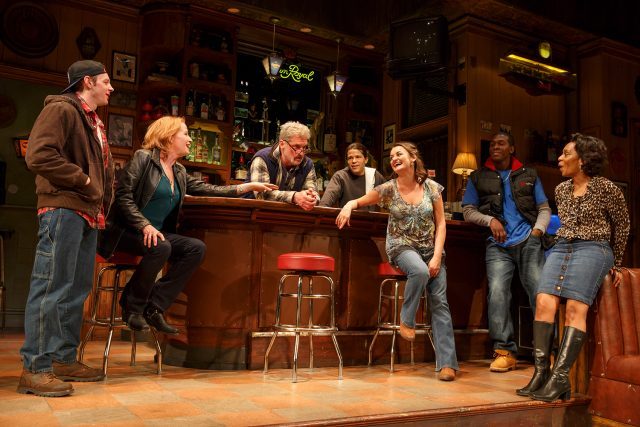
A local bar serves as the main set in Broadway production of Lynn Nottage’s SWEAT

Studio 54
254 West 54th St.
Tuesday – Sunday through October 1, $59-$149
212-719-1300
sweatbroadway.com

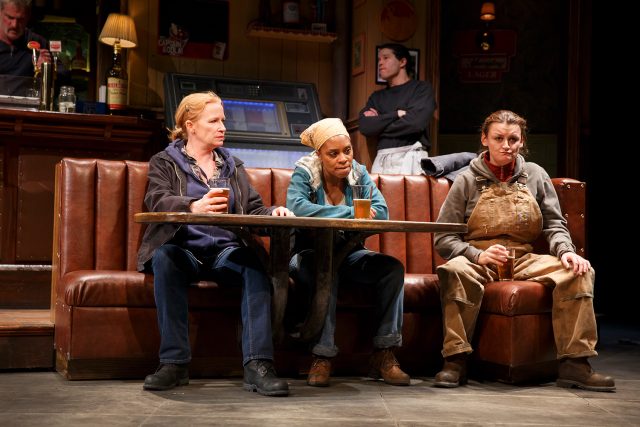
Pulitzer Prize-winning playwright Lynn Nottage at last makes her Broadway debut with the timely Sweat, as powerful and searing at Studio 54 as it was last year at the Public Theater. The two-act play takes place in 2000 and 2008 in Reading, Pennsylvania, where the futility of the American dream is on display. The play opens with a scene in 2008, as former best friends Chris (Khris Davis) and Jason (Will Pullen) have been released from prison after eight years behind bars for an undisclosed crime. Flashback to 2000, when factory workers Cynthia (Michelle Wilson), Chris’s mother, who’s married to the drug-addicted Brucie (John Earl Jelks); Tracey (Johanna Day), Jason’s mother; and Jessie (Alison Wright), a divorced drunkard, are celebrating a birthday in a bar run by former factory worker Stan (James Colby) and his bus boy, Oscar (Carlo Albán). When a front-office job at the factory becomes available, Cynthia shows an interest in getting off the floor, leading to dissension in the ranks, jealousy, envy, and, ultimately, violence.

SWEAT

Tracey (Johanna Day), Cynthia (Michelle Wilson), and Jessie (Alison Wright) weigh their options over pints of beer in SWEAT

Sweat has transferred exceedingly well from the Public to Broadway, with only very minor tweaks to the script by Nottage (Intimate Apparel, Meet Vera Stark), while the direction by Kate Whoriskey (How I Learned to Drive, The Piano Teacher), who also helmed Nottage’s Ruined, is even sharper. The only cast change is Wright (The Americans), who adds more depth to the role of Jessie; Lance Coadie Williams also returns as a parole officer assigned to Chris and Jason, along with John Lee Beatty’s expertly designed rotating set. (All of the actors give strong performances, but Day stands out as a single mother who is willing to see only so far in front of her.) The play gets right to the heart of what has been happening in the United States during and after the recent presidential campaign, as Democrats and Republicans continue to argue over jobs, particularly in the Rust Belt. Nottage did a lot of firsthand research in Reading, the steel and textile town that was ranked as the most impoverished city in America in 2011 and has remained in the top ten ever since, with extremely high unemployment and low education leading to a poverty rate of more than forty percent. She met with many of the struggling people there, encountering feelings of desperation, sadness, and betrayal, and turned their poignant stories into Sweat, a fierce and fiery work with plenty of heart and soul, a brilliant microcosm of a deeply divided nation where hardworking people have to live with choices no one should be forced to make. [Ed. note: Sweat has just earned Nottage her second Pulitzer Prize, announced on April 10; she also won in 2009 for Ruined, making her the first female playwright to win multiple Pulitzers.]