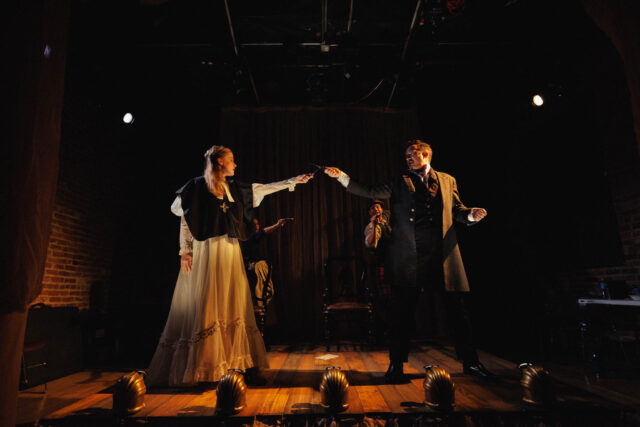
Torrey Townsend’s Jewish Plot takes a unique look at antisemitism (photo by Ken Yotsukura)
JEWISH PLOT
Theatre 154
154 Christopher St. between Greenwich & Washington Sts.
Through November 8, $52.24 – $73.24
www.jewishplot.com
About halfway through the shrewdly inventive Jewish Plot, one of the actors (Madeline Weinstein) reads a ferocious monologue by playwright Torrey Townsend that includes the following breathless diatribe:
“I’m just not hot right now / not exciting / not commercial / not happening / what I should do is make a pivot and frontface with something new / what I should do is start writing about Jews / it’s a subject that people love! / my god people love stories about Jews / it doesn’t even matter / stories about rich Jews / stories about poor Jews / stories about secular Jews / stories about religious Jews / Jews during World War Two / and Jews joining the underground / and Jews trying to escape the camps / and Jews being helped by non-Jews to escape the camps / and Jews being helped by other Jews to escape the camps / and Jews coming to America and assimilating / and Jews coming to America and not assimilating / and Jews experiencing trauma / yes especially above all else Jews experiencing trauma / Jews in the past experiencing trauma / Jews in the present experiencing trauma / Jews half in the past and half in the present experiencing trauma / Jews in multiple dimensions of time and place experiencing trauma / Jews beyond time and place experiencing trauma / Jews as stand-ins for all humans / the timeless truth of all humans experiencing trauma / modern Jews and ancient Jews and Biblical Jews experiencing trauma. . . .”
Right now there are numerous off-Broadway shows that tackle Jewish identity and trauma, coming at a fraught time when the mayoral race involves accusations of antisemitism and there is an uneasy ceasefire in the war in Gaza between Israel and Hamas: Jewish Plot at Theatre 154, Hannah Senesh at Theatre Row, Awake and Sing! at St. George’s Episcopal Church, Slam Frank: A New Musical at Asylum NYC, and Playing Shylock at the Polonsky Shakespeare Center; in addition, the Mint’s Crooked Cross and William Spatz’s Truman vs. Israel closed last weekend. Below I take a closer look at four of them, which I saw on four successive days.
Jewish Plot seemed problematic from the start. First, it had to move from the Brick in Brooklyn to Theatre 154 in the West Village because of an electrical fire. Then, the night I went, Weinstein made a long announcement about how various actors and musicians had quit, but the show, an adaptation of I. W. Bruntmole’s 1889 Jewish Plot; or, The Semite of Mayfair, which deals with antisemitism in Victorian England, would go on, with four performers who would do their best with the technical aspects such as sound and lighting. Oh, and Townsend was in a dressing room still putting finishing touches on the second act.
In Bruntmole’s play, Baron Morris von Azenberg (Eddie Kaye Thomas), who is Jewish, is engaged to actress Sophia Fitzkernerton (Tess Frazer), who is not. But she has to break up with him because, despite his prominent station, her family has forbidden her to marry a Jew; her mother calls the Baron a “Jew devil,” while her brothers refer to him as “the filthy Jew beast.”
The devastated Baron heads off to the Sgorg Inn, where he meets the Abbé Artemis de Romantis (Frazer), who blames all the world’s ills on the Jews. “There’s nothing in the past two thousand years that doesn’t come down to the Jews,” he tells innkeepers Owen (Neil D’Astolfo) and Conner (Weinstein). “The Jews have the money, the Jews are the ones who have robbed the Catholic Church of its power, the Jews are the ones who have brought down the French Empire. Everything’s been a plot, an ingeniously worked-out plot orchestrated by the sons of Israel, the Zionists, the New World Order — call it by any other name. — The Jews control the algorithm; all the rest of us are mice scampering around inside their system.” Offended by the Abbé’s insinuations, the Baron challenges him to a duel.
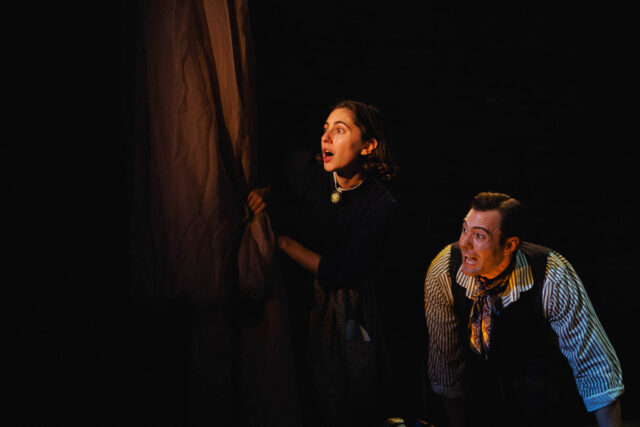
Madeline Weinstein, Neil D’Astolfo — and the audience — can’t believe what they see at Theatre 154 (photo by Ken Yotsukura)
In the second act, Townsend delivers a furious screed about Jewish theater, taking on Itamar Moses (The Ally), Jesse Eisenberg (The Revisionist), Tom Stoppard (Leopoldstadt), and, primarily, Joshua Harmon (Bad Jews), while also bringing up such antisemitic tropes as Jews “eatin’ Christian babies, and drinkin’ their blood!”
Townsend throws in a litany of anachronistic references, intimating how antisemitism continues over time. “This is a Super Bowl of scapegoating, a primordial Mardi Gras,” Townsend writes. It’s a brutal yet hilarious monologue, way too long, but it is as Jewish as it gets, particularly when he includes his mother. “Imagine a Jewish story without a Jewish mother,” he opines parenthetically. He also brings up his grandfather, Meyer Steinglass, “the head and front of the Zionist effort,” who wrote speeches for Golda Meir and raised $35 billion for Israel Bonds.
Lovingly directed with chaotic flair by Sarah Hughes, Jewish Plot is wonderfully titled; it’s about the millennia-old plot against Jews, the supposed plot by Jews to control the world, the plot of Jewish plays, and the burial plot, as antisemitism has resulted in so much death. Weinstein (The Ally) is sensational in the wildly unpredictable work, serving as our personable guide through the neverending scourge of hatred and prejudice that comes with being Jewish.

David Schechter’s Hannah Senesh tells the inspiring story of a real Jewish hero (photo by Tricia Baron)
HANNAH SENESH
National Yiddish Theatre Folksbiene at Theatre Row
410 West 42nd St. between Ninth & Tenth Aves.
Tuesday – Sunday through November 9, $92.50
bfany.org
nytf.org/hannah-senesh
Writer-director David Schechter’s Hannah Senesh, presented by the National Yiddish Theatre Folksbiene at Theatre Row through November 9, is framed by the title character’s mother, Catherine, sitting in a chair, proudly telling the audience in heavily accented English about seeing her daughter in a Budapest prison in 1944, locked up with other underground Zionists. “Hannah’s behavior before the members of the Gestapo was quite something. She always stood up to them, warning them plainly of the bitter fate what they would suffer after they lose the war,” Catherine says. “Even the warden of the prison, who I can only describe to you as . . . inhuman . . . animal . . . even he considered it a privilege to visit her cell daily to argue with her fearless criticism of the German rule and her prophecies of Allied victory. He knew she was Jewish, but he also knew that she was a British paratrooper who had come to fight them. And having been taught for years that Jews never fight back, they will accept the vilest treatment what you give them . . . he was struck . . . by her courage.”
In between, Hannah tells her true story, based on her diaries and other writings (translated by Marta Cohn and Peter Hay), taking us from Budapest in 1934, when, at the age of twelve, she declares herself a vegetarian and complains about a party dress her mother has bought her, through her teen years as she describes her ideal boy and her fury when she wins a school election but it is invalidated because she is Jewish, to her decision to become a Zionist. Quoting Polish writer Nahum Sokolow, she explains, “Zionism is the movement of the Jewish people for its revival.”
Shortly after turning eighteen, she immigrates to British Mandate Palestine, where she lives on a kibbutz. But as Hitler and the Nazis continue their march through Europe, Hannah decides she has to get her mother out before it’s too late, so she volunteers for a dangerous mission.

Jennifer Apple portrays both Hannah Senesh and her mother, Catherine, in poetic show (photo by Tricia Baron)
Jennifer Apple is terrific as both Hannah and Catherine, the former with a gleefully idealistic view of life, the latter more pragmatic; Hannah often flits about onstage, singing, dancing, and twirling a large blue-and-white multipurpose cloth that evokes what will be the colors of the Israeli flag, while Catherine, in dowdy clothing, is tense and controlled. The set features the chair and a writing desk surrounded by walls on which the sun, clouds, storms, and abstract shapes are projected.
The music, arranged by Steven Lutvak, includes Schechter’s adaptation of “Soon” and Liz Swados’s “One, Two, Three” in addition to Senesh’s popular poem “A Walk to Caesarea (‘Eli, Eli’),” in which she sings, “Oh Lord, my G-d / I pray that these things never end / The sand and the sea / The rush of the waves / The crash of the heavens / The prayer of man.”
The narrative doesn’t focus enough on what made Hannah a beloved hero in Israel — I actually had to Google her when I got home to find out more of the details — and the late inclusion of a second character (Simon Feil) feels unnecessary, but the play does a good job introducing us to this extraordinary young woman.
I can’t help but wonder what she would do if she were alive today.
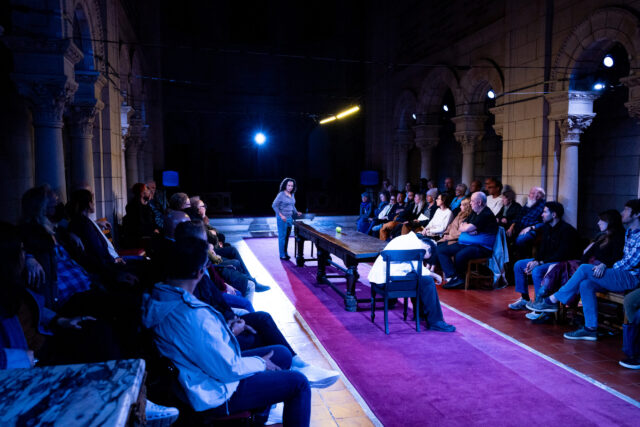
Sea Dog’s adaptation of Awake and Sing!, about a Jewish family, takes place in a church (photo by Jeremy Varner)
AWAKE AND SING!
St. George’s Episcopal Church
209 East Sixteenth St. at Rutherford Pl.
Through November 8, $25-$75, 7:30
www.seadogtheater.org
Zionism and Israel don’t come up in Clifford Odets’s 1935 family melodrama, Awake and Sing!, but the play, currently enjoying a sublime ninetieth-anniversary production from Sea Dog Theater at St. George’s Episcopal Church, does deal with antisemitism, and assimilation, in its own way.
In her 1983 book From Stereotype to Metaphor: The Jew in Contemporary Drama, Ellen Schiff calls it “the earliest quintessentially Jewish play outside the Yiddish theatre. It bears the unmistakable stamp of authenticity, exactly what one would wish from a Jewish dramatist writing a slice of Jewish life problem play.”
This is the third production of Awake and Sing! that I’ve reviewed. In 2013, I saw an excellent all-Asian adaptation from NAATCO at Walkerspace, and in 2017 I caught a superb Yiddish version from New Yiddish Rep at the 14th Street Y. Sea Dog’s rendition features a diverse cast, which makes the story more universal without sacrificing its Jewishness.
It’s 1933, and the Berger family is struggling to get by in a cramped Bronx apartment. Matriarch Bessie Berger (Debra Walton) wants her children to marry well, but son Ralph (Trevor McGhie), a wannabe entertainer, is secretly dating a young woman from a poor family, and daughter Hennie (Daisy Wang) is not particularly fond of her two suitors, the acerbic and cynical Moe Axelrod (Christopher J. Domig) and the plain, uninspiring Sam Feinschreiber (Sina Pooresmaeil). Bessie’s husband, Myron (Juan Carlos Diaz), is a timid, ineffectual man with a taste for gambling, while Bessie’s elderly father, Jacob (Gary Sloan), wanders around the apartment listening to Enrico Caruso and spouting Marxist doctrine. Bessie’s brother, Morty (Alfred C. Kemp), who has a successful fashion business, stops by once in a while to defend capitalism and help out financially, but apparently not as much as he could.
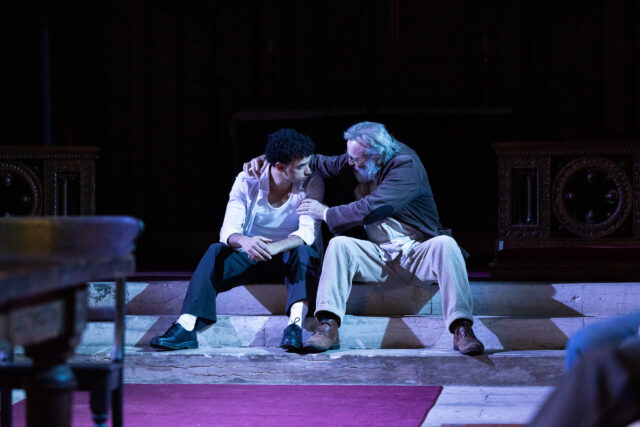
Jacob (Gary Sloan) tries to get through to his grandson, Ralph (Trevor McGhie), in multigenerational Clifford Odets drama (photo by Jeremy Varner)
An early conversation emphasizes the family’s religion.
Myron: The whole world’s changing right under our eyes. Presto! No manners. Like the great Italian lover in the movies. What was his name? The Sheik . . . No one remembers? [Exits]
Ralph: Jake . . .
Jacob: Noo?
Ralph: I can’t stand it.
Jacob: There’s an expression — “strong as iron you must be.”
Ralph: It’s a cock-eyed world.
Jacob: Boys like you could fix it some day. Look on the world, not on yourself so much. Every country with starving millions, no? In Germany and Poland a Jew couldn’t walk in the street. Everybody hates, nobody loves.
When Hennie gets pregnant and the man who did it leaves town, the close-knit but argumentative family has some important decisions to make, facing difficult choices in very hard times.
Director Erwin Maas and production designer Guy De Lancey, who previously collaborated on Sea Dog’s moving Tuesdays with Morrie, make good use of the church’s narrow chantry. The audience sits in two rows on either side of the space, which is centered by a long table with chairs at each end and a green apple in the middle, the only prop in the show. The characters occasionally walk behind columns, down the hall, and into nooks, where their consternation is livestreamed on four video monitors. The actors’ voices do reverberate in the high ceilings, but your ears will quickly get accustomed to that.
Odets, the son of Eastern European Jewish immigrants, chose the title from the Old Testament, Isaiah 26:19, which declares, “Awake and sing, ye that dwell in dust,” but the added exclamation point seems almost like a tease as the men and women pursue an American dream that feels always out of their grasp, as if they will never be able to get out of the dust.
Many historians have likened this current time in the United States to 1930s Germany and the rise of fascism, and that undercurrent bristles under the play, since, with the benefit of hindsight, we know where things are heading for Jack, Morty, and the Jews of Europe.
The more things change. . . .
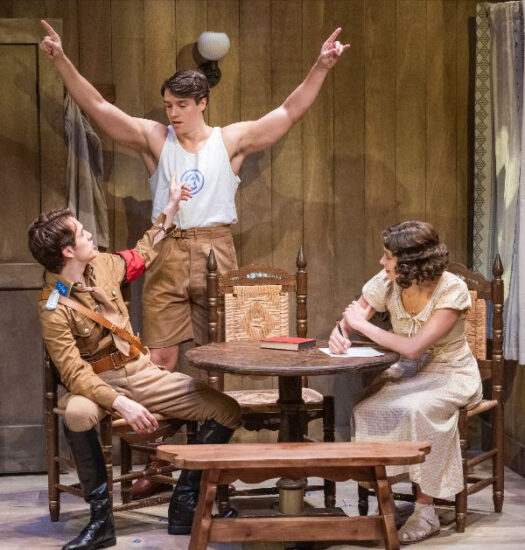
Mint revival is a timely look at the growth of fascism (photo by Todd Cerveris Photography)
CROOKED CROSS
The Mint Theater at Theatre Row
410 West 42nd St. between Ninth & Tenth Aves.
Closed November 1
minttheater.org
bfany.org
Sally Carson’s Crooked Cross begins on Christmas Eve, 1932, and there’s no doubt as to what it’s about and where things are heading: The title refers to the Nazi swastika.
The American premiere of the 1935 play, based on Carson’s 1934 novel, comes courtesy of the Mint Theater, which specializes in reviving lost or forgotten works. The show closed November 1 at Theatre Row but leaves a lasting impression.
In the small German town of Kranach, Moritz Weissmann (Ty Fanning) is in love with Lexa Kluger (Ella Stevens), who lives with her brothers, Helmy (Gavin Michaels) and Erich (Jakob Winter), and their parents (Katie Firth and Liam Craig). Moritz, who recently lost his mother, is taking care of his aging father (Douglas Rees).
A few months later, at a ball in a Munich hotel, Moritz is accosted by a young man (Ben Millspaugh) wearing a uniform with a swastika badge on it who yells, “Blast you! . . . You filthy Jew . . . beastly foreigner! Get out of the way . . . or I’ll . . .” Lexa is shocked by the altercation, saying, “I didn’t know it was like that.” Moritz considers ending his relationship with Lexa so as not to put her in harm’s way, but there’s no avoiding it once Helmy, Erich, and their friend Otto (Jack Mastrianni), who desires Lexa, have all joined the party and go everywhere in their brown storm trooper uniforms with swastikas on the arm. (The frightening costumes are by Hunter Kaczorowski.)
When Lexa tells Helmy that she doesn’t want to give up Moritz, he accuses her of being selfish. “But Helmy, what is being selfish? I’ve thought of so many things lately. And the more I think, the more everything gets a different value,” she tells him. “I’m sure of one thing, I can say this about Moritz, and it’s rare to be able to say it about anyone – I don’t want a single thing different about him, there’s nothing I don’t want or don’t love about Moritz.” Helmy bitterly replies, “Only his being a Jew.” Lexa answers quietly, “Perhaps even that.”
Carson pulls no punches as the Nazi party quickly grows and Moritz has to reevaluate his future in Germany with his father and Lexa.
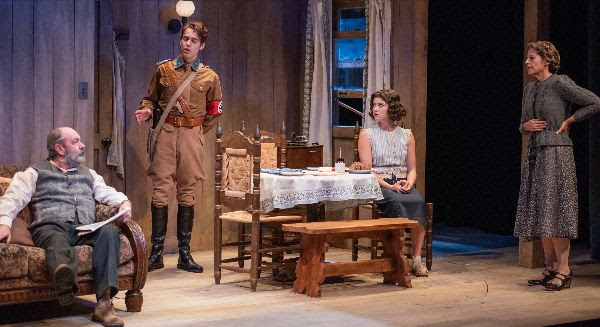
A close German family is torn apart by Nazism in Sally Carson’s Crooked Cross (photo by Todd Cerveris Photography)
“The German youth had been brought up to believe that their country was ‘beaten’ and ‘second-class.’ They developed a feeling of inferiority,” Carson said at a 1935 postshow discussion. “Then along came Hitler who said, ‘You are not second rate and you are not going to be.’ This creed inspired the young people. . . . Whether he will continue to bamboozle the people much longer, no one knows.” The British author never saw the full force of the Nazis in WWII; she died in 1941 at the age of thirty-eight. Crooked Cross was the first of a trilogy that continued with 1936’s The Prisoner and 1938’s A Traveller Came By.
Adroitly directed by Jonathan Bank on Alexander Woodward’s cramped living room set (which converts to other tight spaces), Crooked Cross is a warning sign in 2025, nearly begging the audience to squarely face what is happening in America and around the world, to the Jews, refugees, and other minorities. The narrative avoids getting preachy, instead making its points with expert precision. The fine cast is led by a stellar performance by Stevens, in her New York debut, as Lexa, a caring and honest young woman who represents all of us who believe that the worst will not happen, that humanity can never go that far.
But as Jewish Plot, Hannah Senesh, Awake and Sing!, Crooked Cross, and so many other works dealing with antisemitism, bigotry, and injustice have revealed across the last ninety years and more, it would be folly to underestimate the power and reach of hate.
[Mark Rifkin is a Brooklyn-born, Manhattan-based writer and editor; you can follow him on Substack here.]