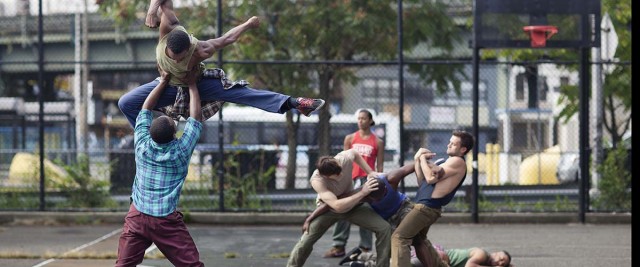
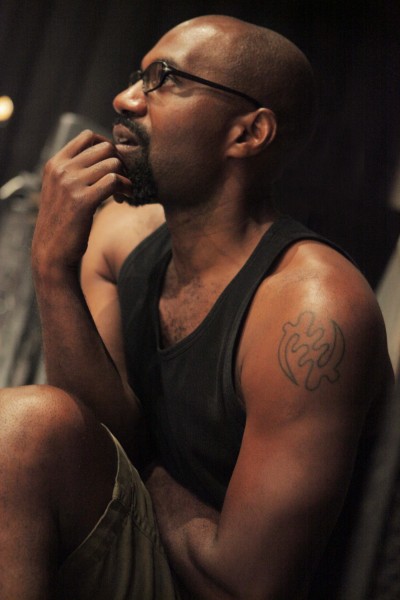
Choreographer Kyle Abraham and jazz drummer Otis Brown III will team up for outdoor sound and movement workshop in Times Square on October 12
Who:Kyle Abraham and Otis Brown III What:“Improvisation and Statements of Freedom in Jazz and Movement” Where: Broadway Plaza, Times Square, Broadway between 42nd & 43rd Sts. When: Monday, October 12, free, 2:00 – 4:30 Why: From November 10 to 15, MacArthur Fellow Kyle Abraham’s Abraham.In.Motion company will perform at the Joyce, in a program with live music that includes Absent Matter, a collaboration with jazz drummer Otis Brown III, a New Jersey native whose debut album, The Thought of You, was released by Revive/Blue Note last year. Brown will also be part of the Robert Glasper Trio, which will play live to Abraham’s The Gettin’ at the Joyce. You can get a taste of what’s to come on October 12, when Abraham and Brown team up for a free workshop in Times Square, for dancers and nondancers alike. “Improvisation and Statements of Freedom in Jazz and Movement” uses sound and dance to explore social change; to participate in the workshop, you can register by contacting Arts@TimesSquareNYC.org.
Ronald K. Brown will celebrate the thirtieth anniversary of Evidence, a Dance Company, at the Joyce starting February 24 (photo by Ayodele Casel)
EVIDENCE, A DANCE COMPANY
Joyce Theater
175 Eighth Ave. at 19th St.
February 24 – March 1, $10-$49
212-242-0800 www.joyce.org www.evidencedance.com
When he was in second grade, Brooklyn-born dancer and choreographer Ronald K. Brown wanted to be Arthur Mitchell, the first African American to dance with the New York City Ballet and founder of the Dance Theatre of Harlem. In 1985, Brown, then only nineteen, formed his own troupe, which he named Evidence, a Dance Company, to honor family, ancestors, teachers, tradition, faith, and the African diaspora. From February 24 through March 1, Brown, who has also choreographed works for Alvin Ailey American Dance Theater, Muntu Dance Theater of Chicago, and Ballet Hispanico in addition to The Gershwins’ Porgy and Bess on Broadway, will be celebrating his company’s thirtieth anniversary with a pair of special programs at the Joyce. Program A includes 2014’s The Subtle One, about experiencing the love of another, with live music by Selma composer Jason Moran and the Bandwagon; the gorgeous Grace, created for Alvin Ailey in 1999; and the excerpts “Exotica” and “March” from 1995’s Lessons, the latter set to the words of the Reverend Dr. Martin Luther King, Jr., performed by Annique Roberts and Coral Dolphin. Program B comprises the Evidence premiere of 2014’s Why You Follow/Por Que Sigues, commissioned for Havana’s MalPaso Dance Company (who will be at the Joyce March 3-8); 1999’s Gatekeepers, a piece originally for Philadanco that delves into Native American mythology and African traditions; excerpts from 2007’s multimedia One Shot: Rhapsody in Black & White, inspired by Pittsburgh photographer Charles “Teenie” Harris; and the New York premiere of Brown’s 2014 solo piece, Through Time and Culture, which brings a unique perspective to his long career. A charming and engaging Guggenheim Fellow and dedicated Brooklynite who is currently an artist in residence at BRIC in Fort Greene, where Evidence will perform in November 2015, Brown recently discussed his life and career, particularly about these past ten years.
twi-ny: Back in 2005, we had lunch together and talked about your twentieth anniversary season. How has the last decade treated you and Evidence?
Ronald K. Brown: The time has been full since that conversation ten years ago. These past ten years have brought Evidence and me more than we could have imagined. In 2010, we had a U.S. State Department tour as a part of DanceMotion/USA and went to Senegal, Nigeria, and South Africa; we were gone for twenty-nine days, performed five times, and taught classes for all ages during our time away. We did have one day off in Grahamstown, South Africa, and were able to go on a safari and relax . . . but the work was great.
I choreographed my first work for Chicago’s Muntu Dance Theatre, and The Gershwins’ Porgy and Bess, which opened first at the American Repertory Theater and then on Broadway.
In November 2013, Evidence moved our offices to Bedford Stuyvesant Restoration Corporation, so for the first time our rehearsals, summer workshops, and daily administrative operations are in the same building — down the hall. That feels great.
twi-ny: Back then, you said, “We have to find out what’s going on in the world. We can’t be disconnected and feel like we’re safe.” How does that relate to you and your work today?
RKB: One thing that I have also learned is that we have to make sure we are connected to those close to us . . . and then that opens up the capacity to be connected to the world. In one of our pieces, On Earth Together, we added dancers from the community in Brooklyn for performances a couple years ago, in South Bend, Indiana, last week, and right now in Pittsburgh. Creating a large cast, talking about grief and compassion, unlocks things that bring the cast closer together . . . and then we can share that compassion with the issues that are happening in the world. Just in talking about the work in South Bend, first an elder confessed that she had lost her husband a month prior. The next day a ten-year-old boy broke down; he had lost his granny two years prior. Then another elder confessed that she had recently lost her husband. And finally, on the last night, a mother and daughter who were in the cast mentioned to [associate artistic director] Arcell [Cabuag] that this particular night was the anniversary of them losing her other daughter. So here we are in this dance, On Earth Together, and the compassion and support was real onstage. Then we could talk about the other things that were going on in the world that were in the recent news.
I’m grateful for the openness of folks who come to the audition and the classes, not knowing that there will be a space to share themselves in a safe place.
twi-ny: From February 24 through March 1, you’ll be presenting your thirtieth anniversary season, at the Joyce. How did you go about choosing which of your pieces will be part of the two programs?
RKB: When we put a program together, we want the evening to have a flow that makes sense. That feels right. I also want to make sure there is a range in the work, things that are new but with something different added, like having The Subtle One being performed live with composer Jason Moran and his group the Bandwagon. I also want to make sure there is work that has not been seen in a while and again with an added surprise. This year the male duet “March” will be danced by two women.
twi-ny: What was the impetus behind creating your new solo piece, “Through Time and Culture”?
RKB:Through Time and Culture was commissioned last year by the American Dance Festival. I wanted to build a solo that demonstrated a sense of perseverance and pressing through, because of the support that family and teachers have given me.
I selected music that would allow me to show the connections of dances from around the world. The dance also is a way that I could breathe the stages of grief as I dealt with the transition of my father to join the ancestors a couple years ago, and my mother in 1996.
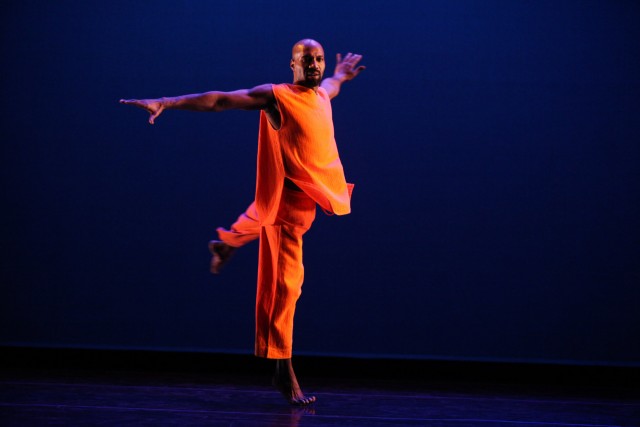
Ronald K. Brown will perform a solo piece as part of anniversary season at the Joyce (photo by Julieta Cervantes)
twi-ny: You travel around the world, adding elements of African movement to your work. Where have you been recently that has influenced your choreography?
RKB: My last two trips to Havana, in 2013 and 2014, definitely had an impact on the work. Seeing the social, folklore, and contemporary dance and work helped me understand more fully what I do, similar to seeing artists in Nigeria during that 2010 trip, where I saw B-Boys, breakdancers, folks improvising, traditional artists, young people showing Evidence some dances from Atlanta, and a choreographer who has been creating Contemporary African Dance for over fifteen years. All these moments helped me understand the expansion of the dance world and what is possible.
The lessons are really to continue to study and then go in to the studio to create, grateful to have an increased sense of freedom with more techniques and rhythms to call on.
twi-ny: You’ve now choreographed five pieces for the Alvin Ailey American Dance Theater. Is your approach to that different from how you choreograph for Evidence?
RKB: When I choreograph on Ailey, or any other company, for the most part I create something that is specifically for them. I generally have three weeks to set a work on Ailey; that first day I am teaching material so that I can identify two casts, and by Wednesday I need to provide a list of dancers selected for the piece. With such a set deadline up front, I come to the studio with some material to teach.
With Evidence on the first day . . . I have the title . . . some music . . . and perhaps some written text and images that I use to fuel the movement that will come once I get in the zone of discovery . . . in the moment and dance it out. This cannot happen with Ailey until I have cast it.
The great thing about Ailey is that the artistic staff there continues to give me time to clean up and clarify things in further rehearsals before the New York season and U.S. or European tours.
In Evidence, the dancers will let me know that I can continue to clarify and shape the piece and make changes to allow the piece to be . . . what it is meant to be, and as long as I am not taking time away from us rehearsing repertory. For the most part, Evidence agrees. . . . “Ron, finish the new work and we will do our homework for when you are ready to rehearse us in the older work.”
twi-ny: You mentioned earlier choreographing the Broadway revival of Porgy and Bess. Do you have any future plans for more Broadway productions?
RKB: This past fall Arcell Cabuag and I worked with director/writer Moises Kaufman on an Afro-Cuban musical version of Carmen. It premiered at the University of Miami, with four professional actors from New York and the other roles played by students form the theater department of U of M. I’m not sure what the life of the piece will be after that, ideally a regional theater further development of the work and hopefully a Broadway run. But that is the hope, who the creative team will be. . . .
A couple years ago I met with a company that commissions works for Broadway and I have begun thinking of some ideas and will begin writing something soon. I will look for collaborators when the time is right.
But right now, I’m focused on Evidence and our upcoming season at the Joyce, a project at Williams College, and a new work for Ailey in 2015. I am also talking to a company in Detroit about setting something. If someone comes to me with a fit for Broadway and it works out time-wise, I would consider it . . . but the commitment for Porgy and Bess was major. Incredible . . . but major. The Porgy national tour was also a wonderful revisit. But the timing made sense. Complicated, but it worked out.
twi-ny: You have a special relationship with Brooklyn. You were born and raised there, and your company has been based there from the beginning, becoming an integral part of the community. And you recently moved into the Bedford Stuyvesant Restoration Center for Arts and Culture. How has that move gone?
RKB: The move to Restoration in November 2013 was a nice move for Evidence. In December 2014 we had to move all of our costumes and props there as well.
It feels great to have a home. We have rehearsed at Restoration for over ten years. When the company is in rehearsal down the hall, I can take care of admin assignments and then go to the studio to rehearse, give notes, and go back to my admin hat.
A few years ago, when we moved our Summer Dance Workshop Series from Medgar Evers Preparatory School to Restoration, the staff at Restoration and Arcell both saw how much sense it made for Evidence to have our educational efforts also happen at BSRC. When our office was in Fort Greene, there was the additional chore of bringing the set-up supplies to another location. Now we just walk down the hall.
I think the dancers who come from all over to take our summer workshop and/or my weekly Tuesday-night class appreciate that Evidence has a home. I also appreciate that it was the first place I took a dance class when I was eight years old and where I competed in storytelling contests; mine was the collection of Anansi the Spider. (The contests took place in the atrium, what used to be an ice-skating rink.)
twi-ny: Brooklyn has changed significantly over the last thirty years. What would you consider the best and worst parts of that change?
RKB: I know that there is an effort to increase the presence of new business and create new corridor around Bedford Stuyvesant Restoration Plaza. The farmers market across the street from BSRC and some of the new businesses are wonderful assets to the community.
The worst parts are the multitude of condos going up surrounded by folks who cannot afford them. Improvements in neighborhoods for the people who live there is a beautiful thing, but when folks are displaced or outpriced . . . this is another thing. We all deserve healthy food choices and respectful neighbors.
twi-ny: Congratulations on your thirtieth anniversary. When you were a kid in Bed-Stuy, dancing at home, dressing up as Arthur Mitchell, did you ever think that things would turn out this way?
RKB: Thank you. I had no idea of how things would turn out. There are models of what is possible. Alvin Ailey, Katherine Dunham, Arthur Mitchell, Pearl Primus, but also my grandfather Ruben McFadgion. I remember two conversations I had with my Poppi; every summer we would drive down from Brooklyn to Raeford, North Carolina, where my grandfather (Poppi) was building a house.
I asked him, “Where are the plans for the house?” He responded, “I don’t need plans; I know what I want.”
This house is five bedrooms, two bathrooms, a basement the same length of the house, where we would roller skate (until he finished).
I asked, “Why is the house so big?” He said, “So you have somewhere to go.”
Flash forward: I’m in the house working on the laptop and he says, “You went to school for that? I would never be able to do that.”
My response: “No, Poppi, I did not go to school for this. . . . I think I have your genes.”
His response: “That’s right, Kevin . . . keep God first.” [ed note: Brown’s family calls him by his middle name, Kevin.]
I tell people, there is freedom in listening and obeying. I try to do that. . . . I had no idea things would turn out the way they did.
Usually when you talk about Cincinnati being in New York, it means that the Reds are taking on the Mets at CitiField or the Bengals are in town taking on the Jets or the Giants at the Meadowlands. But this week it refers to Cincy in NYC, seven days of art, music, dance, theater, and food celebrating the Queen of the West. The centerpiece is the Cincinnati Ballet, returning to New York City for the first time in thirty-five years as part of its fiftieth anniversary season. The company, which features six Cuban dancers, will be presenting three recent works at its Joyce debut from May 6 to 11. Resident choreographer Adam Hougland’s 2013 Hummingbird in a Box is a piece for eight dancers, set to seven specially commissioned songs by guitar god Peter Frampton and Gordon Kennedy; Frampton, who performed the music live at the Cincinnati premiere, will be on hand to introduce the work on opening night at the Joyce. Trey McIntyre’s 2004 Chasing Squirrel is a wildly energetic and fanciful piece for ten dancers in dazzling costumes by Sandra Woodall, with raucous Latino-infused music recorded by the Kronos Quartet. And Val Caniparoli’s 2013 Caprice is an elegant piece that brings together live musicians and ten dancers to Paganini’s “Violin Caprices.” Cincinnati Ballet artistic director Victoria Morgan will participate in a Joyce Dance Chat following the May 7 show.
Cincy in NYC also includes University of Cincinnati College-Conservatory of Music jazz alums performing at Lincoln Center, “Music and Words with Ricky Ian Gordon” at the National Opera House, a Cincinnati Playhouse in the Park staged reading of Cincinnati native Theresa Rebeck’s new play, Fool, at Pearl Studios, the May Festival Chorus and Cincinnati Symphony Orchestra at Carnegie Hall, seven Cincy chefs preparing a special meal at the James Beard House, the CCM Ariel Quartet playing Haydn, Berg, and Beethoven at the 92nd St. Y’s downtown SubCulture, and, at the Metropolitan Museum of Art, the reunion of Rembrandt’s separate portraits of a husband and wife, the Taft Museum’s “Portrait of a Man Rising from His Chair” and the Met’s “Portrait of a Young Woman with a Fan.”
The third edition of Focus Dance, the annual celebration of American movement-based art, will take place January 7-12 with four programs presented by the Joyce Theater in conjunction with Gotham Arts Exchange. Curated by Laurie Uprichard, each performance runs between eighty-five and one hundred minutes and features two U.S.-based companies, beginning January 7 with Vicky Shick and Dancers’ Everything You See and doug elkins choreography, etc.’s Scott, Queen of Marys (also January 12). Morgan Thorson’s The Thing of It Is and Keely Garfield Dance’s Twin Pines (part real, part arboreal) double up on January 8 and 11, while Yvonne Rainer and Group’s Assisted Living: Do You Have Any Money? and Urban Bush Women’s Dark Swan team up on January 9 and 12. The final program pairs Jean Butler’s Hurry with Mark Haim Dance and Theater’s This Land Is Your Land. The pieces are a mix of old and new works and offer a concise yet broad look at the current American dance scene.
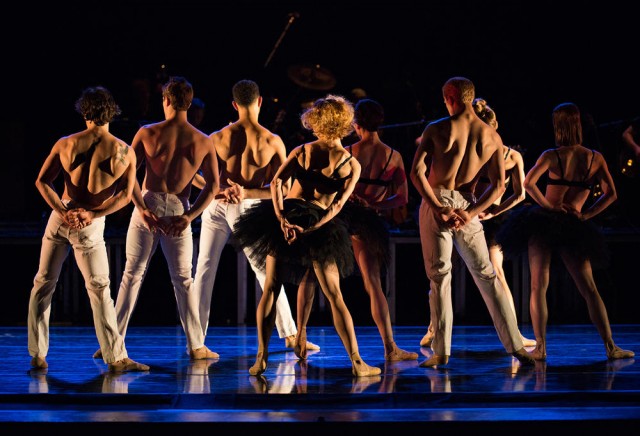
The supremely talented Cedar Lake Contemporary Ballet is celebrating its tenth anniversary with three wide-ranging works at the Joyce from May 7 to 12. The strong, highly physical company, led by artistic director Benoit-Swan Pouffer, ballet master Alexandra Damiani, and spectacular dancer Jason Kittelberger, will present the New York premiere of Jiří Kylián’s Indigo Rose, which the Dutch choreographer originally created for the twentieth anniversary of Nederlands Dans Theater 2 in 1998; the piece includes a long sheet that casts shadows and silhouettes as the dancers move to music by J. S. Bach, John Cage, Robert Ashley, and others. The evening also includes the world premiere of Horizons by Greek dancer and choreographer Andonis Foniadakis, which examines the personal and the public, action and reaction, with a score by composer and visual artist Julien Tarride. And the company looks back at its past with Canadian choreographer Crystal Pite’s Ten Duets on a Theme of Rescue, a 2008 piece in which five dancers rotate into ten duets that examine the theme of rescue through movement, visuals, music, and narrative. There will be a Dance Chat with members of the company after the May 8 show, a Joyce Pre-Show discussion led by Susan Thomasson prior to the May 9 performance, and Joris Jan Bos will lead a DANY Master Class (open level, $15) on May 10 at 10:00 am. Cedar Lake, which is based in a warehouse-like space on Twenty-Sixth St. in Chelsea, rarely fails to thrill, combining inventive staging with amazingly athletic dancers, highlighted by Kittelberger along with Jon Bond, Acacia Schachte, and Nickemil Concepcion.
Born in Newark and based in New York City, choreographer Stephen Petronio is taking to the streets for his latest evening-length piece, Like Lazarus Did (LLD 4/30). The creator of such works as Underland,The Architecture of Loss, and I Drink the Air Before Me examines religion and resurrection in LLD, which will begin at Nineteenth St. and Ninth Ave., where composer Son Lux, trumpeter C. J. Camerieri (yMusic, Sufjan Stevens), violinist Rob Moose (Bon Iver, yMusic), and four choristers will lead a procession into the lobby of the Joyce, where they will make an invocation, all before the “official” dance starts inside onstage. Inside the theater, visual artist Janine Antoni will be suspended in a helicopter stretcher hanging over the audience. “Almost every religion promises some kind of rebirth or resurrection,” Petronio says in a promotional video for the show, “and how odd that the only thing that you can’t prove is the thing that drives the marketplace of all these religions.” A major collaborative effort that will have unique, site-specific elements at each venue it plays, LLD will be performed by the Stephen Petronio Company — Julian De Leon, Davalois Fearon, Joshua Green, Gino Grenek, Barrington Hinds, Natalie Mackessy, Jaqlin Medlock, Nick Sciscione, Emily Stone, and Joshua Tuason — in addition to thirty members of the Young People’s Chorus of New York City (directed by Francisco Núñez), Son Lux, and members of Bon Iver and yMusic, with costumes by H. Petal and lighting by Ken Tabachnick. The April 30 and May 1 shows will include a preshow musical performance in front of the Joyce as well. Ticket holders are encouraged to come early every night to experience Antoni’s unique installation. The May 2 show will be preceded by a talk led by Susan Thomasson at the neighboring Sushi Masaru restaurant and followed by a Dance Chat with members of the cast and crew.
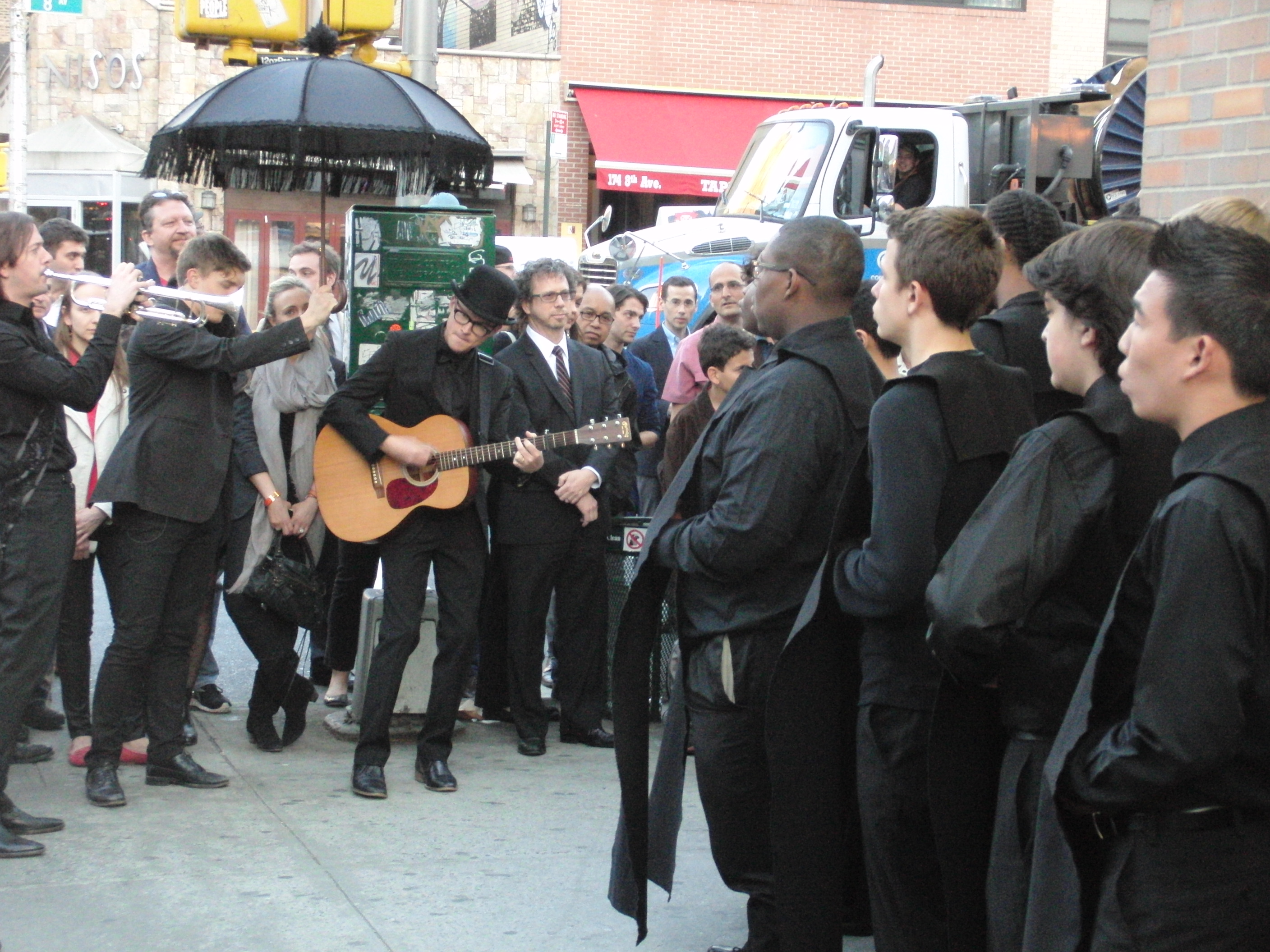
Stephen Petronio’s LIKE LAZARUS DID begins with a funeral procession outside the Joyce (photo by twi-ny/mdr)
Update: Stephen Petronio throws himself quite a New Orleans-style funeral in his latest evening-length piece, the site-specific Like Lazarus Did. The show begins outside the Joyce as musicians C. J. Camerieri, Son Lux, and Rob Moose play the slave song “Like Lazarus Did,” which features the oft-repeated refrain “I want to die / like Lazarus did.” Inside the theater, the curtain is lifted slightly above the stage, revealing a barefooted Petronio in a black suit, lying flat on his back as if dead. Meanwhile, performance artist Janine Antoni hangs over the audience, remaining stock-still in a helicopter stretcher surrounded by body parts, holding a light as if beckoning Petronio to rise up and join her in an ascent to the unknown. What follows is sixty minutes of bold and beautiful movement, with small hints at a narrative involving birth, death, and rebirth and heaven and hell, particularly when the back wall is illuminated in red with a stark, disinviting entrance and later when cords fall from above like the hands of God. Son Lux’s memorable score ranges from the traditional to the avant-garde, from pure gospel to cutting-edge experimental, with glorious contributions from the Young People’s Chorus of New York City, conducted by Francisco Núñez. The dancers are uniformly excellent, with a standout performance by Davalois Fearon, but they do so in some very silly costumes (loose-fitting smocks and skirts) by H. Petal and Tara Subkoff that actually detract from the overall impact of the show. Otherwise, Like Lazarus Did is a dazzling funeral procession that is well worth being a part of.
MARTHA GRAHAM DANCE COMPANY
Joyce Theater
175 Eighth Ave. at 19th St.
Thursday, February 28, 8:00; Saturday, March 2, 2:00; Sunday, March 3, 7:30, $10-$59
212-645-2904 www.joyce.org www.marthagraham.org
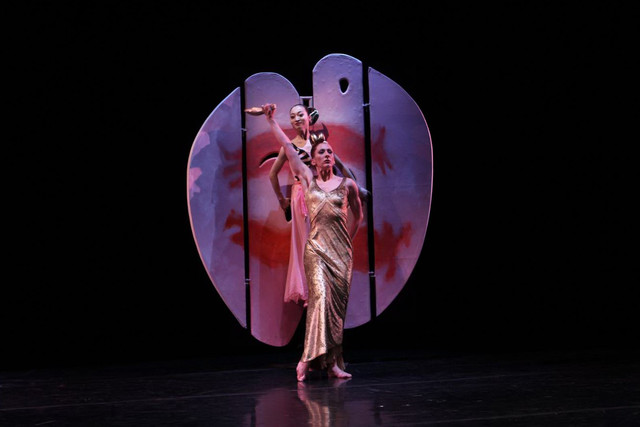
The Martha Graham Dance Company’s winter season at the Joyce, dubbed “Myth & Transformation,” kicked off on February 20 with a pair of productions that served as a microcosm for both the title of the season as well as for the two sides of the company itself. First up was Graham’s 1962 piece Phaedra, a tale of love, infidelity, and revenge featuring Blakely White-McGuire as Phaedra, Maurizio Nardi as Hippolytus, Tadej Brdnik as Theseus, and PeiJu Chien-Pott as Pasiphea, with Mariya Dashkina Maddux as Artemis and Xiaochuan Xie as Aphrodite, in a set composed of four structures designed by Japanese sculptor Isamu Noguchi. Graham’s Phaedra gained notoriety because two members of Congress denounced it as obscene when the work was on tour courtesy of State Department funds, but today it seems tame and rather plain. The trio of men show off their nearly impossible six-pack abs, Artemis shoots off unseen arrows, and Phaedra does curious things with a knife, but the piece feels old-fashioned and dry, as if it were dug up from a time capsule, and Robert Starer’s score sounds like it’s made up of leftovers from West Side Story. For those who think Graham’s work, which changed the face of modern dance for decades, is no longer as relevant as it once was, now cast into a category of legend and myth, Phaedra is a strong example.
Phaedra (Blakely White-McGuire) is manipulated by Aphrodite (Xiaochuan Xie) in Martha Graham Dance Company production of PHAEDRA (photo courtesy of Costas)
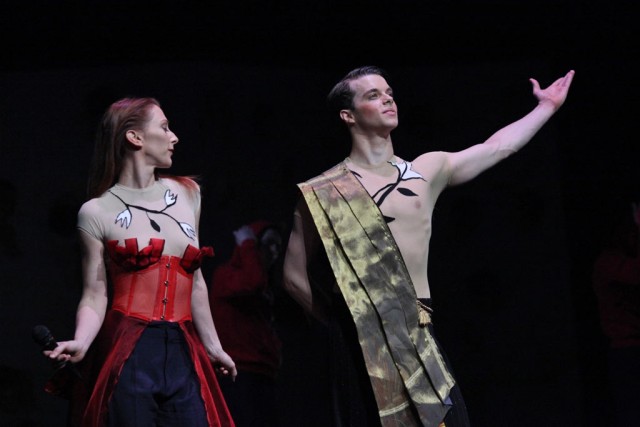
But The Show (Achilles Heels) is everything Phaedra is not, a tantalizing, dazzling piece that celebrates Graham’s continuing transformative influence on narrative and movement. Originally commissioned for the White Oak Dance Project in 2002, Richard Move’s unique take on the story of Helen of Troy (Katherine Crockett, in the role she created) and Achilles (Graham apprentice Lloyd Mayor, playing the part previously performed by Mikhail Baryshnikov at White Oak in 2002 and Rasta Thomas at the Kitchen in 2006) is filled with plenty of glitz and glamour as well as beautiful movement. The fanciful production features music by Arto Lindsay, new and old songs by Debbie Harry and Blondie, and a two-sided backdrop painted by artist Nicole Eisenman as well as piped-in dialogue that is mouthed by the lead actors from either previous incarnations of the show (which featured Misha as Achilles and Harry as Athena), or from old Hollywood sword and sandal epics. Move, who appeared as Graham in Martha@ . . . The 1963 Interview two years ago at DTW — and whose own grandmother was Miss Athens — turns the red-clad Athena (White-McGuire) into the host of a reality TV show in which the contestant Achilles answers Jeopardy!-like questions when not staring at himself in a mirror, playing with a mechanical dove, or being covered in glitter. As opposed to Phaedra, a relic from a bygone age, Move’s The Show (Achilles Heels) is a Greek tragedy for the twenty-first century, a tale of love and war told by a Graham devotee who has no boundaries. (Phaedra and The Show [Achilles Heels] will be presented at the Joyce on February 28 and March 2 and 3, with the roles of Phaedra, Hippolytus, and Theseus in the former played by Crockett, Lloyd Knight, and Ben Schultz, respectively, at some performances.)