Tag Archives: Jennifer Mogbock

WELCOME TO THE MACHINE: TIM BLAKE NELSON WORLD PREMIERE AT LA MAMA

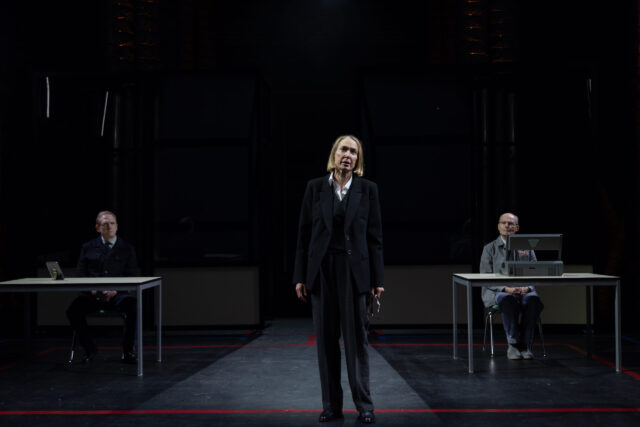
A Lawyer (Elizabeth Marvel) attempts to defend her client in Kafka-esque And Then We Were No More (photo by Bronwen Sharp)

AND THEN WE WERE NO MORE
La MaMa Experimental Theatre Club
The Ellen Stewart Theatre
66 East Fourth St. between Second Ave. & Bowery
Tuesday – Sunday through November 2, $49-$99
www.lamama.org

“‘It’s a remarkable piece of apparatus,’ said the officer to the explorer and surveyed with a certain air of admiration the apparatus which was after all quite familiar to him. The explorer seemed to have accepted merely out of politeness the Commandant’s invitation to witness the execution of a soldier condemned to death for disobedience and insulting behavior to a superior.”

So begins Franz Kafka’s 1918 short story, “In the Penal Colony,” which actor, director, novelist, playwright, and screenwriter Tim Blake Nelson recently read with one of his sons. The existential tale serves as the inspiration for Nelson’s gripping new play, And Then We Were No More, continuing at La MaMa through November 2.

The two-hour show (plus intermission) takes place in the near future, in a privately owned prison in a large complex that has a new machine that apparently can painlessly and efficiently execute those convicted of capital crimes. It’s a Kafka-esque institution where no one has a name and everything has been decided in advance. An Official (Scott Shepherd) goes by the book but likes making an occasional joke, which floats away without a laugh. He has brought in a Lawyer (Elizabeth Marvel) to defend the Inmate (Elizabeth Yeoman), who has been convicted of killing her husband, their two children, and her mother. Often watching the proceedings from a distance is an Analyst (Jennifer Mogbock) representing the corporation’s financial interest in the machine. Meanwhile, the Machinist (Henry Stram) fiercely defends the system and his beloved execution device as he tracks statistics.

The Lawyer reluctantly accepts the job; selected by a computer algorithm she essentially has no choice. At the Lawyer’s first meeting with her client, the Inmate says to her in an irrational manner, “I am not no my name / by name name me by name / but you would say know me / by name / by my name / you would swim / in the muddy of no more name / rise up and see / vapor wickedness / bloom in white sky / rain retreat like lost / far flood / nameless name. . . . smell on you same air / breathe / anger / plague skin crawled / needs swarming / scratch self death.” The Lawyer soon learns that there is no option to delay or cancel the execution based on her client’s possible insanity.

During the trial, the case is made directly to the audience, which serves as a kind of jury; when the verdict is announced, the powerlessness of the individual envelops the room with Kafka-esque grandeur.
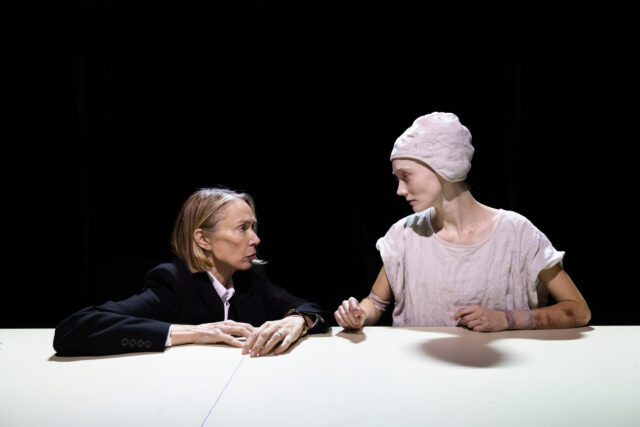
A Lawyer (Elizabeth Marvel) faces impossible odds with her client (Elizabeth Yeoman) in world premiere at La MaMa (photo by Bronwen Sharp)

And Then We Were No More is gorgeously staged by director Mark Wing-Davey (The Hitchhiker’s Guide to the Galaxy, Mad Forest), as the tension, and strangeness, ratchet up scene after scene. David Meyer’s jaw-dropping set features a series of strikingly colored air ducts, bland chairs and tables, and the mysterious machine that supernumeraries move around like automatons. Marina Draghici’s costumes range from office chic to an odd, somewhat deranged outfit worn by those about to be executed. Henry Nelson (one of Tim’s children) and Will Curry’s sound design switches from compelling interstitial music to ominous machine drones to horrific screeches when the Lawyer says the Inmate’s name out loud, in defiance of the rules.

The cast, which also includes William Appiah, E. J. An, Kasey Connolly, and Craig Wesley Divino as the supernumeraries in multiple roles, capture the feeling of the Kafka-esque environment, where so much is not explained. Nelson, who has written two novels and such plays as Socrates, Eye of God, and The Grey Zone (he adapted the last two into films) and has appeared in such movies as The Thin Red Line, Captain America: Brave New World, and O Brother, Where Art Thou?, has created a sinister, foreboding dystopian existence with And Then We Were No More, one that feels all too real given what is happening to the justice system under the current US administration.

Various scenarios are like warning signals, telling us what might be waiting for us right around the corner:

An Analyst: If the work is stymied, if we cannot demonstrate success . . .
An Official: I understand.
An Analyst: Everyone must understand.
An Official: We can do what we can do.
An Analyst: This is a sentiment no longer relevant in our time.
An Official: Or it’s the only relevant sentiment.

“Ready now!” the officer announces after preparing the machine to do its business in Kafka’s tale.

He might be, but are we?

[Mark Rifkin is a Brooklyn-born, Manhattan-based writer and editor; you can follow him on Substack here.]

HOOP DREAMS: FLEX / THE HALF-GOD OF RAINFALL

Starra Jones (Erica Matthews) and Sidney Brown (Tamera Tomakili) face off against each other in Candrice Jones’s Flex (photo by Marc J. Franklin)

FLEX
Lincoln Center Theater at the Mitzi E. Newhouse
150 West 65th St. between Broadway & Amsterdam Ave.
Through August 20
www.lct.org/shows/flex

“Being a fan is like having a religion,” Matt says in Rajiv Joseph’s King James, a play that ran this spring at MTC at New York City Center about two Cleveland men who bond over their mutual love of hoops star LeBron James, perhaps the greatest player of all time.

Here in New York, basketball itself is a religion. Fans continue to worship the Knicks and pack Madison Square Garden even though the team has won only one playoff series in ten years and has not taken home a championship in half a century; the city went into mourning when former All-Star MVP center Willis Reed died this past March at the age of eighty. Across the East River, the Nets have been in turmoil since they moved to Brooklyn in 2012, going through superstars at the Barclays Center like Halloween candy, with nothing to show for it.

Meanwhile, for those paying attention, the other team at Barclays, the New York Liberty, is having its best season since the Women’s National Basketball Association started in 1997, in serious contention for its first league title.

Basketball lies at the heart of two current dramas in Manhattan, one worthy of a championship, the other, well, in need of significant rebuilding; both conclude their seasons on August 20.

At Lincoln Center’s Mitzi E. Newhouse, Candrice Jones’s Flex is a fast-paced and exciting play set in rural Arkansas in 1998, where five seventeen-year-old Black women on the team known as the Lady Train are preparing for their next big game. Shooting guard Sidney Brown (Tamera Tomakili) is being scouted by major colleges. Point guard Starra Jones (Erica Matthews) is a ball hog jealous of the attention Sidney is getting. Power forward Cherise Howard (Ciara Monique) believes they all need to be cleansed and offers to baptize everyone. Center Donna Cunningham (Renita Lewis) is the most grounded and caring of the tight-knit group. And shooting guard April Jenkins (Brittany Bellizeare) is pregnant but wants to keep playing, despite the strong objections of coach Francine Pace (Christiana Clark).

Matt Saunders’s primary set consists of half a court, with the rim affixed on the top of a barn garage. The floor is actually parquet but we’re told it’s dirt. At the beginning, all five players appear to be with child, but following practice, four of them take out fake pregnant belly prosthetics. It’s a funny moment that instantly shows their camaraderie and support for one another.

The narrative is divided into four quarters, just like a basketball game. The cast displays its skills right from the opening tip-off, getting into a rhythm. “My first buzzer beater ever! / I finally know I’m just as good as you! / No more Plainnole, Arkansas, dirt courts for me, Mama! / No more dust in my eyes, my ankles, my fingernails. / I’m gonna win regionals, then state,” Starra says to her late mother, who gave up bball for the army. “Ain’t no way you gonna believe this. / But, scouts are coming here, to Plainnole. / You said by the time I got older. / There’d be a girls’ NBA. / You were right. / I’m going to the WNBA.”

Starra’s selfishness leads to major problems when the teammates hang out one night at Sidney’s house, discussing Michael Jordan, sexual abuse, abortion, condoms, and boxers vs. briefs. Soon they’re in an ingeniously designed car, singing Aaliyah’s “Are You That Somebody,” each of them highlighting individual lines that are particularly meaningful, which include “I’ve been holdin’ back this secret from you / I probably shouldn’t tell it, but / But if I, if I let you know / You can’t tell nobody, I’m talkin’ ’bout nobody.” Secrets keep coming out — or teeter around the rim — as the state tournament approaches and the game plan might involve benching several starting players.

Tony-nominated director Lileana Blain-Cruz (Fefu and Her Friends, Anatomy of a Suicide) guides the action like a masterful basketball coach, smoothly transitioning between offense and defense, knowing exactly who should have the ball at any given moment. The play is in constant motion, leaving no time for slacking. In a brilliant move, the stage crew dress like referees, adding humor and referencing how the players are too often being judged.

While it’s about a lot more than just basketball, Jones doesn’t overplay the metaphors, keeping her eyes on the rock as the action heats up. Mika Eubanks’s costumes range from sweats, shorts, and T-shirts to snazzy uniforms, with Adam Honoré’s lighting and Palmer Hefferan’s sound contributing to the overall tension.

The title refers specifically to a play run by the five players on the court, but it also evokes the Brooklyn street dance known as flexing, a word used for boasting or expressing oneself, and the standard dictionary meaning, to bend, intimating that the teammates have to be flexible if they want to succeed.

The cast, which also features Eboni Edwards as the sixth member of the Lady Train, comes together like a successful team with a legitimate shot at the crown. They face serious issues at school and at home, with boyfriends, girlfriends, and relatives, and with race and religion, but the more they work together, the more their goals are within reach, but it’s going to take more than a buzzer-beating three-pointer for them to win in the game of life.

Demi (Mister Fitzgerald) leads his team on the Battle Field in Inua Ellams’s The Half-God of Rainfall (photo by Joan Marcus)

THE HALF-GOD OF RAINFALL
New York Theatre Workshop
79 East Fourth St. between Second & Third Aves.
Through August 20
www.nytw.org

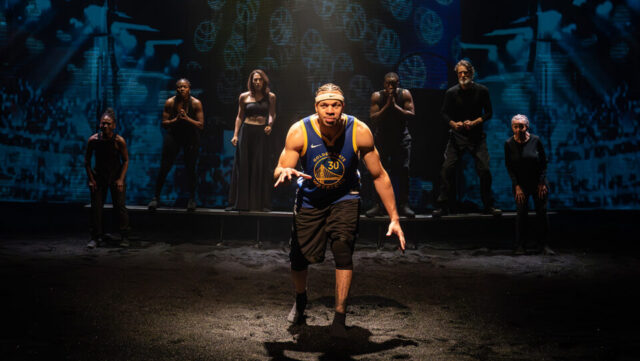
Over at New York Theatre Workshop, Inua Ellams’s The Half-God of Rainfall features seven characters on a floor of dirt and mulch, constructed around the game of basketball while being about much more, although precisely what gets garbled like a stalled offense and a defense with too many holes.

The ninety-minute play, a melding of Greek and Yoruba mythology told as an epic poem in chapters, opens with the fine cast introducing themselves, a dose of reality that immediately blurs the fantasy that follows. At the center is Demi (Mister Fitzgerald), a demigod born to Zeus (Michael Laurence) and the mortal Modúpé (Jennifer Mogbock). Observing the proceedings are the River Goddess Osún (Patrice Johnson Chevannes), Sàngó, an Orisha God of Thunder (Jason Bowen), Hera, the Goddess of Marriage, Women, and Family (Kelley Curran), the Orisha Gods Òrúnmilà and Elégba (Lizan Mitchell), and other mythical figures. Because his father is Zeus, the young Demi, called the Town Crier because of his propensity to rain down tears, is banned from playing basketball, which in this world represents war.

Mortals play on a makeshift court known as the Battle Field — “where generals were honored and mere soldiers crushed” — built with telephone poles, tires, fishing nets, and charcoal. “Basketball was more than sport; the boys were obsessed,” Elégba says. “They played with a righteous thirst,” Hera adds. Sàngó: “There were parries, thrusts . . .” Elégba: “shields and shots . . .” Zeus: “strategies and tactics . . .” Osún: “land won and lost . . .” Modúpé: “duels fought . . .” Hera: “ball like a missile . . .” Zeus: “targets locked.”

When Demi surprisingly reveals a remarkable shooting acumen, everyone begins to view him differently. But Demi’s prowess leads to both an NBA contract as well as disagreements among the Gods and a war that takes place with weapons, not a round ball.

Similarly to the young women in Flex, the young men in Rainfall engage in trash-talking and worship Michael Jordan; among the same issues that are brought up are sexual assault, prayer, and competition that extends beyond the court. Whereas the women see basketball as a way to improve their lot in life and form a close group, in Rainfall “Hera rolled her eyes at how mortal Gods could be, how like men to reduce disputes down to sporting feats, but it was done: the stakes, awful, the route to run.”

Characters in Rainfall shift between dialogue and narration, often in the same speech, so it can become confusing whether they’re talking to the audience or the other Gods and mortals. Too much of the action is described instead of playing out on the court, turning the show into a kind of staged reading. Riccardo Hernández’s set contains scrims on three sides where Tal Yarden projects abstract and concrete images that only add to the perplexity. Linda Cho’s costumes and the props at times feel more like cosplay than serious theater.

The thirty-eight-year-old Ellams, who was born in Nigeria and raised there and in England and Ireland, has been playing basketball since he was twelve; he is also a Marvel Comics enthusiast and has written books and performed solo shows. He stuffs too much into The Half-God of Rainfall, which also has problems with its timeline as it ventures between the ancient and the present, particularly when Sàngó mentions which other real-life all-stars are demigods. (How many people in the audience are likely to know who Clyde Drexler is?)

From start to finish, Flex shows that it’s got game, effectively executing its strategy with an expert balance of humor and sincerity as it sets its sights on its championship goals. The Half-God of Rainfall is all over the place, in desperate need of a tactical blueprint if it wants to have a shot at possibly making the playoffs.

[Mark Rifkin is a Brooklyn-born, Manhattan-based writer and editor; you can follow him on Substack here.]

SHAKESPEARE IN THE PARK: MERRY WIVES

An exuberant cast welcomes Shakespeare in the Park back to the Delacorte in Merry Wives (photo by Joan Marcus)

MERRY WIVES
Central Park, Delacorte Theater
Monday – Saturday through September 18, free, 8:00
shakespeareinthepark.org

Shakespeare in the Park returns to the Delacorte after a canceled 2020 Covid summer season with the Public Theater’s exuberant but overbaked Merry Wives, continuing through September 18. Adapted by actress and playwright Jocelyn Bioh, who has appeared in such shows as An Octoroon and The Red Letter Plays: In the Blood and written such works as School Girls; or, the African Mean Girls Play and Nollywood Dreams, the play is thoroughly updated but often feels like a mash-up of such sitcoms as What’s Happening!! and The Jeffersons with such reality programs as The Bachelorette and Real Housewives.

The evening begins with Farai Malianga in a Brooklyn Nets Kyrie Irving jersey pounding on his djembe and eliciting an engaging call-and-response with the audience. It’s a wonderful start, reminiscent of how the late Baba Chuck Davis would kick off BAM’s annual DanceAfrica series. The seating is less thrilling but important, divided into sections full of vaccinated people who may choose not to mask — most don’t — and two emptier sections of unvaccinated people who must be masked and socially distanced.

Merry Wives is set in modern-day South Harlem, with a cast of characters from Ghana, Liberia, Nigeria, and Senegal, portrayed exclusively by actors of color. In 2019, Kenny Leon directed a fabulous all-Black version of Much Ado About Nothing, but lightning doesn’t strike twice.

Madams Ford (Susan Kelechi Watson) and Page (Pascale Armand) join forces in contemporary update of Merry Wives (photo by Joan Marcus)

There’s a reason why The Merry Wives of Windsor is so rarely presented; it’s only been performed at the Delacorte twice before, in 1974 (with George Hearn, Marilyn Sokol, Barnard Hughes, Cynthia Harris, Michael Tucker, and Danny DeVito) and 1994 (with Margaret Whitton, David Alan Grier, Andrea Martin, Brian Murray, and Tonya Pinkins). It’s not one of the Bard’s better plays, a Medieval farce that tears down one of his most beloved creations, Sir John Falstaff, far too mean-spiritedly. And too many of the devices and subplots — mistaken identity, the exchange of letters, secret romance — feel like hastily written retreads here.

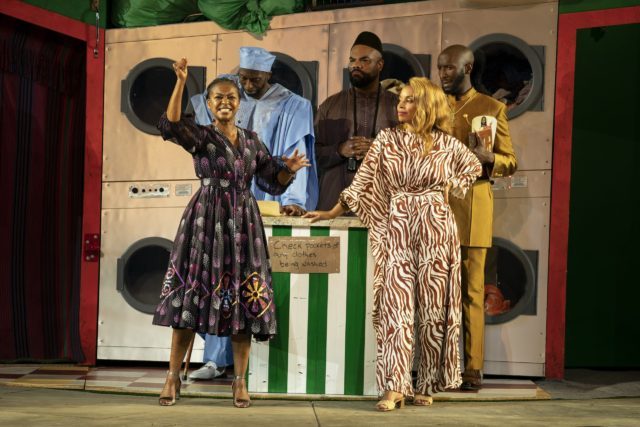
Falstaff (Jacob Ming-Trent) is a Biggie Smalls–loving wannabe playa out to conquer laundromat owner Madam Nkechi Ford (Susan Kelechi Watson) and socialite Madam Ekua Page (Pascale Armand), making cuckolds of their husbands, the distinguished Mister Nduka Ford (Gbenga Akinnagbe) and the generous Mister Kwame Page (Kyle Scatliffe).

“Nah man, I’m serious,” the sweats-wearing Falstaff tells Pistol (Joshua Echebiri), one of his minions. Madam Page “did so course over my exteriors with such a greedy intention that the appetite of her eye did seem to scorch me up like a burning-glass. She bears the purse too; she is from a region in Ghana, all gold and bounty. I will be cheaters to them both, and they shall be sugar mamas to me; we’re gonna have the Ghanaian and the Nigerian jollof rice! Go bear this letter to Madam Page — and this one to Madam Ford. And then, my friend, I will thrive! . . . I mean . . . We will thrive.”

Misters Kwame Page (Kyle Scatliffe) and Nduka Ford (Gbenga Akinnagbe) try to avoid being cuckolded in Bard farce in Central Park (photo by Joan Marcus)

At the same time, the Pages’ daughter, Anne (Abena), is considered the most eligible bachelorette in Harlem and is being wooed by the well-established Doctor Caius (David Ryan Smith), the shy, nervous Slender (Echebiri), and Anne’s true love, Fenton (MaYaa Boateng), whom no one approves of. Manipulating various elements are the caring Pastor Evans (Phillip James Brannon) and the busybody Mama Quickly (Angela Grovey). Madams Ford and Page get wind of Falstaff’s deceit and team up to confound him, while a jealous Mister Ford disguises himself as a Rastaman named Brook to try to uncover Falstaff’s plan to bed his wife. “Please, off with him!” Sir John tells Brook about Ford. “I will stare him out of his wits, I will awe him with my club; I shall hang like Lebron James over the cuckold’s horns.” It all concludes with a series of matches that are as playful as they are convenient and contemporary.

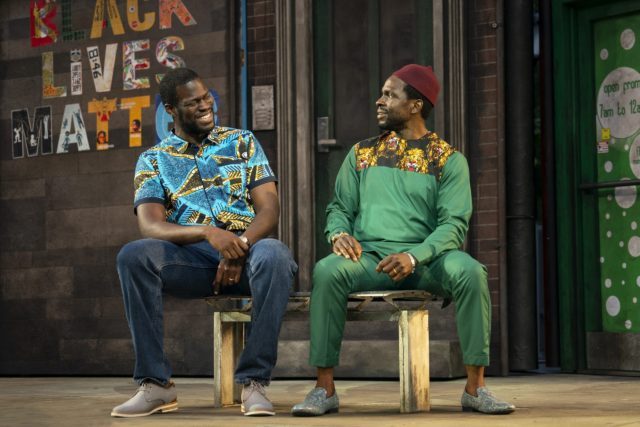
Beowulf Boritt’s set is fabulous, consisting of the facades of a health clinic, a laundromat, and a hair braiding salon, which open up to reveal various interiors. Dede Ayite’s gorgeous costumes honor traditional African designs with bold colors and patterns. But director Saheem Ali (Fireflies, Fires in the Mirror), the Public’s associate artistic director who helmed audio productions of Romeo y Julieta, Richard II, and Anne Washburn’s Shipwreck: A History Play About 2017 during the pandemic lockdown, can’t get a grip on the story, instead getting lost in silly, repetitive slapstick that overwhelms the narrative. The laughs come inconsistently, settling for trivial humor over sustained comedy. This Merry Wives is a crowd pleaser the way familiar but routine sitcoms and reality shows are; light and frothy, none too demanding, but once they’re done, you’re on to the next program.