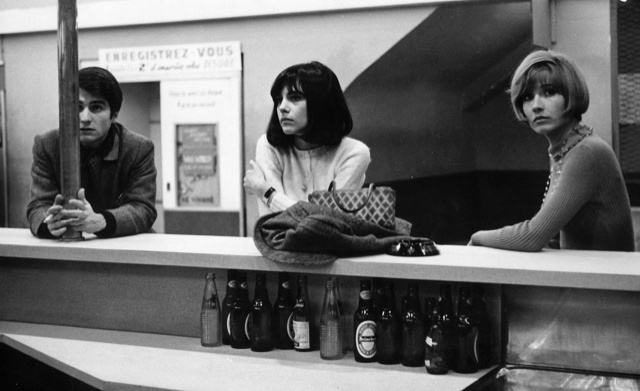
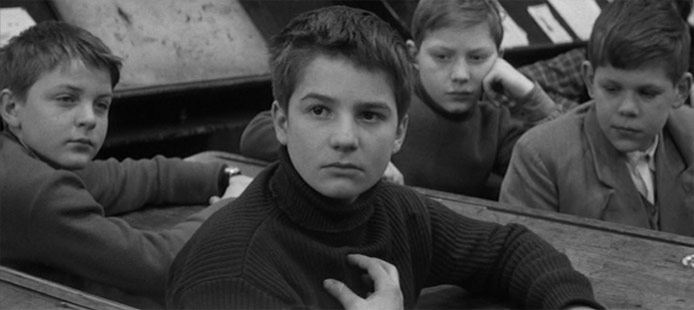
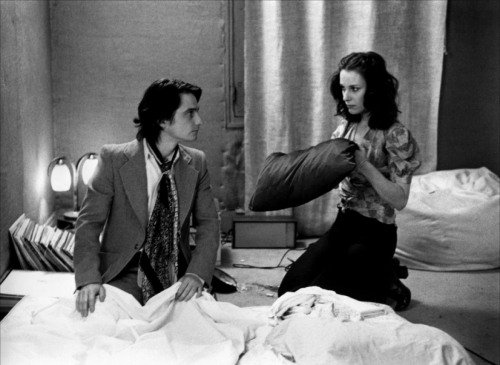
Jean-Pierre Léaud plays a rather peculiar young man in Jean-Luc Godard’s MASCULIN FÉMININ
MASCULIN FÉMININ (Jean-Luc Godard, 1966)
Film Society of Lincoln Center
Elinor Bunin Munroe Film Center, Francesca Beale Theater
144 West 65th St. between Broadway & Amsterdam Ave.
Saturday, October 19, 9:10
Series continues through October 31
212-875-5601
www.filmlinc.com
 In a 1966 interview with Pierre Daix about Masculin féminin, director Jean-Luc Godard said, “When I made this film, I didn’t have the least idea of what I wanted.” Initially to be based on the Guy de Maupassant short stories “The Signal” and “Paul’s Mistress,” the film ended up being a revolutionary examination of the emerging youth culture in France, which Godard identifies as “the children of Marx and Coca-Cola.” Godard threw away the script and worked on the fly to make the film, which stars Jean-Pierre Léaud as Paul, a peculiar young man who quickly becomes obsessed with budding pop star Madeleine, played by real-life Yé-yé singer Chantal Goya. (Godard discovered her on a television variety show.) Paul chases Madeleine, getting a job at the same company, going to the movies and nightclubs with her and her friends, and meeting her in cafés, where he wants to talk about the troubles of contemporary society and she just wants to have a good time. “Man’s conscience doesn’t determine his existence. His social being determines his conscience,” Paul proclaims. He continually argues that there is nothing going on even as strange events occur around him to which he is completely oblivious, including a lover’s spat in which a woman guns down a man in broad daylight. (Sounds of rapid-fire bullets can be heard over the intertitles for each of the film’s fifteen faits précis, evoking a sense of impending doom.) Paul has bizarre conversations with his best friend, Robert (Michel Debord), a radical who asks him to help put up anarchist posters. Posing as a journalist, Paul brutally interviews Miss 19 (Elsa Leroy), a young model with a very different view of society and politics. Godard has also included a playful battle of the sexes in the center of it all: Paul wants Madeleine, much to the consternation of Madeleine’s roommate, Elisabeth (Marlène Jobert), who also has designs on her; meanwhile, Robert goes out with another of Madeleine’s friends, the more grounded Catherine (Catherine-Isabelle Duport), who is interested in Paul.
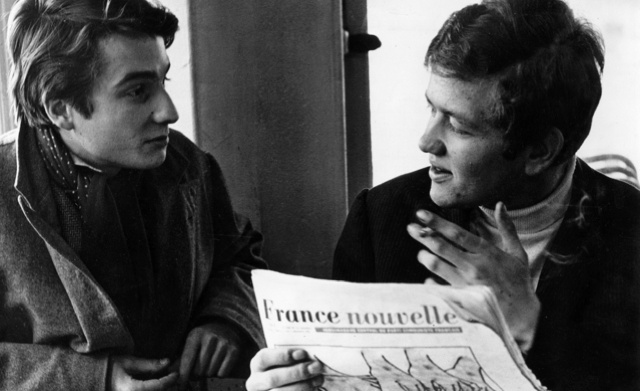
Paul (Jean-Pierre Léaud) and Robert (Michel Debord) discuss radicalism in Godard New Wave classic
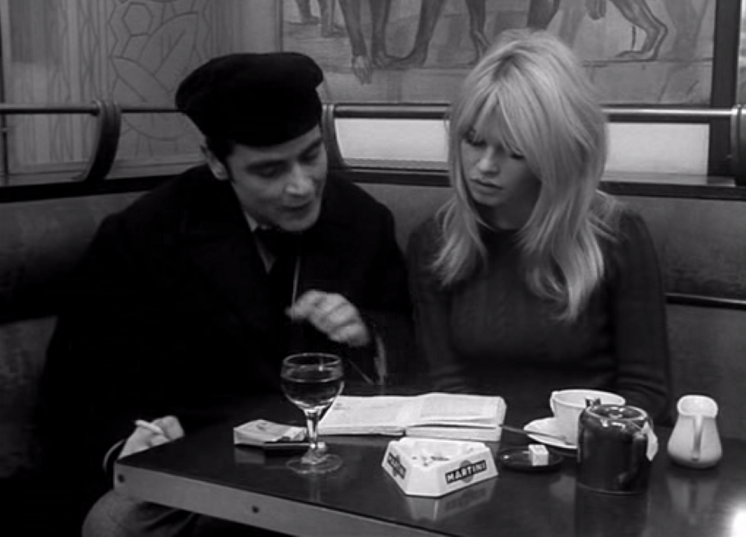
It all makes for great fun, taking place in a surreal black-and-white world dominated by rampant consumerism. In addition, Godard comments on the state of cinema itself. As they watch a Bergman-esque Swedish erotic film (directed by Godard and starring Eva-Britt Strandberg and Birger Malmsten), Paul dashes off to the projectionist, arguing that the aspect ratio is wrong. And in a café scene, French starlet Brigitte Bardot and theater director Antoine Bourseiller sit in a booth, playing themselves as they go over a script, bringing together the real and the imaginary. “I no longer have any idea where I am from the point of view of cinema,” Godard told Daix. “I am in search of cinema. It seems to me that I have lost it.” Well, he apparently found it again with the seminal Masculin feminin, which is screening October 19 at 9:10 at the Francesca Beale Theater as part of the expansive Film Society of Lincoln Center series “Jean-Luc Godard — The Spirit of the Forms,” which continues through October 31 with such other Godard works as Nouvelle Vague, Le Petit soldat, Two or Three Things I Know About Her, Vivre sa vie, and many more.
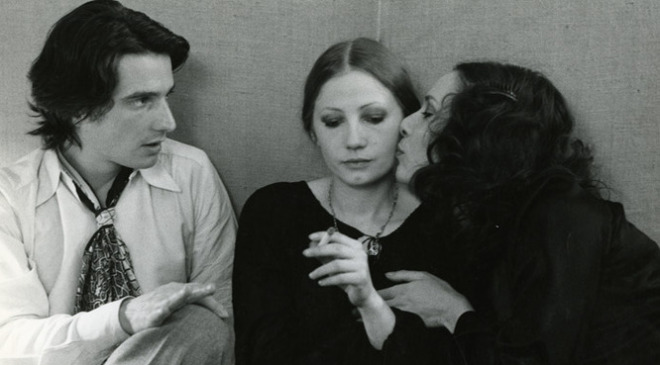
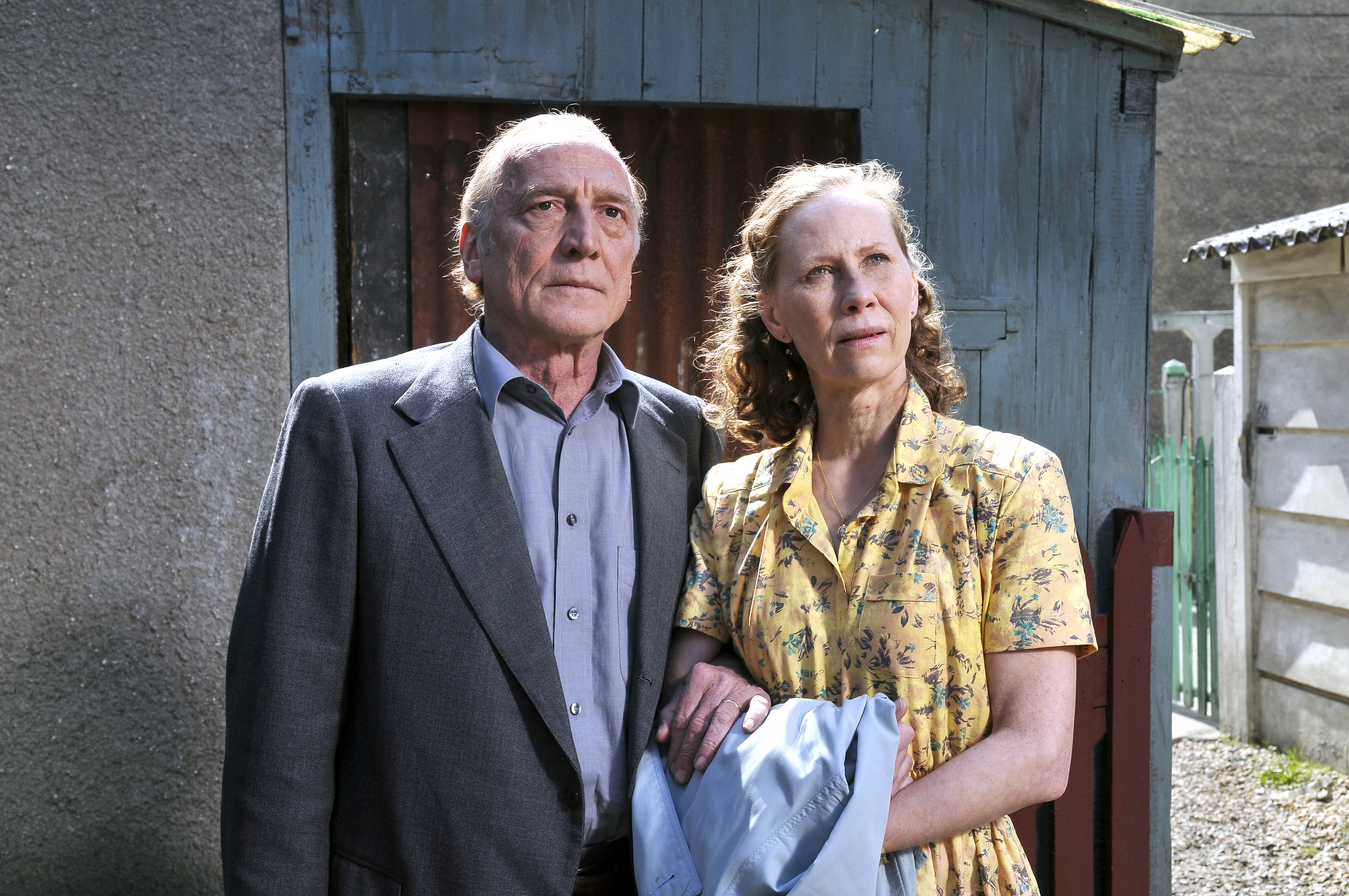
 For nearly thirty years, Finnish auteur Aki Kaurismäki (Leningrad Cowboys Go America, The Man Without a Past) has been making existential deadpan black comedies that are often as funny as they are dark and depressing. Has there ever been a film as bleak as 1990’s The Match Factory Girl, in which a young woman (Kati Outinen) suffers malady after malady, tragedy after tragedy, embarrassment after embarrassment, her expression never changing? In his latest film, the thoroughly engaging Le Havre, Kaurismäki moves the setting to a small port town in France, where shoeshine man Marcel Marx (André Wilms), a self-described former Bohemian, worries about his seriously ill wife (Outinen) while trying to help a young African boy (Blondin Miguel), who was smuggled into the country illegally on board a container ship, steer clear of the police, especially intrepid detective Monet (Jean-Pierre Darroussin), who never says no to a snifter of Calvados. Adding elements of French gangster and WWII Resistance films with Godardian undercurrents — he even casts Jean-Pierre Léaud in a small but pivotal role — Kaurismäki wryly examines how individuals as well as governments deal with illegal immigrants, something that has taken on more importance than ever amid the growing international economic crisis and fears of terrorism. Through it all, Marcel remains steadfast and stalwart, quietly and humbly going about his business, deadpan every step of the way. Wouter Zoon’s set design runs the gamut from stark grays to bursts of color, while longtime Kaurismäki cinematographer Timo Salminen shoots scene after scene with a beautiful simplicity. Winner of a Fipresci critics award at Cannes this year and Finland’s official entry for the Best Foreign Language Film Oscar, Le Havre, the first of a proposed trilogy, is another marvelously unusual, charmingly offbeat tale from a master of the form. A selection of the 2011 New York Film Festival, Le Havre is screening January 6 at 6:30 as part of the “Nordic Oscar Contenders” series at Scandinavia House, which begins January 4 with Pernilla August’s Swedish entry, Svinalängorna (Beyond), and concludes January 9 with Anne Sewitsky’s Norwegian drama Sykt lykkelig (Happy, happy).