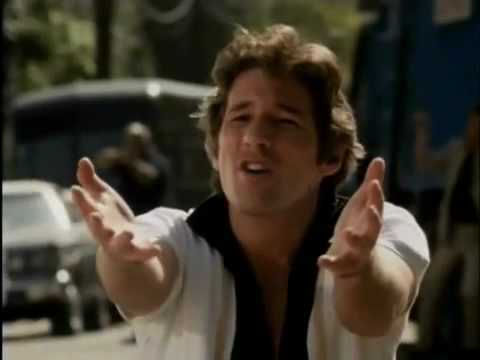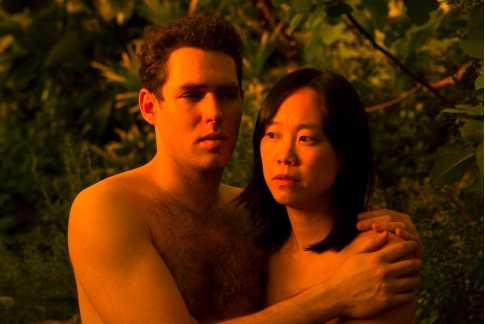
Yanira Castro’s PARADIS is first site-specific dance project to be held at the Brooklyn Botanic Garden (photo by Kevin Kwan)
Brooklyn Botanic Garden
Desert House in the Steinhardt Conservatory and the Cherry Esplanade
1000 Washington Ave.
June 2-4, $20, 8:00/8:30
www.dancetheaterworkshop.org
www.acanarytorsi.org
The Brooklyn Botanic Garden is already one of New York City’s paradises, but on Thursday, Friday, and Saturday, choreographer Yanira Castro will make it even more so. The Puerto Rican-born, Brooklyn-based Castro, who specializes in site-adaptable dance installations, is bringing her a canary torsi “organism” to the Desert House in the Steinhardt Conservatory and then on to the Cherry Esplanade for Paradis, the first site-specific dance project held at the century-old botanic garden. Inspired by the last part of Jean-Luc Godard’s 2004 film Notre Musique, the piece incorporates audience movement into the choreography, performed by nine dancers (Peggy Cheng, Simon Courchel, Shayla-Vie Jenkins, Luke Miller, Peter Schmitz, Stuart Singer, Darrin Wright, Pamela Vail, and Kimberly Young), with live piano accompaniment by Michael Dauphinais and sound design by Stephan Moore. Presented by Dance Theater Workshop, Paradis is the follow-up to last fall’s Wilderness, a performance and audio installation that took place at the Invisible Dog Art Center in Brooklyn. Paradis is scheduled for June 2 at 8:00, June 3 at 8:30, and June 4 at 8:00, and tickets are only $20, which is pretty cheap for your own piece of paradise.
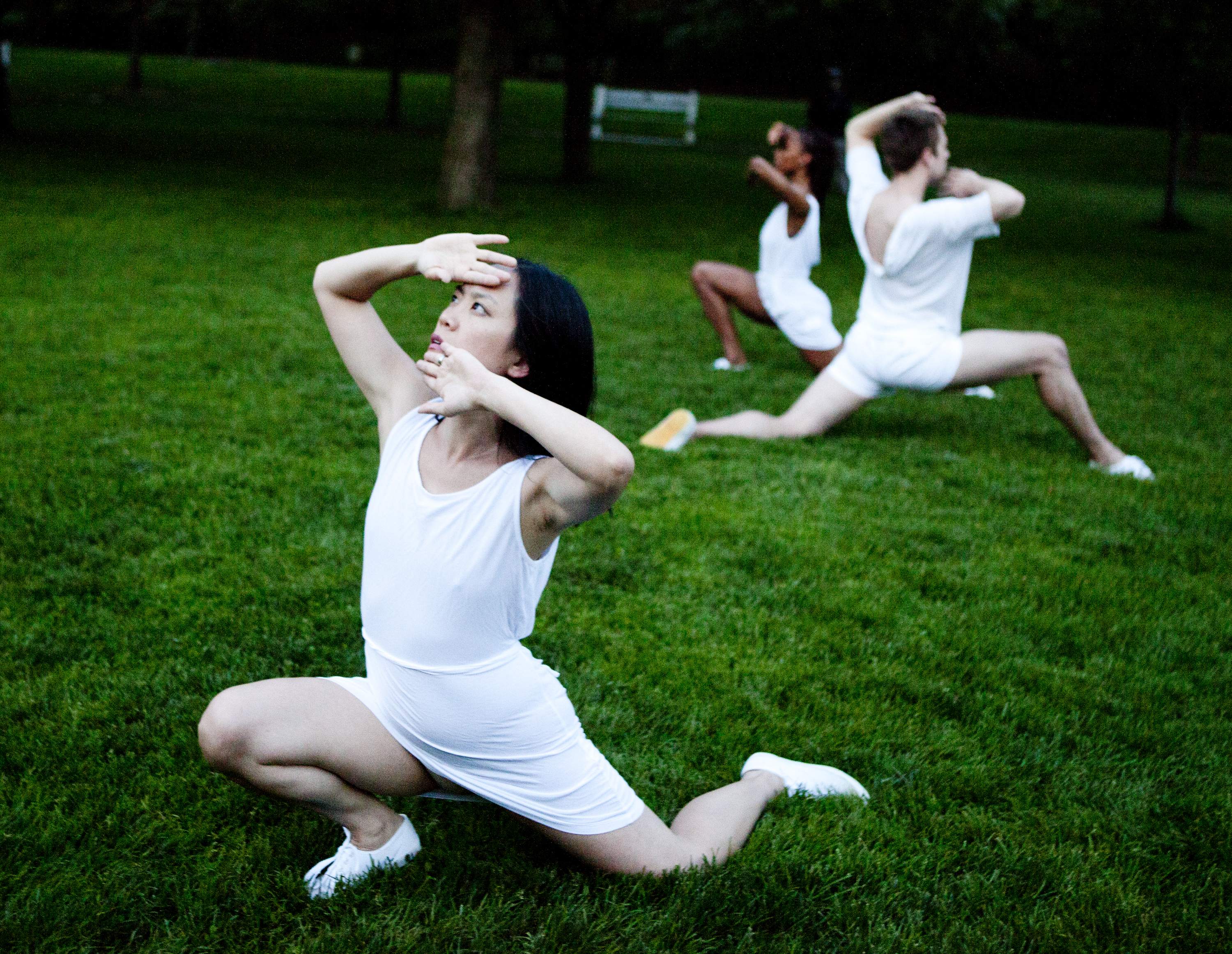
Yanira Castro | a canary torsi celebrate the Brooklyn Botanic Garden in PARADIS (photo by Yi-Chun Wu)
Update: Yanira Castro’s Paradis does indeed turn out to be a piece of paradise. The audience of approximately sixty people first meets in the visitor center (be sure to go to the 1000 Washington St. entrance), then is led to the Brooklyn Botanic Garden’s Steinhardt Conservatory, where they surround the outside of the Desert House. Inside, Peter Schmitz, dressed all in white with white face paint, stands still before slowly making his way around the cactus plants and trees, using herky-jerky motion, then moving faster, stopping to mime eating an apple, then erupting in off-key song, dancing and singing to tinny, lo-fi, scratchy piano music that pipes out of security guards’ walkie-talkies. Expanding his work with Castro on Wilderness, Schmitz evokes Adam in the Garden of Eden as well as Frankenstein’s monster and the Supreme Being as he learns to walk, talk, and eat. At the end of the solo, the audience is led in the dark to the wide expanse of the resplendently green Cherry Esplanade, where they come upon Michael Dauphinais playing the piano (sounding much better in person than over the walkie-talkies), playing an evolving score that is impacted by the presence of the crowd. Four huge spotlights illuminate the lawn as Peggy Cheng, Simon Courchel, Shayla-Vie Jenkins, Luke Miller, Stuart Singer, Darrin Wright, Pamela Vail, and Kimberly Young emerge in the distance, frolicking across the grass and eventually weaving through the crowd, who can sit or stand wherever they want. After being selected to follow a particular dancer, the audience segments into groups that end up watching a deeply intimate, thrillingly erotic duet. Inspired very directly by the “Paradis” section of Jean-Luc Godard’s Notre Musique, Castro’s Paradis feels like it grew organically out of the ground (or descended from the heavens), like the lovely trees and flowers that cover the garden’s fifty-two lush acres. No mere spectacle, the piece invites the viewer to become part of a magical experience, a fitting tribute to the beauty of the Brooklyn Botanic Garden and the endless imagination of Castro and her company.
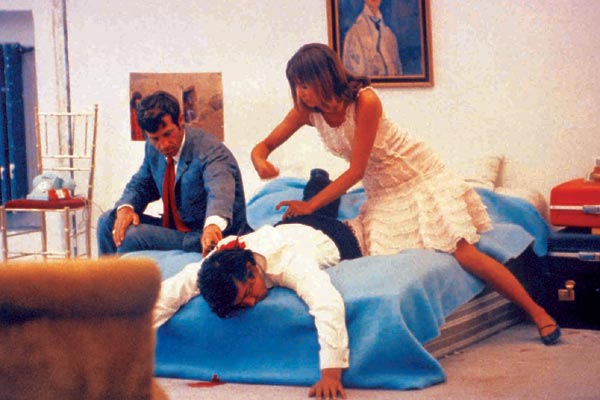
 Art, American consumerism, the Vietnam and Algerian wars, Hollywood, and the cinema itself get skewered in Jean-Luc Godard’s fab feaux gangster flick / road comedy / romance epic / musical Pierrot Le Fou. Based on Lionel White’s novel Obsession, the film follows the chaotic exploits of Ferdinand Griffon (Jean-Paul Belmondo) and Marianne Renoir (Anna Karina, Godard’s then-wife), former lovers who meet up again quite by accident. The bored Ferdinand immediately decides to leave his wife and family for the flirtatious, unpredictable Marianne, who insists on calling him Pierrot despite his protestations. Soon Ferdinand is caught in the middle of a freewheeling journey involving gun running, stolen cars, dead bodies, and half-truths, all the while not quite sure how much he can trust Marianne. Filmed in reverse-scene order without much of a script, the mostly improvised Pierrot Le Fou was shot in stunning color by Raoul Coutard. Many of Godard’s recurring themes and style appear in the movie, including jump cuts, confusing dialogue, written protests on walls, and characters speaking directly at the audience, which is more or less along for the same ride as Ferdinand. And as with many Godard films, the ending is a doozy.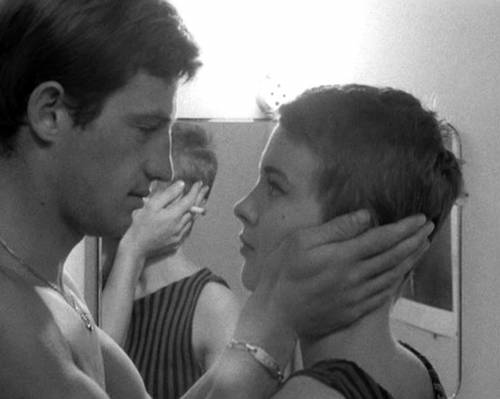
 The fiftieth-anniversary restoration of Jean-Luc Godard’s Nouvelle Vague classic, BREATHLESS, will leave audiences, well, breathless. Godard’s first feature-length film, buoyed by an original treatment by François Truffaut and with Claude Chabrol serving as technical adviser, is as much about the cinema itself as it is about would-be small-time gangster Michel Poiccard (an iconic Jean-Paul Belmondo), an ultra-cool dude wandering from girl to girl in Paris, looking for extra helpings of sex and money and having trouble getting either. Along the way he steals a car and shoots a cop as if shooing away a fly before teaming up with Patricia Franchini (Jean Seberg) and heading out on the run. Godard references William Faulkner and Dashiell Hammett, Humphrey Bogart and Sam Fuller as Michel and Patricia make faces at each other, discuss death, and are chased by the police. Anarchy prevails, both in Belmondo’s character and the film as a whole, which can go off in any direction at any time. Godard himself shows up as the man who identifies Michel, and there are also cameos by New Wave directors Jean-Pierre Melville and Jacques Rivette. The beautiful restoration, supervised by the film’s director of photography, Raoul Coutard, also includes a brand-new translation and subtitles that breathe new life into one of cinema’s greatest treasures. Although many of the restored movies that play at Film Forum do so immediately prior to DVD release, no DVD is currently planned for this version of BREATHLESS, so if you missed it when it ran earlier this year, you’ll have to catch it during this return engagement, which ends December 7.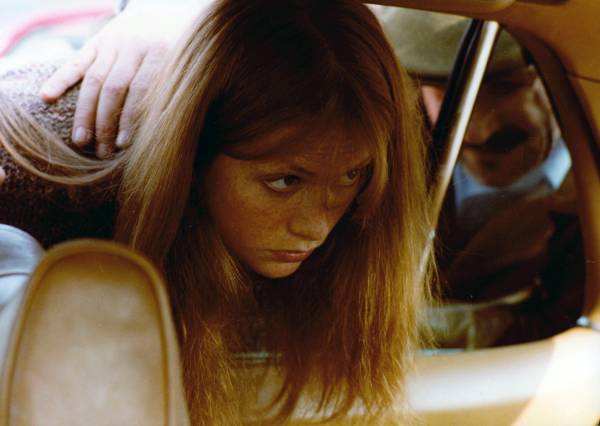
 Screening at Film Forum in a new 35mm print in honor of its thirtieth anniversary, Jean-Luc Godard’s EVERY MAN FOR HIMSELF marked a return to a somewhat more accessible narrative for the Nouvelle Vague auteur, although that does not mean it is by any means a traditional story or that it follows mainstream conventions. Arranged in four sections — the Imaginary (Slow Motion), Fear (Run for Your Life), Commerce (Trade), and Music — the film focuses on a smarmy, unlikable cigar-smoking video director, unironically named Paul Godard (Jacques Dutronc), who fights with his ex-wife (Paule Muret), wonders why he can’t touch his eleven-year-old daughter (Cécile Tanner) in rather sensitive areas, has driven away his bicycle-riding girlfriend, Denise Rimbaud (Nathalie Baye), and pays for a visit from Isabelle (Isabelle Huppert), a prostitute who recites lines from Charles Bukowski in her head while plying her trade and seeking her independence. Godard frames many of the images like paintings, coming alive with bright, bold colors. Nearly all of the interior scenes are filmed in long takes with no camera movement or cross-cutting (with two notable exceptions), while other scenes are filled with slow-motion shots, forcing viewers to question what they are seeing. Meanwhile, snippets of Gabriel Yared’s score and incidental music are often heard by only some of the characters, who wonder where the sounds are coming from. Godard infuses the film with various thoughts on Marxism, feminism, capitalism, pedophilia, incest, and violence against women; in one unforgettable scene, a businessman arranges a ridiculously funny Rube Goldberg-like foursome, acting like a film director, mocking Jean-Luc Godard’s own profession. Thirty years down the road, EVERY MAN FOR HIMSELF, also known as SLOW MOTION and, in French, SAUVE QUI PEUT (LA VIE), feels as relevant, as challenging, and as entertaining as ever. (Note: Film critic and Godard biographer Richard Brody will introduce the 8:20 screening on November 19.)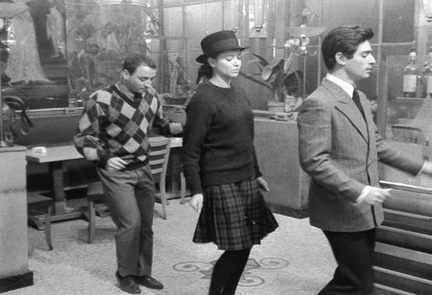
 When a pair of disaffected Parisians, Arthur (Claude Brasseur) and Franz (Sami Frey), meet an adorable young woman, Odile (Anna Karina), in English class, they decide to team up and steal a ton of money from a man living in Odile’s aunt’s house. As they meander through the streets of cinematographer Raoul Coutard’s black-and-white Paris, they talk about English and wealth, dance in a cafe while director Jean-Luc Godard breaks in with voice-over narration about their character, run through the Louvre in record time, and pause for a near-moment of pure silence. Godard throws in plenty of commentary on politics, the cinema, and the bourgeoisie in the midst of some genuinely funny scenes. BAND OF OUTSIDERS is no ordinary heist movie; based on Dolores Hitchens’s novel FOOL’S GOLD, it is the story of three offbeat individuals who just happen to decide to attempt a robbery while living their strange existence, as if they were outside from the rest of the world. The trio of ne’er-do-wells might remind Jim Jarmusch fans of the main threesome from STRANGER THAN PARADISE (1984), except Godard’s characters are more aggressively persistent. BAND OF OUTSIDERS is screening as part of Film Forum excellent series “The Heist,” in a double feature with Jean-Pierre Melville’s BOB LE FLAMBEUR.