Tag Archives: jean-luc godard

A DEBT TO THE CINEMA: MABOU MINES CELEBRATED AT ANTHOLOGY FILM ARCHIVES

MABOU MINES CINEMA
Anthology Film Archives
32 Second Ave. at Second St.
March 13 – March 19
www.anthologyfilmarchives.org

“Do I owe a debt to the cinema?” a character asks in Lee Breuer’s 1974 forty-minute video The Red Horse Animation, part of the weeklong Anthology Film Archives series “Mabou Mines Cinema.”

Actually, lovers and creators of experimental avant-garde film and theater owe a huge debt to Mabou Mines.

Founded in 1970 by Breuer, JoAnne Akalaitis, Philip Glass, Ruth Maleczech, and David Warrilow, Mabou Mines has been presenting unique, wholly original live works onstage for more than half a century, but the collective, currently under the artistic leadership of Mallory Catlett, Karen Kandel, and Carl Hancock Rux, also has a long history of low-budget DIY films that pushed the boundaries of what cinema can be.

From March 13 to 19, Anthology will be screening nine films across seven programs, with numerous shows followed by Q&As with special guests. Perhaps the most unusual work in the series is the theatrical premiere of Jill Godmilow’s 2001 Mabou Mines’ Lear ’87 Archive (Condensed), a nearly six-hour documentary of the making of the troupe’s 1990 adaptation of Shakespeare’s King Lear, which won multiple Obies and starred Maleczech as Lear, Greg Mehrten as the Fool, Ellen McElduff as Elva, Bill Raymond as Goneril, Ron Vawter as Regan, and Lute Ramblin’ as Cordelion. It will be shown in two parts; the March 14 show will be followed by a Q&A with Mehrten and journalist Alisa Solomon.

In Godmilow’s 1984 hybrid Far from Poland, the director, who passed away last September at the age of eighty-two, is determined to make a documentary about the Polish Solidarity movement despite being denied a visa, so she takes viewers behind the scenes into her process as she discusses the possibilities with Mark Magill, incorporates archival news footage, and re-creates interviews with Anna Walentynowicz (played by Ruth Maleczech), Elzbieta Komorowska (Hanna Krall), reporter Barbara Lopienska (Honora Fergusson), government censor K-62 (Bill Raymond), Polish dictator Wojciech Jaruzelski (David Warrilow), journalist Richard Fraser (John Fitzgerald), and shipyard worker Adam Jarewski (Mark Margolis). The March 17 screening will be followed by a Q&A with film historian Susan Delson and film scholar Ricky Herbst.

In 2009, I saw Mabou Mines Dollhouse at St. Ann’s Warehouse; in my review, I wrote, “Winner of two Obies — for director (and company cofounder) Lee Breuer and star Maude Mitchell — this unique reimagination of Henrik Ibsen’s controversial 1879 feminist classic features three leading men who are all under four and a half feet tall, with the three main women approaching six feet, immediately calling into question issues of strength, power, and social status.” The previous year, Breuer directed a film of the stage work, which Anthology will be screening on March 15 at 7:45, followed by a Q&A with professor Olga Taxidou and co-adaptor Mitchell.

The series was programmed by Breuer’s son Mojo Lorwin; below is a look at other highlights.
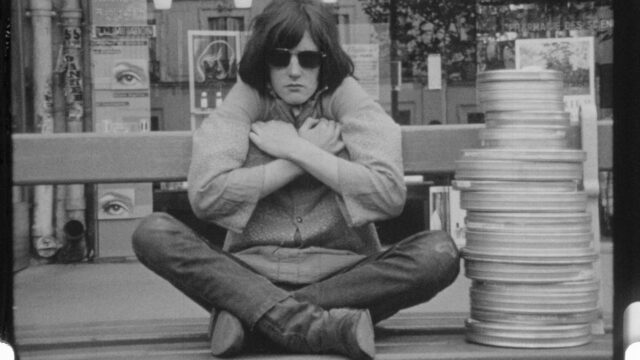
Mojo Lorwin finishes his father’s film, Moi-même, after more than half a century

MOI-MÊME (Mojo Lorwin & Lee Breuer, 1968/2024)
Friday, March 13, 6:30
Wednesday, March 18, 6:30
www.anthologyfilmarchives.org

In 1968, experimental theater director, playwright, and poet Lee Breuer began making a black-and-white improvised film during the May 1968 Paris riots, where he was living at the time. He and cinematographer John Rounds shot the footage but never added sound, edited it, or wrote a script. In 1970, Breuer cofounded the seminal New York City company Mabou Mines with Philip Glass, Ruth Maleczech, JoAnne Akalaitis, David Warrilow, and Frederick Neumann, winning numerous Obies among other accolades over the next half century, but he never finished the movie, which itself is about making a movie.

Breuer died in January 2021 at the age of eighty-three; one of his children, Mojo Lorwin, decided to complete the project, hiring voice actors and musicians and serving as writer, director, editor, and producer. The result is the hilarious Nouvelle Vague satire Moi-même (“Myself”), a sixty-five-minute foray into the world of François Truffaut, Jacques Rivette, Jean-Pierre Melville, Agnès Varda, William Klein, and Jean-Luc Godard, who makes a cameo, walking backward as Kevin shares a series of statements ending with “Everything is a movie.”

Kevin Mathewson stars as Kevin (voiced in 2024 by Declan Kenneally), an adolescent who is making a film with his alter ego (Patrick Martin). As he proceeds around town, he meets up with a strange driver (executive producer Russ Moro / 2024 composer Olivier Conan), a movie producer (Frederick Neumann / David Neumann, Frederick’s son), a starlet (Ginger Hall / Clove Galilee, Breuer and Maleczech’s daughter), the son of a baron (Warrilow / David Neumann), an Italian heiress (Renata / Tessie Herrasti), a revolutionary actress (Anna Backer / Tiera Lopper), her replacement (Judy Mathewson, Kevin’s younger sister / Ruma Breuer, Lee’s granddaughter), a sleazy agent (Mark Smith / Alon Andrews), a couple of goons (Pippo and Mike Trane / Frier McCollister), and the owner of a film shop (Lee Pampf / Thomas Cabus). He is often accompanied by his conscience (Maleczech / Alexandra Zelman-Doring) as he faces financial and creative crises.

Lorwin has fun with cinematic and societal tropes while maintaining the underground, DIY feel; for example, he doesn’t match the dialogue exactly to the movement of the characters’ mouths as they make such proclamations as “The movies aren’t fair,” “The movies are a game and everyone who plays is a cheater,” and “All I want is to be seen and heard.” The soundtrack consists of unexpected sound effects and songs and music by Frank LoCastro, Alex Klimovitsky, Eliot Krimsky, Conan, and others.

There’s lots of drinking and smoking, violent shootings, political ranting, discussions of art and love, vapid gatherings, a heist, a touch of psychedelia, and superfluous nudity, nearly everything you could possibly want in a French film.

“Film costs money, more than you’ve got,” the driver barks at Kevin. “Producers are perverts,” Kevin tells the actress while preparing a baby bottle of milk. Unable to afford film reels, Kevin says, “Film is more expensive than love and revolution.”

Describing the film to the agent, Kevin explains, “Here it is: It’s me, but it’s not me. You dig? I mean, it’s the film adaptation of me. I just need a little bread to turn boring old me into moi-même. Feels like doors are finally opening for me.” He delivers the last line as a door opens in front of him.

Perhaps the most important line of dialogue is given to Kevin from a man on the street, who tells him, “There are no rules.” I would add, “Viva la revolución!”

Moi-même is being shown March 13 and 18 at 6:30 at Anthology Film Archives and will be followed by Q&As with professor emeritus Arthur Sabatini, Kevin Mathewson, and Lorwin.
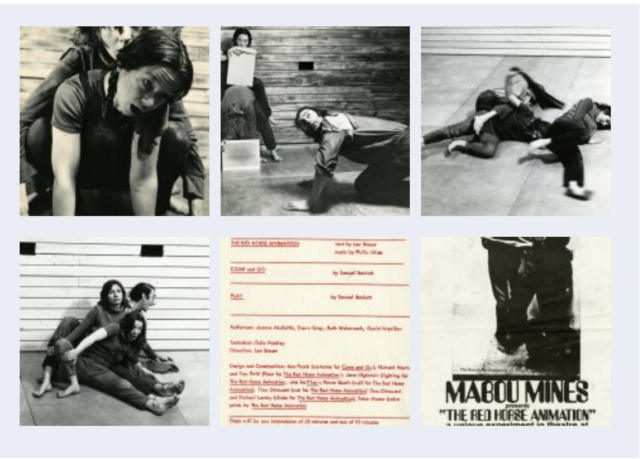
The Red Horse Animation captures a live Mabou Mines performance with cinematic additions

THE RED HORSE ANIMATION (Lee Breuer, 1974) / B. BEAVER ANIMATION (Lee Breuer, Chris Coughlan, and Craig Jones, 1979) / SISTER SUZIE CINEMA (Lee Breuer, 1982)
Friday, March 13, 8:45
Wednesday, March 18, 8:30
www.anthologyfilmarchives.org

The second program in the “Mabou Mines Cinema” series brings together a trio of cutting-edge shorts that embody the Mabou Mines approach to art while challenging the audience to adjust their expectations. The thirty-eight-minute Horse Animation captures Mabou Mines’ inaugural production, a piece that melds together movement, music, and text by Breuer that is a kind of manifesto as JoAnne Akalaitis, Ruth Maleczech, and David Warrilow crawl over one another across the floor, recite words in robotlike fashion (“I’m not myself. How in my illness I see something, my life, somewhere. And now it comes to me that I am a representation”), laugh, and turn into ghostlike digital projections by DeeDee Halleck, whose camera shoots the rest of the film in grainy black-and-white from a multitude of angles; the live music is by Philip Glass. In a 1970 Guggenheim program note, Breuer wrote about the piece, “The red horse, in its representational form, materializes and falls apart in the course of the performance. It lives in real time. ‘Lives’ in this sense means conveys meaning to its creators and observers. It tries to create its life outside the real performance time. It tries to live in dramatic time.”

In B. Beaver Animation, Breuer, Chris Coughlan, and Craig Jones zoom close in on Fred Neumann as he delivers a thirty-minute monologue about floods, snow, beavers, and dams; when he says early on, “To be specific, a force of nature,” he could be speaking about himself as he tears through the words like he’s in a race against time, with stutters and occasional breaks so he — and the audience — can catch a breath until he slows down for the dramatic finale.

And in Sister Suzie Cinema, the a capella quintet 14 Karat Soul performs gospel-tinged doo-wop songs while in a movie theater, the flickering light illuminating them in the darkness until they take flight in a nineteen-minute cinematic fantasia directed by Breuer in muted colors and written by Breuer and composer Bob Telson. The March 18 screening will be followed by a Q&A with Carl Hancock Rux, Telson, and singer Glenny T of 14 Karat Soul.
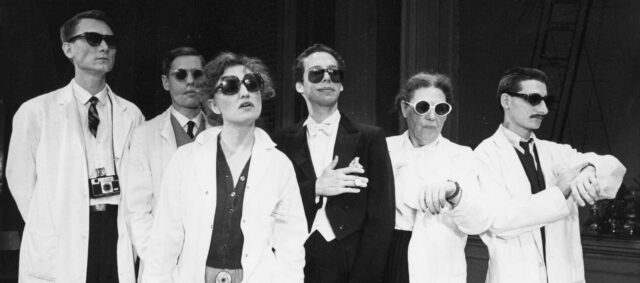
Dead End Kids is an unusual, haunting look at nuclear war from JoAnne Akalaitis

OTHER CHILDREN (JoAnne Akalaitis, 1979) / DEAD END KIDS: A HISTORY OF NUCLEAR POWER (JoAnne Akalaitis, 1986)
Monday, March 16, 7:00
Thursday, March 19, 7:00
www.anthologyfilmarchives.org

Other Children, JoAnne Akalaitis’s first film and not a Mabou Mines production, is a visually rich, poetic adaptation of Jane Bowles’s last work of fiction, the coming-of-age short story “A Stick of Green Candy.” The nineteen-minute film was shot in Cape Breton, Nova Scotia, in a small house, on the streets, and at a rocky clay pit. Juliet Glass stars as Mary, Erik Moskowitz as Franklin, George Rosenblatt as her father, and Joan Jonas as his mother; the verbatim dialogue is overdubbed by Glass, Moskowitz, Bill Raymond as the man, and Ellen McElduff as the woman and features such gems as this from Franklin’s mother: “I’d rather have a girl than a boy. There’s nothing much I can discuss with a boy. A grown woman isn’t interested in the same things a boy is interested in. My preference is discussing furnishings. Always has been. I like that better than I like discussing styles. I’ll discuss styles if the company wants to, but I don’t enjoy it nearly so well. The only thing about furnishings that leaves me cold is curtains. I never was interested in curtains, even when I was young. I like lamps about the best. Do you?” Jacki Ochs’s camera lovingly follows Mary, bringing her imaginary adventures to life as she leads an army of mountain-goat fighters, with gentle editing by David Hardy. In a rare title card with narration from the original story, we are told, “All at once she had had the fear that by looking into her eyes the soldiers might divine her father’s existence. To each one of them she was like himself — a man without a family.” The 16mm film, which was restored in 2022, concludes with the Hackberry Ramblers’ jaunty Cajun country instrumental “Just Once More.”

Other Children is screening on March 16 and 19 with Akalaitis’s 1986 feature Dead End Kids: A History of Nuclear Power, which captures Akalaitis’s Obie-winning 1980 play that incorporates numerous elements as it assesses the future of the world, with a cast that includes McElduff, Ruth Maleczech, Terry O’Reilly, Greg Mehrten, Fred Neumann, Glass, and Lee Breuer and Maleczech’s children Clove Galilee and Lute Ramblin’ in addition to David Byrne, who composed the synth soundtrack. The March 19 screening will be followed by a Q&A with journalist Don Shewey and McElduff.

Meanwhile, Mabou Mines is still going strong, having recently staged Samuel Beckett’s All That Fall, directed by Akalaitis, with such promising upcoming shows as the opera Barcelona, Map of Shadows and Rux’s Etudes.

[Mark Rifkin is a Brooklyn-born, Manhattan-based writer and editor; you can follow him on Substack here.]

MATURING ON FILM: A DIFFERENT COMING OF AGE AT METROGRAPH

THE COMING OF AGE
Metrograph
7 Ludlow St. between Canal & Hester Sts.
October 12 – November 2
metrograph.com

The Metrograph series “‘The Coming of Age” is not a collection of works about young people discovering themselves as they advance from puberty to adolescence to adulthood. Instead, it explores films about people growing old.

“We’re aging: Older adults are the fastest growing age demographic globally and expected to double in size in the US by 2060. And yet our film culture clings to youth,” series curator Sarah Friedland said in a statement. “‘The Coming of Age’ liberates the genre from the strictures of youth to present an anti-ageist portrait of growing older in global cinema, drawing on my film-viewing research to prepare for the making of my feature debut, Familiar Touch. Presenting films from the silent era up through our current moment of seismic demographic shift, ‘The Coming of Age’ bears the name of Simone de Beauvoir’s seminal 1970 feminist book on aging and borrows the genre as a frame for seeing and celebrating older adults in the fullness and complexity of themselves. What links each film in this series is not aging as a subject but the aging subject’s perspective, showing old age in the diversity of its experience: as a time for pleasure, poetry, resistance, and even revenge.”

Running October 12 through November 2, the series includes a wide range of international selections, from Lemohang Jeremiah Mosese’s This Is Not a Burial, It’s a Resurrection and Yasujirô Ozu’s Tokyo Story to F. W. Murnau’s The Last Laugh and “Choreographies of Aging,” consisting of shorts by such directors as Kevin Jerome Everson, Barbara Hammer, and Friedland, who will take part in a postscreening discussion with director Wen Hu after the October 18 presentation. She will also be on hand October 12 to introduce Familiar Touch with star Kathleen Chalfant and critic Amy Taubin at 5:00 and then introduce Vittorio De Sica’s Umberto D. at 7:30.

Below is a closer look at four of the films.

De Sica Neorealist classic is the heartbreaking story of a man and his dog

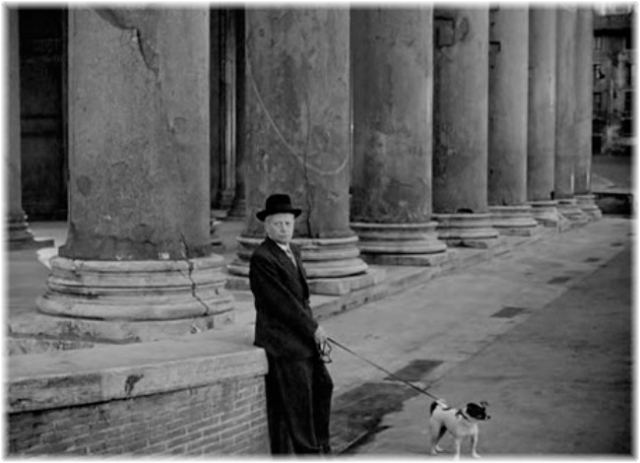
De Sica neorealist classic is the heartbreaking story of an elderly man and his faithful dog

UMBERTO D. (Vittorio De Sica, 1952)
Sunday, October 12, 7:30
Monday, October 20, 4:45
metrograph.com

You might never stop crying. Vittorio De Sica’s neorealist masterpiece Umberto D. stars Carlo Battisti (a professor whom De Sica saw one day and thought would be perfect for the lead role; it would be Battisti’s only film) as Umberto Domenico Ferrari, an elderly former bureaucrat who is too proud to sacrifice his dignity in order to pay his mean-spirited landlady (Lina Gennari), who rents out his room by the hour while he’s out walking his beloved dog, Flag, and trying to find some way to get money and food. Umberto D. is befriended by the boardinghouse maid (Maria Pia Casilio), who is pregnant with the child of one of two servicemen, neither of whom wants to have anything to do with her. As Umberto D.’s options start running out, he considers desperate measures to free himself from his loneliness and poverty. His relationship with Flag is one of the most moving in cinema history. Don’t miss this remarkable achievement, which was lovingly restored in 2002 for its fiftieth anniversary by eighty-six-year-old lighting specialist Vincenzo Verzini, who was known as Little Giotto.

Yun Jung-hee returned to the screen for the first time in sixteen years in moving Poetry

POETRY (SHI) (Lee Chang-dong, 2010)
Friday, October 17, 3:30
Saturday, October 18, noon
www.kino.com/poetry
metrograph.com

Returning to the screen for the first time in sixteen years, legendary Korean actress Yun Jung-hee is mesmerizing in Lee Chang-dong’s beautiful, bittersweet, and poetic Poetry. Yun stars as Mija, a lovely but simple woman raising her teenage grandson, Wook (Lee David), and working as a maid for Mr. Kang (Kim Hi-ra), a Viagra-taking old man debilitated from a stroke. When she is told that Wook is involved in the tragic suicide of a classmate (Han Su-young), Mija essentially goes about her business as usual, not outwardly reacting while clearly deeply troubled inside. As the complications in her life grow, she turns to a community poetry class for solace, determined to finish a poem before the memory loss that is causing her to forget certain basic words overwhelms her. Winner of the Best Screenplay award at the 2010 Cannes Film Festival, Poetry is a gorgeously understated work, a visual, emotional poem that never drifts from its slow, steady pace. Writer-director Lee (Peppermint Candy, Secret Sunshine) occasionally treads a little too close to clichéd melodrama, but he always gets back on track, sharing the moving story of an unforgettable character. Throughout the film he offers no easy answers, leaving lots of room for interpretation, like poems themselves.

Ian Fiscuteanu brings to life the slow death of a unique character in Cristi Puiu’s very dark comedy

THE DEATH OF MR. LAZARESCU (Cristi Puiu, 2005)
Wednesday, October 22, 6:20
metrograph.com

Poor Mr. Lazarescu. He lives in a shoddy hovel of an apartment in Bucharest, where he drinks too much and gets out too little. He moves around very slowly and has trouble saying what’s on his mind, even to his three cats. His family is sick and tired of telling him to lay off the booze, so they ignore his complaints. Suffering from headaches and stomach pain, he phones for an ambulance several times, but it arrives only after a neighbor calls as well. Mr. Lazarescu then spends the rest of this very long night fading away as he is taken to hospital after hospital by the ambulance nurse, who gets involved in a seemingly endless battle with doctors to try to save him. Ian Fiscuteanu is sensationally realistic as Mr. Lazarescu; you’ll quickly forget that he’s not really a drunk, disgusting, dying old man. Luminita Gheorghiu is excellent as Mioara, the nurse who gets caught up in Mr. Lazarescu’s case. Winner of the Cannes Film Festival’s Un Certain Regard Award, cowriter-director Cristi Puiu’s very dark comedy is simply captivating; despite a slow start, it’ll pull you in with its well-choreographed scenes, documentary style, and careful camera movement. (Also look for the subtle and very specific naming of characters.) Using Éric Rohmer’s “Six Moral Tales” as inspiration, Puiu has said that The Death of Mr. Lazarescu is the first of his own “Six Stories from the Bucharest Suburbs,” this one dealing with “the love of humanity,” followed by 2010’s Aurora.

NO HOME MOVIE

Chantal Akerman creates a unique profile of her mother in deeply personal No Home Movie

NO HOME MOVIE (Chantal Akerman, 2015)
Friday, October 24, 4:45
metrograph.com
icarusfilms.com

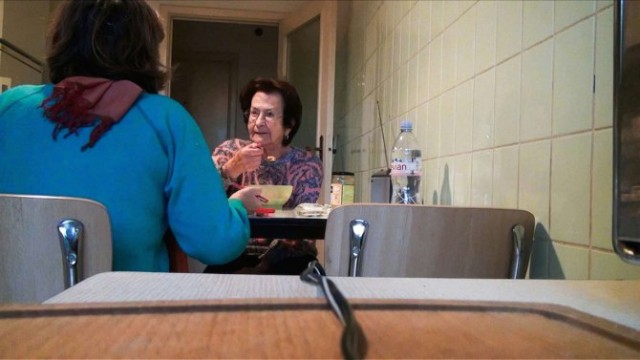
Chantal Akerman’s No Home Movie was meant to be a kind of public eulogy for her beloved mother, Natalia (Nelly) Akerman, who died in 2014 at the age of eighty-six, shortly after Chantal had completed shooting forty hours of material with her. But it also ended up becoming, in its own way, a public eulogy for the highly influential Belgian auteur herself, as she died on October 5, 2015, at the age of sixty-five, only a few months after the film screened to widespread acclaim at several festivals (except at Locarno, where it was actually booed). Her death was reportedly a suicide, following a deep depression brought on by the loss of her mother. No Home Movie primarily consists of static shots inside Nelly’s Brussels apartment as she goes about her usual business, reading, eating, preparing to go for a walk, and taking naps. Akerman sets down either a handheld camera or a smartphone and lets her mother walk in and out of the frame; Akerman very rarely moves the camera or follows her mother around, instead keeping it near doorways and windows. She’s simply capturing the natural rhythms and pace of an old woman’s life. Occasionally the two sit down together in the kitchen and eat while discussing family history and gossip, Judaism, WWII, and the Nazis. (The elder Akerman was a Holocaust survivor who spent time in Auschwitz.) They also Skype each other as Chantal travels to film festivals and other places. “I want to show there is no distance in the world,” she tells her mother, who Skypes back, “You always have such ideas! Don’t you, sweetheart.” In another exchange, the daughter says, “You think I’m good for nothing!” to which the mother replies, “Not at all! You know all sorts of things others don’t know.”

NO HOME MOVIE

Shots of a tree fluttering in the Israeli wind enhance the peaceful calm of No Home Movie

Later they are joined by Chantal’s sister, Sylviane, as well as Nelly’s home aide. The film features long sections with no dialogue and nobody in the frame; Akerman opens the movie with a four-minute shot of a lone tree with green leaves fluttering in the wind in the foreground, the vast, empty landscape of Israel in the background, where occasionally a barely visible car turns off a far-away road. Akerman returns to Israel several times during the film, sometimes shooting out of a moving car; these sections serve as interludes about the passage of time as well as referencing her family’s Jewish past. At one point, Akerman makes potatoes for her mother that they eat in the kitchen, a direct reference to a scene in Akerman’s feminist classic, Jeanne Dielman, 23 Quai due Commerce, 1080 Bruxelles. Knowing about what happened to both mother and daughter postfilming casts a shadow over the documentary, especially when Chantal tells her mother, “I’m in a very, very good mood. . . . Let’s enjoy it; it’s not that common.” As the film nears its conclusion, there is almost total darkness, echoing the end of life. Through it all, Akerman is proud of her mother; reminiscing about kindergarten, she remembers, “And to everybody, I would say, this is my mother.” No Home Movie achieves that very same declaration, now for all the world to see and hear.

BEACHES OF AGNES

Agnès Varda takes an unusual approach to autobiography in The Beaches of Agnès

THE BEACHES OF AGNÈS (LES PLAGES D’AGNÈS) (Agnès Varda, 2008)
Friday, October 24, 2:00
Sunday, October 26, 11:00 am
metrograph.com

“The whole idea of fragmentation appeals to me,” filmmaker, photographer, and installation artist Agnès Varda says in the middle of her unusual cinematic autobiography, the César-winning documentary The Beaches of Agnès. “It corresponds so naturally to questions of memory. Is it possible to reconstitute this personality, this person Jean Vilar, who was so exceptional?” She might have been referring to her friend, the French actor and theater director, but the exceptional Belgian-French Varda might as well have been referring to herself. Later she explains, “My memories swarm around me like confused flies. I hesitate to remember all that. I don’t want to.” Fortunately for viewers, Varda (Jacquot de Nantes, The Gleaners and I) does delve into her past in the film, sharing choice tidbits from throughout her life and career, in creative and offbeat ways that are charmingly self-effacing. Using cleverly arranged film clips, re-creations, photographs, and an array of frames and mirrors, the eighty-year-old Varda discusses such colleagues as Jean-Luc Godard, Chris Marker, and Alain Resnais; shares personal details of her long relationship with Jacques Demy; visits her childhood home; rebuilds an old film set; speaks with her daughter, Rosalie Varda, and son, Mathieu Demy; talks about several of her classic films, including La Pointe Courte, Cléo from 5 to 7, and Vagabond; and, in her ever-present bangs, walks barefoot along beaches, fully aware that the camera is following her every move and reveling in it while also feigning occasional shyness. Filmmakers don’t generally write and direct documentaries about themselves, but unsurprisingly, the Nouvelle Vague legend and first woman to win an honorary Palme d’or makes The Beaches of Agnès about as artistic as it can get without becoming pretentious and laudatory.

[Mark Rifkin is a Brooklyn-born, Manhattan-based writer and editor; you can follow him on Substack here.]

EVERYTHING IS A MOVIE: MOI-MÊME AT SEGAL FEST

Mojo Lorwin finishes his father’s film, Moi-même, after more than half a century

MOI-MÊME (Mojo Lorwin & Lee Breuer, 1968/2024)
Segal Center Film Festival on Theater and Performance
Anthology Film Archives
32 Second Ave. at Second St.
Saturday, May 17, $10– $14, 3:00
Festival runs May 15– 28
www.thesegalcenter.org
www.anthologyfilmarchives.org

In 1968, experimental theater director, playwright, and poet Lee Breuer began making a black-and-white improvised film during the May 1968 Paris riots, where he was living at the time. He and cinematographer John Rounds shot the footage but never added sound, edited it, or wrote a script. In 1970, Breuer cofounded the seminal New York City company Mabou Mines with Philip Glass, Ruth Maleczech, JoAnne Akalaitis, David Warrilow, and Frederick Neumann, winning numerous Obies among other accolades over the next half century, but he never finished the movie, which itself is about making a movie.

Breuer died in January 2021 at the age of eighty-three; one of his children, Mojo Lorwin, decided to complete the project, hiring voice actors and musicians and serving as writer, director, editor, and producer. The result is the hilarious Nouvelle Vague satire Moi-même (“Myself”), a sixty-five-minute foray into the world of François Truffaut, Jacques Rivette, Jean-Pierre Melville, Agnès Varda, William Klein, and Jean-Luc Godard, who makes a cameo, walking backward as Kevin shares a series of statements ending with “Everything is a movie.”

Kevin Mathewson stars as Kevin (voiced in 2024 by Declan Kenneally), an adolescent who is making a film with his alter ego (Patrick Martin). As he proceeds around town, he meets up with a strange driver (executive producer Russ Moro / 2024 composer Olivier Conan), a movie producer (Frederick Neumann / David Neumann, Frederick’s son), a starlet (Ginger Hall / Clove Galilee, Breuer and Maleczech’s daughter), the son of a baron (Warrilow / David Neumann), an Italian heiress (Renata / Tessie Herrasti), a revolutionary actress (Anna Backer / Tiera Lopper), her replacement (Judy Mathewson, Kevin’s younger sister / Ruma Breuer, Lee’s granddaughter), a sleazy agent (Mark Smith / Alon Andrews), a couple of goons (Pippo and Mike Trane / Frier McCollister), and the owner of a film shop (Lee Pampf / Thomas Cabus). He is often accompanied by his conscience (Maleczech / Alexandra Zelman-Doring) as he faces financial and creative crises.

Lorwin has fun with cinematic and societal tropes while maintaining the underground, DIY feel; for example, he doesn’t match the dialogue exactly to the movement of the characters’ mouths as they make such proclamations as “The movies aren’t fair,” “The movies are a game and everyone who plays is a cheater,” and “All I want is to be seen and heard.” The soundtrack consists of unexpected sound effects and songs and music by Frank LoCastro, Alex Klimovitsky, Eliot Krimsky, Conan, and others.

There’s lots of drinking and smoking, violent shootings, political ranting, discussions of art and love, vapid gatherings, a heist, a touch of psychedelia, and superfluous nudity, nearly everything you could possibly want in a French film.

“Film costs money, more than you’ve got,” the driver barks at Kevin. “Producers are perverts,” Kevin tells the actress while preparing a baby bottle of milk. Unable to afford film reels, Kevin says, “Film is more expensive than love and revolution.”

Describing the film to the agent, Kevin explains, “Here it is: It’s me, but it’s not me. You dig? I mean, it’s the film adaptation of me. I just need a little bread to turn boring old me into moi-même. Feels like doors are finally opening for me.” He delivers the last line as a door opens in front of him.

Perhaps the most important line of dialogue is given to Kevin from a man on the street, who tells him, “There are no rules.” I would add, “Viva la revolución!”

Moi-même is being shown May 17 at 3:00 at Anthology Film Archives as part of the Segal Center Film Festival on Theater and Performance, followed by a Q&A with Lorwin (Summer in the City, 2020 Brooklyn Film Festival) and Kevin Mathewson, moderated by Segal Center executive director Frank Hentschker. The festival runs May 15– 28 at Anthology and the CUNY Graduate Center and includes such other presentations as the North American premiere of Aniela Gabryel’s Radical Move, the US premiere of Sophie Fiennes’s Acting, Pinny Grylls and Sam Crane’s Grand Theft Hamlet, and a Richard Foreman retrospective.

Meanwhile, Mabou Mines (The Lost Ones, The Gospel at Colonus, Dollhouse) is still going strong; their latest piece, This Like a Dream Keeps Other Time, is playing May 15– 18 at their East Village home, @122CC.

[Mark Rifkin is a Brooklyn-born, Manhattan-based writer and editor; you can follow him on Substack here.]
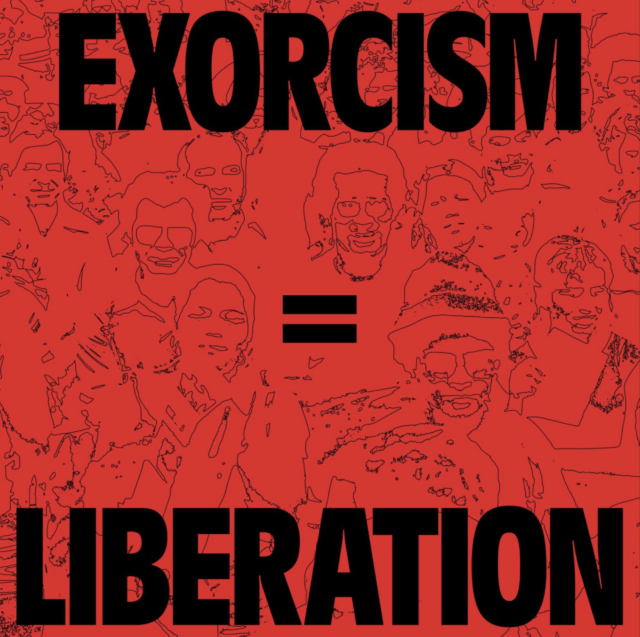
YANIRA CASTRO: EXORCISM = LIBERATION

EXORCISM = LIBERATION
Multiple locations
September 6-28, free
www.acanarytorsi.org

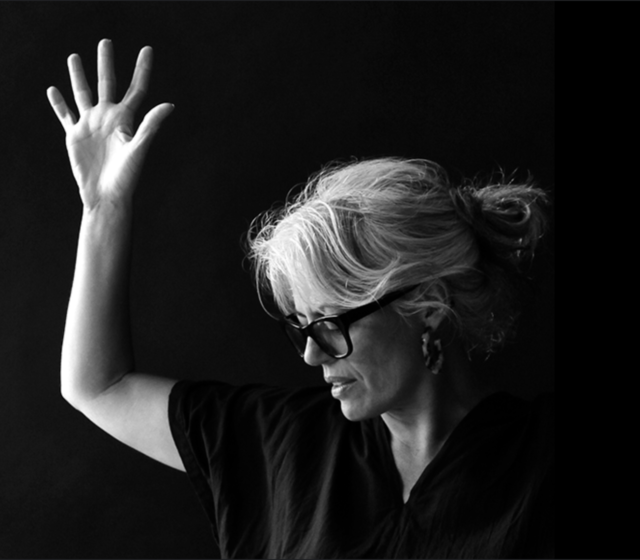
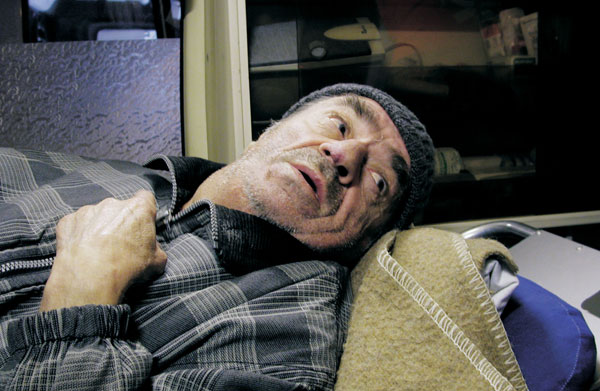
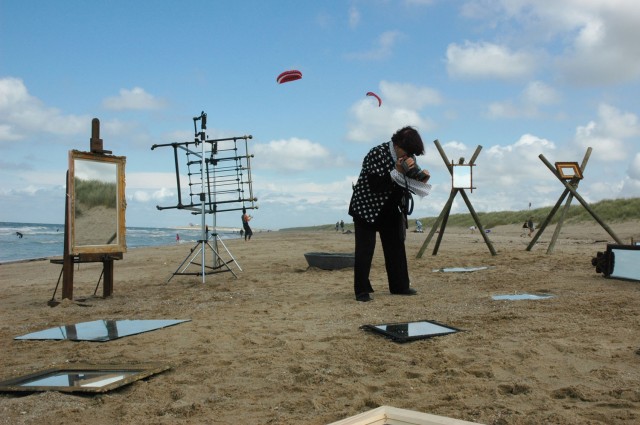
Yanira Castro is a fearless creator always ready to challenge herself and fully engage the audience. Born in Puerto Rico and based in Brooklyn, Castro and her company, a canary torsi (an anagram of her name), have presented such involving, complex, and entertaining multidisciplinary works as Dark Horse/Black Forest, a dance installation for public restrooms; the Jean-Luc Godard–inspired Paradis, a site-specific performance outdoors at twilight at the Brooklyn Botanic Garden; Performance | Portrait, an interactive video installation at the Invisible Dog Art Center; now.here.this, a meditative march of resistance in Prague; and Last Audience, a live communal laboratory at New York Live Arts, a performance manual, and a three-part space-opera podcast.

“Yanira Castro is a structural obsessive. She is an art scientist. She sees the rules and patterns lurking just beneath the surface of things,” Chocolate Factory Theater cofounding artistic director Brian Rogers has written. “The stuff that’s easier not to see . . . chaos staring at itself in the mirror, finding order.”

The Chocolate Factory is one of several venues hosting Castro’s latest project, Exorcism = Liberation, which explores climate change, immigration, land rights, colonialism, and self-determination in activations modeled around political campaigns. Kicking off September 6 and continuing each Saturday this month, the programs, seen through a Puerto Rican lens, include listening sessions, live music, food, and posters, stickers, banners, lawn signs, and pins. (There will also be activations in Chicago, and Western Massachusetts.)

Exorcism = Liberation asks participants to examine three slogans: “I came here to weep,” “Exorcism = Liberation,” and “What is your first memory of dirt?” Conceived, written, and directed by Castro, the project features audio design by Erica Ricketts, graphics by Alejandro Torres Viera and Luis Vázquez O’Neill, voice performances by Melissa DuPrey, josé alejandro rivera, and Steph Reyes, a bomba danced by Michael Rodríguez, and live musical performances by devynn emory and Martita Abril.

In a 2014 twi-ny talk about Court/Garden at Danspace Project, Castro explained, “It is not that I want to challenge the audience. I want to create a scenario for them and to be in conversation with them and I want them to form the picture, craft their experience. Their presence dynamically changes what is occurring. That is what ‘live’ means for me. It is dynamic because of the people in the room.”

In addition to the below events, installations at Abrons Arts Center, the Center for Performance Research (with a November activation date TBD), and the Chocolate Factory will continue into November.

Yanira Castro will present activations of Exorcism = Liberation in multiple locations this month

Friday, September 6, 6:00
I came here to weep: immersive group audio experience with movement score performed by Martita Abril, light refreshments prepared by Castro, stickers and pins available, Abrons Arts Center, 466 Grand St. at Pitt St., Manhattan

Saturday, September 7, 6:00
What is your first memory of dirt?: activation and collective listening session, followed by movement score “Clearing Practice” performed by devynn emory, light refreshments prepared by Castro, stickers and pins available, the Invisible Dog garden, 51 Bergen St., Brooklyn

Saturday, September 14, 7:00
CATCH 76: collective action, followed by a movement score performed by Martita Abril, with ice pops and limbers de coco y limon, the Chocolate Factory Theater (outside), 38-33 24th St., Long Island City

Saturday, September 21, 2:00
I came here to weep: activation and long table discussion with Jeremy Toussaint-Baptiste, Sami Hopkins, and Theodore (ted) Kerr, ISSUE Project Room, 22 Boerum Pl., Brooklyn

Saturday, September 28, 2:00-4:00
Exorcism = Liberation: activation with ice pops, limbers de coco y limon, the Clemente Soto Vélez Cultural & Educational Center, 107 Suffolk St., Manhattan

Friday, October 25, 1:00 – 9:00
OPEN LAB: What is your first memory of dirt? Aural Archiving with Yanira Castro / a canary torsi, advance RSVP required, the Center for Performance Research, 361 Manhattan Ave., Brooklyn

[Mark Rifkin is a Brooklyn-born, Manhattan-based writer and editor; you can follow him on Substack here.]
VISIONARY AUTEURS: FIVE DECADES OF MK2

LE BONHEUR

François (Jean-Claude Drouot) tries to convince Thérèse (Claire Drouot, his real-life wife), that he has plenty of happiness to spread around in Le Bonheur

LE BONHEUR (HAPPINESS) (Agnès Varda, 1965)
Metrograph
7 Ludlow St. between Canal & Hester Sts.
Wednesday, June 19, 8:15
Thursday, June 20, 5:30
Series continues through July 4
metrograph.com/film

Metrograph is celebrating the fiftieth anniversary of the family-run independent film company mk2, founded in 1974 by Marin Karmitz, with “Visionary Auteurs: Five Decades of mk2,” consisting of screenings of nearly two dozen works, from such directors as Louis Malle, Claude Chabrol, Marcel Carné, the Dardenne brothers, Jean-Luc Godard, Wim Wenders, Hong Sang-soo, and Menahem Golan. On June 16, 19, and 20, Metrograph will show a classic from French Nouvelle Vague filmmaker Agnès Varda.

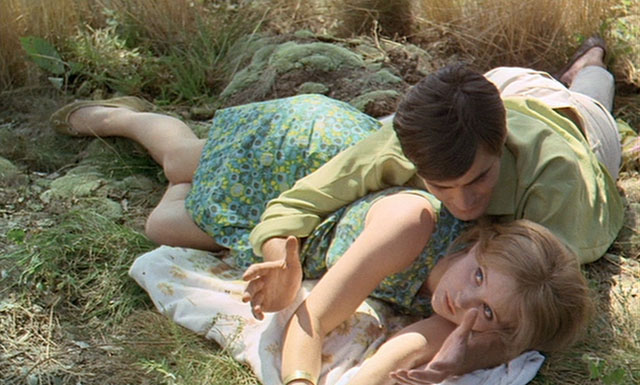
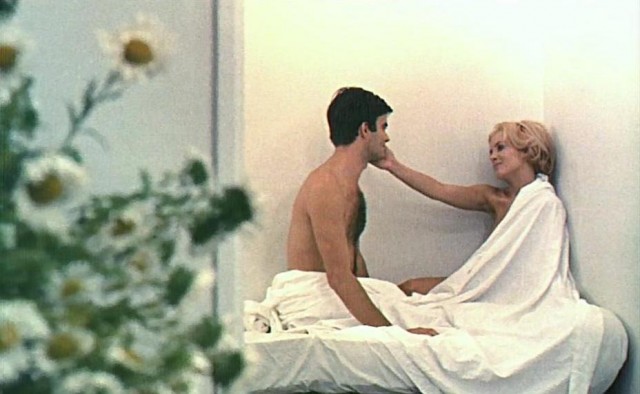
In 1965, Varda said about her third film, Le Bonheur, which translates as Happiness: “Happiness is mistaken sadness, and the film will be subversive in its great sweetness. It will be a beautiful summer fruit with a worm inside. Happiness adds up; torment does too.” That is all true nearly fifty years later, as the film still invites divided reaction from critics. “Miss Varda’s dissection of amour, as French as any of Collette’s works, is strikingly adult and unembarrassed in its depiction of the variety of love, but it is as illogical as a child’s dream,” A. H. Weiler wrote in the New York Times in May 1966. “Her ‘Happiness,’ a seeming idyll sheathed in irony, is obvious and tender, irresponsible and shocking and continuously provocative.” All these decades later, the brief eighty-minute film is all that and more, save for the claim that it is illogical. In a patriarchal society, it actually makes perfect, though infuriating, sense.

François and Émilie (Marie-France Boyer) seek out their own happiness in Nouvelle Vague classic

François and Émilie (Marie-France Boyer) seek out their own happiness in Nouvelle Vague classic

French television star Jean-Claude Drouot (Thierry La Fronde) stars as the handsome François, who is leading an idyllic life with his beautiful wife, Thérèse (Claire Drouot), and their delightful kids, Pierrot (Olivier Drouot) and Gisou (Sandrine Drouot), in the small, tight-knit Parisian suburb of Fontenay. While away on a job, François meets the beautiful Émilie (Marie-France Boyer), a postal clerk who connects him to his wife via long-distance telephone, flirting with him although she knows he is happily married. And despite being happily married, François returns the flirtation, offering to help with her shelves when she moves into an apartment in Fontenay. Both François and Émilie believe that there is more than enough happiness to go around for everyone, without any complications. “Be happy too, don’t worry,” Émilie tells him. “I’m free, happy, and you’re not the first,” to which he soon adds, “Such happiness!” And it turns out that even tragedy won’t put a stop to the happiness, in a plot point that angered, disappointed, confused, and upset many critics as well as the audience but is key to Varda’s modern-day fairy tale.

The beauty of nature plays a key role in LE BONHEUR

The beauty of nature plays a key role in Le Bonheur

Le Bonheur is Varda’s first film in color, and she seems to have been heavily influenced by her husband, Jacques Demy (The Umbrellas of Cherbourg, The Young Girls of Rochefort), bathing the film in stunning hues that mimic Impressionist paintings, particularly the work of Pierre-Auguste Renoir, in a series of picnics and flower-filled vases. In a sly nod, at one point a black-and-white television is playing the 1959 film Le Déjeuner Sur L’herbe (“Picnic on the Grass”), which was directed by Jean Renoir, one of Auguste’s sons, and also deals with sex, passion, procreation, and nature. Le Bonheur also features numerous scenes that dissolve out in singular blocks of color that take over the entire screen. Cinematographers Claude Beausoleil and Jean Rabier shoot the film as if it takes place in a candy-colored Garden of Eden, all set to the music of Mozart, performed by Jean-Michel Defaye. Varda doesn’t allow any detail to get away from her; even the protagonists’ jobs are critical to the story: François is a carpenter who helps builds new lives for people; Thérèse is a seamstress who is in the midst of making a wedding gown; and Émilie works in the post office, an intermediary for keeping people together. As a final touch, François, who represents aspects of France as a nation under Charles de Gaulle, and his family are played by the actual Drouot clan: Jean-Claude and Claire are married in real life (and still are husband and wife after more than fifty years), and Olivier and Sandrine are their actual children, so Le Bonheur ends up being a family affair in more ways than one.

Zhao Tao

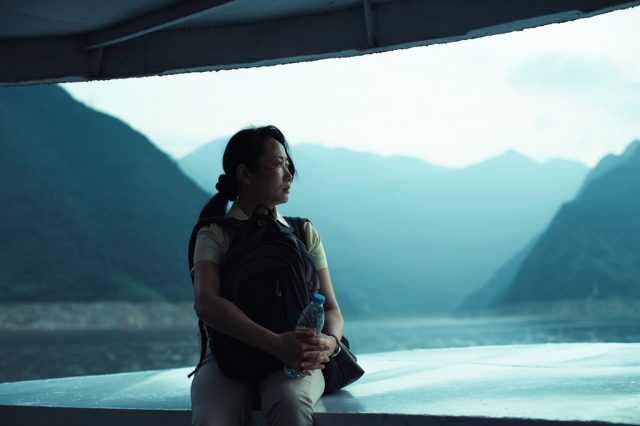
Qiao (Zhao Tao) how her life is turning out in Jia Zhang-Ke’s Ash Is Purest White

ASH IS PUREST WHITE (Jia Zhang-Ke, 2018)
Friday, June 28, 10:30
Saturday, June 29, 9:15
Thursday, July 4, 9:15
metrograph.com/film
www.ashispurestwhitemovie.com

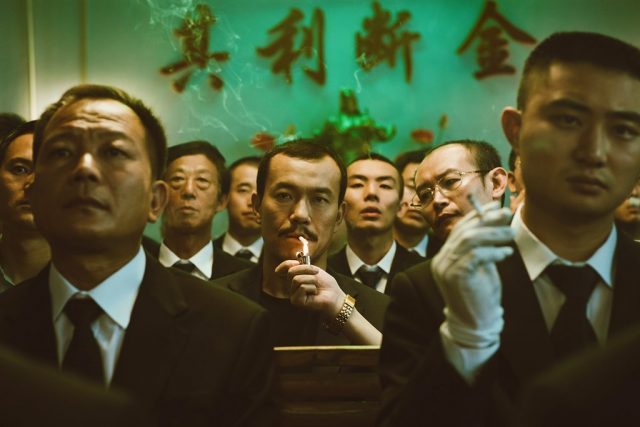
Jia Zhang-Ke reaches into his recent past, and China’s, in his elegiac Ash Is Purest White. In the film, which screens at Metrograph June 28 and 29 and July 4, the Sixth Generation writer-director’s wife and muse, Zhao Tao, stars as Qiao, a combination of the characters she played in Jia’s 2002 Unknown Pleasures and 2006 Still Life. It’s the spring of 2001, and Qiao is living in style with her handsome, ultracool jianghu boyfriend, well-respected local gangster Guo Bin (Liao Fan). She runs a gambling parlor, where she asserts her power with men who are in awe of her. But when a rival gang attacks Bin and Qiao pulls a gun, their lives take a series of unexpected turns as the story moves first to 2006 and then to 2018, when things are decidedly, and sadly, different for both of them in a China that has changed as well.

Liao Fan

Things are about to change for Guo Bin (Liao Fan) in Ash Is Purest White

As in many of his fiction works, Jia includes documentary elements as he touches upon China’s socioeconomic crisis, primarily exemplified by the Three Gorges Dam project, which led to the displacement of families and the literal disappearance of small communities. Working with a new cinematographer, Eric Gautier, who has lensed films for Olivier Assayas, Walter Salles, Leos Carax, Alain Resnais, and Arnaud Desplechin, among others — his longtime cameraman, Yu Lik-Wai, was unavailable — Jia incorporates general footage he shot between 2001 and 2006 of everyday people and architecture that underscores China’s many changes. There are many gorgeous shots of towns and cities, at one point bathed in white volcanic ash, with costumes of bright yellow, red, and blue, as Gautier goes from digital video to Digibeta, HD video, film, and the RED Weapon camera to add distinct textures. (Jia took the title from what was supposed to be Fei Mu’s last work, which was later made by Zhu Shilin.)

Qiao and Bin try to go back, but little is the same, except for some of their old friends, who are still trying to hold on to the way things were. Zhao (A Touch of Sin, Mountains May Depart) is slow and deliberate as Qiao, her wide eyes telling a story all their own as she wrestles with disappointment, searching for some meaning in her life, while Fan (The Final Master; Black Coal, Thin Ice) is bold and forceful as a proud, powerful man who undergoes a radical shift. “The city is developing fast. It’s ours for the taking,” Bin says early on. But in Jia’s moving, heartfelt epic, there’s nothing for them to grab on to anymore.

[Mark Rifkin is a Brooklyn-born, Manhattan-based writer and editor; you can follow him on Substack here.]

ISABELLE HUPPERT AT THE QUAD

Isabelle will be in person — not on the phone — at the Quad for Q&As following screenings of Jean-Paul Salomé’s La Syndicaliste

Who: Isabelle Huppert
What: Screenings followed by Q&As
Where: Quad Cinema, 34 West 13th St. between Fifth & Sixth Aves.
When: December 1-2 (festival continues all month)
Why: For more than half a century, French actress Isabelle Huppert has been one of cinema’s brightest stars. She’s appeared in more than 130 films, working with a who’s who of international directors, including Claude Chabrol, Márta Mészáros, Jean-Luc Godard, Diane Kurys, Bertrand Tavernier, David O. Russell, Joachim Trier, Hal Hartley, Ursula Meier, Bertrand Blier, Curtis Hanson, Hong Sang-soo, Ira Sachs, Paul Verhoeven, Wes Anderson, Michael Cimino, and Michael Haneke. She’s also done more than thirty plays, including 4.48 Psychose, The Maids, and The Mother in New York.

Huppert will be back in New York on December 1 and 2, participating in Q&As following screenings of Jean-Paul Salomé’s Venice Film Festival selection La Syndicaliste, a thriller in which Huppert plays real-life Irish trade unionist and whistleblower Maureen Kearney. Huppert will be at the Quad for the 7:15 show on December 1 and the 4:15 and 7:15 shows on December 2. The Quad will also be presenting “Restorations Starring Isabelle Huppert,” part of its ongoing “From the Vault: The Cohen Film Collection” series, on three Wednesdays in December: Benoît Jacquot’s 1999 Keep It Quiet on December 6, André Téchiné’s 1979 The Brontë Sisters on December 13, and Maurice Pialat’s 1980 Loulou on December 20. Finally, her latest film, François Ozon’s The Crime Is Mine, a murder mystery adapted from a 1934 play, opens exclusively at the Quad on December 25. Huppert, who turned seventy this past March, is as resplendent as ever, so these Q&As are must-see events.

[Mark Rifkin is a Brooklyn-born, Manhattan-based writer and editor; you can follow him on Substack here.]
60th ANNIVERSARY 4K RESTORATION: CONTEMPT

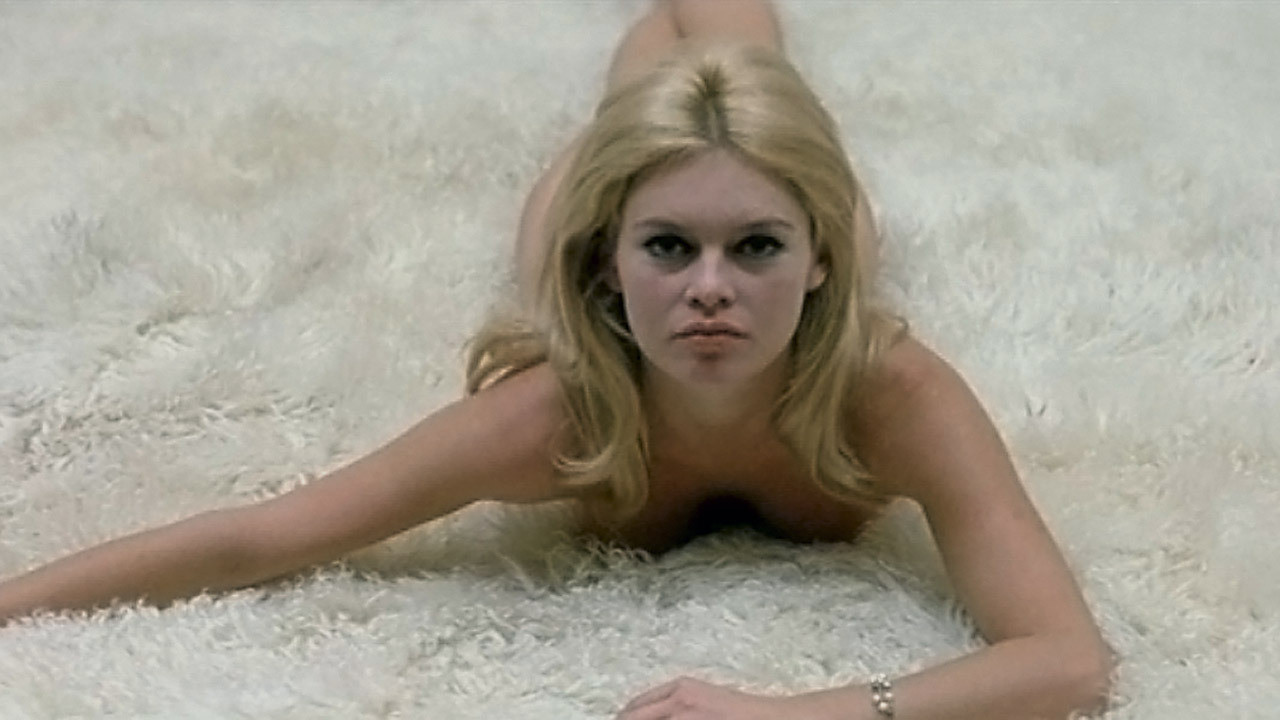
Brigitte Bardot shows off both her acting talent and beautiful body in Jean-Luc Godard’s Contempt

CONTEMPT (LE MEPRIS) (Jean-Luc Godard, 1963)
Film Forum
209 West Houston St.
June 30 – July 13
212-727-8110
www.filmforum.org

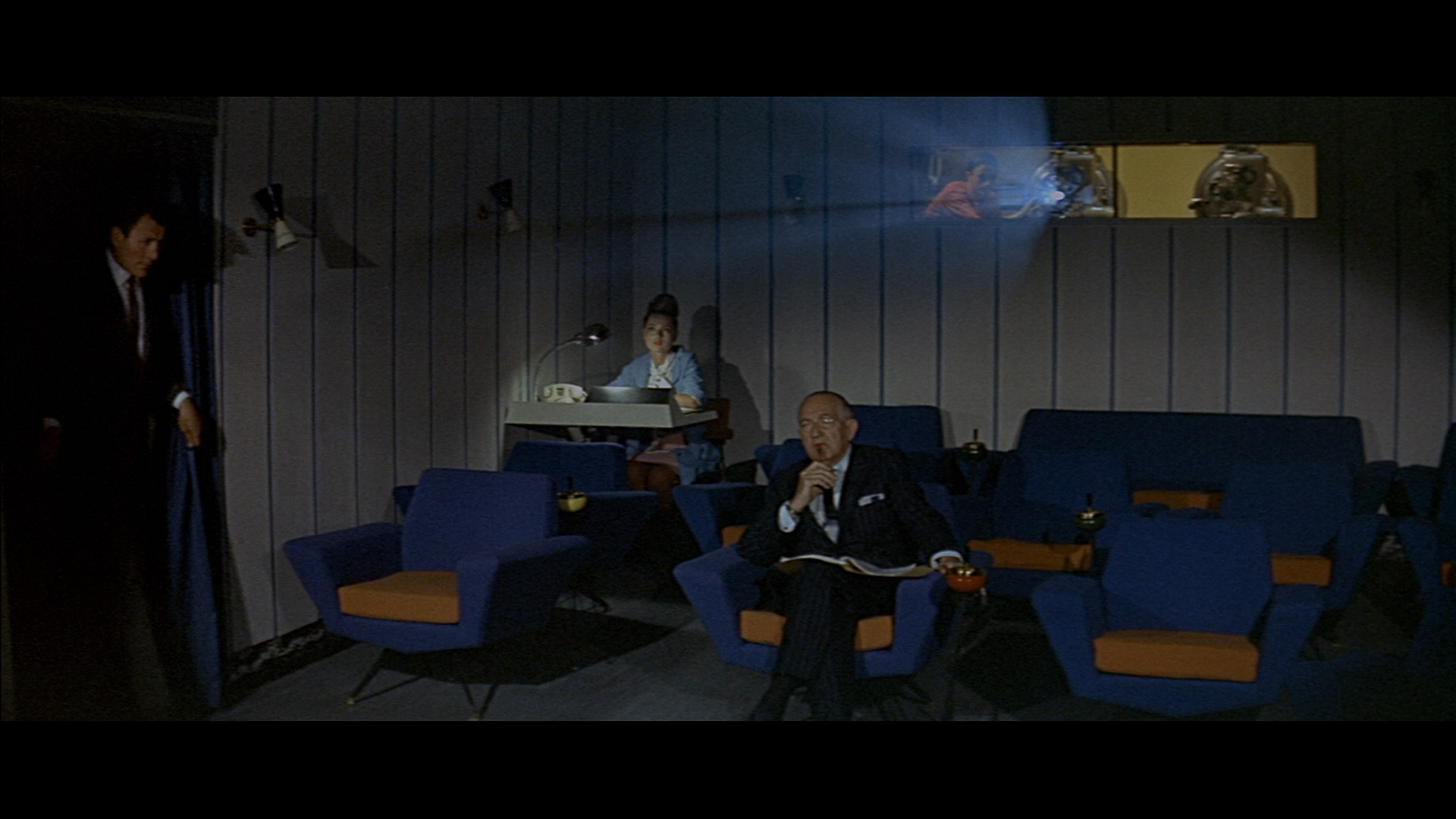
French auteur Jean-Luc Godard, who died last September at the age of ninety-one, didn’t hold back any of his contempt for Hollywood cinema in his multilayered masterpiece Contempt, which is being shown June 30 – July 13 in a sixtieth-anniversary 4K restoration at Film Forum. Loosely based on Alberto Moravia’s Il Disprezzo, Contempt stars Michel Piccoli as Paul Javal, a French screenwriter called to Rome’s famed Cinecittà studios by American producer Jeremy Prokosch (Jack Palance ) to perform rewrites on Austrian director Fritz Lang’s (played by Lang himself) adaptation of The Odyssey by ancient Greek writer Homer. Paul brings along his young wife, the beautiful Camille (Brigitte Bardot), whom Prokosch takes an immediate liking to. With so many languages being spoken, Prokosch’s assistant, Francesca Vanini (Giorgia Moll), serves as translator, but getting the various characters to communicate with one another and say precisely what is on their mind grows more and more difficult as the story continues and Camille and Paul’s love starts to crumble. Contempt is a spectacularly made film, bathed in deep red, white, and blue, as Godard and cinematographer Raoul Coutard poke fun at the American way of life. (Both Godard and Coutard appear in the film, the former as Lang’s assistant director, the latter as Lang’s cameraman — as well as the cameraman who aims the lens right at the viewer at the start of the film.)

Producer Jeremy Prokosch (Jack Palance) doesn’t always have the kindest of words for director Fritz Lang in Contempt

Bardot is sensational in one of her best roles, whether teasing Paul at a marvelously filmed sequence in their Rome apartment (watch for him opening and stepping through a door without any glass), lying naked on the bed, asking Paul what he thinks of various parts of her body (while Coutard changes the filter from a lurid red to a lush blue), or pouting when it appears that Paul is willing to pimp her out in order to get the writing job. Palance is a hoot as the big-time producer, regularly reading fortune-cookie-like quotes from an extremely little red book he carries around that couldn’t possibly hold so many words. And Lang, who left Germany in the mid-1930s for a career in Hollywood, has a ball playing a version of himself, an experienced veteran willing to put up with Prokosch’s crazy demands. Vastly entertaining from start to finish, Contempt is filled with a slew of inside jokes about the filmmaking industry and even Godard’s personal and professional life, along with some of the French director’s expected assortment of political statements and a string of small flourishes that are easy to miss but add to the immense fun, all set to a gorgeous romantic score by Georges Delerue.