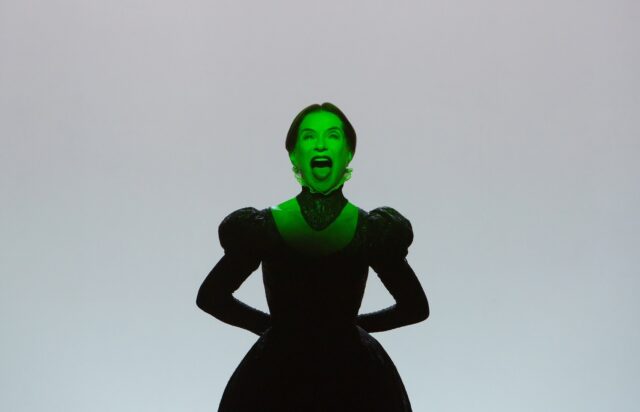
Isabelle Huppert portrays Mary, Queen of Scots in third collaboration with Robert Wilson (photo by Lucie Jansch)
ROBERT WILSON & ISABELLE HUPPERT: MARY SAID WHAT SHE SAID
NYU Skirball Center for the Performing Arts
566 La Guardia Pl.
February 27 – March 2, $125 nyuskirball.org
In October 2005, French superstar Isabelle Huppert performed Sarah Kane’s blistering solo piece, 4.48 Psychose, at BAM’s Harvey Theater. For ninety-five minutes, the Oscar-nominated, BAFTA, César, and Cannes–winning actress stood stock-still — except for occasionally scanning the audience or extending a finger — portraying a woman who had just suffered a mental breakdown.
In New York, Huppert has also appeared in Florian Zeller’s The Mother at the Atlantic in 2019 and, at BAM, in Krzysztof Warlikowski’s Phaedra(s) in 2016 and Robert Wilson’s Quartett in 2009.
Always ready to take on artistic challenges, Huppert has teamed up with Wilson for the third time with Mary Said What She Said, in which Huppert, who has made more than 135 films, including The Lacemaker,Heaven’s Gate,The Piano Teacher, and Elle, gets inside the head of Mary, Queen of Scots, the sixteenth-century Scottish monarch. The show is divided into three parts consisting of eighty-six paragraphs, beginning with “Memory, open my heart.”
Wilson, who has dazzled the world with such wildly unpredictable and visually stunning productions as Einstein on the Beach,The Black Rider, and The Old Woman, is the director of the Théâtre de la Ville-Paris commission as well as the set and lighting designer. The text, which is performed in French with English surtitles, is by longtime Wilson collaborator, novelist, and essayist Darryl Pinckney, using Mary’s own letters and Stefan Zweig’s 1935 biography of the queen in his research. The music is by Ludovico Einaudi, who has worked with such experimental composers as Luciano Berio and Karlheinz Stockhausen.
The US premiere at NYU Skirball runs February 27 to March 2; all tickets are $125 to see one of the greatest actors of our era in a show by one of the most inventive creators of our time, promising to be something special. As a bonus, Huppert will participate in a talkback following the 7:30 show on March 1.
[Mark Rifkin is a Brooklyn-born, Manhattan-based writer and editor; you can follow him on Substack here.]
Ivan (Mark Eydelshteyn) and Ani (Mikey Madison) set off on a frenetic romance in Anora
MAIN SLATE: ANORA (Sean Baker, 2024)
Film at Lincoln Center
Saturday, September 28, 6:15
Sunday, September 29, noon www.filmlinc.org
The sixty-second edition of the New York Film Festival is under way, and the first standout is Sean Baker’s Anora.
Winner of the Palme d’Or at Cannes, Anora is a nonstop wild ride through the frenetic, unpredictable relationship between a stripper and the scion of a Russian oligarch. It starts out luridly but quickly morphs into a touching and surprisingly human tale.
Mikey Madison, who starred in the 2022 Scream sequel, shows off her mighty pipes in the film, making a career breakthrough as Ani, a stripper living in a Brighton Beach railroad apartment who catches the eye of Ivan Zakharov (Mark Eydelshteyn), who buys her for a week, lighting up the nights in a cavalcade of sex and drugs while developing what appears to be turning into a real relationship. But when his parents, Nikolai (Aleksei Serebryakov) and Galina (Darya Ekamasova), find out about it, they sic their guard dogs, Igor (Yura Borisov), Toros (Karren Karagulian), and Garnick (Vache Tovmasyan), on them, leading to hilariously violent scenes as Ani sets out to prove that she is not a hooker and is not ashamed of being a sex worker.
Written, edited, and directed by Baker, whose previous work includes Take Out,Tangerine,The Florida Project, and Red Rocket,Anora is an aggressive, in-your-face trip that races from Coney Island to Las Vegas, with lush cinematography by Drew Daniels, a pulsating score by Matthew Hearon-Smith, and fanciful costumes by Jocelyn Pierce.
Madison, a regular on Better Things and Lady in the Lake, is fearless as Ani, a determined young woman who knows what she wants and is not afraid to say it out loud and fight for it. The coda is disappointing — it would have been much better if the film ended before the final moments in the car — but otherwise Anora is a thrilling cinematic experience.
Anora is screening September 28 and 29, with Baker and Madison on hand for Q&As. The ferocious film will then return to Lincoln Center for a theatrical run in mid-October, with Baker and Madison participating in Q&As October 16 and 18. Keep watching this space for more reviews from NYFF62.
Iris (Isabelle Huppert) takes notes while teaching Isong (Kim Seungyun) French in Hong Sangsoo’s A Traveler’s Needs
MAIN SLATE: A TRAVELER’S NEEDS (Hong Sangsoo, 2024)
Film at Lincoln Center
Wednesday, October 2, 9:00
Thursday, October 3, 6:15 www.filmlinc.org
Longtime New York Film Festival favorite Hong Sangsoo returns to Lincoln Center with two touching works for NYFF62. For nearly thirty years, the South Korean Hong has been making contemplative, character-driven films in which writers or directors develop different kinds of relationships with actors, fans, students, and other admirers amid a lot of drinking, eating, and smoking as they discuss art, love, human nature, and film itself.
In such gems asOki’s Movie,The Day He Arrives,Yourself and Yours,Like You Know It All, and Right Now, Wrong Then, Hong constructs slow-paced, intriguing philosophical narratives in which not much necessarily happens but nearly every minute is imbued with meaning.
In A Traveler’s Needs, Isabelle Huppert, in her third Hong film (following 2012’s In Another Country and 2017’s Claire’s Camera), stars as Iris, a mysterious Frenchwoman who seems to just appear and disappear; we know almost nothing about her or why she is in Seoul.
When we first encounter her, she is teaching French to a young pianist, Isong (Kim Seungyun), asking her questions using index cards and an old cassette recorder that looks almost like a toy. We soon find out that Iris is not a trained teacher but someone who only recently developed her unique method, which involves asking her students how they feel deep inside, and that she has no idea if it will actually work.
Iris, who dresses like she is on vacation, wearing a flowery dress, green sweater, and wide-brimmed hat, next visits Wonju (Lee Hyeyoung) and her husband, Haesoon (Kwon Haehyo), to teach them French. Wonju is suspicious of Iris and her technique, but as they partake of more of the milky rice wine known as makgeolli, everyone loosens up a bit.
Later, Iris returns home, to an apartment she shares with Inguk (Ha Seongguk), a younger man who is not quite ready to introduce her to his mother, Yeonhee (Cho Yunhee), although the relationship between Inguk and Iris is unclear.
So how does A Traveler’s Needs make you feel? Like many of Hong’s films, it’s a calm tale featuring lots of conversation and long takes, highlighted by another superb performance by Huppert. It might be best exemplified by a scene in which Iris approaches a tiny river, takes off her shoes, steps into the water, looks around while humming, and drops one of her shoes. It’s hard to tell if it was supposed to happen, but Huppert lets out an adorable sigh, picks it up, shakes it out, and carries on.
Hong also incorporates an oddly endearing repetition in the film, in dialogue, character traits, and Iris’s movement, particularly how she walks when she exits a scene. She practically floats in and out of her world, innocent and carefree, like a child. Hong’s camera loves her — he wrote, directed, photographed, produced, and edited the film in addition to composing the score — and so will you.
A Traveler’s Needs is screening October 2 at 9:00 and October 3 at 6:15, with Huppert participating in Q&As after each show; she will also return to Lincoln Center November 21 for a Q&A when the film opens at the Walter Reade Theater.
Jeonim (Kim Minhee) and her uncle, Chu Sieon (Kwon Haehyo), reunite at a university in By the Stream
MAIN SLATE: BY THE STREAM (Hong Sangsoo, 2024)
Film at Lincoln Center
Friday, October 4, 9:00
Friday, October 11, 6:45 www.filmlinc.org
“I’ll light the smallest lamp in the corner and protect it until I die,” a college student tells Chu Sieon (Kwon Haehyo) when he asks four young women what they want to do in the future in Hong Sangsoo’s By the Stream. It’s a subtle admission in a subtle film filled with small lamps in corners, literally and figuratively.
Hong wrote, edited, produced, directed, photographed, and composed the score for the film, another intimate, eloquent drama about people just going about their daily lives, eating, drinking, and talking about creativity and love. It takes place on a lovely campus at a woman’s university in Seoul, where it’s time for the annual skit contest, when the various departments put on ten-minute shows. Art professor Jeonim (Kim Minhee) is in a jam when the director in charge of the script for her department has been kicked out after sleeping with three of the students.
Jeonim makes a desperate call to her uncle, Chu, a onetime popular actor who was canceled for unstated reasons and has been running a small bookstore on a remote lake for decades. Niece and uncle have not spoken for ten years, but Sieon accepts the offer, returning to the school where he got his start forty years before. While the four art students are not exactly psyched about the script he has written for them, the head of the department, Jeong (Cho Yunhee), is instantly smitten with him, an adoring fan who wants to spend more and more time with him — and he doesn’t seem to mind all the attention.
With skit night approaching, Jeonim, Sieon, and Jeong do a lot of eating, talking, and drinking, enjoying eel and the milk rice wine known as makgeolli, as relationships grow more complicated and characters reexamine who they are and what they want.
By the Stream is Hong’s thirty-second film since his debut, 1996’s The Day a Pig Fell into the Well. It’s also the thirteenth Hong film Kim has starred in; they began an affair in 2015 — they are both separated from their spouses, with whom they have children, which caused a scandal in South Korea — and Kim, an award-winning international star, has not worked for another director since Park Chan-wook’s 2016 The Handmaiden. Hong is twenty-two years older than Kim; Kwon is seventeen years older than Cho. That is not to imply that By the Stream is autobiographical, but it appears to have personal elements that add intrigue to the gentle magic of the storytelling and characterization.
Kim won the Best Performance award at Locarno for her role as Jeonim, who spends much of her time drawing the ripples in a stream, the water ever changing and constantly moving, like life. She then re-creates the patterns on her loom, finding solace in making art. Chu is reenergized by his decision to direct the skit, interacting with people as he hasn’t since isolating himself at his bookstore. And Jeong shows a different side of herself as she becomes a fan girl forming a connection with the object of her affection.
Hong often leaves his camera fixed as the action unfolds, particularly when the three protagonists are at tables, eating, drinking, and talking, composing a kind of flowing, ever-changing portrait. Water has been a leitmotif throughout Hong’s career; several of his films have the words water,river,beach, and stream in them, and in others, water plays a part, like the beautiful scene in A Traveler’s Needs when Iris (Isabelle Huppert) steps into a small stream.
As in so many of Hong’s works, By the Stream proceeds at its own hypnotic pace, offering profound if understated treatises on the little things in life, like that small lamp in the corner.
Larry Cotton (Andrew Robinson) and his daughter, Kirsty (Ashley Laurence), have their hands full in Hellraiser
REVIVALS: HELLRAISER (Clive Barker, 1987)
Saturday, October 5, 9:15
Wednesday, October 9, 1:00 www.filmlinc.org
“What’s your pleasure?” an unseen character asks at the beginning and end of Clive Barker’s Hellraiser, now screening at NYFF62 in a 4K restoration. Adapted from his novella The Hellbound Heart, the horror film made quite a splash when it was released in 1987, and its legacy as a genre classic has only grown over the years, despite, not because of, nine sequels, none of which Barker wrote or directed. The film faced bans and censorship, so Barker had to make some concessions, editing certain ultraviolent and S&M scenes, but there are still plenty in there to justify its cult status.
“We did a version which had some spanking in it and the MPAA was not very appreciative of that,” Barker said in the DVD audio commentary. “[They also] told me I was allowed two consecutive buttock thrusts from Frank but a third would be deemed obscene.”
The film begins with Frank Cotton (Sean Chapman) in Morocco acquiring a puzzle box and, upon solving it in his suburban American home, getting sent to a hell realm where pain mixes with pleasure, a decadent take on the hot nightclub scene of the 1980s. Years later, Frank’s brother, Larry (Andrew Robinson), returns to the family homestead with his second wife, Julia (Clare Higgins), who unbeknownst to him had a torrid affair with Frank. Larry’s daughter, Kirsty (Ashley Laurence), shows up to provide support, but it’s instantly clear that she and Julia are not besties.
When Larry severely cuts his hand while helping the creepy movers bring a bed upstairs, the blood oozes into the floorboards and awakens Frank, who is a skinless terrifying creature (portrayed by Oliver Smith). Frank reveals to Julia, who still has the hots for him, that he can regain his skin and they can have a life together if she feeds him other human beings, so she hits the bars, bringing men home to be devoured by her lover. Larry is completely oblivious to what is going on right under his nose, but Kirsty grows suspicious, leading to an appropriately blood-soaked, out-of-this-world climax.
Hellraiser is most remembered and revered for the Cenobites, ghoulish S&M characters known as the Chatterer (Nicholas Vince), Butterball (Simon Bamford), the unnamed female (Grace Kirby), and their leader, Pinhead (Doug Bradley), who became a breakout star. The general plot is derivative and the acting has a heavy dose of soap opera attitude, but Barker pushes it all beyond the limits of standard genre fare, toying with cliché so you won’t always know what’s coming. Christopher Young’s score, Michael Buchanan’s production design, Jocelyn James’s art direction, and Aileen Seaton’s hair stylings capture the ’80s sensibility and look better than ever in the restoration, as do the special effects and intense makeup and costumes.
All in all, this version of Hellraiser provides the answer to the question “What’s your pleasure?”
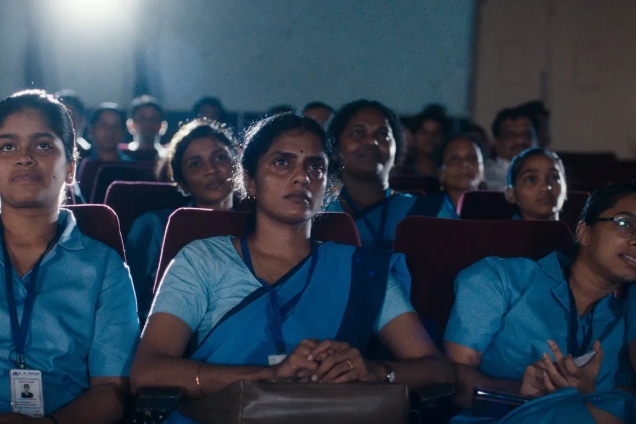
Prabha (Kani Kusruti) takes a new look at her life in All We Imagine as Light
MAIN SLATE: ALL WE IMAGINE AS LIGHT (Payal Kapadia, 2024)
Film at Lincoln Center
Monday, October 7, 6:00
Tuesday, October 8, 9:15
Free talk Wednesday, October 9, 4:00
Thursday, October 10, 3:30 www.filmlinc.org
Indian filmmaker Payal Kapadia won the Golden Eye at Cannes in 2021 for best documentary for A Night of Knowing Nothing, a film that mixes fact and fiction while telling the story of two lovers trying to stay connected via letters amid student protests in India. Kapadia mixes fact and fiction again in her follow-up, the tender and deeply poignant All We Imagine as Light, which won the Grand Prix at Cannes earlier this year.
The new work opens with gritty shots of the streets of Mumbai, as unseen people share their difficulties trying to make a new life for themselves after migrating from the country. “There’s always the feeling I’ll have to leave,” one person says. Another opines, “The city takes time away from you.” A third argues, “Why would anyone want to move back?”
Kapadia, who was born in Mumbai, then shifts to the fictional tale of two nurses and a third hospital employee fighting loneliness as they care for sick people. Prabha (a heart-wrenching Kani Kusruti) and the younger Anu (Divya Prabha) live together in an apartment in the city. Prabha, who is in an arranged marriage, has not seen her husband, who is working in Germany, for more than a year. Anu, whose family is Hindi, is in love with a Muslim man, Shiaz (Hridhu Haroon), keeping their relationship secret for fear of being discovered and shunned. And Parvaty (Chhaya Kadam) is a recent widow who is being evicted from her home of twenty-two years because her name is nowhere on the paperwork left behind by her husband.
When Prabha receives a brand-new German rice cooker in the mail, she assumes it is from her spouse, perhaps a message that he is not coming back and that she should proceed with her life. But she is tentative to start dating, even as she is pursued by the goofy but sweet Dr. Manoj (Azees Nedumangad), who writes poetry for her.
The three women decide to hit the road, taking a trip to Parvaty’s seaside Maharashtrian hometown, where they take stock of their lives, particularly after a man washes up onshore.
All We Imagine as Light is sensitively shot by cinematographer Ranabir Das, with a soft, jazzy score by Topshe as soft rain falls, trains pass by in the background, and Prabha and Parvaty throw stones at a billboard for a pending skyscraper that proclaims, “CLASS is a privilege reserved for the PRIVILEGED.”
All We Imagine as Light is an engaging and touchingly lyrical look at womanhood in contemporary Mumbai, as the city threatens three women with potential isolation and alienation until they bind together. The youngest, Anu, instills new energy into the others to reevaluate their situations and take action. “Do you ever think of the future?” Anu asks.
The film appropriately provides no firm answers in the end, but it is clear that Kapadia’s future is a bright one.
All We Imagine as Light is screening at NYFF62 on October 7, 8, and 10, with the writer-director participating in Q&As following the first two showings. She will also be at the Amphitheater at the Elinor Bunin Munroe Film Center on October 9 at 4:00 for a free talk with Portuguese director Miguel Gomes, whose Grand Tour is screening October 8, 9, and 11 at the festival.
[Mark Rifkin is a Brooklyn-born, Manhattan-based writer and editor; you can follow him on Substack here.]
Isabelle will be in person — not on the phone — at the Quad for Q&As following screenings of Jean-Paul Salomé’s La Syndicaliste
Who: Isabelle Huppert What: Screenings followed by Q&As Where:Quad Cinema, 34 West 13th St. between Fifth & Sixth Aves. When: December 1-2 (festival continues all month) Why: For more than half a century, French actress Isabelle Huppert has been one of cinema’s brightest stars. She’s appeared in more than 130 films, working with a who’s who of international directors, including Claude Chabrol, Márta Mészáros, Jean-Luc Godard, Diane Kurys, Bertrand Tavernier, David O. Russell, Joachim Trier, Hal Hartley, Ursula Meier, Bertrand Blier, Curtis Hanson, Hong Sang-soo, Ira Sachs, Paul Verhoeven, Wes Anderson, Michael Cimino, and Michael Haneke. She’s also done more than thirty plays, including 4.48 Psychose,The Maids, and The Mother in New York.
Huppert will be back in New York on December 1 and 2, participating in Q&As following screenings of Jean-Paul Salomé’s Venice Film Festival selection La Syndicaliste, a thriller in which Huppert plays real-life Irish trade unionist and whistleblower Maureen Kearney. Huppert will be at the Quad for the 7:15 show on December 1 and the 4:15 and 7:15 shows on December 2. The Quad will also be presenting “Restorations Starring Isabelle Huppert,” part of its ongoing “From the Vault: The Cohen Film Collection” series, on three Wednesdays in December: Benoît Jacquot’s 1999 Keep It Quiet on December 6, André Téchiné’s 1979 The Brontë Sisters on December 13, and Maurice Pialat’s 1980 Loulou on December 20. Finally, her latest film, François Ozon’s The Crime Is Mine, a murder mystery adapted from a 1934 play, opens exclusively at the Quad on December 25. Huppert, who turned seventy this past March, is as resplendent as ever, so these Q&As are must-see events.
[Mark Rifkin is a Brooklyn-born, Manhattan-based writer and editor; you can follow him on Substack here.]
Isabelle Huppert is luminous once again, even in the hokey comic thriller Mama Weed (La Daronne), opening July 16 at the Village East. The French grand dame stars as Patience Portefeux, a widow with two grown daughters who is out of money, threatened with eviction by her tough landlord, Mrs. Fo (Jade Nadja Nguyen). Patience works as a French-Arabic translator for the police, currently enmeshed in stopping a major drug deal that secretly involves Khadidja (Farida Ouchani), the nurse who cares for Patience’s elderly mother (Liliane Rovère).
In order to protect Khadidja and her son, Choca (Mourad Boudaoud), who is in on the deal with his friend Scotch (Rachid Guellaz), Patience warns her in advance. The deal goes bad, the drugs disappear, but Patience decides to track them down herself, and when she finds them she concocts a plan to become a local drug lord so she can once again live life in the high style to which she was accustomed. While Choca and Scotch are minor leaguers who are easily manipulated, Patience has to be more careful with the extremely dangerous Cherkaoui brothers (Youssef Sahraoui and Kamel Guenfoud), who want their hash stash back. She does all this under the nose of the determined police chief, Philippe (Hippolyte Girardot), who is in charge of the case and whom she just happens to be dating.
Liberally adapted by director Jean-Paul Salomé (Les Braqueuses,Playing Dead) and Hannelore Cayre from Cayre’s novel The Godmother with the participation of Huppert, Mama Weed can’t quite figure out what it wants to be, treading the line between comedy, police procedural, romance, thriller, and widow in a man’s world trying to rise above adversity. Looking better than ever in her late sixties, Huppert is mesmerizing to watch, especially as Marité Coutard’s costumes get more and more colorful and complex, but you’ll run out of, er, patience as the plot grows more and more absurd. Patience is neither Walter White (Bryan Cranston) from Breaking Bad nor Nancy Botwin (Mary-Louise Parker) from Weeds; her success relies on too much plain luck that stretches the bounds of credulity.
Winner of the Jacques Deray Prize for best detective film and nominated for a César for Best Adapted Screenplay, Mama Weed has its moments, especially in Patience’s evolving relationship with Mrs. Fo, but the hole-ridden story feels like smoking weed of questionable quality — you’re never sure it’s truly getting you where you want to be.
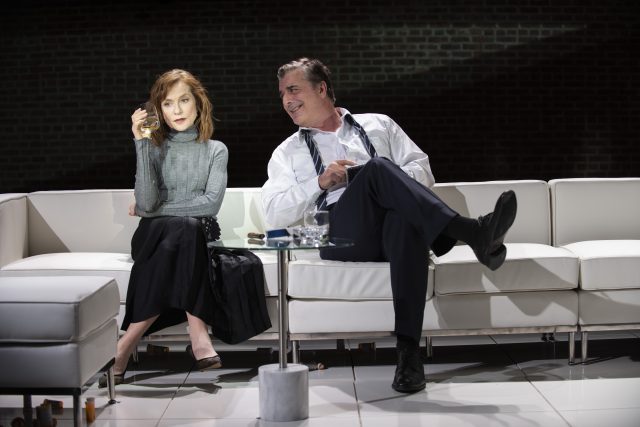
Isabelle Huppert and Chris Noth star in US premiere of Florian Zeller’s The Mother at the Atlantic (photo by Ahron R. Foster)
Atlantic Theater Company
Linda Gross Theater
336 West 20th St. between Eighth & Ninth Aves.
Tuesday – Sunday through April 13, $101.50
866-811-4111 atlantictheater.org
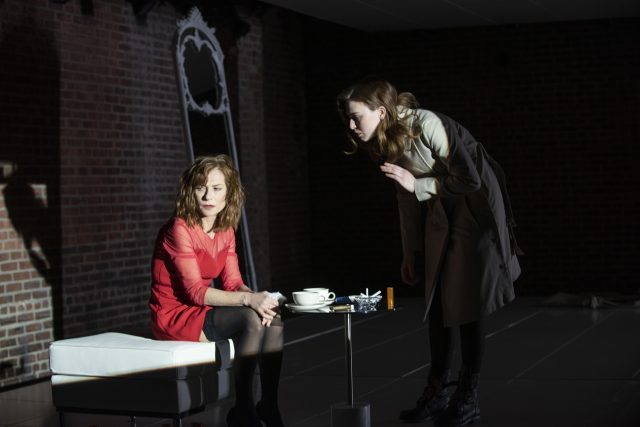
In 2016, Frank Langella won a Tony as the title character in the US premiere of French playwright and novelist Florian Zeller’s The Father, a gripping tale of an elegant Parisian gentleman suffering from dementia. Now Oscar nominee Isabelle Huppert stars in the US premiere of Zeller’s The Mother, a less-successful work that opened last night at the Atlantic. Written in 2010, four years before The Father,The Mother is a companion piece that follows an empty nester’s descent into depression. As the audience enters the Linda Gross Theater, Anne (Huppert) is already seated on a ridiculously long, almost blindingly white sectional couch that runs the length of the stage. She is reading a book but seems to not be paying close attention to it. Under several cushions and a small table are bottles and bottles of pills, and a wine bottle rests on the floor by a mirror. Mark Wendland’s powerful set is backed by a brick wall, as if there is no escape for any of the characters in Anne’s closed-in world. Everything is black, white, and gray, like a dream, except for a red dress. When Anne’s husband, Peter (Chris Noth), comes home from work, she is cold and distant. He asks her how her day was, and she replies, “I stayed in, did nothing. Waited. . . . I’m aware of a great void.”
The prodigal son (Justice Smith) returns in The Mother (photo by Ahron R. Foster)
In the morning, he’s scheduled for a four-day seminar in Buffalo, but she thinks he’s going away with another woman. “I’ve been had. That’s the truth of it,” she says accusingly. “I’ve been had. All the way down the line.” She is also deeply upset that her son, Nicolas (Justice Smith), never returns her calls or comes to visit, and she is intensely jealous of his girlfriend, Emily (Odessa Young). However, she doesn’t seem to care much about her daughter. “I realize now. I should never have had children. Especially with someone like you,” she tells her husband. “You’ve lost your mind, Anne,” he says. There’s a flash, and then the scene repeats, albeit with significant differences as the play explores alternate planes of reality in the mind of a woman living on the edge, leaving the audience unsure: Are we watching events unfold in a straight dramatic narrative or only in Anne’s imagination?
Anne (Isabelle Huppert) wants nothing to do with her son’s girlfriend (Odessa Young) in play about depression (photo by Ahron R. Foster)
Although Huppert (Quartett,4.48 Psychose) and Noth (Law & Order, Sex and the City) are excellent as the troubled couple, they don’t quite pass as being in their late forties, despite Huppert’s youthful elegance. (They are both in their mid-sixties.) The “redos” of the scenes, done so effectively in Nick Payne’s Constellations, present more of a conundrum here. Director Trip Cullman (Lobby Hero,Six Degrees of Separation) includes some deft touches, particularly involving the use of Emily and a bed later in the play, but a projection near the end is emblematic of the play’s insistence on keeping things confusing and its inability to get to the heart of the matter. Zeller (The Lie, The Truth) and translator Christopher Hampton (The Philanthropist, Appomattox), who refer to The Mother as “a black farce,” attempt to equate the two men in Anne’s life in sexual ways (pay attention to the black jacket and the red dress), but the attempt to capture Anne’s failing sanity ultimately gets lost. “I know how to tell the difference between dreams and reality,” Anne tells Peter. The play doesn’t, even though that’s part of the point.
Maria Vial (Isabelle Huppert) is determined to see her coffee crop through to fruition despite the growing dangers in Claire Denis’s White Material
WHITE MATERIAL (Claire Denis, 2009)
BAMcinématek, BAM Rose Cinemas
30 Lafayette Ave. between Ashland Pl. & St. Felix St.
Tuesday, July 17, 7:00
Series continues through July 19
718-636-4100 www.bam.org www.ifcfilms.com
BAMcinématek has teamed up with the Racial Imaginary Institute, a collective that “convenes a cultural laboratory in which the racial imaginaries of our time and place are engaged, read, countered, contextualized, and demystified,” to present the series “BAMcinématek and the Racial Imaginary Institute: On Whiteness.” Continuing through July 19, the festival, which “aims to foster a dialogue about what it means to be white in America,” has already shown such films as Taxi Driver, The Swimmer, The Jerk, Rocky, and Ferris Bueller’s Day Off. It moves to another continent on July 17 with Claire Denis’s White Material. In an unnamed West African nation besieged by a bloody civil war between rebels and the military government, Maria Vial (Isabelle Huppert) steadfastly refuses to leave her coffee plantation, determined to see the last crop through to fruition. Despite pleas from the French army, which is vacating the country; her ex-husband, André (Christophe Lambert), who is attempting to sell the plantation out from under her; and her workers, whose lives are in danger, Maria is unwilling to give up her home and way of life, apparently blind to what is going on all around her. She seems to be living in her own world, as if all the outside forces exploding around her do not affect her and her family. Without thinking twice, she even allows the Boxer (Isaach De Bankolé) to stay there, the seriously wounded leader of the rebel militia, not considering what kind of dire jeopardy that could result in. But when her slacker son, Manuel (Nicolas Duvauchelle), freaks out, she is forced to take a harder look at reality, but even then she continues to see only what she wants to see. A selection of both the New York and Venice Film Festivals, White Material is an often obvious yet compelling look at the last remnants of postcolonial European domination as a new Africa is being born in disorder and violence. Directed and cowritten (with French playwright Marie Ndiaye) by Denis (Chocolat, Beau Travail), who was born in Paris and raised in Africa, the film has a central flaw in its premise that viewers will either buy or reject: whether they accept Maria’s blindness to the evolving situation that has everyone else on the run. Watching Maria’s actions can be infuriating, and in the hands of another actress they might not have worked, but Huppert is mesmerizing in the decidedly unglamorous role.
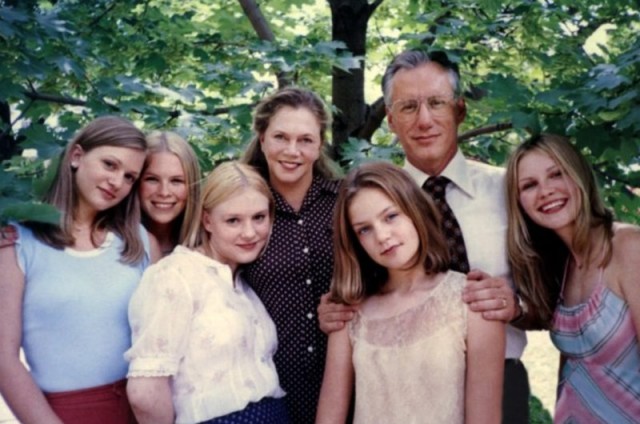
A family is torn apart by tragedy in Sofia Coppola’s The Virgin Suicides
THE VIRGIN SUICIDES (Sofia Coppola, 1999)
BAMcinématek, BAM Rose Cinemas
30 Lafayette Ave. between Ashland Pl. & St. Felix St.
Tuesday, July 17, 4:30 & 9:30
Series continues through July 19
718-636-4100 www.bam.org
The Virgin Suicides, which traces the downfall of a suburban Michigan family in the 1970s, is chock-full of period songs, with well-known tunes by Heart, the Hollies, Carole King, Styx, Todd Rundgren, 10CC, the Bee Gees, and ELO all over the film. But it’s Air’s score that gives it added emotional depth, from tender piano lines that evoke Pink Floyd and late-era Beatles to rowdier, synth-and-drum-heavy moments to mournful dirges and hypnotic, spacey sojourns. In the film, nerdy math teacher Ronald Lisbon (James Woods) and his wife (Kathleen Turner) are raising five teenage girls, Therese (Leslie Hayman), Mary (A. J. Cook), Bonnie (Chelse Swain), Lux (Kirsten Dunst), and Cecilia (Hanna R. Hall). As the tale begins, Cecilia is rushed to the hospital after attempting suicide. “What are you doing here, honey? You’re not even old enough to know how bad life gets,” her doctor says, to which she responds, looking directly into the camera, “Obviously, Doctor, you’ve never been a thirteen-year-old girl.” On her next try, Cecilia succeeds in killing herself, leading Mrs. Lisbon to become stiflingly overprotective and domineering. But she starts losing control of her daughters when high school hunk Trip Fontaine (Josh Hartnett) falls hard for Lux. Coppola (Lost in Translation, The Bling Ring) shows a sure hand in her directorial debut, marvelously capturing small-town teen angst, even if things go a bit haywire in the latter stages. The film is narrated by Giovanni Ribisi and also stars Jonathan Tucker, Noah Shebib, Anthony DeSimone, Lee Kagan, and Robert Schwartzman as a group of boys who are rather obsessed with the sisters in different ways. There are also cameos by Scott Glenn as a priest, Danny DeVito as a psychiatrist, and Michael Paré as the adult Trip, and look for a pre-Star Wars Hayden Christensen as Jake Hill Conley. In an interview with Dazed in conjunction with the fifteen-year anniversary of The Virgin Suicides, Air’s Nicolas Godin noted, “I really hated being a teenager. It was a pretty horrible time, and although I had good friends, I am so happy to be out of that time. . . . I definitely brought that to the film score, this idea of not being loved enough.” You can show your love for The Virgin Suicides at BAMcinématek on July 17 at 4:30 & 9:30 when it screens as part of “BAMcinématek and the Racial Imaginary Institute: On Whiteness.” The series continues with Francis Ford Coppola’s The Godfather Part II on July 18 and Jordan Peele’s Oscar-winning Get Out on July 19, followed by a discussion with culture writer Rembert Browne.
And the FIAF audience award for favorite César-winning Best Actress ever goes to . . .
RED CARPET SCREENING AND PARTY
French Institute Alliance Française, Florence Gould Hall
55 East 59th St. between Madison & Park Aves.
Tuesday, March 6, $14, 4:00 & 7:30
212-355-6100 www.fiaf.org
The ninetieth Academy Awards will be given out tonight, but there is also excitement building for another highly anticipated movie contest, the conclusion of FIAF’s two-month CinéSalon series “Best Actress: A César-Winning Showdown.” On Tuesday nights from January 9 to February 20, the French Institute Alliance Française presented films featuring nine of France’s finest actresses, each of whom has won the coveted César for Best Actress. On March 6 at 4:00 and 7:30, the winner will be announced with a special surprise screening and wine and beer reception (in addition to Champagne at the later show), and attendees are encouraged to come in festival attire. The outstanding nominees are Marion Cotillard, Isabelle Adjani, Nathalie Baye, Emmanuelle Riva, Romy Schneider, Juliette Binoche, Catherine Deneuve, Sandrine Bonnaire, and Isabelle Huppert. FIAF has offered a hint about the film that will be screened, starring the audience-voted favorite César winner ever: “This French cinema gem will keep you at the edge of your seat and make you laugh too.”







 BAMcinématek has teamed up with the