Tag Archives: Hans Holbein the Younger

HOME IS WHERE THE ART IS: THE FRICK IS BACK — AND BETTER THAN EVER

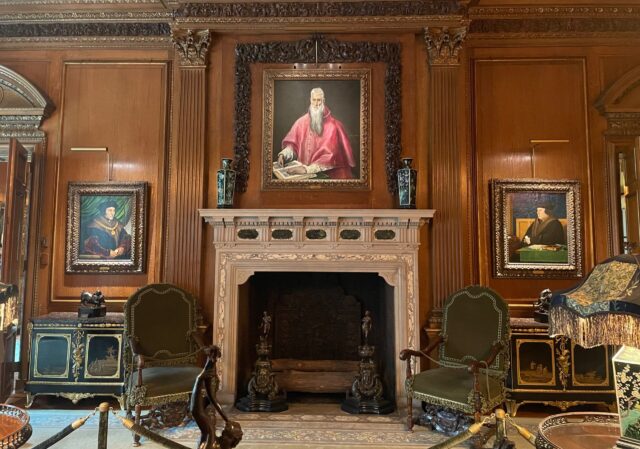
El Greco’s St. Jerome is once again flanked by Hans Holbein the Younger’s Sir Thomas More and Thomas Cromwell (photo by twi-ny/mdr)

THE FRICK COLLECTION
1 East 70th St. at Fifth Ave.
Wednesday – Sunday, $17-$30 (pay-what-you-wish Wednesdays 2:00–6:00)
www.frick.org

The Frick is my happy place.

Judging by the smiles on the faces of the hundreds of other Fricksters I encountered at a recent members preview of the reopened Fifth Ave. institution, I am far from the only one.

In 1913, American industrialist and art collector Henry Clay Frick commissioned the architecture firm of Carrère and Hastings to design the building as both a private home and a public resource. Frick died in 1919 at the age of sixty-nine; his daughter, Helen Clay Frick, served as a founding trustee of the collection and, in 1920, established the Frick Art Reference Library. In 1931, the building was adapted into a museum by architect John Russell Pope. The Frick Collection opened on December 11, 1935, for distinguished guests; three days later, ARTnews editor Alfred M. Frankfurter wrote that it is “one of the most important events in the history of American collecting and appreciation of art.”

The Frick closed in March 2020 for a major renovation, temporarily moving its remarkable holdings to the nearby Breuer Building on Seventy-Fifth and Madison, the former home of the Whitney. On April 17, the Frick will reopen to the public, with ten percent more square footage, going from 178,000 square feet to 196,000, including 60,000 square feet of repurposed space and 27,000 square feet of new construction, increasing the gallery space by thirty percent, highlighted by the unveiling of the second floor, which has been converted from administrative offices to fifteen rooms of masterpieces. The renovation and revitalization also features a new Reception Hall, Education Room, and 218-seat auditorium.
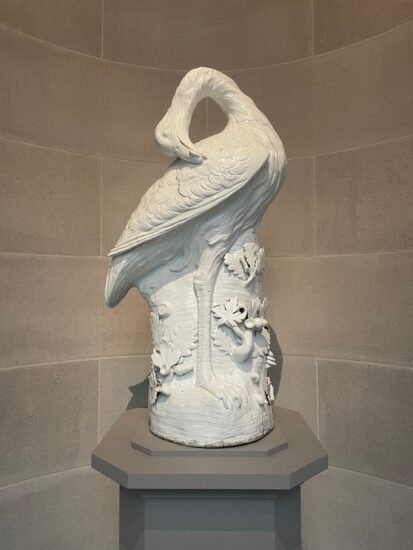
The 1732 Great Bustard resides on a pedestal near the Garden Court fountain (photo by twi-ny/mdr)

The main floor will be familiar to anyone who has ever visited the Frick; amid some minor changes, the twenty rooms have remained mostly intact. The Gainsboroughs are in the Dining Room, Boucher’s The Four Seasons are in the West Vestibule, four Whistler portraits stand tall in the Oval Room, Fragonard’s The Progress of Love series populates the Fragonard Room, and Goya’s Portrait of a Lady (María Martínez de Puga?) brings mystery to the East Gallery.

El Greco’s Purification of the Temple can be found in the Anteroom, Tiepolo’s Perseus and Andromeda in the East Vestibule, and Vecchietta’s The Resurrection in the Octagon Room. John C. Johansen’s portrait of Henry Clay Frick enjoys primo placement in the Library, where he is joined by Gilbert Stuart’s 1795 portrait of George Washington and numerous canvases by such British artists as Reynolds, Gainsborough, Romney, Turner, and Constable, whose Salisbury Cathedral from the Bishop’s Grounds has delighted me over and over again.

The Garden Court, with its peaceful fountain surrounded by columns, plantings, and Barbet’s Angel, is one of the loveliest indoor respites in the city.
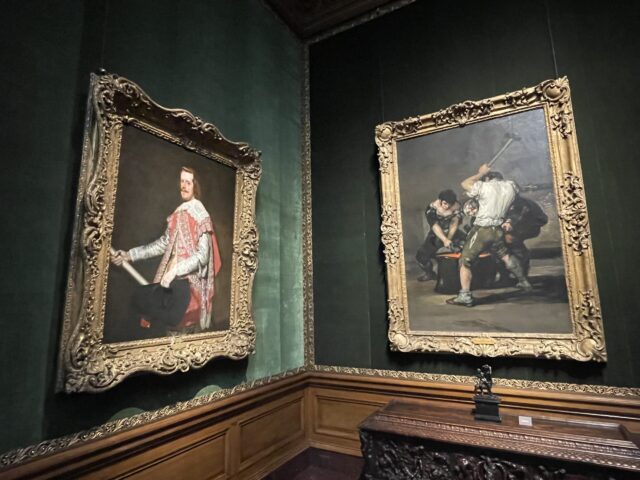
Velázquez’s King Philip IV of Spain and Goya’s The Forge hang catty corner in the West Gallery (photo by twi-ny/mdr)

The glorious West Gallery houses many of the greatest hits, from Rembrandt’s stunning 1658 Self-Portrait and Velázquez’s regal King Philip IV of Spain to Goya’s gritty The Forge and Veronese’s enigmatic parable The Choice Between Virtue and Vice, along with a pair of gorgeous Turner port scenes, Corot’s captivating landscape The Lake, Vermeer’s Mistress and Maid, portraits by El Greco, Hals, Goya, and Van Dyke, and more than a dozen small mythological sculptures.
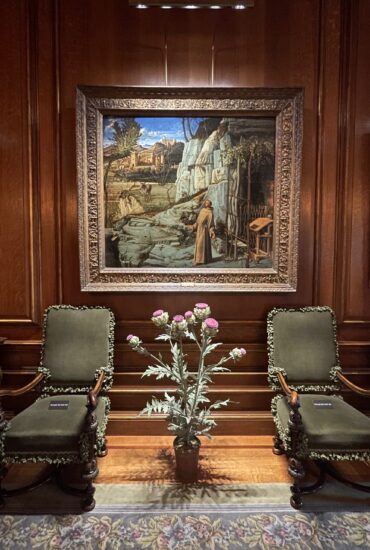
Bellini’s St. Francis in the Desert no longer has its own room but is coping (photo by twi-ny/mdr)

The centerpiece of the Frick has always been the Living Hall, with magisterial furniture, chandeliers, large vases, and a five-hundred-year-old Persian carpet. On one wall, Titian’s Pietro Aretino and Portrait of a Man in a Red Hat flank Bellini’s St. Francis in the Desert, which in the Frick Madison had its own room. Opposite that trio is the pièce de résistance: El Greco’s elongated St. Jerome stares out above the fireplace; to his left and right, respectively, are Hans Holbein the Younger’s stunning portraits of archenemies Thomas Cromwell and Sir Thomas More, the latter, in my opinion, the most spectacular portrait in the history of Western art. Its name, the Living Hall, could not be more appropriate, as it feels lived in.
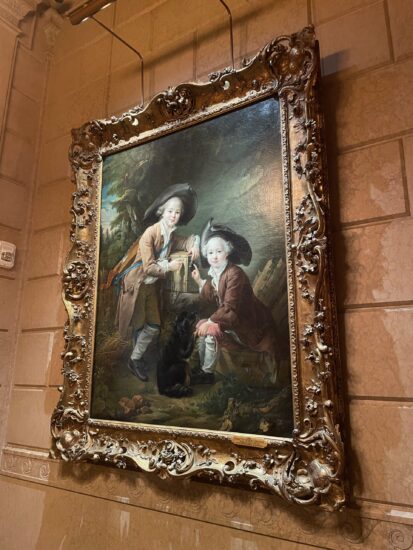
Drouais’s The Comte and Chevalier de Choiseul as Savoyards is near the base of the stairs (photo by twi-ny/mdr)

The South Hall offers two Vermeers, Girl Interrupted at Her Music and Officer and Laughing Girl, facing a Frick fan favorite, Bronzino’s Lodovico Capponi, with its cleverly placed sword. After years of appearing behind the ropes that bar visitors from going upstairs, Drouais’s The Comte and Chevalier de Choiseul as Savoyards, depicting two young boys smiling like the cat who ate the canary, can now be approached before you make your pilgrimage to newly sanctified land.

And then, there it is: the Grand Stairway leading to the previously off-limits second floor. The looks as people make their way to the steps are fascinating, a mix of bated breath, yearning, excited anticipation, and even stealth, as if some museumgoers still can’t believe it is allowed. At the landing is a decorative screen and an Aeolian-Skinner organ that was once played by Archer Gibson for Henry and at dinner parties. At the top is Pierre-Auguste Renoir’s La Promenade, a lush oil of a woman and two young twin sisters that used to reside near the base of the stairs and now serves as a fine introduction to the myriad treasures upstairs.
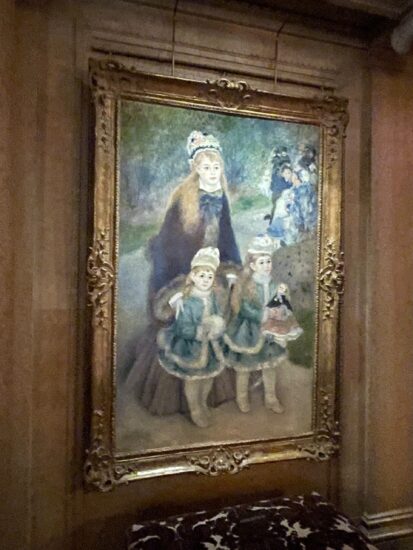
Pierre-Auguste Renoir’s La Promenade greets visitors at the top of the Grand Stairway (photo by twi-ny/mdr)

The second floor is a mazelike procession of tighter spaces where the Fricks lived, again adorned with dazzling classics and lesser-known works that were not regularly on view in the past. Corot’s Ville-d’Avray and The Pond are in the Breakfast Room, with sets of jars and wine coolers and Théodore Rousseau’s The Village of Becquigny. Manet’s The Bullfight can now be found in the Impressionist Room, joined by Degas’s The Rehearsal and Monet’s Vétheuil in Winter, which had numerous people gasping. “I don’t remember ever seeing this before,” one woman said, and others nodded. Don’t miss Watteau’s The Portal of Valenciennes in the Small Hallway.
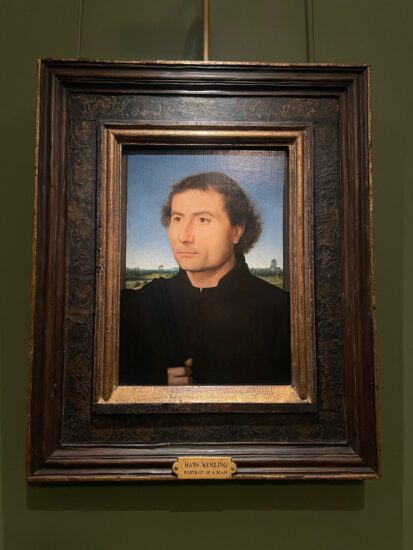
Hans Memling’s Portrait of a Man is now upstairs in the Sitting Room at the Frick (photo by twi-ny/mdr)

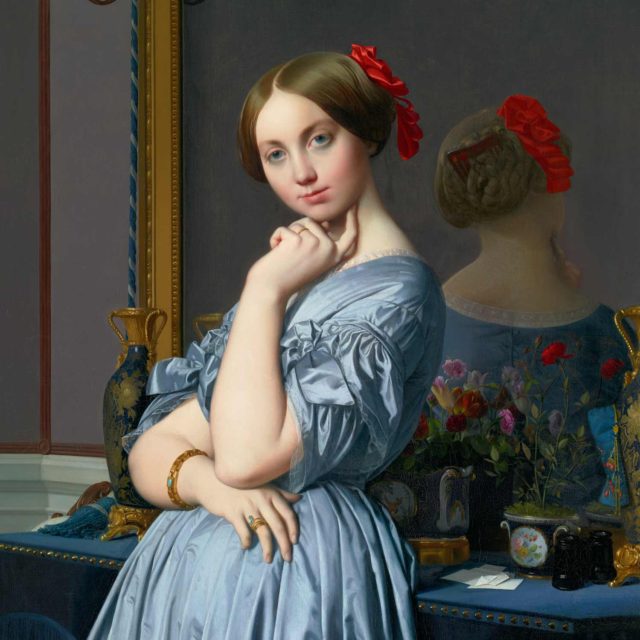
The Gold-Grounds Room gathers such religious works as Fra Filippo Lippi’s The Annunciation, Piero della Francesca’s The Crucifixion, and Paolo Veneziano’s The Coronation of the Virgin. Although there is a user-friendly app that tells you where everything is, I preferred searching on my own and was thrilled when I finally located Hans Memling’s Portrait of a Man in the Sitting Room, a depiction of an invitingly calm, laid-back man. Ingres’s Louise, Princesse de Broglie, Later the Comtesse d’Haussonville, another Frick fave, now holds court in the Walnut Room, near Houdon’s marble Madame His.

Among the other second-floor galleries are the Clocks and Watches Room, the Du Paquier Passage, the Boucher Room and Anteroom, the Ceramics Room, the Medals Room, and the Lajoue Passage, each with their own charm. And be sure to check out the hallway ceilings, covered in a beautiful mural with fabulous detail in the corners and ends.
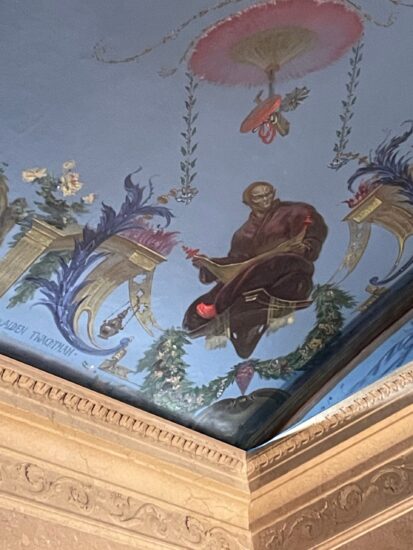
The corners of the second-floor ceiling murals hold tiny gems (photo by twi-ny/mdr)

As recently retired former Frick director Ian Waldropper notes in the Frick’s Essential Guide, “The reopening of the renovated Frick Collection is cause for celebration.” It’s an inspiring place to visit old friends and make new ones, to see masterpieces in literal and figurative new light. One way the Frick has not changed is that the institution still does not allow any photos or videos, except at the early members and press previews. At first, I wasn’t going to take any pictures, but then I heard a few guards say, “Get out your cameras now, because you won’t be allowed to starting April 17.”

My happy place is back, and just in time.

There are two current special exhibitions; “Highlights of Drawings from the Frick Collection,” continuing in the Cabinet through August 11, consists of a dozen rarely displayed works, from Pisanello’s haunting pen and brown ink Studies of Men Hanging and Whistler’s surprising black chalk and pastel Venetian Canal to Goya’s brush and brown wash The Anglers and the coup de grâce, Ingres’s graphite and black chalk study for Louise, Princesse de Broglie . . .
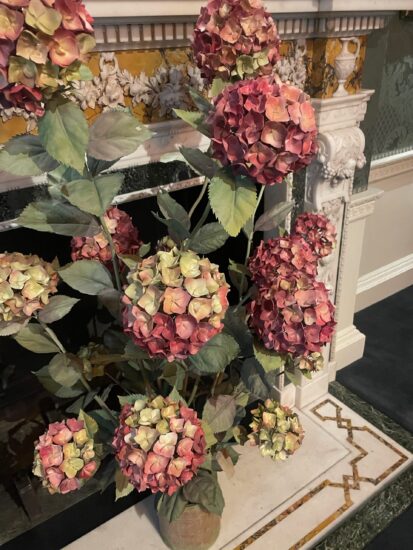
Vladimir Kanevsky’s porcelain hydrangeas can be found in the Breakfast Room (photo by twi-ny/mdr)

Meanwhile, for “Porcelain Garden,” US-based Ukrainian artist Vladimir Kanevsky has installed porcelain flowers in nineteen locations throughout the Frick, on the floor and on tables, in vases and pots, creating a dialogue between the fragile plants and the museum’s many treasures; you’ll find lilacs in the Dining Room, foxgloves in the West Vestibule, cascading roses and white hyacinths in the Fragonard Room, dahlia branches and anemones in the Portico Gallery, and a lemon tree in the Garden Court, among others.

And from June 18 to August 31, “Vermeer’s Love Letters” unites the Frick’s Mistress and Maid with the Rijksmuseum’s Love Letter and the National Gallery of Ireland’s Woman Writing a Letter, with Her Maid.

Below are only some of the scheduled programs, with more to come.

Friday, April 18
Gallery Talk: A Home for Art, Library Gallery, free with museum admission, 6:00 & 7:00

Gallery Talk: Closer Look at Vermeer’s Mistress and Maid, West Gallery, free with museum admission, 6:00 & 7:00

Friday, April 25
Gallery Talk: A Home for Art, Library Gallery, free with museum admission, 6:00 & 7:00

Saturday, April 26
Spring Music Festival: Jupiter Ensemble, Lea Desandre, Anthony Roth Costanzo, Stephen A. Schwarzman Auditorium, 7:00

Thursday, May 1
Spring Music Festival: Takács Quartet and Jeremy Denk, Piano, Stephen A. Schwarzman Auditorium, 7:00

Saturday, May 3
Spring Music Festival: Sarah Rothenberg, Solo Piano, Stephen A. Schwarzman Auditorium, 7:00

Sunday, May 4
Spring Music Festival: Alexi Kenney, Violin and Amy Yang, Fortepiano, Stephen A. Schwarzman Auditorium, 7:00

Thursday, May 8
Sketch Night, free with advance RSVP, 5:00
Spring Music Festival: Emi Ferguson, Flute and Ruckus, Baroque Ensemble, Stephen A. Schwarzman Auditorium, 7:00

Friday, May 9
Stephen K. and Janie Woo Scher Fellow Lecture: The Milicz Medals of Johann Friedrich of Saxony and the Subtleties of Political Art in the Age of Reformation, with Maximilian Kummer, Ian Wardropper Education Room, free with advance RSVP, 6:00

Sunday, May 11
Spring Music Festival: Mishka Rushdie Momen, Solo Piano, Stephen A. Schwarzman Auditorium, 5:00

[Mark Rifkin is a Brooklyn-born, Manhattan-based writer and editor; you can follow him on Substack here.]
CAPTURING HOLBEIN: THE ARTIST IN CONTEXT

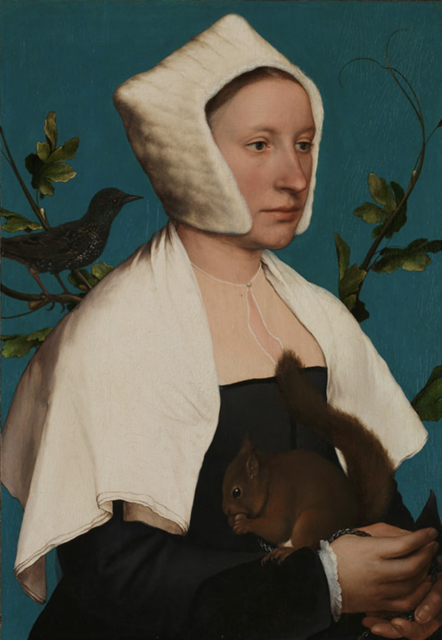
Hans Holbein the Younger, A Lady with a Squirrel and a Starling (Anne Lovell?), oil on panel, ca. 1526–28 (National Gallery, London)

CAPTURING HOLBEIN: THE ARTIST IN CONTEXT
The Morgan Library & Museum, Gilder Lehrman Hall
225 Madison Ave. at Thirty-Sixth St.
Friday, May 6, $30, 2:00 – 6:30
“Capturing Holbein: The Artist in Context” continues through May 15
www.themorgan.org

“Welcome to the house / to the Haus of Holbein / Ja, ooh ja, das ist gut / Ooh ja, ja / The Haus of Holbein,” the characters sing in the hit Broadway musical Six, about the six wives of Henry VIII, the king for whom Hans Holbein the Younger (1497/98–1543) was the court painter.

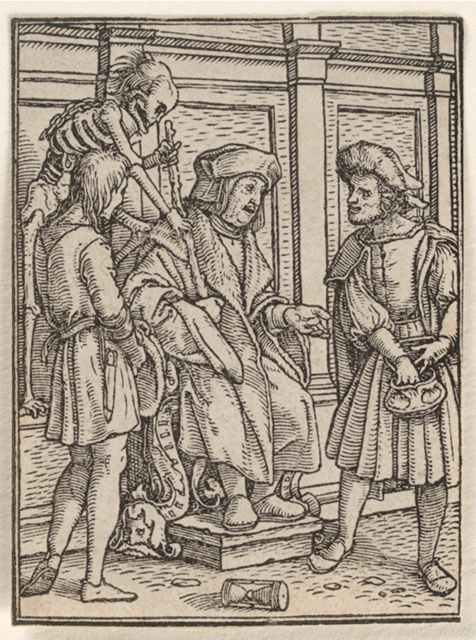
Hans Lützelburger, after designs by Hans Holbein the Younger, Death and the Judge, woodcuts, ca. 1526 (the Metropolitan Museum of Art, New York, Rogers Fund, 1919)

Right now the Haus of Holbein is the Morgan Library, which is hosting the revelatory exhibition “Holbein: Capturing Character” through May 15. The German-Swiss Holbein was best known for his exquisitely detailed portraiture, including his remarkable 1527 depiction of Sir Thomas More, on loan here from the Frick. These portraits — A Lady with a Squirrel and a Starling (Anne Lovell?), A Member of the Wedigh Family, the miniatures Portrait of a Court Official of Henry VIII and Simon George, Roundel Portrait of the Printer Johann Froben of Basel, a painting of his early supporter Erasmus, which features the phrase “I yield to none” — go deep inside his subjects, becoming not mere representations in oil but a look into their souls. In her catalog essay “The Pictorial Eloquence of Hans Holbein the Younger,” J. Paul Getty Museum curator Anne T. Woollett writes that the exhibit “considers how the artist engaged with the philosophical debate about the superiority of the written word over the painted image to convey an individual’s interior qualities. Holbein’s masterful manipulation of the viewing experience emerges through close examination of his drawings, paintings, and related works of art such as portrait medals and symbolic jewels.”

But amid all this glorious work, it is Holbein’s 1524–25 print series, “Images of Death,” that is most memorable. A collaboration with blockcutter Hans Lützelburger and based on the medieval danse macabre, “Images of Death” is a startling narrative that follows the skeletal Death as he confronts royals and peasants alike, holding aloft an hourglass, engaging in battle, playing instruments, and leading people to their ultimate, inescapable fate, which comes to everyone regardless of their wealth or power.

On May 6 from 2:00 to 6:30, the Morgan is hosting the afternoon symposium “Capturing Holbein: The Artist in Context” in the museum’s Gilder Lehrman Hall; the program consists of six presentations in addition to the keynote lecture, “Becoming Holbein: Art and Portraiture,” by Jochen Sander of the Städel Museum: “Flexibility and Rapport: Holbein’s Working Method” by Woollett, “Inherent Ingenuity: Holbein’s Portrait of Georg Gisze (1532)” by Alexander Marr of Cambridge University, “Drawing in Time: Portrait Studies by Holbein and His Contemporaries” by the Morgan’s Austėja Mackelaitė, “The Contexts for Character in Holbein’s Narrative Prints” by Jeanne Nuechterlein of York University, “Metalwork Design Drawings from the Circle of Hans Holbein the Younger” by Olenka Horbatsch of the British Museum, and “‘Foolish Curiosity’: Holbein’s Earliest English Afterlives” by Adam Eaker of the Met.

Even if you can’t make the symposium — perhaps the Morgan will record it and make it available later online — be sure to see the exhibit, co-organized with the Getty, before it leaves town. As Morgan director Colin B. Bailey says in the above video, “[Holbein] was the greatest artist of the sixteenth century working in England but really one of the greatest artists of the European Renaissance. His works are rare, they’re fragile, they’re precious, they’re rarely lent, and that’s why this exhibition is such an opportunity.”

FRICK MADISON AND THE SLEEVE SHOULD BE ILLEGAL

Jean-Auguste-Dominique Ingres, Comtesse d’Haussonville, oil on canvas, 1845 (Purchased by the Frick Collection, 1927)

FRICK MADISON AND THE SLEEVE SHOULD BE ILLEGAL
945 Madison Avenue at 75th Street
Thursday – Sunday, $12-$22 (includes free guide), 10:00 am – 6:00 pm
www.frick.org/madison

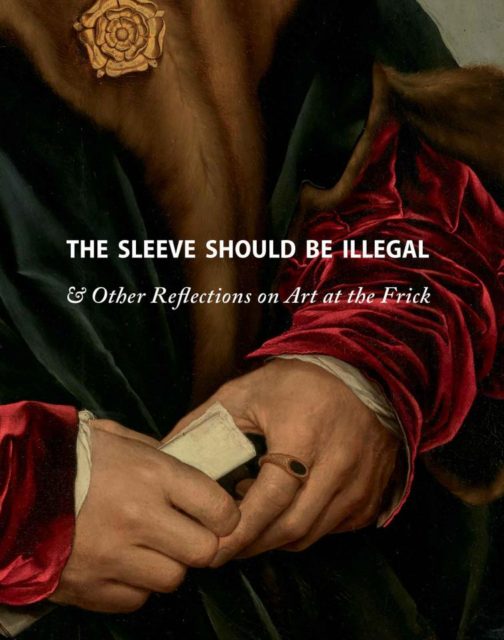
For the first twelve months of the pandemic, the Frick, my favorite place in New York City, was my “virtual home-away-from-home” when it came to art. And I mean that in a different way than Lloyd Schwartz does in his piece on Johannes Vermeer’s Officer and Laughing Girl in the recently published book The Sleeve Should Be Illegal & Other Reflections on Art at the Frick, in which the poet and classical music critic uses that phrase to describe what the museum, opened to the public in 1935 at Fifth Ave. and Seventieth St., meant to him when he was growing up in Brooklyn and Queens. The book features more than sixty artists, curators, writers, musicians, and philanthropists waxing poetic about their most-admired work in the Frick Collection.

A native of Brooklyn myself, I am referring specifically to the institution’s online presence during the coronavirus crisis. It had closed in March 2020 for a major two-year renovation, moving its remarkable holdings to the nearby Breuer Building on Seventy-Fifth and Madison, the former home of the Whitney from 1966 to 2014, then host to the Met Breuer for an abbreviated four years. Starting in April 2020 and continuing through last month, chief curator Xavier F. Salomon (and occasionally curator Aimee Ng) gave spectacular prerecorded illustrated art history lectures on Fridays at 5:00 focusing on one specific work in the museum’s holdings; thousands of people from around the world tuned in live to learn more about these masterpieces. Two questions added a frisson of excitement for devoted fans: What cocktail would the curator select to enjoy with the painting, sculpture, or porcelain/enamel object that week? And which smoking jacket would Xavier be rocking? These sixty-six marvelous “Cocktails with a Curator” episodes can still be seen here.

For more than half my life, the Frick has been the spot I go to when I need a break from troubled times, a respite from the craziness of the city, a few moments of peace amid the maelstrom. Going to the Frick, which was designed by Carrère and Hastings and served as the home of Pennsylvania-born industrialist Henry Clay Frick from 1914 until his death in 1919 at the age of sixty-nine, was like visiting old friends, reflecting on my existence among familiar and welcoming surroundings. There is still nothing like sitting on a marble bench in John Russell Pope’s Garden Court, with its lush plantings, austere columns, and lovely fountain, in between continuing my intimate, personal relationships with cherished canvases. In Sleeve, philanthropist Joan K. Davidson writes about Giambattista Tiepolo’s Perseus and Andromeda, “Entering the Frick, the visitor tends to head to the galleries where the Fragonards, Titians, El Greco, the great Holbeins, and other Frick Top Treasures are to be found. Or, perhaps, you turn left to the splendid English portraits in the Dining Room. But not so fast, please. You could miss my picture!” I am not nearly so generous as Davidson, not at all ready to share my prized works with others, preferring alone time with each.

After being teased by Salomon’s discussion of Rembrandt’s impossibly powerful 1658 self-portrait, which gave a glimpse of where it is on display at Frick Madison, it was with excitement and more than a little trepidation that I finally ventured toward Marcel Breuer’s Brutalist building, worried it would feel like seeing friends in a hotel where they’re staying while their kitchen is being remodeled. As artist Darren Waterston admits in his piece on Giovanni Bellini’s St. Francis in the Desert, about his first pilgrimage to the museum, “I remember feeling a nervous anticipation as I approached the Frick, as if I were meeting a lost relative or a new lover for the first time.” He now makes sure to return at least once every year.

In addition, I was poring over Sleeve, a cornucopia of Frick love. Many of the rapturous entries are just as much about the institution itself and how the pieces are arranged as the chosen object. Writing about the circle of Konrad Witz’s Pietà, short story writer and translator Lydia Davis explains, “Because of the reliable permanence of the collection — the paintings usually hanging where I knew to find them — they became engraved in my memory. Over time, of course, I changed, so my experience of the paintings also changed.” Fashion designer Carolina Herrera, praising Goya’s Don Pedro, Duque de Osuna, notes, “I would love to move in. And, as one does, I would like to move the furniture around, hang the paintings in different places, and put some of the objects away, to change them from time to time.”

While I had contemplated moving in, I had never considered rearranging anything, although I was blown away when, after decades of seeing Hans Holbein the Younger’s portrait of Sir Thomas More in the Living Hall, where it looks over at Holbein’s portrait of More’s archnemesis, Sir Thomas Cromwell, well above eye level and separated by a fireplace and El Greco’s exquisite painting of St. Jerome, I was able to belly up to the canvas at my height when it was displayed temporarily in the Oval Room, leaving me, as curator Edgar Munhall pointed out on the audio guide, “weak in the knees.” Entering Frick Madison, my thoughts zeroed in on my impending rendezvous with Holbein and More.

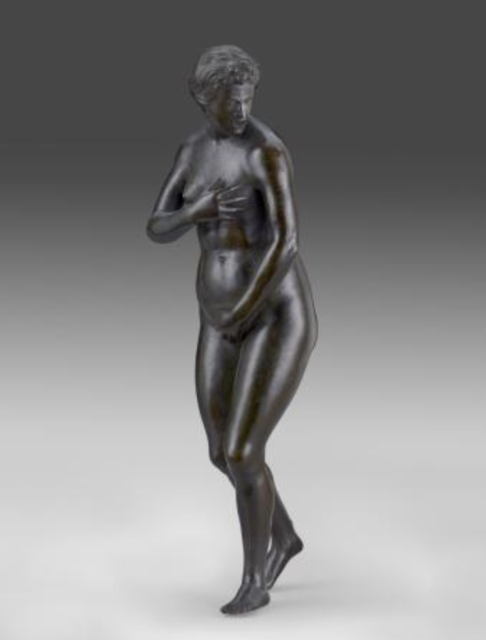
Unknown artist (Mantua?), Nude Female Figure (Shouting Woman), bronze with silver inlays, early 16th century (Henry Clay Frick Bequest)

Five people melt over the More portrait in Sleeve; in fact, the title of the book comes from novelist Jonathan Lethem’s foray into the work. Nina Katchadourian raves, “Every time I visit the Frick, I go to the Living Hall to look at Holbein’s portrait of Sir Thomas More. I love it as a painting, but I also see it as the first spark in a series of chain reactions that happen among objects in the room. . . . It is a staging of masterpieces that is itself a masterpiece of staging.” I quickly found the canvas, in its own nook with Cromwell, as if there were nothing else in the world but the two of them. You can get dangerously close to the breathtaking canvases, glorying in Holbein’s remarkable brushwork, his unique ability to capture the essence of each man in a drape of cloth, a ring, a stray hair, a bit of white fabric sticking out from a fur collar.

Utterly pleased and satisfied with the placement of the Holbeins — while I did miss all the finery usually surrounding them, seeing them both so unencumbered just felt right — I continued my adventure to track down other old friends and make new ones. St. Francis in the Desert, a work that demands multiple viewings, with new details emerging every time, usually hangs across from More, but here it has its own well-deserved room. Referring to St. Francis’s position in the painting, hands spread to his sides, looking up at the heavens, artist Rachel Feinstein writes, “That moment of isolation is fascinating in the context of the situation we are in now because of COVID-19. Our family of five may not be living alone in a cave right now, but due to the current circumstances, we have turned more inward, like St. Francis. Looking at this image and its sharp clarity during this time of fear and uncertainty is very soothing and inspirational.”

Trips to the Frick bring up childhood memories for many Sleeve contributors (Lethem, Moeko Fujii, Bryan Ferry, Stephen Ellcock, Julie Mehretu); describing seeing Rembrandt’s Polish Rider for the first time in high school, novelist Jerome Charyn remembers, “He could have been a hoodlum from the South Bronx with his orange pants and orange crown. . . . I left the Frick in a dream. I had found a mirror of my own wildness on Fifth Avenue, a piece of the Bronx steppe.” Donald Fagen and Abbi Jacobson recall lost love, while Frank, Edmund De Waal, and Adam Gopnik bring up Marcel Proust. Arlene Shechet and Wangechi Mutu find the feminist power in the early sixteenth century sculpture Nude Female Figure (Shouting Woman). “Making a small work is an unforgiving process,” Shechet writes. “There is no room for missteps, and the Shouting Woman is an example of exquisite perfection, her bold demeanor wrought with great feeling and delicacy. The plush palace that is the Frick becomes eminently more compelling when I visit with this giant of a sculpture.”

Artist Tom Bianchi gets political when delving into Goya’s The Forge, a harrowing canvas that depicts blacksmiths hard at work as if in hell. “The presence of The Forge in the collection is an anomaly,” Bianchi explains. “Frick’s fortune was built on the labor of steelworkers, whose union he infamously opposed. His reduction of the salaries of his workers resulted in the Homestead strike in 1892, in which seven striking workers and three guards were killed and scores more injured. Ultimately, Frick replaced the striking workers, mostly southern and eastern European immigrants, with African American workers, whom he paid a 20 percent lower wage. One wonders if Frick appreciated the irony of the inclusion of this painting among his Old Masters.”

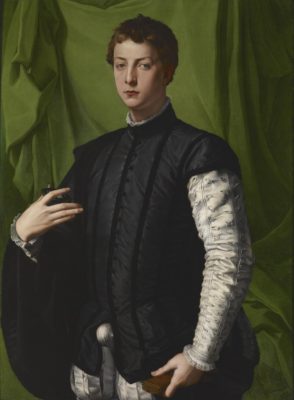
Agnolo Bronzino (Agnolo di Cosimo di Mariano), Lodovico Capponi, oil on panel, 1550–55 (The Frick Collection; Henry Clay Frick Bequest)

I’ve always had a minor issue with how the Frick’s three Vermeers, Officer and Laughing Girl, Mistress and Maid, and Girl Interrupted at Her Music, are displayed; two of the three can usually be seen in the South Hall, above furniture, in a narrow space that is easy to pass by, especially if you are checking out the opposite Grand Staircase, which will at last be open to the public when the Frick reopens in mid-2023.

There are no such obstacles at Frick Madison, where all three are in the same room on the second floor. Together the Vermeers are feted by Fujii, Frank, Vivian Gornick, Gregory Crewdson, Susan Minot, Judith Thurman, and Schwartz. Meanwhile, various artists are completely shut out of Sleeve accolades, including Hans Memling (Portrait of a Man), Frans Hals (Portrait of an Elderly Man and Portrait of a Woman), François Boucher (The Four Seasons), Edgar Degas (The Rehearsal), John Constable (Salisbury Cathedral from the Bishop’s Grounds), Carel Fabritius (The Goldfinch), François-Hubert Drouais (The Comte and Chevalier de Choiseul as Savoyards), Paolo Veronese (Wisdom and Strength), and Pierre-Auguste Renoir (La Promenade). Rembrandt’s aforementioned self-portrait receives five nods (Roz Chast, Rineke Dijkstra, Diana Rigg, Jenny Saville, Mehretu), while Ingres’s Comtesse d’Hassuonville nets three (Jed Perl, Firelei Báez, Robert Wilson).

But the biggest surprise for me was the popularity of Bronzino’s Lodovico Capponi, chosen by Susanna Kaysen, David Masello, Daniel Mendelsohn, Annabelle Selldorf, and Catherine Opie. When I saw it at Frick Madison, I had no recollection whatsoever of the 1550s vertical oil painting of a page with the Medici court; it felt like I was seeing it for the very first time. It’s an arresting picture, highlighted by loose background drapery, the curious position of the fingers of each hand, the privileged look in his eyes, and, of course, the ridiculously funny codpiece/sword. As I stood in front of it, it did not strike me the way other portraits at the Frick do; in her “Cocktails with a Curator” entry on the piece, Ng says with a big smile, “This one really is one of my most favorite, if not favorite, works at the Frick. . . . I know I’m not the only one. . . . This is a painting that’s at the heart of many people who are close to the Frick.” When I go back to Frick Madison, which will be very soon, I’m going to spend more time with Lodovico, and I am already preparing myself to make a beeline for it when the original Frick reopens. I clearly must be missing something, as Lodovico has taken a brief sojourn to the Met, where it is not only included in the major exhibition “The Medici: Portraits and Politics, 1512–1570,” which runs through October 11, but is the cover image of the catalog.

Selldorf writes in her piece on Lodovico, “Art informs the space, but the space also informs the art.” Whether it’s the Frick Madison or the Frick on Fifth, “The genius, beauty, and mystery behind its doors may change your life,” Herrera promises. It’s changed myriad lives over its nine-decade existence, from other artists’ to just plain folks’ like you and me. You’re bound to fall in “love at first sight” — as New York Philharmonic principal cellist Carter Brey describes his initial encounter with George Romney’s Lady Hamilton as “Nature” — with at least one work at the Frick, something that will stay with you for a long time, an objet d’art you’ll visit again and again and develop a meaningful relationship with over the years. Just be sure to stay out of my way when I’m reconnecting with Sir Thomas More.