Tag Archives: Ghrai DeVore-Stokes

ALVIN AILEY AMERICAN DANCE THEATER AT BAM

Jamar Roberts’s Ode is a meditation on gun violence (photo by Paul Kolnik)

ALVIN AILEY AMERICAN DANCE THEATER
BAM Howard Gilman Opera House
30 Lafayette Ave. between Ashland Pl. & St. Felix St.
June 4-9, $37-$105
718-636-4100
www.bam.org

If you missed Alvin Ailey American Dance Theater’s annual monthlong visit to City Center this past November/December, you can still catch two programs from their sixty-fifth anniversary season, taking place at BAM’s Howard Gilman Opera House June 4-9. Alvin Ailey had close ties to BAM, dancing there in 1956 and starting a company residency in 1969.

“Contemporary Visions” consists of new productions of Jamar Roberts’s 2019 Ode, Hans van Manen’s 1997 Solo, and Alonzo King’s 2000 Following the Subtle Current Upstream. Set to Don Pullen’s “Suite (Sweet) Malcolm (Part 1 Memories and Gunshots),” Ode is a seventeen-minute meditation on gun violence, restaged by Ghrai Devore-Stokes. Solo, originally performed by the company in 2005 and restaged by Clifton Brown and Rachel Beaujean, is seven minutes of playful one-upmanship as three male dancers strut their stuff in a kind of dance-off, their costumes (by Keso Dekker) differentiated by yellow, orange, and red; as each finishes a solo, they make gestures and eye movements inviting the next dancer to top what they have just done. But this is no mere rap battle; instead, it’s set to Sigiswald Kuijken’s versions of Johann Sebastian Bach’s “Partita for Solo Violin No. 1 in B minor, BWV 1002 — Double: Presto” and “Partita for Solo Violin No. 1 in B minor, BWV 1002 — Double: Corrente.”
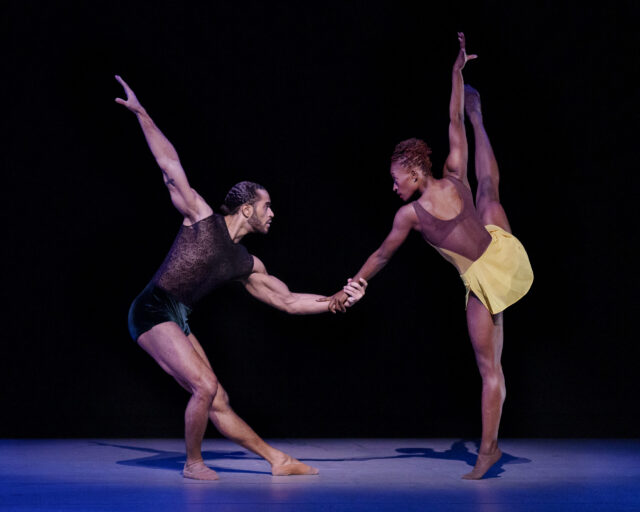
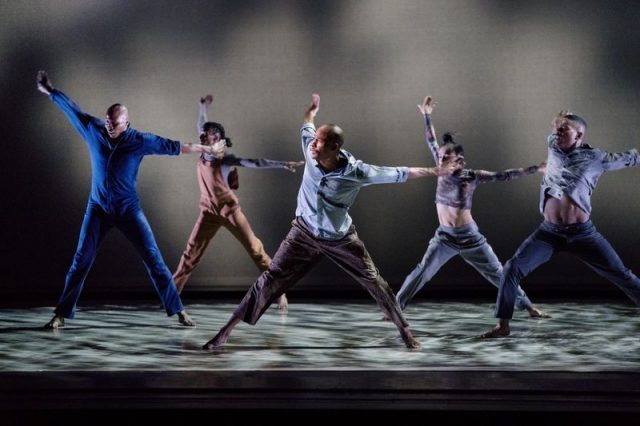
Alonzo King’s Following the Subtle Current Upstream is part of “Contemporary Visions” Ailey program at BAM (photo by Paul Kolnik)

And Following the Subtle Current Upstream, which King calls “a piece about how to return to joy,” is a twenty-two-minute work that unfolds in a series of vignettes with nine dancers performing to silence, a storm, chiming bells, and other sounds by Indian percussionist Zakir Hussain, American electronics composer Miguel Frasconi, and the late South African singer and activist Miriam Makeba. At one point a dancer is alone onstage, like a music box ballerina, two horizontal beams of smoky light overhead; the lighting is by Al Crawford based on Axel Morgenthaler’s original design, with tight-fitting, short costumes by Robert Rosenwasser, the men in all black, the women in black and/or yellow.

“All Ailey” is a treat for company aficionados, with presentations of the Ailey classics Memoria (1979), A Song for You (1972), Cry (1971), and Revelations (1960). Memoria, which will be performed with members of Ailey II and students from the Ailey School, was inspired by the death of Ailey’s friend and colleague Joyce Trisler; it is set to music by Keith Jarrett. A Song for You, an excerpt from Love Songs, features Donny Hathaway’s version of Leon Russell’s title track. Ailey choreographed the seventeen-minute Cry as a birthday gift for his mother. And Revelations is, well Revelations, one of the most famous and important dance works of all time.

[Mark Rifkin is a Brooklyn-born, Manhattan-based writer and editor; you can follow him on Substack here.]
ALVIN AILEY AMERICAN DANCE THEATER: ALL NEW AT CITY CENTER

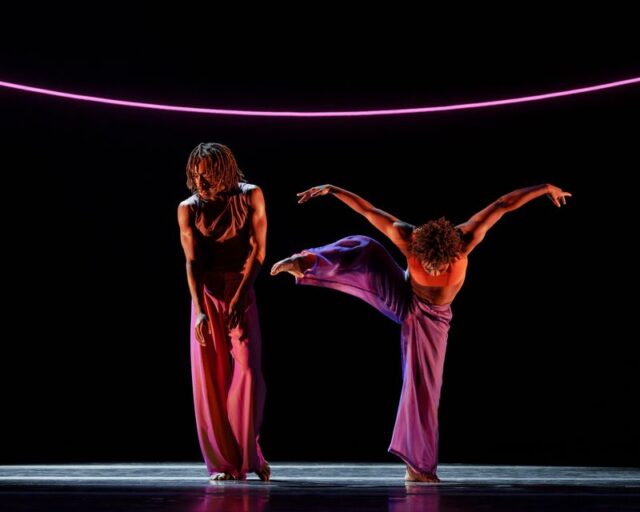
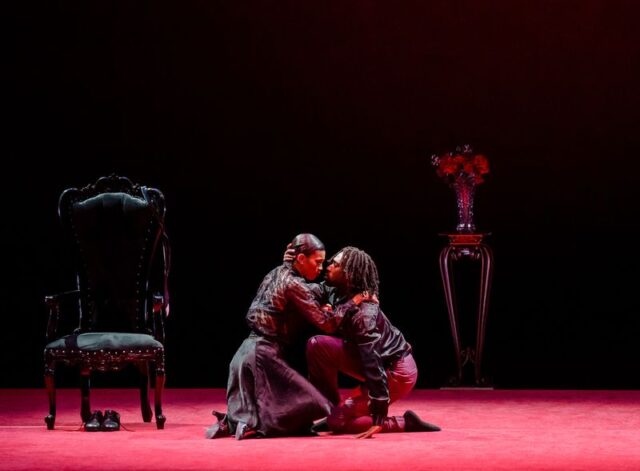
Ghrai DeVore-Stokes and Chalvar Monteiro explore love in Jamar Roberts’s In a Sentimental Mood (photo by Paul Kolnik)

ALVIN AILEY AMERICAN DANCE THEATER: ALL NEW
New York City Center
131 West 55th St. between Sixth & Seventh Aves.
Through December 24, $39-$169
www.alvinailey.org
www.nycitycenter.org

It was all about coupling, uncoupling, and never-coupling at Alvin Ailey American Dance Theater’s all-new program on December 15, part of the annual City Center season that continues through Christmas Eve. The evening began with the world premiere of Jamar Roberts’s poignant and emotional In a Sentimental Mood, in which Courtney Celeste Spears and Christopher R. Wilson follow the trajectory of a relationship in a dark and mysterious red-lit room. Spears appears first, dressed in a long white coat and white hat with red gloves, filled with hope as a scratchy recording of Duke Ellington’s “There’s Something About an Old Love” plays. She rips off her coat and hat to reveal a sexy black outfit underneath as she is joined by Christopher R. Wilson and the two get romantic to Rafiq Bhatia’s version of “The First Time Ever I Saw Your Face,” featuring vocalist Cécile McLorin Salvant, who sings, “The first time ever I kissed your mouth / I felt the earth move in my hand / Like the trembling heart of a captive bird,” holding the last word for a jarring, extended period. As Roberts’s sharp, angular choreography continues, the dancers experience an angry, then melancholic setback and try to reunite to Ornette Coleman’s “Lonely Woman” and Ellington’s “Single Petal of a Rose.” It’s a lovely piece from former longtime Ailey dancer Roberts, who also designed the costumes and set, enhanced with stark lighting by Brandon Stirling Baker.

Belén Indhira Pereyra and Patrick Coker merge as one in Paul Taylor’s DUET (photo by Paul Kolnik)

Following a pause, Jacquelin Harris and Renaldo Maurice become one in the company premiere of Paul Taylor’s 1964 DUET, a classic pas de deux set to Franz Josef Haydn’s “The Seven Last Words of Christ” Sonata VII in E-flat major – Largo. Dressed in George Tacet’s tight-fitting, colorful bodysuits, Harris and Maurice move elegantly with sinewy expertise, their beings merging amid their confident love.

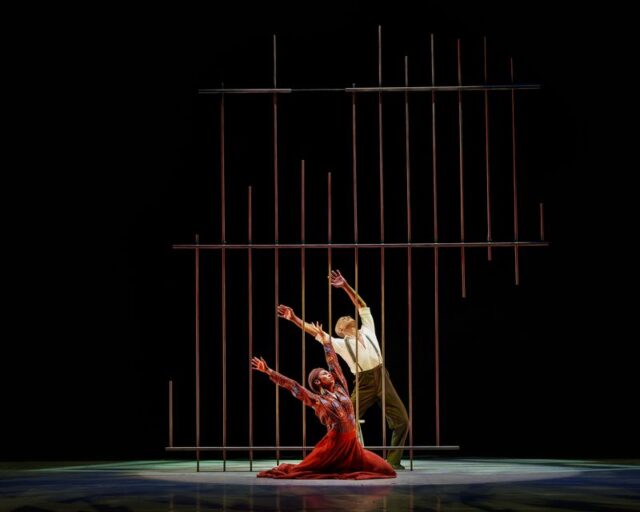
Vernard Gilmore and Ghrai DeVore-Stokes reach for freedom in Alvin Ailey’s Survivors (photo by Paul Kolnik)

After intermission, a new production of Ailey and Mary Barnett’s 1986 Survivors, restaged by Masazumi Chaya, focuses on the love story between Nelson and Winnie Mandela after his arrest. As jazz drummer Max Roach’s “Survivors” and “Triptych” practically explode (balanced by Peter Phillips’s stings), Harris, in a flowing red skirt and African top, and Yannick Lebrun, in brown pants, a white shirt, and suspenders, are separated by incomplete bars, evoking both the injustice of Apartheid and the possibility of freedom. (The costumes are by Toni-Leslie James, with original décor by Douglas Grekin and lighting by Tim Hunter.) They are accompanied by Wilson, Solomon Dumas, Hannah Alissa Richardson, Caroline T. Dartey, and Yazzmeen Laidler, wearing traditional South African hats and serving as a kind of Greek chorus. It’s a powerful work about a determined couple, all the more affecting since we know that Mandela was freed in 1990 and he and Winnie divorced in 1996.

Chalvar Monteiro and Ashley Green come together and break apart in Kyle Abraham’s Are You in Your Feelings? (photo by Paul Kolnik)

The world premiere of Kyle Abraham’s Are You in Your Feelings? brought the house down, an exhilarating celebration of Black culture. Through spoken dialogue and such songs as the Flamingos’ “I Only Have Eyes for You,” Lauryn Hill’s “Forgive Them Father,” Drake’s “That’s How You Feel,” Erykah Badu’s “I’ll Call U Back,” and Kendrick Lamar’s “LOVE. ft. Zacari,” seven women (Dartey, Ghrai DeVoire-Stokes, Samantha Figgins, Ashley Kaylynn Green, Ashey Mayeux, Miranda Quinn, and Deidre Rogan) and five men (Dumas, Maurice, James Gilmer, Chalvar Monteiro, and Jermaine Terry), flirt, diss, come together, and grow apart in front of a backdrop of a fluorescent semicircle and larger, flatter circle, suggesting the sun and the moon. At the center of it all are Monteiro and Green, who swirl, embrace, push away, and keep an eye on each other as various other couples, including two men, form and dissolve. There’s a little bit of West Side Story here, some Night Creature there, leading to a thrilling finale.

Are You in Your Feelings? bursts with a masterful, infectious energy that is a fitting conclusion to a night of love and separation, joy and sadness, humor and romance, starting and ending with the choreographers who are leading AAADT into the future, Roberts and Abraham.

AILEY VIRTUAL SPRING GALA: HOPE, PROMISE, AND THE FUTURE

Kanji Segawa’s Future is part of Alvin Ailey virtual spring gala (photo by Cherylynn Tsushima)

Who: Alvin Ailey American Dance Theater, Lonnie G. Bunch III, James E. Clyburn, Michelle Obama, DJ M.O.S., DJ Kiss
What: Virtual gala
Where: Alvin Ailey online
When: Thursday, June 24, free with RSVP, 7:30 (available for forty-eight hours)
Why: Alvin Ailey American Dance Theater’s virtual spring gala looks ahead with a public celebration of “Hope, Promise and the Future.” On June 24 at 7:30, the company, founded in 1958 and dedicated “to further the pioneering vision of the choreographer, dancer, and cultural leader Alvin Ailey by building an extended cultural community which provides dance performances, training and education, and community programs for all people,” will present a special program of dance and recognizing honorees. The evening features works by Ghrai DeVore-Stokes (Hope), Chalvar Monteiro (Promise), and Kanji Segawa (Future), filmed in such locations as Hudson Yards, St. Nicholas Park, and the Unisphere, in addition to artistic director Robert Battle’s For Four, set to Wynton Marsalis’s “Delfeayo’s Dilemma,” and Bird Lives!, a Charlie Parker tribute with Clifton Brown and students from the Ailey School. AAADT will also honor Secretary of the Smithsonian Lonnie G. Bunch III and the late congressman John L. Lewis, the latter with reflections from Congressman James E. Clyburn, excerpts from Jamar Roberts’s March on Washington Film Festival commission In Memory, and an appearance by former first lady Michelle Obama. “Over the past year, we’ve learned to focus on the opportunity of this moment, not the challenges, and the privilege of carrying on the legacy of Alvin Ailey that speaks to all of us,” Battle said in a statement. “Instilled in movement is a message of hope that helps us look towards the bright promise of our future together. We’re delighted to have this opportunity to share Ailey’s inspiring artistry in new dance films and honor a legend of the civil rights movement as we join in a virtual celebration with our community around the world.” The gala will be followed by a dance party with DJ M.O.S. and DJ Kiss. Admission is free with RSVP although donations will be accepted, and the presentation will be available on demand for forty-eight hours.

AILEY REVEALED: ALL NEW

(photo by Paul Kolnik)

Donald Byrd’s Greenwood looks at 1921 Tulsa Race Massacre (photo by Paul Kolnik)

ALVIN AILEY AMERICAN DANCE THEATER
New York City Center
130 West 56th St. between Sixth & Seventh Aves.
Through January 5, $29-$159
212-581-1212
www.alvinailey.org
www.nycitycenter.org

Alvin Ailey American Dance Theater’s monthlong 2019–20 annual winter season at City Center is titled “Ailey Revealed,” offering a potpourri of works that celebrate the company’s past, present, and future. Every year I attend one of the “All New” programs, and the one I saw on December 20 was, pun intended, a revelation. The evening began with choreographer Donald Byrd’s fifth work for the company, Greenwood, a stirring interpretation of the 1921 Tulsa Race Massacre, which is also the starting point of the sensational HBO series Watchmen. In the late spring of 1921, there was some kind of incident between white elevator operator Sarah Page (danced here by Danica Paulos) and black shoeshiner Dick Rowland (Chalvar Monteiro), a pair of teenagers who might have known each other and even had a relationship. For still unknown reasons, she screamed and he was arrested, imprisoned, and nearly lynched. When the black community marched to the jail to protest, the white community, already uneasy at the success of black businesses in Tulsa’s Greenwood district, known as “Black Wall Street,” used the situation as an excuse to rampage through the district, kill hundreds of black citizens, and destroy millions of dollars’ worth of property.

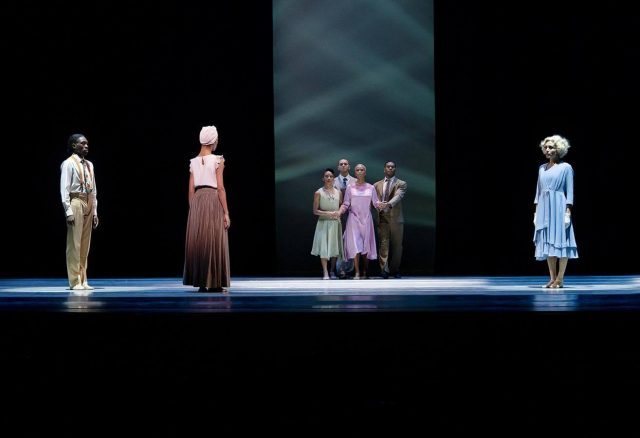
Set to original compositions by Israeli ambient music composer Emmanuel Witzthum (joined on two pieces by British musician Craig Tattersall) as well as two southern black folk songs, Greenwood is a fierce and powerful thirty-five-minute work. The elevator scene is repeated slightly differently several times, as if in differing recollections and retellings, each followed by Monteiro trying to escape (running in place) as two black couples, Clifton Brown and Jacquelin Harris and Solomon Dumas and Ghrai DeVore-Stokes, react alongside them and Ku Klux Klan members wreak havoc. The three couples are in conventional 1920s attire, the men in suits, the women in brightly colored long dresses, while the Klan (Jeroboam Bozeman, Patrick Coker, Samantha Figgins, James Gilmer, Michael Jackson Jr., Yannick Lebrun, and Miranda Quinn) is dressed in silver outfits and masks. (The superb costumes are by Doris Black; Watchmen fans are likely to think of “Mirror Guy” from the cable show.) Throughout the piece, Courtney Celeste Spears, in more traditional African apparel, walks slowly around the stage, solemnly bearing witness to the tragedy. A long opening in the back serves as an entrance and exit, Jack Mehler’s lighting changing colors as smoke emerges, as if hell awaits. Byrd refers to his recent work as a kind of “theater of disruption”; Greenwood more than captures that philosophy.

(photo by Paul Kolnik)

Camille A. Brown’s City of Rain is a tribute to a lost friend (photo by Paul Kolnik)

Following intermission is a new production of Lar Lubovitch’s sensual 1990 duet Fandango. The seventeen-minute work is performed by Paulos and Brown to Ravel’s “Bolero,” both in black costumes. They longingly explore each other’s body, much of the time moving on the floor. It’s like a sweet palette cleanser after the brute force of Greenwood and a tender lead-in to the company premiere of Camille A. Brown’s City of Rain, a reimagined version of the Tony winner’s 2010 work about the loss of her friend Greg “Blyes” Boomer, who died of a paralyzing illness the previous year.

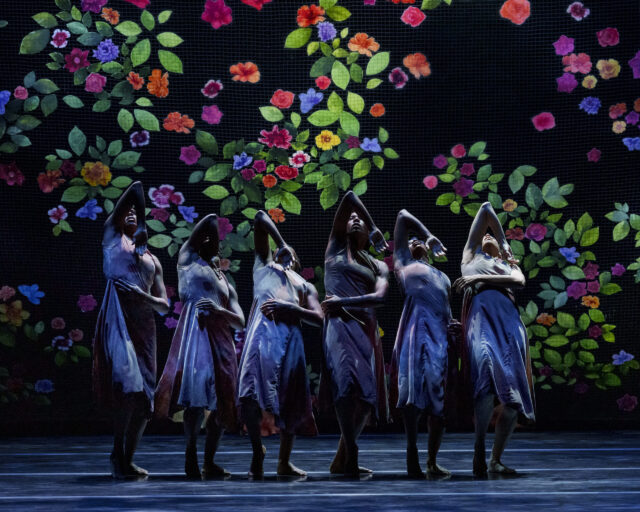
Set to Jonathan Melville Pratt’s “Two Way Dream” for strings, percussion, voice, synthesizers, and laptop, City of Rain features ten dancers (Jeroboam Bozeman, Patrick Coker, Solomon Dumas, Jacquelin Harris, Yannick Lebrun, Danica Paulos, Belén Indhira Pereyra, Miranda Quinn, Jessica Amber Pinkett, and Courtney Celeste Spears) moving in unison, rolling around on the floor, breaking off into smaller groups, and reaching toward the sky for seventeen minutes, in costumes by Mayte Natalio and with lighting by Burke Wilmore. Brown (The Groove to Nobody’s Business, The Evolution of a Secured Feminine) melds different styles in the emotionally gripping piece.

(photo by Paul Kolnik)

Aszure Barton’s BUSK is reimagined for Alvin Ailey (photo by Paul Kolnik)

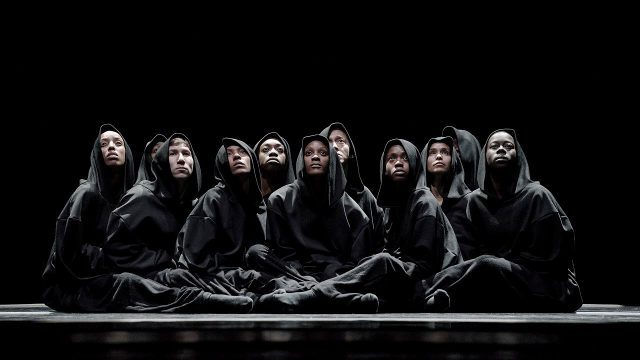
The evening concludes in a big way with the company premiere of Aszure Barton’s 2009 BUSK, in which the daring Canadian-born choreographer explores what she calls the “multitasking [and] the wisdom of the body.” Updated for this presentation and staged by Jonathan Alsberry, BUSK, which is named for the Spanish word “buscar,” meaning “to look for, is performed by thirteen dancers dressed in dark monks’ robes with hoods, designed by Michelle Jank. Nicole Pearce’s lighting and set includes a small stoop and a disco ball. The spectacular piece is packed with stunning moments and punctuated with surprise and delight: The dancers occasionally make funny faces, sit in a center circle and bow their heads, and wave white-gloved hands. A soloist has fun with a hat. An impressive chest is bared. The score consists of eight wide-ranging songs, by Camille Saint-Saëns, Moondog, Daniel Belanger, and others, that add to the unpredictability of the twenty-minute work. Barton’s previous Ailey piece was 2013’s Lift. Let’s hope it’s not another six years before the next one.

The City Center season, which wishes a fond farewell to longtime dancer and associate artistic director Masazumi Chaya, who has been with the company since 1970, continues through January 5. There will be all-new programs on December 28, January 1, and January 4 (with a mix from the above as well as a new production of Judith Jamison’s Divining and/or the world premiere of Jamar Roberts’s Ode). In addition, “Ailey Classics” takes place December 28 and January 3, “3 Visionaries” on December 24, and the season finale on January 5.