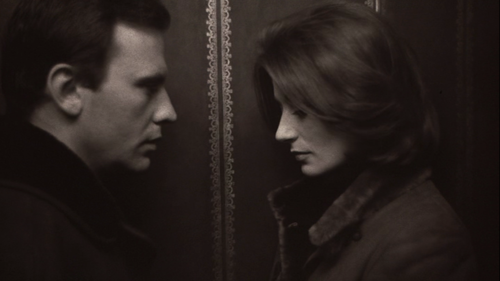
Anouk Aimée and Jean-Louis Trintignant play characters trying to escape their pasts in Claude Lelouch’s A MAN AND A WOMAN
A MAN AND A WOMAN (UN HOMME ET UNE FEMME) (Claude Lelouch, 1966)
French Institute Alliance Française, Florence Gould Hall
55 East 59th St. between Madison & Park Aves.
Tuesday, March 28, $40, 7:30
212-355-6100
fiaf.org
 Winner of both the Oscar for Best Foreign Language Film and the Palme d’Or at Cannes, Claude Lelouch’s A Man and a Woman is one of the most popular, and most unusual, romantic love stories ever put on film. FIAF is celebrating the work’s fiftieth anniversary by screening a newly restored version on March 28 as part of the Focus on French Cinema festival, followed by a Q&A with the seventy-nine-year-old Lelouch, who has also made such films as Vivre pour vivre, Les Uns et les Autres, La bonne année, and La Belle Histoire, and writer-director Philippe Azoulay. In A Man and a Woman, Oscar-nominated Anouk Aimée stars as Anne Gauthier and Jean-Louis Trintignant as Jean-Louis Duroc, two people who each has a child in a boarding school in Deauville. Anne, a former actress, and Jean-Louis, a successful racecar driver, seem to hit it off immediately, but they both have pasts that haunt them and threaten any kind of relationship. Shot in three weeks with a handheld camera by Lelouch, who earned nods for Best Director and Best Screenplay (with Pierre Uytterhoeven), A Man and a Woman is a tour de force of filmmaking, going from the modern day to the past via a series of flashbacks that at first alternate between color and black-and-white, then shift hues in curious, indeterminate ways. Much of the film takes place in cars, either as Jean-Louis races around a track or the protagonists sit in his red Mustang convertible and talk about their lives, their hopes, their fears. The heat they generate is palpable, making their reluctance to just fall madly, deeply in love that much more heart-wrenching, all set to a memorable soundtrack by Francis Lai. Lelouch, Trintignant, and Aimée revisited the story in 1986 with A Man and a Woman: 20 Years Later, without the same impact and success. There will also be a special twenty-minute excerpt from Azoulay’s upcoming documentary about Lelouch, Tourner Pour Vivre (Shoot to Live); the evening will conclude with an after-party featuring wine, cocktails, and hors d’oeuvres.

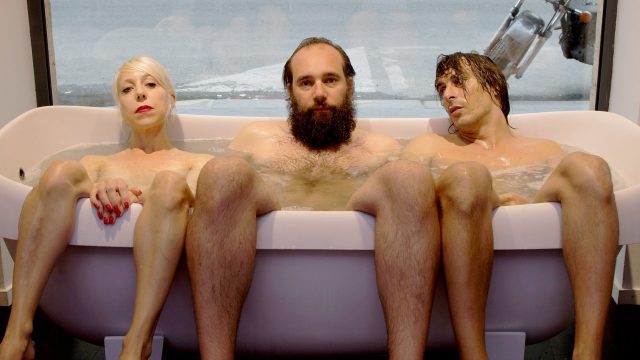
 FIAF’s “Comedy on Film: What Makes the French Laugh?” series continues on Valentine’s Day with Jean-Christophe Meurisses’s Apnée, a riotous, ludicrous, hysterical, and often cringeworthy absurdist fable about an anarchic trio of friends/lovers who flit about France doing anything they want, unaware of the consequences of their actions. Céline (Céline Fuhrer), Thomas (Thomas Scimeca), and Maxence (Maxence Tual) are all id, no ego and superego, as they live in their own reality, separate from the rest of what is considered conventional society. Wearing wedding dresses, they try to get married; seeking to relax, they take a bath together in a storefront window; in search of a family, they storm in on an older, empty nest couple. Indeed, they are like three children who don’t know any better, who haven’t reached basic levels of adulthood, but at their core, they just want to be happy, and what’s wrong with that? Writer-director Meurisses’s feature debut, which was nominated for Best First Film at the Cannes Film Festival (the Golden Camera) and the Lumière Awards as well as the
 FIAF’s Cinésalon series “Poetic and Political: The Cinema of Rabah Ameur-Zaïmeche” continues November 29 with Ameur-Zaïmeche’s second feature, Bled Number One (Back Home), the follow-up and kind of prequel to Wesh Wesh and the second part of an unofficial trilogy that concludes with