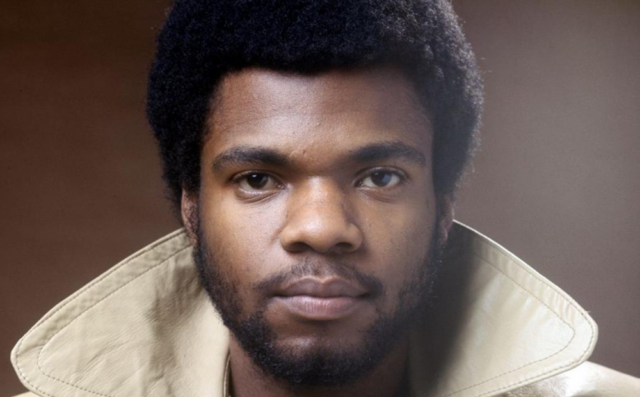
The life and career of Billy Preston held many surprises revealed in documentary
BILLY PRESTON: THAT’S THE WAY GOD PLANNED IT (Paris Barclay, 2024)
Film Forum
209 West Houston St.
Opens Friday, February 20 filmforum.org
“Will it go ’round in circles? / Will it fly high like a bird up in the sky?” Billy Preston sang in his 1973 smash hit. He might not have realized it then, but that line foretold his career, which had a seemingly endless series of ups until it all came crashing down.
The rise and fall of one of popular music’s most talented and beloved figures is intimately detailed in Paris Barclay’s revelatory documentary, Billy Preston: That’s the Way God Planned It.
Born in 1946 and raised in the church by his mother, gospel singer Robbie Lee Williams, Preston began playing the piano at age three, appeared on The Nat “King” Cole Show in 1957, accompanied Mahalia Jackson and Pearl Bailey on keyboards in the 1958 film St. Louis Blues, played with the gospel group the Cogics (Church of God in Christ), and as a teenager toured with Little Richard and the Rolling Stones. An enthusiastic man with an infectious gap-toothed smile and a collection of impressive wigs, Preston was soon recording with the Stones, Sam Cooke, Sly Stone, Ray Charles, and Aretha Franklin.
He singlehandedly rescued the Beatles when the Fab Four was preparing the Let It Be album and concert, just dropping by to say hello but then taking a seat at the organ and starting to improvise with John, Paul, George, and Ringo, infusing them with the energy they had been previous lacking as rumors swirled that the band was breaking up. The tabloids nicknamed him the Fifth Beatle and the Black Beatle. “He never put his hands in the wrong place,” Starr says in the film.
Preston might have been the ultimate sideman, but when performing he couldn’t help himself, often getting up and dancing wildly, joy emanating out of every pore. He couldn’t read music and never used charts but just felt the music blaze through him, even when playing backup. “He would steal the record without you even knowing until later, and you’d go, ‘He’s done it again,’” Clapton explains.
When Preston brought an original song to George Harrison for a potential solo LP, the Quiet Beatle quickly assembled an all-star roster to back him up: Harrison, Eric Clapton, Keith Richards, and Ginger Baker.
In the 1970s, he hit the charts with such songs as “Outa-Space,” “Will It Go Round in Circles,” “Nothing from Nothing,” and “With You I’m Born Again,” all of which are featured prominently in the film. He was a musical guest on the very first episode of Saturday Night Live. Most people don’t realize that Preston wrote and originally recorded “You Are So Beautiful,” made famous by Joe Cocker; one of the highlights of the documentary is Preston’s performance of the song at the Apollo 50 celebration, joined by Cocker and Patti LaBelle on vocals. We also learn that it is a love song — to his mother, who he also plays it with in the film.
But his life started falling apart as he got lost in a haze of drugs and alcohol (Courvoisier, coke, eventually crack), starred as Sgt. Pepper in the ill-fated movie Sgt. Pepper’s Lonely Hearts Club Band, and continued to hide his sexuality, even though his friends, family, and musical colleagues knew he was gay going back to his youth. He was often seen with young men he referred to as cousins, but he was overcome with loneliness.
In their debut documentary, three-time Emmy winner Barclay (NYPD Blue,Glee) and cowriter Cheo Hodari Coker (Ray Donovan,Luke Cage) also delve into the sexual abuse Preston suffered as a child, which added to his problems as an adult. In the 1990s, he was arrested for DUI, charged with assault and child molestation, and spent time in prison, but he kept on playing music until his death in 2006 at the age of fifty-nine.
“He couldn’t move on,” soul and gospel singer Merry Clayton says. “No one knew what had transpired but us, the inner circle, family people. He’d have that smile, but his heart would be broken.”
Producer Suzanne de Passe notes, “Billy Preston was a gifted, genius, wonderful, talented human being, and he had a very, very self-destructed aspect to who he was. I wish I could have been more of a help in the parts that weren’t any of my business.”
Similarly, engineer Bob Margouleff says wistfully, “I don’t think anyone, including me, knew how to help him.”
The film has a bevy of revelatory archival material, from photographs and home movies to rare clips of Preston from childhood through his entire career, including key segments from a 2004 live appearance. Barclay also speaks with Billy Porter, producer Tony Jones, recording artists Gloria Jones and Blinky Williams, Pastor Sandra Crouch, musician Cory Henry, A&M publicist Don Mizell, biographer David Ritz, Preston’s cowriter Bruce Fisher, his nephew Derrick Preston, his managers Bob Ellis and Joyce McRae Moore, and numerous members of his bands, who all share poignant stories of Preston as a performer and a human being, a man bursting with life but hiding so much inside.
“I just want to be free, to play the music that God’s given to me,” Preston says.
It’s a tragic, if not unfamiliar, story, in this case happening to a cherished person who could not conquer his demons. But as he sang in his first big hit: “Let not your heart be troubled / Let mourning sobbing cease / Learn to help one another / And live in perfect peace.”
[Billy Preston: That’s the Way God Planned It opens February 20 at Film Forum, with Q&As with the filmmakers and special guests at the 7:00 shows on Friday and Saturday.]
[Mark Rifkin is a Brooklyn-born, Manhattan-based writer; you can follow him on Substack here.]
“The words of the prophets are written on subway walls and tenement halls,” Paul Simon sang in 1964.
Film Forum, which just named Tabitha Jackson its new director, has teamed up with the Tenement Museum to present the wide-ranging sixty-plus-movie series “Tenement Stories: From Immigrants to Bohemians,” in which there are plenty of prophets. Running February 6–26, the program includes classic favorites, lesser-known gems, and plenty of surprises that take place in old New York, from D.W. Griffith’s The Musketeers of Pig Alley with Lillian Gish and The New York Hat with Mary Pickford and Lionel Barrymore, both released in 1912, to Film Forum repertory artistic director Bruce Goldstein’s 2010 Les Rues de Mean Streets (screening with Martin Scorsese’s 1973 Mean Streets) and 2020 Uncovering the Naked City (shown with Jules Dassin’s 1948 The Naked City) in addition to Aicha Cherif’s 2025 Heat (accompanying Diego Echeverria’s 1984 Los Sures).
“In the silent and early talkie eras, Hollywood churned out cinematic fantasies about the super-rich, but there were also many movies set in New York’s so-called tenement districts, particularly the Lower East Side of Manhattan, once the most densely populated place on earth,” Goldstein said in a statement. “That and other neighborhoods, like Harlem, East Harlem, and parts of Brooklyn and the Bronx, also had an avid moviegoing population — in the 1930s and ’40s, the Lower East Side alone had over thirty movie theaters, from fleapits to palaces — so people were seeing versions of their own lives reflected onscreen. The same neighborhoods would show up in later movies, but with New York’s changing population represented.”
The festival boasts films by Francis Ford Coppola, King Vidor, Charlie Chaplin, Buster Keaton, Hal Ashby, Ken Jacobs, Sergio Leone, John Huston, D. W. Griffith, Leon Ichaso, Raoul Walsh, Preston Sturges, Sean Baker, and many more; among the stars are James Cagney, Loretta Young, Bette Davis, Humphrey Bogart, Robert De Niro, Harvey Keitel, Edward G. Robinson, Ginger Rogers, James Woods, Elizabeth McGovern, Joe Pesci, Natalie Wood, Rita Moreno, Dick Gregory, Marilyn Monroe, Sidney Poitier, Ruby Dee, Al Pacino, Diane Keaton, Jack Kerouac, and Allen Ginsberg.
Tenement Museum president Annie Polland added, “Abraham Cahan, editor of the Jewish Daily Forward, famously wrote to his readers, ‘Under your tenement roofs is real life — the very stuff of which the greatest books are written.’ In 1900, 75% of Manhattanites lived in a tenement — a shared experience for decades of New Yorkers and their descendants. Every day the Tenement Museum shares the stories of those tenement dwellers — immigrant, migrant, and refugee families — by taking people into their re-created homes. The Film Forum series shows these real life dramas through film, letting you time travel through the tenements, from the Yiddish-speaking sweatshop in Uncle Moses, to a young Irish American girl’s awakening in A Tree Grows in Brooklyn, to Martin Scorsese’s portrait of his parents in ItalianAmerican,, to more recent tenement life, as seen through the eyes of Latino, Chinese, Iranian, and other New Yorkers.”
On February 8 and 13, the museum is hosting “Love at the Tenement,” a Valentine’s Day holiday tour of 97 Orchard St., followed by “Crime in the Tenements: Fact and Fiction,” which will have their own real-life tenement stories.
There will be numerous special presentations during the series, including live piano accompaniment by Steve Sterner; introductions by Cathy Sorsese, Uncle Floyd Show alum Michael Townsend Wright, and Kaity Tong; postscreening conversations with Peter McCrea, Cherif, and Mari Rodríguez Ichaso; and a Yiddish vaudeville performance by Allen Lewis Rickman, Yelena Shmulenson, Steve Sterner, and Shane Baker, who have been involved in such Yiddish treats as The Essence: A Yiddish Theatre Dim Sum and Tevye Served Raw. On February 16, “16mm Treasures from the New York Public Library” comprises four shorts introduced by NYPL collection manager Elena Rossi-Snook.
Below is a look at several of the films, which shine a light on the history of New York City since the turn of the twentieth century, particularly as a new home for immigrant families.
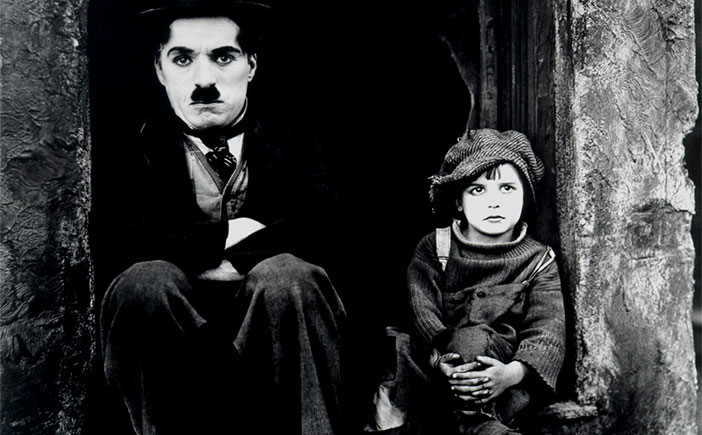
A Tramp (Charlie Chaplin) and an abandoned child (Jackie Coogan) form a family in The Kid
THE KID (Charles Chaplin, 1921)
Sunday, February 8, 11:00 am filmforum.org
Charlie Chaplin’s first feature, The Kid, was a breakthrough for the British-born silent-film star, a touching and tender sixty-eight-minute triumph about a poor soul getting a second chance at life. When a baby arrives at his doorstep, a Tramp (Chaplin) first tries to ditch the boy, but he ends up taking him to his ramshackle apartment and raising him as if he were his own flesh and blood. Although he has so little, the Tramp makes sure the child, eventually played by Jackie Coogan, has food to eat, clothes to wear, and books to read. Meanwhile, the mother (Edna Purviance, Chaplin’s former lover), who has become a big star, regrets her earlier decision and wonders where her son is, setting up a heartbreaking finale.
In addition to playing the starring role, Chaplin wrote, produced, directed, and edited the film and composed the score for his company, First National, wonderfully blending slapstick comedy, including a hysterical street fight with an angry neighbor, with touching melodrama as he examines poverty in post-WWI America, especially as seen through the eyes of the orphan boy, played beautifully by Coogan, who went on to marry Betty Grable, among others, and star as Uncle Fester in The Addams Family. Chaplin’s innate ability to tell a moving story primarily through images reveals his understanding of cinema’s possibilities, and The Kid holds up as one of his finest, alongside such other silent classics as 1925’s The Gold Rush and 1931’s City Lights. The film is screening with Chaplin’s 1917 short Easy Street, with live piano accompaniment by Steve Sterner.
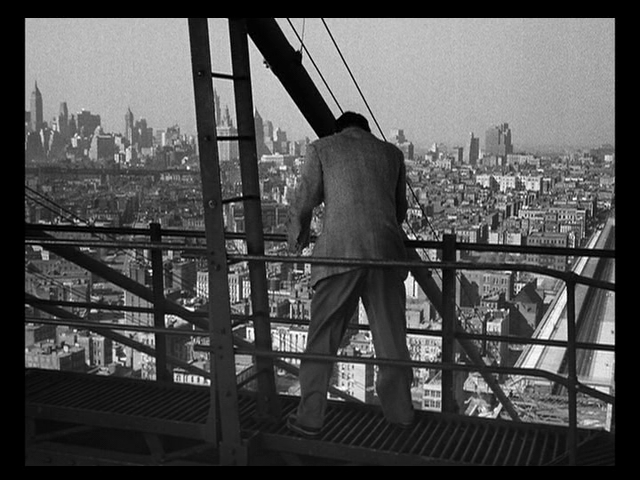
The Naked City features more than one hundred NYC locations
THE NAKED CITY (Jules Dassin, 1948)
Thursday, February 12 , 12:50
Wednesday, February 18, 8:10 www.filmforum.org
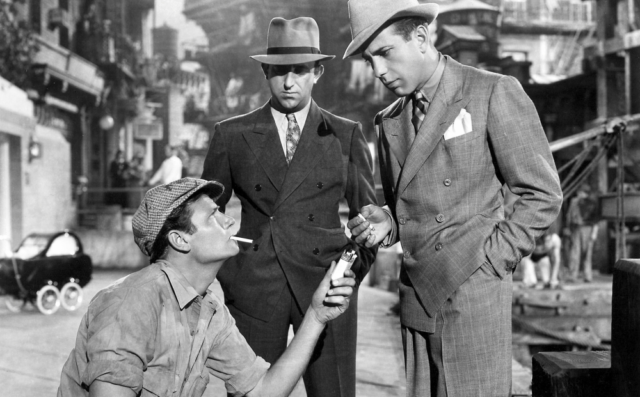
Jules Dassin’s police procedural was one of the first films shot on location in New York City, bringing to life the grit of the streets. Barry Fitzgerald stars as Lt. Muldoon, an Irish cop who knows the game, never allowing anything to get in the way of his sworn duty to uphold the law while never getting too emotionally involved. A model has turned up dead, and young detective Jimmy Halloran (Don Taylor) is heading up the investigation, which includes such suspects as swarthy Frank Niles (Howard Duff). Producer Mark Hellinger’s narration is playful and knowing, accompanying William Daniels’s great camerawork through Park Avenue and the Lower East Side, stopping at little city vignettes that have nothing to do with the story except to add to the level of reality. The thrilling conclusion takes place on the Williamsburg Bridge. The film will be followed by Bruce Goldstein’s 2020 documentary Uncovering the Naked City, which visits many of The Naked City’s locations.
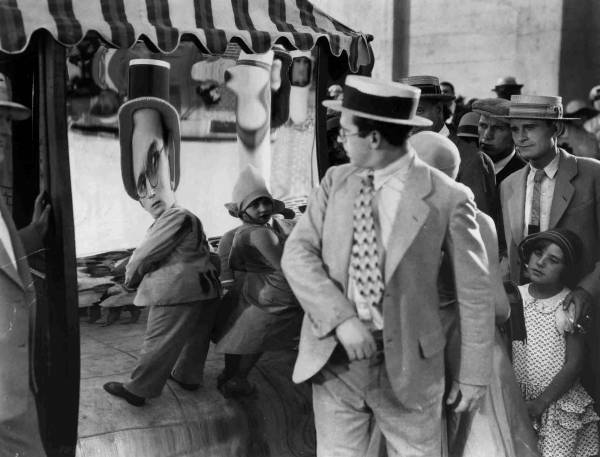
Harold Lloyd has a crazy time in Coney Island in Speedy
Much like the end of the silent film era itself, the last horse-drawn trolley is doomed in Harold Lloyd’s final silent film. Big business is playing dirty trying to get rid of the trolley and classic old-timer Pop Dillon. Meanwhile, Harold “Speedy” Swift, a dreamer who wanders from menial job to menial job (he makes a great soda-jerk with a unique way of announcing the Yankees score), cares only about the joy and wonder life brings. But he’s in love with Pop’s granddaughter, Jane, so he vows to save the day. Along the way, he gets to meet Babe Ruth. Ted Wilde was nominated for an Oscar for Best Director, Comedy, for this thrilling nonstop ride through beautiful Coney Island and the pre-depression streets of New York City. The 4K restoration will feature live piano accompaniment by Steve Sterner.
The Connection is a gritty, jazzy New York City story
THE CONNECTION (Shirley Clarke, 1962)
Thursday, February 19, 4:20
Friday, February 20, 8:00
Tuesday, February 24, 1:00 filmforum.org
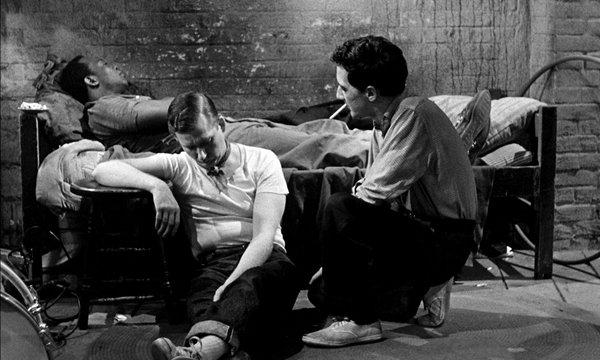
“Now look, you cats may know more about junk, see,” square film director Jim Dunn (William Redfield) says midway through The Connection, “but let me swing with this movie, huh?” Adapted by Jack Gelber from his play and directed and edited by Shirley Clarke, The Connection is a gritty tale of drug addicts awaiting their fix that was banned for obscenity after only two matinee screenings back in October 1962. In 2012, a sharp new fiftieth-anniversary print was released, beautifully restored by Ross Lipman of the UCLA Film & Television Archive. In a New York City loft, eight men are waiting for their man: Leach (Warren Finnerty), the ringleader who has an oozing scab on his neck; Solly (Jerome Raphael), an intelligent philosopher who speaks poetically about the state of the world; Ernie (Garry Goodrow), a sad-sack complainer who has pawned his horn but still clutches tight to the mouthpiece as if it were a pacifier; Sam (Jim Anderson), a happy dude who tells rambling stories while spinning a hula hoop; and a jazz quartet consisting of real-life musicians Freddie Redd on piano, Jackie McLean on sax, Larry Richie on drums, and Michael Mattos on bass. Dunn and his cameraman, J. J. Burden (Roscoe Lee Browne), are in the apartment filming the men as Dunn tries to up the drama to make it more cinematic as well as more genuine. “Don’t be afraid, man,” Leach tells him. “It’s just your movie. It’s not real.” When Cowboy (Carl Lee) ultimately shows with the stuff, Bible-thumping Sister Salvation (Barbara Winchester) at his side, things take a decidedly more drastic turn.
Mixing elements of the French New Wave with a John Cassavetes sensibility and cinema verité style, Clarke has made an underground indie classic that moves to the beat of an addict’s craving and eventual fix. Shot in a luridly arresting black-and-white by Arthur Ornitz, The Connection is like one long be-bop jazz song, giving plenty of time for each player to take his solo, with standout performances by McLean musically and Raphael verbally. The film-within-a-film narrative allows Clarke to experiment with the mechanics of cinema and challenge the audience; when Dunn talks directly into the camera, he is speaking to Burden, yet he is also breaking the fourth wall, addressing the viewer. Cutting between Burden’s steady camera and Dunn’s handheld one, Clarke adds dizzying swirls that rush past like a speeding subway train. A New York City native, Clarke made such other films as The Cool World and Portrait of Jason and won an Academy Award for her 1963 documentary Robert Frost: A Lover’s Quarrel with the World. The restoration is part of Milestone Films’ Shirley Clarke Project, which has preserved and restored a quartet of her best work, inclduing the 1985 documentary Ornette: Made in America.
Young Elgar Winthrop Julius Enders’s (Beau Bridges) spoiled life of privilege is about to dramatically change in The Landlord
THE LANDLORD (Hal Ashby, 1970)
Friday, February 20, 3:40
Saturday, February 21, 6:10
Thursday, February 26, 4:50 filmforum.org
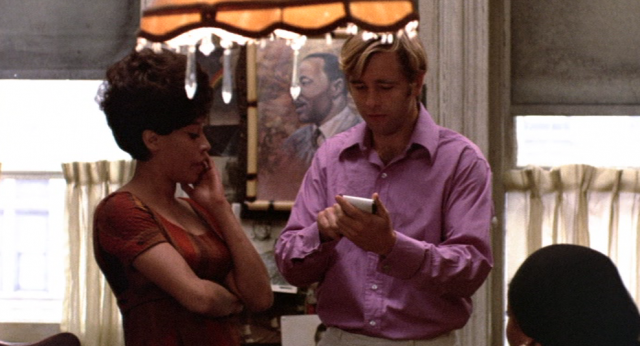
When rich kid Elgar Winthrop Julius Enders (Beau Bridges) finally decides to do something with his spoiled life of privilege, he takes a rather curious turn, buying a dilapidated tenement in a pregentrified Park Slope that resembles the South Bronx in Hal Ashby’s poignant directorial debut, The Landlord. At first, the less-than-worldly Elgar doesn’t quite know what he’s gotten himself into, believing it will be easy to kick out the current residents and then replace the decrepit building with luxury apartments. He pulls up to the place in his VW bug convertible, thinking he can just waltz in and do whatever he wants, but just as his car is vandalized, so is his previously charmed existence, as he gets to know wise house mother Marge (Pearl Bailey), the sexy Francine (Diana Sands), her activist husband, Copee (Louis Gossett Jr.), and Black Power professor Duboise (Melvin Stewart), none of whom is up-to-date with the rent. Meanwhile, Elgar starts dating Lanie (Marki Bey), a light-skinned half-black club dancer he assumed was white, infuriating his father, William (Walter Brooke), and mother, Joyce (a delightful, Oscar-nominated Lee Grant), who are in the process of setting up their daughter, Susan (Susan Anspach), with the white-bread Peter Coots (Robert Klein).
Elgar has a whole lot of learning to do in Hal Ashby’s New York City–set black comedy
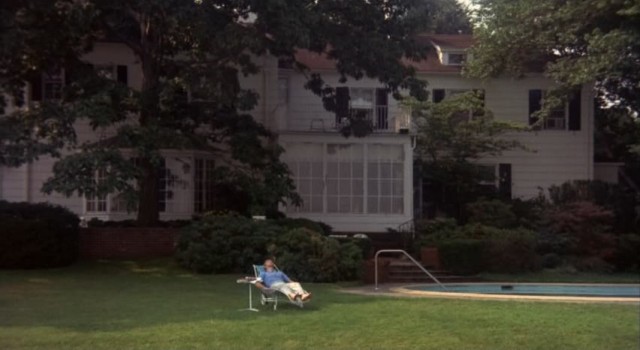
Based on the novel by Kristin Hunter, The Landlord is a telling microcosm of race relations and class conflict in a tumultuous period in the nation’s history, as well as that of New York City, coming shortly after the civil rights movement and the free-love late ’60s. The film is masterfully shot by Astoria-born cinematographer Gordon Willis (Klute, Annie Hall, Manhattan, all three Godfather movies), who sets the bright, open spaces of the Enderses’ massive estate against the dark, claustrophobic rooms of the dank tenement. Screenwriter Bill Gunn (Ganja and Hess) and Ashby avoid getting overly preachy in this at-times outrageous black comedy, incorporating slapstick along with some more tender moments; the scene in which Joyce meets Marge is a marvel of both. And just wait till you see Coots’s costume at a fancy fundraiser. The Landlord began quite a string for Ashby, who followed it up with Harold and Maude, The Last Detail, Shampoo, Bound for Glory, Coming Home, and Being There in a remarkable decade for the former film editor (In the Heat of the Night), who died in 1988 at the age of fifty-nine.
[Mark Rifkin is a Brooklyn-born, Manhattan-based writer whose maternal grandparents grew up in Lower East Side tenements; you can follow him on Substack here.]
The Quay Brothers return to Film Forum with their first feature-length film in twenty years, another foray into the unknown and unseen
SANATORIUM UNDER THE SIGN OF THE HOURGLASS (the Quay Brothers, 2024)
Film Forum
209 West Houston St.
Opens Friday, August 29
212-727-8110 www.filmforum.org
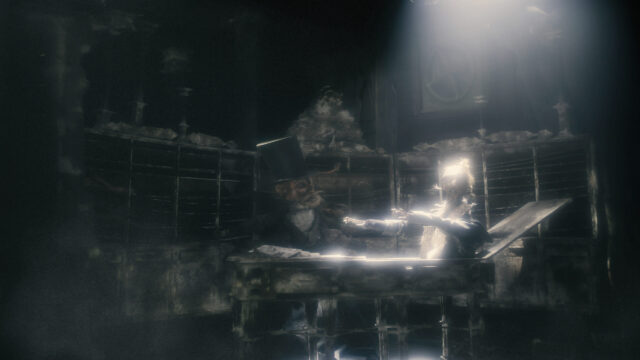
As if a new film from the Quay Brothers is not already reason enough to celebrate, the rejoicing can escalate because their latest, Sanatorium under the Sign of the Hourglass, is another masterful addition to their forty-year career.
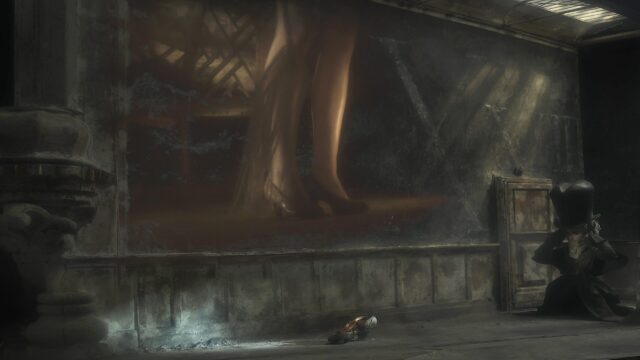
Philadelphia-born, England-based identical twins Stephen and Timothy Quay make unique, complex stop-motion animated works that incorporate elements of German expressionism, silent film tropes, noir, and psychoanalysis, creating dark, heavily atmospheric tales that push the boundaries of storytelling conventions, using eerie, fragile dolls and puppets along with mysterious live action and spectral experimental music. They started out in 1985 with the eleven-minute Little Songs of the Chief Officer of Hunar Louse, or This Unnameable Little Broom, Being a Largely Disguised Reduction of the Epic of Gilgamesh, Tableau II, a dreamlike fantasia involving a creepy, clownlike figure surrounded by doors and drawers that open and close by themselves and windows that offer views into other worlds. They followed that up with the 1986 classic Street of Crocodiles, based on Bruno Schulz’s 1934 short story collection and inspired by the work of Czech filmmaker, artist, and playwright Jan Švankmajer; the twenty-minute opus revolutionized the genre, focusing on a man, dressed like a magician, who looks into a strange contraption that leads him into a portentous alternate universe where inanimate objects move and clocks have no hands.
Only their third feature-length film — after 1994’s Institute Benjamenta and 2004’s The Piano Tuner of Earthquakes — Sanatorium under the Sign of the Hourglass, based on the 1937 novel and other writings by Schulz, is a natural progression from those early days, a kind of summation of everything that came before it. The narrative is set at Sanatorium Karpaty in the foothills of the Karpathian Mountains, where patient J (Zenaida Yanowsky) is convalescing. We first meet Adela I (Allison Bell), a young woman peering around suspiciously, her knee blocking part of her face as we listen to a scratchy 1936 Radio Archive recording of a voice explaining, “Sometimes, at the opening . . . of a street someone turned to the sky half a face, with one frightened and shining eye, and listened to the rumble of space.” Next we see, through the pupil in a large, disembodied eye, three men in top hats, two chimneysweeps (Andrzej Kłak and Leszek Bzdyl) and an auctioneer (Tadeusz Janiszewski). The auctioneer is selling such unusual items as “Twin Quail eggs of supernatural size, laid during the Solar Eclipse . . . of 12 May 1706? Or three petrified ribs of a Siren . . . together with her hands found in the Royal Menagerie of Fredensborg . . . in the year 27 September 1674. Or an Iron Harpoon . . . struck by lightning! Or the Warm Blood of Bees! Or the Hour of your Death!”
Sanatorium under the Sign of the Hourglass is another audiovisual marvel by the Brothers Quay
The auctioneer, who also refers to himself as a flogger and a pedlar, returns to his sparse office, where his assistant (Wioletta Kopańska) shows him a new item that has been delivered for him to sell; in his booming thespian voice, he reads: “Forbiddingly called Maquette for the Sepulchre of a Dead Retina, it is a singularly decrepit but ornate wooden box having the appearance of a miniature funerary cabinet with a skilfully hidden secret drawer allegedly containing the deceased retina of its original owner. Penetrating the exterior skin of this box are seven randomly placed lenses with tiny adjustable screws. Each lens holds a glimpse of one of the seven final images that the said eye beheld. And when positioned correctly, once a year, on the 19th of November, the sun’s rays are aligned to strike the dead retina — thereby liquefying it, anointing each of the seven images and setting them in motion.”
The box suddenly comes to life, and the auctioneer peers into one of the lenses and sees Józef, a doll in a top hat who wanders through an old, ghostly train, going from coach to coach as doors and secret entrances swing open and closed and ghastly figures appear and disappear. In voiceover, the auctioneer narrates the proceedings as Józef meets the multiarmed Dr. Gotard, who is caring for Józef’s ailing father. Józef encounters a broken hourglass, a dilapidated bridge, a buzzing neon sign in red and blue, used chalk for hire, and old mirrors as he makes his way through netherworld vestibules.
The story occasionally cuts back to live action with real actors, where Józef (Kłak) is told by the chambermaid (Kopańska) that it is always night there. He peers through a keyhole and watches what might be some kind of S&M encounter, bathed in a golden light. A horde of men (Bzdyl, Robert Martyniak, Łukasz Łucjan, Marek Jasek) are tantalized by Adela II (Kopańska). Back in his doll form, Józef is led to a crumbling theater for one person; his seat is Loge 7A, which is restricted view.
It all combines for a storytelling tour de force, zeroing in on the voyeuristic nature of humanity, from how we watch movies and theater to how we interact with one another in real life and fantasy.
Sanatorium under the Sign of the Hourglass unfolds in seven sections, including “Provocations Found in Evening Corridors: Hosanna!,” “Distant Presences Traced Around the Circumference of a Knee,” “The Idolatrous Procession,” and “Travels in the Last World.” It’s a Victorian steampunk dark nightmare that is like an ASMR fan’s dream. The attention to detail in every shot, every sound is remarkable, resulting in a hypnotic audiovisual experience. The Quays are credited with the puppets, décors, animation, and cinematography; the spectacular production design is by Agata Trojak, with sets by Anna Podhajny, props by Mateusz Niedzielak, costumes by Dorothée Roqueplo, live-action cinematography by Bartosz Bieniek, and sound by Joakim Sundström and the Quays.
Timothy Nelson’s original score features electronic noise, propulsive drumming, and spectral tones, accompanied by additional music by Alfred Schnittke performed by the Berlin Radio Symphony Orchestra. The methods employed by the Brothers Quay are so dazzling that their mind-blowing sets were on display in the fall 2009 exhibit “Dormitorium: Film Décors by the Quay Brothers” at Parsons the New School for Design, and they were honored with the wide-ranging 2012–13 MoMA retrospective “Quay Brothers: On Deciphering the Pharmacist’s Prescription for Lip-Reading Puppets.”
Not even the most serious students of Freud and Jung will make sense of everything as the film investigates concepts of time and space, of life and death in ways that both chill and thrill. (In their director comments, the Quays call Sanatorium “an exploration of motifs and themes taken from the mytho-poetic writings of Bruno Schulz integrating both puppets and live-action to score the demiurgic nervature of Schulz’s 13th apocryphal month in the Regions of the Great Heresy.”) As they have done in This Unnameable Little Broom,Street of Crocodiles, and such other shorts as The Comb,The Phantom Museum: Random Forays into the Vaults of Sir Henry Wellcome’s Medical Collection,Metamorphosis,Through the Weeping Glass: On the Consolations of Life Everlasting (Limbos & Afterbreezes in the Mütter Museum), and The Doll’s Breath — some of which are documentaries — they invite viewers into fantastical, unimaginable realms and dimensions that are as confounding as they are beautiful, as unnerving as they are intensely involving and satisfying.
Sanatorium under the Sign of the Hourglass opens August 29 at Film Forum; each screening will be preceded by a specially recorded introduction by the Quay Brothers. The 6:10 show on Friday will be introduced by Literary Hub editor Olivia Rutigliano.
[Mark Rifkin is a Brooklyn-born, Manhattan-based writer and editor; you can follow him on Substack here.]
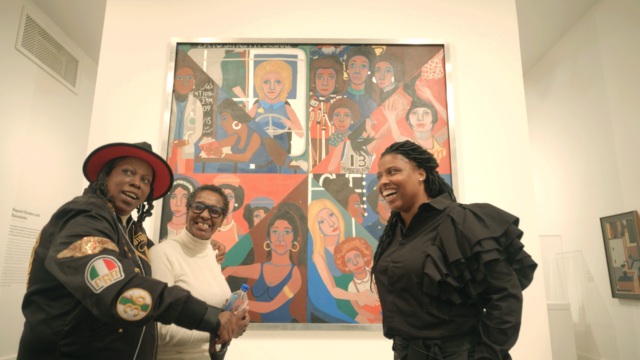
Formerly incarcerated women Enid “Fay” Owens, Nancy Sicardo, and Mary Baxter check out Faith Ringgold’s For the Women’s House in Paint Me a Road Out of Here
PAINT ME A ROAD OUT OF HERE (Catherine Gund, 2024)
Film Forum
209 West Houston St.
Opens Friday, February 7
212-727-8110 www.filmforum.org
“No one and nothing is safe at a prison, including the guards, the inmates, the walls, the furniture, and especially that painting,” author and activist Michele Wallace says in Catherine Gund’s moving and passionate documentary Paint Me a Road Out of Here, opening February 7 at Film Forum.
Author of such books as Black Macho and the Myth of the Superwoman and Dark Designs and Visual Culture, Wallace is the daughter of children’s book writer, painter, sculptor, and performance artist Faith Ringgold. The work she is referring to is her mother’s 1972 For the Women’s House, an eight-foot-by-eight-foot mural that was commissioned for the New York City Correctional Institution for Women on Rikers Island.
Before starting the mural, Ringgold visited the institution and met with some of the women. “I knew that each one wanted to be inspired, to renew their life,” she says in the film. “They wanted to be out of there, of course. And it was obvious to me that the reason why many of them were there was because they had a lack of freedom. I asked the women, ‘What would you like to see in this painting that I’m going to do to inspire you?’ And one girl said, ‘I want to see a road leading out of here.’”
The large canvas is divided into eight triangular sections depicting women in nontraditional roles, including as professional basketball players, a bus driver, a police officer, a priest, a lawyer, a construction worker, and US president, accompanied by quotes from Rosa Parks and Coretta Scott King.
“Almost every single profession in that painting was not open to women in 1971,” curator Rujeko Hockley points out. She also equates prisons with museums, noting, “Black people were held captive in one institution and excluded from the other.”
Gund traces the history of For the Women’s House, delving into its conception, detailing how it was painted over in white by prison employees in 1988, and examining its restoration and the very strange journey it took as the Brooklyn Museum attempted to acquire it in order to save it from potential oblivion. She also places it in context within Ringgold’s career, looking at her seminal 1967 breakthrough gallery show, featuring such powerful and important works as Die,The Flag Is Bleeding, and The American People Series #19: US Postage Commemorating the Advent of Black Power. She meets with Ringgold in her studio, on her porch, and at the New Museum, which eventually hosted her revelatory career retrospective, “American People,” in 2022.
The director balances that narrative with the inspirational tale of Mary Enoch Elizabeth Baxter, who gave birth while incarcerated and fought to right her life through art and activism after serving time. Baxter returns to the Riverside Correctional Facility in Philadelphia in 2022 and installs a mural comprising multiple affirmations, providing hope for the women there through art. She also developed a friendship with Ringgold.
Gund (Born to Fly: Elizabeth Streb vs. Gravity,Chavela), who participated in freeing the painting after first encountering it in late 2021, speaks with Michael Jacobson, who was the commissioner of the Dept. of Corrections in the mid-1990s when the painting virtually disappeared; artist and author Michelle Daniel Jones, who teamed up with Baxter to put on an exhibition; curators Hockley and Catherine Morris, who staged “We Wanted a Revolution: Black Radical Women, 1965–85” at the Brooklyn Museum in 2017; Rikers corrections officer Barbara Drummond, who led the fight to preserve For the Women’s House; and ACA gallerist Dorian Bergen, who explains about Ringgold’s early work, “These are among the most important paintings of the twentieth century. History had to catch up with Faith.”
The artworks shown in the film will be eye-opening to viewers who are not familiar with Ringgold’s oeuvre, from the aforementioned pieces to Childhood,The Fall of America,Sojourner Truth Tanka: Ain’t I a Woman,Uptight Negro, and Flag Is Bleeding. “I became an artist so that I could tell my story,” Ringgold, who dressed in splashy outfits with sparkling accoutrements, says, and what a story it is.
A New York City native, Ringgold passed away in New Jersey in 2004 at the age of ninety-three. Her remarkable legacy will live on in the hearts and minds of her many fans, fellow artists, and incarcerated and formerly incarcerated women who find freedom in what she stood for.
As curator and author Nicole R. Fleetwood declares, “I think art is disruptive, and I think art disrupts lazy thinking.”
There is no lazy thinking when it comes to Faith Ringgold.
[There will be a series of postscreening discussions at Film Forum, presented by the New Museum and the Women’s Community Justice Association on February 7 at 7:00, the Center for Art & Advocacy on February 8 at 7:00, the Vera Institute of Justice and Silver Art Projects on February 13 at 7:00, the New York Women’s Foundation and the Center for the Study of Women and Society at the Graduate Center on February 18 at 6:30, and the Guggenheim on February 20 at 6:30.]
[Mark Rifkin is a Brooklyn-born, Manhattan-based writer and editor; you can follow him on Substack here.]
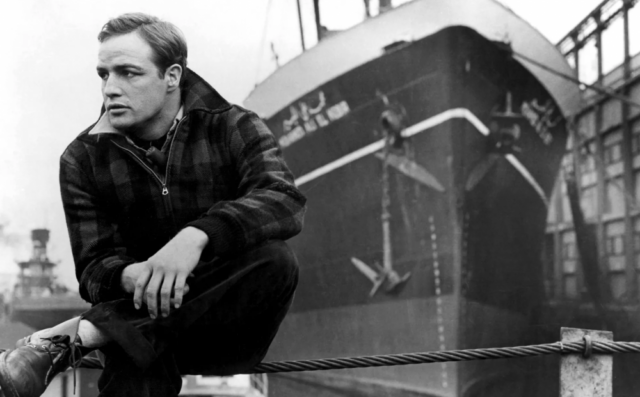
Film Forum series pays tribute to Marlon Brando centennial with such films as On the Waterfront
BRANDO 100
Film Forum
209 West Houston St.
December 13-26
212-727-8110 filmforum.org
Born in Omaha, Nebraska, in April 1924 to a traveling salesman father and theater actress mother, Marlon Brando Jr. went on to become one of the greatest actors of all time — and the most-quoted screen star in cinema history.
“The horror. The horror.” —Marlon Brando as Col. Walter Kurtz, Apocalypse Now (Francis Ford Coppola, 1979)
Film Forum is paying tribute to the eight-time Oscar nominee and two-time winner with “Brando at 100,” a two-week festival honoring the centennial of his birth, consisting of twenty-one of his films and one documentary.
“What’re you rebelling against, Johnny?” — Mildred (Peggy Maley) “Whaddya got.” —Marlon Brando as Johnny Strabler, The Wild One (László Benedek, 1953)
The series opens December 13 with five favorites, Julius Caesar,The Men,A Streetcar Named Desire,On the Waterfront, and The Wild One, and continues through December 26 with such other highlights as The Godfather,The Freshman,Last Tango in Paris,The Missouri Breaks, and Viva Zapata!
“Hey, Stella!” —Marlon Brando as Stanley Kowalski in A Streetcar Named Desire (Elia Kazan, 1951)
Author and film historian Foster Hirsch (A Method to Their Madness: The History of the Actors Studio,Hollywood and the Movies of the Fifties) will introduce the 7:10 screening of On the Waterfront on December 13 and the 1:00 screening of Reflections in a Golden Eye on December 26.
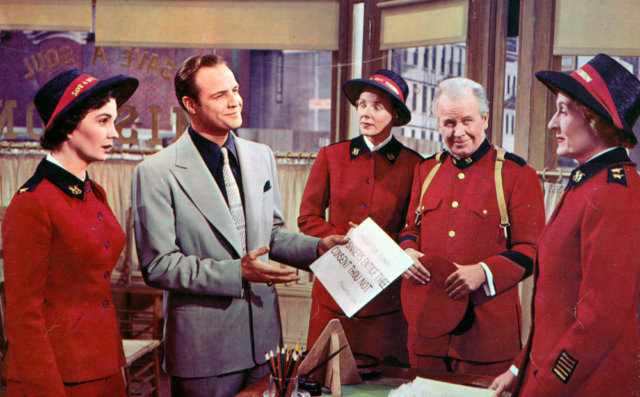
Marlon Brando sings (!) in Joseph L. Mankiewicz’s 1955 Guys and Dolls
“I’m gonna make him an offer he can’t refuse.” —Marlon Brando as Don Vito Corleone in The Godfather (Francis Ford Coppola, 1972)
On December 16 at 8:00, Film Forum will pair Fred Zinnemann’s 1950 The Men with Albert and David Maysles’s half-hour 1966 documentary Meet Marlon Brando.
“You don’t understand. I coulda’ had class. I coulda’ been a contender. I could’ve been somebody instead of a bum, which is what I am. Let’s face it.” —Marlon Brando as Terry Malloy in On the Waterfront (Elia Kazan, 1954)
While Brando, who died in 2004 at the age of eighty, was a controversial, iconoclastic figure for much of his career, Film Forum is focusing on his myriad successes.
“The only thing an actor owes his public is not to bore them.” —Marlon Brando
Boring? Not Marlon Brando. As his acting teacher and Method mentor, Stella Adler, wrote, “He has the ability to hold the reality of his character and the needs of the script simultaneously, making every performance electric.”
[Mark Rifkin is a Brooklyn-born, Manhattan-based writer and editor; you can follow him on Substack here.]
Bruce Weber focuses in on Peter Johnson and others in cinematic hodgepodge
CHOP SUEY (Bruce Weber, 2001)
Film Forum
209 West Houston St.
Sunday, November 3, 8:15
Wednesday, November 6, 8:50
Series runs November 1-7
212-727-8110 www.filmforum.org www.bruceweber.com
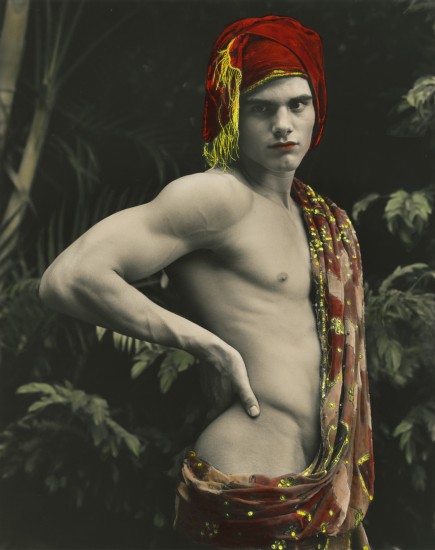
Fashion photographer Bruce Weber, who directed the seminal Chet Baker doc Let’s Get Lost a quarter century ago, made this entertaining hodgepodge of still photos, old color and black-and-white footage, and new interviews and voice-over narration back in 2001. You might not know much about Frances Faye, but after seeing her perform in vintage Ed Sullivan clips and listening to her manager/longtime partner discuss their life together, you’ll be searching YouTube to check out a lot more. The film also examines how Weber selects and treats his male models, who are often shot in homoerotic poses for major designers (and later go on to get married and have children). As a special treat, Jan-Michael Vincent’s extensive full-frontal nude scene in Daniel Petrie and Sidney Sheldon’s 1974 Buster and Billie is on display here, as are vintage clips of Sammy Davis Jr., adventurer Sir Wilfred Thesiger, former Vogue editor Diana Vreeland, and Robert Mitchum singing in a recording studio with Dr. John.
The film is about model Peter Johnson and Weber as much as it is about the cult of celebrity; Weber gets to chime in on Elizabeth Taylor, Montgomery Clift, Clark Gable, Frank Sinatra, Arthur Miller, and dozens of other famous names and faces. Though an awful lot of fun, the film is disjointed, lacking a central focus, and the onscreen titles, end credits, and promotional postcards are chock-full of typos — perhaps emulating a Chinese takeout menu, hence the film’s title? Chop Suey is screening November 3 at 8:15, followed by a Q&A with Peter Johnson, and November 7 at 8:50 as part of Film Forum’s “Bruce Weber” series, which runs November 1-7 and also includes a new 4K restoration of Let’s Get Lost, followed by a talk with cinematographer Jeff Preiss; 1987’s Broken Noses, about former Olympian boxer Andy Minsker; 2018’s Nice Girls Don’t Stay for Breakfast, followed by a conversation with Carrie Mitchum and editor Chad Sipkin; 2004’s A Letter to True, a tribute to Weber’s dog; a compilation of shorts, videos, commercials, and works in progress; and The Treasure of His Youth: The Photographs of Paolo di Paolo.
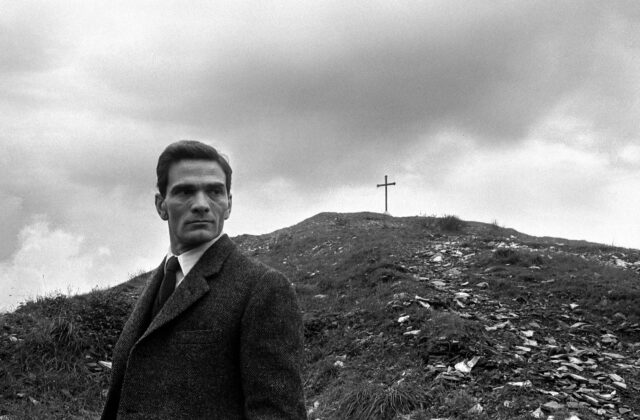
Paolo di Paolo’s photograph of Pier Paolo Pasolini at Monte dei Cocci in 1960 is one of many highlighted in Bruce Weber documentary
THE TREASURE OF HIS YOUTH: THE PHOTOGRAPHS OF PAOLO DI PAOLO (Bruce Weber, 2022)
Saturday, November 2, 1:00 www.filmforum.org
“The mystery of Paolo di Paolo to me is that he was able to give up photography, something he once had such passion for,” documentarian Bruce Weber says at the beginning of the fabulous The Treasure of His Youth: The Photographs of Paolo di Paolo, a warm and inviting film about one of the greatest photographers you’ve never heard of.
In 1954, Italian philosopher Paolo di Paolo saw a Leica III camera in a shop window and, at the spur of the moment, decided to buy it. That led to fourteen extraordinary years during which the self-taught artist took pictures for Il Mondo and Il Tempo, documenting, primarily in black-and-white, postwar Italy as well as the country’s burgeoning film industry. He was not about glitz and glamour; he captured such figures as Luchino Visconti, Anna Magnani, Ezra Pound, Simone Signoret, Marcello Mastroianni, Charlotte Rampling, Alberto Moravia, Sofia Loren, Giorgio Di Chirico, and others in private moments and glorying in bursts of freedom. He went on a road trip with Pier Paolo Pasolini for a magazine story in which the director would write the words and di Paolo would supply the images. His photos of the society debut of eighteen-year-old Princess Pallavincini are poignant and beautiful, nothing like standard publicity shots.
Paolo di Paolo’s relationship with the camera is revealed in lovely documentary (photo courtesy Little Bear Films)
Then, in 1968, just as suddenly as he picked up the camera, he put it away, frustrated by the growing paparazzi culture and television journalism. A few years ago, Weber and his wife went into a small gallery in Rome where Weber, who has had a “love affair” with Rome since he was ten, discovered magnificent photos of many of his favorite Italian film stars. The gallery owner, Giuseppe Casetti, told him that the pictures were by an aristocratic gentleman he had bumped into at flea markets and who one day came into the bookstore where he was working and gave him one for free, knowing he was a collector. Casetti wanted to know who had taken the photo; “I was once a photographer,” di Paolo told him unassumingly.
That set Weber off on a search to find out everything he could about di Paolo, who is now ninety-seven. Even his daughter, Silvia di Paolo, had no knowledge of her father’s past as a photographer until she found nearly a quarter of a million negatives in the basement of the family home and began organizing them about twenty years ago. Paolo had never spoken of this part of his life; he wrote books on philosophy, was the official historian of the Carabinieri, and restored antique sports cars, but his artistic career was an enigma even though it was when he met his wife, his former assistant.
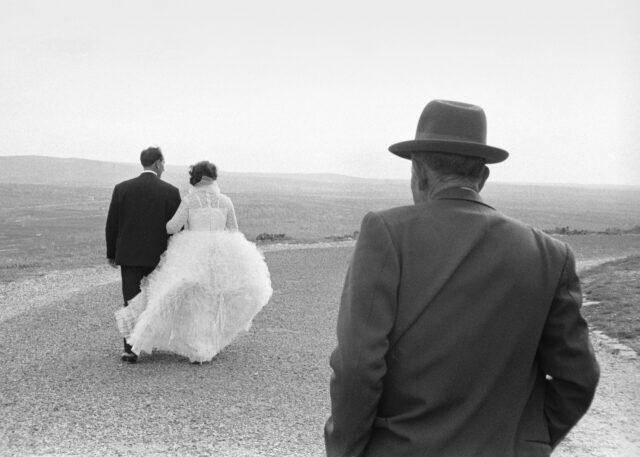
The father of the bride watches the young couple as they head down a country road (photo by Paolo di Paolo)
Weber follows di Paolo as he meets with photographer Tony Vaccaro, film producer Marina Cigona, and his longtime friend (but not related) Antonio do Paola, visits his childhood home in Larino, is interviewed by the young son of Vogue art director Luca Stoppini, and attends his first-ever retrospective exhibition (“Il Mondo Perduto” at the Maxxi Museum in Rome). And he picks up the camera again, taking photos at a Valentino fashion show.
Cinematographer Theodore Stanley evokes di Paolo’s unpretentious style as he photographs the aristocratic gentleman walking up a narrow cobblestoned street, his cane in his right hand, an umbrella in his left over his head, and driving one of his sports cars. Editor and cowriter Antonio Sánchez intercuts hundreds and hundreds of di Paolo’s photos, several of which are discussed in the film: a spectacular shot of Pasolini at Monte dei Cocci, the director in the foreground, the famous cross atop a hill in the background; Visconti in a chair, fanning himself; a scene in which a father, hands in his pocket, watches his daughter and new son-in-law walking away on an empty country road. There are also clips from such classic films as Rocco and His Brothers,Accatone,Rome Open City,Marriage Italian Style, and 8½. It’s all accompanied by John Leftwich’s epic score.
As Cigona tells di Paolo about having ended his flourishing photography career, “People said, ‘Why did you do that? You were quite famous.’” It was never about the fame for di Paolo, but now the secret is out.
“For me, every object is a miracle,” Pasolini says in an archival interview. In The Treasure of His Youth, Weber treats every moment with di Paolo and his photographs as a miracle. So will you.
[Mark Rifkin is a Brooklyn-born, Manhattan-based writer and editor; you can follow him on Substack here.]
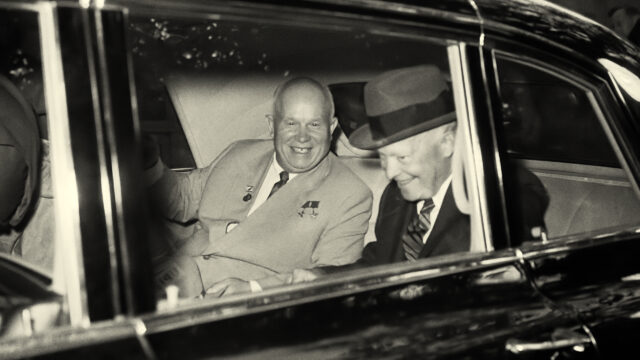
Nikita Khrushchev visits America and President Dwight D. Eisenhower in Soundtrack to a Coup d’État
SOUNDTRACK TO A COUP d’ÉTAT (Johan Grimonprez, 2024)
Film Forum
209 West Houston St.
Opens Friday, November 1
212-727-8110 filmforum.org kinolorber.com
Two new documentaries opening November 1 in New York use music and poetry, respectively, to look at a pair of seminal moments in twentieth-century world history.
At Film Forum, visual artist Johan Grimonprez’s Soundtrack to a Coup d’État is a 150-minute jazz epic, an exhilarating barrage of words, images, and music that delves deep into the January 1961 assassination of Patrice Lumumba, the first prime minister of what would become the Democratic Republic of the Congo. In 1960, in a move that struck a blow against colonialism, sixteen African countries were admitted to the United Nations, and that year also saw the UN’s first peacekeeping operation on the continent. Amid espionage and international machinations, the cold war reaches new levels. Soviet chairman Nikita Khrushchev rhythmically bangs his shoe on a General Assembly table and US president Dwight D. Eisenhower befriends Belgian king Baudouin in an effort to secure uranium. The CIA gets involved in possibly nefarious operations in Africa, using unknowing jazz musicians as deflections.
Grimonprez (dial H-I-S-T-O-R-Y,Shadow World) and editor Rik Chaubet interweave quotes by Khrushchev, Eisenhower, Malcolm X, Sukarno, Gamal Abdel Nasser, Fidel Castro, activist Léonie Abo, Irish diplomat and writer Conor Cruise O’Brien, CIA director Allen Dulles, Secretary of State John F. Dulles, activist Andrée Blouin, mercenaries “Mad” Mike Hoare and Bruce Bartlett, Belgian premier Gaston Eyskens, UN secretary-general Dag Hammarskjöld, writer In Koli Jean Bofane, CIA station chief Larry Devlin, DRC president Joseph Kasa-Vubu, Voice of America broadcaster Willis Conover, Belgian colonel Frédéric Vandewalle, and others with songs by such legends as Nina Simone (“Wild Is the Wind”), Louis Armstrong (“Black and Blue”), Miriam Makeba (“Mbube”), Thelonius Monk, John Coltrane (“In a Sentimental Mood”), Miles Davis (“Blue in Green”), Ornette Coleman (“January”), Dizzy Gillespie (“And Then She Stopped”), and Duke Ellington (“Take the ‘A’ Train”), along with archival footage, album covers, and boldly designed graphics.
The musical centerpieces are drummer Max Roach and vocalist Abbey Lincoln (“Tears for Johannesburg,” “Freedom Day,” “Triptych: Prayer/Protest/Peace”), who, at the UN Security Council in 1961, protested the murder of Lumumba, and Gillespie, who speaks with his trademark humor about the controversies. “This is what you might call a cool war,” Ellington tells Gillespie, who responds, “The weapon that we will use is the cool one,” holding up his horn. He also has fun teasing a television news journalist about the situation in Africa.
Powerful, poetic quotes are spoken or are blasted across the screen.
“One day independence will come to the Congo and the white will become black, and the black will become white.” — Congolese cleric Simon Kimbangu
“There is a limit to the usefulness of the past.” — Indian UN ambassador Krishna Menon
“The enemy is imperialism.” — Ghanaian president Kwame Nkrumah
“Any fool can start a war that even a wise man cannot end.” — Soviet chairman Nikita Khrushchev (over footage of a submarine rising through ice and Khrushchev petting his dog, looking like a Bond villain)
“Sure, I’d rather be a poet than a politician. . . . I’m suspicious of the written word; I prefer the spoken word. I trust it more in the world of politics.” — Belgian premier Paul-Henri Spaak
“If Africa is shaped like a revolver, then Congo is its trigger.” — French psychiatrist and philosopher Frantz Fanon
Soundtrack to a Coup d’État is like a multimedia jazz concert, every minute promising some kind of improvisatory surprise from many of the greatest singers and instrumentalists of the era. It’s a radical documentary with radical views; the scenes when Khrushchev and Castro come to America are unforgettable, and several of its positions on issues are controversial. But it moves and grooves to the rhythm of the beat in a way that will suck you into its world while making you reconsider much of what you know about the incidents it explores.
Grimonprez will be at Film Forum for Q&As following the 6:45 screening on November 1 and the 4:00 show on November 2.
After: Poetry Destroys Silence explores how poetry deals with such tragic events as the Holocaust
AFTER: POETRY DESTROYS SILENCE (Richard Kroehling, 2024)
Cinema Village
22 East 12th St. between University Pl. & Fifth Ave.
Opens Friday, November 1 www.cinemavillage.com www.after.film
In the 2016 documentary The Last Laugh, director Ferne Pearlstein spoke with survivors as well as such comics as Mel Brooks, Carl Reiner, Harry Shearer, David Steinberg, Susie Essman, and Rob Reiner in an attempt to find a connection between humor and the Holocaust “You can do jokes about Nazis,” Gilbert Gottfried says in the film, “but if you say ‘Holocaust,’ then it becomes bad taste.”
In After: Poetry Destroys Silence, writer, director, and editor Richard Kroehling looks at the relationship between poetry and the Holocaust, but, unsurprisingly, there is little humor to be found. It’s an intensely serious film that tries to tell its story in a form that mimics that of its subject. Just as Soundtrack to a Coup d’État unfurls like a jazz concert, After is told like an epic poem. But in this case, scenes of poignant purity and beauty are interrupted by self-congratulatory moments as experts feel the need not just to share poetry but to defend its existence as a necessary art form in interpreting history.
Following a projected quote from Theodor Adorno that reads, “To write a poem after Auschwitz is barbaric,” poet Alicia Ostriker explains, “After Auschwitz, poetry is barbaric. It’s easy for people to think that and many people do, but they’re thinking that is part of the contempt for poetry; that is also contempt for the human soul.”
“After certain kinds of genocide and suffering, how can the world go on at all?” poet and critic Edward Hirsch asks. “I think it’s the obligation of poetry to respond to certain kinds of horror. The Holocaust is a kind of test case for poetry because of course it defies language. It defeats language. And yet language has to respond. It’s our job as poets to remember what happened.”
The film works better when it concentrates on the poems themselves, which are often accompanied by archival footage from Auschwitz, shots of nature (especially fire and water), whispers, and music from a violin, piano, and typewriter. Citing memories from his time in the camps, ninety-one-year-old survivor Walter Fiden proclaims, “Everything can be overcome. Nothing is hopeless.”
Hungarian poet and actor Géza Röhrig (Son of Saul,To Dust) recalls visiting an empty Auschwitz in 1986, using a map his grandfather made, and seeing various artifacts left behind, from toothbrushes and children’s toys to Hebrew letters and drawings on walls. He notes, “I felt that if I could not become six million, I will step into the shoes of one.”
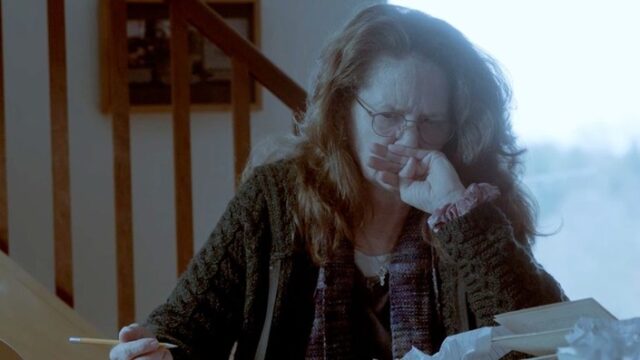
There are other contributions from survivor Paul Celan, Yehuda Amichai, Christine Poreba, Taylor Mali, Sabrina Orah Mark, film producer Janet R. Kirchheimer, and Pulitzer Prize nominee Cornelius Eady, who performs an anonymous poem from the Warsaw Ghetto with a jazz sensibility. In a ten-minute segment in the middle of the film, Oscar winner Melissa Leo (The Fighter,Frozen River) and Bo Corre (Mulberry St.,Harrow Island) try to find meaning in a lost photograph from 1945. Tribute is paid to Raoul Wallenberg, Oskar Schindler, and André Trocmé. The late photographer Charles Carter recites haunting poetry while contemporary shots of his are mixed in with historical footage. The beautiful cinematography is by Lisa Rinzler, with evocative sound by Helge Bernhardt.
In Soundtrack to a Coup d’État, Max Roach declares, “We do use the music as a weapon against man’s inhumanity toward man.” The same can be said for the poetry in After.
After: Poetry Destroys Silence opens November 1 at Cinema Village, with Kroehling on hand for a Q&A following the 1:00 screening. On November 3 at 5:00, Kroehling, Kirchheimer, Eady, and Röhrig will participate in a panel discussion and reception at Town & Village Synagogue, moderated by Rabbi Irwin Kula, and there will be a panel discussion with the same group on November 6 at Cinema Village after the 7:00 show.
[Mark Rifkin is a Brooklyn-born, Manhattan-based writer and editor; you can follow him on Substack here.]