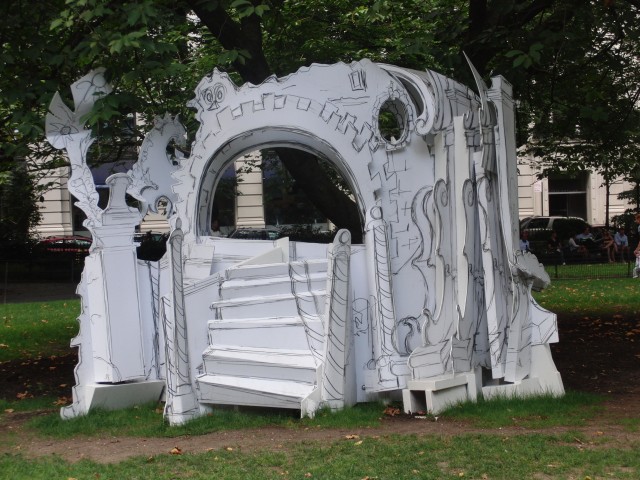
“Rococo Hut” is one of three sculptural pieces that make up Rachel Feinstein’s “Folly” in Madison Square Park (photo by twi-ny/mdr)
FOLLY
Madison Square Park
23rd to 25th Sts. between Madison Ave. & Broadway
Wednesday, September 3, free, 5:30 – 8:30
Exhibition continues through September 7
www.madisonsquarepark.org
folly slideshow
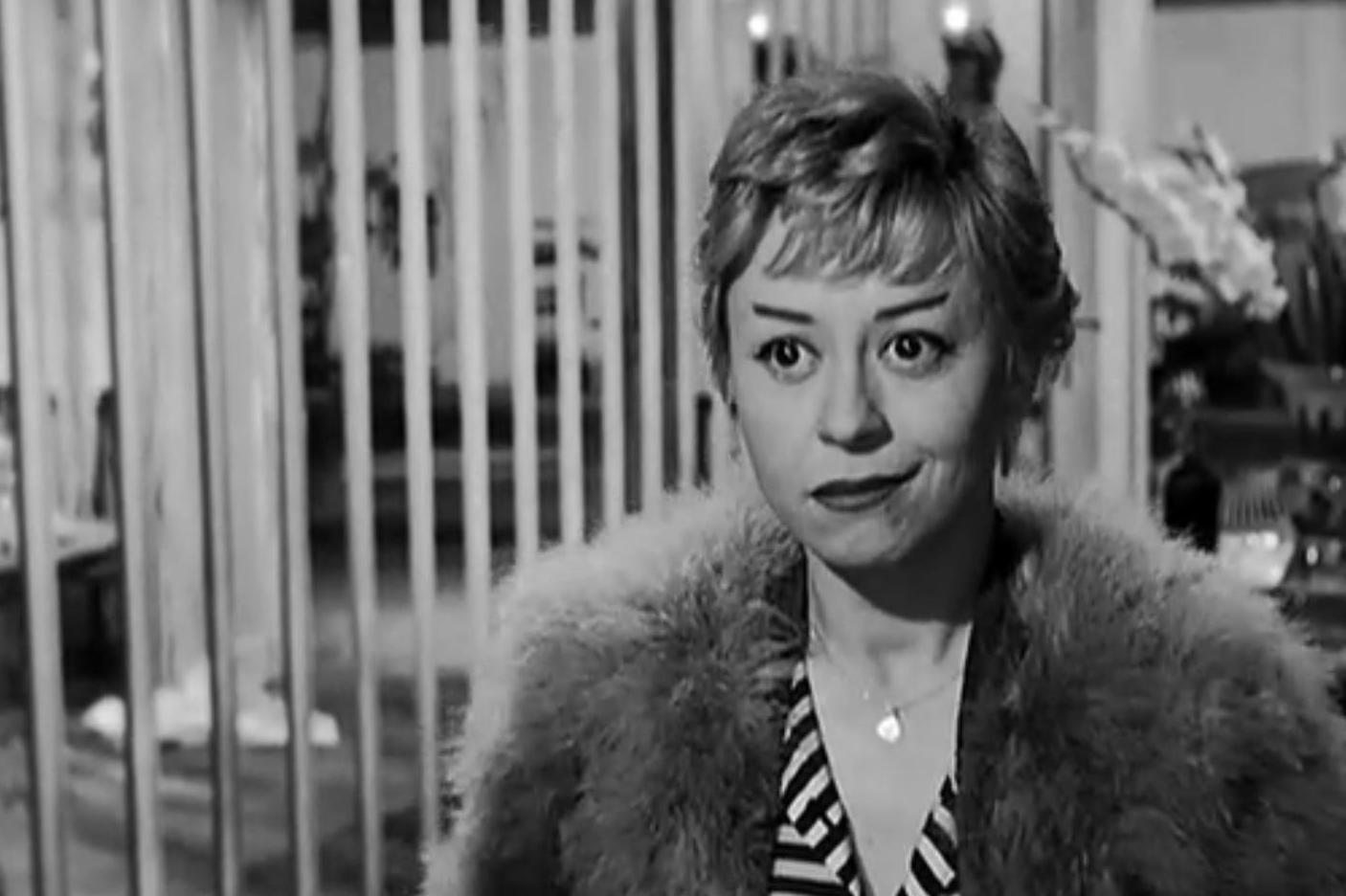
At first look, Rachel Feinstein’s site-specific “Folly” installation in Madison Square Park appears to be a trio of fragile ornamental structures, seemingly crudely made out of paper (they began life as handmade paper models), that could serve as backdrops for a high school play. Echoing fairy-tale-like nonfunctional garden decoration from eighteenth- and nineteenth-century Europe as well as Nymphenburg porcelain, the three pieces — “Cliff House,” inspired by Ballets Russes sets; “Rococo Hut,” influenced by Marie Antoinette’s château Le Petit Triannon; and “The Flying Ship,” based on a Commedia dell’arte skit about Punchinello — are actually constructed from powder-coated aluminum. The works, which also give nods to Federico Fellini, Marlene Dietrich’s portrayal of Catherine the Great in The Scarlet Empress, and Giovanni Battista Piranesi’s real and imagined landscapes, might look like they could collapse at any moment — “Rococo Hut” features crooked steps, “The Flying Ship” uses a tree for balance, and “Cliff House” looks supremely unsafe — but they are sturdy enough to be home to a wide-ranging collection of performances on September 3. “The Madison Park Conservancy has given me the opportunity to marry my early interest in theater and performance with my later obsession with the handmade in one of the most spectacular settings. I picture ‘Folly’ as an empty Fellini-esque set dropped into the middle of a lush green wonderland in the historical Flatiron district of New York City,” the New York City-based Feinstein (“The Snow Queen”), who was born in Defiance, Arizona, and raised in Miami, said in a statement. “I have always been driven by the stark contrast between good and evil in old fairy tales. Having this setting, a hidden natural jewel situated within the tall skyscrapers of yesterday and today, will be the perfect backdrop for my theater, where the real people who occupy the park every day will stand in as Commedia dell’arte performers.”
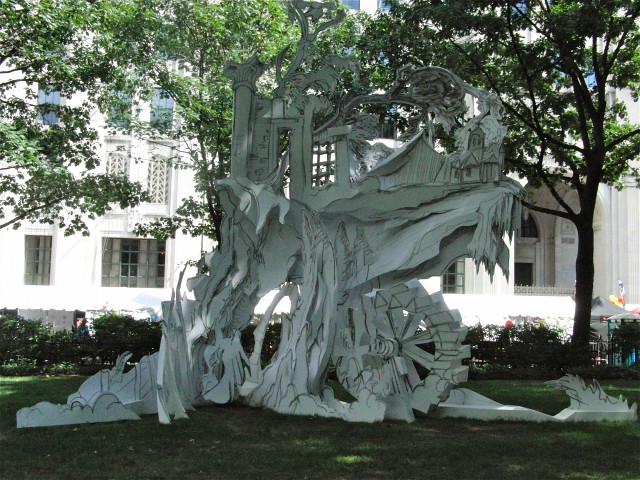
Rachel Feinstein’s “Folly” will be home to a wide-ranging performance festival on September 3 (photo by twi-ny/mdr)
On Wednesday, “The Last Days of Folly” will consist of My Barbarian performing its “Broke Baroque Suite”; a procession through the park led by artists Allison Brainard and Cara Chan; musical segues by Jarvis Cocker based on Maurice Ravel’s Daphnis et Chloé for the Ballets Russes; Sofia Coppola directing six Joffrey Ballet School ballerinas dancing to Isao Tomita’s version of one of Claude Debussy’s Arabesques; a sound-and-movement piece from multidisciplinary artist Tamar Ettun; Little Did Productions’ magic lantern interpretation of parts of the Ramayana with Luke Santy on sitar and Jessica Lorence on vocals; an improvised dance by Lil Buck set to music by Paul Cantelon and cellist Wolfram Koessel; Kalup Linzy’s “Romantic Loner” and “One Life to Heal,” with live music by Mike Jackson; Molly Lowe’s nude costume incorporating numerous performers; a music set by Angela McCluskey and Cantelon, joined by Lil Buck and others; a puppet show from Shana Moulton; a new video work by Tony Oursler collaborating with Constance DeJong; a sound installation by Carlos Vela-Prado; and “Folly”-inspired fashion from Giles Deacon, Duro Olowu, Zac Posen, Narciso Rodriguez, Cynthia Rowley, Proenza Schouler, and Madeline Weinrib. We have no idea how this is all going to be squeezed into a mere three hours, but we can’t wait to find out.
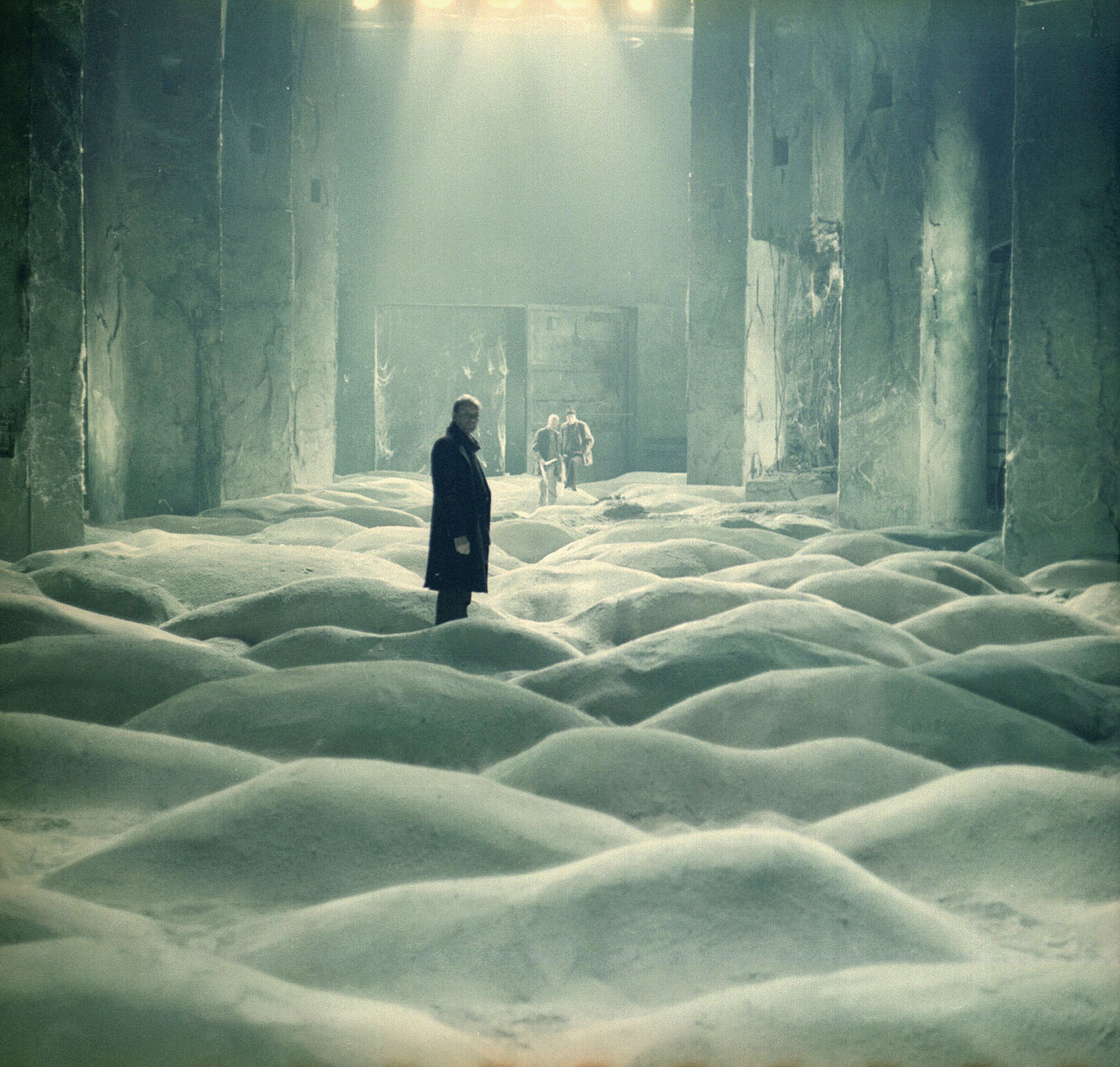
 Set in a seemingly postapocalyptic world that is never explained, Andrei Tarkovsky’s Stalker is an existential work of immense beauty, a deeply philosophical, continually frustrating, and endlessly rewarding journey into nothing less than the heart and soul of the world. Alexander Kaidanovsky stars as Stalker, a careful, precise man who has been hired to lead Writer and Professor (Tarkovsky regulars Anatoli Solonitsyn and Nikolai Grinko, respectively) into the forbidden Zone, a place of mystery that houses a room where it is said that people can achieve their most inner desires. While Stalker’s home and the bar where the men meet are dark, gray, and foreboding, the Zone is filled with lush green fields, trees, and aromatic flowers — as well as abandoned vehicles, strange passageways, and inexplicable sounds. The Zone — which heavily influenced J. J. Abrams’s creation of the island on Lost — has a life all its own as past, present, and future merge in an expansive land where every forward movement is fraught with danger but there is no turning back. An obsessive tyrant of a filmmaker, Tarkovsky (Andrei Rublev, Solaris) imbues every shot with a supreme majesty, taking viewers on an unusual and unforgettable cinematic adventure. Stalker is screening for free March 20 at the Mid-Manhattan Library as part of the series “Three Auteurs of World Cinema,” which began with six films by Wong Kar-wai and continues with Tarkovsky’s The Sacrifice on March 27 before presenting eight works by Federico Fellini beginning April 10 with I Vitteloni.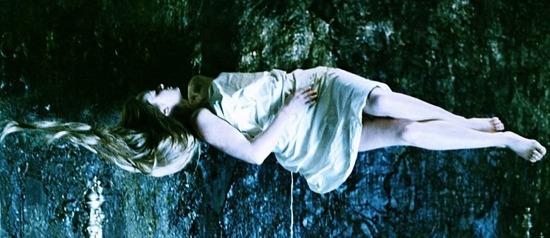
 ”Words can’t really express a person’s emotions. They’re too inert.” So says Andrei Tarkovsky in his dream-filled, surreal classic The Mirror, which features long scenes with little or no dialogue. Tarkovsky turns the mirror on himself and his childhood to tell the fragmented and disjointed story of WWII-era Russia through his own personal experiences with his family. Tarkovsky was obsessed with film as art, and this nonlinear film, which shifts back and forth between color and black-and-white, is his poetic masterpiece; he even includes his father’s (Arseny Tarkovsky) poems read over shots that are crafted as if paintings. Many of the actors (which include his mother, Maria Vishnyakova, and his wife, Larisa Tarkovskaya, in addition to Margarita Terekhova, Ignat Daniltsev, and Anatoli Solonitsyn) play several roles; have fun trying to figure out who is who and what exactly is going on at any one moment. The Mirror is screening for free March 13 at the Mid-Manhattan Library as part of the series “Three Auteurs of World Cinema,” which began with six films by Wong Kar-wai and continues with Tarkovsky’s Stalker and The Sacrifice before presenting eight works by Federico Fellini beginning April 10 with I Vitteloni.