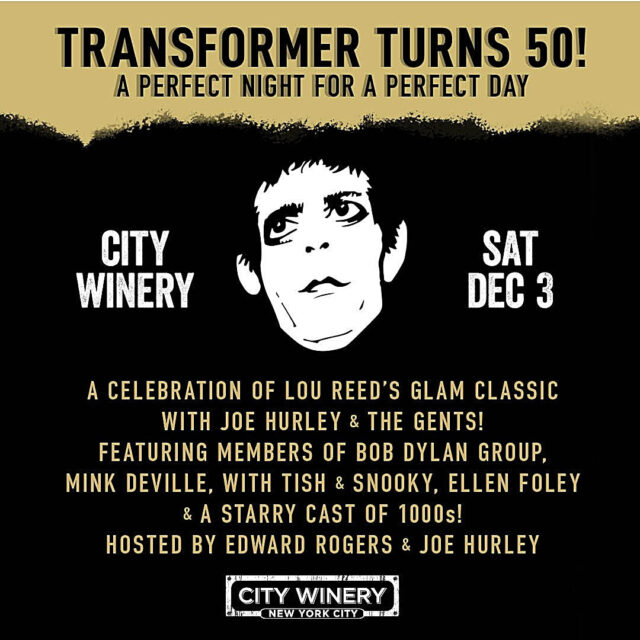
Who: Joe Hurley & the Gents, Eugene Hutz, Edward Rogers, Mary Lee Kortes, Ellen Foley, Don Fleming, Tish & Snooky, Richard Barone, Eamon Rush, Roger Clark, Screaming Orphans, Michael Tee, Jesse Bates, more
What: Tribute to Lou Reed’s 1972 Transformer album
Where: City Winery New York, 25 Eleventh Ave. at Fifteenth St., 646-751-6033
When: Saturday, December 3, $30-$55, 8:00
Why: In November 1972, Lou Reed released his second solo album following the dissolution of the seminal experimental Velvet Underground. His eponymous debut earlier that year was met with barely a whimper, but Transformer was a transformative record, for Reed and for rock music itself. Produced by David Bowie and Mick Ronson, the LP boldly mixed glam with S&M from its opening words. “Vicious / You hit me with a flower / You do it every hour / Oh, baby, you’re so vicious / Vicious / You want me to hit you with a stick / But all I’ve got’s a guitar pick / Huh, baby, you’re so vicious,” Reed declared over a squealing guitar and happily thudding bass. Reed changed the face of top-forty radio with his biggest hit, “Walk on the Wild Side,” which detailed the adventures of Andy Warhol Factory denizens Holly Woodlawn, Candy Darling, Joe Dallesandro, Jackie Curtis, and Joe Campbell and included controversial lyrics that are still shocking today. “Andy’s Chest” is about Warhol, inspired by his 1968 shooting. The album was way ahead of its time, exploring gay and trans subculture and androgyny years before the AIDS crisis.
In celebration of the album’s golden anniversary, City Winery is hosting “Transformer Turns 50!,” in which Joe Hurley & the Gents and special guests will perform the record and other Reed/VU tracks; joining in will be Eugene Hutz, Mary Lee Kortes, Ellen Foley, Don Fleming, Richard Barone, Roger Clark, Screaming Orphans, and members of Ian Hunter’s Rant Band, Roxy Music, Twisted Sister, the Bob Dylan Band, Sonic Youth, and Mink DeVille. Transformer also features the gorgeous “Perfect Day” and “Satellite of Love,” the playful “New York Telephone Conversation,” and the Tin Pan Alley–like closer, “Goodnight Ladies,” which is now a kind of epitaph for Reed, who died in 2013 at the age of seventy-one; “Goodnight ladies, ladies goodnight / It’s time to say goodbye,” he sings. “Oh, nobody calls me on the telephone / I put another record on my stereo / But I’m still singing a song of you / It’s a lonely Saturday night.”
Reed fans must also check out “Lou Reed: Caught Between the Twisted Stars,” the outstanding, wide-ranging exhibition at the New York Public Library for the Performing Arts, consisting of hundreds of Reed items, from early, never-before-heard recordings to interviews, photographs, memorabilia, and live footage, highlighted by songs from the Transformer tour, when Reed dyed his hair blonde and did a bit of disco dancing, in a black T-shirt and dark sunglasses.
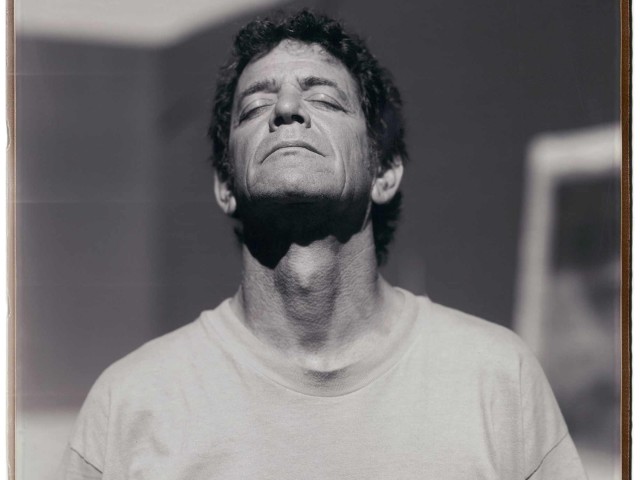
 In December 2006, Lou Reed resurrected his 1973 masterwork, Berlin, a deeply dark and personal song cycle that was a critical and commercial flop upon its initial release but has grown in stature over the years. (As Reed sings on the album’s closer, “Sad Song”: “Just goes to show how wrong you can be.”) The superbly staged adaptation, directed by Academy Award nominee Julian Schnabel (Basquiat, The Diving Bell and the Butterfly), took place at Brooklyn’s intimate St. Ann’s Warehouse, featuring Rob Wasserman and longtime Reed sideman Fernando Saunders on bass, Tony “Thunder” Smith on drums, Rupert Christie on keyboards, and guitarist extraordinaire Steve Hunter, reunited with Lou for the first time in three decades. The band is joined onstage by backup singers Sharon Jones and Antony, the Brooklyn Youth Chorus, and a seven-piece orchestra (including cello, viola, flute, trumpet, clarinet, and flugel). Amid dreamlike video montages shot by Schnabel’s daughter, Lola, depicting Emmanuelle Seigner as the main character in Berlin, as well as experimental imagery by Alejandro Garmendia, Reed tells the impossibly bleak story of Caroline, a young mother whose life crashes and burns in a dangerously divided and debauched Germany. “It was very nice / It was paradise,” Reed sings on the opening title track, but it’s all downhill from there. “It was very nice / It was paradise” might also now serve as a kind of epitaph for one of the most important poets of the last fifty years. Berlin is being shown at Damrosch Park Bandshell at 10:30 on July 30, with headphones available.