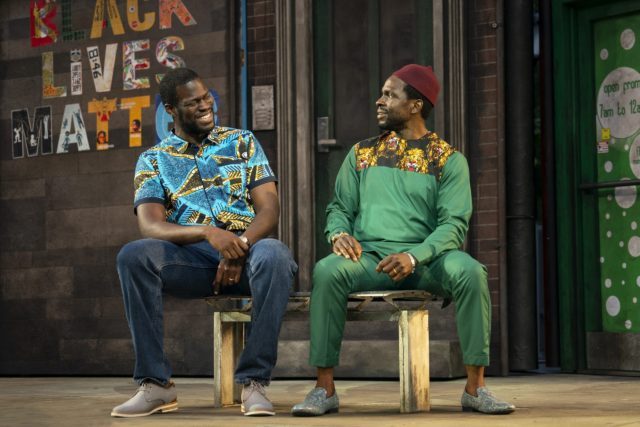
Tag Archives: Delacorte Theater

NOT AS YOU LIKE IT: TWELFTH NIGHT AT THE DELACORTE

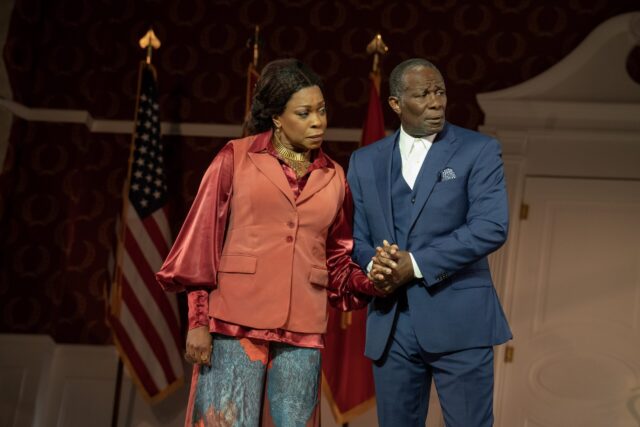
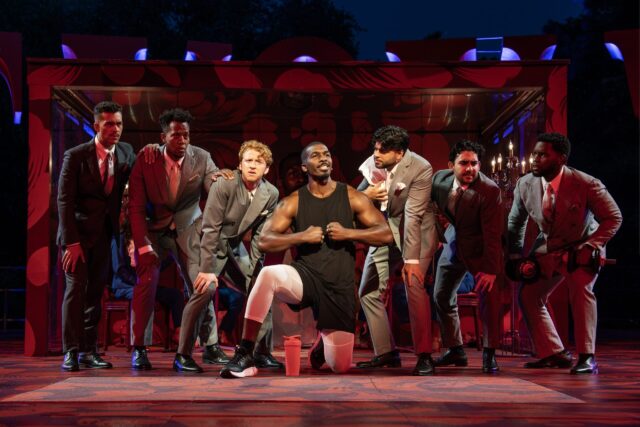
Duke Orsino (Khris Davis) and his minions get ready for action in Twelfth Night (photo by Joan Marcus)

TWELFTH NIGHT
Delacorte Theater, Central Park
Tuesday – Sunday through September 14, free with advance RSVP, 8:00
shakespeareinthepark.org

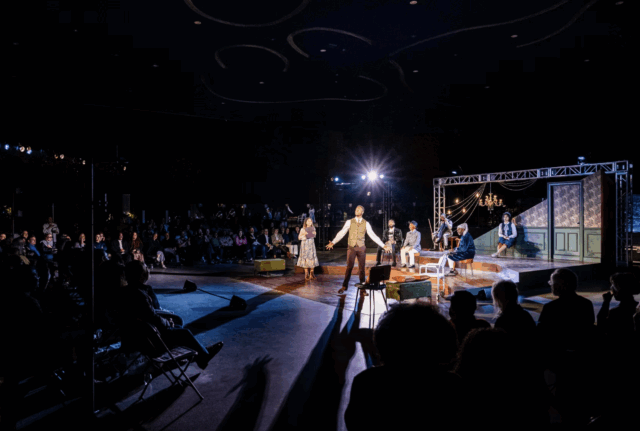
The confusion begins early in Saheem Ali’s inconsistent adaptation of William Shakespeare’s 1601–02 romantic comedy, Twelfth Night, which opens the newly revitalized Delacorte Theater in Central Park. As the audience enters the space — the majority of the $85 million upgrade went to technical operations, dressing rooms, bathrooms, accessibility, and signage, along with improvements to the facade and seats — a string quartet is playing on a red stage that features swirling patterns and, in giant, bold letters around the back, the subtitle of the play: What You Will. (The renovation did not rid the Delacorte of its famous raccoons, one of which ambled along atop the back wall moments before the play began, eliciting the adoring attention of the crowd.)

Then Ghanaian American singer-songwriter Moses Sumney, portraying the fool, Feste, walks onto the stage with a guitar and sings, “All the world’s a stage, / And all the men and women merely players. / They have their exits and their entrances, / And one man — or woman — in their time plays many parts.”

The line actually comes from the second act of As You Like It and seems like a cliché here taken out of context, even with its addition of “or woman.” Meanwhile, the musical shift from classical to Sumney’s alternative/indie R&B is jarring, and the character feels more like a demonic troubadour than one of Shakespeare’s fools.
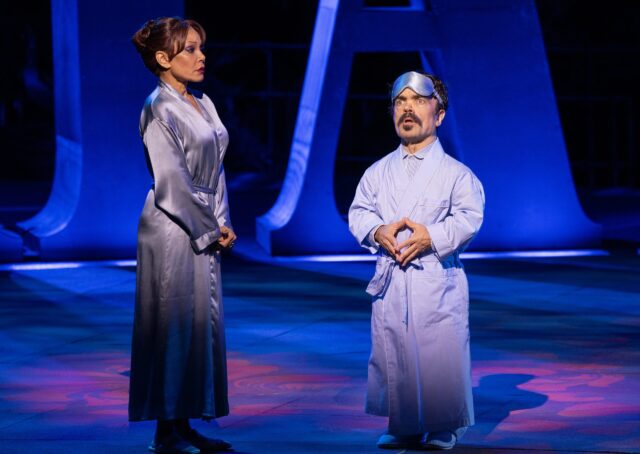
Maria (Daphne Rubin-Vega) offers some intriguing news to Malvolio (Peter Dinklage) in Shakespeare production at revitalized Delacorte (photo by Joan Marcus)

Next, a sea captain (Joe Tapper) and Viola (Lupita Nyong’o) rise in a small boat from one of the Delacorte’s new modular trap doors. Emphasizing that they are strangers to this land, the first words they say to each other are in Swahili, although most of their conversation in in English. (Nyong’o was born in Mexico and raised in Kenya and speaks fluent English, Spanish, Luo, and Swahili.) The explicatory scene lets us know that there has been a shipwreck that has led the captain and Viola to Illyria, which is ruled by the duke Orsino (Khris Davis), who is in love with Olivia (Sandra Oh), a count’s daughter who is mourning the recent deaths of her father and brother and currently uninterested in suitors. Viola’s brother, Sebastian (Junior Nyong’o), was also on the ship, and Viola holds out hope that he has survived as well. She decides to disguise herself as a man named Cesario and serve the duke. (Sebastian has indeed survived and is on the island, with Antonio [b], an enemy of the duke’s, as his servant.) Only then do we meet Orsino as he declares to court gentleman Curio (Ariyan Kassam) and Feste, “If music be the food of love, play on,” which usually starts the play.

Thus, this Twelfth Night has a completely different atmosphere, which is not in itself a bad thing. I am not a Bard purist who insists that Shakespeare plays should not be messed with. Among the endless beauties of his work are the myriad possibilities it offers for reinterpretation. Over the last dozen years, I have seen three memorable productions of Twelfth Night: one on Broadway starring Mark Rylance as an Olivia who is light on her feet and a wickedly funny and towering Stephen Fry as her steward, the much-maligned Malvolio, in a delightful version that harkened back to the seventeenth century in form and style; one off Broadway by Axis that was dark and foreboding and utterly involving; and one at the Delacorte in 2018, an engaging musical comedy by Shaina Taub, who also portrayed Feste. (Twelfth Night is a favorite of the Public Theater’s Shakespeare in the Park presentations, having been staged six times previously, going back to 1969.)

In 2021, I was disappointed in Jocelyn Bioh and Ali’s Merry Wives, which moved the location of the story from Windsor to South Harlem and felt too caught up in shtick, and the same is true here. Scenes move by too quickly as actors enter and leave down the aisles, via the traps, and through the “What You Will” wall like a one-ring circus, not allowing enough time for character development or actor chemistry. Attempts at amusement abound: Olivia’s uncle, the Falstaffian Sir Toby Belch (John Ellison Conlee), and his sidekick, the cheeky Sir Andrew Aguecheek (Jesse Tyler Ferguson), hang out in a hot tub doing lines of coke and whippets when they’re not plotting with Olivia’s chambermaid, Maria (Daphne Rubin-Vega), to publicly embarrass Malvolio (Peter Dinklage) in front of Olivia, whom he secretly pines for. Orsino asserts his strength and power by working out barechested at a gym and ordering his minions to drop and do pushups for punishment. Sir Toby, Sir Andrew, and Fabian (Kapil Talwalkar) hide from Malvolio behind four handheld letters, T, R, E, and E, instead of a tree, which is cute at first but goes on too long. A duel is transformed into a comic boxing match, with Sir Andrew in full boxing regalia.
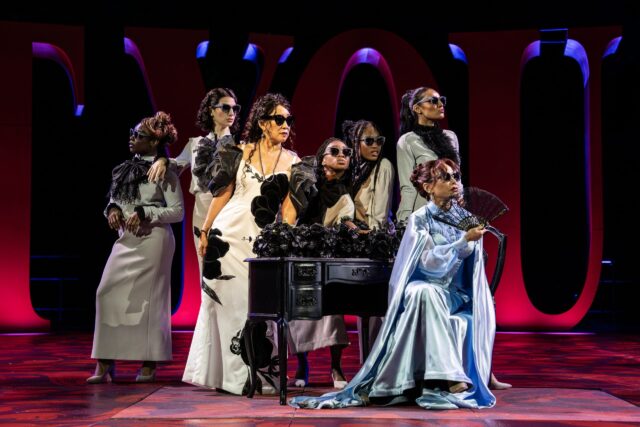
Olivia (Sandra Oh) and her minions get ready for action in Twelfth Night (photo by Joan Marcus)

Real-life siblings Lupita and Junior Nyong’o are dapper in their double-breasted suits. The inspired casting of Dinklage as Malvolio tails off when he is left doing too much voguing, particularly when trying to put a smile on his face. Davis has impressive abs. The actor known as b seems out of place whenever they’re onstage, although the part of Antonio can be a challenge to integrate in even the best of productions. Rubin-Vega looks fabulous, but it’s hard to remember she’s playing a maid. Conlee has fun as Sir Toby, but it’s Oh who steals the show as Olivia, wonderfully balancing comedy and pathos as her lust builds up, subduing her mourning with an elegant wit and grace, best capturing the spirit of Ali’s intentions.

The director has excelled in such non-Shakespeare plays as James Ijames’s Fat Ham, Bioh’s Nollywood Dreams, and Donja R. Love’s Fireflies, but I’ve found both Merry Wives and now Twelfth Night overwrought and scattershot, with too many scenes and characters appearing to come from different plays, lacking continuity despite individual moments that shine. It’s perhaps best exemplified by the Twelfth Night finale, a showcase for costume designer Oana Botez and set designer Maruti Evans; it looks fabulous, but it comes out of nowhere. It elicits wild applause from the audience, but it feels like a preening peacock that has arrived onstage, perhaps watching out for that raccoon.

[Mark Rifkin is a Brooklyn-born, Manhattan-based writer and editor; you can follow him on Substack here.]
MUCH ADO ABOUT SOMETHING: FREE SUMMER NYC THEATER 2025

The free summer theater season kicked off this month with Molière in the Park’s The Imaginary Invalid (photo by Russ Rowland)

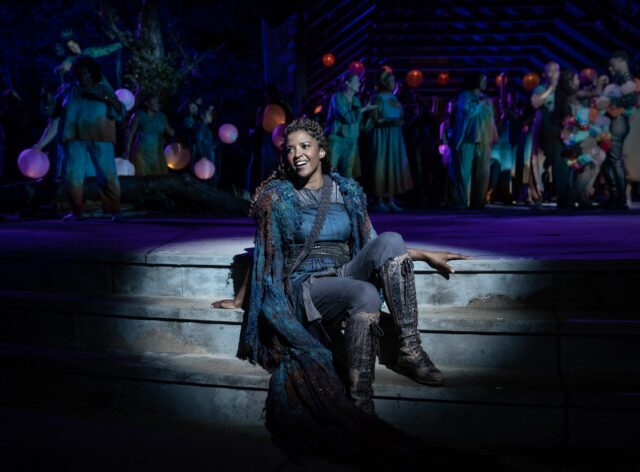
The Public Theater is back presenting Shakespeare in the Park at the Delacorte after a yearlong revitalization, but there are plenty more places to catch the Bard and others for free as well, listed below. Note that some productions strongly suggest advance RSVP and involve moving to multiple locations during the performance.

Through May 25
Molière in the Park: Molière’s The Imaginary Invalid, starring Tony nominee Sahr Ngaujah, the LeFrak Center at Lakeside, Prospect Park, free with RSVP, 3:00 or 7:30

Thursday, May 29
through
Sunday, June 22

Hudson Classical Theater Company: Julius Caesar, Soldiers’ and Sailors’ Monument, West Eighty-Ninth St. & Riverside Dr., Riverside Park, 6:30

Thursday, May 29
through
Sunday, June 29

The Public Theater’s Mobile Unit: Much Ado About Nothing, directed by Rebecca Martínez, with music and lyrics by Julián Mesri, Astor Plaza (May 29-31), the New York Public Library & Bryant Park (June 3-8), Wolfe’s Pond Park (June 11), J. Hood Wright Park (June 12-14), the Cathedral Church of St. John The Divine (June 15), Sunset Park (June 17-18), A.R.R.O.W. Field House (June 20), Queens Night Market (June 21), Roy Wilkins Park (June 22), Maria Hernandez Park (June 25), St. Mary’s Park (June 26), Travers Park (June 27), the Peninsula in Prospect Park (June 28-29)

Saturday, May 31
Barefoot Shakespeare Company: Unrehearsed! The Comedy of Errors, Summit Rock, Central Park, 5:30

Tuesday, June 3
through
Sunday, July 6

NY Classical: All’s Well That Ends Well, Central Park (June 3-22), Carl Schurz Park (June 24-29), Battery Park (July 1-6), free with RSVP, 7:00

Wednesday, June 4
through
Sunday, June 29

Smith Street Stage: Shakespeare in Carroll Park: Henry V, Carroll Park

Thursday, June 12
through
Sunday, June 22

Shakespeare Downtown: Tennessee Williams’s Tiger Tail, Castle Clinton, Battery Park, 6:30

Saturday, June 21
through
Sunday, July 20

Boomerang Theatre Company: Richard II, Central Park West & Sixty-Ninth St., Central Park, $1.70, 2:00

Thursday, June 26
through
Sunday, July 20

Hudson Classical Theater Company: Jane Austen’s Sense and Sensibility, Soldiers’ and Sailors’ Monument, West Eighty-Ninth St. & Riverside Dr., Riverside Park, 6:30

Saturday, July 5
through
Sunday, July 27

The Classical Theatre of Harlem: Memnon, by Will Power, starring Eric Berryman, Richard Rodgers Amphitheater, Marcus Garvey Park

Thursday, July 17
through
Saturday, August 2

Shakespeare in the Parking Lot: A Midsummer Night’s Dream, by the Drilling Company, Lower East Side Prep parking lot, 145 Stanton St. (entrance on Rivington between Norfolk & Suffolk)

Thursday, July 24
through
Sunday, August 17

Hudson Classical Theater Company: Henrik Ibsen’s The Lady from the Sea, Soldiers’ and Sailors’ Monument, West Eighty-Ninth St. & Riverside Dr., Riverside Park, 6:30

Tuesday, August 5
through
Saturday, August 23

Hip to Hip Theater: Hamlet and The Tempest, preceded by children’s workshop, nine locations

Thursday, August 7
through
Sunday, September 14

Shakespeare in the Park: Twelfth Night, starring Lupita Nyong’o, Sandra Oh, Daphne Rubin-Vega, Peter Dinklage, Khris Davis, Junior Nyong’o, Moses Sumney, b, and Jesse Tyler Ferguson, Delacorte Theater, Central Park, 8:00

Saturday, August 23
Barefoot Shakespeare Company: Unrehearsed! The Comedy of Errors, Summit Rock, Central Park, 4:00

Friday, August 29
through
Tuesday, September 2

Pericles: A Public Works Concert Experience, the Cathedral Church of St. John the Divine, music and lyrics by Troy Anthony, directed by Carl Cofield

[Mark Rifkin is a Brooklyn-born, Manhattan-based writer and editor; you can follow him on Substack here.]

PUBLIC WORKS: THE TEMPEST

Renée Elise Goldsberry is sensational as Prospero in Public Works musical adaptation of The Tempest (photo by Joan Marcus)

THE TEMPEST
Central Park, Delacorte Theater
Through September 3, free, 8:00
publictheater.org

In 2013, the Public Theater inaugurated its Public Works program, which partners with community organizations throughout the five boroughs, with a musical adaptation of William Shakespeare’s The Tempest, featuring music and lyrics by Todd Almond, who played Ariel alongside Laura Benanti as the Goddess, Norm Lewis as Prospero, Carson Elrod as Caliban, and some two hundred nonprofessional actors from such local groups as the Fortune Society, the Brownsville Recreation Center, the Children’s Aid Society, DreamYard, and Domestic Workers United.

In 2015, Michael Greif directed a nonmusical Shakespeare in the Park version with Sam Waterston as Prospero, followed in 2019 by Laurie Woolery’s streamlined Mobile Unit adaptation with Myra Lucretia Taylor as the sorcerer.

Woolery is back in charge for the latest iteration, a brand-new lighthearted Public Works interpretation with music and lyrics by Miami native and Columbia grad Benjamin Velez in his full-fledged New York debut. Public Theater artistic director Oskar Eustis promised in his introduction we will all be able to boast, “I was there” as Velez’s career takes flight.

Ariel (Jo Lampert) orchestrates drama with the help of her minions in The Tempest (photo by Joan Marcus)

Tony winner Renée Elise Goldsberry (Hamilton, As You Like It) is sensational as Prospero, the rightful duke of Milan who has fled to a remote island after her brother, Antonio (Anthony Chatmon II), usurped her crown with the help of his friend Alonso, the king of Naples (Joel Frost), twelve years earlier. Living with her sixteen-year-old daughter, Miranda (Naomi Pierre), she now rules over dozens and dozens of spirits in addition to her slave, the deformed Caliban (Theo Stockman), and her indentured servant, the sprite Ariel (Jo Lampert).

In the thrilling opening number, a vengeful Prospero declares, “I call upon the skies, the eyes of justice watching over / There sail my enemies, I send the breeze their way / I summon every cloud to be a shroud on those who wronged me / They took my life so now I vow to make them pay! . . . I’ll finally be free / of the tempest in me.”

The shipwreck brings Antonio and Alonso to the island, along with Sebastian (Tristan André), Alonso’s brother; Ferdinand (Jordan Best), Alonso’s son; Gonzalo (Susan Lin), Alonso’s councilor; and the comic relief of Stephano (Joel Perez), the king’s butler, and Trinculo (Sabrina Cedeño), the king’s fool. Prospero sends out Ariel, who can make herself invisible, to create mayhem with her trusted spirits; meanwhile, Miranda and Ferdinand fall in love.

Velez’s songs, with playful orchestrations by Mike Brun, range from the bouncy “Vibin’ on to You,” in which Miranda and Ferdinand proclaim their affection for each other, to “A Crown Upon Your Head,” a chance for Sebastian and Alonso to scheme to take over, although the number is hampered by overpreening choreography (by Tiffany Rea-Fisher) at the end; from the fun but too long “A Fool Can Be a King,” in which the Three Stooges–like trio of Stephano, Trinculo, and Caliban imagine Stephano ruling the island, to Caliban’s mostly unnecessary “The Isle Is Full of Noises.” Goldsberry brings down the house with the rollicking, hilarious “Log Man,” in which Prospero considers the love between Miranda and Ferdinand, singing, “Innocence flies like the last gasp of summer / Childhood dies in the arms of a lover / Nobody tries to hold on like a mother / But one day you have to let go / When she meets her log man.”

Alexis Distler’s set repurposes Beowulf Boritt’s design for this summer’s earlier Hamlet, with the six-piece band playing in part of a house that is sinking into the ground, next to the gutted main section. Wilberth Gonzalez’s costumes are based in water and earth colors and textures, with unique headpieces for most characters; Ariel’s transformation is a highlight, as are Caliban’s ratty, chainlike vestment and Prospero’s goth steampunk dress. David Weiner’s lighting and Jessica Paz’s sound expertly incorporate the large cast, with as many as eighty-eight performers onstage at once.

Sone classic lines get cut and plot points get condensed across one hundred minutes, and the finale is anticlimactic, but the spirit of the show is intoxicating. It’s a joy to see established actors working with first-timers and regulars from the Brownsville Recreation Center, the Casita Maria Center for Arts & Education, the Center for Family Life, the Children’s Aid Society, DreamYard, Domestic Workers United, the Fortune Society, and the Military Resilience Foundation, including Brianna Cabrera, Patrick O’Hare, Vivian Jett Brown, and Edwin Rivera as Spirit Ancestor lead singers.

This Tempest bids a fond farewell to the Delacorte as we know it, as the sixty-one-year-old theater begins a two-year renovation after the show ends its one-week run September 3. As Antonio usually says, but not in this version, “What’s past is prologue.”

[Mark Rifkin is a Brooklyn-born, Manhattan-based writer and editor; you can follow him on Substack here.]
SHAKESPEARE IN THE PARK: HAMLET

Kenny Leon’s Hamlet follows his Much Ado About Nothing at the Delacorte (photo by Joan Marcus)

HAMLET
Central Park
Delacorte Theater
Tuesday – Sunday through August 6, free, 8:00
shakespeareinthepark.org

Don’t let the recent parade of Hamlets stop you from seeing Kenny Leon’s incisive adaptation that opened last week at the Public’s Delacorte Theater in Central Park.

There has been a surfeit of faithful versions and unique reimaginings of William Shakespeare’s 1599–1601 tragedy in New York City since 2015, from Robert Icke’s staging at Park Ave. Armory with Alex Lawther in the title role, Yaël Farber’s variation at St. Ann’s Warehouse starring Ruth Negga, and James Ijames’s Pulitzer Prize–winning Fat Ham at the Public and on Broadway with Marcel Spears to the Public Theater Mobile Unit’s traveling show with Chukwudi Iwuji, Michael Laurence’s Hamlet in Bed at Rattlestick, and Thomas Ostermeier and Theater Schaubühne Berlin’s iteration at BAM with Lars Eidinger.

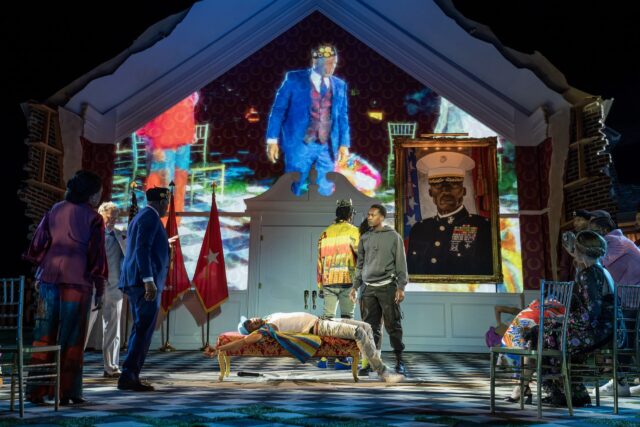
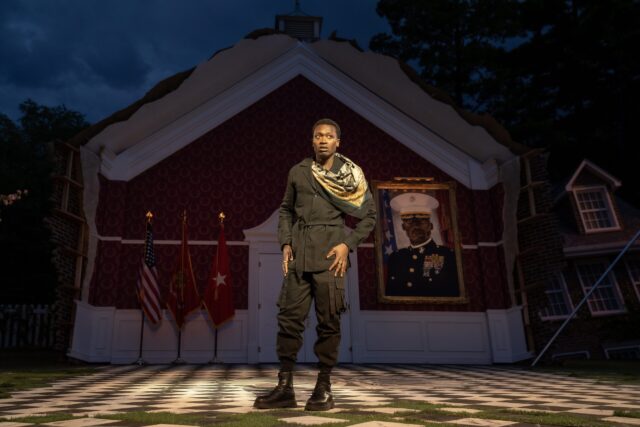
Tony winner Leon turns this Hamlet into a kind of sequel to his 2019 Delacorte triumph, a rollicking modern-day interpretation of Much Ado About Nothing that took place at a Georgia estate prominently displaying “Abrams 2020” banners, referring to two-time former Georgia gubernatorial candidate Stacey Abrams. Set designer Beowulf Boritt is back, tearing the estate in half; one part of the house is sinking into the ground, an Abrams poster sticking out at an angle, like a lonely, overturned grave marker, while a black SUV is stuck in the mud on the other side. It is as if a tornado, or a dangerous presidency, ripped through the land, leaving America in tatters, the white tiles on the grass evoking a cemetery. (The Delacorte itself will be torn down after this summer’s Hamlet and Public Works presentation of The Tempest to undergo a major renovation; it is scheduled to reopen in 2025.)

The central facade features a large portrait of a military hero in full dress uniform, looking like a dictator: the previous king’s funeral is just getting underway as a quartet performs three biblical hymns alongside a flag-draped coffin. “When you go, you’ll have to go alone / When you go, you’ll have to go alone / No one in this world / Can take your journey / When you go, you’ll have to go alone,” they sing. Leon adds in Harry Belafonte’s “Day-o,” an out-of-place tribute to the recently deceased artist and activist, but he also gives us a lovely introduction to Ophelia (Solea Pfeiffer), who offers, “You and Me (No Love Stronger).” Ophelia is given more agency than usual in this adaptation as she considers her affection for Hamlet (Ato Blankson-Wood).

Ato Blankson-Wood is impressive as the introspective Hamlet in latest Shakespeare in the Park production (photo by Joan Marcus)

“For Hamlet, and the trifling of his favor, / Hold it a fashion and a toy in blood, / A violet in the youth of primy nature, / Forward, not permanent, sweet, not lasting, / The perfume and suppliance of a minute, / No more,” Laertes (a firm Nick Rehberger) warns his sister before leaving.

Ophelias’s father and Claudius’s chief counsel, Polonius (Daniel Pearce), admonishes, “In few, Ophelia, do not believe his vows, / I would not, in plain terms, from this time forth / Have you so slander any moment leisure / As to give words or talk with the Lord Hamlet. / Look to ’t, I charge you. Come your ways.”

The dead king’s brother, Claudius (John Douglas Thompson), has quickly gained the throne by marrying his brother’s widow, Gertrude (Lorraine Toussaint). Deeply affected by this turn of events, Hamlet feels like he is alone. “A little more than kin and less than kind,” he whispers to the audience about his new stepfather. Blankson-Wood is brilliant as Hamlet slowly descends into madness, with Leon exploring the character’s state of mind more insightfully than I can remember ever seeing before.

Hamlet is soon visited by the ghost of his father, who appears like a distorted monster, projected onto the gable of the house, his otherworldly voice (recorded by Samuel L. Jackson) explaining to his son that Claudius murdered him; he proclaims, “Revenge his foul and most unnatural murder.” At one point Allen Lee Hughes’s lighting casts the shadow of Hamlet’s head across his father’s portrait, suggesting that he will never be able to escape from the former king’s legacy. (The lighting is by Allen Lee Hughes, with sound by Justin Ellington and projections by Jeff Sugg.)

Claudius calls for Hamlet’s old friends Rosencrantz (Mitchell Winter) and Guildenstern (Brandon Gill) to spy on him. Meanwhile, Hamlet arranges for a traveling troupe of players (Mikhail Calliste, Lauryn Hayes, LaWanda Hopkins, and Colby Lewis) to put on a show that will reveal to the king that Hamlet knows that he is a liar and a murderer. “The play’s the thing / Wherein I’ll catch the conscience of the king,” he says. The players perform a rap song, Jason Michael Webb’s “Cold World,” which features such un-Shakespearean lyrics as “Days are precious when you’re livin’ in a warzone / Tryna live, heart heavy like a diamond / City’s cold, but the streets are even colder / Gotta get out ’fore they say my time is over.” When Hamlet describes the plot, with its murder and marriage, Claudius gets up and storms off. The battle is on.

Leon (Topdog/Underdog, A Soldier’s Play) streamlines the play to a mere two hours and forty-five minutes with intermission, eliminating the subplot of the Norwegian crown prince Fortinbras, who mounts a challenge to Hamlet after Hamlet’s father slays his father. We don’t see Barnardo (Trí Lê), Horatio (Warner Miller), and Marcellus (Lance Alexander Smith) initially encounter the ghost. There is no mention of any state being “rotten,” no “to the manner born,” no “thoughts be bloody,” but none of that is missed.

Polonius is wonderfully portrayed by Pearce (Mother of the Maid, Timon of Athens) as a persnickety, bow-tied southern gentleman in a seersucker suit. Thompson, one of our greatest classical actors whether doing Shakespeare (The Merchant of Venice), Eugene O’Neill (The Iceman Cometh), or August Wilson (Jitney), is stirring as Claudius, commanding the stage with a moving vulnerability, while Toussaint (A Midsummer Night’s Dream, Stuff Happens) is a worthy cohort, finding compassion for her son even as her husband grows more combative. Greg Hildreth (Company, Moscow Moscow Moscow Moscow Moscow Moscow) nearly steals the show as the gravedigger, who uses skulls like bowling balls.

Lorraine Toussaint and John Douglas Thompson sparkle as Gertrude and Claudius in Hamlet (photo by Joan Marcus)

The staging does supply some significant problems. As opposed to Leon’s Much Ado About Nothing, which was set in modern-day Atlanta, it is not clear when and where his Hamlet unfolds, in Denmark, Georgia, or a different location. While Much Ado had an all Black and brown cast, Hamlet has several Caucasian actors. There are subtle references to what is happening in Trump-era America, the dialogue is spoken with a flowing style, and Jessica Jahn’s costumes are contemporary dress, from Claudius’s blue suit to Laertes’s dungaree jacket to Hamlet’s hoodie and Ophelia’s revealing bustier. So impressive in Much Ado, the car now seems like an excess prop. Leon might be attempting to meld past with present, but it can cause confusion, as when letters are delivered during a time when SUVs and 2020 placards are present.

Following in the footsteps of such actors as Sarah Bernhardt, Laurence Olivier, Richard Burton, Nicol Williamson, Mel Gibson, Kenneth Branagh, and Ethan Hawke — and, at the Delacorte itself, Michael Stuhlbarg in 2000, Sam Waterston in 1975, Stacy Keach in 1972, and Albert Ryder in 1964 — Blankson-Wood (Slave Play, The Total Bent) is a Hamlet for these times. His journey into madness has a method in it, a young man troubled by what he sees going on all around him, with his parents, his girlfriend, and the ruling class.

“I will be brief. Your noble son is mad. / ‘Mad’ call I it, for, to define true madness, / What is ’t but to be nothing else but mad?” Polonius says to Claudius. Blankson-Wood’s Hamlet is no skulking college student or shy mama’s boy; he is a prince trying to find his way in a complex and dangerous world, one that provides no sympathy. He delivers six of Hamlet’s seven soliloquies (“How all occasions do inform against me” has been cut) with a thoughtful, understated tenderness, not demanding attention to himself but instead to the character’s search for an unreachable inner peace.

It’s heartbreaking but, after all, Hamlet is a tragedy, no matter where or when it is set.

[Mark Rifkin is a Brooklyn-born, Manhattan-based writer and editor; you can follow him on Substack here.]
PUBLIC WORKS: AS YOU LIKE IT

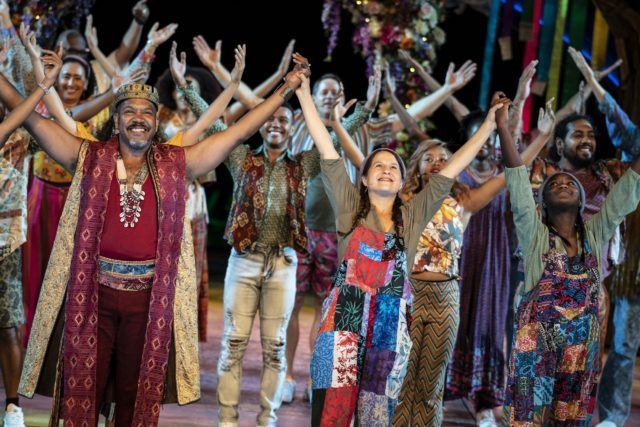
A diverse cast of amateurs and pros comes together in As You Like It at the Delacorte (photo by Joan Marcus)

AS YOU LIKE IT
Central Park, Delacorte Theater
Tuesday – Sunday through September 11, free, 8:00
publictheater.org

In celebration of the sixtieth anniversary of the Delacorte Theater and the tenth anniversary of the Public Theater’s Public Works program, which brings together professional artists and community members in short-run, large-scale productions, Shakespeare in the Park has brought back Public Theater artist-in-residence Shaina Taub and Public Works director Laurie Woolery’s 2017 adaptation of the Bard’s pastoral comedy favorite, As You Like It. Continuing in Central Park through September 11, the musical is a delightful take on the story of hidden identity, family dysfunction, and true love, set in and around the forest of Arden and given a decidedly twenty-first-century twist while often referencing the show.

“All the world’s a stage / and everybody’s in the show / Nobody’s a pro / All the world’s a stage / and every day, we play our part / acting out our heart / Year by year, we grow / learning as we go / trying to tell a story we can feel / How do you make the magic real?” Taub, as the melancholy Jaques, sings as a form of introduction, words that relate to the musical, to Public Works, and life itself.

Later, Duke Senior (usually portrayed by Darius de Haas but I saw Amar Atkins), who has been exiled by his younger brother, Duke Frederick (Eric Pierre), and leads a poor but tight-knit community in Arden, declares, “I will not be free / until we are all free / Under the greenwood tree / you shall see no enemy / Do not fear / All / All are welcome here,” letting everyone onstage and in the audience know that this is an inclusive experience. The cast of 127 features performers from ages 7 to 82, mostly amateurs, from partner organizations across the five boroughs: Brownsville Recreation Center, Casita Maria Center for Arts and Education, Center for Family Life in Sunset Park, Children’s Aid, DreamYard, Domestic Workers United, the Fortune Society, and Military Resilience Foundation. Each participant is listed in the program and gets to make a personal statement.

Taub, who wrote the music and lyrics, and Woolery, who directs, have created a multiethnic spectacle with key gender swaps, which deliver added depth to the narrative. Tired of being persecuted by his older brother Oliver (Renrick Palmer), orphaned gentleman Orlando (Ato Blankson-Wood, Trevor McGhie) believes he can prove his worth by winning a wrestling tournament. The bouts are hilariously choreographed in a ring that rises from below the stage; the competitors range from the masked and massive Bronco to Frankie Flow and a wiry and vicious caveman (actual lucha libre wrestlers from the Bronx Wrestling Federation).

Rosalind (Rebecca Naomi Jones) is banished by her uncle, Duke Frederick (Eric Pierre), in Shakespeare adaptation (photo by Joan Marcus)

After pulling out a surprise victory, Orlando falls instantly in love with Rosalind (Rebecca Naomi Jones), the daughter of Duke Senior, and is subsequently banished by her uncle. Rosalind, accompanied by her best friend, Celia (Idania Quezada), Duke Frederick’s daughter, disguise themselves as Ganymede and Aliena, respectively, and head out into the forest joined by their loyal fool, Touchstone (Christopher M. Ramirez). Orlando flees the court and goes to Arden as well, seeking out his sweetheart.

Soon Orlando, not recognizing that Ganymede is in fact Rosalind, is befriended by his disguised love, who teaches him the art of wooing. Celia develops a liking for Oliver. Touchstone becomes desperate to hook up with farmhand Andy (Jonathan Jordan), who might have a thing for farmer William (Damion Allen). And shepherdess Silvia (Brianna Cabrera; Claudia Yanez) is mad for shepherdess Phoebe (Bianca Edwards), who wants nothing to do with her and instead develops a taste for Ganymede.

Distressed by Phoebe’s spurning, Silvia sings, “You Phoebe me / Why you gotta Phoebe me?” Phoebe cruelly retorts, “You say my glance is lethal / but girl, I know you’re lying / cause I’m giving you a death stare / and I don’t see you dying!” To “Phoebe” someone becomes a joke throughout the rest of the play.

Meanwhile, whenever Orlando bursts out into a solo, he is joined by a riotous backup group dressed in gleaming all-white, De Boys band dancers (Tristan André, Pierre Harmony Graves, Bobby Moody, Edwin Rivera), who groove with him seamlessly to the immense delight of the audience.

But trouble awaits when Duke Frederick decides to invade the forest and put an end to all the romantic shenanigans.

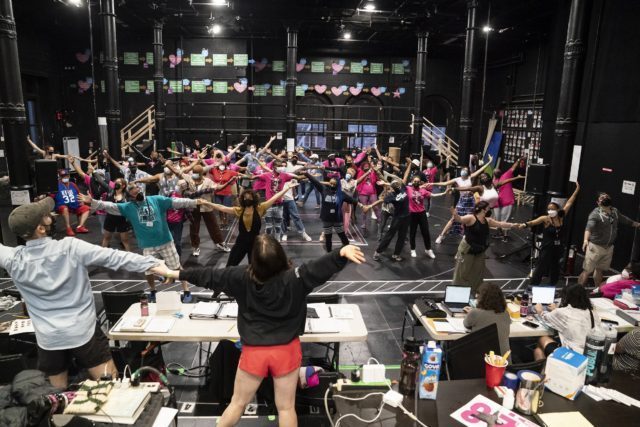
The large cast rehearses indoors for As You Like It (photo by Joan Marcus)

Taub, who previously adapted Twelfth Night for Public Works, serves as a kind of narrator as Jaques, appearing now and then to offer such warnings as “We shall make the same mistakes and never learn!,” “The worst fault you have is to be in love,” and “Give me leave to speak my mind and I will through and through cleanse the infected world, if they will patiently receive my medicine!” Of course, the medicine she and Woolery (Manahatta, Eureka) deliver is more than just a panacea but at the very least a temporary cure for whatever ails you.

The songs run the gamut from pop to R&B to rap and romantic ballads, with wonderful orchestrations by Mike Brun and original choreography by Sonya Tayeh, playfully restaged with additions by Billy Griffin. Duke Frederick’s entrances and exits are particularly memorable, accompanied by a royal guard that proclaims, “All hail Duke Frederick” to a melody that recalls the evil Imperial March theme from Star Wars, while the De Boys boy band brings down the house each time they put on the moves.

The set, anchored by a rear bridge and three trees on a revolving center, is by Myung Hee Cho, with lavish costumes by Emilio Sosa, lighting by Isabella Byrd, and sound by Sun Hee Kil. The animal puppets are by James Ortiz, the designer behind the remarkable puppets in The Skin of Our Teeth and Into the Woods.

The cast is a delight, from the leads to the bit players; in the program, the actors are listed alphabetically and each gets the same amount of space, three or four lines, whether it’s Taub, Jones, Blankson-Wood, or Ramirez or Vivian Jett Brown as Miss Amiens, Tommy Williams or Jason Asher as the referee, or Monica Patricia Davis or Alfreda Small as Ada.

The show was written in response to the 2016 presidential election and how it has torn apart the nation. It returns at a time when we all need healing and a way to come together despite our differences. In As You Like It, Jaques calls it “a miserable world,” but it’s significantly better with musicals like this in it.

SHAKESPEARE IN THE PARK: RICHARD III

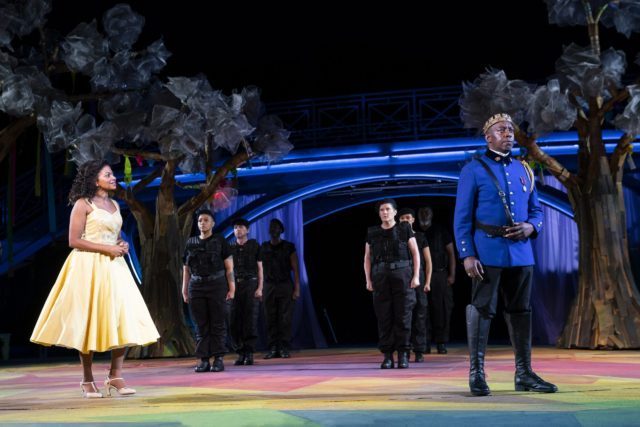
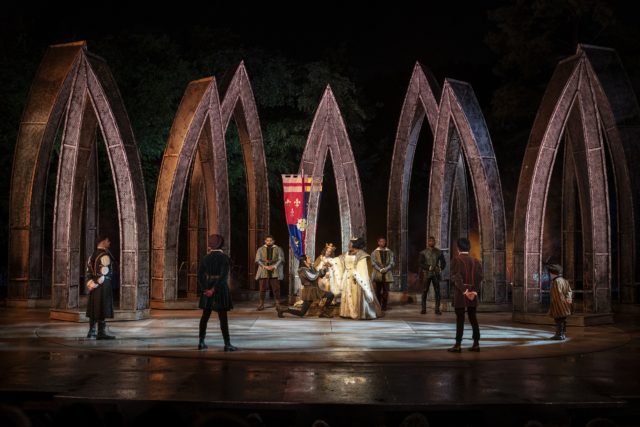
Robert O’Hara’s Richard III is set among moving gothic arches (photo by Joan Marcus)

RICHARD III
Central Park, Delacorte Theater
Tuesday – Sunday through July 17, free, 8:00
publictheater.org

There’s a moment early on in Robert O’Hara’s Shakespeare in the Park production of Richard III that defines the rest of the play. When Richard (playwright and actor Danai Gurira), the Duke of Gloucester, is wooing Lady Anne (Ali Stroker) after having murdered her husband, the prince, and her father, the king, he gives her his dagger so she can kill him. “If thy revengeful heart cannot forgive, / Lo, here I lend thee this sharp-pointed dagger, / Which if thou please to hide in this true breast / And let the soul forth that adoreth thee, / I lay it naked to the deadly stroke / And humbly beg the death upon my knee—” Richard says. She plunges the dagger into his chest, but alas, it is merely a prop that Richard takes back and fake stabs himself with a few times.

Richard smiles and the crowd laughs, but it prepares us for a different kind of Richard III, and a different kind of Richard. The scene is key to the success of the play; if Richard can woo Lady Anne, who passionately despises him, then he can in turn win over the audience to root him on while he treacherously lays waste to anyone and everyone in his way on his journey to acquiring the crown.

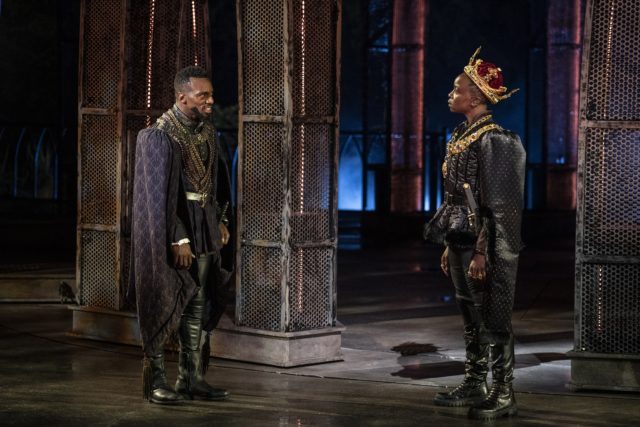
Richard is usually portrayed by a white man with a humped back and a menacing limp. But here he is played by a Zimbabwean American woman, looking magnificent in black leather with gold details and a closely shaved head with ominous designs. There’s no limp and no hunch, recalling Jamie Lloyd’s recent staging of Edmond Rostand’s Cyrano de Bergerac at the BAM Harvey, where a stunning James McAvoy wore no embarrassing proboscis, perhaps the hottest Cyrano in history.

So it’s a hard sell when Gurira admits, “I, that am not shaped for sportive tricks, / Nor made to court an amorous looking glass; / I, that am rudely stamped and want love’s majesty / To strut before a wanton ambling nymph; I, that am curtailed of this fair proportion, / Cheated of feature by dissembling nature, / Deformed, unfinished, sent before my time / Into this breathing world scarce half made up, / And that so lamely and unfashionable / That dogs bark at me as I halt by them.”

Ratcliffe (Daniel J. Watts) has some stern words with Richard III (Danai Gurira) in Shakespeare in the Park production (photo by Joan Marcus)

Despite that anomaly, we are with Gurira’s Gloucester from the very start, in a prologue taken from the third part of Henry VI as he stabs the king. Gurira’s monologues to the audience are not as intense as we are used to; this is a more likable Richard, and that works, for the most part. Gurira, who is well known as Michonne on The Walking Dead and Okoye in Black Panther and has appeared on Broadway in Joe Turner’s Come and Gone and at the Delacorte in Measure for Measure, has a charismatic mystique as she marches across Myung Hee Cho’s minimalist set, consisting of eleven large gothic arches that rotate around the stage and occasionally flicker with colored lights. (The lighting is by Alex Jainchill, with fashionable costumes by Dede Ayite and sound and music by Elisheba Ittoop.)

But O’Hara (Slave Play, Barbecue), who has previously directed Gurira’s Eclipsed and The Continuum, never finds the right pace as the show labors through its two hours and forty minutes (with a twenty-minute intermission). We are too often waiting for something to happen instead of it just happening; the electricity rarely sparks.

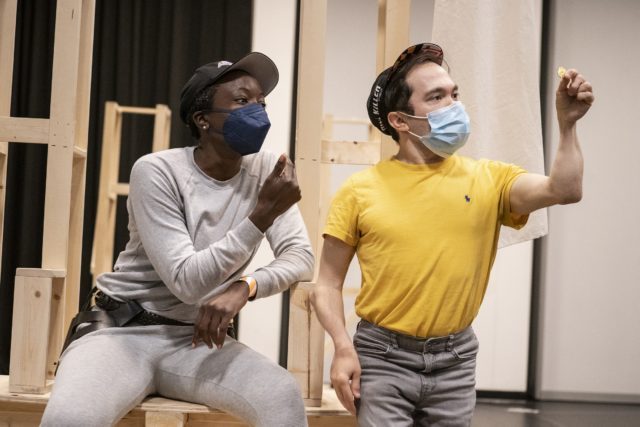
There are stylish moments, but too many scenes feel like set pieces that stand on their own but do not flow into one another. Tony winner Stroker (Oklahoma! Spring Awakening) is lovely as Lady Anne, especially when she shows up later in a blinged-out wheelchair. Monique Holt (Cymbeline, Romeo & Juliet), who is deaf, adds a unique aspect to the Duchess of York, but not everything she signs is translated. One of the assassins, played by Maleni Chaitoo, is also deaf. And Rivers is portrayed by Matthew August Jeffers, who has a rare form of dwarfism.

Danai Gurira and Matthew August Jeffers rehearse in masks for Richard III (photo by Joan Marcus)

Interestingly, while Gurira’s Richard has no physical disabilities, Richmond and King Edward IV are played by Gregg Mozgala (Cost of Living, Merchant of Venice), who has cerebral palsy, which affects how he walks; Mozgala starred as a high school version of Richard III in Teenage Dick at the Public in 2018.

Sharon Washington (Feeding the Dragon Wild with Happy), who portrayed Lady Anne at the Delacorte in 1990, brings down the house as Queen Margaret, who sees through Richard immediately. She lets loose after declaring, “I can no longer hold me patient,” making us yearn for her return after she exits. The cast also features Sanjit De Silva as Buckingham, Skyler Gallun as the Prince of Wales, Paul Niebanck as George, Michael Potts as Lord Stanley, Ariel Shafir as Lord Hastings, Heather Alicia Simms as Queen Elizabeth, Matthew August Jeffers as a standout among the ensemble, and Daniel J. Watts as Catesby / Ratcliffe.

Richard III kicks off the sixtieth anniversary season of Shakespeare in the Park at the Delacorte; the inaugural presentation, in 1962, was The Merchant of Venice with George C. Scott as Shylock and James Earl Jones as the Prince of Morocco. Richard III has been staged at the Delacorte in 1966 with Philip Bosco, 1983 with Kevin Kline, and 1990 with Denzel Washington. Among the others who have portrayed the devious duke onstage are Scott, Laurence Olivier, Ian McKellen, Kevin Spacey, Al Pacino, Benedict Cumberbatch, Alec Guinness, Peter Dinklage, Mark Rylance, and Lars Eidinger, who was spectacular in Thomas Ostermeier’s adaptation at BAM in 2017. Gurira is a worthy addition to that list, even if the production itself leaves too much to be desired in a hopefully glorious summer.

SHAKESPEARE IN THE PARK: MERRY WIVES

An exuberant cast welcomes Shakespeare in the Park back to the Delacorte in Merry Wives (photo by Joan Marcus)

MERRY WIVES
Central Park, Delacorte Theater
Monday – Saturday through September 18, free, 8:00
shakespeareinthepark.org

Shakespeare in the Park returns to the Delacorte after a canceled 2020 Covid summer season with the Public Theater’s exuberant but overbaked Merry Wives, continuing through September 18. Adapted by actress and playwright Jocelyn Bioh, who has appeared in such shows as An Octoroon and The Red Letter Plays: In the Blood and written such works as School Girls; or, the African Mean Girls Play and Nollywood Dreams, the play is thoroughly updated but often feels like a mash-up of such sitcoms as What’s Happening!! and The Jeffersons with such reality programs as The Bachelorette and Real Housewives.

The evening begins with Farai Malianga in a Brooklyn Nets Kyrie Irving jersey pounding on his djembe and eliciting an engaging call-and-response with the audience. It’s a wonderful start, reminiscent of how the late Baba Chuck Davis would kick off BAM’s annual DanceAfrica series. The seating is less thrilling but important, divided into sections full of vaccinated people who may choose not to mask — most don’t — and two emptier sections of unvaccinated people who must be masked and socially distanced.

Merry Wives is set in modern-day South Harlem, with a cast of characters from Ghana, Liberia, Nigeria, and Senegal, portrayed exclusively by actors of color. In 2019, Kenny Leon directed a fabulous all-Black version of Much Ado About Nothing, but lightning doesn’t strike twice.

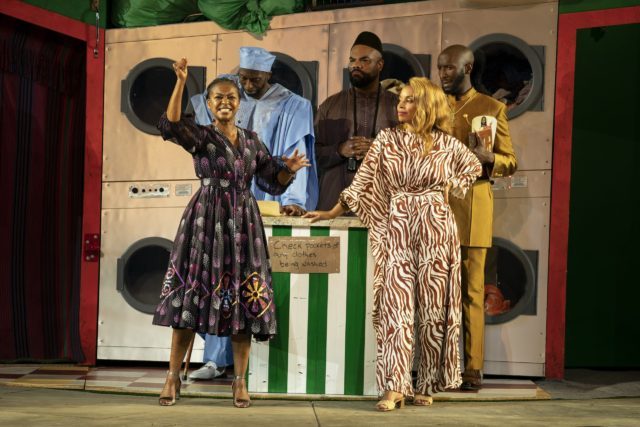
Madams Ford (Susan Kelechi Watson) and Page (Pascale Armand) join forces in contemporary update of Merry Wives (photo by Joan Marcus)

There’s a reason why The Merry Wives of Windsor is so rarely presented; it’s only been performed at the Delacorte twice before, in 1974 (with George Hearn, Marilyn Sokol, Barnard Hughes, Cynthia Harris, Michael Tucker, and Danny DeVito) and 1994 (with Margaret Whitton, David Alan Grier, Andrea Martin, Brian Murray, and Tonya Pinkins). It’s not one of the Bard’s better plays, a Medieval farce that tears down one of his most beloved creations, Sir John Falstaff, far too mean-spiritedly. And too many of the devices and subplots — mistaken identity, the exchange of letters, secret romance — feel like hastily written retreads here.

Falstaff (Jacob Ming-Trent) is a Biggie Smalls–loving wannabe playa out to conquer laundromat owner Madam Nkechi Ford (Susan Kelechi Watson) and socialite Madam Ekua Page (Pascale Armand), making cuckolds of their husbands, the distinguished Mister Nduka Ford (Gbenga Akinnagbe) and the generous Mister Kwame Page (Kyle Scatliffe).

“Nah man, I’m serious,” the sweats-wearing Falstaff tells Pistol (Joshua Echebiri), one of his minions. Madam Page “did so course over my exteriors with such a greedy intention that the appetite of her eye did seem to scorch me up like a burning-glass. She bears the purse too; she is from a region in Ghana, all gold and bounty. I will be cheaters to them both, and they shall be sugar mamas to me; we’re gonna have the Ghanaian and the Nigerian jollof rice! Go bear this letter to Madam Page — and this one to Madam Ford. And then, my friend, I will thrive! . . . I mean . . . We will thrive.”

Misters Kwame Page (Kyle Scatliffe) and Nduka Ford (Gbenga Akinnagbe) try to avoid being cuckolded in Bard farce in Central Park (photo by Joan Marcus)

At the same time, the Pages’ daughter, Anne (Abena), is considered the most eligible bachelorette in Harlem and is being wooed by the well-established Doctor Caius (David Ryan Smith), the shy, nervous Slender (Echebiri), and Anne’s true love, Fenton (MaYaa Boateng), whom no one approves of. Manipulating various elements are the caring Pastor Evans (Phillip James Brannon) and the busybody Mama Quickly (Angela Grovey). Madams Ford and Page get wind of Falstaff’s deceit and team up to confound him, while a jealous Mister Ford disguises himself as a Rastaman named Brook to try to uncover Falstaff’s plan to bed his wife. “Please, off with him!” Sir John tells Brook about Ford. “I will stare him out of his wits, I will awe him with my club; I shall hang like Lebron James over the cuckold’s horns.” It all concludes with a series of matches that are as playful as they are convenient and contemporary.

Beowulf Boritt’s set is fabulous, consisting of the facades of a health clinic, a laundromat, and a hair braiding salon, which open up to reveal various interiors. Dede Ayite’s gorgeous costumes honor traditional African designs with bold colors and patterns. But director Saheem Ali (Fireflies, Fires in the Mirror), the Public’s associate artistic director who helmed audio productions of Romeo y Julieta, Richard II, and Anne Washburn’s Shipwreck: A History Play About 2017 during the pandemic lockdown, can’t get a grip on the story, instead getting lost in silly, repetitive slapstick that overwhelms the narrative. The laughs come inconsistently, settling for trivial humor over sustained comedy. This Merry Wives is a crowd pleaser the way familiar but routine sitcoms and reality shows are; light and frothy, none too demanding, but once they’re done, you’re on to the next program.