Tag Archives: dean haspiel

TWI-NY TENTH ANNIVERSARY TALK: NOVA REN SUMA

Nova Ren Suma will read from her highly anticipated YA debut, IMAGINARY GIRLS, at twi-ny’s tenth anniversary bash Wednesday night at Fontana’s

Fontana’s
105 Eldridge St. between Grand & Broome Sts.
Wednesday, May 18, free, 7:00 – 9:30
212-334-6740
www.fontanasnyc.com
www.novaren.com

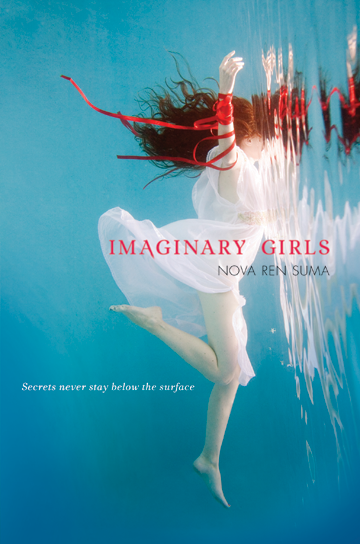
A self-described “easily distracted writer,” “daydreamer,” and “big sister,” New York City-based author Nova Ren Suma is making quite a splash with her debut YA novel, Imaginary Girls (Dutton, June 14, $17.99). Suma agonized over every sentence and every word of the stunning book, resulting in a beautifully written story of the deep bond between two sisters living in upstate New York, not far from where Suma was raised. “Ruby said I’d never drown — not in deep ocean, not by shipwreck, not even by falling drunk into someone’s bottomless backyard pool,” the slightly surreal novel begins. Suma’s first book, the 2009 middle-grade hardcover Dani Noir, was an engaging tale of a thirteen-year-old girl obsessed with film noir, Rita Hayworth, and a suspicious relationship. Suma, a charming young woman who loves talking about music, literature, food, and cats, will be appearing May 23 at the NYC Teen Author Carnival at the Mulberry Street Library, but before that she’ll be giving the first public reading from Imaginary Girls at twi-ny’s tenth anniversary celebration May 18 at Fontana’s, along with Dean Haspiel, Andrew Giangola, and Kyle Thomas Smith and live musical performances from Megan Reilly and James Mastro, Paula Carino and the Sliding Scale, and Evan Shinners. In preparation for the event, Suma chatted with twi-ny about her creative process.

twi-ny: After reading an early draft of Imaginary Girls, I told you not to let your agent or editor change a thing because I found it so beautiful. I’m now poring over an advance reader’s copy, and you have indeed made changes, which make the book even better. You were wise not to listen to me. What was the editing/revising experience like for you, especially when you had so many people lavishing you with praise?

Nova Ren Suma: Imaginary Girls is a surreal novel in which unexplainable things happen, and where reality is in question, which pretty much mirrors my entire experience getting the book published. My agent signed me on just two chapters, sent me off to write more, and then when I had a couple more chapters he quickly sold the novel unfinished to my dream publisher, which meant that I got to work with my editor very early on during the writing of the manuscript. It doesn’t sound real. My editor did say some extremely nice things about those early pages that made me blush, but she also worked me harder than I ever expected, seeing the potential in the story and finding ways to dig it out of me through quite a few revision letters, phone calls, and edit meetings. It was a thrilling, humbling experience to have the help of such a brilliant editor. Even now I suspect that she knows Ruby, one of the main characters, as well as I do. At one point I rewrote about two hundred pages in the middle of the book. At another point I cut about twenty thousand words. I was revising long after I thought I’d be finished. I pulled all-nighters like I haven’t done since college. I laughed, I cried, I wore pajamas out in the street. . . . It was intense. It was also the best experience I’ve ever had writing anything in my life. I love what the book became.

So I have to thank you for not just reading my manuscript at such a rough, raw stage but for saying just the right things. I was about to dive headfirst into a summer and fall of deep revision. I think I really needed that praise to make it through to the other side.
twi-ny: You have a strong online presence, on Facebook, your Distraction no. 99 blog, and other sites, connecting not only with readers but with other teen writers. What are some of the benefits you’ve gained from being part of this growing community of YA authors? What are the drawbacks?

NRS: The YA community online inspires me to no end and I am so grateful to be a part of it — everyone was so welcoming. But it’s also true that all the time spent connecting with other writers and readers and booksellers and bloggers and librarians is time not spent writing. It’s easy to get caught up in being online, to think you need to have a presence on every site, doing every shiny new thing in the way of social networking, and I’m easily swept away by that. I find blogging to be a great way to kick-start my writing — warm up my typing fingers, you know — but sometimes I think longingly of the years before Twitter was invented, wishing I could time-travel back there for a week or two, just to finish this manuscript.

Even so, I do think the benefits outweigh the distractions — at least, we authors have to hope they do. We tell ourselves they do. I happen to believe that if you’re writing for teens in this day and age and you’re not connecting with other authors and readers online, you’re doing yourself a great disservice. Then again, you probably wrote a hundred pages more than I did this month, so what do I know?

twi-ny: You have very eclectic musical tastes. Were there any specific songs or albums that got you going while writing Imaginary Girls? You’re now working on your next novel; has the song list changed for that?

NRS: I write to music, so Imaginary Girls is deeply connected to a series of songs I listened to while writing and revising the book. I often find a song that goes with a certain chapter and then I loop it and play it on repeat whenever I’m working on that particular piece of the manuscript. I play it until the words melt away and I can’t hear them anymore. I’ve been known to play one song over and over again for a week. Imaginary Girls is written in the voice of a sixteen-year-old girl, and the great majority of the songs on the novel’s playlist are sung by women. The first song to make an appearance was “Werewolf” by Cat Power. The first chapter of the book was written to “Hanging High” by Lykke Li — a song my little sister introduced me to. Other songs on the playlist include “Family Tree” by Bellafea, “These White Lights Will Bend to Make Blue” by Azure Ray, “Eighties Fan” by Camera Obscura, “Blinding” by Florence + the Machine, and “Never. Always. Good.” by Today the Moon, Tomorrow the Sun—a song you introduced me to while I was writing the book, if you remember. The only song from my own teenage years that made it to the playlist was an old Jane’s Addiction song, for nostalgia’s sake: “Summertime Rolls.”

As for my next novel — another dark, surreal story . . . but not a sequel — as I write, I build its playlist. Certain sections must be written to certain songs: “Zebra” by Beach House, “Lilac Wine” by Nina Simone, “The Spine Song” by Cake Bake Betty, “Stars” by the Xx. I’m always looking for new music because I never know what piece of the novel a new song might inspire.

twi-ny: As a full-time writer, you now have the freedom to decide when and where you write. So, when and where are your favorite places and times to write? Is it easier or harder to remain disciplined with fewer obligations outside of writing?

NRS: One of my favorite places to write is a particular café downtown. I only like to go in the mornings, before it gets too packed with NYU students. If you’re curious about what the café is, you’ll find it thanked in my book’s acknowledgments. I pick a table against the back wall, near an outlet, order a mocha — they have delicious mochas — and then dive in. The full-time writing life is still very new to me, so I have to treat going to write like I did going to my job. Even though I have a writing desk at home, I only let myself use it at night. I force myself to get up early, put on clothes and not pajamas, leave my apartment, get caffeine, and go to my “office.” That’s the Writers Room in Manhattan, where many other writers work. I like to visit my favorite café before going to the Writers Room because that is the very same routine I had while working my last full-time day job. I used to write in the café every morning before going in to work, so I go there to remind myself. The truth is that it’s harder to stay disciplined when time is so boundless, so if I can trick myself into thinking I don’t have very much time left in the day, I tend to write more.

There are some mornings now when I forget that I’m not supposed to be stopping at a certain point and rushing to the subway to get to work . . . and then reality washes over me: I have all day.

I have all day, I think excitedly. Then comes the weight of it, the responsibility, recalling how much I’ve always wanted this, and that washes over me too: I have ALL day. So I damn well better make good use of it.
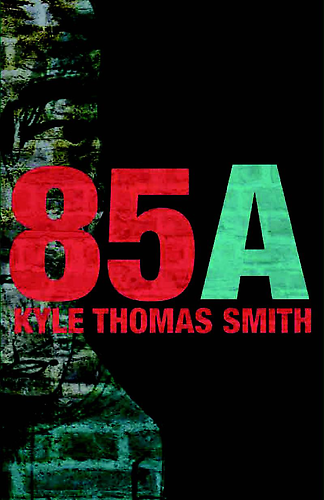
TWI-NY TENTH ANNIVERSARY TALK: KYLE THOMAS SMITH

Kyle Thomas Smith will read from his debut novel, 85A, on May 18 at Fontana’s as part of twi-ny’s tenth anniversary celebration

Fontana’s
105 Eldridge St. between Grand & Broome Sts.
Wednesday, May 18, free, 7:00 – 9:30
212-334-6740
www.fontanasnyc.com
www.85anovel.com

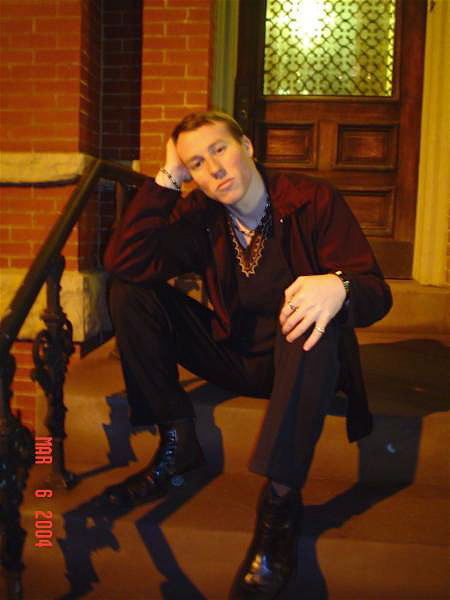
“Every detention, every chip of glass piercing my forearm from the inside, every minute the 85A is late drives me that much closer to London.” So begins Kyle Thomas Smith’s harrowing debut novel, 85A (Bascom Hill, August 2010, $14.95), the brutally honest story of Chicago teenager Seamus O’Grady, who is desperate to get out of a city, school, and family that relentlessly beats him down both mentally and physically. Although the plot of the book is not based on Smith’s real life — he was born and raised in Chicago and moved to Brooklyn in 2003, where he currently lives with his partner and cats — the setting is, and he does a marvelous job capturing the heart and soul of the dark underbelly of his hometown over the course of one long day in January 1989. Smith, a passionate, engaging young man with an infectious joie de vivre, has written for websites and magazines including Sentient City: The Art of Urban Dharma, Boston’s Edge, and The Brooklyn Rail, is an ardent Buddhist practitioner and meditator, and is a multidimensional, enthusiastic individual who feels right at home whether at a punk-rock show or a classical music concert, at experimental theater or an opera at the Met. Smith will read from 85A as part of twi-ny’s free tenth anniversary celebration May 18 at Fontana’s, which will also feature readings from Dean Haspiel, Nova Ren Suma, and Andrew Giangola and live performances from James Mastro and Megan Reilly, Paula Carino and the Sliding Scale, and Evan Shinners.

twi-ny: Seamus is a fascinating character who doesn’t quite understand that with actions come consequences, at least not always the desired kind. How much did you play with Seamus’s lack of/dawning self-awareness?

Kyle Thomas Smith: I was always careful to keep Seamus’s naïveté front-and-center. On the one hand, he’s a city kid who coolly assesses every environment he enters. On the other hand, he’s a misfit and a dreamer. He’s in a bad situation at home, he doesn’t have many friends, he’s not learning in school, so he copes by escaping into fantasy. He projects these fantasies on to the wrong people and builds all sorts of castles in the air. I have always been preoccupied with the notion that there are different types of intelligence. Seamus is hopeless when it comes to academics but his imaginative capacities are off the charts. Yet it’s his imaginative intelligence that could also plunge him headlong into an abyss. In order to illustrate that conflict, I had to constantly ground Seamus’s character in “ungroundedness.”

twi-ny: Music plays a key role in 85A, but you have said that the music that inspires Seamus is not the music that inspires you. What music inspired you when you were Seamus’s age, and what music inspires you today?

KTS: Well, when I was Seamus’s age, the music I listened to and the music that inspired me were two different things. In early high school, I let the scene dictate my tastes. So I listened to a lot of Skinny Puppy and Ministry and a lot of their industrial-goth side projects, but inside I was much more drawn to Bauhaus and Joy Division and even softer stuff like the Smiths, Cocteau Twins, and Robyn Hitchcock. But things changed for me when the Pixies’ Surfer Rosa and Jane’s Addiction’s Nothing’s Shocking surfaced. That was incredible shit and it inspired me to abandon what I was supposed to be listening to and go straight for what I wanted. I went way, way, way back to basics at that point and steeped myself in the Stones (pardon my orgasm), Bowie, Lou Reed, John Cale, and Dylan (especially) — my soul was much more in alignment with all of them. I still love them and I still love the Pixies, but I’m more hooked on Miles Davis and Nina Simone these days. My partner is an opera and classical music aficionado, so my ear has become trained on the Brahms and Chopin that he’s always playing. I keep going back in time. I’m afraid I don’t know much about what’s going on in music anymore, though I do like Gnarls Barkley and Danger Mouse a lot. That’s some deep, inventive stuff right there.

twi-ny: You’ve had readings in your native Chicago, where the book is set, as well as in New York City, your adopted hometown. Has reaction to the book been different in each city? Based on your personal experience, what are some of the major differences between the two cities?

KTS: 85A has been well received in New York. Maybe it’s because there’s been too much written about New York already and New Yorkers are sick of always reading about themselves; they want to read about another dynamic American city for a change. And a lot of nostalgic, homesick Chicago transplants in New York tell me how much the book brings them back.

As for Chicago itself, I can’t tell you how over the moon I was when the Chicago Tribune gave 85A a great review. It was one of those hometown-boy-makes-good experiences. But Chicago is another kettle of fish. It’s an extremely proud city, and people in its music, lit, and art scenes can be incredibly territorial. I recently saw a spot-on documentary about Chicago’s 80s punk scene called You Weren’t There. The title perfectly sums up that chest-thumping, I-was-there-you-weren’t attitude that some people still cop to this day. And that attitude was on flagrant display on this one major Chicago website that posted a poorly written review of 85A that bashes Seamus and completely misrepresents the book. It set off a shit-storm of parochial, internecine comments from people who admitted that they’d never even read 85A. The day it was posted, I had just come to town and was supposed to do a reading at Quimby’s Books the following night. I had no idea how I was going to get through it. But when I got up in front of the audience, a more confident spirit overtook me and people couldn’t have been more receptive to what I was reading. So . . . Chicago can be a tough crowd but it can give a lot of love too.

The difference between the two cities — that’s a damned good question. Chicago winters are never easy, but I never knew why they got such a bad rap until I first moved to New York and then went home for a visit. Holy witch’s tit in a steel bra! How I got through daily life for so many years in that town I have no idea. I like Chicago’s modern architecture better, but New York and Chicago are both world-class cities with some of the best cultural offerings on the planet. Many New Yorkers who have moved to Chicago say they don’t miss New York at all. They say they have just as good a time in Chicago and it’s much cheaper and more manageable. I would probably see Chicago the same way if I wasn’t from there, but there just seems to be more here and you never know what you’re going to stumble upon next when you explore New York neighborhoods, no matter how long you’ve lived in its boroughs.

TWI-NY TENTH ANNIVERSARY TALK: DEAN HASPIEL

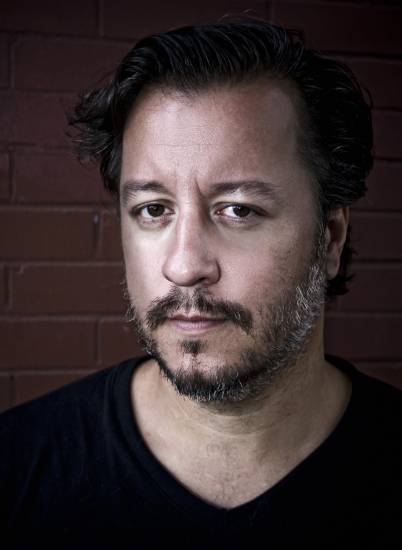
Dean Haspiel will participate in twi-ny’s tenth anniversary celebration on May 18 at Fontana’s (photo by Seth Kushner)

Fontana’s
105 Eldridge St. between Grand & Broome Sts.
Wednesday, May 18, free, 7:00 – 9:30
212-334-6740
www.fontanasnyc.com
www.deanhaspiel.com

For more than two decades, Dean Haspiel has been a comic book force all his own. A wildly talented and gregarious writer, illustrator, promoter, creator, and organizer, Dino works nonstop to build up his own expansive resume as well as the industry itself. In February 2006, he started ACT-I-VATE, a web-based comics collective that features such series as Josh Neufeld’s “Lionel,” Kevin Colden’s “Fishtown,” Nick Bertozzi’s “Iraq War Stories,” and his own “Billy Dogma” and “Street Code,” the latter a terrific semiautobiographical tale set in New York City, where Dino was born and raised. Along the way, he has collaborated on prestigious projects with Harvey Pekar (American Splendor, The Quitter), Jonathan Lethem (Back on Nervous St.), Michael Chabon (The Escapist), and Jonathan Ames (The Alcoholic), and he contributes drawings and illustrations to Ames’s HBO cable series Bored to Death, which features Zach Galifianakis playing a character inspired by Haspiel’s real life.

On May 14, Ames and Haspiel will be honored at the “100 Works on Paper” benefit at Kentler International Drawing Space in Red Hook, where attendees donate $200 and go home with an original work of art. On May 18, the Emmy-winning Haspiel will be presenting a new Street Code comic as part of twi-ny’s tenth anniversary celebration at Fontana’s, which will also feature readings from Nova Ren Suma, Andrew Giangola, and Kyle Thomas Smith and live performances from James Mastro and Megan Reilly, Paula Carino and the Sliding Scale, and Evan Shinners.

twi-ny: You’ve collaborated with such talented writers as Harvey Pekar, Jonathan Lethem, Michael Chabon, and Jonathan Ames; who is your next dream collaborator?

Dean Haspiel: I’ve been itching to collaborate with author Tim Hall on an original graphic novel and we have something planned. I’d also like to collaborate with mystery writer Joe R. Lansdale on adapting his brilliant Hap and Leonard characters into comics form. Plus, I don’t think my career would feel satisfactory if I hadn’t collaborated with some of my favorite comic book writers, the likes of Mark Waid, J. M. DeMatteis, and a handful of others.

twi-ny: Who is your favorite character to draw, whether created by you or another artist?

DH: My favorite characters to draw are my creator-owned Billy Dogma & Jane Legit. But I love drawing Stan Lee and Jack Kirby’s the Thing from the Fantastic Four, and I was recently afforded the opportunity to write and draw a short Thing story in an upcoming issue of Marvel Comics’ Strange Tales sequel.

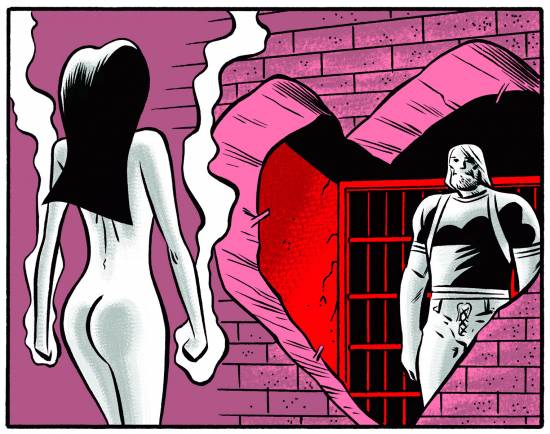
Jane Legit shows her love for Billy Dogma in Dean Haspiel’s “Bring Me the Heart of Billy Dogma,” from THE ACT-I-VATE PRIMER

Jane Legit shows her love for Billy Dogma in Dean Haspiel’s “Bring Me the Heart of Billy Dogma,” from THE ACT-I-VATE PRIMER

twi-ny: On Bored to Death, Zach Galifianakis’s Ray Hueston character is based on you. Is it easy to watch him, or does it hit a little too close to home?

DH: The Ray Hueston character on Bored to Death is loosely based on some events that happened to me, but I don’t think Zach Galifianakis was subjected to a parallax view of my life and my behavioral traits by any stretch of the imagination. So, I can safely declare that Zach and Jonathan Ames have wholly created Ray from spirited, albeit inspired, cloth. However, I was recently privy to the filmmaking of a certain scene in the upcoming season and I remarked how bizarre it was to watch my proposed doppelganger play out an important event, something I never got the opportunity to do in my own life, and how frustrating yet weirdly cathartic that was for me.

twi-ny How do you find the time to do all the things you do, including serving as a relentless promoter of the comics industry?

DH: Don’t even get me started. If everyone on their chosen social networking sites would just share what they liked with the simple click of a button rather than whine about this and that and publish what they had for lunch, I might be able to shrug off my self-imposed burden to cheer what is good and, instead, produce more stories and eat dinner before ten pm with the people I love to spend time with. Alas, the internet accesses a dark gene in humanity that encourages some folks to constantly complain and act like jerks and do things they wouldn’t dare do in front of real people. I don’t do anything that we all couldn’t do together if we just took a minute to think straight and understand our information and entertainment values.

TWI-NY TENTH ANNIVERSARY PARTY

Fontana’s
105 Eldridge St. between Grand & Broome Sts.
Wednesday, May 18, free, 7:00 – 9:30
212-334-6740
www.twi-ny.com
www.fontanasnyc.com

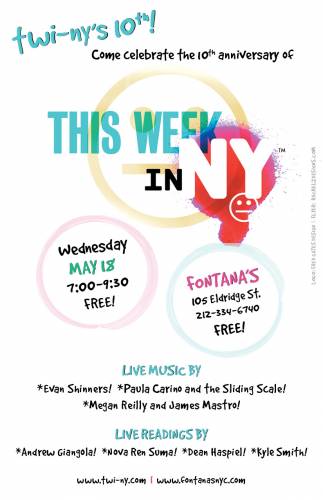
In April 2001, after being kicked out of an internet start-up that had promised the moon but instead delivered a pink slip, I took the two-week severance check and became a tourist in my own town, going to museums and galleries, independent films and lectures, and other cool events that make New York City what it is. I then wrote about my cultural journey, sending a short e-mail to a few dozen friends and relatives. Well, a couple of them seemed to enjoy it, including one person in particular, who convinced me to keep on doing it. Ten years later, here we are, celebrating the aluminum anniversary of This Week in New York: The Insider’s Guide to the City. On May 18, some of my favorite writers and musicians will be participating in a blowout party at Fontana’s on the Lower East Side, and every one of you is invited — and best of all, it’s free. Just sign up here to let us know you’re coming!

7:00: Andrew Giangola, The Weekend Starts on Wednesday
7:15: Megan Reilly with James Mastro
7:45: Nova Ren Suma, Imaginary Girls
8:00: Paula Carino and the Sliding Scale
8:30: Dean Haspiel, Billy Dogma, Street Code
8:45: Kyle Smith, 85A
9:00: Evan Shinners

MoCCA FEST 2011

69th Regiment Armory
68 Lexington Ave. between 25th & 26th Sts.
April 9-10, $10-$12/day, $15-$20/both days, 11:00 am – 6:00 pm
212-254-3511
www.moccany.org

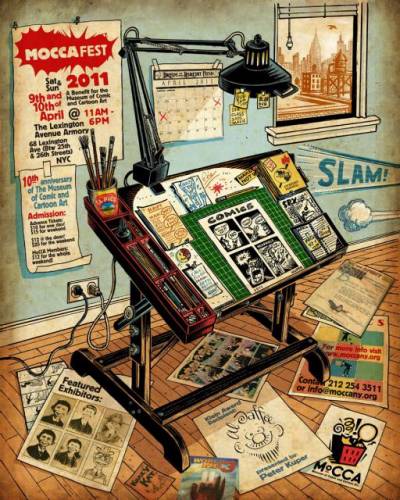
The Museum of Comic and Cartoon Art is celebrating its tenth anniversary this year at MoCCA Fest 2011, taking place April 9-10 at the 69th Regiment Armory on Lexington Ave. The lineup, as usual, is extensive and impressive, featuring such exhibitors as Drawn + Quarterly, Fanfare-Ponent Mon, Meathaus, NBM, First Second, Rabid Rabbit, Top Shelf, Pantheon, Act-I-Vate, Abrams, Fantagraphics, and various Scandinavian consulates general along with signings by Ben Katchor, Michael Kupperman, Dean Haspiel, Kim Deitch, Mo Willems, R. Sikoryak, Galit & Gilad Seliktar, Neil Kleid, Stephen Vrattos, Farel Dalrymple, and Tom Forget, among many others. Two dozen panels are scheduled, from “The State of Editorial Cartooning,” with Ruben Bolling, Tim Kreider, and Ted Rall, moderated by Brian Heater, and “A New Generation of New Yorker Cartoons,” with Drew Dernavich, Paul Noth, Zachary Kanin, and Emily Flake, moderated by Bob Mankoff, to “Reciprocal Influence: Comics and Graphic Design,” with Chip Kidd, Craig Yoe, Yuko Shimizu, Josh Bernstein, and David Mac, moderated by Jeff Newelt, and “The Enterprising Will Eisner,” with Jules Feiffer, Denis Kitchen, and Paul Levitz, moderated by Charles Brownstein. In addition, Jerry Robinson will be talking “Batman, the Joker, and Beyond,” Gahan Wilson will be getting into “Playboy and Beyond,” and Peter Kuper will be presenting the 2011 Klein Award to the great MAD veteran Al Jaffee. Brings lots of cash, especially singles and fives so you can buy lots of small books and cool pamphlets that you’ll find only at MoCCA Fest. And if you’re looking for a little something extra, sign up for the Tenth Anniversary Wine Tasting and Fundraiser for the Museum of Comic and Cartoon Art, being held at their 594 Broadway home Saturday night from 8:00 to 10:00; admission is only twenty bucks.

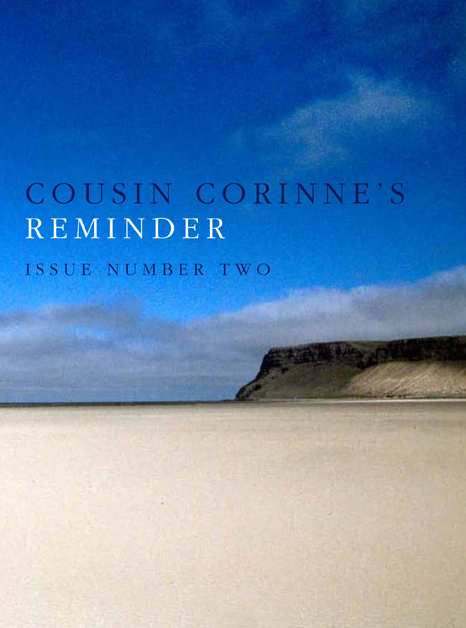
COUSIN CORINNE’S REMINDER: ISSUE NUMBER TWO PARTY

BookCourt
163 Court St. between Dean & Pacific Sts.
Wednesday, January 26, free, 7:00
718-875-3677
www.bookcourt.org
www.cousincorinne.com

In April 2010, the inaugural issue of the oversized trade paperback Cousin Corinne’s Reminder was published, released by an independent Brooklyn-based publishing group in conjunction with the Cobble Hill store BookCourt, whose manager, Zack Zook, served as executive editor. The biannual journal’s stated mission “is to widen the scope of artistic representation within the printed world by combining literary and visual presences.” The first issue included contributions from such notables as Charles Bock, Anne Waldman, Jonathan Letham & Dean Haspiel, Mark Borthwick, Kimiko Yoshida, Donald Moss, and James Frey. The second issue has just been released, bigger and better than the first, a compendium of fiction, poetry, comics, photography, art, and other ramblings from authors and artists who mostly hail from Brooklyn. Beautifully designed by Michael Fusco, Issue Number Two opens with, appropriately enough, George Emilio Sanchez’s “Shalom,” a brief story about his heritage, and includes such other highlights as David Hollander’s absurdist, futuristic “The Limits of Bioinformatics and the Problematic of Meaninglessness: A Case Study”; Stanley Crouch’s “A Darkie French Princess,” about a young man fighting the expectations that come with art, athletics, the quest for knowledge, and skin tone; and Stephen Elliott’s sex diary, “Selections from the Daily Rumpus.” Tierney Gearon’s “The Haircut” creates a touching narrative through a suite of six photographs of a naked mother giving her young son a haircut with a stunning vista behind them, while Anthony Barboza’s “Black Dreams / White Sheets” consists of ten photos in which ten black men, women, and a child are shown lying in different positions on a mattress, shot from directly above. Amelie Mancini’s talk about her newfound love of baseball is accompanied by her David Hockney-inspired paintings of such Hall of Famers as Babe Ruth, Ty Cobb, and Tom Seaver. And the Comix Blox, curated by Haspiel, includes tasty tidbits from Michel Fiffe, Tim Hamilton, and Haspiel himself.

The release of the second issue of Cousin Corinne’s Reminder will be celebrated at BookCourt on January 26 with a special program that includes an opening performance by Sanchez, readings by Crouch, Priscilla Becker, Todd Colby, Catherine Lacey, and Adam Wilson, a comix presentation by Haspiel and Joan Reilly, signings by comix contributors Jen Ferguson, Hamilton, and Fiffe, a painting by Mancini, free drinks, and other guests.

KingCon II

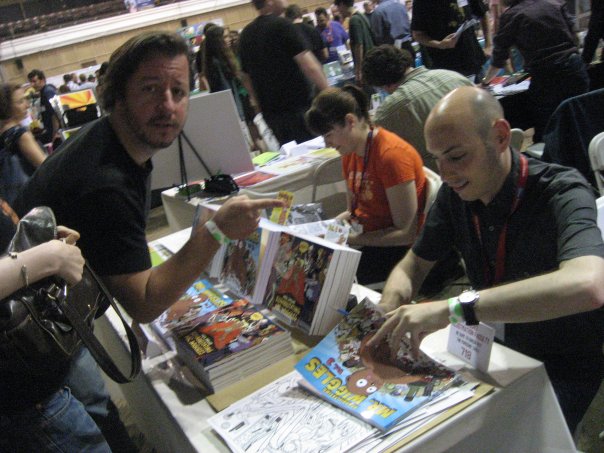
Dean Haspiel and Neil Swaab will both be part of KingCon II in Brookly this weekend (photo by twi-ny/mdr)

Brooklyn Lyceum
227 Fourth Ave. between President & Union Sts.
Friday, November 5, $3, 8:00
November 6-7, $3-$10, 11:00 am – 7:00 pm
718-857-4816
www.kingconbrooklyn.com

The second annual KingCon independent comics and animation convention got under way with two panel discussions on Thursday night at the Brooklyn Lyceum and has a hoppin’ party scheduled for tonight, with readings and live music by such guests as Jeff Newelt, Jen Ferguson, Paul Pope, Dean Haspiel, Joan Hilty, Joe Infurnari, Americans UK, and the Charles Soule Band. The convention kicks into high gear Saturday and Sunday, featuring appearances by such writers and illustrators as Kyle Baker, Simon Fraser, Michael Kuperman, Neil Swaab, Mike Cavallaro, and Becky Cloonan, with such panels as “Collaboration Counseling,” “The Funny Pages: Comedy in Comics,” “How to Draw Comic Characters for Kids of All Ages,” and “Hips, Lips & Pencil Tips: The Sexual Female as Feminist Focal Point.” We can’t wait for Saturday afternoon’s look at the Brooklyn-set HBO series BORED TO DEATH, a discussion with creator Jonathan Ames and graphic artist Haspiel, moderated by Newelt.