Tag Archives: david zayas

JOHN PATRICK SHANLEY: DOUBT: A PARABLE / BROOKLYN LAUNDRY

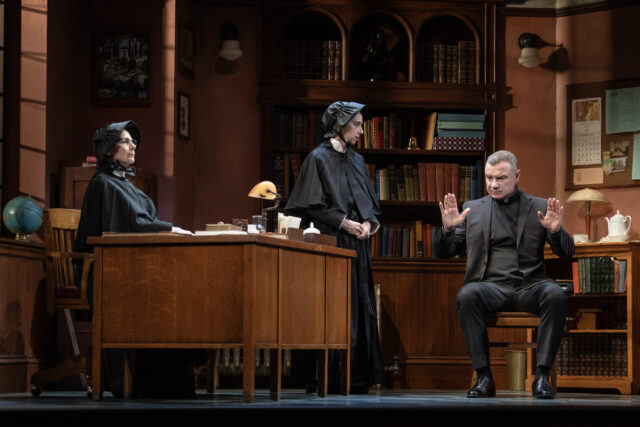
Sister Aloysius (Amy Ryan), Sister James (Zoe Kazan), and Father Flynn (Liev Schreiber) have a serious talk in Doubt (photo by Joan Marcus)

DOUBT: A PARABLE
Todd Haimes Theatre
227 West Forty-Second St. between Broadway & Eighth Ave.
Tuesday – Sunday through April 14, $68-$344
212-539-8500
www.roundabouttheatre.org

“What do you do when you’re not sure? That’s the topic of my sermon today. You look for God’s direction and can’t find it,” Father Flynn (Liev Schreiber) says at the beginning of the first Broadway revival of John Patrick Shanley’s 2004 Pulitzer- and Tony-winning Doubt: A Parable. “Doubt can be a bond as powerful and sustaining as certainty. When you are lost, you are not alone.”

Shanley has two plays running concurrently in New York City, both dealing with doubt and certainty. Roundabout’s production of Doubt has been extended at the Todd Haimes Theatre through April 21, while Manhattan Theatre Club’s world premiere of Brooklyn Laundry has been extended at City Center through April 14. (A sold-out revival of Shanley’s 1983 two-character Danny and the Deep Blue Sea, starring Christopher Abbott and Aubrey Plaza, completed a limited run at the Lucille Lortel in January; it covered some of the same themes as the other two.)

Doubt and Brooklyn Laundry both feature four characters, rotating sets, high-powered performances, real-life inspiration, and, with just a few exceptions, a series of scenes between two characters. But while the former flows seamlessly as the plot unfolds, the latter is bumpy and much less structured.

Doubt takes place in St. Nicholas Church in the Bronx in 1964, during the Second Vatican Council, which sought to update Catholicism in response to the modern world, moving away from scholasticism and centuries-old doctrine and theology toward new ways of relating to lay people, priests, and nuns. Not everyone was on board, and some still aren’t sixty years later.
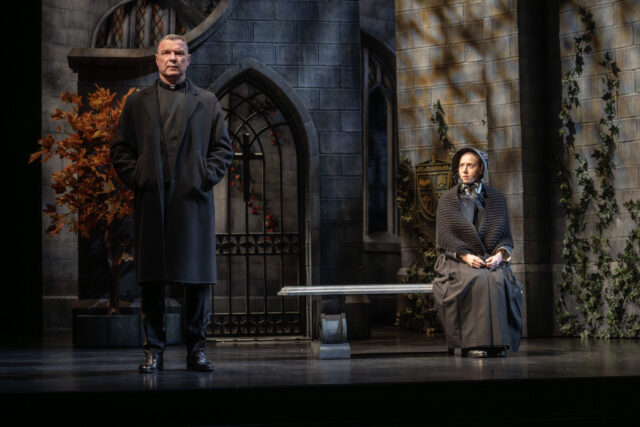
Father Flynn (Liev Schreiber) shares a moment with Sister James (Zoe Kazan) in the church garden (photo by Joan Marcus)

The school is run by the hard-nosed, impossibly strict principal Sister Aloysius (Amy Ryan), a member of the Sisters of Charity, who has no time for art, music, dancing, ballpoint pens, Frosty the Snowman, Father Flynn’s long fingernails, or the monsignor, who she thinks is oblivious. She believes that “satisfaction is a vice” and “innocence is a form of laziness.” When young teacher Sister James (Zoe Kazan) stops by her office, Sister Aloysius starts drilling her on classroom methods, claiming she’s too lenient with her students. She wants her to pay more attention but won’t say exactly what Sister James should be looking for. “I must be careful not to create something by saying it. I can only say I am concerned, perhaps needlessly, about matters in St. Nicholas School,” the older nun says with suspicion.

Later, in the church garden, Sister Aloysius asks about Donald Muller, the first Black student in the school; she is sure that Donald, an altar boy, will get bullied, but when Sister James points out that Father Flynn has taken him under his wing, Sister Aloysius immediately tightens up. “So it’s happened,” she says, as if she has been waiting for this moment.

She learns that Father Flynn had a private talk with Donald in the rectory. Later, in her office, she demands that Father Flynn tell her what happened. The priest refuses, arguing that it was a sensitive, personal matter while understanding exactly what the principal is accusing him of without her saying it out loud. When he is eventually forced to talk about it, he explains that he was only protecting the child and did nothing wrong. That’s not enough for Sister Aloysius, who still suspects him; he storms out, and she tells Sister James, who believes the father, “These types of people are clever. They’re not so easily undone. . . . I’ll bring him down. With or without your help.”

What follows is a tense cat-and-mouse game between the principal and the priest; Sister Aloysius even calls in Donald’s mother (Quincy Tyler Bernstine), who shocks her with her response to learning that her son might be in danger from a predatory priest.
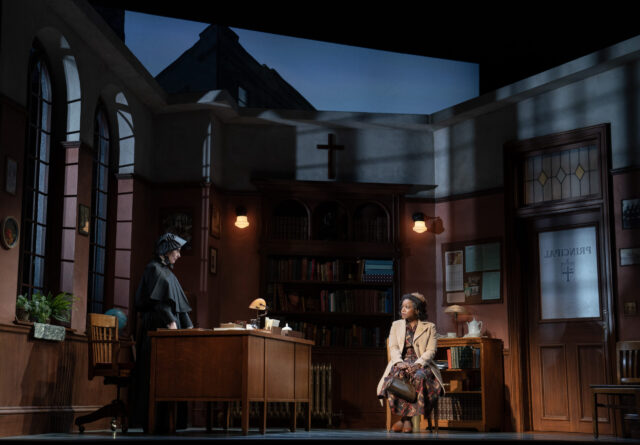
Sister Aloysius (Amy Ryan) has some harsh words for Mrs. Muller (Quincy Tyler Bernstine) in Broadway revival of Doubt (photo by Joan Marcus)

Doubt debuted on Broadway in 2004, with Brían F. O’Byrne as Father Flynn, Cherry Jones as Sister Aloysius, Heather Goldenhersh as Sister James, and Adriane Lenox as Mrs. Muller; all four cast members received Tony nominations, with Jones and Lenox winning, along with awards for Best Play and Best Director (Doug Hughes). In 2008, Shanley adapted the play into a feature film, with Philip Seymour Hoffman as Father Flynn, Meryl Streep as Sister Aloysius, Amy Adams as Sister James, and Viola Davis as Mrs. Muller, all of whom were nominated for Oscars, along with Shanley’s adapted screenplay, which expanded the story to include more than fifty roles.

Director Scott Ellis (Take Me Out, The Assembled Parties) masterfully directs the ninety-minute play, never letting the tension break as the audience wonders whether Father Flynn actually abused Donald. The story was partly inspired by Shanley learning years later that his high school mentor was a sexual predator, as well as his deep respect for nuns. Except for one scene between the two sisters and the father, all the others feature two characters talking about intolerance, faith, gossip, love, God, and what, or who, to believe.

David Rockwell’s sets move between Sister Aloysius’s austere office and the garden, with a projection in the back of buildings next to the church. Everything disappears and windows drop from above when Father Flynn delivers his homilies. Linda Cho’s costumes are primarily dark habits and vestments. Kenneth Posner’s lighting and Mikaal Sulaiman’s sound maintain the eery, mysterious feeling of impending doom.

Bernstine (The Amateurs, Our Lady of 121st Street) is powerful as Mrs. Muller, who is not afraid to make her unique point of view known, and Kazan (Love, Love, Love; A Behanding in Spokane) is wonderful as the doe-eyed innocent who is in over her head.

Two-time Tony nominee Ryan (Love, Love, Love; A Streetcar Named Desire) is almost unrecognizable as Sister Aloysius, the cagey principal who trusts no one except God. She portrays her as diamond-hard, a cold, steely woman without kindness or compassion but she’s not quite a villain, although you’d have to look hard to find a soft spot; you hope she is wrong about Father Flynn not only because he is a more relatable person but because you want her not to win. (Or do you?) Schreiber (Les Liaisons Dangereuses, A View from the Bridge) is utterly brilliant as her prey, his eyes mesmerizing, his gestures works of art; he is almost otherworldly when giving his sermons, then down to earth when teaching the boys basketball.

“Now, the thing about shooting from the foul line: It’s psychological,” Father Flynn explains. “The rest of the game you’re cooperating with your teammates, you’re competing against the other team. But at the foul line, it’s you against yourself. And the danger is: You start to think.”

He’s talking about a lot more than basketball.
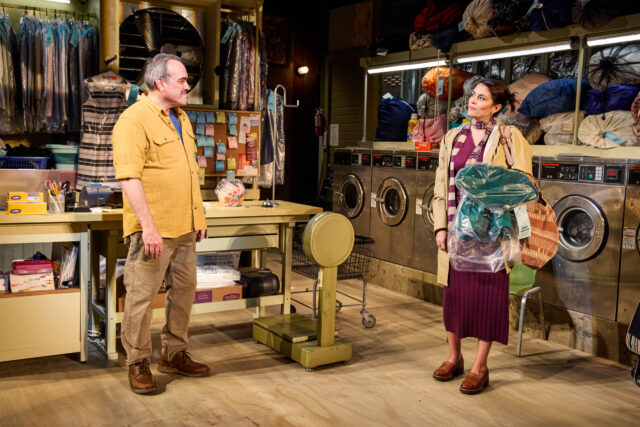
Owen (David Zayas) and Fran (Cecily Strong) take stock of their lives in Brooklyn Laundry (photo by Jeremy Daniel)

BROOKLYN LAUNDRY
Manhattan Theatre Club
MTC at New York City Center – Stage I
Tuesday – Sunday through April 14, $119-$129
212-581-1212
www.manhattantheatreclub.com

“You believe in God?” Fran Costello (Cecily Strong) asks Owen (David Zayas) shortly after meeting him.

“Yeah, why not? You want your dry cleaning?” he responds.

Inspired by having his clothes lost by a local laundromat, John Patrick Shanley’s Brooklyn Laundry is a slight but enjoyable seventy-five-minute trip into a quartet of people facing turning points in their lives. Fran is a cynical thirty-seven-year-old office worker, the youngest of three siblings; her sister Trish (Florencia Lozano) lives in a hospice trailer in Pennsylvania with her two young kids, her ex-husband in jail; her sister Susie (Andrea Syglowski), who lives with her husband and their six-year-old son in the city, is the responsible one; and the fiftyish Owen owns three laundries and hasn’t been with a woman since his fiancée left him two years before.

It’s not exactly love at first sight for Fran and Owen when she comes in to drop off a bag of laundry, where she has a credit because they lost her laundry six months ago. “You’re like my fiancée was,” he says. “She’s . . . ?” Fran begins. “Gone. She was like you. Smart, one inch from terrific, but gloomy,” he continues. She answers, “I don’t think I’m gloomy. I think what I’m suffering from is reality.” Owen: “Some folks look life in the mouth.” Fran: “You’re not one of those people who think I’m manifesting, are you?”

He asks her on a date, and she reluctantly agrees. “Why would you want to have dinner with a person who’s in the middle of an episode?” she asks. He responds, “I don’t know. Everybody has a bad day.”

Fran goes out with Owen and meets up with Trish in Pennsylvania and Susie in Brooklyn as she takes stock of her sad, lonely life; her problems are not about to just come out in the wash.
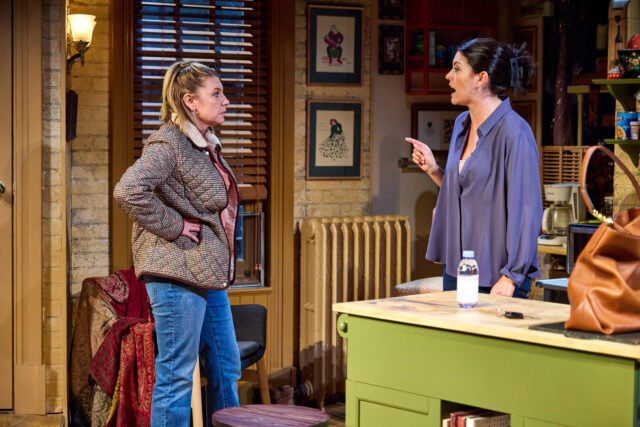
Susie (Andrea Syglowski) and Fran (Cecily Strong) have a family squabble in John Patrick Shanley world premiere for MTC (photo by Jeremy Daniel)

The concept of sleep is an underlying theme of the play. At one point, Susie says to Fran, “It’s a wake-up call,” and Fran responds, “Was I asleep?” Sleep is brought up by all four characters, which harkens back to Doubt. “Oh. I can’t sleep,” Sister Aloysius tells Father Flynn, who asks, “Why not?” The nun says, “Bad dreams. Actually one bad dream and then I haven’t slept right since.” Later, she says to Sister James, “Maybe we’re not supposed to sleep so well.”

Santo Loquasto’s set rotates from Owen’s laundry, which appears to be fully operational, chugging away as the audience enters, to the bedroom in Trish’s trailer, Fran’s studio apartment, and the restaurant where Fran and Owen go to dinner. Suzy Benzinger’s costumes are naturalistic, Brian MacDevitt’s lighting is sharp, particularly in the dinner scene, and John Gromada’s original music and sound maintain the mood, along with Lil Nas X’s “Old Town Road.”

All four actors are exceptional; Lozano (Placebo, One Wet Brain) imbues the dying Trish with a keen sense of humor, Syglowski (Dig, Halfway Bitches Go Straight to Heaven) brings humanity to the angry and frustrated Susie, Strong (The Search for Signs of Intelligent Life in the Universe, Schmigadoon!) empowers Fran through all her awkwardness, and Zayas (Cost of Living, Anna in the Tropics) proves once again why he’s one of the best around, portraying the unpredictable and frightfully honest Owen with charm to spare.

Written and directed by Oscar, Tony, and Obie winner and Emmy nominee Shanley (Outside Mullingar, Prodigal Son), Brooklyn Laundry contains unexpected dialogue with clever undertones. When Owen tells Fran she can keep a quarter that fell on the floor, she says she doesn’t want it, so he asks, “What? You afraid of a little change?” Trish loves the artificial flowers she’s had for twenty years. “You can wash them. They never fade,” she says, as opposed to clothing, or people. When Owen and Fran are at dinner, she is upset that chicken is not on the menu, so he urges her, “This is exactly when reality becomes super important. You must choose from what exists on the menu, Fran, and not choose the invisible thing in your mind.”

However, each scene seems to exist in its own mind; they never come together as a whole, unfolding like loosely connected stories with chapters missing.

“What do you do when you’re not sure?” Father Flynn asks in Doubt, a nearly perfectly executed drama. Meanwhile, Brooklyn Laundry feels unsure of itself, unable to sleep well.

[Mark Rifkin is a Brooklyn-born, Manhattan-based writer and editor; you can follow him on Substack here.]
COST OF LIVING

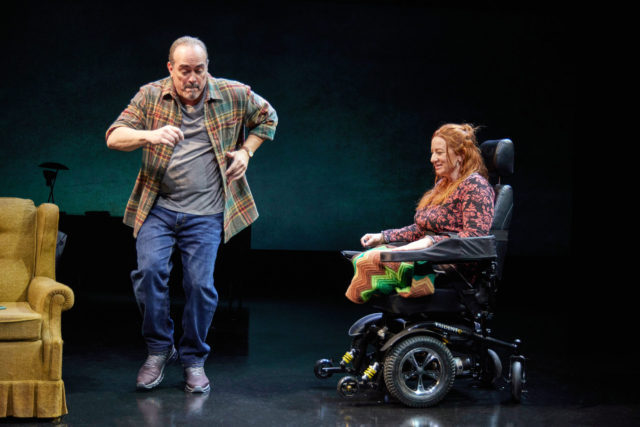
Eddie (David Zayas) and Ani (Katy Sullivan) face adversity in Cost of Living (photo © Jeremy Daniel)

COST OF LIVING
Samuel J. Friedman Theatre
261 West Forty-Seventh St. between Broadway & Eighth Ave.
Tuesday – Sunday through November 6, $74-$298
www.manhattantheatreclub.com

When I saw Manhattan Theatre Club’s production of Martyna Majok’s Cost of Living at New York City Center’s Stage I five and a half years ago, I did not anticipate that it would win the Pulitzer Prize for Drama. I also never imagined that the show, which I called “a tender, emotional play about four lonely people seeking connections,” would eventually transfer to Broadway. But Cost of Living has made a terrific transition to MTC’s Samuel J. Friedman Theatre, with all its tenderness, emotion — and sense of humor — fully intact. In fact, it is now even better.

The play is once again directed by Obie winner Jo Bonney on Wilson Chin’s set, which rotates between the homes of John (Gregg Mozgala), a Harvard grad working on his PhD at Princeton and confined to a wheelchair with cerebral palsy, and Ani (Katy Sullivan), a quadriplegic also in a wheelchair.

While John is looking for a caregiver and interviews and hires Jess (Kara Young), a Princeton grad scrambling to make a living by working multiple jobs and who assures John that despite her slight build she can handle his needs, Ani initially refuses help from her ex-husband, Eddie (David Zayas), a former truck driver with a new girlfriend.

The play opens with Eddie sitting at a bar, talking to an unseen person in what is essentially a long, compelling monologue delivered directly to the audience. “The shit that happens is not to be understood. That’s from the Bible,” he says. “That life is good for people. I was thankful for every day they ain’t invented yet the trucker-robots. That life is good. The road. Sky. The scenery. Except the loneliness. Except in the case of all the, y’know, loneliness. This was what my wife was good for. Not that this was the only thing.”

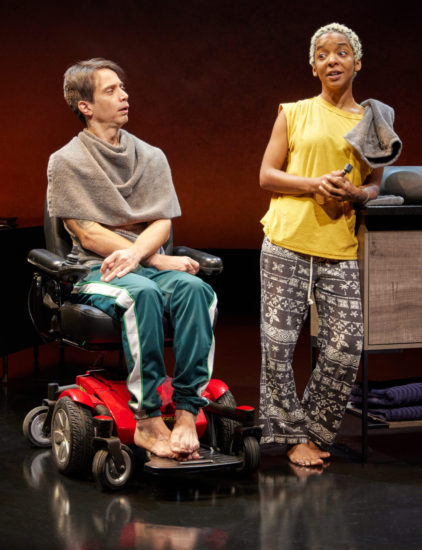
John (Gregg Mozgala) and Jess (Kara Young) come to an agreement in Cost of Living (photo © Jeremy Daniel)

The loneliness and vulnerability experienced by all four characters is palpable, expressed most effectively in scenes of back-to-back caretaking. In the first, Jess washes John in the shower, moving him out of his chair and then back into it, followed by Eddie giving Ani a bath.

Describing his sensations, John tells Jess that his body feels as if he’s constantly under attack. “That’s what it’s like. Under my skin. From underneath my skin. Like people hitting me from beneath my skin. And that’s what you’ll be working with. Every morning. Is touching, shaving, undressing, washing, and clothing — that. That’s what I’m like.”

Meanwhile, Eddie visits Ani on a day her nurse hasn’t shown up, so Eddie asks Ani to hire him instead. “What do you think’s gonna happen you come take care of me a few hours a day? Huh?” she spurts out. “You brush my teeth a couple mornings, dump my bedpan a few times, and BOOM, conscience — fuck-shit, clap yer hands when I say Boom. . . . Yer not doin’ penance on me.”

The separate storylines merge at the end in an uneasy finale that acknowledges that we all encounter tremendously painful issues in life, regardless of our physical or psychological situations, which is further established during the curtain call.

Both Mozgala (Teenage Dick, Diagnosis of a Faun), who has cerebral palsy, and Sullivan (The Long Red Road, Finish Line), who was born without lower legs, return from the original cast, and both give intense, superb performances again, neither one pulling any punches. Young (Clyde’s, Halfway Bitches Go to Heaven) displays a tenacious fragility as Jess, who might be getting in over her head, while Zayas (Dexter, Anna in the Tropics) proves once more that he is one of New York City’s finest actors, balancing toughness with a sweet gentleness that shines through. Jeff Croiter’s lighting and Rob Kaplowitz’s sound capture the pervasive loneliness playing out onstage.

“Self-pity has little currency in these characters’ worlds. Humor, however, has much,” Majok (Ironbound, Sanctuary City) explains in a script note. Her and Bonney’s (Father Comes Home from the Wars, Fucking A) approach feels honest and unambiguous, as summarized in this exchange between Jess and John:

Jess: Sorry, I never worked with the, differently-abled —
John: Don’t do that.
Jess: What?
John: Don’t call it that.
Jess: Why, I —
John: Don’t call it differently-abled.
Jess: Shit, is that not the right term?
John: It’s fucking retarded. . . .
Jess: So what do I, how do I, refer to you?
John: Are you planning on talking about me?
Jess: No.
John: Why not? I’m very interesting.

The Broadway debut of Cost of Living, which was expanded from Majok’s 2015 short play John, Who’s Here from Cambridge, is a lot more than interesting, and you’ll be sure to be talking about it long after seeing it.

SigSpace: EMANCIPATED STORIES

Who: Quiara Alegría Hudes, Sean Ortiz, Sean Carvajal, Dominic Colón, Kenyatta Emmanuel, Suave Gonzales, Renee Goust, David Zayas, Kenyatta Emmanuel, Renee Goust, Jamie Maleszka, more
What: Installation and pop-up events
Where: Signature Theatre, the Pershing Square Signature Center Lobby, 480 West Forty-Second St. at Tenth Ave.
When: June 29 – July 24, Tuesday – Sunday, noon – 5:00, free
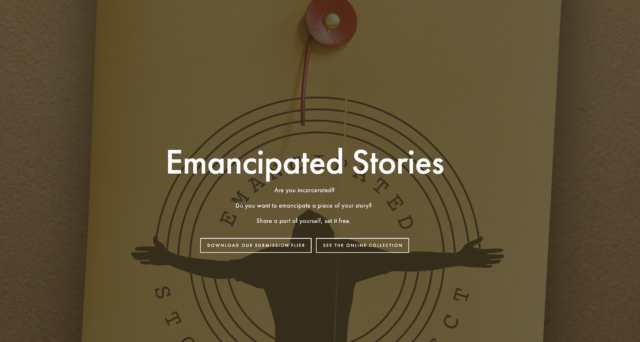
Why: Last summer, the Signature Theatre reopened with the immersive installation The Watering Hole, which included Vanessa German and Haruna Lee’s “This Room Is a Broken Heart,” part of which involved choosing a postcard designed by an incarcerated individual and sending a note to someone living behind bars. This summer the Signature has taken that a step further by teaming with the Fortune Society and Emancipated Stories to present an installation focusing on words and art by incarcerated people. Founded in 1967, the Fortune Society’s mission is “to support successful reentry from incarceration and promote alternatives to incarceration, thus strengthening the fabric of our communities . . . through believing, building lives, and changing minds.” Emancipated Stories was started by prison reform activist and playwright Quiara Alegría Hudes and her cousin Sean Ortiz, who spent ten years behind bars, as a way for incarcerated people to have their voices heard through handwritten letters that are shared on Instagram and in special installations.

Hudes, the Signature’s premiere writer-in-residence and author of such works as In the Heights, Water by the Spoonful, Daphne’s Dive, and Miss You Like Hell, explained in a statement, “The thing that’s fun and safe about theater is that the basic rule of engagement is one of listening. The fundamental contract is: I’m going to listen, I’m going to pay attention. Similarly, what we’re seeking to create is a communal space of sharing and openness. Within this installation and the events we’ve planned, the lines between audience and performer are more porous; it’s more of a gathering, and there’s no fourth wall, and we put the original letters in people’s hands. When you hold someone’s piece of paper and it’s handwritten — and you feel the grooves — it’s like holding someone’s hand. It’s an instant connection that’s part of the liveness of it. Surprising heart doors come open in these moments.”

“The Fortune Society is thrilled to be in community and collaboration with Signature Theatre and Quiara Alegría Hudes to help bring this insightful and moving project to life,” Fortune Society director of creative arts Jamie Maleszka added. “The goal of Emancipated Stories is to center and celebrate the full humanity of community members who are currently and formerly incarcerated and to grow meaningful connections through storytelling. The project perfectly aligns with our mission to build people, not prisons, and invest in more just collective futures.”

“SigSpace: Emancipated Stories” will be open in the theater lobby Tuesday through Sunday from June 29 through July 24, from noon to 5:00; admission is free. In addition, there will be four pop-up events, free with advance RSVP, featuring actors, artists, activists, musicians, writers, and members of the Fortune Society activating the installation, which was designed by Yazmany Arboleda with Emmanuel Oni, through music, discussions, readings, and writing letters in response to those from incarcerated individuals.

Wednesday, June 29
Kick-off, with actors David Zayas and Sean Carvajal, artist and activist Suave Gonzales, and Felix Guzman and Daniel Kelly of the Fortune Society, hosted by playwright Quiara Alegría Hudes, free with RSVP, 5:00 – 7:00

Wednesday, July 13
Music Night, with composer Kenyatta Emmanuel, singer-songwriter Renee Goust, writer and actor Dominic Colón, and others, hosted by Quiara Alegría Hudes, free with RSVP, 5:00 – 7:00

Sunday, July 17
Family Day, with Fortune Society community members and actor Sean Carvajal, moderated by Fortune Society director of creative arts Jamie Maleszka and Quiara Alegría Hudes, free with RSVP, noon – 2:00

Wednesday, July 20
Quiet Writing Time, free with RSVP, 5:00 – 7:00

ROMEO Y JULIETA

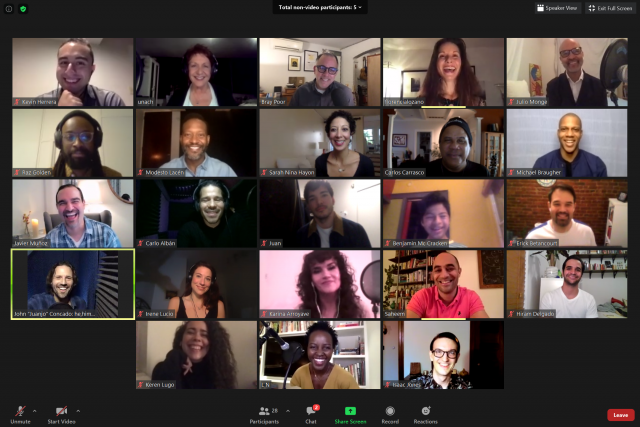
The Public Theater’s bilingual radio play Romeo y Julieta was rehearsed over Zoom (screenshot courtesy the Public Theater)

Who: Saheem Ali, Lupita Nyong’o, Juan Castano, Alfredo Michel Modenessi, Rebeca Ibarra, more
What: Online premiere listening party for bilingual audio production of Romeo y Julieta
Where: The Greene Space and the Public Theater
When: Thursday, March 18, free with RSVP, 6:45 (stream available for one year)
Why: Unsurprisingly, audio plays have made a comeback during the pandemic, with theaters in lockdown. Keen Company’s Season of Audio Theater has included finkle’s 1993 and Pearl Cleage’s Digging in the Dark, with James Anthony Tyler’s All We Need Is Us up next. Playing on Air, which predated the Covid-19 crisis, has posted such nonvisual works as Cary Gitter’s How My Grandparents Fell in Love, Daniel Reitz’s Napoleon in Exile, Naveen Bahar Choudhury’s Skin, and Dominique Morisseau’s Jezelle the Gazelle, featuring such actors as Julie White, Jesse Eisenberg, Marsha Mason, Ed Asner, Jane Kaczmarek, J. Alphonse Nicholson, and others.

Meanwhile, the Public Theater has presented Anne Washburn’s Shipwreck: A History Play About 2017 as well as the four-part Free Shakespeare on the Radio: Richard II, adapted and directed by Saheem Ali. Ali has now teamed up with playwright Ricardo Pérez González on Romeo y Julieta, a bilingual audio adaptation based Alfredo Michel Modenessi’s Spanish translation of Shakespeare’s heart-wrenching tragedy.

Colorful illustrations by Erick Dávila add visuals to bilingual radio play (courtesy the Public Theater)

The play alternates between English and Spanish; thankfully, you don’t hear every line in both languages, or else the show would be four hours long. However, the Public provides the script on its website so you can follow along and see the full translation. (The website also offers a visual guide to the cast and characters, a bilingual synopsis, colorful illustrations by Erick Dávila, and a trailer.) Presented in conjunction with WNYC Studios and the Greene Space, the radio play premieres on March 18 at 6:45 with much virtual fanfare, kicking off with a preshow greeting and cocktail demonstration (Mezcal Negroni or nonalcoholic Mojito), hosted by WNYC’s Rebeca Ibarra. Then the group listening party starts at 7:00, followed by a live talkback and Q&A with Ali, actors Lupita Nyong’o, who plays Juliet, and Juan Castano, who stars as Romeo, and translator Modenessi, moderated by Ibarra. Everything is free with advance RSVP, but you have to supply your own drinks.

The rest of the cast consists of Carlo Albán as Benvolio, Karina Arroyave as the apothecary, Erick Betancourt as Abram, Michael Braugher as Balthasar, Carlos Carrasco as Lord Montague, Ivonne Coll as the nurse, John J. Concado as Peter, Hiram Delgado as Tybalt, Guillermo Diaz as Gregory, Sarah Nina Hayon as Lady Montague, Kevin Herrera in the ensemble, Modesto Lacen as Prince Escalus and Capulet’s cousin, Florencia Lozano as Capulet, Irene Sofia Lucio as Mercutio, Keren Lugo as Sister Joan, Benjamin Luis McCracken as Paris’s page, Julio Monge as Friar Lawrence, Javier Muñoz as Paris, and David Zayas as Sampson. The original score by Michael Thurber is performed by Jon Lampley on trumpet, Eddie Barbash on alto saxophone, and Mark Dover on bass clarinet; bassist Thurber will also entertain the audience during intermission. The stream of the radio play will be available for one year.

THE TWI-NY PANDEMIC AWARDS (SO FAR)

The inaugural Antonyo Awards celebrated the best of Black theater on and off Broadway (screenshot by twi-ny/mdr)

The inaugural Antonyo Awards celebrated the best of Black theater on and off Broadway (screenshot by twi-ny/mdr)

I’ve been writing about New York City arts and culture since May 2001, focusing on events that require people to leave their homes and venture out to museums, theaters, movie houses, restaurants, botanical gardens, clubs, and other venues to experience art, film, dance, plays, music, nature, and other forms of entertainment.

But as of March 12, all of that was shut down. I had anticipated that twi-ny would effectively be shut down as well, but to my surprise and delight many arts institutions, once they realized they would be closed for a long period of time, embraced the situation and began making works they presented over Zoom, Instagram Live, Facebook Live, YouTube, and their own sites. I was initially worried that I would not know what to do with the sudden free time I had — I’m used to going out five or six nights a week, covering whatever is happening in the city — but soon enough I was ridiculously busy watching and writing about the endless stream of productions being made for the internet and, often, about the pandemic itself, exploring ideas of loneliness and confinement and, once the George Floyd protests began, equality, racism, and freedom. It’s been exciting navigating through so much creativity and following how so many individuals and companies are experimenting with online technology in ways that are not only thrilling to watch but beckon toward the future, with the ability to reach a global audience all at the same moment, at the touch of a button.

And so, as we celebrate America’s 244th birthday — one in which we have come to understand that we have a lot of work to do to face a shameful past that continues into the present — and most of us will be partying from wherever we are sheltering in place, it’s also time to celebrate the ingenuity of actors, directors, artists, writers, musicians, composers, dancers, choreographers, journalists, comedians, thinkers, and others who are making this crisis so much more bearable than it could have been.

Below are the first of hopefully only two This Week in New York Pandemic Awards, honoring the best in live programming that took place between March 13 and June 30. The only rule is that there has to be a live facet to it — either occurring at that minute and/or with an interactive element such as a live Q&A or live chatting. Depending on how the reopening goes and with many arts venues unlikely to start having in-person audiences until 2021, we will be back in December for what we fervently hope will be the second and last Pandemic Awards.

Happy Fourth!

BEST NEW PLAY
Arlekin Players Theatre, State vs. Natasha Benin, based on Natasha’s Dream by Yaroslava Pulinovich, translated by John Freedman, directed by Igor Golyak, performed by Darya Denisova. Filming live from their bedroom, married couple Igor Golyak and Darya Denisova collaborate with an inventive team to come up with an ingenious participatory experience that has been extended through July 12 (free).

The Public Theater, What Do We Need to Talk About? Conversations on Zoom, written by Richard Nelson, with Jay O. Sanders, Maryann Plunkett, Sally Murphy, Laila Robins, and Stephen Kunken. Richard Nelson adds an unexpected chapter to his Apple Family Plays as Richard, Barbara, Marian, Tim, and Jane gather together on Zoom to take stock of their lives once again in this poignant, moving work that closed June 28. But you can catch up on the clan again in Nelson’s follow-up, And So We Come Forth — The Apple Family: A Dinner on Zoom, which continues on YouTube through August 26.

BEST SHORT PLAY SERIES
The Homebound Project. Benefiting No Kid Hungry, each iteration of the Homebound Project consists of ten short pandemic-related solo tales by an all-star team of writers (Michael R. Jackson, Sarah Ruhl, C. A. Johnson, Sarah DeLappe, Qui Nguyen, Anne Washburn, Samuel D. Hunter, Bess Wohl, John Guare, Clare Barron), directors (Steven Pasquale, Leigh Silverman, Jerry Zaks, Trip Cullman, Danya Taymor), and performers (Amanda Seyfried, Daveed Diggs, Diane Lane, Blair Underwood, Phillipa Soo, Zachary Quinto, Mary-Louise Parker, William Jackson Harper, Jessica Hecht, Marin Ireland), streamed for a limited time; the fourth edition is scheduled for July 15-19 (minimum donation $10).

The 24 Hour Plays. These Viral Monologues are divided into thematic groupings called rounds that comprise intimate solo plays between four and fifteen minutes in length, with Tony Shalhoub, Marin Ireland, Daveed Diggs, Ashley Park, Santino Fontana, Rebecca Naomi Jones, Jake Gyllenhaal, Cynthia Nixon, David Hyde-Pierce, Maddie Corman, Michael Cerveris, Elizabeth Marvel, Brandon J. Dirden, Quincy Tyler Bernstine, Ethan Hawke, and others in works by Lynn Nottage, Kristoffer Diaz, Donald Margulies, Lydia Diamond, David Lindsay-Abaire, Preston Max Allen, Jonathan Marc Sherman, and more, each iteration benefiting a different charity based on that round’s topic (free).

Diane Lane

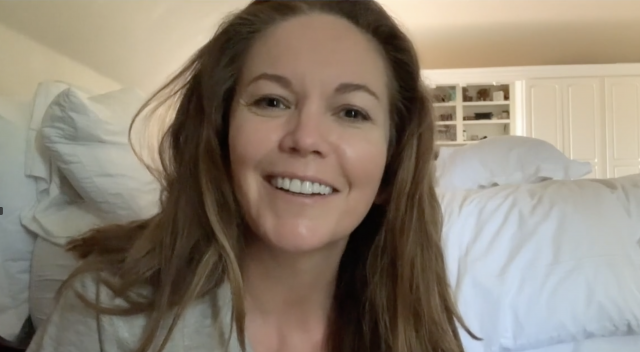
Diane Lane was luminescent in Michael R. Jackson’s Let’s Save the World for the Homebound Project (screenshot by twi-ny/mdr)

BEST PERFORMANCE IN A SHORT PLAY
Diane Lane, Let’s Save the World, written by Michael R. Jackson, The Homebound Project. Academy Award nominee Diane Lane is luminescent in Pulitzer Prize winner Michael R. Jackson’s bright, shiny tale about angels and hope.

André De Shields, “A Father’s Sorrow,” written by Shaka Senghor, The 24 Hour Plays. Tony winner De Shields is a force in Shaka Senghor’s “A Father’s Sorrow,” playing Elder Qualls, a priest whose son has been incarcerated.

BEST PERFORMANCE BY A HUSBAND-AND-WIFE TEAM
Mandy Patinkin and Kathryn Grody, Twitter, directed by Gideon Grody-Patinkin. Nearly every day, Gideon Grody-Patinkin takes out his smartphone and records his parents, actors Mandy Patinkin and Kathryn Grody, as they have breakfast, experience computer problems, discuss TikTok, and just live life during a pandemic; this is about as real as it gets, and it’s funny as hell.

Tony Shalhoub and Brooke Adams, Happy Days, written by Samuel Beckett, Plays in the House, part of Stars in the House, hosted by indefatigable pandemic MVPs Seth Rudetsky and James Wesley. After beating their coronavirus infections, Tony Shalhoub and Brooke Adams, who have been married since 1992, revisited Samuel Beckett’s Happy Days, which they toured with in 2015, performing it live from their bedroom for Stars in the House, with proceeds benefiting the Actors Fund.

BEST PERSONAL STORY TOLD BY A PLAYWRIGHT
Lynn Nottage, “Pilgrims,” TrickleUP NYC Artists Network. Two-time Pulitzer Prize winner Lynn Nottage shared a remarkable true story about a tree in her backyard for TrickleUP, a grassroots subscription video platform (minimum donation $10/month) with short performances by a wide range of talent including Suzan-Lori Parks, Taylor Mac, Kathleen Chalfant, Lucas Hnath, Jane Houdyshell, Tonya Pinkins, Jefferson Mays, Rachel Chavkin, Miguel Gutierrez, Paula Vogel, Faye Driscoll, Thomas Jay Ryan, Dominique Morisseau, Basil Twist, Latanya Richardson Jackson, Alan Cumming, and many more, benefiting artists affected by the Covid-19 cancellations.

BEST REUNION READING
LAByrinth Theater Company, Our Lady of 121st Street, A LAByrinth Virtual Reading and Benefit, written by Stephen Adly Guirgis, with Elizabeth Canavan, Liza Colón-Zayas, Scott Hudson, Russell G. Jones, Portia, Al Roffe, Felix Solis, David Zayas, Bobby Cannavale, John Doman, Laurence Fishburne, Dierdre Friel, David Deblinger, and Elizabeth Rodriguez. The LAByrinth Theater Company gave a blistering Zoom reading of Stephen Adly Guirgis’s 2002 play about a group of people gathering for the funeral of a murdered nun whose corpse has gone missing; the acting, led by David Zayas and Bobby Cannavale, was the best I’ve seen online during this crisis.

BEST ZOOM SHAKESPEARE NOT IN THE PARK
Theater of War, The Oedipus Project, with Frances McDormand, John Turturro, Oscar Isaac, Jeffrey Wright, Frankie Faison, David Strathairn, Glenn Davis, Marjolaine Goldsmith, and Jumaane Williams, translated and directed by Bryan Doerries. Theater of War, which specializes in presenting ancient Greek and modern plays and examining them through a razor-sharp sociocultural lens, put on a stunning Zoom reading of several scenes from Sophocles’s Oedipus the King, followed by a community discussion about elder care, relating the play to what is happening in nursing homes during the pandemic; Oscar Isaac as the doomed ruler tore the house down with an unforgettable finale.

BEST ZOOM NOT-SHAKESPEARE NOT IN THE PARK
Molière in the Park, Tartuffe, directed by Lucie Tiberghien, with Raúl E. Esparza, Samira Wiley, Kaliswa Brewster, Toccarra Cash, Chris Henry Coffey, Naomi Lorrain, Jared McNeill, Jennifer Mudge, Rosemary Prinz, and Carter Redwood. Molière in the Park founding artistic director Lucie Tiberghien and cofounding producer Garth Belcon usually stage works by Jean-Baptiste Poquelin, aka Molière, in Prospect Park, but this summer season they have gone virtual, staging an exciting adaptation of Tartuffe on Zoom; the fab production design by Kris Stone makes it look as if the performance is taking place on the gorgeous estate of Orgon, one of the main characters. The cast features Raúl E. Esparza as the villainous scoundrel Tartuffe and Samira Wiley as Orgon (free; extended through July 12 on YouTube).

BONUS: BEST ZOOM BUM
Raúl E. Esparza, Tartuffe, Molière in the Park. Four-time Tony nominee Raúl E. Esparza shocked and excited the audience when he dropped trou during the first performance, setting the chat board on fire with squeals of delight from fans all over the world at the sight of his bare bottom.

BEST INTRODUCTION TO A PLAY
Simon McBurney, The Encounter. From May 15 to 22, St. Ann’s Warehouse streamed a recording of The Encounter, a primarily one-man play about human contact that uses sound in extraordinary ways, from his London-based Complicité company. McBurney stretches the bounds of what we think we see and hear in his spectacularly inventive lockdown-related introduction, toying with technology like a master magician with a fantastic, childlike sense of humor and wonder.

BEST THEATER INTERVIEW SERIES
Red Bull Theater Company, RemarkaBULL Podversations. Red Bull has been busy during the coronavirus crisis, presenting reunion readings of such previous productions as Coriolanus and The Government Inspector as well as talks with actors about specific speeches from the theatrical canon, what they call “RemarkaBULL Podversations,” including Elizabeth Marvel discussing and delivering the “Cry Havoc” speech from Julius Caesar, Michael Urie exploring the “Queen Mab” monologue from Romeo & Juliet, and Chukwudi Iwuji digging deep into the “Homely Swain” soliloquy from Henry VI.

BEST AWARDS SHOW
Broadway Black, The Antonyo Awards, directed by Zhailon Levingston. The inaugural Antonyo Awards was an eye-opening experience as the best in Black theater was celebrated in ways that the Tonys and others would never be able to; it was all the more powerful given that it took place on Juneteenth as the country was reaching critical mass over the George Floyd protests and the Covid-19 pandemic.

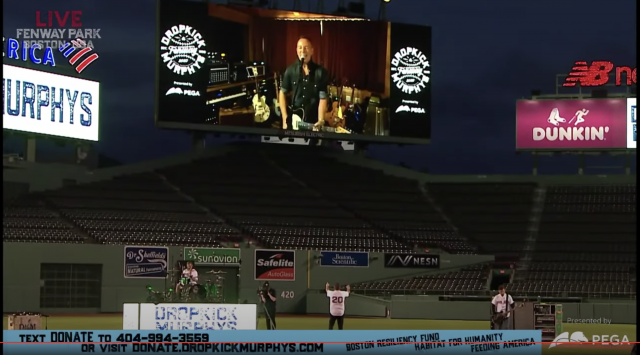
Dropkick Muprhys

Dropkick Murphys jam with Bruce Springsteen at empty Fenway Park (screenshot by twi-ny/mdr)

BEST LIVE OUTDOOR CONCERT
Dropkick Murphys: Streaming Outta Fenway, with special appearance by Bruce Springsteen. Boston’s Dropkick Murphys took over an empty Fenway Park with a ferocious two-hour live set that had me dancing like a madman in my home office. It reached a nearly impossible crescendo when Bruce Springsteen joined in from his New Jersey farm. The benefit for Feeding America, Habitat for Humanity Greater Boston, and the Boston Resiliency Fund can still be seen here; be sure to crank it up to eleven.

Hello from FitzGerald’s: @StayAtHomeConcert caravan with Jon Langford. British troubadour Jon Langford, of the Mekons, the Waco Brothers, the Pine Valley Cosmonauts, the Skull Orchard, and Wee Hairy Beasties, traveled through the streets of suburban Chicago regaling the neighborhood with jaunty songs delivered on the back of music club FitzGerald’s white truck, his saucy humor and lovely acoustic songs as intoxicating as ever.

BEST SOLO A CAPELLA PERFORMANCE
Brian Stokes Mitchell, “The Impossible Dream.” One of the most inspiring moments of the pandemic occurred nightly after the 7:00 clap as Tony winner Brian Stokes Mitchell, trying to regain his voice following a difficult battle with Covid-19, stuck his head out his West Side apartment window and crooned “The Impossible Dream,” changing a few words to honor the essential health-care workers who helped him and who continue to lead the fight against the virus despite the inherent risks. Mitchell had to stop doing it when the crowds reached unsustainable levels, making social distancing itself impossible.

BEST FACEBOOK LIVE CONCERT SERIES
Richard Thompson, couch concerts with Zara Phillips. Every few weeks, British musician Richard Thompson, one of the world’s great guitarists and songwriters, takes a seat in his Montclair, New Jersey, living room and performs tunes from throughout his fifty-plus-year career, joined by his partner, singer-songwriter and adoption activist Zara Phillips. Being able to see Thompson’s guitar playing thisclose is worth the price of admission — it’s free, but donations are accepted for the Community FoodBank of NJ — and his wry quips, delivered with a devilish smile, are a joy in these hard times. Thompson will be performing his brand-new pandemic EP, Bloody Noses, in its entirety on July 5 at 4:00; he is also thrilled to finally have a live gig, backing Phillips at a free July 15 outdoor show in Woodbridge.

Chick Corea, Piano Improvisation. Legendary jazz pianist Chick Corea, who turned seventy-nine last month, has been performing gorgeous piano improvisations on Facebook Live, a necessary respite on that platform from arguing politics with high school classmates you haven’t seen in years.

BEST INSTAGRAM MUSIC BATTLES
Swizz Beatz, Verzuz. Hip-hop producer Swizz Beatz is on a mission to support and celebrate living artists during this pandemic, and he is doing so by hosting a series of online battles between Alicia Keys and John Legend, Kirk Franklin and Fred Hammond, Bounty Killer and Beanie Man, Nelly and Ludacris, Erykah Badu and Jill Scott, and Babyface and Teddy Riley.

BEST INSTAGRAM DANCE SHOW
D-Nice, Club Quarantine. Harlem-born D-Nice was the first deejay to get the internet cooking once everything shut down, getting people up and grooving to his live Club Quarantine parties on Instagram.

BEST ZOOM MUSIC VIDEO OF AN OLD SONG
“Raise You Up,” Kinky Boots International Pride Cast Reunion, with Billy Porter, Stark Sands, Annaleigh Ashford, Wayne Brady, Harvey Fierstein, Cyndi Lauper, and more. Reunion videos are hot, but none captured the heat like this Pride anthem from Kinky Boots, performed by an all-star cast.

Modern English, “I Melt with You.” British band Modern English resuscitated its 1982 smash hit with a quarantine edition that is melting the internet, with leader Robbie Grey impressing not only with his vocals but his lockdown look.

BEST SOLO DANCE PERFORMANCE
Jamar Roberts, Cooped, WPA Virtual Commission, choreographed by Jamar Roberts. Longtime Ailey dancer Jamar Roberts’s Cooped is the most explosive five minutes to come out of the arts world during the pandemic; with fierce determination, Roberts investigates solitude, confinement, and the black body, set to a searing score by David Watson on bagpipes and Tony Buck on drums.

Sara Mearns, Storm, WPA Virtual Commission, choreographed by Joshua Bergasse. NYCB principal dancer Sara Mearns glides across her New York City apartment, stopping by the window to assess the world outside, in this sensitive, reaffirming work choreographed by her husband, Joshua Bergasse, and set to Margo Seibert’s rendition of pianist Zoe Sarnak’s “The Storm Will Pass Soon Now.”

Jaqlin Medlock, #GIMMESHELTER, Stephen Petronio Company. Native New Yorker Jaqlin Medlock dazzled in Stephen Petronio’s work choreographed over Zoom for the company’s gala fundraiser, performing breathtaking movement in her apartment.

BEST ZOOM DANCE
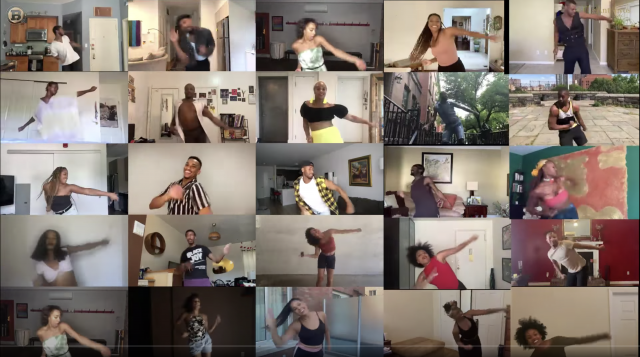
Martha Graham Dance Company, Immediate Tragedy, Martha Matinees, choreographed by Janet Eilber. Martha Graham Dance Company has been presenting classic archival footage in its Martha Matinees series, but for Immediate Tragedy, artistic director Janet Eilber reimagined Graham’s lost 1937 solo for a company of dancers over Zoom, moving around the individual Zoom boxes like a thrilling game of Tetris; just magnificent.

Streb

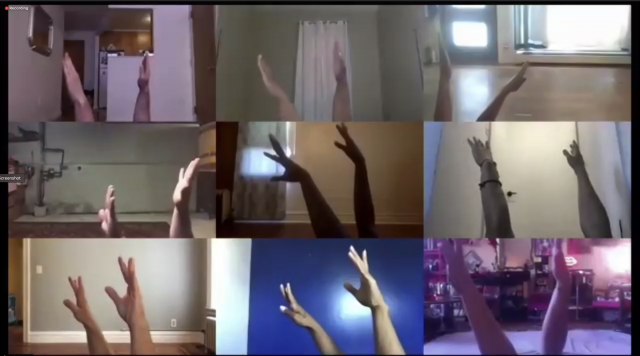
STREB gala featured new Zoom dance focusing on the grammar of the human body (screenshot by twi-ny/mdr)

STREB, Body Grammar, choreographed by Elizabeth Streb. Elizabeth Streb’s Action Heroes, who combine acrobatics, athletics, and dance on unique apparatuses in jaw-dropping ways, focuses in on the performers’ heads, hands, feet, arms, legs, and torsos in an experimental work that would make Bruce Nauman proud.

BEST TELEPHONE OPERA
On Site Opera, To My Distant Beloved, Beethoven’s An die ferne Geliebte, music by Ludwig van Beethoven, song text by Alois Isidor Jeitteles, additional English dialogue by Monet Hurst-Mendoza, directed by Eric Einhorn, with soprano Jennifer Zetlan and pianist David Shimoni or baritone Mario Diaz-Moresco and pianist Spencer Myer. On Site Opera was in a bind during the pandemic, as the New York City–based company specializes in site-specific productions in unique locations. But it has come up with a splendid alternative, a twenty-minute performance adapted from Beethoven’s An die ferne Geliebte, delivered over the phone for one listener at a time. To enhance the romantic tale of longing, each listener receives emailed love letters prior to either a soprano or baritone calling you up and singing just for you, with interactive dialogue as well. You don’t have to know anything about opera to fall in love with this experience, one of the best — and most unusual — of the pandemic, and even better now that it’s been extended through August 9 ($40).

BEST INTERVIEW SERIES
92nd Street Y, 92Y Online. The 92nd Street Y has always featured a great lineup of guests from across the artistic, sociocultural, culinary, and geopolitical spectrum, and it’s been no different during the coronavirus crisis, with its doors on the Upper East Side closed for the near future. But that hasn’t stopped the Y from presenting live, online talks about just about any topic imaginable, with celebrities galore and hot-button issues. Many of the events are free, but you have to pay for some of the archived discussions. Our favorite is a free one with Pamela Adlon chatting with her friend Mario Cantone, a wild and woolly conversation that never lets up.

Ken Davenport, The Producer’s Perspective. Theater producer Ken Davenport has been one of the busiest guys during the lockdown, speaking with dozens of theater stalwarts about the state of the industry and what they’re doing during the crisis. Among his sixty guests have been Alan Cumming, Kate Rockwell, David Henry-Hwang, Jason Alexander, Marilu Henner, Kenny Leon, Jenn Colella, Santino Fontana, Ashley Park, Dominque Morisseau, and Kerry Butler, with Steven Pasquale, Danny Burstein, and Raúl E. Esparza coming up.

BEST FILM & TELEVISION REUNION SERIES
Josh Gad, “Reunited Apart.” Cuddly, lovable Josh Gad lets his fan-geek show by bringing back the casts of classic films from the 1980s and ’90s, and you might be shocked to see that just about everyone participates from wherever they are sheltering in place. So far he has brought together the cast and crew of Ghostbusters, The Goonies, The Lord of the Rings, Splash, Back to the Future, and Ferris Bueller’s Day Off, all of which can be watched for free on YouTube, with donations accepted for specific charities.

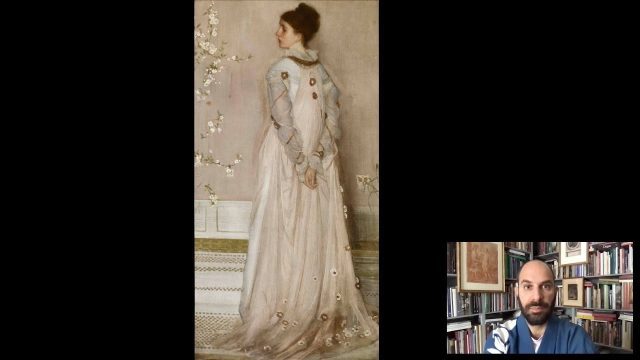
Xavier F. Salomon discusses classic works from the Frick while enjoying specialty cocktails in weekly talk

Xavier F. Salomon discusses classic works from the Frick while enjoying specialty cocktails in weekly talk

BEST ART TALKS
The Frick Collection, “Cocktails with a Curator,” with Xavier F. Salomon. Frick chief curator Xavier F. Salomon has become an internet sensation, hosting “Cocktails with a Curator” every Friday at 5:00, exploring in depth a work from the Frick Collection, relating it to the current crisis, and selecting a cocktail to accompany the fifteen-minute talk. His warm, genteel, engaging demeanor, vast historical knowledge, and love of highballs are just the recipe for an art-starved public. You can also catch him on Wednesdays going around the world in “Travels with a Curator.”

“Art at a Time Like This,” curated by Barbara Pollack and Anne Verhallen. Curators Barbara Pollack and Anne Verhallen have been asking the question, “How can we think of art at a time like this?” since March 17, when they began exploring existing and/or new work by one specific artist a day, Monday through Friday, putting it in context of the Covid-19 crisis and, later, the George Floyd protests. Among the impressive list of participants are Ai Weiwei, Chitra Ganesh, William Kentridge, Petah Coyne, Dread Scott, Laurie Simmons, Mel Chin, Alfredo Jaar, and Mary Lucier. Pollack and Verhallen have also hosted weekly live, interactive Zoom discussions with many of the artists, examining fascinating aspects of the intersection of art and politics. Of course, their basic question focuses on painting, sculpture, video, and installation art, but it also relates to dance, music, theater, literature, film, television, and more. How can we think of any of this at a time like this? All of the above awardees, and everyone else who is creating art during a time like this, should be justly celebrated, not only for entertaining and educating us, but for shining a light on what the world may be like on the other side of this.

THEATER OF WAR: THE KING LEAR PROJECT

theater of war

Who: Bryan Doerries, Frankie Faison, Amy Ryan, Kathryn Erbe, Marjolaine Goldsmith, David Zayas, Jumaane Williams
What: Live Zoom theatrical production and discussion from Theater of War
Where: Zoom link sent with advance registration
When: Thursday, June 11, free with RSVP, 7:00
Why: One of the best Zoom presentations of the pandemic has been Theater of War’s The Oedipus Project, in which Frances McDormand, John Turturro, Oscar Isaac, Jeffrey Wright, Frankie Faison, David Strathairn, Glenn Davis, Marjolaine Goldsmith, and Jumaane Williams gave a live, powerful dramatic reading of scenes from Sophocles’s fifth-century BCE classic, Oedipus the King, from wherever they were sheltering in place. (Most of the actors chose relatively spare, blank backgrounds while Turturro opted for an anachronistic study.) The event was introduced by Theater of War cofounder and adapter/director Bryan Doerries, who also led a postshow discussion relating the play to the Covid-19 crisis.

The organization now turns its attention to the themes of caregiving and death with The King Lear Project, streaming live on Zoom on June 11 at 7:00. In the play, Lear asks, “Doth any here know me? This is not Lear: Doth Lear walk thus? Speak thus? Where are his eyes? Either his notion weakens, or his discernings are lethargied — Ha! Waking? ’tis not so. Who is it that can tell me who I am?” To which the Fool responds, “Lear’s shadow.” The reading will feature another all-star lineup performing from home, consisting of Amy Ryan, David Zayas, Kathryn Erbe, Faison, Goldsmith, and Public Advocate Williams; it will be followed by a talk facilitated by Doerries with four community panelists on the subjects of aging, dementia, elder care, and family dynamics, examining the play — which Shakespeare wrote, perhaps while self-isolating, during the 1606 plague, when theaters had shut down — in context with the current pandemic.

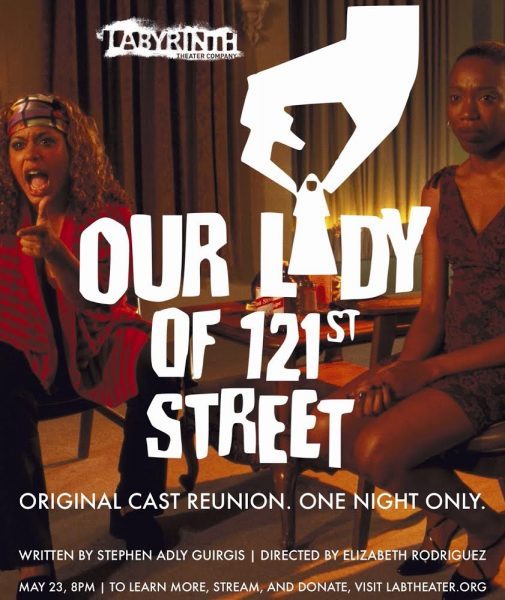
OUR LADY OF 121st STREET: A LAByrinth VIRTUAL READING AND BENEFIT

our lady

Who: Elizabeth Canavan, Liza Colón-Zayas, Scott Hudson, Russell G. Jones, Portia, Al Roffe, Felix Solis, David Zayas, Bobby Cannavale, John Doman, Laurence Fishburne, Dierdre Friel, David Deblinger, Elizabeth Rodriguez, Stephen Adly Guirgis
What: Live benefit reading of Stephen Adly Guirgis play
Where: LAByrinth Theater Company website
When: Saturday, May 23, free (donations accepted), 8:00
Why: Stephen Adly Guirgis’s Our Lady of 121st Street is timelier than ever in the age of coronavirus. The 2002 play, which was originally presented by the LAByrinth Theater Company in 2002 and revived at the Signature in 2018, takes place in and around a funeral home in Harlem, where the body of the late Sister Rose has gone missing as people from her past experience an odd kind of reunion. During the pandemic, in-person funerals are a rare event for very limited attendees, and bodies pile up in refrigerated trucks and makeshift tent-morgues. (“What kind of fuckin’ world is this?!” a character says early on.) On May 23 at 8:00, the LAByrinth is staging a live Zoom reunion reading of the play, directed by Elizabeth Rodriguez, who recently starred in Guirgis’s latest gem, Halfway Bitches Go Straight to Heaven.

The all-star cast features most of the original lineup, along with notable additions. Returning from the 2002 production, which was directed by Philip Seymour Hoffman, are Elizabeth Canavan as Marcia, Liza Colón-Zayas as Norca, Russell G. Jones as Flip, Portia as Inez, Al Roffe as Pinky, Felix Solis as Balthazar, and David Zayas as Edwin; they are joined by Scott Hudson as Gail from the 2003 iteration at the Union Square Theatre, John Doman as Father Lux and Dierdre Friel as Sonia from the Signature revival, Laurence Fishburne as Rooftop from the 2004 LA debut of the show, and Bobby Cannavale from Guirgis’s The Motherfucker with the Hat as Victor. LAByrinth cofounder David Deblinger, who portrayed Gail in the 2002 version, will read the stage directions. As a bonus, Pulitzer Prize winner Guirgis (Jesus Hopped the A Train, The Last Days of Judas Iscariot) will receive the LAByrinth’s Dave Hogue Award. The performance, a benefit for the LAByrinth, will stream live, then be available for twenty-four hours only. “This reading, featuring both original cast members from the LAB company and others whose work we’ve long admired, will help our community come together and hopefully raise some much-needed funds to get us through these unprecedented, tough times,” company artistic director John Ortiz said in a statement. I’ve seen three productions of the play by three different companies, and I was blown away each time; I can’t wait to see it again, amid these challenging times.