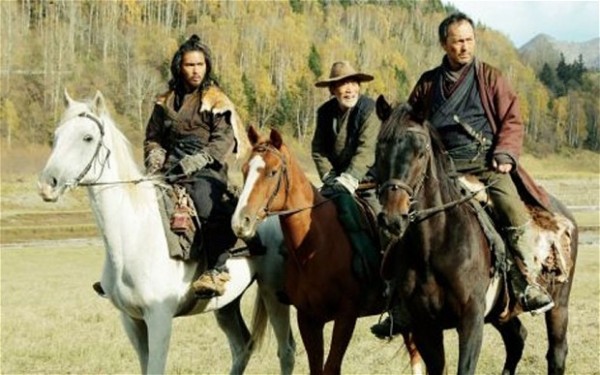
Yūya Yagira, Akira Emoto, and Ken Watanabe play an unlikely trio of bounty hunters in Lee Sang-il’s brilliant adaptation of Clint Eastwood’s UNFORGIVEN
UNFORGIVEN (YURUSAREZARU MONO) (Lee Sang-il, 2013)
Japan Society
333 East 47th St. at First Ave.
Tuesday, July 15, 8:30
Festival runs July 10-20
212-715-1258
www.japansociety.org
www.warnerbros.co.jp
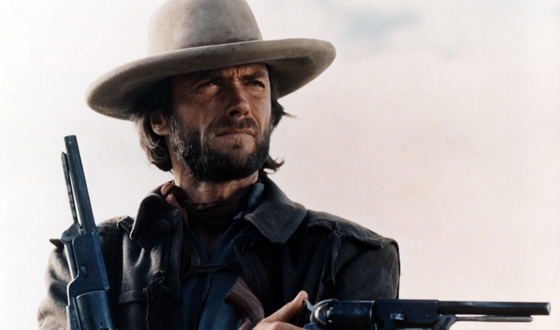
 For more than half a century, Hollywood has remade a plethora of Asian films, from The Magnificent Seven (Seven Samurai) to The Departed (Infernal Affairs), from Shall We Dance? (Sharu wi Dansu?) to The Grudge (Ju-On), among so many others. But there’s a relatively new trend in which Japan, Korea, and China are now remaking American films, including Ghost: Mouichido Dakishimetai (Ghost), Wo Zhi Nv Ren Xin (What Women Want), and Saidoweizu (Sideways). One of the latest, and best, is Japanese-born Korean director Lee Sang-il’s spectacularly honest and faithful remake of Clint Eastwood’s 1992 Oscar-winning revisionist Western, Unforgiven — in some ways returning the favor of Eastwood’s having starred in Sergio Leone’s 1964 spaghetti Western A Fistful of Dollars, a remake of Akira Kurosawa’s Yojimbo. In Unforgiven, Ken Watanabe, who was nominated for an Academy Award for his performance in The Last Samurai and starred in Eastwood’s Letters from Iwo Jima, plays Jubei Kamata, the Japanese version of Eastwood’s William Munny.
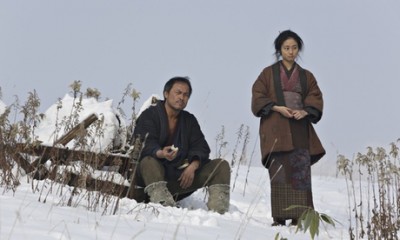
Jubei Kamata (Ken Watanabe) and Natsume (Shiori Kutsuna) are out for revenge in UNFORGIVEN
The Meiji restoration is under way, as the age of the shogunate has ended and Japan is finally opening to the West and beginning to modernize. Formerly a famous warrior and killer, Jubei is now a poor farmer living in isolation with his two young children from his sadly brief marriage to an Ainu woman. One day an old ally from his violent past, Kingo Baba (Akira Emoto), suddenly shows up, asking Jubei to join him on a manhunt to collect a reward for killing two samurai brothers (Yukiyoshi Ozawa and Takahiro Miura) who brutally cut up a prostitute (Shiori Kutsuna). Sworn to peace, Jubei at first refuses, but he relents because he desperately needs money to take care of his family. The two men are soon joined by Goro Sawada (Yūya Yagira), a wild, unpredictable Ainu who is looking to get even with all the Japanese who have abused and continue to mistreat his race. But standing in their way is vicious police chief Ichizo Oishi (Koichi Sato), a ruthless, power-mad sadist who will do anything to get what he wants. All the while, writer Yasaburo Himeji (Kenichi Takito) keeps taking notes, initially as the biographer of notorious killer Masaharu Kitaoji (Why Don’t You Play in Hell?’s Jun Kunimura), who strolls into town thinking that Oishi’s rules don’t apply to him. It all leads to a tense and gripping climactic showdown that honors Eastwood’s original while also establishing its own memorable identity.
Lee (Hula Girls, Villain) marvelously adapts David Webb Peoples’s Oscar-nominated screenplay, moving the setting to 1880s Hokkaido. The general story follows the American version very closely, with Lee adding uniquely Japanese elements, focusing on the transition from swords to guns in addition to Japanese racism against the Ainu, which also evokes the continued discrimination in Japan against Koreans born there. The film is strikingly photographed by Norimichi Kasamatsu and lovingly directed by Lee, alternating between glorious shots of the vast landscape and claustrophobic interiors where danger hovers in every corner. Unforgiven is no mere good vs. evil tale, with clear-cut heroes and villains; nearly all the men and women fall somewhere in between. Watanabe gives a mesmerizing performance as Jubei, especially when he shows and admits his fear. Sato is appropriately vicious as Oishi, putting his own spin on a character made famous by an Oscar-winning Gene Hackman, while Emoto ably recalls Morgan Freeman as the loyal but aging old friend. Taro Iwashiro’s score can get a little melodramatic, but that’s just a minor quibble with this otherwise brilliant Japanese adaptation of an American classic. The East Coast premiere of Unforgiven is taking place July 15 at Japan Society’s Japan Cuts: The New York Festival of Contemporary Japanese Cinema series, which runs through July 20 and includes such other films as Yoju Matsubayashi’s The Horses of Fukushima, the world premiere of Moko Ando’s 0.5mm, Eiji Uchida’s Greatful Dead, and a surprise screening of the Mo Brothers’ Killers.
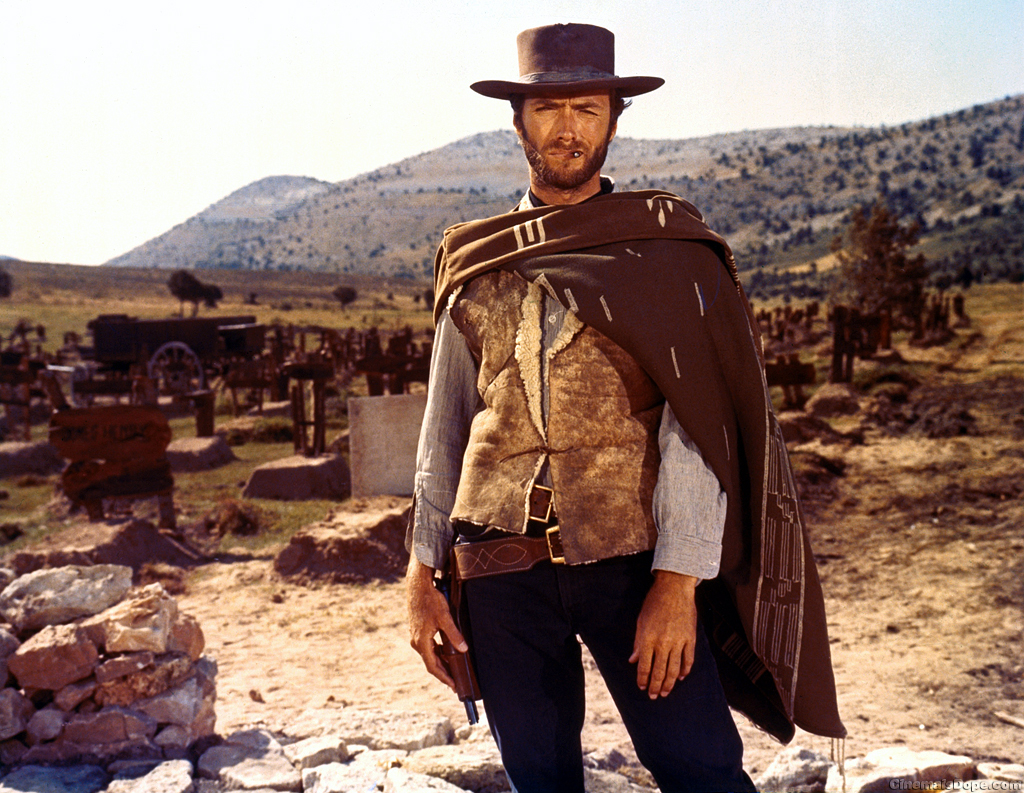
 One of the all-time-great spaghetti Westerns, Sergio Leone’s dusty three-hour operatic oater stars Clint Eastwood as the Good (Blondie), Lee Van Cleef as the Bad (Angel Eyes), and Eli Wallach as the Ugly (Tuco Benedicto Pacifico Juan Maria Ramirez, whose list of criminal offenses is a riot), three unique individuals after $200,000 in Confederate gold buried in a cemetery in the middle of nowhere. Nearly 20 minutes of never-before-seen footage added to the film several years ago, with Wallach and Eastwood overdubbing brand-new dialogue, so if you haven’t seen it in a while, it might just be time to catch it again, this time on the big screen as part of Film Forum’s impressive “Spaghetti Westerns” series. Ennio Morricone’s unforgettable score and Torino delli Colli’s gorgeous widescreen cinematography were also marvelously enhanced; their work in the scene when Tuco first comes upon the graveyard will make you dizzy with delight. And then comes one of the greatest finales in cinema history. The Good, the Bad and the Ugly is screening at Film Forum on June 9, 10, 12, and 21, with the series continuing with such well-known classics and under-the-radar gems as Damiano Damiani’s A Bullet for the General, Giulio Petroni’s Death Rides a Horse, Monte Hellman’s China 9, Liberty 37, and Giulio Questi’s Django Kill . . . If You Live, Shoot!