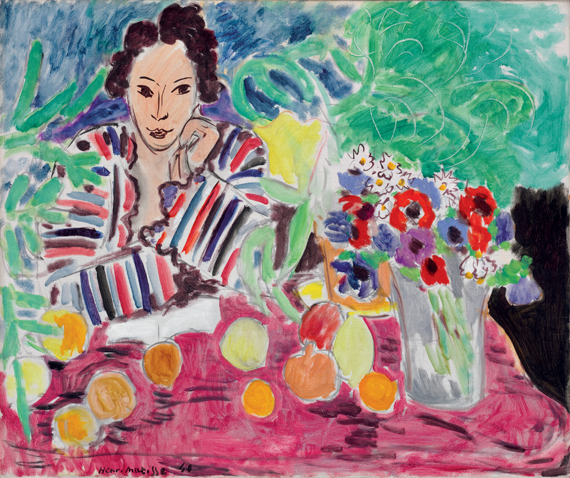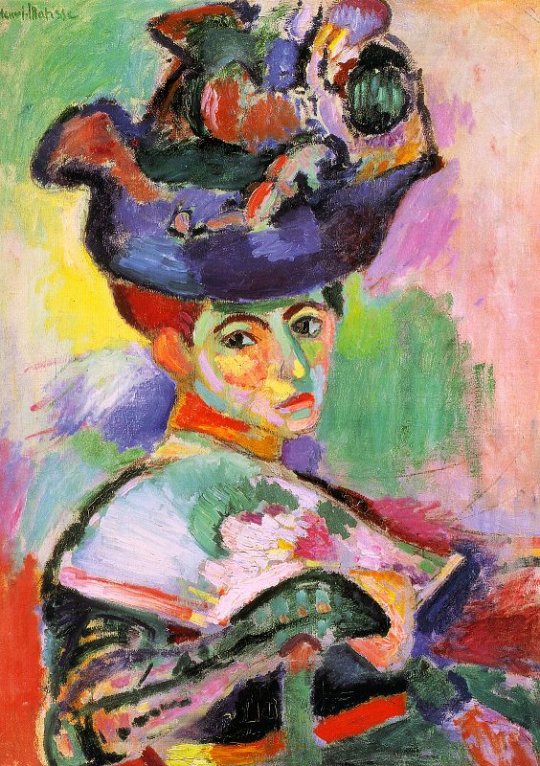
Henri Matisse, “Woman with a Hat,” oil on canvas, 1905 (© 2012 Succession H. Matisse / Artists Rights Society, New York)
Metropolitan Museum of Art
The Tisch Galleries, second floor
1000 Fifth Ave. at 82nd St.
Tuesday – Sunday through June 3, $25
212-570-3949
www.metmuseum.org
Like last year’s “Collecting Matisse and Modern Masters: The Cone Sisters of Baltimore” exhibition at the Jewish Museum, the Met’s “The Steins Collect: Matisse, Picasso, and the Parisian Avant-Garde” does an extraordinary job revealing the fascinating life of a family dedicated to the love of art. In the first decade of the twentieth century, siblings Leo, Gertrude, and Michael Stein, along with Michael’s wife, Sarah, moved to Paris, where they became entranced by the work of such artists as Pierre-Auguste Renoir, Paul Cézanne, Henri de Toulouse-Lautrec, Pierre Bonnard, Odilon Redon, and Edgar Degas. Although not wealthy, the upper-middle-class Steins had some extra money from the family’s old clothing business and real estate holdings, so they decided to spend whatever they could on up-and-coming artists whose work they could afford. Soon they were showing off paintings by the relatively little-known Pablo Picasso and Henri Matisse, hosting Saturday salons, and counting among their friends Claribel and Etta Cone, art dealer Ambroise Vollard, art historian Bernard Berenson, and such artists as Henri Manguin and Picasso and Matisse, whom they famously introduced to each other in 1905-6. The Met exhibit ranges from works that are known to have directly influenced the Steins to want to start collecting art to the many paintings that ended up hanging on their walls, complete with photographs and a site-specific video projection that shows exactly where they were hung in their Paris apartments. Leo, at one time an aspiring artist, and Gertrude, who became a famous and controversial writer, wrote often about their adventures in the art world, so the accompanying text is filled with delightful quotes that display the likes and dislikes of the siblings. “All our recent accessions are unfortunately by people you never heard of so there’s no use trying to describe them,” Leo Stein wrote in 1905, “except that one of those out of the salon [Matisse’s ‘Woman with a Hat’] made everybody laugh except a few who got mad about it and two other pictures are by a young Spaniard named Picasso whom I consider a genius of very great magnitude.”
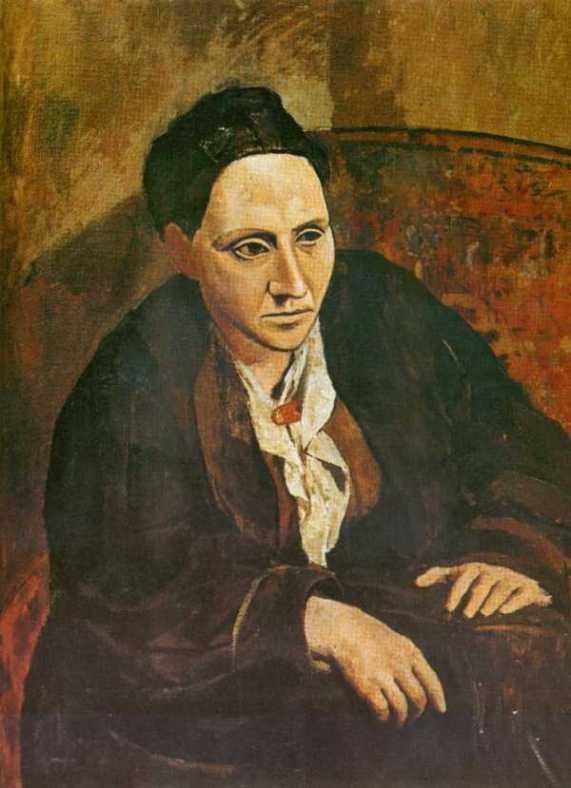
Pablo Picasso, “Gertrude Stein,” oil on canvas, 1905-6 (© 2012 Estate of Pablo Picasso / Artists Rights Society, New York)
But Leo grew unhappy later on with the direction Picasso was taking, at the same time that he was not thrilled with Gertrude’s growing relationship with Alice B. Toklas. “Both [Picasso] & Gertrude are using their intellects, which they ain’t got, to do what would need the finest critical tact, which they ain’t got neither,” he wrote in 1913, “and they are in my belief turning out the most go’almighty rubbish that is to be found.” In the 1930s, Gertrude admitted, “It is very difficult now that everybody is accustomed to everything to give some idea of the uneasiness once felt when one first looked at all these pictures on the walls.” And what pictures they are hanging on the walls of the Met in a smartly curated display, highlighted by Matisse’s revolutionary “Woman with a Hat,” Picasso’s justly famous portrait of Gertrude Stein, Cézanne’s “Bathers,” and three versions of “La Coiffure” by Manguin, Matisse, and Picasso. The exhibition also includes Jo Davidson’s sculpture of Gertrude Stein (another cast of which sits in Bryant Park), family photographs, a painting by Leo Stein and drawings by Sarah Stein, a clip from the 1934 opera Four Saints in Three Acts by Gertrude Stein and Virgil Thomson, home movies of Sarah and Michael Stein at their villa designed by Le Corbusier, and Gertrude’s handwritten will. In conjunction with “The Steins Collect,” the Met will be screening a series of related films, including Perry Miller Adato’s Paris the Luminous Years on May 29 at 2:00 and Jill Godmilow and Linda Bassett’s Waiting for the Moon, about the relationship between Gertrude Stein and Toklas, on May 31 at 2:00.