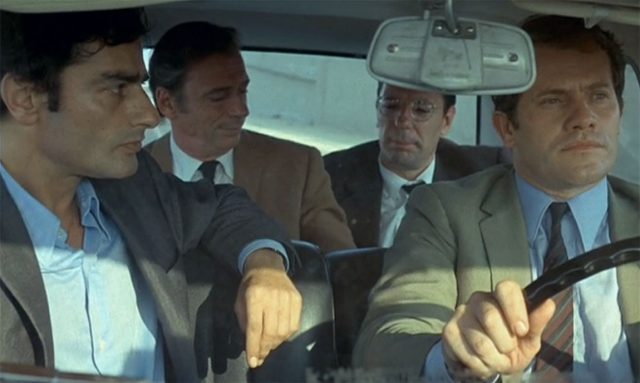
The Deputy (Yves Montand, rear left) is on his way to a fateful encounter in Costa-Gavras’s Z
CINÉSALON: Z (Costa-Gavras, 1969)
French Institute Alliance Française, Florence Gould Hall
55 East 59th St. between Madison & Park Aves.
Tuesday, December 12, $13, 4:00 & 7:30
Series continues Tuesdays through December 19
212-355-6100
fiaf.org
 In her new book Cinematic Overtures: How to Read Opening Scenes (Columbia University Press, $20, November 2017), Columbia professor and film historian Annette Insdorf writes that the beginning moments of Costa-Gavras’s masterful 1969 political thriller, Z, “places us metaphorically in the perspective of the investigator even before we meet him: we must be attentive to detail, skeptical, and then capable of seeing the larger picture. Given the film’s incorporation of flashbacks as well, Z builds a cumulative sense of inevitability that the truth will emerge.” Insdorf will be at FIAF on December 12 to sign copies of her book and introduce the 7:30 screening of Z, which is part of the CinéSalon series “Actor’s Choice: Lambert Wilson & Yves Montand,” curated by French actor and singer Wilson. (The film will also be shown at 4:00; both screenings will be followed by a wine reception.) The Algerian-French coproduction was adapted by Costa-Gavras and Jorge Semprún from Vassilis Vassilikos’s novel, a fictionalized account of the 1963 assassination of Greek left-wing antiwar activist Grigoris Lambrakis and the government cover-up that tried to make it look like an unavoidable accident. “Any similarity to real persons and events is not coincidental. It is intentional,” the credits explain. The film opens with rapid cuts of military and religious medals before zeroing in on a meeting in which the General (Pierre Dux) tells fellow law enforcement and governmental figures that they must eradicate the “ideological mildew,” referring to left-wing activists and, specifically, a deputy (Montand), based on Lambrakis, who is scheduled to speak at a large rally. After a violent incident, the Magistrate (Jean-Louis Trintignant) starts interviewing participants and witnesses and refuses to give up even when the General, the Colonel (Julien Guiomar), and other important figures threaten him as he seeks the truth, which doesn’t matter at all to those in power, who feel they understand the larger scheme of things. The Magistrate is helped by a photojournalist (producer Jacques Perrin) who is not afraid of asking penetrating questions and secretly snapping pictures. As the lies build, the truth slowly emerges, but that doesn’t mean the violence is over.
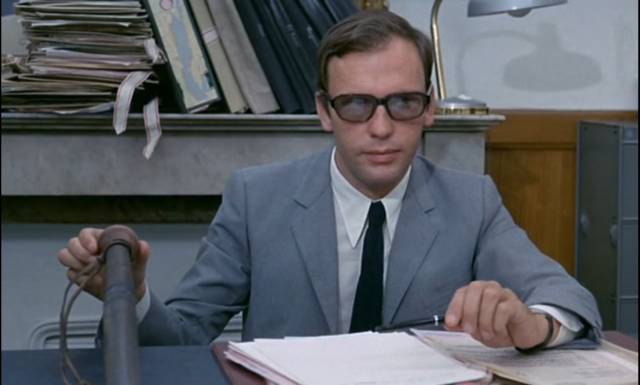
The Magistrate (Jean-Louis Trintignant) is intent on getting to the bottom of a government cover-up in classic political thriller
Costa-Gavras, a Greek expat who lives and works in France, has made many political films in his long career (State of Siege, L’Aveu, Missing, Amen.), influenced by his father, who was part of the anti-Nazi Greek resistance and was later imprisoned by Greece for being a Communist. Z might ostensibly be based on specific events, but unfortunately it’s a universal story that could take place just about anywhere in a world that has lost such leaders as Martin Luther King Jr., the Kennedy brothers, Yitzhak Rabin, Anwar Sadat, Mahatma Gandhi, Malcolm X, and others to assassination. The film, which is in French, never reveals where it is set, and most of the characters are not named, instead identified by their jobs: the deputy, the colonel, the general, the magistrate, etc. Cinematographer Raoul Coutard, best known for his work with Jean-Luc Godard, François Truffaut, and Philippe Garrel, shoots the film in a cinéma-vérité style, favoring handheld cameras (he also plays the English surgeon); Françoise Bonnot’s editing keeps building the tension while flirting with documentary-like elements; and Mikis Theodorakis’s lively score complements the action with energy and fervor. There’s also a huge dose of sly humor bordering on farce throughout. The film is particularly relevant in America, where terms such as “fake news” and “truthiness” have taken hold and the forty-fifth president has repeatedly called for and/or condoned violence against his opponents, his rivals’ supporters, and the free press. The title refers to the French word “Zei,” which means “He lives!” a phrase used by protestors; when the military took over Greece in 1967, it banned the use of the letter “Z” on placards and graffiti, along with many other things, which are listed over the closing credits. “Z” was nominated for five Oscars — Best Picture, Best Adapted Screenplay, Best Director, Best Editing, and Best Foreign Language Film, winning the latter two; it was the first film to be nominated for both Best Picture and Best Foreign Language Film. In addition, Trintignant (Amour, The Conformist, A Man and a Woman) was named Best Actor at Cannes. “Actor’s Choice” concludes December 19 with Jérôme Salle’s The Odyssey, with Lambert Wilson, Pierre Niney, and Audrey Tatou.
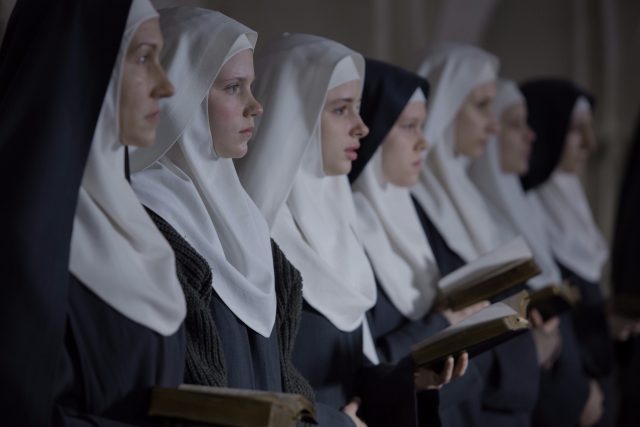
 FIAF’s CinéSalon series “Cinematographer Caroline Champetier: Shaping the Light” continues the celebration of the career of the César-winning French director of photography October 24 with two of her best films, Anne Fontaine’s Les Innocentes and Léos Carax’s Holy Motors, each of which will be followed by a Q&A and wine and beer reception with Champetier. Inspired by a true story, Les Innocentes is a haunting tale of a French WWII Red Cross doctor, Mathilde Beaulieu (Lou de Laâge), who is secretly summoned by Sister Maria (Agata Buzek) to help a nun give birth in a remote Polish convent. She soon discovers that several of the Benedictine nuns are pregnant, the result of brutal rapes by Soviet soldiers. The Mother Superior (Agata Kulesza) doesn’t want any outsiders to know what happened, out of both shame and fear, but the babies, and the nuns themselves, may not survive without obstetric care. Mathilde, a Communist, is stationed at a mobile surgical hospital in Warsaw, where she primarily assists Samuel (Vincent Macaigne), a Jewish doctor tending to wounded soldiers after the war, in December 1945; she gets into trouble with Samuel when she refuses to even hint at where she is disappearing to. As the due dates for the multiple births draw close, so does the danger surrounding Mathilde and the nuns.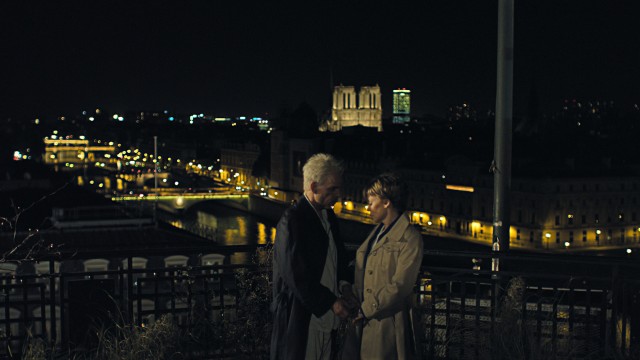
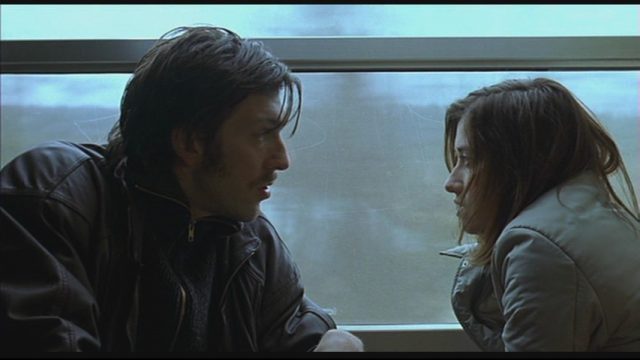
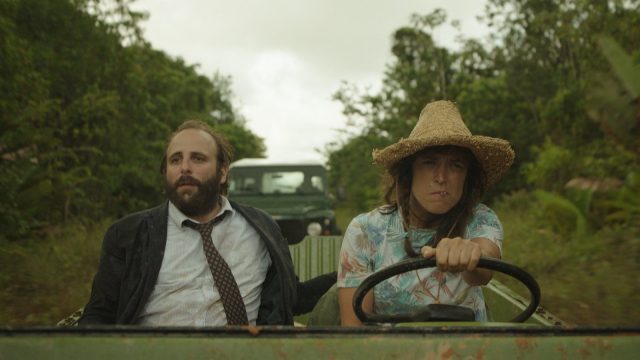
 “Vines . . . are like internships,” Ulrich (Pascal Tagnati) tells Marc Châtaigne (Vincent Macaigne) in Antonin Peretjatko’s madcap colonialist farce, Struggle for Life. “Don’t drop one till you got another.” Nothing ever goes right for middle-aged schlemiel Châtaigne, who has been assigned by Rosio (Jean-Luc Bideau) of the Ministry of Standards to oversee the construction of an indoor ski resort in the jungles of Guiana; Guia-Snow, Rosio explains, will show South America that France can export a coveted resource, cold weather. Châtaigne’s contact in Guiana is lunatic bureaucrat Galgaric (Mathieu Amalric), who assigns him a driver named Tarzan (Vimala Pons), a grown woman who is interning with the Department of Forestry and Water and is in charge of renovating gardens. Soon Châtaigne and Tarzan are lost in the jungle, encountering a variety of oddballs, including Christian Duplex (Pascal Légitimus), Georges (Thomas De Pourquery), and Damien (Rodolphe Pauly), each of whom is somehow involved in either tearing down or saving the Amazon. Meanwhile, Châtaigne is being hunted by strange and skillful tax minister Maître Friquelin (Fred Tousch). They also meet up with dangerous insects and animals, cannibals, and parking meters. Jerry Lewis’s The Patsy meets Woody Allen’s Bananas in this hit-or-miss satire of French colonialism and government programs, in which interns are given a tremendous amount of power and responsibility, with director-cowriter Peretjatko (La Fille du 14 juillet) leaving no sight gag unturned. Yes, a lot of them are just plain stupid, but a whole bunch are just plain funny as well.
 On February 28, legendary auteur Agnès Varda was at FIAF for the special talk “Agnès Varda: Visual Artist.” The Belgium-born, France-based Varda, who is eighty-eight, will be back at FIAF on March 7 for the 7:30 screening of her 1975 documentary, Daguerréotypes, after which she will participate in a Q&A with former MoMA curator Laurence Kardish. (The film will also be shown at 4:00; both screenings will be followed by a wine and beer reception.) The eighty-minute work, which only received its official U.S. theatrical release in 2011 at the Maysles Cinema, is an absolutely charming look at Varda’s longtime Parisian community. In the film, Varda, who has made such New Wave classics as