Tag Archives: Chukwudi Iwuji

SHAKESPEARE IN THE PARK: HAMLET

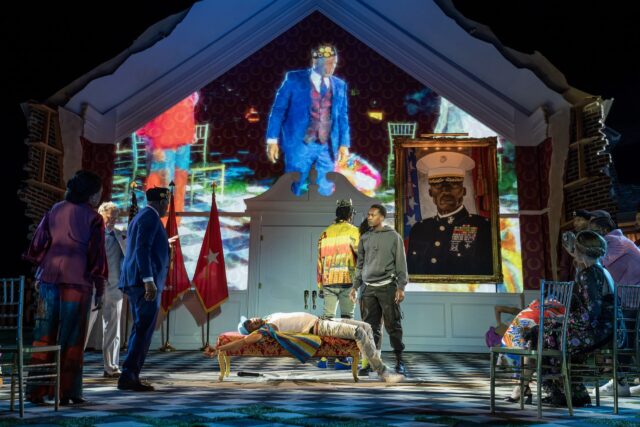
Kenny Leon’s Hamlet follows his Much Ado About Nothing at the Delacorte (photo by Joan Marcus)

HAMLET
Central Park
Delacorte Theater
Tuesday – Sunday through August 6, free, 8:00
shakespeareinthepark.org

Don’t let the recent parade of Hamlets stop you from seeing Kenny Leon’s incisive adaptation that opened last week at the Public’s Delacorte Theater in Central Park.

There has been a surfeit of faithful versions and unique reimaginings of William Shakespeare’s 1599–1601 tragedy in New York City since 2015, from Robert Icke’s staging at Park Ave. Armory with Alex Lawther in the title role, Yaël Farber’s variation at St. Ann’s Warehouse starring Ruth Negga, and James Ijames’s Pulitzer Prize–winning Fat Ham at the Public and on Broadway with Marcel Spears to the Public Theater Mobile Unit’s traveling show with Chukwudi Iwuji, Michael Laurence’s Hamlet in Bed at Rattlestick, and Thomas Ostermeier and Theater Schaubühne Berlin’s iteration at BAM with Lars Eidinger.

Tony winner Leon turns this Hamlet into a kind of sequel to his 2019 Delacorte triumph, a rollicking modern-day interpretation of Much Ado About Nothing that took place at a Georgia estate prominently displaying “Abrams 2020” banners, referring to two-time former Georgia gubernatorial candidate Stacey Abrams. Set designer Beowulf Boritt is back, tearing the estate in half; one part of the house is sinking into the ground, an Abrams poster sticking out at an angle, like a lonely, overturned grave marker, while a black SUV is stuck in the mud on the other side. It is as if a tornado, or a dangerous presidency, ripped through the land, leaving America in tatters, the white tiles on the grass evoking a cemetery. (The Delacorte itself will be torn down after this summer’s Hamlet and Public Works presentation of The Tempest to undergo a major renovation; it is scheduled to reopen in 2025.)

The central facade features a large portrait of a military hero in full dress uniform, looking like a dictator: the previous king’s funeral is just getting underway as a quartet performs three biblical hymns alongside a flag-draped coffin. “When you go, you’ll have to go alone / When you go, you’ll have to go alone / No one in this world / Can take your journey / When you go, you’ll have to go alone,” they sing. Leon adds in Harry Belafonte’s “Day-o,” an out-of-place tribute to the recently deceased artist and activist, but he also gives us a lovely introduction to Ophelia (Solea Pfeiffer), who offers, “You and Me (No Love Stronger).” Ophelia is given more agency than usual in this adaptation as she considers her affection for Hamlet (Ato Blankson-Wood).

Ato Blankson-Wood is impressive as the introspective Hamlet in latest Shakespeare in the Park production (photo by Joan Marcus)

“For Hamlet, and the trifling of his favor, / Hold it a fashion and a toy in blood, / A violet in the youth of primy nature, / Forward, not permanent, sweet, not lasting, / The perfume and suppliance of a minute, / No more,” Laertes (a firm Nick Rehberger) warns his sister before leaving.

Ophelias’s father and Claudius’s chief counsel, Polonius (Daniel Pearce), admonishes, “In few, Ophelia, do not believe his vows, / I would not, in plain terms, from this time forth / Have you so slander any moment leisure / As to give words or talk with the Lord Hamlet. / Look to ’t, I charge you. Come your ways.”

The dead king’s brother, Claudius (John Douglas Thompson), has quickly gained the throne by marrying his brother’s widow, Gertrude (Lorraine Toussaint). Deeply affected by this turn of events, Hamlet feels like he is alone. “A little more than kin and less than kind,” he whispers to the audience about his new stepfather. Blankson-Wood is brilliant as Hamlet slowly descends into madness, with Leon exploring the character’s state of mind more insightfully than I can remember ever seeing before.

Hamlet is soon visited by the ghost of his father, who appears like a distorted monster, projected onto the gable of the house, his otherworldly voice (recorded by Samuel L. Jackson) explaining to his son that Claudius murdered him; he proclaims, “Revenge his foul and most unnatural murder.” At one point Allen Lee Hughes’s lighting casts the shadow of Hamlet’s head across his father’s portrait, suggesting that he will never be able to escape from the former king’s legacy. (The lighting is by Allen Lee Hughes, with sound by Justin Ellington and projections by Jeff Sugg.)

Claudius calls for Hamlet’s old friends Rosencrantz (Mitchell Winter) and Guildenstern (Brandon Gill) to spy on him. Meanwhile, Hamlet arranges for a traveling troupe of players (Mikhail Calliste, Lauryn Hayes, LaWanda Hopkins, and Colby Lewis) to put on a show that will reveal to the king that Hamlet knows that he is a liar and a murderer. “The play’s the thing / Wherein I’ll catch the conscience of the king,” he says. The players perform a rap song, Jason Michael Webb’s “Cold World,” which features such un-Shakespearean lyrics as “Days are precious when you’re livin’ in a warzone / Tryna live, heart heavy like a diamond / City’s cold, but the streets are even colder / Gotta get out ’fore they say my time is over.” When Hamlet describes the plot, with its murder and marriage, Claudius gets up and storms off. The battle is on.

Leon (Topdog/Underdog, A Soldier’s Play) streamlines the play to a mere two hours and forty-five minutes with intermission, eliminating the subplot of the Norwegian crown prince Fortinbras, who mounts a challenge to Hamlet after Hamlet’s father slays his father. We don’t see Barnardo (Trí Lê), Horatio (Warner Miller), and Marcellus (Lance Alexander Smith) initially encounter the ghost. There is no mention of any state being “rotten,” no “to the manner born,” no “thoughts be bloody,” but none of that is missed.

Polonius is wonderfully portrayed by Pearce (Mother of the Maid, Timon of Athens) as a persnickety, bow-tied southern gentleman in a seersucker suit. Thompson, one of our greatest classical actors whether doing Shakespeare (The Merchant of Venice), Eugene O’Neill (The Iceman Cometh), or August Wilson (Jitney), is stirring as Claudius, commanding the stage with a moving vulnerability, while Toussaint (A Midsummer Night’s Dream, Stuff Happens) is a worthy cohort, finding compassion for her son even as her husband grows more combative. Greg Hildreth (Company, Moscow Moscow Moscow Moscow Moscow Moscow) nearly steals the show as the gravedigger, who uses skulls like bowling balls.

Lorraine Toussaint and John Douglas Thompson sparkle as Gertrude and Claudius in Hamlet (photo by Joan Marcus)

The staging does supply some significant problems. As opposed to Leon’s Much Ado About Nothing, which was set in modern-day Atlanta, it is not clear when and where his Hamlet unfolds, in Denmark, Georgia, or a different location. While Much Ado had an all Black and brown cast, Hamlet has several Caucasian actors. There are subtle references to what is happening in Trump-era America, the dialogue is spoken with a flowing style, and Jessica Jahn’s costumes are contemporary dress, from Claudius’s blue suit to Laertes’s dungaree jacket to Hamlet’s hoodie and Ophelia’s revealing bustier. So impressive in Much Ado, the car now seems like an excess prop. Leon might be attempting to meld past with present, but it can cause confusion, as when letters are delivered during a time when SUVs and 2020 placards are present.

Following in the footsteps of such actors as Sarah Bernhardt, Laurence Olivier, Richard Burton, Nicol Williamson, Mel Gibson, Kenneth Branagh, and Ethan Hawke — and, at the Delacorte itself, Michael Stuhlbarg in 2000, Sam Waterston in 1975, Stacy Keach in 1972, and Albert Ryder in 1964 — Blankson-Wood (Slave Play, The Total Bent) is a Hamlet for these times. His journey into madness has a method in it, a young man troubled by what he sees going on all around him, with his parents, his girlfriend, and the ruling class.

“I will be brief. Your noble son is mad. / ‘Mad’ call I it, for, to define true madness, / What is ’t but to be nothing else but mad?” Polonius says to Claudius. Blankson-Wood’s Hamlet is no skulking college student or shy mama’s boy; he is a prince trying to find his way in a complex and dangerous world, one that provides no sympathy. He delivers six of Hamlet’s seven soliloquies (“How all occasions do inform against me” has been cut) with a thoughtful, understated tenderness, not demanding attention to himself but instead to the character’s search for an unreachable inner peace.

It’s heartbreaking but, after all, Hamlet is a tragedy, no matter where or when it is set.

[Mark Rifkin is a Brooklyn-born, Manhattan-based writer and editor; you can follow him on Substack here.]

RemarkaBULL PODVERSATION: EXPLORING LADY MACBETH WITH ISMENIA MENDES

(photo by Richard Termine)

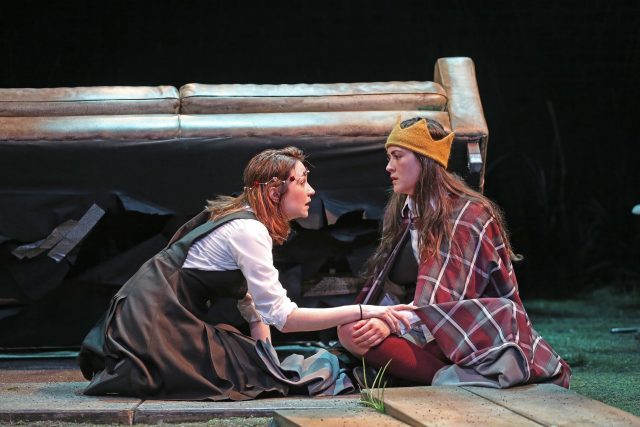
Lady Macbeth (Ismenia Mendes) reaches out to her royal husband (Isabelle Fuhrman) in inventive reimagining of Shakespeare tragedy (photo by Richard Termine)

Who: Ismenia Mendes, Nathan Winkelstein
What: Livestreamed conversation about Lady Macbeth
Where: Red Bull Theater online
When: Monday, May 9, free with advance RSVP (donations accepted), 7:30
Why: Macbeth is all the rage now, with a much-derided version starring Daniel Craig and Ruth Negga currently playing at the Longacre on Broadway and Joel Coen’s film version with Denzel Washington and Frances McDormand having garnered three Oscar nominations. One of the best and most innovative adaptations in decades was staged by Red Bull Theater at the Lucille Lortel in 2019, directed by Erica Schmidt and set at a girls school. The fierce and furious, sexy and sinister ninety minutes starred Isabelle Fuhrman as Macbeth and Ismenia Mendes as Lady Macbeth.

In conjunction with the streaming release of the 2019 production, available on demand May 16-29, Red Bull is hosting its latest RemarkaBULL Podversation, “Exploring Lady Macbeth,” with Mendes (Troilus and Cressida, Henry V) and associate artistic director and host Nathan Winkelstein performing the “How now! what news?” scene, followed by a discussion and an audience Q&A. In the dastardly dialogue, Lady Macbeth tells her husband, “What beast was’t, then, / That made you break this enterprise to me? / When you durst do it, then you were a man; / And, to be more than what you were, you would / Be so much more the man. Nor time nor place / Did then adhere, and yet you would make both: / They have made themselves, and that their fitness now / Does unmake you. I have given suck, and know / How tender ’tis to love the babe that milks me: / I would, while it was smiling in my face, / Have pluck’d my nipple from his boneless gums, / And dash’d the brains out, had I so sworn as you / Have done to this.” Previous RemarkaBULL Podversations, which are always a treat, have featured Kate Burton, André De Shields, Elizabeth Marvel, Chukwudi Iwuji, Patrick Page, Lily Rabe, Jay O. Sanders, Michael Urie, and others and can be viewed for free here.

TWI-NY TALK: JESSE BERGER OF RED BULL THEATER

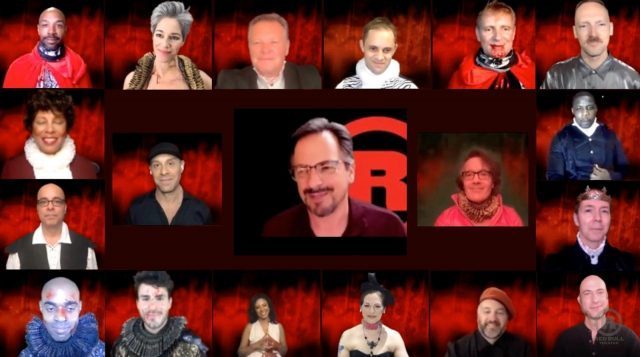
Founding artistic director Jesse Berger introduces one of Red Bull’s livestreamed readings during the pandemic (screenshot by twi-ny/mdr)

Red Bull Theater
Galathea: Monday, March 15, free (suggested donation $25), 7:30 (available on demand through March 19)
Galatea: Monday, March 22, free (suggested donation $25), 7:30 (available on demand through March 26)
Paradise Lost: Monday, April 12 & 26, free (suggested donation $25), 7:30
www.redbulltheater.com

A year ago yesterday, New York City closed all entertainment venues, leading to endlessly sad postponements and cancellations that no one thought would last as long as it has. Theater companies were forced to examine their immediate and long-term futures: Some went into hiatus, others came up with intermittent virtual offerings, and a handful went all in, quickly developing an online streaming presence through readings, conversations, and innovative interactive live programming. One of the busiest, and most successful, has been Red Bull Theater. Founded in 2003 by artistic director Jesse Berger, Red Bull specializes in splendidly designed and costumed Jacobean works (Ben Jonson’s Volpone, John Ford’s ’Tis Pity She’s a Whore, Richard Brinsley Sheridan’s The School for Scandal) in addition to inventive contemporary adaptations (Erica Schmidt’s Mac Beth set in a girls school, Berger’s take on Gogol’s The Government Inspector, starring Michael Urie). Over its history, the troupe has also hosted more than two hundred Revelation Readings with all-star casts in various theaters, and it sponsors the Shakespeare in Schools initiative to bring the Bard to young students.

Red Bull’s virtual season kicked off in April with the first-ever “RemarkaBULL Podversation,” with Urie delivering Mercutio’s “Queen Mab” speech from Romeo and Juliet, followed by a discussion with Red Bull associate artistic director Nathan Winkelstein; subsequent Podversations have featured Chukwudi Iwuji performing “A Homely Swain” from Henry VI,
Elizabeth Marvel doing “Cry Havoc” from Julius Caesar, and the phenomenal Patrick Page delving deep into Othello in “Exploring Iago.” All Podversations are available for free on YouTube, but the dozen live Zoom readings the company has streamed, from Berger’s new version of Thomas Middleton’s The Revenger’s Tragedy to Anchuli Felicia King’s modern-day Keene and Frances Burney’s The Woman Hater directed by Everett Quinton, remain online for only four days after the initial livestream. Each reading is accompanied by still-available Bull Session panels with Winkelstein and members of the cast and crew. Up next is a two-parter, John Lyly’s 1588 queer love story, Gallathea, on March 15, in collaboration with the Drama League, and MJ Kaufman’s new Galatea, on March 22, a trans love story in collaboration with WP Theater. Red Bull held its tenth annual Short New Play Festival in July, a fun virtual evening with works by Jeremy O. Harris, Theresa Rebeck, and others, with casts that included Kathleen Chalfant, Lilli Cooper, Edmund Donovan, William Jackson Harper, and Charlayne Woodard; the eleventh annual event, the theme of which is restoration, is scheduled for July 12.

A native Oregonian who was previously the assistant director of the Shakespeare Theatre Company in Washington, DC, Berger took time out of his ridiculously busy schedule to talk about Red Bull, the pandemic, and the future of theater.

Jesse Berger is front and center at a Red Bull Zoom reading (photo courtesy Red Bull Theater)

twi-ny: Red Bull has been one of the most active theaters in the country during the pandemic, going back to April. How and when was it decided to proceed full steam ahead with reunion readings and conversations?

jesse berger: It’s been almost exactly a year since the shutdown, and I think all of us went through the stages of grief at different paces — shock, denial, etc. — and out of that confoundingly confusing time and in consultation and through conversations with our wonderful team — led by our great managing director Jim Bredeson, wonderful board, terrific staff, extraordinary artistic associates, and other supporters — came the hunger for us to do something, anything, to connect our community. So . . . the original impetus was really just — get something out there that is our work that gets artists and audiences together, even if only virtually.

Just two weeks after lockdown began, on March 26, we announced the first of what has become a robust series of online activities. Since then it has simply been a learning experience that has led us to do more. For the first six months, we really just tried different ways to improve and experiment with the online experiences we were concocting. As it began to sink in over the summer that this shutdown was likely going to take a year or more, we made the decision to proceed with planning a fully virtual season for 2020–21. We probably hit our stride on these activities around October and have of course kept looking for ways to improve and innovate throughout.

twi-ny: The economic toll on theater companies has been devastating. Have these programs been financially viable for you?

jb: It has been devastating, indeed, and we count ourselves among the lucky ones because we were relatively financially healthy and relatively unencumbered when the shutdown hit. We made the decision to offer all our activities for free or pay what you can, and of course to compensate participating artists as much as we possibly can. We have found that audiences have by and large been generous in responding to this work and this method, so the programs are at minimum paying for themselves / breaking even through many small donations of $25, $10, $50. . . . Then we have hugely relied upon the larger generosity of larger donors, major institutional supporters, government support like PPP, and other foundation grants to keep the lights on and the staff fully employed. We’re grateful for the fact that we have not had to lay anyone off or furlough.

twi-ny: Red Bull has been streaming presentations several Monday nights every month going back to nearly the beginning of the lockdown, while other theaters have either been silent or put on occasional readings or talks, but not necessarily both. What’s the process like, especially gathering everyone together for the reunions, rehearsing over Zoom, and working at such a furious pace?

jb: We have a wonderful staff of four, and I appreciate you recognizing the quantity as well as the quality of the overall work output from Red Bull in this time! All I can say is that everyone is working hard, but I think it’s fair to say that no one feels particularly overwhelmed or overtaxed. We’ve simply done our best to be efficient and strategic with our efforts and our plans. As far as gathering the artists and that process, it’s not that different from the before-times — we reach out with offers to agents and/or directly to the participating artists, we make a schedule, we stick to it. The new stuff is the preplanning around what if anything needs to be sent to the actors for them to do their best work — greenscreens, microphones, internet help, lighting, etc. Nathan also schedules one-on-one tech sessions to check in with every participant so they have what they need before rehearsals start.

twi-ny: Red Bull’s bread and butter is Jacobean theater, which seems to be very relevant to what is happening today. Why do you think that is?

jb: Well, while I believe in social progress and that many things are probably better for humanity now than they were four hundred years ago, I’m also totally convinced that human beings and human relationships weren’t that different four hundred years ago. If anything, this most recent plague has brought home how similar our times are, even if the circumstances in which we live are more civilized — and thankfully we have amazing scientists making vaccines in record time. Also, I think that the Jacobeans in particular feel pretty contemporary in their outlook. These plays can be powerfully used to reflect our current society’s hypocrisies and inequities as well as its greatest hopes and aspirations.

twi-ny: In October, the amazing Patrick Page gave a master class on Iago as part of the company’s “Othello 2020” project. Have you seen his one-man show for Shakespeare Theatre Company, All the Devils Are Here? Have you watched much theater during the pandemic, and if so, has anything stuck out for you?

jb: Patrick Page is amazing, isn’t he? He’s one of the best Shakespearean actors in America, and beyond. We actually were privileged to share the New York premiere of All the Devils Are Here as a one-night benefit performance last February to a packed house at the Cherry Lane, so I know it well.

Patrick and I go way back — we both hail from an Oregon background, and we actually met when we were both working at the Utah Shakespeare Festival a number of years ago. It’s been a great experience to reconnect with him at Red Bull in NYC over the past years — he starred in our productions of The Duchess of Malfi and Coriolanus and has taught a number of acting intensives for us. He was also our 2010 Matador Award for Excellence in Classical Theater recipient. He’s great. I can’t wait to work with him again. And All the Devils Are Here on film is well worth your time, as well as Patrick’s excellent PODversation with Nathan on Iago.

I was voraciously consuming online theater in the earlier days of the pandemic, but I will admit to watching a bit less over time. Part of the reason is personal and part professional. I have two young kids at home, so finding additional time to watch things on the screen beyond keeping up with everything we are doing at Red Bull is hard. However, I loved Richard Nelson’s What Do We Need to Talk About?, Michael Urie’s Buyer & Cellar, TFANA’s Mad Forest, Jefferson Mays’s Scrooge, and Bill Irwin and Christopher Fitzgerald’s Old Globe comedy routine.

twi-ny: Do you and Nathan ever sleep?

jb: I can’t speak for Nathan, but thanks to the aforementioned wonderful two young kids at home, no — I never sleep. And yes, Red Bull’s online activity has certainly kept us a bit sleep deprived.

twi-ny: Do you have a wish list of plays you’d like to do as readings or of actors you’d like to work with online?

jb: Yes, but it’s top secret!

Jesse Berger has been a busy man during the coronavirus lockdown (photo courtesy Red Bull Theater)

twi-ny: Companies are now starting to film plays on their stage, selecting works that feature very small casts, often only one or two actors. Red Bull specializes in plays with many characters. Are there any plans to film anything onstage? How will cast size affect what plays you do once we come out of this?

jb: With the work we do, large cast sizes are often de rigueur and can make for difficult decisions when it comes to our budget. However, we have also produced plays such as Erica Schmidt’s seven-actor Mac Beth, Keith Hamilton Cobb’s two-actor American Moor, as well as Jean Genet’s The Maids, plus a ten-actor (is that small?) Coriolanus directed by Michael Sexton. As we begin to get clear guidance from the authorities and the unions that represent the artists with whom we work, we will be better situated to make decisions about if we might have to do some smaller cast plays simply as a safety necessity. And we are certainly keeping our eye on and out for some great material that will suit that bill.

twi-ny: Once theaters are back open and audiences are allowed inside, what do you think is the future of virtual productions? Do you see hybrid works continuing, or do you think online shows and readings will phase out?

jb: At the moment, I think the genie is out of the bottle, and online readings will likely continue. I suspect they will continue to be part of many theaters’ ancillary programming. I know they will be part of our future as they enable us to reach audiences worldwide with the work that is central to our mission. Of course our heart and soul will still be in the live theater experience.

twi-ny: What has sheltering in place been like for you on a personal level? Have you remained in New York City the whole time or been able to travel to see family?

jb: We were relatively lucky to be out of NYC for the first six months of the shutdown and have also been grateful to be able to be back in NYC since September. Sadly we have not yet been able to see our extended family who live all over the country, although we are Zooming with them a lot. Now that vaccines are rolling out, we are looking forward to making some plans to see everyone again in person.

twi-ny: Once you’re fully vaccinated, what’s the first thing you’re going to do that you have not been able to do since last March?

jb: So many things to do! But . . . it’s still a bit complicated, isn’t it?

WHO’S THERE: HAMLET AND BLACK LIVES

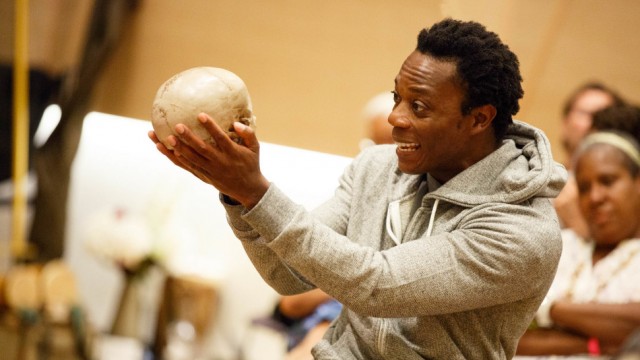
Chukwudi Iwuji will discuss the 2016 Public Theater Mobile Unit production of Hamlet in virtual program on November 10 (photo by Joan Marcus)

Who: Karen Ann Daniels, Chukwudi Iwuji, Patricia MacGregor, James Shapiro, Praycious Wilson-Gay
What: Discussion about race, Shakespeare, community, and the Public Theater’s Mobile Unit
Where: The Public Theater website and YouTube channel
When: Tuesday, November 10, free with RSVP, 7:00
Why: In the fall of 2016, the Public Theater’s Mobile Unit, after traveling across New York City, brought Patricia McGregor’s contemporary production of Hamlet to the Shiva Theater; I called the show “a playful adaptation highlighted by a superior performance by Olivier Award winner and Royal Shakespeare Company associate artist Iwuji, who is both inspired and inspiring as Hamlet. Iwuji, who has never played the role before, jumps in feet first, giving his all, often making direct eye contact with the audience to bring them further into the story. He does a lot of shouting, but he balances that with beautifully rendered soliloquies that (almost) feel like they could have been written today.” With the Public Theater and the Mobile Unit shut down because of the pandemic, the downtown institution will be presenting the virtual program “Who’s There: Hamlet and Black Lives,” a free discussion with Iwuji and McGregor on November 10 at 7:00. It is exciting to watch the actor talk about Shakespeare; on June 29, he delivered an impassioned reading of the “Homely Swain” speech from Henry IV and then waxed poetic about the play for a Red Bull Theater RemakaBULL Podversation, which can be viewed here. The Public presentation will explore Hamlet and the Mobile Unit itself within the context of the Black Lives Matter movement and the state of our divided nation, with Iwuji and McGregor joined by Mobile Unit director Karen Ann Daniels, Mobile Unit community programs manager Praycious Wilson-Gay, and Shakespeare scholar in residence James Shapiro.

RemarkaBull PODVERSATIONS: CHUKWUDI IWUJI

Henry VI

Chukwudi Iwuji will discuss and perform from Henry VI on June 29

Who: Chukwudi Iwuji, Nathan Winkelstein
What: Live discussion of the title character, “a homely swain,” of Henry VI
Where: Red Bull Theater’s website, Vimeo, Facebook Live
When: Monday, June 29, free, 7:30
Why: Red Bull Theater’s RemarkaBULL Podversations streaming series continues June 29 with Shakespearean star and Olivier winner Chukwudi Iwuji discussing Henry VI with Red Bull associate producer Nathan Winkelstein; Iwuji will also perform a passage that includes: “Would I were dead! if God’s good will were so; / For what is in this world but grief and woe? / O God! methinks it were a happy life, / To be no better than a homely swain; / To sit upon a hill, as I do now, / To carve out dials quaintly, point by point, / Thereby to see the minutes how they run, / How many make the hour full complete; / How many hours bring about the day; / How many days will finish up the year; / How many years a mortal man may live.” The Nigerian-born British thespian portrayed Henry VI in the Royal Shakespeare Company’s three-part production in 2006-8; on these shores he has played Edgar in King Lear and the title character in Othello for Shakespeare in the Park, Hamlet for the Public Theater Mobile Unit, and the Duke of Birmingham in Richard III at BAM while also winning an Obie for Bruce Norris’s The Low Road. You should also check out Iwuji’s Brave New Shakespeare Challenge performance of the balcony scene from Romeo & Juliet, delivered from his home in Harlem. Future RemarkaBULL Podversations feature the “I am I” speech from Richard III with Matthew Rauch on July 6 and the “All the World’s a Stage” soliloquy from As You Like It with Stephen Spinella on July 13.

SHAKESPEARE IN THE PARK: OTHELLO

(photo by Joan Marcus)

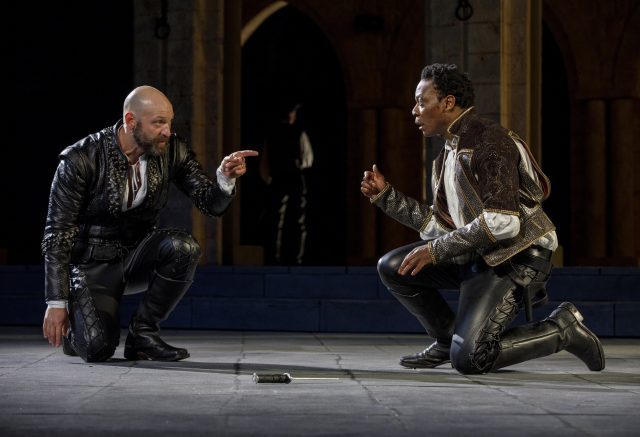
Iago (Corey Stoll) has a point to make with Othello (Chukwudi Iwuji) in Othello at the Delacorte (photo by Joan Marcus)

Central Park
Delacorte Theater
Tuesday-Sunday through June 24, free, 8:00
shakespeareinthepark.org

While filming Richard Eyre’s 2018 BBC television adaptation of King Lear, Chukwudi Iwuji, who was playing the king of France, was told by Sir Anthony Hopkins, who was starring in the title role, “You must be ready for your Othello now.” Iwuji proves he is more than ready in Ruben Santiago-Hudson’s gripping, emotional production that opened last night at the Delacorte in Central Park as part of the Public Theater’s annual Shakespeare in the Park presentation. Born and raised in Nigeria, later educated in Ethiopia and England, and now living in New York City, Iwuji, a Royal Shakespeare Company associate artist, has built up quite a resume at the Public, portraying the narrator and Enobarbus in Anthony and Cleopatra at the Anspacher in 2014, as Edgar in King Lear at the Delacorte that same year with John Lithgow as the monarch, taking the lead in Hamlet in the Public Theater’s Mobile Unit abbreviated 2016 version, and being nominated for awards as slave John Blanke in Bruce Norris’s The Low Road at the Anspacher earlier this year. (He also played the duke of Buckingham in Richard III at BAM in 2012.) In a role previously played at the Delacorte by James Earl Jones in 1964 and Raul Julia in 1979 and 1991, Iwuji might be shorter in stature and more naturally handsome than most actors who portray Othello, but he commands the role from the very moment he appears onstage, displaying a regal charm and joie de vivre even as he is instantly hustled by his devious ensign, Iago, played here by the tall, thin, bald Corey Stoll with a sarcastic and cynical sense of humor that is often laugh-out-loud funny.

(photo by Joan Marcus)

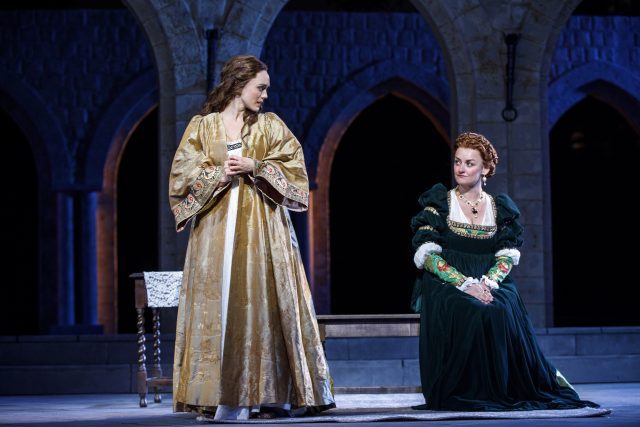
Desdemona (Heather Lind) and Emilia (Alison Wright) help the women take charge in Othello in Central Park (photo by Joan Marcus)

Tony-winning actor and director Santiago-Hudson (Jitney, Paradise Blue) keeps the focus on romance, particularly the deep, passionate love between Othello and Desdemona (Heather Lind), who have just gotten married against the wishes of her father, senator Brabantio (Miguel Perez), contrasting sharply with the much colder relationship between Iago and his wife, Emilia (Alison Wright). A Venetian military hero fighting the Turks, Othello has complete trust in Iago, who is out to destroy him, using and abusing his right-hand man, Roderigo (Motell Foster), in the process. Iago’s plan involves driving Othello into a jealous rage by convincing him that Desdemona is being unfaithful with Othello’s loyal lieutenant, Cassio (Babak Tafti), whose girlfriend, Bianca (Flor De Liz Perez), is no mere prostitute. In Santiago-Hudson’s vision, Desdemona, Bianca, and Emilia are strong female characters who are quick to stand up for themselves. Wright brings the house down in a late, fiery speech that gets to the heart of the truth. The excellent ensemble also includes Peter Jay Fernandez as the duke of Venice, Andrew Hovelson as Lodovico, Thomas Schall as Montano, and Peter Van Wagner as Gratiano, the cast moving through Rachel Hauck’s relatively basic but effective set, two walls with gothic archways, with a small tower on either side. Toni-Leslie James’s period costumes have a punk edge, consisting of lots of black leather and cool accessories on the men and lush gowns on the women.

(photo by Joan Marcus)

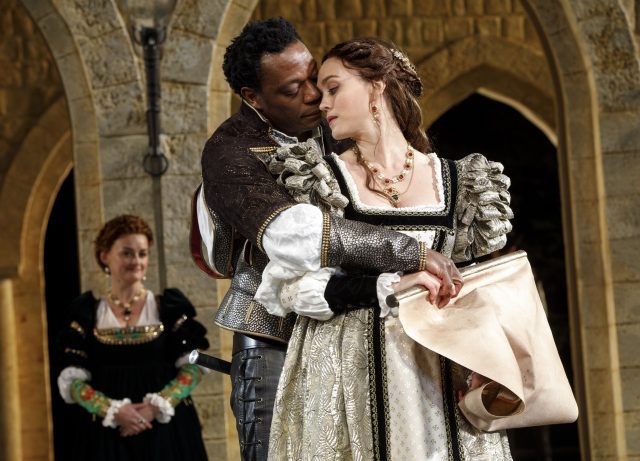
Othello (Chukwudi Iwuji) holds on tight to Desdemona (Heather Lind) as Emilia (Alison Wright) looks on in Rubin Santiago-Hudson’s stirring period version of classic Shakespeare play (photo by Joan Marcus)

“Rude am I in my speech / And little blessed with the soft phrase of peace,” Othello says early on, but in actuality Iwuji speaks Shakespeare’s words with such poetic beauty and skill that it evokes the sound of the birds singing in the trees as night falls. Iwuji and Lind (The Merchant of Venice, Incognito) are electric together; at one point Othello lifts his arm out to her and it is magical. Meanwhile Stoll (Intimate Apparel, Plenty), in his third consecutive year doing Shakespeare in the Park (following Troilus and Cressida and Julius Caesar), and Emmy nominee Wright (The Americans, Sneaky Pete) are also a dynamic pair as their characters’ marriage heads toward a giant abyss of lies. Of course, even with the concentration on romance and the emergent power of the women, as well as the undercurrent of racism that is always simmering, the success of the play ultimately relies on the chemistry between the actors playing Othello and Iago, who have previously been portrayed by such mixed-race pairs as David Oyelowo and Daniel Craig, Chiwetel Ejiofor and Ewan McGregor, Laurence Fishburne and Kenneth Branagh, Paul Robeson and José Ferrer, Jones and Christopher Plummer, and Julia and Christopher Walken. “O grace! O heaven forgive me! / O monstrous world! Take note, take note, O world: / To be direct and honest is not safe,” the conniving Iago says. “Nay, stay. Thou shouldst be honest,” the too-easily-convinced Othello replies. Iwuji and Stoll have now become part of the canon, and they well earn their place in this stirring, elegant production.

THE LOW ROAD

(photo by Joan Marcus)

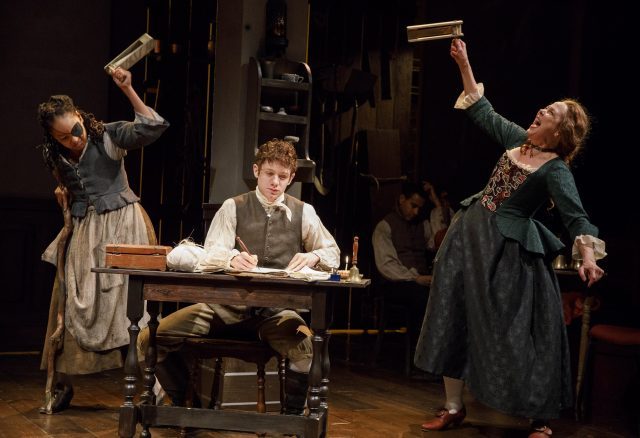
Jim (Chris Perfetti) tries to unbalance the books while being celebrated by Old Tizzy (Crystal A. Dickinson) and Mrs. Trewitt (Harriet Harris) in The Low Road (photo by Joan Marcus)

Anspacher Theater, the Public Theater
425 Lafayette St. at Astor Pl.
Tuesday through Sunday through April 8, $85
212-539-8500
publictheater.org

Pulitzer Prize winner Bruce Norris uses Adam Smith’s 1776 economic epic, An Inquiry into the Nature and Causes of the Wealth of Nations, as the basis for his potent and rollicking The Low Road, running at the Public’s Anspacher Theater through April 8. The Texas-born Norris follows the development of American capitalism through the trials and tribulations of one Jim Trewitt, from his birth in 1758 to the year of independence, 1776. The bitter yet playful satire is narrated by Smith (Daniel Davis), who hovers around the stage and in the aisles as he watches the shenanigans unfold along with the audience when he’s not front and center, using business-speak to introduce scenes. “As the ladies within had no marketable skills to speak of, they set about to purvey the only commodity available to them,” he says about a brothel, where the madam, Mrs. Trewitt (Harriet Harris), and her one-eyed slave, Old Tizzy (Crystal A. Dickinson), have taken in a baby left to them by one “G. Washington of Virginia,” according to a note that also promises they will be “generously compensated” upon the lad’s seventeenth birthday. One day, young Jim (Jack Hatcher) fortuitously comes upon a work-in-progress by Smith, reading a paragraph that will change his life: “Every individual endeavours as much as he can to employ his capital in support of domestic industry. He neither intends to promote the public interest nor knows how much he is promoting it. He intends only his own gain, and he is, in this, led by an invisible hand to promote an end that was never part of his intention. Nor is it the worse for society that it was no part of it.” Jim becomes a master with money, embezzling from Mrs. Trewitt without the slightest bit of guilt, and upon his seventeenth birthday, he (now played by Chris Perfetti) heads out on his own with a hidden stash under his hat. He buys himself a slave, John Blanke (Chukwudi Iwuji), loses a lot more than just his shirt to a mysterious masked thief, gets taken in by Brother Pugh (Max Baker), the presiding elder of the Bible-thumping New Light of Zion Colony of Waterfleet, and courts the daughter (Tessa Albertson) of the fabulously wealthy Isaac Low (Kevin Chamberlin). All the while, he is accompanied by Blanke, who turns out to be a lot more than the “deef . . . substandard product” he thought he purchased.

(photo by Joan Marcus)

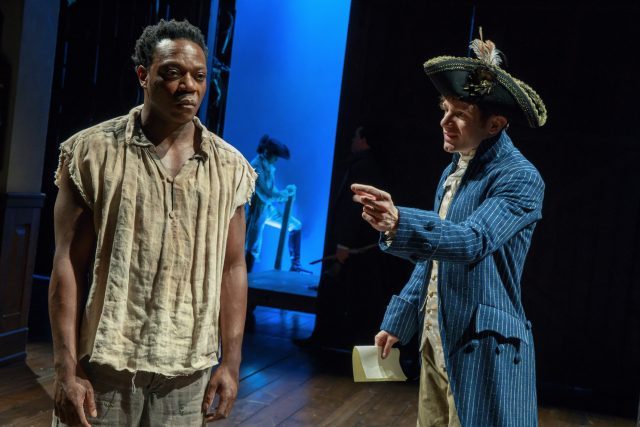
Jim Trewitt (Chris Perfetti) belittles his new slave, John Blanke (Chukwudi Iwuji), in Bruce Norris play at the Public Theater (photo by Joan Marcus)

Tony winner Norris (Clybourne Park, A Parallelogram) fills The Low Road with economic language and potent platitudes that never get tedious or pedantic — and much of which is as true today as it was in Smith’s time, taking on income inequality, class, gender, legacy, luxury, labor, power, property, organized religion, the military, and race. “All profit is theft,” Constance Pugh (Susannah Perkins) declares. “As he considered the disparity betwixt himself and the man whose chamber-pot he presently emptied, he wondered what it should be that caused such divergence of fortune,” Smith says of Trewitt cleaning up after the Duke of Buccleuch (Gopal Divan) at the brothel. “Might I suggest you learn to value that which cannot be obtained at gunpoint?” Blanke tells Jim shortly after they had been shackled together, evoking Sidney Poitier and Tony Curtis in Stanley Kramer’s The Defiant Ones. “You provide commendable service to my men and in return we provide you with protection. Now, surely that’s a fair exchange, yes?” Captain Shirley (Richard Poe) reminds Mrs. Trewitt when explaining why he and his soldiers don’t have to pay for their jaunts with her ladies of the night. “Yet somehow it seemed that, as his authority increased, the affection of those within had diminished proportionally,” Smith says of Jim as he cheats Mrs. Trewitt and her coterie, continuing, “For, their needs were modest, and, as a future gentleman, his were understandably greater.” And just in case the audience doesn’t tune into how modern these ideas still sound, the second act begins with a brilliantly conceived scene that establishes Jim as the founding father of corporate greed.

(photo by Joan Marcus)

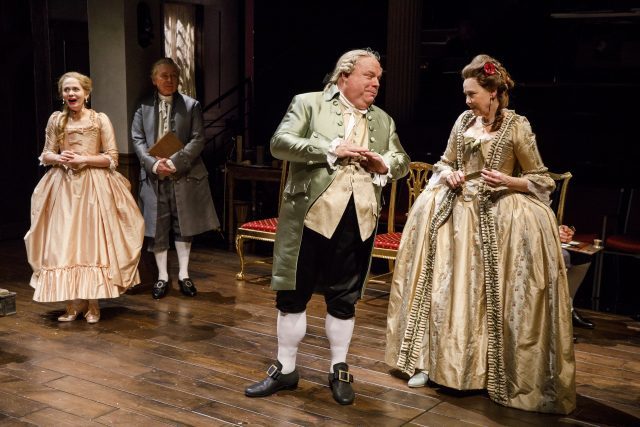
Isaac Low (Kevin Chamberlin) shares his good fortune with his wife (Harriet Harris) as their daughter (Tessa Albertson) and Adam Smith (Daniel Davis) look on in The Low Road (photo by Joan Marcus)

Four-time Tony nominee and three-time Obie winner Michael Greif (Dear Evan Hansen, A Parallelogram) superbly directs a cast of eighteen on the small Anspacher stage, which undergoes numerous changes by scenic designer David Korins, as chairs, tables, beds, barriers, a podium, and other elements are wheeled on and off; a short technical delay the night I went actually gave insight to the complexity behind the staging. Emily Rebholz’s period costumes and J. Jared Janas and Dave Bova’s wig and hair design are right on target, as is live music by violinist Josh Henderson, composed by Mark Bennett. Perfetti (Picnic, Cloud Nine) brings an engaging quirkiness to the role of Jim; you can’t help but root for him even though he does terrible things that will essentially lead to the subprime mortgage crisis of 2008. RSC veteran Iwuji (Hamlet, Hedda Gabler) is ferocious as John Blanke, representing America’s greatest shame and delivering the timeless line “But how much profit does one need? P’raps there ought be some penalty for the accumulation of unseemly wealth.” And Tony nominee Daniel Davis (Wrong Mountain, Talking Heads) lends it all a grand Shakespearean air. Thirty years ago, Gordon Gekko proclaimed, “Greed is good.” Norris ingeniously takes roads both low and high to reveal just how American that concept is, from the birth of the nation to this very minute.