Tag Archives: brooklyn academy of music

NEXT WAVE 2019

(photo by Heidrun Lohr)

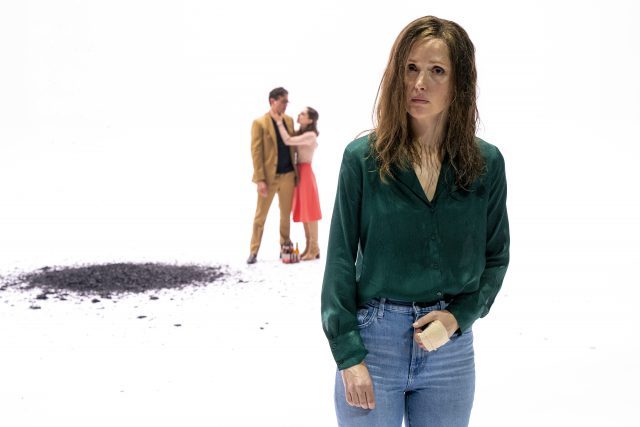
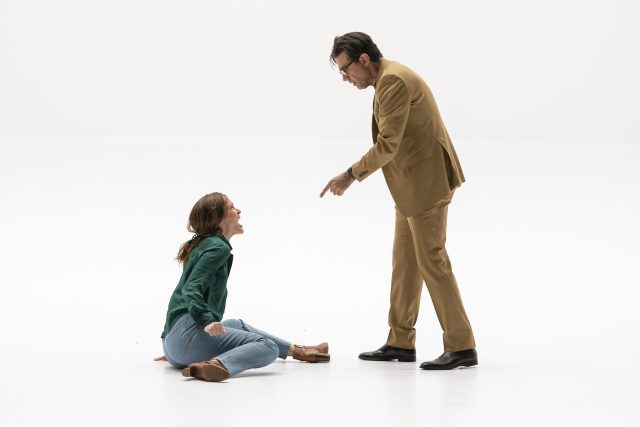
The Second Woman repeats the same scene from John Cassavetes’s Opening Night one hundred times (photo by Heidrun Lohr)

BAM Howard Gilman Opera House, Peter Jay Sharp Building, 230 Lafayette Ave.
BAM Fisher, Fishman Space, 321 Ashland Pl.
October 15 – December 15
718-636-4100
www.bam.org

Like myriad loyal BAMgoers, I look forward every year to the announcement of the Next Wave Festival at the Brooklyn Academy of Music, which has been presenting cutting-edge, experimental, and innovative dance, music, film, theater, opera, and hard-to-categorize multidisciplinary performances from around the world for nearly forty years. We eagerly scour the schedule to see when our longtime BAM favorites will be returning, scanning for such beloved names and companies as Robert Wilson, Sasha Waltz, Grupo Corpo, Batsheva, Philip Glass, Sankai Juku, Ivo van Hove, Mark Morris, Théâtre de la Ville, William Kentridge, Laurie Anderson, and the incomparable Pina Bausch, programmed by masterful executive producer Joe Melillo since 1999.

But this year’s lineup features nary a single familiar name, including that of Melillo, who retired after the Winter/Spring season. For his debut Next Wave Festival, new artistic director David Binder has opted to include a roster of performers all making their BAM debuts as well. But don’t be scared off by the lack of recognition. There was a time when no one in New York had ever seen Pina Bausch, Sankai Juku, Batsheva, Sasha Waltz, et al. And by its very nature, the Next Wave is all about the future of performance, delivered to an eager and intrepid audience open to anything and everything.

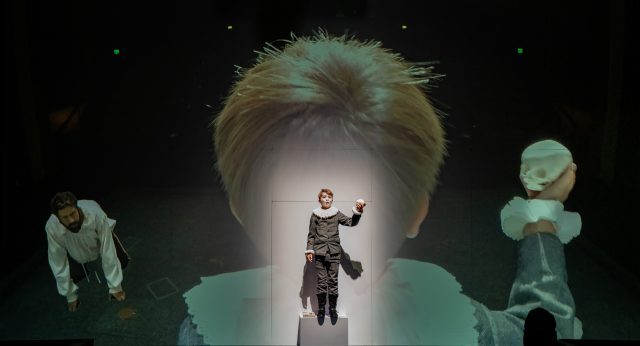
(photo by Ernesto Galan)

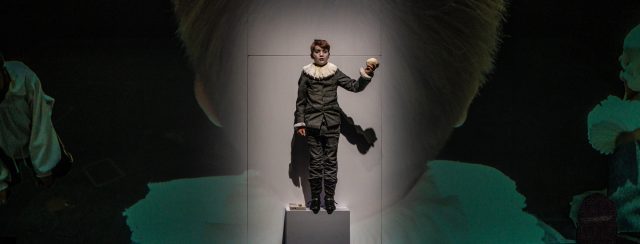
Dead Centre’s Hamnet tells the story of Shakespeare’s son (photo by Ernesto Galan)

“In programming my first season at BAM, I was inspired by the genesis of Next Wave and the groundbreaking work of my predecessors, Harvey Lichtenstein and Joe Melillo,” Binder said in a statement. “Next Wave is a place to see, share, and celebrate the most exciting new ideas in theater, music, dance, and, especially, the unclassifiable adventures. We’ve invited a slate of artists who have never performed at BAM. Each and every one of them is making a BAM debut, with artistic work that’s surprising and resonant. I’m excited to launch this season and to build BAM’s next chapter
with you.”

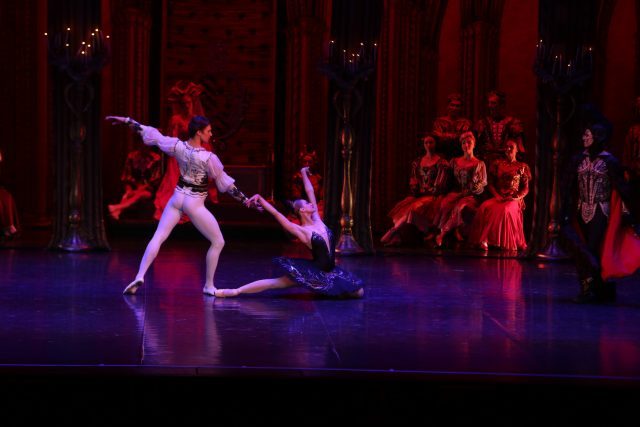
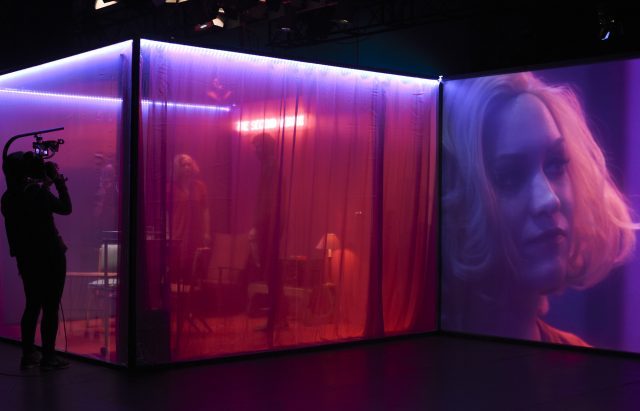
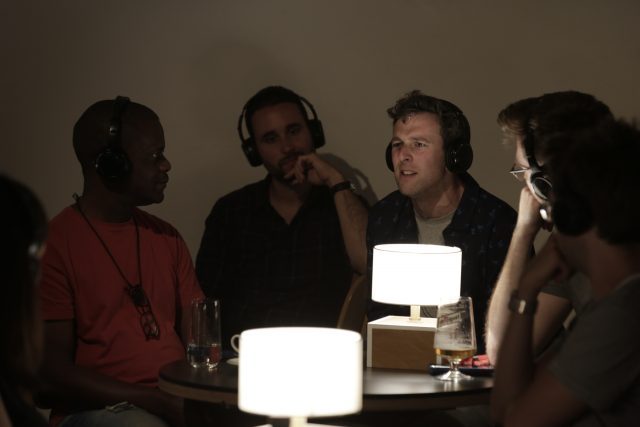
The 2019 Next Wave roster is an impressive one, kicking off October 15-20 with Michael Keegan-Dolan and Teaċ Daṁsa’s Swan Lake / Loch na hEala, about a young girl sexually assaulted by a priest. In The Second Woman, Alia Shawkat performs the same scene from John Cassavetes’s Opening Night one hundred times with one hundred different men over the course of twenty-four consecutive hours. Christiane Jatahy’s What if they went to Moscow? explores film and theater in a retelling of Anton Chekhov’s Three Sisters that takes place concurrently onstage at the BAM Fisher and onscreen at BAM Rose Cinemas, the audiences switching places as the performance repeats. In Dante or Die’s User Not Found, audience members sit in a café at the Greene Grape Annex on Fulton St., following the exploits of a man a few tables away. Dimitris Papaioannou breaks boundaries as he explores human existence in The Great Tamer. And Glenn Kaino’s When a Pot Finds Its Purpose will be the inaugural free exhibition at the new Rudin Family Gallery at BAM Strong.

(photo by Justin Jones)

Dante or Die’s User Not Found takes place in the Greene Grape Annex on Fulton St. (photo by Justin Jones)

The 2019 Next Wave Festival also includes Bruno Beltrão/Grupo de Rua’s Inoah, Dumbworld’s free outdoor art piece He Did What?, Selina Thompson’s free interactive installation Race Cards, Dead Centre’s Hamnet, Marlene Monteiro Freitas’s Bacchae: Prelude to a Purge, Untitled Projects/Unicorn Theatre, UK’s The End of Eddy, Peeping Tom’s 32 rue Vandenbranden, Fuel/National Theatre/Leeds Playhouse’s Barber Shop Chronicles, Kyle Marshall Choreography’s A.D. & Colored, Kate McIntosh’s In Many Hands, and Meow Meow’s A Very Meow Meow Holiday Show. Still worried about unfamiliarity? If you’ve been to BAM before, you should be ready, willing, and able to be surprised, and if you’ve never been to BAM, you should be preparing to make your debut.

BAM NEXT WAVE FESTIVAL: THE BACCHAE

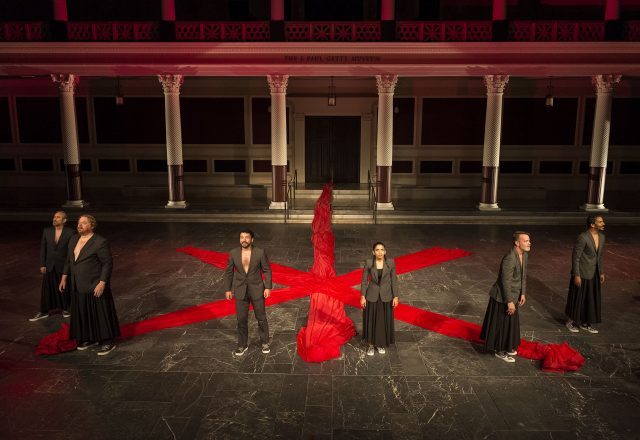
(photo by Craig Schwartz)

Anne Bogart and SITI Company relate Euripides’ The Bacchae to today’s sociopolitical ills in new interpretation (photo by Craig Schwartz)

THE BACCHAE
Brooklyn Academy of Music
BAM Harvey Theater
651 Fulton St. at Ashland Pl.
October 3-7, $40-$75
718-636-4100
www.bam.org

Anne Bogart and SITI Company return to BAM’s Next Wave Festival with their new interpretation of Euripides’ classic tale of gods and mortals, religion and the state, the earthly and the divine, The Bacchae. “More than any other play in Western civilization, Euripides’ is probably the one that most directly addresses the art of theater,” Bogart explains in a program note. “We are aware, for example, that we are looking at an actor or at a precisely lit staging and scenery, but at the same time we allow ourselves to enter into another world that is merely suggested by what is actually present.” The work, which premiered at the Getty Villa in California last month, is translated by Aaron Poochigian, with set and lighting by Brian H Scott, sound by Darron L West, and music composed by Erik Sanko. The cast features Ellen Lauren as Dionysus, Barney O’Hanlon as Tiresias, Stephen Duff Webber as Cadmus, Eric Berryman as Pentheus, and Akiko Aizawa as Agave. In conjunction with the show, the talk “Speaking Truth to Power: On Fear and Governance” will take place October 5 at the BAM Fisher’s Hillman Studio ($15, 6:00), with Anne Bogart and Monica Youn in conversation with Corey Robin, and BAM and the Mark Morris Dance Group are teaming up for “Introduction to Suzuki & Viewpoints,” a master class with SITI, on October 10 ($25, 12 noon) for theater artists, actors, dancers, performers, and directors.

LONG DAY’S JOURNEY INTO NIGHT

(photo by Richard Termine)

Sir Richard Eyre’s intimate staging of Eugene O’Neill classic continues at BAM through May 27 (photo by Richard Termine)

Brooklyn Academy of Music
BAM Harvey Theater
651 Fulton St.
through May 27, $25-$150, 7:30
718-636-4100
www.bam.org

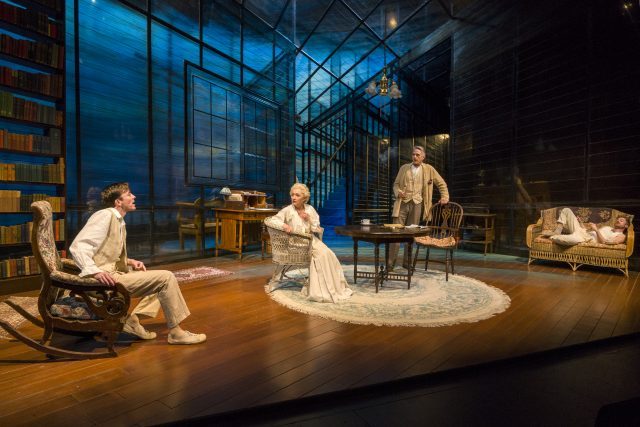
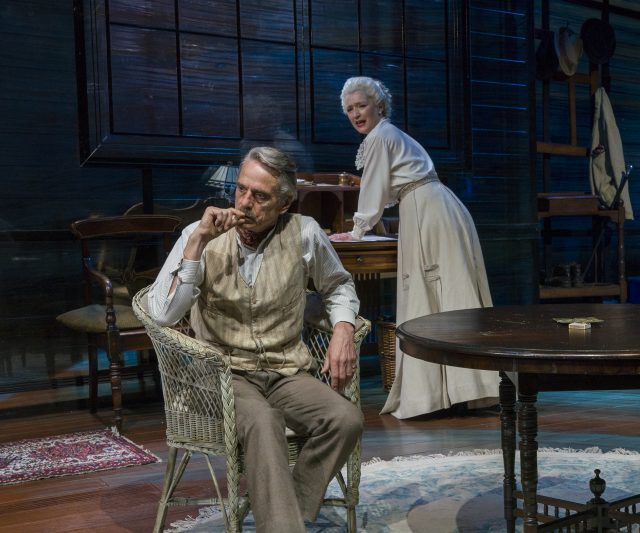
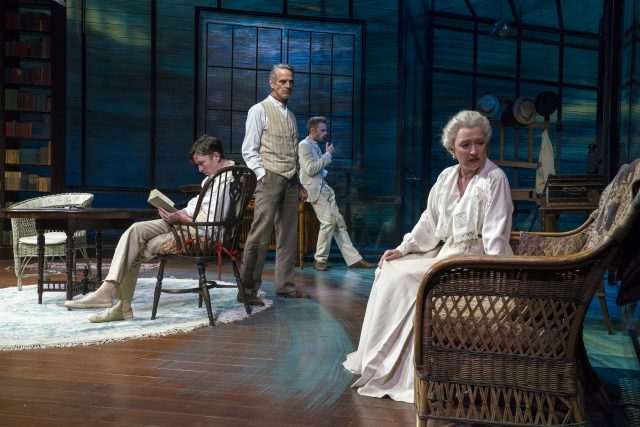
The walls are closing in on the Tyrone family and there’s not much anyone can do about it in Sir Richard Eyre’s deeply intimate staging of Eugene O’Neill’s autobiographical masterpiece, Long Day’s Journey into Night, a work so personal that O’Neill never wanted it to be performed. Eyre initially brought the show to the Bristol Old Vic as part of the venerable institution’s 250th anniversary in 2016, with Oscar, Emmy, and Tony winner Jeremy Irons as James Tyrone and Olivier winner and Oscar nominee Lesley Manville as his wife, Mary; the Bristol was where Eyre saw his first play and where Irons trained. A stunning, slightly amended production is now running at the BAM Harvey through May 27 before heading out to California. Rob Howell’s set is staggeringly breathtaking, a large living room with sharply angled glass walls and ceilings that seem to both threaten and expose James and Mary as well as their sons, the sickly Edmund (Matthew Beard) and the ne’er-do-well Jamie (Rory Keenan), along with the maid, Cathleen (Jessica Regan). James is a famous actor who, emotionally crippled by childhood poverty, chose the easy way out, a financially successful career touring his big hit, The Count of Monte Cristo, rather than pursuing artistic challenges. Despite his money, he remains fearful and miserly, and his family has been scarred by it. While James, Jamie, and Edmund drink heartily, Mary is addicted to painkillers, claiming they are for the rheumatism that is crippling her hands. She has recently returned from yet another stay in a sanitarium, and the men are keeping a close eye on her, particularly when she goes upstairs and spends time in the extra bedroom, where she loses herself in her morphine-addled world. James desperately wants to keep the truth about Edmund’s illness from Mary, but he no longer has the tight grip on his family that he might have once had.

(photo by Richard Termine)

James Tyrone (Jeremy Irons) and Mary (Lesley Manville) fight many demons in Long Day’s Journey into Night (photo by Richard Termine)

It all takes place on a foggy August day in 1912, but the show feels as relevant as ever, given the current opioid crisis that is devastating America, and O’Neill’s knowing depiction of functional alcoholism is as sharp as ever. Former National Theatre director Eyre (Ghosts at BAM, The Crucible on Broadway) focuses on conversations between two characters, making it feel like we are invading their privacy, intruding on this dysfunctional family, whether we’re watching a sweet, romantic moment between James and Mary, a warm bonding between James and Edmund, or a lovely little talk between Mary and Cathleen. The cast is exceptional, led by a brilliant performance by Manville (The Phantom Thread, Ghosts); she plays Mary with more of a firm grounding than usual, as if Mary has a legitimate fighting chance to beat her addiction. (Previous portrayers of Mary include Tony winners Florence Eldridge, Vanessa Redgrave, and Jessica Lange as well as Geraldine Fitzgerald, Zoe Caldwell, Bibi Andersson, Laurie Metcalf, Liv Ullmann, and Colleen Dewhurst.) In one scene she starts to go upstairs several times but turns back, which tortures her husband and sons and teases the audience, even though we know where she will eventually end up. Irons (Reversal of Fortune, The Real Thing) is classy and erudite as James, his long legs spread apart magnificently when he’s smoking his cigar and reading the paper at the table; he looks at Mary with real tenderness, recalling a love he might never recapture. (The role has earned Tonys for Fredric March and Brian Dennehy and nominations for Jack Lemmon and Gabriel Byrne; other portrayers include Laurence Olivier, James Cromwell, Robert Ryan, Alfred Molina, and David Suchet.)

(photo by Richard Termine)

The Tyrone family can’t look away from their troubled existence in Bristol Old Vic production at BAM (photo by Richard Termine)

Tony nominee Beard (Skylight, And When Did You Last See Your Father?) has an amiability not always associated with Edmund, while Keenan (Liola, The Kitchen) is brash and determined as Jamie, who has given up on any kind of reputable future. Regan (Doctors, Liola) makes the most of the small but important role of Cathleen. Peter Mumford’s lighting often results in characters’ being reflected in the windows, like ghostly apparitions of their troubled souls. As dark as the play is, Eyre holds out just enough hope that this time things will turn around for the Tyrones, that maybe Jamie will get a real job, Edmund will beat consumption, Mary will kick morphine, and James will go back to the stage. But as Mary says, “None of us can help the things life has done to us. They’re done before you realize it, and once they’re done they make you do other things until at last everything comes between you and what you’d like to be, and you’ve lost your true self forever.” Written seventy-five years ago, O’Neill’s words still ring true, providing yet more sparks to this American classic.

KING LEAR

(photo by Richard Termine)

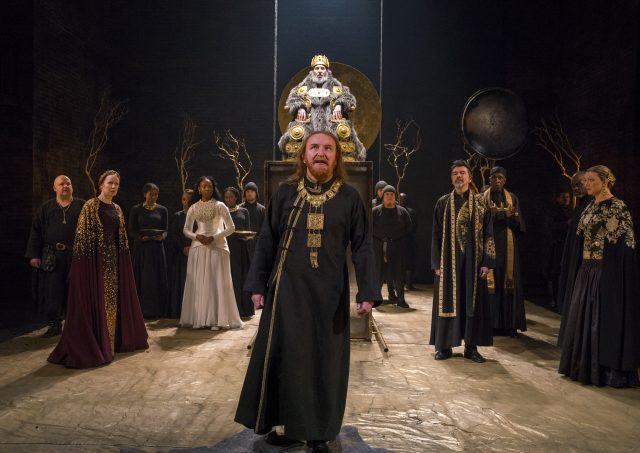
Kent (Antony Byrne) is at the ready as Lear (Sir Antony Sher) enters in Royal Shakespeare production at BAM (photo by Richard Termine)

Brooklyn Academy of Music
BAM Harvey Theater
651 Fulton St.
April 7-29, $35-$125, 7:30 (plus weekend matinees)
718-636-4100
www.bam.org

Sir Antony Sher bids adieu to Shakespeare in a dark version of the already dark King Lear, continuing at BAM’s Harvey Theater through April 27. The Royal Shakespeare Company production takes place in a dank, dreary, dismal world reminiscent of Akira Kurosawa’s The Lower Depths, where poverty and disillusionment reign. As the audience enters the theater, robed and hooded figures slowly walk onstage from the wings and sit on a vinyl tarp covering the ground, which is strewn with black gravel, while hellish mist floats in. After several minutes, they leave and a door in the back wall opens; Lear, wearing an enormous, brutal, bearlike fur coat, makes his entrance, sitting on his throne atop a large box with transparent sides. The members of the court are all dressed in black, some with gold adornments, except for one woman, who we soon learn is Cordelia (Mimi Ndiweni). Prepared to divide his kingdom into thirds, Lear listens as first Goneril (Nia Gwynne), who is married to the Duke of Albany (Clarence Smith), then Regan (Kelly Williams), wed to the Duke of Cornwall (James Clyde), profess their undying love for their father, and each is rewarded with their share of the kingdom. But when Cordelia, the youngest daughter, tells Lear she loves him as a child should love a parent, refusing to damn him with faint praise, he disinherits her. Lear’s trusted friend and adviser, the Earl of Kent (Antony Byrne), questions the king’s decision, so he is exiled. Afterward, another of Lear’s advisers, the Earl of Gloucester (David Troughton), is tricked by his illegitimate son, Edmund (Paapa Essiedu), into believing that his older son, Edgar (Oliver Johnstone), has plotted against him, leading Edgar to run away and disguise himself as Poor Tom, a crazy wanderer. Things don’t go well from there for anyone in the play, which was inspired by Raphael Holinshed’s Chronicles of England, Scotland, and Ireland and Sir Philip Sidney’s Countess of Pembroke’s Arcadia.

The Brooklyn Academy of Music has been presenting Lear for more than 150 years, with a wide range of actors portraying the king, from Ernesto Rossi and Edwin Booth to Frank Langella and Sir Derek Jacobi. “It’s all Ian McKellen’s fault,” Sher writes at the beginning of his latest book, Year of the King: The Lear Diaries; McKellen played Lear at BAM in 2007. Directed by RSC artistic director Gregory Doran, Sher’s longtime partner, this Lear is more subtle than most, if that word can be used at all to describe the Bard’s monumental tragedy. The sixty-eight-year-old Sher plays Lear as a sad, gentle, at times spoiled child who is already in decline before completely unraveling. With great understatement he towers over everyone in the storm scene, high atop the box, video of a rushing waterfall raging behind him, but he has already lost it all. Byrne is a fine, forceful Kent, boasting a shaved head with a warriorlike tattoo; he’s determined to bring the king back to reality, but he knows it’s too late. Troughton is magnificent as Gloucester, a pathetic figure on his way to certain doom, his hair so disheveled you want to go onstage and hug him (and comb his dreary locks). Johnstone’s Edgar is heartbreaking as well, a kind of sprite who has been beaten down by a cruel world he can’t understand. And Graham Turner is a memorable Fool, a tall, strong clown whose mind and body break down over time.

(photo by Richard Termine)

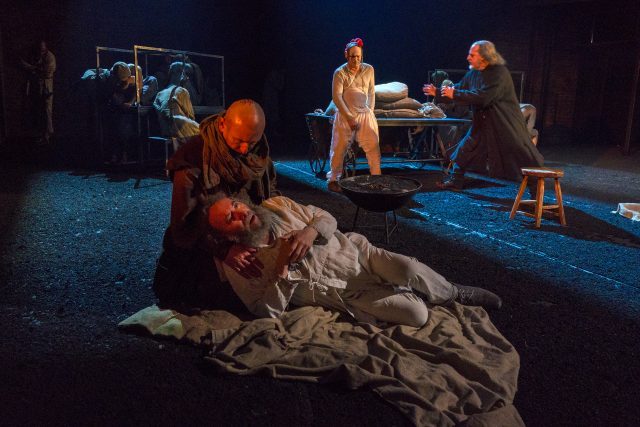
Kent (Antony Byrne) attends to a failing Lear (Sir Antony Sher) as the Fool (Graham Turner) looks on (photo by Richard Termine)

Niki Turner’s set is mostly spare, with various objects, from small trees to chairs and tables to large circles on poles representing the sun and the moon, carried by the cast. The large box is a curious addition that might not completely work — perhaps it’s a metaphor for peering inside the minds of the characters, particularly Lear’s, or else is a sign of being trapped — but it is eerily effective in the blinding scene, blood spurting and splashing onto the transparent sides. Doran focuses on the act of seeing throughout the play, giving prominence to lines about sight and eyes. “What, art mad? A man may see how this world goes with no eyes,” Lear tells Gloucester. “’Tis the times’ plague, when madmen lead the blind,” the Fool says to the old man (Edward James Walters). Tim Mitchell’s lighting, Jonathan Ruddick’s sound design, and Ilona Sekacz’s music, performed by musicians on balconies on the right and left of the stage, combine for a threatening atmosphere; the goings-on grow so somber that a surprising amount of the audience did not return after intermission for the second act, although I’d like to think that was more because those patrons were not prepared for nearly three and a half hours of gloom and doom. But this is Lear, after all, in this case featuring one of the world’s greatest Shakespearean actors taking his final Bard bow. It might be more of a whisper than a scream, but it is majestic and monumental nonetheless.

KING LEAR

(photo by Ellie Kurttz)

Sir Antony Sher bids William Shakespeare adieu in final Bard role (photo by Ellie Kurttz)

Brooklyn Academy of Music
BAM Harvey Theater
651 Fulton St.
April 7-29, $35-$125, 7:30 (plus 1:30 and 3:00 weekend matinees)
718-636-4100
www.bam.org

The Brooklyn Academy of Music has a thing for King Lear. Since 2007, it has presented three major productions, starring Sir Ian McKellen, Sir Derek Jacobi, and Frank Langella. During that time period, New York has also seen the tragic ruler portrayed by John Lithgow at the Delacorte, Michael Pennington at TFANA, and Sam Waterston and Kevin Kline at the Public. Now comes sixty-eight-year-old South African-born English actor Sir Antony Sher, in what is being billed as his final Shakespeare role. The two-time Olivier Award winner, Tony nominee, and longtime Royal Shakespeare Company member has previously played the Fool in Lear, Shylock in The Merchant of Venice, Prospero in The Tempest, Falstaff in both parts of Henry IV at BAM, Leontes in The Winter’s Tale, and the title characters in Richard III, Titus Andronicus, and Macbeth. The RSC production runs at the BAM Harvey April 7-29, directed by Gregory Doran (Sher’s longtime partner), with sets by Niki Turner, lighting by Tim Mitchell, and music by Ilona Sekacz. The cast also features Nia Gwynne as Goneril, Kelly Williams as Regan, Mimi Ndiweni as Cordelia, and Graham Turner as the Fool. In conjunction with the show, RSC assistant director Anna Girvan and members of the company will give a class on April 24 at 1:00 ($25) at the Mark Morris Dance Center “for emerging professional actors,” and Girvan and company members will lead the open workshop “Inside the Storm” on April 26 at noon ($20) at Mark Morris “for curious adult (18+) theatergoers of all abilities.”

CELLULAR SONGS

(photo by Stephanie Berger)

Meredith Monk (left) and Vocal Ensemble perform Cellular Songs at BAM through March 18 (photo by Stephanie Berger)

Brooklyn Academy of Music
BAM Harvey Theater
651 Fulton St.
March 14-18, $25-$55
718-636-4100
www.bam.org
www.meredithmonk.org

Legendary interdisciplinary artist Meredith Monk offers a brief prologue to her latest evening-length work, Cellular Songs, with an audiovisual installation in the lobby at the BAM Harvey Theater. Five small monitors, side by side and just about at eye level, show five women (the primary cast of Cellular Songs) uttering sounds as the camera cuts from facial close-ups to just their mouths and to X-rays of the human brain and hand. It serves as an aperitif to the main course, a gorgeous seventy-five-minute piece incorporating experimental sound, movement, video, and lighting. The show begins with a film by Katherine Freer of five enormous hands projected on the stage floor, touching and clutching fingers. Monk then walks out with four members of her Vocal Ensemble, Ellen Fisher, Katie Geissinger, Allison Sniffin, and Jo Stewart, all dressed in loose-fitting white and beige costumes by Yoshio Yabara, who also designed the environment, which features several chairs, a piano in one corner, and a small pile of white clothes near the back. Individually and as a unit, the five women vocalize sounds that form unique rhythms, complemented by their movement, which includes lying on the floor, gathering around the piano, and sitting in a circle, holding hands. Joe Levasseur’s lighting goes from individual and group spots to bathing the production in reds and blues. In the program, Monk explains, “Some of the pieces have much more dissonance and chromatic kind of harmonies, and the forms are almost like three-dimensional sculptures. Earlier, my music had much more to do with layering. Now you can almost see or hear the piece rotating as if it were a sculpture in space, though it’s just a musical form.”

Meredith Monk gets closer to the earth in Cellular Songs at BAM (photo by Stephanie Berger)

Meredith Monk gets closer to the earth in Cellular Songs at BAM (photo by Stephanie Berger)

Cellular Songs is a follow-up to the environmentally conscious On Behalf of Nature and was inspired by Siddartha Mukherjee’s Pulitzer Prize–winning book, The Emperor of All Maladies: A Biography of Cancer. The seventy-five-year-old New York City native has taken the concept of the cell as both healthy and unhealthy biological unit and applied it to music, as if each note is a cell. The majority of the utterances by the five performers are just sounds, although at one point Monk (Songs of Ascension, Vessel) sings the song “Happy Woman,” in which she repeats “I’m a happy woman” over and over again, along with some other adjectives replacing “happy.” The work is about transcendence and connection, about the life cycle of birth, life, and death, as revealed when the Vocal Ensemble is joined by ten members of the Young People’s Chorus of New York City; the fifteen girls and women split into three sets of five by age, each group in slightly different costumes. As Monk also explains in the program, “As artists, we’re all contending with what to do at a time like this. I wanted to make a piece that can be seen as an alternative possibility of human behavior, where the values are cooperation, interdependence, and kindness, as an antidote to the values that are being propagated right now.” Cellular Songs is a multimedia celebration of hope in a deeply troubled era, offering tired souls the opportunity to immerse themselves in a uniquely uplifting aural and visual landscape that is free of sentimentality or rage, instead a place for contemplation, harmony, and more than a little magic.

RICHARD III

(photo by Richard Termine)

Lars Eidinger makes a major announcement as title character in spectacular staging of Richard III at BAM (photo by Richard Termine)

Brooklyn Academy of Music
BAM Harvey Theater
651 Fulton St.
October 11-14, $35-$115, 7:30
718-636-4100
www.bam.org
www.schaubuehne.de

Richard III is one of the greatest characters in William Shakespeare’s canon, a hunchbacked purveyor of pure evil as he rises to power in fifteenth-century England. The deliciously maleficent and vengeful egomaniac has been played on stage and screen by a plethora of master thespians, including Laurence Olivier, Ian McKellen, Kevin Spacey, Al Pacino, Benedict Cumberbatch, Alec Guinness, Peter Dinklage, Mark Rylance, and George C. Scott. But now there’s a new monarch in town, by far and away the best portrayer of the dastardly demon I have ever seen: German actor Lars Eidinger. In Schaubühne Berlin’s ferocious, nonstop version, continuing at the BAM Harvey through October 14 and directed by Thomas Ostermeier (An Enemy of the People, Hedda Gabler, both at BAM), Eidinger is electrifying, literally and figuratively, as the extraordinary last of the Plantagenets. Eidinger speaks most of his dialogue using an old-fashioned bullet microphone that dangles from above, equipped with a light and a camera for extreme close-ups. Eidinger occasionally throws the mic away from him, then grabs it as it circles back in a kind of homage to Roger Daltrey. At one point the night I went, the mic sent out electric shocks right into Eidinger’s face, but he gamely carried on, muttering about “technical difficulties” with a wry smile. Wearing a white T-shirt, black pants and shoes, and a leather-strap helmet, his Richard is part dilapidated Alex from A Clockwork Orange, part steampunk gone wild, in a world of fashionably dressed men and women who, at the beginning, are at a decadent party straight out of a Christian Schad painting. (The fanciful costumes are by Florence von Gerkan.)

(photo by Richard Termine)

Richard (Lars Eidinger) surveys his domain in Thomas Ostermeier’s fast and furious Richard III (photo by Richard Termine)

As he takes care of business with his brothers, Clarence (Christoph Gawenda, also Dorset and Stanley) and Edward (Thomas Bading, also Lord Mayor of London and the Second Murderer), Hastings (Sebastian Schwarz, also Brakenbury and Ratcliff), Buckingham (Moritz Gottwald), Queen Margaret (Robert Beyer, also Catesby and the First Murderer), and Rivers (Laurenz Laufenberg), the hunched, club-footed Richard drags himself around Jan Pappelbaum’s set, which is fronted by a half-circle sandbox, with a two-story metal structure in the back, with poles that characters can slide down. When Richard wonderfully woos Lady Anne (Jenny König), he strips down almost completely, leaving only the black pillow that is fastened to his shoulder to form his hump. (Is it simply Eidinger’s prop, or could it be Richard’s?) Richard also makes his way into the audience several times, grabbing a seat, chatting patrons up, and waking up someone who was dozing off in the front row. He primarily speaks in German, although he ad libs in English, at which points he often looks back at one of the three surtitle screens to see if these words are projected there. He also quotes Tyler, the Creator and raps an Eminem song. But don’t let all of the unpredictable, devilish fun distract you from Richard’s real purpose: systematically dispatching anyone and everyone in his path to the throne, even a couple of puppets. Nils Ostendorf’s loud, furious score is made even more dramatic by Thomas Witte’s live drumming and Sébastien Dupouey’s video projections; Witte sits behind his kit stage left, clearly enjoying Eidinger’s antics. By the time Richard is ready for the final battle scene, there is no one else left onstage; he is fighting himself, as if the whole thing is taking place in his warped, deranged mind. It’s a captivating finale to a rousing version that breathes invigorating life into this always dependable warhorse.