Tag Archives: Benja Kay Thomas

FAT HAM

Fat Ham reimagines Shakespeare’s Hamlet taking place at a family barbecue (photo by Joan Marcus)

FAT HAM
American Airlines Theatre
227 West Forty-Second St. between Broadway & Eighth Ave.
Tuesday – Sunday through July 2, $45-$242
212-539-8500
www.fathambroadway.com

Last July I saw James Ijames’s delightfully delicious Fat Ham at the Public Theater. The show has made the smoothest of transitions to Broadway at the American Airlines Theatre, with the same cast, crew, and set. If anything, the play is now even better, nominated for five Tonys, for Best Play, Best Featured Actress, Best Costume Design, Best Lighting Design, and Best Direction. Below is an update of my original review, slightly amended to account for the move to the Great White Way, with revised photos and a tiny tweak to the script.

There’s no “To be or not to be” in James Ijames’s rousing, spirited adaptation of one of William Shakespeare’s most famous tragedies, Hamlet. In the Pulitzer Prize–winning Fat Ham, continuing at the American Airlines Theater through July 2, there’s no “To thine own self be true,” no “There are more things in Heaven and Earth, Horatio,” no “Good-night, sweet prince,” no “Something is rotten in the state of Denmark.” But to give you the tasty flavor of Ijames’s big queer Black take on the familiar tale, his Hamlet, known as Juicy (Marcel Spears), says, “Ah, there’s the rub” only after Rev (Billy Eugene Jones) shares the secret to smoking pork.

The ninety-five-minute show, coproduced by the National Black Theatre and the Public, takes place in the backyard of, according to the script, “a house in North Carolina. Could also be Virginia, or Maryland or Tennessee. It is not Mississippi, or Alabama or Florida. That’s a different thing all together.” The time is “a kind of liminal space between the past and the present with an aspirational relationship to the future that is contingent to your history living in the south. All that to say . . . I’m writing this play from inside the second decade of the twenty-first century. This world aesthetically sits anywhere in the four to six decades preceding the current moment.”

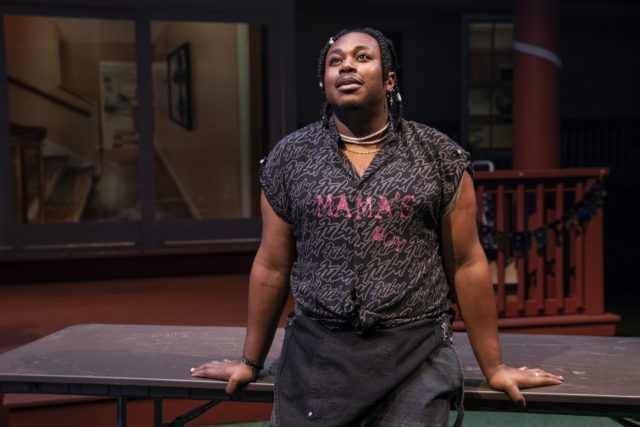
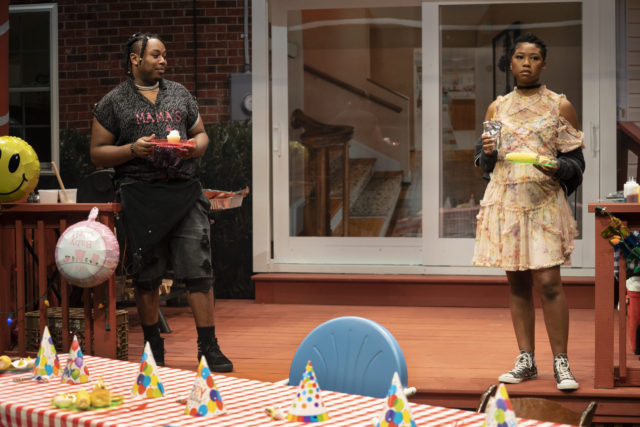
At its core, the story echoes the original. Juicy’s father, the king (Claudius; Jones), has been murdered by his brother, Rev, who then married his brother’s widow, Tedra (Gertrude; Tony nominee Nikki Crawford). Juicy hangs out with his best friend, Tio (Horatio; Chris Herbie Holland). Everyone assumes that Juicy is destined to wed his supposed true love, Opal (Ophelia; Adrianna Mitchell). Her very protective brother, Larry (Laertes; Calvin Leon Smith), is in the military and suffers from PTSD. Tedra’s best friend, Rabby (Polonius; Benja Kay Thomas), Larry and Opal’s mother, loves drinking and celebrating the Lord.

The play opens with Juicy on the back porch of a suburban home helping prepare for a barbecue party for Rev and Tedra’s bethrothal as Tio watches porn on his phone. “Your daddy ain’t been dead a week and he already Stanley steamering your mom. Cold,” Tio says. “Stanley steamering your mom . . . ,” Juicy quizzically repeats. Tio clarifies, “Eating your momma’s box? Doing the nasty with your mom? That better?” This is not your grandparents’ Hamlet.

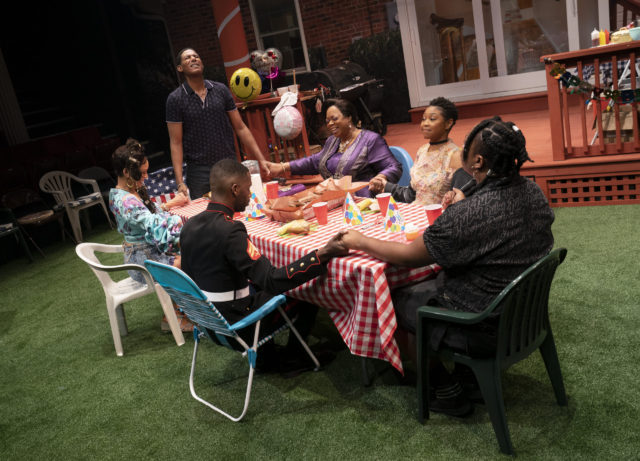
Rev (Billy Eugene Jones) leads a prayer before family and friends partake of barbecue in Fat Ham (photo by Joan Marcus)

A few minutes later, Juicy is visited by the ghost of his father, Pap, dressed in white, eerie smoke drifting around his neck and shoulders. Pap wants his son to avenge his death — and to stop eating candy bars unless he wants to get “the suga,” which runs in the family. Pap orders Juicy to split Rev open: “Make his thighs into hams. His intestines into chitlins. Pickle his feet and boil his head down to a skull! Crisp up his belly and dry out his balls and grind them up into a fine powder. Lay that all out on the table, invite over your nearest and dearest, and feast. And then make me a plate.” Pap also belittles his son’s education choices, studying human resources at the University of Phoenix. “Scam. Who goes to college online to learn how to manage human beings. Them things don’t go,” he scolds.

The potential relationship between Juicy and Opal has a bit of a problem that only the two of them are aware of: They are both gay. Meanwhile, Larry has a dark secret of his own. But the party goes on, as Rev sings Teena Marie and Juicy warbles Radiohead’s “Creep,” a kind of replacement for the “To be or not to be” soliloquy: “I don’t care if it hurts / I wanna have control / I want a perfect body / I want a perfect soul / I want you to notice / When I’m not around / So fuckin’ special / I wish I was special / But I’m a creep / I’m a weirdo / What the hell am I doin’ here? / I don’t belong here.” The lyrics represent what so many young queer Black men experience, not wanting to be made to feel invisible and less than.

Juicy uses charades to tell his uncle he knows what he did: “The play’s the thing / Wherein I’ll catch the conscience of . . . the . . . King. Preacher. He is a preacher in this play,” he tells the audience. The game is on as Rev and Juicy battle it out.

Fat Ham is outrageously funny, featuring superb over-the-top performances by the ensemble. Spears (Othello, A Midsummer Night’s Dream) has a tender gentleness, a softness, to his every move; dressed in all black (the contemporary costumes are by Dominique Fawn Hill), he would fit right in as Usher in Michael R. Jackson’s A Strange Loop, another “big Black queer” character with a complicated relationship with his family and other people who’s trying to figure out just who he is and what he wants out of life. Human resources is probably not Juicy’s best career path. Perhaps Ijames named him after the Notorious B.I.G. song “Juicy,” in which Biggie Smalls declares, “You know very well / Who you are / Don’t let ’em hold you down / Reach for the stars / You had a goal / But not that many / ’Cause you’re the only one / I’ll give you good and plenty.”
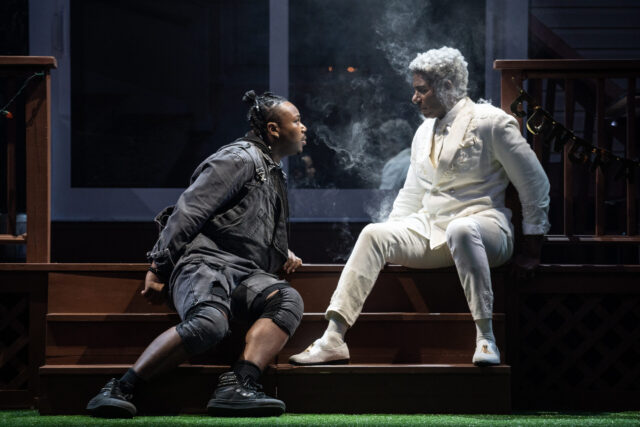
Juicy’s (Marcel Spears) father (Billy Eugene Jones) is smokin’ in Fat Ham (photo by Joan Marcus)

Ijames (White, Kill Move Paradise) interjects Shakespeare at just the right moments, as when, after Larry and Juicy share an intimate moment, the latter turns to the audience and delivers one of the Bard’s masterpieces, the poetic speech that begins “What a piece of work is a man!” But Ijames keenly changes one pronoun, and the meaning of the prose is altered following the scene we just watched,

Stacey Derosier’s lighting keeps things bright and cheery, as does Darrell Grand Moultrie’s choreography on Maruti Evans’s backyard set. Director Saheem Ali (Nollywood Dreams, Merry Wives) ably balances the wackiness with the serious nature of so much of Ijames’s dialogue alongside whimsical references to Ms. Cleo, OnlyFans, and sexy muppets. But it’s not all lighthearted fun.

At one point, Tio, talking about what he is learning from his therapist, explains to Juicy, “He said . . . These cycles of violence are like deep. Engrained. Hell, engineered. Hard to come out of. Like, your Pop went to jail, his Pop went to jail, his Pop went to jail, his Pop went to jail, and what’s before that? Huh? Slavery. It’s inherited trauma. You carrying around your whole family’s trauma, man. And that’s okay. You okay. But you don’t got to let it define you.”

Juicy is determined not to follow in his father’s footsteps, trying to overcome the systemic institutional racism that dooms so many Black men and tears apart families. That’s not exactly the same thing as the handing down of the crown from generation to generation of white men and boys — but it has the potential to become the half-million-dollar crown Biggie was famous for wearing.
FAT HAM

Marcel Spears stars as a different kind of Hamlet in James Ijames’s Pulitzer-winning Fat Ham (photo by Joan Marcus)

FAT HAM
Anspacher Theater, the Public Theater
425 Lafayette St. at Astor Pl.
Tuesday through Sunday through July 31, $50-$80
212-539-8500
publictheater.org

There’s no “To be or not to be” in James Ijames’s rousing, spirited adaptation of one of William Shakespeare’s most famous tragedies, Hamlet. In the Pulitzer Prize–winning Fat Ham, continuing at the Public’s Anspacher Theater through July 31, there’s no “To thine own self be true,” no “There are more things in Heaven and Earth, Horatio,” no “Good-night, sweet prince,” no “Something is rotten in the state of Denmark.” But to give you the tasty flavor of Ijames’s big queer Black take on the familiar tale, his Hamlet, known as Juicy (Marcel Spears), says, “Ah, there’s the rub” only after Rev (Billy Eugene Jones) shares the secret to smoking pork.

The ninety-five-minute show, coproduced by the National Black Theatre and the Public, takes place in the backyard of, according to the script, “a house in North Carolina. Could also be Virginia, or Maryland or Tennessee. It is not Mississippi, or Alabama or Florida. That’s a different thing all together.” The time is “a kind of liminal space between the past and the present with an aspirational relationship to the future that is contingent to your history living in the south. All that to say . . . I’m writing this play from inside the second decade of the twenty-first century. This world aesthetically sits anywhere in the four to six decades preceding the current moment.”

At its core, the story echoes the original. Juicy’s father, the king (Claudius; Jones), has been murdered by his brother, Rev, who then married his brother’s widow, Tedra (Gertrude; Nikki Crawford). Juicy hangs out with his best friend, Tio (Horatio; Chris Herbie Holland). Everyone assumes that Juicy is destined to wed his supposed true love, Opal (Ophelia; Adrianna Mitchell). Her very protective brother, Larry (Laertes; Calvin Leon Smith), is in the military and suffers from PTSD. Tedra’s best friend, Rabby (Polonius; Benja Kay Thomas), Larry and Opal’s mother, loves drinking and celebrating the Lord.

The play opens with Juicy on the back porch of a suburban home helping prepare for a barbecue party for Rev and Tedra’s bethrothal as Tio watches porn on his phone. “Your daddy ain’t been dead a week and he already Stanley steamering your mom. Cold,” Tio says. “Stanley steamering your mom . . . ,” Juicy quizzically repeats. Tio clarifies, “Eating your momma’s box? Doing the nasty with your mom? That better?” This is not your grandparents’ Hamlet.

Rev (Billy Eugene Jones) leads a prayer before family and friends partake of barbecue in Fat Ham (photo by Joan Marcus)

A few minutes later, Juicy is visited by the ghost of his father, Pap, dressed in white, eerie smoke drifting around his neck and shoulders. Pap wants his son to avenge his death — and to stop eating candy bars unless he wants to get “the suga,” which runs in the family. Pap orders Juicy to split Rev open: “Make his thighs into hams. His intestines into chitlins. Pickle his feet and boil his head down to a skull! Crisp up his belly and dry out his balls and grind them up into a fine powder. Lay that all out on the table, invite over your nearest and dearest, and feast. And then make me a plate.” Pap also belittles his son’s education choices, studying human resources at the University of Phoenix. “Scam. Who goes to college online to learn how to manage human beings. Them things don’t go,” he scolds.

The potential relationship between Juicy and Opal has a bit of a problem that only the two of them are aware of: They are both gay. Meanwhile, Larry has a dark secret of his own. But the party goes on, as Rev sings Teena Marie and Juicy warbles Radiohead’s “Creep,” a kind of replacement for the “To be or not to be” soliloquy: “I don’t care if it hurts / I wanna have control / I want a perfect body / I want a perfect soul / I want you to notice / When I’m not around / So fuckin’ special / I wish I was special / But I’m a creep / I’m a weirdo / What the hell am I doin’ here? / I don’t belong here.” The lyrics represent what so many young queer Black men experience, not wanting to be made to feel invisible and less than.

Juicy uses charades to tell his uncle he knows what he did: “The play’s the thing / Wherein I’ll catch the conscience of . . . the . . . King. Cook. He is a cook in this play,” he tells the audience. The game is on as Rev and Juicy battle it out.

Juicy (Marcel Spears) and Opal (Adrianna Mitchell) are not destined to fall in love in reimagining of Shakespeare’s Hamlet (photo by Joan Marcus)

Fat Ham is outrageously funny, featuring superb over-the-top performances by the ensemble. Spears (Othello, A Midsummer Night’s Dream) has a tender gentleness, a softness, to his every move; dressed in all black (the contemporary costumes are by Dominique Fawn Hill), he would fit right in as Usher in Michael R. Jackson’s A Strange Loop, another “big Black queer” character with a complicated relationship with his family and other people who’s trying to figure out just who he is and what he wants out of life. Human resources is probably not Juicy’s best career path. Perhaps Ijames named him after the Notorious B.I.G. song “Juicy,” in which Biggie Smalls declares, “You know very well / Who you are / Don’t let ’em hold you down / Reach for the stars / You had a goal / But not that many / ’Cause you’re the only one / I’ll give you good and plenty.”

Ijames (White, Kill Move Paradise) interjects Shakespeare at just the right moments, as when, after Larry and Juicy share an intimate moment, the latter turns to the audience and delivers one of the Bard’s masterpieces, the poetic speech that begins “What a piece of work is a man!” But Ijames keenly changes one pronoun, and the meaning of the prose is altered following the scene we just watched,

Stacey Derosier’s lighting keeps things bright and cheery, as does Darrell Grand Moultrie’s choreography on Maruti Evans’s backyard set. Director Saheem Ali (Nollywood Dreams, Merry Wives) ably balances the wackiness with the serious nature of so much of Ijames’s dialogue alongside whimsical references to Ms. Cleo, OnlyFans, and sexy muppets. But it’s not all lighthearted fun.

At one point, Tio, talking about what he is learning from his therapist, explains to Juicy, “He said . . . These cycles of violence are like deep. Engrained. Hell, engineered. Hard to come out of. Like, your Pop went to jail, his Pop went to jail, his Pop went to jail, his Pop went to jail, and what’s before that? Huh? Slavery. It’s inherited trauma. You carrying around your whole family’s trauma, man. And that’s okay. You okay. But you don’t got to let it define you.”

Juicy is determined not to follow in his father’s footsteps, trying to overcome the systemic institutional racism that dooms so many Black men and tears apart families. That’s not exactly the same thing as the handing down of the crown from generation to generation of white men and boys —but it has the potential to become the half-million-dollar crown Biggie was famous for wearing.
HALFWAY BITCHES GO STRAIGHT TO HEAVEN

(photo © Monique Carboni)

Stephen Adly Guirgis’s Halfway Bitches Go Straight to Heaven features another large cast of well-drawn characters (photo © Monique Carboni)

Atlantic Theater Company
Linda Gross Theater
336 West 20th St. between Eighth & Ninth Aves.
Tuesday – Sunday through December 29, $81.50
866-811-4111
atlantictheater.org

New York City native Stephen Adly Guirgis has spent much of his career creating wickedly funny, socially relevant plays set in minority communities where the underrepresented, the underserved, and the marginalized confront religion, law enforcement, poverty, racism, systemic institutions, and family dynamics as they battle against a system set up to keep them down. Most of his plays, including Our Lady of 121st Street, In Arabia, We’d All Be Kings, and The Little Flower of East Orange, feature large ensembles that form tight-knit communities onstage. Such is the case with Guirgis’s return to the Atlantic, where his Pulitzer Prize-winning play, Between Riverside and Crazy, debuted in 2014, with the world premiere of the fiendishly hilarious and hard-hitting Halfway Bitches Go Straight to Heaven, which opened last night at the Linda Gross Theater.

(photo © Monique Carboni)

A woman’s residence is the setting for new play by Pulitzer Prize winner Stephen Adly Guirgis (photo © Monique Carboni)

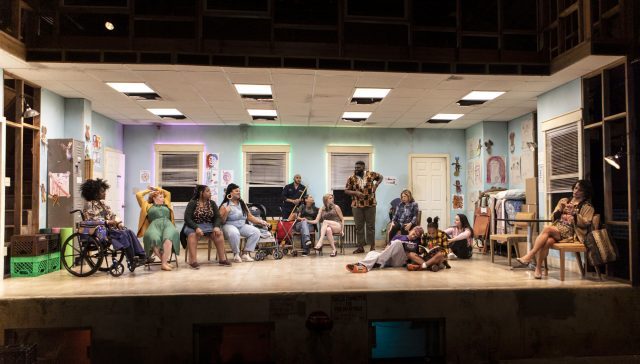
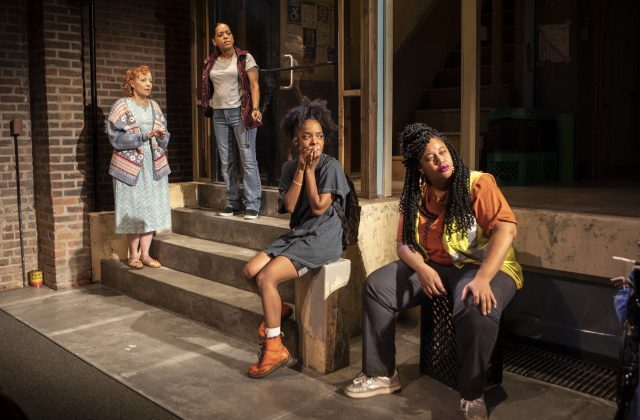
The three-hour LAByrinth Theater coproduction, which flies by with one intermission, takes place in Hope House, a government-funded women’s residence for addicts, the abused, the mentally ill, and survivors of domestic violence. It is run by the strict, serious Miss Rivera (Elizabeth Rodriguez) and Nigerian social worker Mr. Mobo (Neil Tyrone Pritchard). Among those who find shelter at the home are the tough-talking Sarge (Liza Colón-Zayas); her single-mother girlfriend, Bella (Andrea Syglowski); teenage poet Little Melba Diaz (Kara Young); the foul-smelling Betty Woods (Kristina Poe); ex-con Queen Sugar (Benja Kay Thomas) and her bestie, Munchies (Pernell Walker); the lonely, alcoholic Rockaway Rosie (Elizabeth Canavan); the wheelchair-bound rule-breaker Wanda Wheels (Patrice Johnson Chevannes); the trans Venus Ramirez (Esteban Andres Cruz); and the twentysomething Taina (Viviana Valeria), who takes care of her mentally ill mother, Happy Meal Sonia (Wilemina Olivia-Garcia). Also on the staff are eager white millennial social worker Jennifer (Molly Collier); ex-con janitor Joey Fresco (Victor Almanzar); and Father Miguel (David Anzuelo), who has a dark secret in his past. Seventeen-year-old Mateo (Sean Carvajal), whose mother is staying at the home, often helps out, allowed to hang around as the women share their often very private concerns about their troubled lives.

Narelle Sissons’s bilevel set consists of the main gathering room, a stoop, an outdoor bench, a dark alley, a balcony, and a concrete front space where the residents gossip and drink and smoke in defiance of the regulations. LAByrinth artistic director John Ortiz (Guinea Pig Solo, Jack Goes Boating) infuses the proceedings with tremendous vitality as Guirgis’s well-developed characters fight for survival. Taina has a chance to go back to school but is terrified of leaving her mother. Venus insists on staying even though several residents cruelly reject her claim to female identity, accusing her of unfairly invading their safe space. Father Miguel jostles with a man (Greg Keller) who demands to see his wife, who has a restraining order against him. Miss Rivera isn’t sure that Jennifer has what it takes to deal with the residents, who can be harsh and unforgiving. Wanda Wheels seems determined to drink herself to death. And at the center of it all is Sarge, superbly played by Guirgis regular and Tony nominee Rodriguez (Orange Is the New Black, The Motherf**ker with the Hat). A veteran with PTSD, Sarge is fierce and unrelenting, quick to brutally insult people, especially Venus and Betty, but she sometimes lets her more tender and loving side show through. She tells Bella, “I commanded a platoon. I survived combat. Kept my people safe. Took care of the villagers as much as I could. I looked death in the eye — twice — and I didn’t flinch. I can do this, Bella. I can do this with you. If you let me.” Sarge approaches her life like she’s embroiled in a never-ending war, which is true of many of the women living there.

(photo © Monique Carboni)

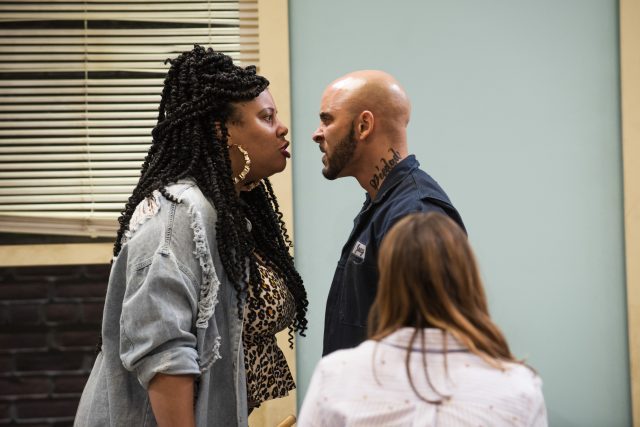
Ex-cons Queen Sugar (Benja Kay Thomas) and Joey Fresco (Victor Almanzar) face off in Halfway Bitches Go Straight to Heaven (photo © Monique Carboni)

The title comes from a poem Little Melba Diaz reads that sums up much of what the play is about, the difficulties and challenges these women can’t break free from: “Halfway Bitches go straight to Heaven / I ex-caped foster care and met a boy named Kevin / He was the apple of my eye but nigga turned into a lemon . . . No money in my pocket, I was feeling kinda low. . . . Words are turds and rhymes are crimes / Memories mere summaries, / Though I might some day share some of these,” she declares. Despite getting a little syrupy as it winds down, Halfway Bitches Go Straight to Heaven is another deeply affecting, honest, and gutsy work that lays bare the lives of too many women who rightfully doubt there’s any light at the end of the tunnel for them.

UNSPEAKABLE: A DRAMATIC FANTASIA

UNSPEAKABLE

UNSPEAKABLE looks at the tumultuous life and career of comedian Richard Pryor

Apollo Theater Soundstage
253 West 125th St.
November 1-3, $20
800-745-3000
www.apollotheater.org
www.facebook.com

One of the most influential and controversial comics of his generation, Richard Pryor was not afraid to take on difficult issues of race and class in his brilliant stand-up routines. Born in Peoria, Illinois, in 1940, Pryor made such films as Richard Pryor: Live on the Sunset Strip, Blue Collar, and Silver Streak and such records as That N*gger’s Crazy and Outrageous, quickly earning a reputation for someone who says exactly what’s on his mind. Earlier this year, Marina Zenovich’s documentary Richard Pryor: Omit the Logic played at the Tribeca Film Festival and on Showtime, and now comes Unspeakable: A Dramatic Fantasia, a stage show inspired by Pryor’s tumultuous life, which ended in 2005 at the age of sixty-five. Written by Rod Gailes OBC and James Murray Jackson, Jr., Unspeakable is a work in development that explores Pryor’s life from childhood to death, focusing on the era between 1967 and 1982. Jackson, Jr., who was named Outstanding Lead Actor for playing the role in a 2005 version at the New York International Fringe Festival, is reprising the part this weekend at the Apollo, with Gailes OBC directing. The cast also includes Benja Kay Thomas, Margot White, Alvin Keith, Nedra McClyde, Adam Couperthwaite, and Nyahale A. Allie. “Richard Pryor broke down barriers, and stereotypes once thought unimaginable, said the unspeakable and did the unthinkable,” Gailes OBC said in a statement. “He taught us by holding a mirror to the conscience of America while self-destructing, and imploding on his own pain and grief. Though flawed in life, he lived uninhibited onstage. He was part preacher, social commentator, political activist, addict, and a whole lot of devil.” Unspeakable runs November 1-3 at the Apollo Theater’s Soundstage; tickets are $20.