Tag Archives: bam harvey theater

THE CARETAKER

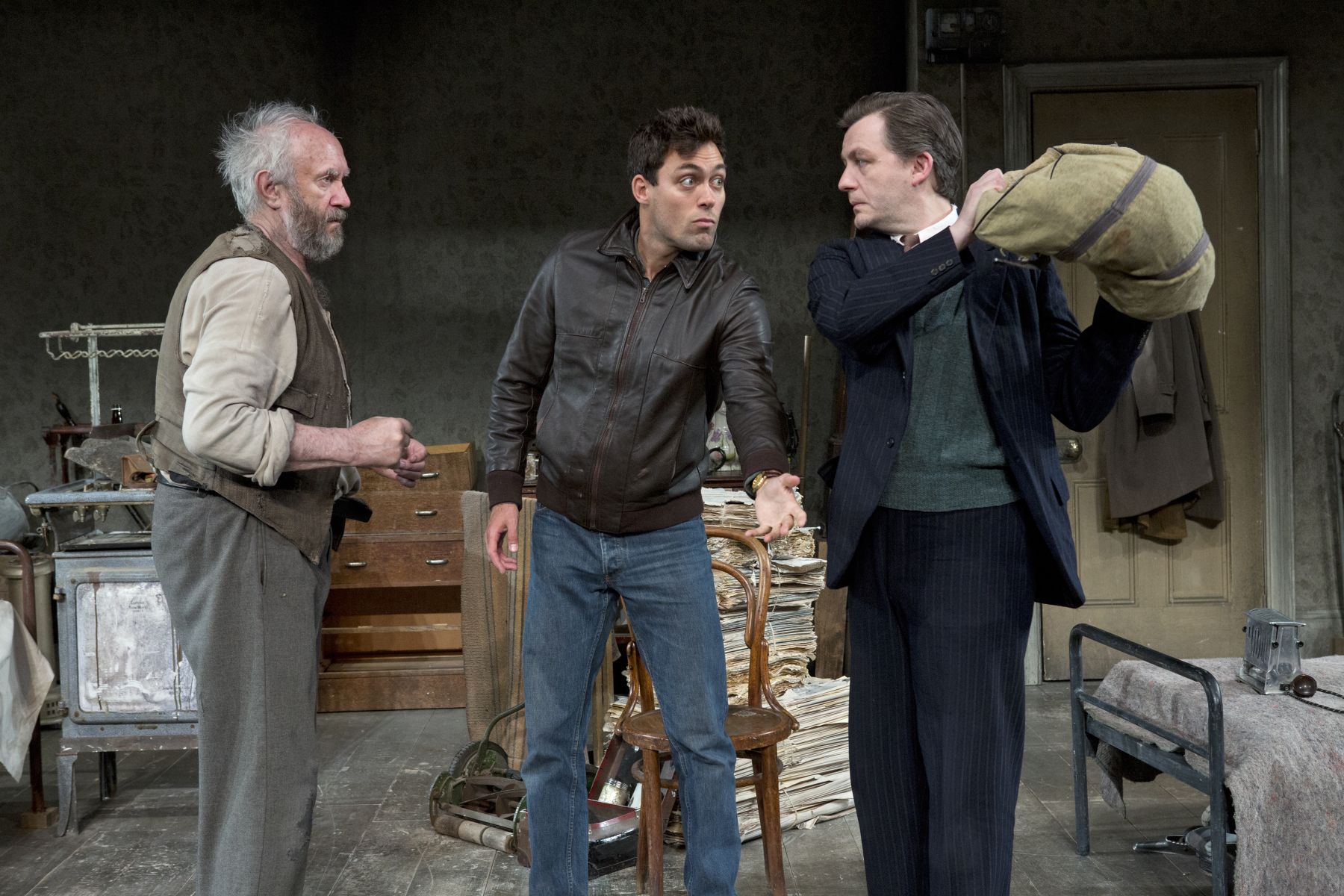
Jonathan Pryce, Alex Hassell, and Alan Cox star in THE CARETAKER at BAM (photo by Richard Termine)

Brooklyn Academy of Music
BAM Harvey Theater
651 Fulton St. between Ashland & Rockwell Pl.
Through June 17, $25-$100
718-636-4100
www.bam.org

Jonathan Pryce gives a whirlwind tour-de-force performance in the latest revival of Harold Pinter’s The Caretaker, running at BAM’s Harvey Theater through June 17. In the Liverpool Everyman and Playhouse/Theatre Royal Bath production, Pryce (Miss Saigon, Comedians) stars as the tramp Davies, a homeless man in tatters who is just looking for a good pair of shoes and a place to rest his weary bones. He is offered both by Aston (Alan Cox), a friendly sort of chap Davies met in a pub who takes Davies to his apartment, a ramshackle space overloaded with dusty, moldy black-and-white and gray objects, the only color a brightly painted ceramic Buddha. Davies is soon being harassed by a strange man who turns out to be Aston’s younger brother, Mick (Alex Hassell), who enjoys teasing the elderly Davies. Over the course of several weeks, the trio engages in existential philosophical discussions à la Beckett’s Waiting for Godot, speaking about nothing and everything as both brothers separately ask him to serve as the apartment building’s caretaker, leading to confusion over who’s really in charge. Meanwhile, Davies keeps talking about having to get to Sidcup to reclaim his identity papers, as his real name is not actually Davies. Directed by Christopher Morahan, The Caretaker is worth seeing just for Pryce’s extraordinary performance as the title character, an endearingly eccentric figure who likes things his own extremely particular way. The first half is filled with eclectic humor and slapstick, but the second half gets bogged down in repetition and plot twists that come out of left field, not really going anywhere ― even though that’s part of the point. “I can take nothing you say at face value,” Mick says to Davies. “Every word you speak is open to any number of different interpretations.” And so it is with the play and Pinter himself. The Caretaker was his breakthrough, premiering in London in 1960 with Donald Pleasence as Davies, Alan Bates as Mick, and Peter Woodthorpe as Aston; Robert Shaw took over the role of Aston on Broadway and in Clive Donner’s 1963 film. Pryce will participate in an Artist Talk following the May 24 performance, speaking with Pinter scholar Austin E. Quigley.
BEING SHAKESPEARE

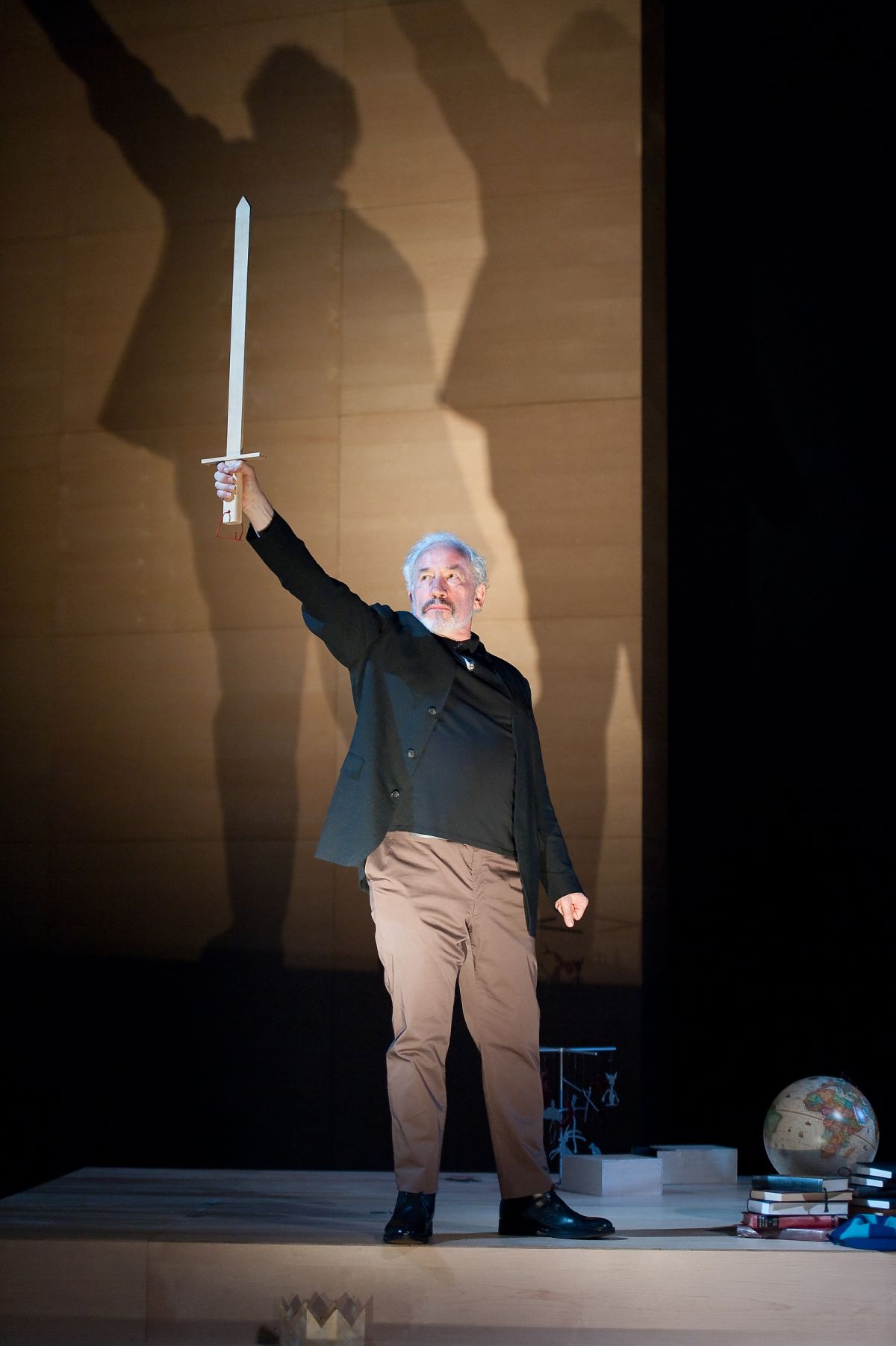
Simon Callow goes through the seven stages of Shakespeare in one-man show (photo by Stephanie Berger)

Brooklyn Academy of Music
BAM Harvey Theater
651 Fulton St. between Ashland & Rockwell Pl.
Through April 14, $25-$100
718-636-4100
www.bam.org

Obsessed with William Shakespeare since he was six years old, British actor Simon Callow, now sixty-two, is currently at BAM playing Hermione and Leontes from The Winter’s Tale, Mark Antony and Caesar from Julius Caesar, Jaques, Orlando, and Rosalind from As You Like It, Antipholus from The Comedy of Errors, Falstaff and Prince Henry from Henry IV, Prospero and Miranda from The Tempest, Quince, Flute, Bottom, and Puck from A Midsummer Night’s Dream, Kings Henry V, Richard II, and Lear (as well as Queen Margaret), both Romeo and Juliet, Macbeth, Old Hamlet, and even Shakespeare himself. And he does all that and more in a mere hour and a half in the one-man show Being Shakespeare, written by Bard scholar and Oxford English literature professor Jonathan Bate and directed and designed by Tom Cairns. Built around Jaques’s seven stages of man monologue from As You Like It — “All the world’s a stage / And all the men and women merely players / They have their exits and their entrances / And one man in his time plays many parts / His acts being seven ages” — Being Shakespeare follows the Bard from birth to death, with Callow (Shakespeare in Love, Four Weddings and a Funeral) discussing various aspects of Shakespeare’s personal life, about which precious little is known, and relating them to specific lines and characters from his plays and sonnets. Although there are a handful of Eureka! moments, there are also a lot of comparisons that are too much of a stretch, supposition instead of fact. Bate does include fascinating tidbits about Shakespeare’s sisters, working in his father’s glove-making shop, dealing with lawyers, and marrying the pregnant Anne Hathaway, but the show often feels more like a historical literary lecture than a dramatic play — and, of course, as Hamlet famously intoned, “The play’s the thing.” Callow does a magnificent job at some points, particularly his marvelously entertaining handling of an exchange between Falstaff and Prince Henry about preparing an army unit and the scene in which Peter Quince is casting Pyramus and Thisbe in Dream, but other snippets lack depth and power, perhaps better in idea than in execution. Being Shakespeare might be a treat for Shakespeare fanatics and completists, but it will leave others wanting more. Callow will participate in a postshow talk moderated by Jeff Dolven on April 12, and Bate will be in conversation with Barry Edelstein on April 15 in the BAM Hillman Attic Studio.

’TIS PITY SHE’S A WHORE

Cheek by Jowl returns to BAM with its first non-Shakespeare Brooklyn production (photo by Manuel Harlan)

Brooklyn Academy of Music
BAM Harvey Theater
651 Fulton St. between Ashland & Rockwell Pl.
March 20-31, $25-$80
718-636-4100
www.bam.org

Founded in 1981 by Declan Donnellan and Nick Ormerod, British theater company Cheek by Jowl specializes in presenting unique takes on the classics, with a primary focus on the actors. The London-based troupe, which has previously been at BAM with As You Like It in 1994, Much Ado About Nothing in 1998,Othello in 2004, Cymbeline in 2007, and Macbeth in 2011, is back at the Harvey with John Ford’s controversial seventeenth-century tragedy, ’Tis Pity She’s a Whore. Directed by Donnellan and designed by Ormerod, the production stars Jack Gordon as Giovanni and Lydia Wilson as Annabella, wealthy siblings who are more than just a little bit too close. Romy Schneider and Alain Delon played the incestuous couple in a 1961 stage version at the Théâtre de Paris directed by Luchino Visconti, while Charlotte Rampling and Oliver Tobias inhabited the roles for Giuseppe Patroni Griffi’s 1971 film, Addio, fratello crudele. The play was even a major inspiration for Peter Greenaway’s 1989 cult classic, The Cook, the Thief, His Wife & Her Lover. So it should be fascinating to see what Cheek by Jowl, which was named after a line in Shakespeare’s A Midsummer Night’s Dream, does in its first non-Bard play in Brooklyn.

Update: As the audience enters the Harvey Theater — which, on the night we went, included namesake and former BAM president Harvey Lichtenstein himself — a young woman in a red hoodie is sitting on a red bed in the middle of the stage, playing with her laptop. On the back wall of her bedroom are movie posters for The Vampire Diaries, A Clockwork Orange, Breakfast at Tiffany’s, and Sweet Bird of Youth, hinting toward such things to come as innocence betrayed, dangerous sex, and a bit of the old ultraviolence, and come they do. The woman on the bed is Annabella (a delightful Lydia Wilson), a cheery sort whose father, Florio (David Collings), is preparing to marry her off to one of a string of well-dressed suitors who parade in front of her, but it turns out that she is most attracted to Giovanni (Jack Gordon), who just happens to be her older brother. After doing the dirty deed — depicted by director Declan Donnellan in a hot and heavy manner — all kinds of nastiness ensues, including scandal, treachery, lies, unwanted pregnancy, deception, more sex, and bloody murder. Cheek by Jowl’s streamlined version of John Ford’s controversial 1633 Jacobean drama is a lively, energetic production thumping with loud dance music and displaying a wry, ribald sense of humor. Although a few couples got up and left following the incest scene, everyone else stayed for the two-hour show — performed without intermission, which makes sense for this fast-paced production — only rising to their feet at the end, expressing their admiration by way of standing ovation.

KRAPP’S LAST TAPE

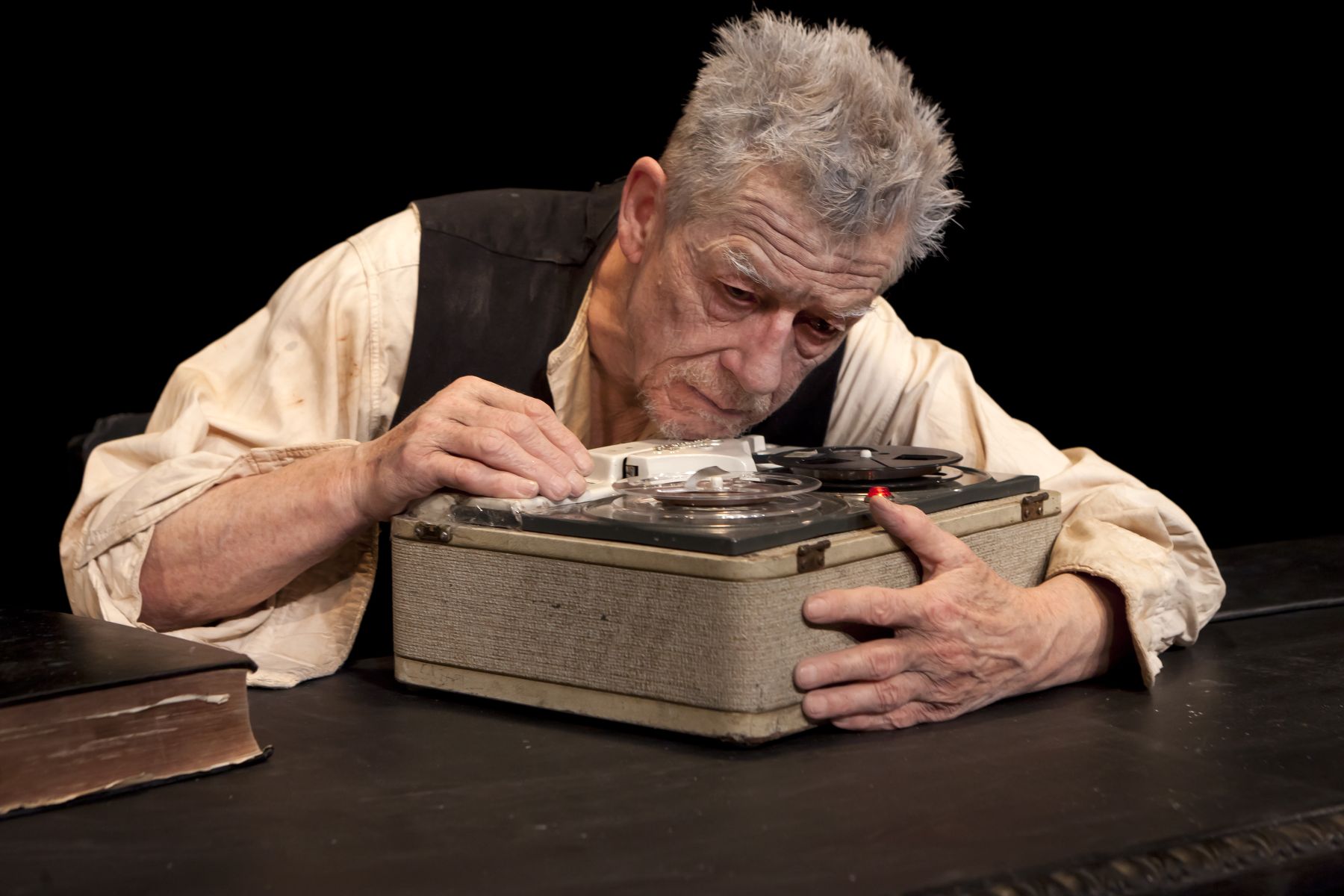
John Hurt listens to his past in KRAPP’S LAST TAPE, running at BAM through December 18 (photo by Richard Termine)

NEXT WAVE FESTIVAL
Brooklyn Academy of Music
BAM Harvey Theater
651 Fulton St. between Ashland & Rockwell Pl.
Through December 18, $25-$90
718-636-4100
www.bam.org

Originally written in 1958 for British actor Patrick Magee, Samuel Beckett’s autobiographical Krapp’s Last Tape is a haunting examination of time, memory, and the futility of language. Performed over the years by the likes of Magee, Harold Pinter, Brian Dennehy, and Michael Gambon, the fifty-five-minute one-act is perhaps most closely identified today with John Hurt, who first appeared in the play at Dublin’s Gate Theatre in 1999, starred in Atom Egoyan’s 2001 film version, and is now giving a bravura command performance at BAM through December 18. Making his New York stage debut, Hurt (Midnight Express, 10 Rillington Place) plays a failed writer named Krapp who, when first seen, is sitting at a table in silence, an old lamp dangling overhead. He says nothing for several minutes and then eventually gets up, walks around in squeaky white shoes, consumes two bananas, slips on a peel he dropped on the floor, and carefully approaches the darkness on either side of him, deciding not to venture out of the lighted area, as if something unknown and dangerous awaits outside his very private, solitary comfort zone. It is a critical moment in the play, establishing the precipice of life and death that Krapp is balancing on while also reminding the audience that this is a staged production. As he does every year on his birthday, Krapp listens to reel-to-reel recordings of messages he left on previous birthdays and makes a new one; in this case, the sixty-nine-year-old shabbily dressed man is looking for the tape he made on his thirty-ninth, which, according to his dusty old ledger, can be found in “box five, spool three.” Krapp takes delight in drawing out the word spool like he is a child. As he listens to his old self discuss the past, present, and future as he saw it thirty years before, he starts and stops the tape, remembering some moments that elicit strong emotions while clearly having no memory of others, the fractured narrative tantalizing and teasing the audience. “Thirty-nine today,” the recorded Krapp says. “Sound as a bell.” But alas, the sixty-nine-year-old Krapp is not sound as a bell, with little but death to look forward to.

Director Michael Colgan and lighting designer James McConnell have placed Krapp in a masterfully minimalist black-and-white world, surrounded by darkness, the only colors the yellow of the bananas and the green in Krapp’s description of a former love’s coat. Hurt, now seventy-one, is a less angry, more fragile and perhaps desperate Krapp than he portrayed in previous versions, cupping his ear tighter as he leans his head to hear the tape, shuffling to the back — through a minefield of his past, the boxes of tapes strewn across the floor — to steal a drink, staring straight ahead, wondering what happened to the ambitious youth he once was. (He even resembles Beckett himself this time around.) Krapp’s Last Tape is an extraordinarily complex work that delves deep into the human psyche, a challenge for both the actor and the audience, a play that will stay with you for a long time, eliciting thoughts of where you’ve been, who you are, and what awaits you in the future. Hurt will participate in a post-show artist talk on December 15; in addition, BAMcinématek will be highlighting four of the British actor’s best films in “John Hurt Quartet,” including The Elephant Man (David Lynch, 1980) on December 12, Scandal (Michael Caton-Jones, 1989) on December 13 (followed by a Q&A with Hurt), Love and Death on Long Island (Richard Kwietniowski, 1997) on December 14, and Nineteen Eighty-Four (Michael Radford, 1984) on December 15.

TONEELGROEP AMSTERDAM: CRIES AND WHISPERS

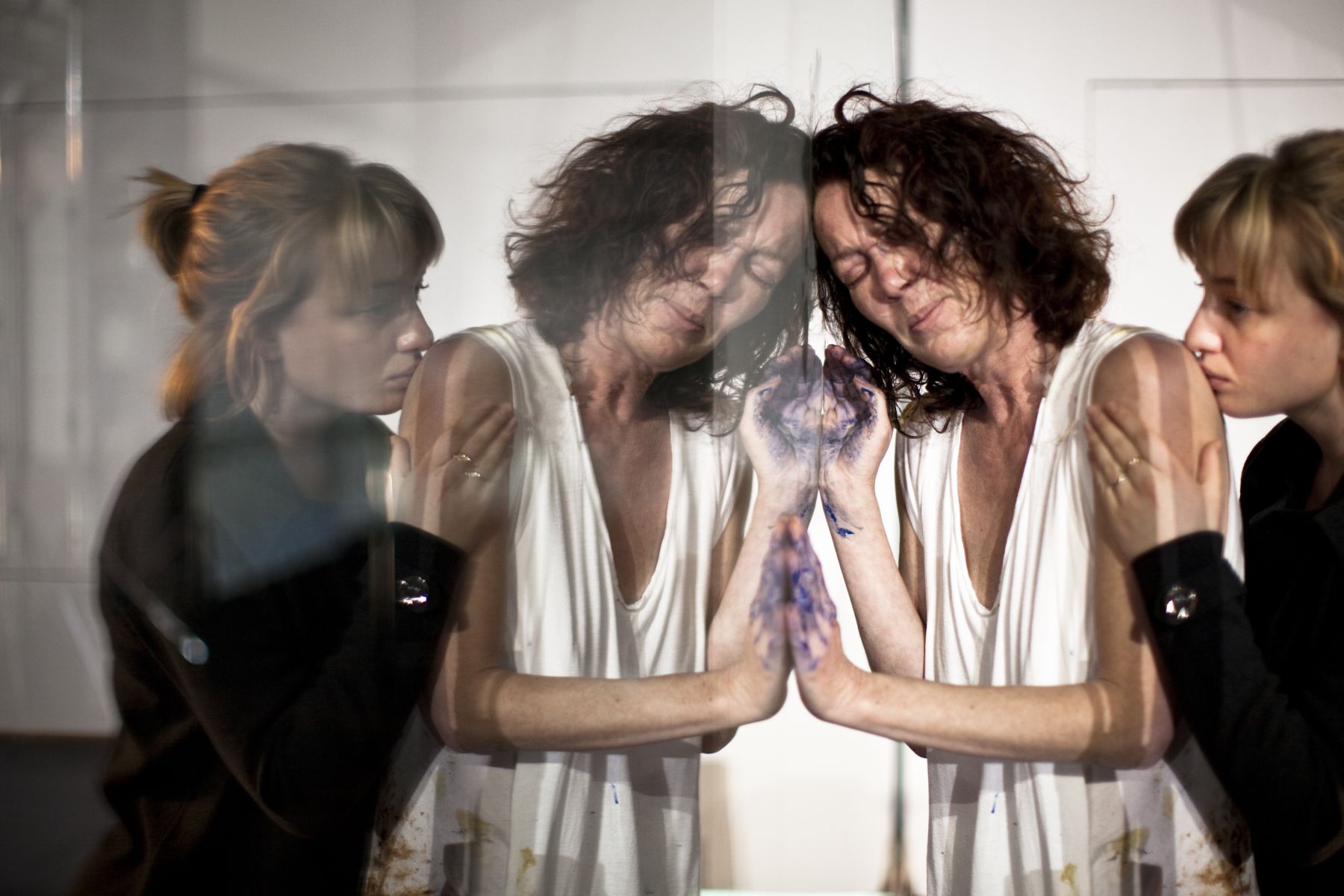
A brave artist’s impending death is the focus of multimedia stage adaptation of Ingmar Bergman’s CRIES AND WHISPERS at BAM (photo by Jan Versweyveld)

Brooklyn Academy of Music
BAM Harvey Theater
651 Fulton St. between Ashland & Rockwell Pl.
October 25-29, $25-$80, 7:30
718-636-4100
www.bam.org
www.tga.nl

The Brooklyn Academy of Music has had a long and fruitful relationship with Swedish director Ingmar Bergman, presenting his films as well as stage productions over the decades. Among the plays Bergman directed at BAM were A Doll’s House, Long Day’s Journey into Night, Miss Julie, The Ghost Sonata, Maria Stuart, and Ghosts, and shortly after his death BAM put together a stellar lineup of actors to read from his diary, including Bibi Andersson, Pernilla August, Lena Olin, and Peter Stormare. BAM and the late auteur continue their collaboration this week with the U.S. premiere of Toneelgroep Amsterdam multimedia adaptation of Bergman’s 1972 intense family drama Cries and Whispers, which starred Harriet Andersson, Kari Sylwan, Ingrid Thulin, and Liv Ullmann. The Dutch company, led by director Ivo van Hove, has previously adapted such cinematic gems as John Cassavetes’s Faces, Husbands, and Opening Night and Luchino Visconti’s Rocco and His Brothers and Ludwig in addition to classic works by Shakespeare, Molière, Williams, Hellman, O’Neill, Ibsen, Chekhov, Pinter, and others. Cries and Whispers features scenography by Jan Versweyveld, dramaturgy by Peter van Kraaij, video design by Tal Yarden, costumes by Wojciech Dziedzic, and sound design by Roeland Fernhout, all coming together for what looks to be an appropriately complex and moving experience.

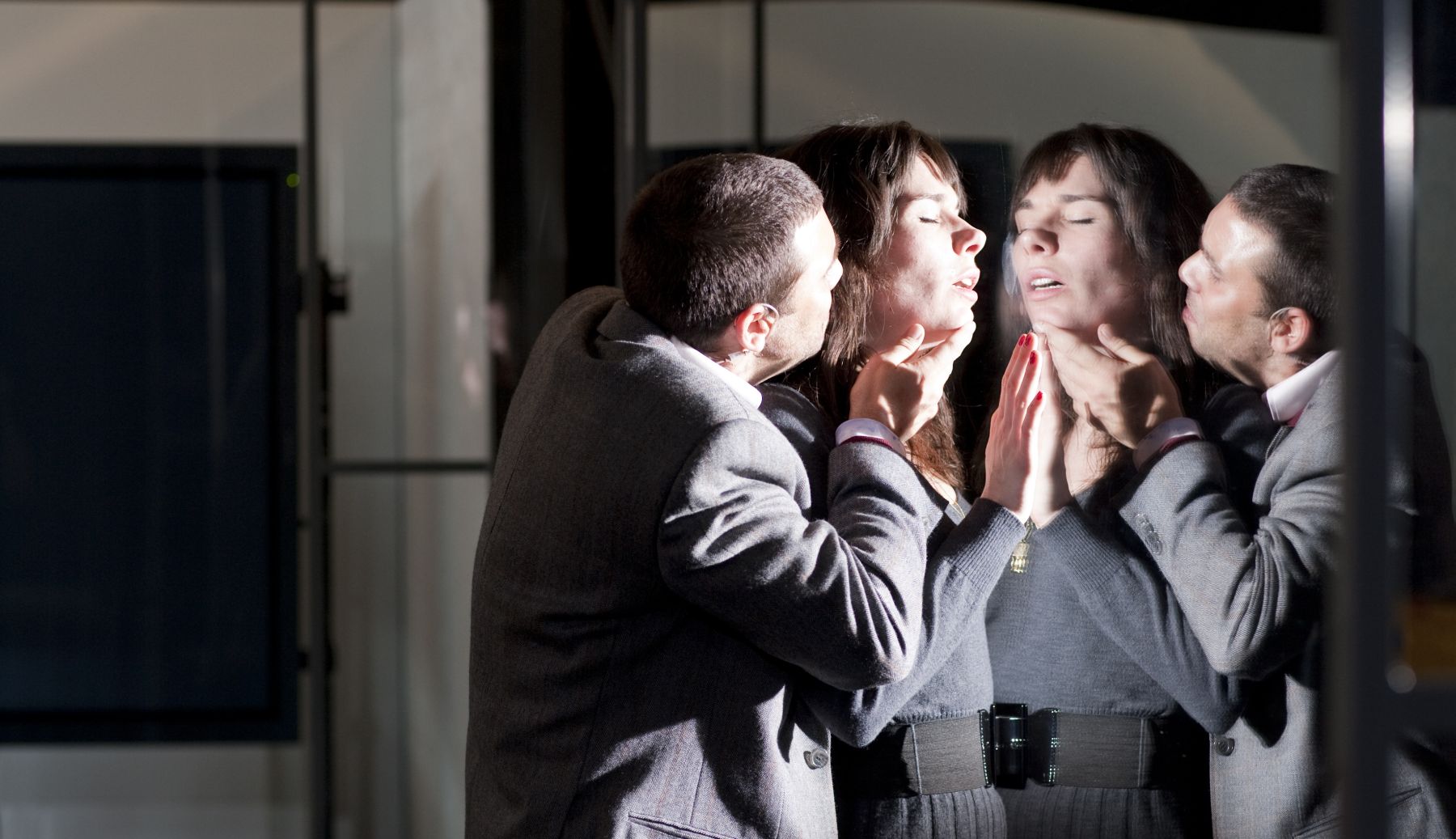
A family faces some harsh truths in CRIES AND WHISPERS (photo by Jan Versweyveld)

Update: Ivo van Hove paints a harrowing, brutal, yet ultimately strangely comforting portrayal of death in Toneelgroep Amsterdam’s intense and, at times, inexplicable Cries and Whispers, running at BAM’s Harvey Theater through October 29. Liberally adapted from Ingmar Bergman’s 1972 film — the company previously staged Bergman’s epic, documentary-like Scenes from a Marriage — this multimedia version turns the protagonist, Agnes (an immensely brave Chris Nietvelt), into a visual artist who is recording her final days, evoking Hannah Wilke’s “Intra-Venus” project. Jan Versweyveld’s stunning set contains mirrors, video screens, television monitors, a drop-down white surrounding wall, reflective glass, and multiple rooms in a mansion where Agnes is being cared for by her sisters, Karin (Janni Goslinga) and Maria (Helina Reijn), and her attending nurse, Anna (Karina Smulders). The pain Agnes feels is physically and emotionally palpable, echoing throughout the theater, especially when she releases an ear-piercing, shattering death howl as an overhead camera swings like a pendulum counting down her last breaths. The twelve silent minutes that follow are mesmerizing — and the show is still barely half over at that point. Although van Hove offers snippets of the other characters’ lives, not enough is learned about them, and there is a heavy dose of nudity, both male and female, that seems titillating but not always necessary. And some viewers might need a stronger stomach when Agnes takes care of some unpleasant bodily functions in plain view. Van Hove has added personal touches to the story, influenced by the death of his own father, who died in 2007, the same year as Bergman. The white color scheme is offset by Agnes’s blue paint and videos, providing a stark contrast that pays homage to Sven Nykvist, who won the Oscar for Best Cinematography for his camerawork on the film version. Van Hove recently told Gothamist that he’ll be back at BAM with an even bigger production for the 2012 Next Wave Festival; we can’t wait to see what he has up his sleeves for that.

BEIJING DANCE THEATER: HAZE

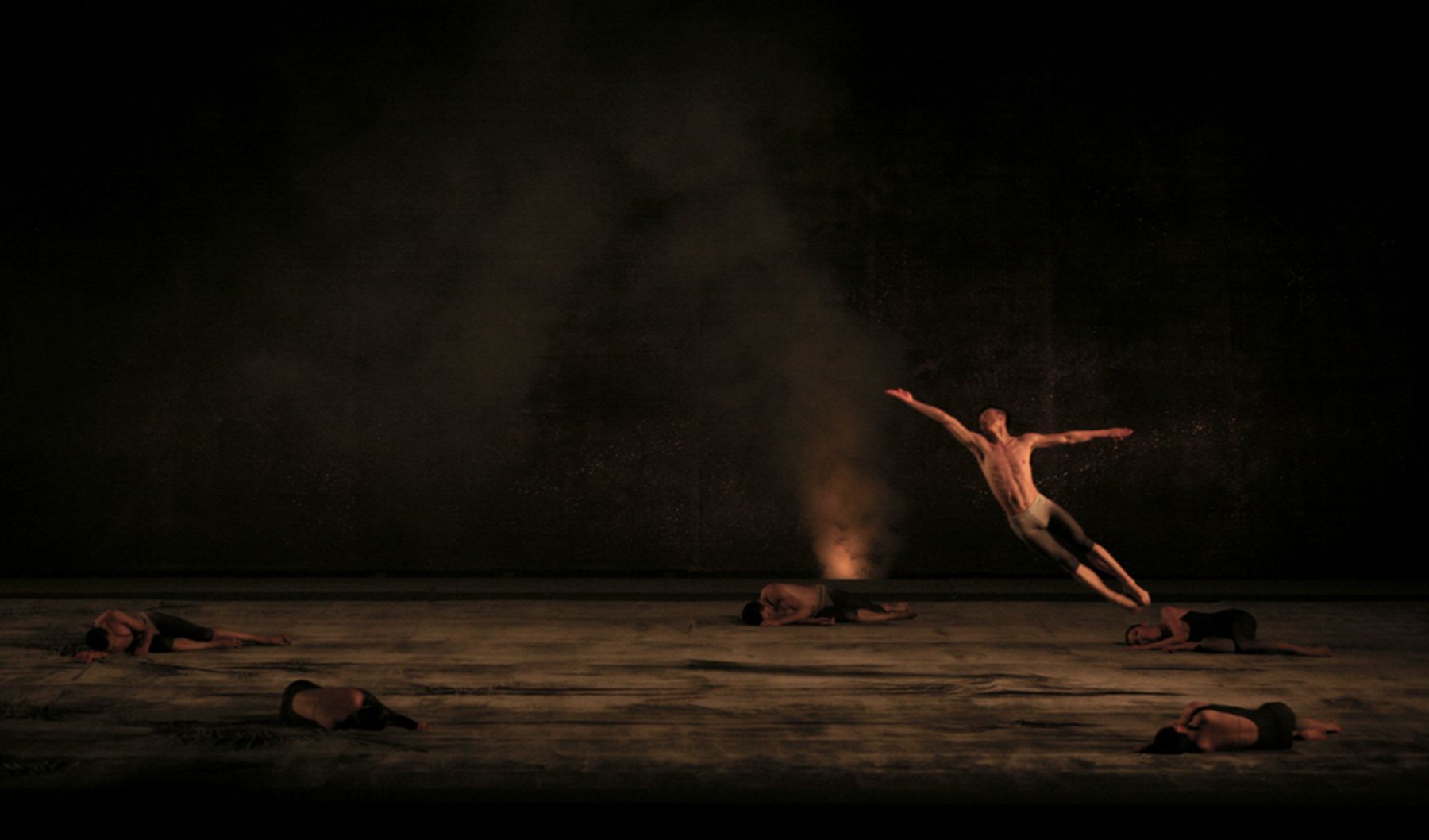
Beijing Dance Theater makes its U.S. debut at BAM’s Next Wave Festival with HAZE (photo by Tan Shaoyuan)

BAM Next Wave Festival
BAM Harvey Theater
651 Fulton St.
October 19-22, $16-$50, 7:30 (October 20 performance reviewed)
718-636-4100
www.bam.org

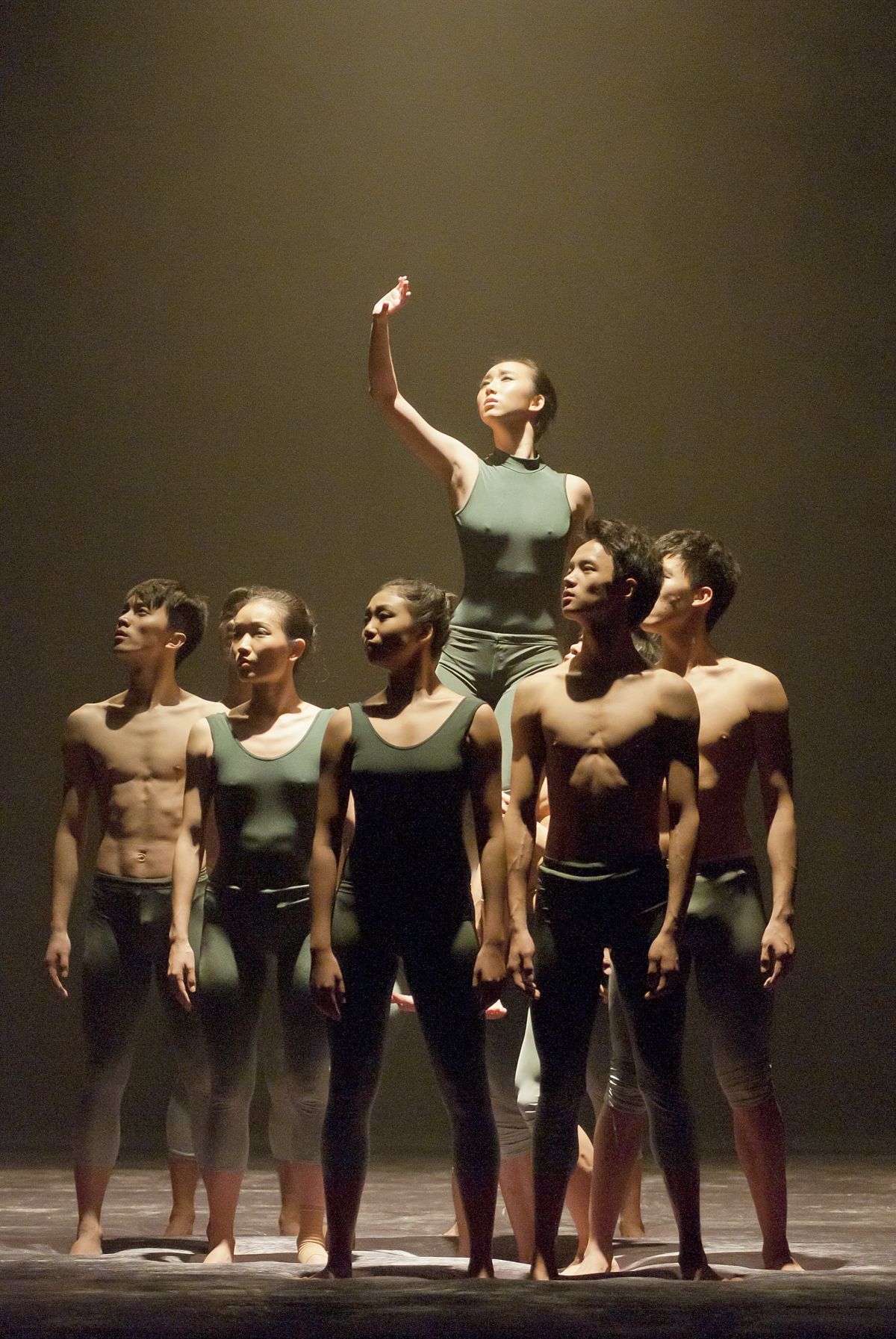
In October 2005, the BAM Next Wave Festival presented Zhang Yimou’s lush transformation of his 1991 film, Raise the Red Lantern, into a sumptuous ballet choreographed by Wang Xinpeng and Wang Yuanyuan. A former resident choreographer for the National Ballet of China who also participated in the opening ceremonies of the 2008 Beijing Olympics (with Zhang), Yuanyuan is now back at the Next Wave Festival with the U.S. premiere of Haze, performed by Beijing Dance Theater, which she began in December 2008 with lighting designer Han Jiang and set designer Tan Shaoyuan. BJD seeks to meld traditional ballet, Chinese folklore and history, and contemporary dance into a more modern experience. Running approximately seventy minutes, Haze is a piece for fourteen dancers, set to music by Henryk Górecki and Biosphere.

Dancers evoke Socialist imagery in Beijing Dance Theater’s HAZE at BAM (photo by Jack Vartoogian)

Update: Beijing Dance Theater made its U.S. debut with Haze, an often beautiful but repetitive and dispassionate abstract exploration of the current environmental and economic crises facing China. The production is set on a spongy surface that allows the company of seventeen dancers to jump, roll, and dive in unusual ways but also limits other type of more traditional movements; the result is that the performers are often slightly but noticeably out of sync. The soundtrack, by Henryk Górecki and Biosphere, primarily consists of overbearing, overly emotional electronic drones that hover over the dancers like a thick cloud, battling it out with a smoke machine that creates a constant haze. Choreographer Wang Yuanyuan has come up with some wonderfully creative moves, and watching the dancers’ feet submerge into the floor evokes a visceral feeling, adding a shared physicality between performer and audience. Wang has divided Haze into three sections, “Light,” “City,” and “Shore,” but never quite achieves the narrative flow she aspires to. Still, there is a lot to admire about Haze, which received a lengthy, rapturous standing ovation the night we attended.

JOHN GABRIEL BORKMAN

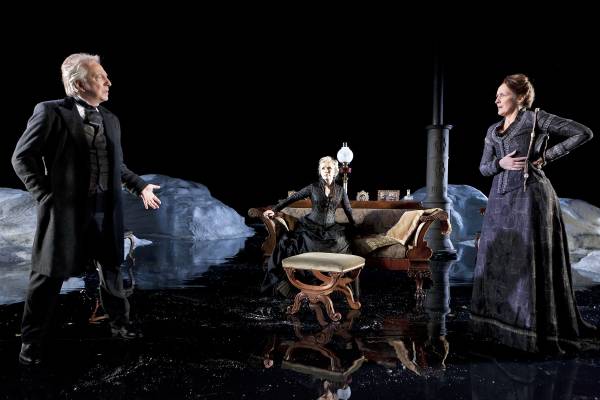
Alan Rickman, Lindsay Duncan, and Fiona Shaw head a stellar production of Ibsen’s JOHN GABRIEL BORKMAN at BAM (photo by Richard Termine)

Brooklyn Academy of Music
BAM Harvey Theater
651 Fulton St.
Through February 6, $25-$80
718-636-4100
www.bam.org

Written in 1896, Henrik Ibsen’s penultimate play, JOHN GABRIEL BORKMAN, feels as fresh and alive as if it were written yesterday. Frank McGuinness’s new English-language version, directed by James Macdonald and first presented at Dublin’s Abbey Theatre this past fall, is currently having its U.S. premiere at BAM’s Harvey Theater, in a splendid production running through February 6. Ibsen’s dark tale of greed, power, and cold, soulless hearts centers on a once-prominent family torn apart by scandal. John Gabriel Borkman (Alan Rickman) was a successful bank manager who ultimately got caught embezzling funds, serving five years in prison before returning home, where he has been pacing in his upstairs cave for eight more years, never seeing his destroyed wife, Gunhild (Fioan Shaw), or his now-grown son, Erhart (Marty Rea). While Borkman is determined to regain his position, refusing to admit his guilt, Gunhild is battling her twin sister, Ella Rentheim (Lindsay Duncan), over Erhart’s love; after Borkman’s arrest, Ella took in Erhart for six years as Gunhild tried to deal with the shame and suddenly having no money. Neither woman is happy that Erhart, in the meantime, has been spending more and more time with the older Fanny Wilton (Cathy Belton), a free-spirited woman whose husband recently left her. Over the course of one very long night, secrets are revealed in a series of dazzling scenes filled with fast-paced dialogue beautifully delivered by the outstanding cast. Set designer Tom Pye has surrounded the stage with large piles of snow, emphasizing the coldness that has taken over the main characters’ hearts. As Ella and Gunhild, both wearing long, mournful black dresses, give one another icy stares, they drag bits of snow into the middle of the sparse room, where chairs are set up by themselves, continuing the physical and psychological isolation, which is furthered by Borkman’s often vacant eyes. As Borkman speaks with his one friend, Vilhelm (John Kavanagh), and teaches piano to Vilhelm’s daughter, Frida (Amy Molloy), upstairs, the grandfather clock in the back can be heard ticking away, counting the seconds till Borkman’s ultimate destiny. Rickman, Duncan, and Shaw so embody their characters that on January 15, when a disturbance was going on in the right front corner of the audience, Rickman calmly announced, still in Borkman’s voice, that the play should be stopped because someone appeared to be ill. After several moments, the sick man was helped out of the theater, and Rickman and Duncan returned to the scene, picking up right where they left off, as if nothing had happened, their fiery passion as palpable as ever. Although McGuinness’s version was written in response to the economic crisis in Ireland, it is impossible not to think of such figures as Bernie Madoff as the Borkmans fight over their despised name, yet JOHN GABRIEL BORKMAN still winds up a timeless, masterful piece of theater. (An Artist Talk with Duncan, Rickman, and Shaw, moderated by Paul Holdengräber, will follow the January 16 performance [$15, 6:45.])