Tag Archives: alvin ailey

PARAMODERNITIES LIVE (with Q&As)

Who: Netta Yerushalmy
What: Dance series with performance and live discussion
Where: Netta Yerushalmy website
When: May 4-9, free, 3:00 (videos with Q&As will remain online through May 24)
Why: Last year, New York City-based choreographer and dancer Netta Yerushalmy presented her full six-part, four-hour series, Paramodernities, at New York Live Arts. Each work, which had been previously individually staged at such locations as Judson Church, the National Museum of the American Indian, Live Artery at New York Live Arts, the 92nd St. Y, and Madison Square Park, deconstructs and re-creates a classic dance piece through performance, text, and discussion, with dancers and scholars participating. I was fortunate to catch several iterations (#s 2&3, rehearsals for #5), which all proved to be captivating and involving; the choreographers who get the Yerushalmy treatment are Vaslav Nijinsky, Martha Graham, Merce Cunningham, Alvin Ailey, Bob Fosse, and George Balanchine. Every day from May 4 to 9 at 3:00, Yerushalmy will stream one work, followed by a live discussion and Q&A with special guests.

The wide-ranging, diverse cast consists of dancers Michael Blake, Gerald Casel, Marc Crousillat, Brittany Engel-Adams, Joyce Edwards, Stanley Gambucci, Taryn Griggs, Magdalena Jarkowiec, Nicholas Leichter, Jeremy Jae Neal, Hsiao-Jou Tang, Megan Williams, and Yerushalmy, with scholars and writers Thomas F. DeFrantz, Julia Foulkes, Georgina Kleege, David Kishik, Carol Ockman, Mara Mills, and Claudia La Rocco. “This project requires people to really care about different kinds of knowledge and to want to implicate their bodies in this very different kind of space and to be vulnerable,” Yerushalmy says about Paramodernities, which will be a new experience when viewed from our homes, where we are sheltering in place, unable to be physically together. I can’t recommend Paramodernities Live highly enough; it is an innovative platform that explores the past, present, and future of dance through a sophisticated and experimental historical context that will leave you in awe.

Monday, May 4
Paramodernities #1: The Work of Dance in the Age of Sacred Lives
A response to Vaslav Nijinsky’s Le Sacre du Printemps (1913)
with special guest Jack Halberstam

Tuesday, May 5
Paramodernities #2: Trauma, Interdiction, and Agency in “The House of Pelvic Truth”
A response to Martha Graham’s Night Journey (1947)
with special guest Pam Tanowitz

Wednesday, May 6
Paramodernities #3: Revelations: The Afterlives of Slavery
A response to Alvin Ailey’s Revelations (1960)
with special guest Tracy K. Smith

Thursday, May 7
Paramodernities #4: An Inter-Body Event
with material from Merce Cunningham’s Rainforest, Sounddance, Points in Space, Beach Birds, and Ocean (1968-90)
with special guest Fred Moten

Friday, May 8
Paramodernities #5: All That Spectacle: Dance on Stage and Screens
A response to Bob Fosse’s Sweet Charity (1969 film)
with special guest Jeremy O. Harris

Saturday, May 9
Paramodernities #6: The Choreography of Rehabilitation: Disability and Race in Balanchine’s Agon
A response to George Balanchine’s Agon (1957)
with special guest Peter N. Miller

CARMEN & GEOFFREY: A BIRTHDAY TRIBUTE TO CARMEN DE LAVALLADE

The life of Carmen de Lavallade and Geoffrey Holder is examined in low-budget documentary screening at Film Forum

CARMEN & GEOFFREY (Linda Atkinson & Nick Doob, 2006)
Film Forum
209 West Houston St.
Friday, March 6, 6:30
212-727-8110
filmforum.org
firstrunfeatures.com

Film Forum is celebrating the eighty-ninth birthday of the one and only Carmen de Lavallade with a special screening of Linda Atkinson and Nick Doob’s 2006 documentary, Carmen & Geoffrey, along with rare footage of de Lavallade and Alvin Ailey dancing the ballet from Porgy and Bess in Howard Beach for a 1960 television show. Carmen & Geoffrey is an endearing look at de Lavallade and Geoffrey Holder’s lifelong love affair with dance — and each other. The New Orleans-born de Lavallade studied with Lester Horton and went to high school with Ailey, whom she brought to his first dance class. Trinidadian Holder was a larger-than-life gentle giant who was a dancer, choreographer, composer, costume designer, actor, director, writer, photographer, painter, and just about anything else he wanted to be.

The two met when they both were cast in Truman Capote and Harold Arlen’s Broadway show House of Flowers in 1954, with the six-foot-six Holder instantly falling in love with de Lavallade; they were together until 2014, when he passed away at the age of eighty-four. Atkinson and Doob combine amazing archival footage — of Eartha Kitt, Josephine Baker, Ulysses Dove, de Lavallade dancing with Ailey, and other splendid moments — with contemporary rehearsal scenes, dance performances, and interviews with such stalwarts as dance critic Jennifer Dunning (author of Geoffrey Holder: A Life in Theater, Dance and Art), former Alvin Ailey artistic director Judith Jamison, dancer Dudley Williams, and choreographer Joe Layton (watch out for his eyebrows), along with family members and Gus Solomons jr, who still works with de Lavallade. The film was made on an extremely low budget and it shows, but it is filled with such glorious footage that you’ll get over that quickly.

AILEY REVEALED: ALL NEW

(photo by Paul Kolnik)

Donald Byrd’s Greenwood looks at 1921 Tulsa Race Massacre (photo by Paul Kolnik)

ALVIN AILEY AMERICAN DANCE THEATER
New York City Center
130 West 56th St. between Sixth & Seventh Aves.
Through January 5, $29-$159
212-581-1212
www.alvinailey.org
www.nycitycenter.org

Alvin Ailey American Dance Theater’s monthlong 2019–20 annual winter season at City Center is titled “Ailey Revealed,” offering a potpourri of works that celebrate the company’s past, present, and future. Every year I attend one of the “All New” programs, and the one I saw on December 20 was, pun intended, a revelation. The evening began with choreographer Donald Byrd’s fifth work for the company, Greenwood, a stirring interpretation of the 1921 Tulsa Race Massacre, which is also the starting point of the sensational HBO series Watchmen. In the late spring of 1921, there was some kind of incident between white elevator operator Sarah Page (danced here by Danica Paulos) and black shoeshiner Dick Rowland (Chalvar Monteiro), a pair of teenagers who might have known each other and even had a relationship. For still unknown reasons, she screamed and he was arrested, imprisoned, and nearly lynched. When the black community marched to the jail to protest, the white community, already uneasy at the success of black businesses in Tulsa’s Greenwood district, known as “Black Wall Street,” used the situation as an excuse to rampage through the district, kill hundreds of black citizens, and destroy millions of dollars’ worth of property.

Set to original compositions by Israeli ambient music composer Emmanuel Witzthum (joined on two pieces by British musician Craig Tattersall) as well as two southern black folk songs, Greenwood is a fierce and powerful thirty-five-minute work. The elevator scene is repeated slightly differently several times, as if in differing recollections and retellings, each followed by Monteiro trying to escape (running in place) as two black couples, Clifton Brown and Jacquelin Harris and Solomon Dumas and Ghrai DeVore-Stokes, react alongside them and Ku Klux Klan members wreak havoc. The three couples are in conventional 1920s attire, the men in suits, the women in brightly colored long dresses, while the Klan (Jeroboam Bozeman, Patrick Coker, Samantha Figgins, James Gilmer, Michael Jackson Jr., Yannick Lebrun, and Miranda Quinn) is dressed in silver outfits and masks. (The superb costumes are by Doris Black; Watchmen fans are likely to think of “Mirror Guy” from the cable show.) Throughout the piece, Courtney Celeste Spears, in more traditional African apparel, walks slowly around the stage, solemnly bearing witness to the tragedy. A long opening in the back serves as an entrance and exit, Jack Mehler’s lighting changing colors as smoke emerges, as if hell awaits. Byrd refers to his recent work as a kind of “theater of disruption”; Greenwood more than captures that philosophy.

(photo by Paul Kolnik)

Camille A. Brown’s City of Rain is a tribute to a lost friend (photo by Paul Kolnik)

Following intermission is a new production of Lar Lubovitch’s sensual 1990 duet Fandango. The seventeen-minute work is performed by Paulos and Brown to Ravel’s “Bolero,” both in black costumes. They longingly explore each other’s body, much of the time moving on the floor. It’s like a sweet palette cleanser after the brute force of Greenwood and a tender lead-in to the company premiere of Camille A. Brown’s City of Rain, a reimagined version of the Tony winner’s 2010 work about the loss of her friend Greg “Blyes” Boomer, who died of a paralyzing illness the previous year.

Set to Jonathan Melville Pratt’s “Two Way Dream” for strings, percussion, voice, synthesizers, and laptop, City of Rain features ten dancers (Jeroboam Bozeman, Patrick Coker, Solomon Dumas, Jacquelin Harris, Yannick Lebrun, Danica Paulos, Belén Indhira Pereyra, Miranda Quinn, Jessica Amber Pinkett, and Courtney Celeste Spears) moving in unison, rolling around on the floor, breaking off into smaller groups, and reaching toward the sky for seventeen minutes, in costumes by Mayte Natalio and with lighting by Burke Wilmore. Brown (The Groove to Nobody’s Business, The Evolution of a Secured Feminine) melds different styles in the emotionally gripping piece.

(photo by Paul Kolnik)

Aszure Barton’s BUSK is reimagined for Alvin Ailey (photo by Paul Kolnik)

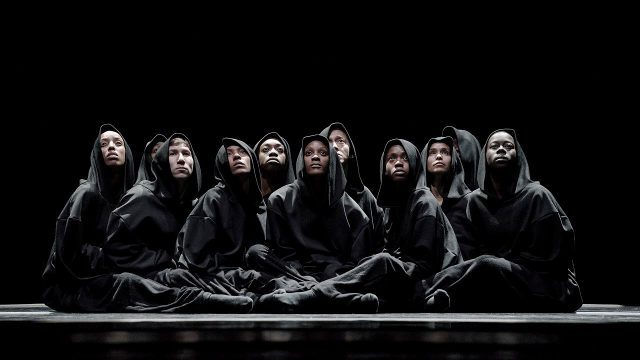
The evening concludes in a big way with the company premiere of Aszure Barton’s 2009 BUSK, in which the daring Canadian-born choreographer explores what she calls the “multitasking [and] the wisdom of the body.” Updated for this presentation and staged by Jonathan Alsberry, BUSK, which is named for the Spanish word “buscar,” meaning “to look for, is performed by thirteen dancers dressed in dark monks’ robes with hoods, designed by Michelle Jank. Nicole Pearce’s lighting and set includes a small stoop and a disco ball. The spectacular piece is packed with stunning moments and punctuated with surprise and delight: The dancers occasionally make funny faces, sit in a center circle and bow their heads, and wave white-gloved hands. A soloist has fun with a hat. An impressive chest is bared. The score consists of eight wide-ranging songs, by Camille Saint-Saëns, Moondog, Daniel Belanger, and others, that add to the unpredictability of the twenty-minute work. Barton’s previous Ailey piece was 2013’s Lift. Let’s hope it’s not another six years before the next one.

The City Center season, which wishes a fond farewell to longtime dancer and associate artistic director Masazumi Chaya, who has been with the company since 1970, continues through January 5. There will be all-new programs on December 28, January 1, and January 4 (with a mix from the above as well as a new production of Judith Jamison’s Divining and/or the world premiere of Jamar Roberts’s Ode). In addition, “Ailey Classics” takes place December 28 and January 3, “3 Visionaries” on December 24, and the season finale on January 5.

AILEY ASCENDING: 3 VISIONARIES

Mass

Robert Battle’s Mass is part of “3 Visionaries” program (photo by Paul Kolnik)

New York City Center
130 West 56th St. between Sixth & Seventh Aves.
November 28 – December 30, $29-$159
212-581-1212
www.alvinailey.org
www.nycitycenter.org

I usually check out one of the all-new programs every year at Alvin Ailey American Dance Theater’s City Center season, guaranteeing that I see productions I’ve never seen before. But for the company’s sixtieth anniversary, I decided instead to choose “3 Visionaries,” an evening of works by AAADT’s trio of artistic directors, Ailey (1958-89), Judith Jamison (1989-2010), and Robert Battle (2011-). The night began with Battle’s 2004 Mass, which the troupe debuted last year, restaged by Elisa Clark. Inspired by seeing Verdi’s Requiem at Carnegie Hall, Battle created a fourteen-minute dance in which a sixteen-piece choir in long robes move under a heavenly glow to John Mackey’s percussive score. (The lighting is by Burke Wilmore, with costumes by Fritz Masten.) The group comes together in a tight circle, forms a straight line, and glides across the floor on their tiptoes in spiritual reverence. Next was Battle’s Ella, reconceived from a solo to a duet in 2016, in which Michael Francis McBride and Chalvar Monteiro spend five exhilarating minutes prancing and preening, having a ball in Jon Taylor’s black sequined outfits as they try to outdo each other to a live recording of Ella Fitzgerald’s scat classic “Airmail Special.”

Cry

AAADT’s Jacqueline Green in Alvin Ailey’s gorgeous Cry (photo by Paul Kolnik)

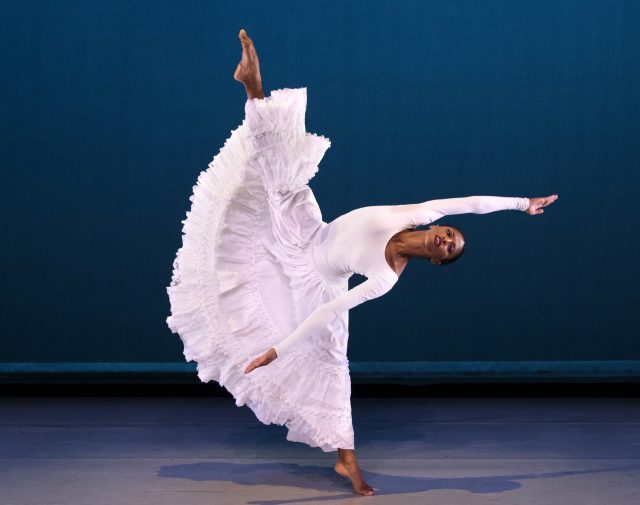
Following intermission, there were two very short excerpts from Jamison’s ouevre, a four-minute solo from Divining, beautifully performed by Jacquelin Harris to music by Monti Ellison and Kimati Dinizulu, and a duet from 1989’s Forgotten Time, with Clifton Brown and Chalvar Monteiro stretching the bounds of what the male body can do, with music by Le Mystere des Voix Bulgares and costumes by Jamison and Ellen Mahlke. Then came a stunning version of Ailey’s 1971 classic, Cry, a seventeen-minute ballet he created as a birthday present for his mother. Wearing A. Christina Giannini’s nineteenth-century-style ruffled white dresses, Akua Noni Parker, Ghrai DeVore, and Constance Stamatiou each perform a solo (to Alice Coltrane’s “Something about John Coltrane,” Laura Nyro’s “Been on a Train,” and the Voices of East Harlem’s “Right On. Be Free,” respectively), with Parker starting out incorporating a long white sash that she uses to clean the floor and as a headdress, celebrating women’s historical and evolving roles in African culture and the diaspora.

Ella

AAADT’s Jacquelin Harris and Megan Jakel let loose in Robert Battle’s Ella (photo by Christopher Duggan)

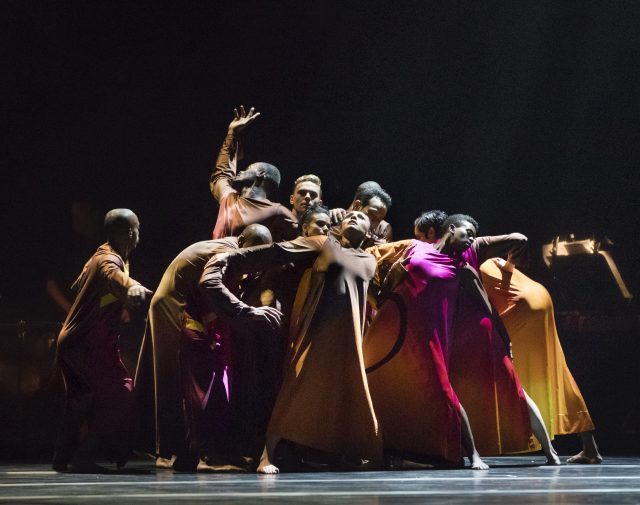
The program concludes with the usual finale (except in the all-new program), Ailey’s signature work, 1960’s Revelations. Don’t look past this thirty-six-minute gem, which still contains plenty of thrills and chills. Ailey was inspired by such writers as James Baldwin and Langston Hughes as well as childhood church services he attended in Texas, leading to a multipart ballet that Ailey explained thusly at its debut: “This suite explores motivations and emotions of African American religious music which, like its heir to the Blues, takes many forms — ‘true spirituals’ with their sustained melodies, ring shouts, song-sermons, gospel songs, and holy blues — songs of trouble, love, and deliverance.” The piece is divided into three sections, “Pilgrim of Sorrow” (“I Been ’Buked,” “Didn’t My Lord Deliver Daniel,” “Fix Me, Jesus”), “Take Me to the Water (“Processional/Honor, Honor,” “Wade in the Water,” “I Wanna Be Ready”), and “Move, Members, Move” (“Sinner Man,” “The Day Is Past and Gone,” “You May Run On,” “Rocka My Soul in the Bosom of Abraham”). Highlights included Parker and Jeroboam Bozeman’s duet to “Fix Me, Jesus,” McBride’s solo to “I Wanna Be Ready,” and the trio of DeVore, Brown, and Stamatiou’s “Wade in the Water.” Ailey also said, “I wanted to explore black culture, and I wanted that culture to be a revelation.” After nearly sixty years, it still is. Ailey’s winter season continues at City Center through December 30, with “3 Visionaries” being presented again on December 26 at 2:00. Among the other upcoming programs are “Timeless Ailey,” “All Battle,” and “All New.” Each performance begins with Bob Bonniol’s new seven-minute documentary short, Becoming Ailey, with audio quotes from Ailey.

AILEY ASCENDING 60th ANNIVERSARY

Alvin Ailey American Dance Theater will be celebrating its sixtieth anniversary at City Center, which is celebrating its seventy-fifth anniversary

Alvin Ailey American Dance Theater will be celebrating its sixtieth anniversary at City Center, which is celebrating its seventy-fifth anniversary

New York City Center
130 West 56th St. between Sixth & Seventh Aves.
November 28 – December 30, $29-$159
212-581-1212
www.alvinailey.org
www.nycitycenter.org

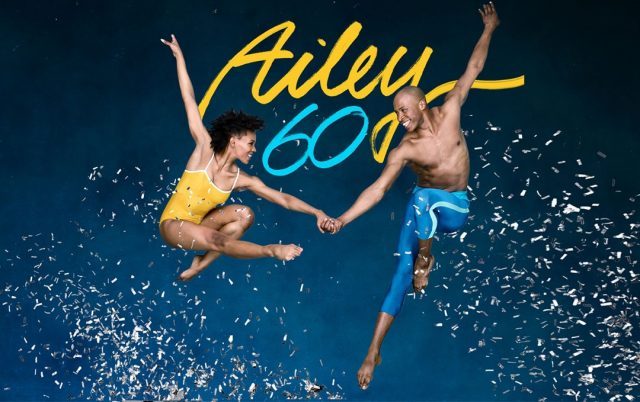
On March 30, 1958, a troupe of black dancers performed as the Alvin Ailey American Dance Theater for the first time, at the 92nd Street YM-YWHA Dance Center, traveling around in station wagons. Now AAADT’s sixtieth anniversary tour pulls up to City Center for the company’s annual monthlong residence, this year running November 28 to December 30. The season, known as “Ailey Ascending,” features new and old works, looking back at the troupe’s glorious history and exciting future. Under the leadership of artistic director Robert Battle, thirty-two dancers, including longtime favorites Hope Boykin, Clifton Brown, Vernard J. Gilmore, Daniel Harder, Rachael McLaren, Akua Noni Parker, Jamar Roberts, and the incomparable Glen Allen Sims and Linda Celeste Sims, will be presenting the world premiere of Ronald K. Brown’s The Call, which Brown refers to as a “love letter to Mr. Ailey,” with music by Johann Sebastian Bach (performed by Chris Thile, Edgar Meyere, and Yo-Yo Ma), Mary Lou Williams, and Asase Yaa; Rennie Harris’s Lazarus, the first two-part AAADT ballet, by AAADT’s first artist-in-residence, dealing with racism and Ailey’s legacy from 1958 to today, set to music by Nina Simone, Terrence Trent D’Arby, Michael Kiwanuka, Odetta, and Darrin Ross, along with the voice of Alvin Ailey; and EN by Jessica Lang (who just announced that Jessica Lang Dance is in its final season, closing on April 30, 2019), her hundredth ballet, with original music by Jakub Ciupinski. There will also be the company premiere of Wayne McGregor’s Kairos, set to Antonio Vivaldi’s “The Four Seasons” reimagined by Max Richter and with set design by Idris Khan. New productions consist of Battle’s Juba and former artistic director Judith Jamison’s Divining and Forgotten Time.

Among the special programs are “All Ailey” (Memoria, Masekela Langage, Revelations; Night Creature, Cry, Masekela Langage, Revelations), “All Battle” (Juba, Ella, No Longer Silent, In/Side, Mass), “All New” (Kairos, Lazarus), “3 Visionaries” (Mass, Ella, Divining, Forgotten Time, Cry, Revelations), and “Timeless Ailey,” comprising excerpts from many well-known and rarely performed Ailey works, including Opus McShann, For “Bird” with Love, Mary Lou’s Mass, The Lark Ascending, Phases, Hidden Rites, and Pas de Duke. The opening-night gala will be chaired by Angela Bassett and Cicely Tyson and features special appearances by Ledisi, Norm Lewis, and Brandie Sutton, a new piece by Battle set to Nina Simone’s “Black Is the Color,” and the premiere of the multimedia Becoming Ailey, which will also kick off every performance except the December 11 celebration of New York City Center’s seventy-fifth anniversary. Also on the schedule are Jamar Roberts’s Members Don’t Get Weary (music by John Coltrane), Jawole Willa Jo Zollar’s Shelter (music by Junior “Gabu” Wedderburn), Talley Beatty’s Stack-Up (music by Earth, Wind & Fire, Grover Washington Jr., Fearless Four, and Alphonze Mouzon), and Twyla Tharp’s The Golden Section (music by David Byrne).

ALVIN AILEY AMERICAN DANCE THEATER: NEW YORK CITY WINTER SEASON 2017

 Linda Celeste Sims in Twyla Tharp’s  The  Golden Section . Photo by Paul Kolnik.

The exquisite Linda Celeste Sims will perform in a new production of Twyla Tharp’s The Golden Section in annual Ailey winter season at City Center (photo by Paul Kolnik)

New York City Center
130 West 56th St. between Sixth & Seventh Aves.
November 29 – December 31, $25-$200
212-581-1212
www.alvinailey.org
www.nycitycenter.org

“When I think about why people should come to see the company right now, this is a moment in time where it is important to take a stand, and sometimes taking a stand means taking a seat to see something that represents the best of humanity,” Alvin Ailey American Dance Theater artistic director Robert Battle says in a video about the troupe’s upcoming season at City Center. “When Alvin Ailey says that dance comes from the people, and should always be delivered back to the people . . . he wanted this company to be a mirror to society so that people could ultimately see how beautiful they are.” The season kicks off November 29 with a special opening-night “Modern American Songbook” gala program consisting of George Faison’s Suite Otis, two parts of Judith Jamison’s Love Stories, the Ray Charles section of Camille A. Brown’s The Groove to Nobody’s Business, the central duet in David Parsons’s Shining Star, and Revelations with live music. This year’s world premieres are Gustavo Ramirez Sansano’s Victoria and longtime Ailey dancer Jamar Roberts’s Members Don’t Get Weary, with company premieres of Battle’s Mass and Johan Inger’s Walking Mad, while there are new productions of Talley Beatty’s Stack-Up, Twyla Tharp’s The Golden Section, and Jawole Willa Jo Zollar’s Shelter. Other highlights include Battle’s Ella and In/Side, Billy Wilson’s The Winter in Lisbon, Ailey’s Night Creature, Mauro Bigonzetti’s Deep, Ulysses Dove’s Episodes, Ronald K. Brown’s Four Corners, and Ailey dancer Hope Boykin’s r-Evolution, Dream. On December 17 at 7:30, “Celebrating the Men of Ailey” features Clifton Brown, Vernard Gilmore, Yannick Lebrun, Glenn Allen Sims, and Roberts performing works by Ailey, Battle, and Gilmore. In addition, the Saturday family matinees will be followed by Q&As with Ailey dancers. The season comes to a close with a New Year’s Eve party boasting a one-night-only, to-be-announced program that concludes with Revelations.

RIVER TO RIVER 2017

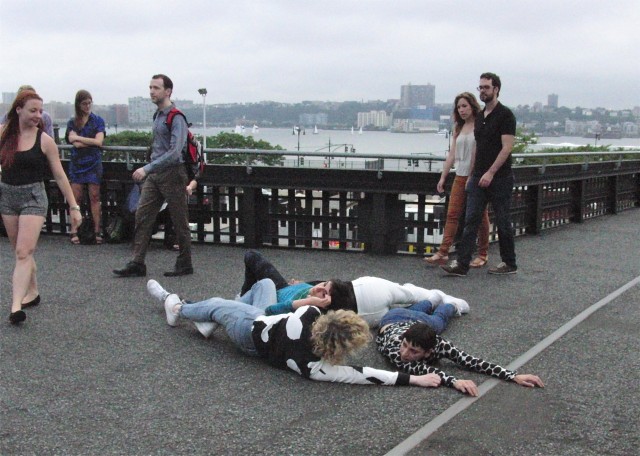
Maria Hassabi presented an informal preview of her latest work this summer on the High Line (photo by twi-ny/mdr)

The latest iteration of Maria Hassabi’s Staged series will move be performed in City Hall Park as part of the River to River Festival (photo by twi-ny/mdr)

Multiple locations downtown
June 14-25, free
www.rivertorivernyc.com
lmcc.net

The best free multidisciplinary arts festival of the summer, River to River packs a whole lot into a narrow amount of time. Sponsored by the Lower Manhattan Cultural Council, this year’s activities, which, as always, focus on more experimental presentations, take place June 14-25 at such locations as Governors Island, Federal Hall, the National Museum of the American Indian, the Fulton Center, City Hall Park, and other downtown areas. While everything is free, some performances require advance registration because of space considerations. In addition to the below events, Katja Novitskova’s “EARTH POTENTIAL” Public Art Fund exhibition opens June 22 in City Hall Park, photographer Kamau Ware’s “Black Gotham Experience” interactive storytelling project will pop up at various places throughout the fest, LMCC’s Open Studios allows visitors the chance to meet with dozens of artists, and Kameelah Janan Rasheed’s “A Supple Perimeter” will be on view at LMCC’s Arts Center and Movie Theater Exterior on Governors Island.

Wednesday, June 14, 6:00
Wednesday, June 21, 8:00
Sunday, June 25, 7:00

The Dance Cartel: R2R Living Rooms, with DJ Average Jo and special guests, Pier A Harbor House
One of the most energetic companies around, the Dance Cartel will host a trio of live music and dance performances at the River to River Festival hub, with plenty of audience participation.

Thursday, June 15, 3:00 & 6:00
Monday, June 19, 3:00

Netta Yerushalmy: Paramodernities #2 and #3, National Museum of the American Indian
South Carolina–born choreographer and performer Netta Yerushalmy’s “Paramodernities” series deconstructs landmark dance works within the framework of modernity. For River to River, she will present Paramodernities #2, examining Martha Graham’s Night Journey, and Paramodernities #3, investigating Alvin Ailey’s Revelations, accompanied by scholars who will take part in public discussions. The seventy-five-minute production will move around inside the National Museum of the American Indian.

Thursday, June 15, 7:00
Saturday, June 17, 7:00
Sunday, June 18, 7:00

A Marvelous Order, Fulton Center
Joshua Frankel, Judd Greenstein, Will Rawls, and Tracy K. Smith have collaborated on the multimedia opera A Marvelous Order, which delves into the famous fight between Robert Moses and Jane Jacobs over the future development of New York City. For the River to River Festival, they will present a twenty-five-minute excerpt at the Fulton Center, with Eliza Bagg, Tomás Cruz, Lucy Dhegrae, Christopher Herbert, and Dashon Burton as Robert Moses and live music by NOW Ensemble, conducted by David Bloom.

Friday, June 16, 6:00
Amir Elsaffar: Rivers of Sound — Not Two, the Plaza at 28 Liberty
American jazz trumpeter and composer Amir Elsaffar celebrates the release of his latest record, Not Two (New Amsterdam, June 16), with a two-hour performance at the Plaza at 28 Liberty featuring his seventeen-piece Rivers of Sound orchestra.

Friday, June 16, 3:30
Saturday, June 17, 3:30
Sunday, June 18, 3:30

Jodi Melnick: Moat, Fort Jay, Governors Island
Choreographer, dancer, and teacher Jodi Melnick, who has said, “I am truly, madly, deeply in love with movement,” has teamed up with visual artist John Monti for Moat, a sixty-minute site-specific performance taking place in the moat that surrounds historic Fort Jay on Governors Island.
(photo by Brian Rogers)

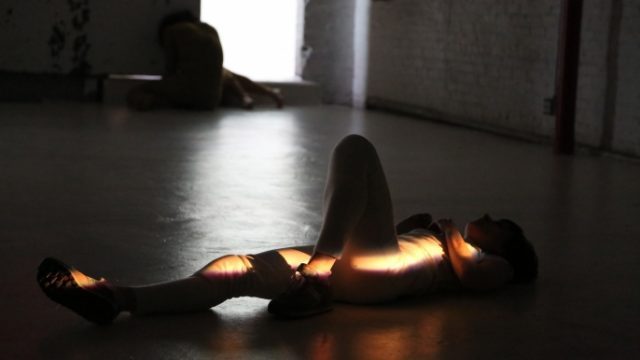
Beth Gill’s Catacomb will be performed in Federal Hall for the River to River Festival (photo by Brian Rogers)

Saturday, June 17, 8:00
Sunday, June 18, 8:00
Monday, June 19, 8:00

Beth Gill: Catacomb, Federal Hall
In May 2016, Bessie Award–winning choreographer Beth Gill presented the site-specific Catacomb at the Chocolate Factory, a dreamlike physical and psychological exploration of what we see and who we are. For River to River, the aching sixty-minute performance moves to historic Federal Hall.

Saturday, June 17, 12 noon – 6:00
Sunday, June 18, 12 noon – 6:00
Saturday, June 24, 12 noon – 6:00
Sunday, June 25, 12 noon – 6:00

The Set-Up: Island Ghost Sleep Princess Time Story Show, the Arts Center at Governors Island
For five years, Wally Cardona and Jennifer Lacey have been collaborating with men and women from multiple dance disciplines, presenting unique performances that push the boundaries of the movement arts. Their project now culminates in a grand finale on Governors Island, with dance masters I Nyoman Catra (Balinese Topeng), Proeung Chhieng (Cambodian), Junko Fisher (Okinawan), Saya Lei (Mandalay-style, classical Burmese), Jean-Christophe Paré (French baroque), Kapila Venu (Indian Kutiyattam), and Heni Winahyuningsih (Javanese refined) and musicians Jonathan Bepler, Reiko Fueting, and Megan Schubert. “Many dances on an ISLAND, a GHOST of what they were, having lost details during a long SLEEP but nevertheless the PRINCESS of their destiny. This TIME it is one STORY, full of fortuitous meetings, grave errors, and happy misunderstandings. It’s a SHOW, folks!” Cardona and Lacey explain. You can see the complete schedule here.

Monday, June 19, 6:00
Tuesday, June 20, 2:00
Wednesday, June 21, 2:00

Faye Driscoll: Thank You for Coming: Play, Broad and Wall Sts.
At last year’s LMCC Open Studios on Governors Island, the endlessly inventive Faye Driscoll offered a work-in-progress showing of the second part of her participatory “Thank You for Coming” series, which began in 2014 with Thank You for Coming: Attendance Play later moved to the BAM Fisher. She now revisits Play, staging a forty-minute version at the intersection of Broad and Wall Sts.

Tuesday, June 20, 4:00 – 8:00
Night at the Museums
Many Lower Manhattan museums and cultural institutions will stay open late on June 20, offering free entry to historic sites along with special programs. Among the participants are the African Burial Ground National Monument, China Institute, Federal Hall National Memorial, Fraunces Tavern Museum, Museum of American Finance, Museum of Jewish Heritage — A Living Memorial to the Holocaust, National Archives at New York City, National Museum of the American Indian, National September 11 Memorial Museum (advance RSVP required), 9/11 Tribute Center, NYC Municipal Archives, Poets House, the Skyscraper Museum, and the South Street Seaport Museum.

Wednesday, June 21, 5:00
Thursday, June 22, 3:00
Friday, June 23, 3:00

Marjani Forté-Saunders: Memoirs of a . . . Unicorn, Melville Gallery, South Street Seaport Museum
Pasadena-born, Harlem based dancer and choreographer Marjani Forté-Saunders, who previously was in the Urban Bush Women Dance Company, brings her solo Memoirs of a . . . Unicorn to the South Street Seaport Museum, a collaboration with media designer Meena Murugesan and sound designer Everett Saunders that relates to the history of Black American magic.

Thursday, June 22, 7:00
Friday, June 23, 7:00
Saturday, June 24, 7:00
Sunday, June 25, 5:00

En Garde Arts: Harbored, Winter Garden, Brookfield Place, 230 Vesey St.
En Garde Arts, which was founded by Anne Hamburger to “catalyze social change” through immersive theater, will stage the sixty-minute site-specific collage play Harbored, about Willa Cather, Lewis & Clark, and Cather’s character Ántonia. The piece, featuring more than fifty performers, is written and directed by Jimmy Maize, with an original score by Heather Christian sung by the Downtown Voices Choir and movement by Wendy Seyb. During the day, you can share your immigration story with them and it just might be incorporated into that night’s show.

Friday, June 23, 6:00
Sunday, June 25, 6:00

Maria Hassabi: Staged? (2016) — undressed, City Hall Park
Last summer, Maria Hassabi presented Movement #2 on the High Line, a dance performed by Simon Courchel, Hristoula Harakas, Molly Lieber, and Oisín Monaghan as people passed by. That morphed into Staged, which ran at the Kitchen in October. Now Hassabi is bringing Staged? (2016) — undressed to City Hall Park, where four dancers will move around Katja Novitskova’s “EARTH POTENTIAL” exhibition.