Ronald K. Brown/EVIDENCE returns to the Joyce for fortieth anniversary celebration
Ronald K. Brown/EVIDENCE, a Dance Company
Joyce Theater
175 Eighth Ave. at 19th St.
February 25 – March 1 (Curtain Chat February 25), $32-$82
212-645-2904 www.joyce.org evidencedance.com
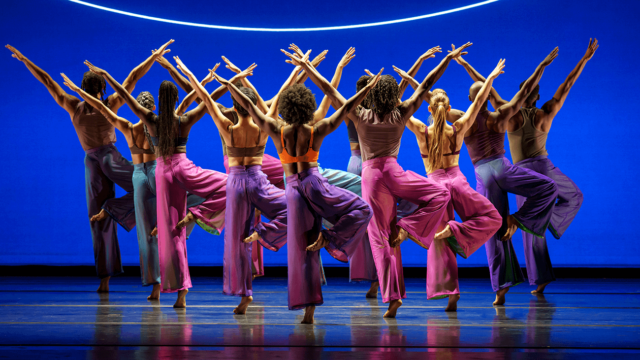
Ronald K. Brown/EVIDENCE celebrates its past while looking toward the future in its annual winter season at the Joyce, running February 25 through March 1. Because of the blizzard, opening night, February 24, has been canceled, but a 7:00 show has just been added, and great seats are available if you hurry.
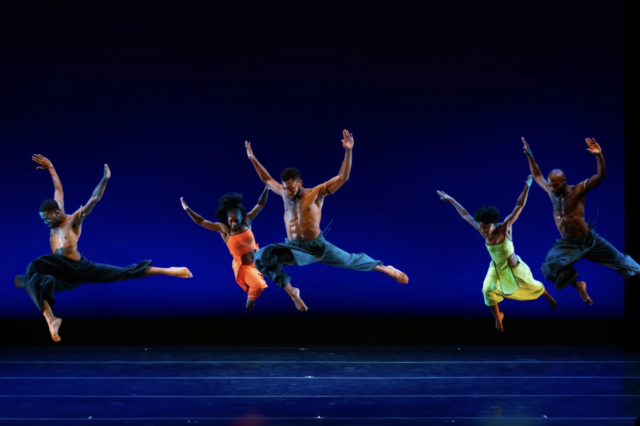
The Brooklyn-based company will be presenting two exciting programs as part of its fortieth anniversary. The first honors longtime collaborator Wunmi Olaiya, a composer, costume designer, dancer, and visual artist who has been working with Brown since 1992, while the second pays tribute to TU Dance cofounding artistic director Toni Pierce-Sands, who danced with Alvin Ailey and EVIDENCE and would begin every TU Dance production with the Ulysses Dove mantra “Nothing to prove, only to share”; Pierce-Sands passed away in November at the age of sixty-three.
“Celebrating Wunmi” — born in London and raised in Lagos, she goes by one name — begins with Ebony Magazine: To a Village, a 1996 piece for Cleo Parker Robinson Dance Ensemble that EVIDENCE debuted in March 1998, featuring music and costumes by Wunmi centered around the repeated phrase “do you see what I see.” Clear as Tear Water is a 2006 solo originally choreographed for Pierce-Sands; at the Joyce, six different dancers will perform the work, which will be set to Wunmi’s “Woman Child” in Program A and Meshell Ndegeocello’s “Heaven” in Program B. Next is 1999’s Gatekeepers, a piece originally for Philadanco that delves into Native American mythology and African traditions, with music and costumes by Wunmi. Following intermission, the evening concludes with the rousing, nonstop Upside Down, an exhilarating excerpt from Brown’s 1998 Destiny, in which the company cuts loose to music by Wunmi, which she will play live with two drummers.
“With the trust Ron affords me, I dare to dream and visualize what the work he is creating is speaking on,” Wunmi explains in a Joyce interview. “Ron tells stories of human beings making their way . . . and, in there, I create costumes to make them visible. Thankful, trust is alive and well.”
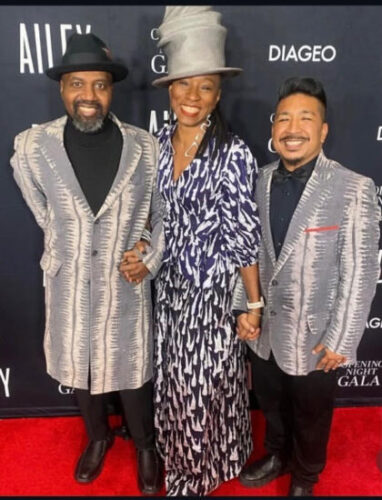
Ronald K. Brown, Wunmi Olaiya, and Arcell Cabuag at the 2024 Alvin Ailey American Dance Theater gala
Planned prior to Pierce-Sanders’s death from cancer, “A Celebration of the Life and Legacy of Toni Pierce-Sands” kicks off with 2012’s Torch, a touching tribute to former Brown student and dance enthusiast Beth Young, who passed away in January 2012, followed by Clear as Tear Water. The company premiere of 2017’s Where The Light Shines Through, originally commissioned for TU at the Ordway, is choreographed by Brown and his partner, Arcell Cabuag, and set to music by Ndegeocello, Susana Baca, Ballet Folklórico Cutumba de Santiago, and Black Motion. The finale is the spectacular 1999 favorite Grace, originally choreographed for Alvin Ailey, which features twelve dancers moving, in costumes by Wunmi, to a melding of modern dance and West African idioms as only Brown and Cabuag can do, with music by Duke Ellington, Roy Davis Jr., and Fela Aníkúlápó Kuti and live vocals by Gordon Chambers; the beats will stay with you long after the show is over.
“This celebration is long overdue and I am happy the time is now,” Brown says in a program note.
The time is always now to see this extraordinary company, still going strong after forty marvelous years.
[Mark Rifkin is a Brooklyn-born, Manhattan-based writer; you can follow him on Substack here.]
The Holy Blues is part of all-new evenings of Alvin Ailey American Dance Theater season at City Center (photo by Steven Pisano)
ALVIN AILEY AMERICAN DANCE THEATER
New York City Center
131 West 55th St. between Sixth & Seventh Aves.
December 3 – January 4, $45-$195 www.alvinailey.org www.nycitycenter.org
It’s been a time of change for Alvin Ailey American Dance Theater. This has been the first year without the shining light of Judith Jamison, the beloved Ailey dancer and artistic director who passed away last November at the age of eighty-one. That month, her successor, Robert Battle, became a resident choreographer with the Paul Taylor Dance Company. And this past spring, longtime Ailey dancer and Juilliard Dance Division dean Alicia Graf Mack was named the fourth artistic director in the history of AAADT.
“This monumental season draws deeply on Alvin Ailey’s legacy rooted in celebrating the resilience of the human spirit while extending its truth and bold virtuosity to reflect this moment in time and our hopes for the future,” Graf Mack said in a statement about the company’s upcoming annual City Center residency. “Each new creation shares the utterly distinctive voice of its choreographer, testifying to the vitality of the tradition Mr. Ailey gave us and the gifts of spirit that Judith Jamison so lovingly nurtured. I am grateful and honored to be a caretaker of this ever-changing continuum of inspiration, along with Matthew Rushing and the company of brilliant dancers whose artistry will move us all as we take our next steps forward.”
Running December 3 through January 4, the 2025 City Center season features the company premiere of Medhi Walerski’s Blink of an Eye, set to J. S. Bach’s violin sonatas and partita, and a new production of Jamison’s duet A Case of You, originally a birthday tribute to Chairman Emerita Joan Weill, danced to Diana Krall’s version of the Joni Mitchell song.
There are five world premieres from a wide range of choreographers. Inspired by Geoffrey Holder’s book Black Gods, Green Islands, about Trinidad and Tobago, Cuban American theater director and arts educator and activist Maija García’s Jazz Island celebrates the Afro-Caribbean diaspora, with original music by jazz trumpeter Etienne Charles. Matthew Neenan’s Ailey debut, Difference Between, is set to music by MacArthur fellow and two-time Obie winner Heather Christian, who sings in “Tomorrow”: “Difference between. Deference, reverence, sever its shoots on the bean / Sanity, brevity, bravery, levity — these are the virtues / are any restored or recorded or / pored over once the romance of it leaves?”
Superstar Jamar Roberts, the company’s first resident choreographer, follows up such gems as Ode,A Jam Session for Troubling Times, and Holding Space with Song of the Anchorite, a reimagining of Alvin Ailey’s 1961 solo Hermit Songs, set to jazz trumpeter Avishai Cohen’s interpretation of a Ravel adagio. In Embrace, Fredrick Earl Mosley incorporates tunes by Stevie Wonder, Kate Bush, Etta James, Maxwell, Ed Sheeran, Des’ree, and P!nk in exploring the intimacy of human connection.
And Urban Bush Women founder and Ailey Artist in Residence Jawole Willa Jo Zollar, collaborating with current Ailey dancer Samantha Figgins and former company member Chalvar Monteiro, looks to the concepts of the Ring Shout and the Door of No Return in The Holy Blues, named after the title of Alvin Ailey’s journal. The twenty-five-minute piece debuted at BAM in June; in a company interview, Figgins explained, “Through life, we have these hills and valleys, our human suffering and our pleasure, our delight, our bliss, our joy, and The Holy Blues is a chance to watch that journey of a group of people — a community, of course, but all individuals — how they tackle the challenges of bringing themselves up out of whatever pain they may be in, out of whatever life throws at them, and how they are able to create something beautiful out of it.”
The thirty-two dancers will also perform the Ailey classics Memoria,Night Creature,Pas de Duke,Masekela Langage,A Song for You,Opus McShann,For Bird — with Love,Love Songs,Reflections in D,Hidden Rites, and Cry; Ronald K. Brown’s Grace; Lar Lubovitch’s Many Angels; Rushing’s Sacred Songs; Elisa Monte’s Treading; and Alonzo King’s Following the Subtle Current Upstream. Many of the programs will conclude with the one and only Revelations, six with live music. In addition, the Saturday family matinees will be followed by a Q&A.
“I join with the entire company in welcoming Alicia Graf Mack in her new role as our artistic director,” Rushing said in a statement. “Her great respect for and commitment to the Ailey mission, along with the perspective and integrity that informs her vision, will help elevate everything we do. We are excited to welcome audiences to New York City Center this holiday season to be uplifted by cherished classics and remarkable new works as the curtain goes up on the next chapter in Ailey’s extraordinary story.”
[Mark Rifkin is a Brooklyn-born, Manhattan-based writer and editor; you can follow him on Substack here.]
Ailey II brings Houston Thomas’s Down the Rabbit Hole back home in two-week NYC season (photo by Nir Arieli)
AILEY II AT CITIGROUP THEATER
Ailey Citigroup Theater
405 West Fifty-Fifth St. between Ninth & Tenth Aves.
March 26 – April 6, $62.25 ailey.org
Ailey II has been on the road, visiting more than two dozen cities, but the company called “the next generation of dance” is coming back to New York for its annual season at the Ailey Citigroup Theater on West Fifty-Fifth St. Running March 26 to April 6, the season is dedicated to longtime Ailey dancer, choreographer, and artistic director Judith Jamison, who passed away in November at the age of eighty-one.
“Ailey II is thrilled to come back to our home stage after an incredible tour across the country as we leap into our sixth decade,” artistic director Francesca Harper said in a statement. “We are eager to welcome both our loyal supporters and new audiences to experience the exciting artistry of Ailey II through two programs that bridge the past and present, celebrating how each generation shapes the future. Whether audiences find joy, connection, or a sense of empowerment, I want them to carry that discovery into their lives long after they leave the theater.”
The company of twelve dancers — Carley Brooks, Meredith Brown, Jennifer M. Gerken, Alfred L. Jordan II, Xavier Logan, Kiri Moore, Corinth Moulterie, Xhosa Scott, Kayla Mei-Wan Thomas, Darion Turner, Eric Vidaña, and Jordyn White — will present “Echoes,” comprising Harper’s Luminous, the world premiere of Houston Thomas’s Down the Rabbit Hole, and a new production of Alvin Ailey’s Streams, and “New Vintage,” consisting of an excerpt from Jamison’s Divining, excerpts from Ailey’s Blues Suite,The Lark Ascending, and Streams,Down the Rabbit Hole, and Baye & Asa’s John 4:20. Each program is approximately 105 minutes with two intermissions; tickets are $62.65.
[Mark Rifkin is a Brooklyn-born, Manhattan-based writer and editor; you can follow him on Substack here.]
Carmen de Lavallade performs with Alvin Ailey at Jacob’s Pillow in 1961 (photo by John Lindquist)
EDGES OF AILEY
Whitney Museum of American Art
99 Gansevoort St.
Wednesday – Tuesday through February 9, $24-$30 (eighteen and under free; Friday nights and second Sundays free)
212-570-3600 whitney.org
“I’m trying to hold up a mirror to our society so they can see how beautiful they are, Black people, you know?” Alvin Ailey once said.
When I was in junior high, we were visited by Alvin Ailey American Dance Theater. I had never seen anything like it, certainly not in my all-white class on Long Island. It opened my eyes to a world of possibilities, now highlighted at the end of every year when I go see AAADT in their annual season at City Center. I was even pulled onstage once by Ailey dancer Belén Pereyra to join her and others for an audience participation section of Ohad Naharin’s Minus 16.
The continuing legacy of Alvin Ailey himself and his company is celebrated in the exhilarating exhibition “Edges of Ailey,” on view at the Whitney through February 9. The dazzling multimedia show features painting, sculpture, drawings, photography, postcards and letters, video, notebooks, posters, and more, along with a multichannel loop of rare archival footage of the troupe’s remarkable history, circling around the top of the gallery in an awe-inspiring video installation. The artworks are divided into such categories as “Blackness in Dance,” “Black Spirituality,” “Black Liberation,” “Ailey’s Collaborators/Nightlife,” and “After Ailey,” arranged in sections that encourage fluid but random movement; you can wander through at your own pace, following your own path.
The exhibit is supplemented by several vitrines filled with wonderful ephemera, from family photos, programs, and research notes to epistolary exchanges with Dudley Williams, Langston Hughes, and Ailey’s mother, Lula Cooper. The notebooks are utterly fascinating, with exciting and revealing notations, early drafts, intricately detailed schedules, and such quotes as “One must discover what the music is about + visualize it if possible.” and “Very important: The choreographer as storyteller / story inventor.”
Exhibit includes notebooks filled with intimate and intricate details of Alvin Ailey’s life and career (photo by twi-ny/mdr)
A handful of the pieces were created specifically for the show, while others date back to the 1860s. Among the artists represented are Carrie Mae Weems, Jacob Lawrence, Lorna Simpson, James Van Der Zee, Alma Thomas, Kevin Beasley, Elizabeth Catlett, Jean-Michel Basquiat, David Driskell, Purvis Young, Horace Pippin, Theaster Gates, and Lyle Ashton Harris. A poem by Nikki Giovanni, “Quilting the Black-Eyed Pea (We’re Going to Mars),” hangs on a long, narrow vertical panel. Three stark 1970 woodcuts by Aaron Douglas are titled Bravado,Flight, and Surrender.
In the center of the space is a daring untitled sculpture by David Hammons made of human hair, wire, metallic mylar, a sledge hammer, plastic beads, string, a metal food tin, panty hose, leather, tea bags, and feathers. Faith Ringgold’s United States of Attica map is in the red, black, and green colors of the Pan-African flag. One of the most poignant sections is “Black Women,” a gathering of such works as Emma Amos’s 1985 Judith Jamison as Josephine Baker, Elizabeth Catlett’s 1947 I Am the Negro Woman, Beauford Delaney’s 1965 Marian Anderson, Geoffrey Holder’s 1976 Portrait of Carmen de Lavallade, Kara Walker’s 1998 African/American, Mickalene Thomas’s 2024 Katherine Dunham: Revelation, and Karon Davis’s 2024 Dear Mama, paying tribute to Black women artists and performers — and, particularly, longtime Ailey dancer and artistic director Judith Jamison, on whom Ailey choreographed the 1971 solo Cry, a birthday present for his mother that he dedicated “to all Black women everywhere — especially our mothers.”
Ailey collaborator Romare Bearden’s “Bayou Fever” series is a colorful depiction of joy and movement. Choreographer and visual artist Ralph Lemon’s Untitled (On Black Music) consists of forty-one ink and watercolor on paper drawings, leaving one slot empty at the lower right. Video stations show performances by Jack Cole, the Katherine Dunham Company, Martha Graham, Duke Ellington, Lester Horton, Pearl Primus, and Ailey himself, including in the three-minute black-and-white A Study in Choreography for Camera, directed by Maya Deren and Talley Beatty.
Ailey was born in Texas in 1931 and died from an AIDS-related illness in New York City in 1989, at the age of fifty-four. He left behind a thrilling legacy of movement and music honoring the African American experience and supporting civil rights and social justice. It’s evident not only in the exhibition itself but in the accompanying program of live performances, which has already featured Ronald K. Brown and Matthew Rushing and continues November 7-9 with Yusha-Marie Sorzano’s This World Anew, November 16 with Bill T. Jones’s Memory Piece: Mr. Ailey, Alvin… the un-Ailey?, December 13-15 with Will Rawls’s Parable of the Guest, January 17-19 with Jawole Willa Jo Zollar’s Solo Voyages, January 24-26 with Excerpts from New Works, February 6-8 with Okwui Okpokwasili and Peter Born’s let slip, hold sway, and Ailey II: Harmonic Echo November 20-24, December 21-22, and January 22-26.
Hope Boykin’s Finding Free makes its debut at Ailey season at City Center (photo by Paul Kolnik)
ALVIN AILEY AMERICAN DANCE THEATER
New York City Center
131 West 55th St. between Sixth & Seventh Aves.
December 4 – January 5, $42-$172 www.alvinailey.org www.nycitycenter.org
Before or after visiting “Edges of Ailey,” you must see the real thing, taking in a a show or two at Alvin Ailey American Dance Theater’s five-week season, its sixty-sixth, at New York City Center, running December 4 through January 5. As always, it’s a combination of world and company premieres, classic favorites by Ailey and other choreographers, and presentations with live music; many programs conclude with the AAADT’s masterpiece, the thirty-six-minute multipart Revelations.
“This season we celebrate the lineage and legacy of Mr. Ailey, highlighting his acclaimed works as well as new ballets by choreographers for whom he paved the way,” interim artistic director Matthew Rushing said in a statement. “As I look at the repertory for our season, I am reminded that dance is both a reflection of our past and a guide to our future. We are excited to welcome audiences this holiday season to be inspired by Ailey’s extraordinary artistry and rich story, as it continues to be written.”
“All New” evenings feature former Ailey dancer Jamar Roberts’s Al-Andalus Blues, set to music by Roberta Flack and Miles Davis; former company member Hope Boykin’s Finding Free, with an original jazz and gospel score by pianist Matthew Whitaker that he will perform live at several shows; Lar Lubovitch’s Ailey debut, Many Angels, which explores St. Thomas Aquinas’s question “How many angels can dance on the head of a pin?,” set to Gustav Mahler’s Symphony No. 5; and Rushing’s Sacred Songs, built around music from the original 1960 version of Revelations that was eventually edited out because of length.
There will also be new productions of Elisa Monte’s twelve-minute duet, Treading, and Ronald K. Brown’s spectacular Grace, which premiered at City Center twenty-five years ago. The opening night gala honors dance educator Jody Gottfried Arnhold with presentations of Grace with Leslie Odom Jr. and Revelations with a live choir.
Other highlights are Dancing Spirit, Brown’s tribute to Jamison; Roberts’s 2019 Ode; Elizabeth Roxas-Dobrish’s Me, Myself and You; Amy Hall Garner’s CENTURY; Hans van Manen’s Solo; Alonzo King’s Following the Subtle Current Upstream; and Kyle Abraham’s Are You in Your Feelings? Among the Ailey classics on the schedule are Memoria,A Song for You,Cry, and Night Creature. Saturday matinees are followed by Q&As with the dancers, which this year welcome newcomers Leonardo Brito, Jesse Obremski, Kali Marie Oliver, and Dandara Veiga and the return of Jessica Amber Pinkett; closing night will celebrate what would have been Alvin Ailey’s ninety-third birthday.
And to keep your Ailey fix rolling, you can stream the eight-part Ailey PBS documentary Portrait of Aileyhere.
[Mark Rifkin is a Brooklyn-born, Manhattan-based writer and editor; you can follow him on Substack here.]
Alvin Ailey American Dance Theater’s Y. Lebrun, P. Coker, X. Mack, and R. Maurice in Alvin Ailey’s For “Bird” — with Love (photo by Dario Calmese)
ALVIN AILEY AMERICAN DANCE THEATER
New York City Center
131 West 55th St. between Sixth & Seventh Aves.
November 29 – December 31, $42-$172 www.alvinailey.org www.nycitycenter.org
No matter what’s going on in the world — and in case you haven’t noticed, right now there’s a whole lot — when the end of November rolls around, you can count on Alvin Ailey American Dance Theater to provide a much-needed respite with its always exciting and entertaining end-of-year season at New York City Center. This time around the company is celebrating its sixty-fifth anniversary by presenting more than two dozen works, including world premieres by first-time AAADT choreographers Amy Hall Garner (CENTURY) and former Ailey dancer Elizabeth Roxas-Dobrish (Me, Myself and You) and new productions of Hans van Manen’s Solo, Alonzo King’s Following the Subtle Current Upstream, Ronald K. Brown’s Dancing Spirit, and Jamar Roberts’s Ode.
Kyle Abraham’s Are You in Your Feelings? is part of Ailey season at City Center (photo by Paul Kolnik)
The programs are divided into “Premiere Night,” “Ailey Classics,” “All Ailey,” “Live Music,” “All New,” and “Pioneering Women of Ailey”; the opening-night gala, honoring former Ailey dancer, choreographer, and artistic director Judith Jamison, pairs a performance of Revelations with a live choir and a world premiere with Tony, Grammy, and Emmy winner and Oscar nominee Cynthia Erivo.
The personal CENTURY was inspired by Garner’s grandfather and is set to music by Ray Charles, Count Basie, the Dirty Dozen Brass Band, and others; Me, Myself and You explores reminiscence, love, and loss. “Pioneering Women of Ailey” pays tribute to Jamison, Carmen de Lavallade, Denise Jefferson, and Sylvia Waters, while rising jazz stars will perform live December 15-17. Among the other highlights the company of thirty-three dancers will perform are Paul Taylor’s DUET, Alvin Ailey and Mary Barnett’s Survivors, Roberts’s In a Sentimental Mood, and Kyle Abraham’s Are You in Your Feelings? After twelve years as artistic director, Robert Battle announced that he is stepping down immediately because of health concerns; longtime Ailey dancer and associate artistic director Matthew Rushing will take over temporarily until the board chooses a full-time successor; among Battle’s works for the company are Ella,For Four,In/Side,Love Stories,Mass, and Unfold.
Brian “HallowDreamz” Henry and GALLIM’s Andrea Miller will present new collaboration at the Joyce (photo courtesy GALLIM)
GALLIM
The Joyce Theater
175 Eighth Ave. at 19th St.
May 31 – June 4, $51-$71
212-691-9740 www.joyce.org www.gallim.org
Brooklyn-based GALLIM returns to the Joyce this week to celebrate its fifteenth anniversary, presenting new and repertory pieces May 31 – June 4. “After a necessary process of metamorphosis during the last three pandemic years, GALLIM emerges with a new generation of dancers, creativity, diverse perspectives, experiences, and backgrounds that inspire and enrich our work,” founding creative director and Guggenheim Fellow Andrea Miller said in a statement.
The evening begins with state, a short trio that A.I.M by Kyle Abraham debuted at the Joyce in 2018; it will be performed by India Hobbs, Vivian Pakkanen, and Emma Thesing, with music by Reggie “RIVKA” Wilkins. FROM (DESDE) is a 2019 collaboration with Juilliard for eight dancers, set to Nicolas Jaar’s ”John the Revelator” and “Killing Time.” The highlight is likely to be the world premiere of song, a collaboration with Krump master Brian “HallowDreamz” Henry that features live painting by abstract expressionist Sharone Halevy and music by RIVKA; HallowDreamz is a former gang member from Bed-Stuy and now dancer and teacher who explores survival in this solo.
Following intermission, Castles is an abridged reimagining of 2013’s Fold Here, inspired by Raymond Carver’s short story “Cathedral,” about a blind man visiting his late wife’s family in Connecticut who asks the narrator to describe cathedrals being shown on a television program they are watching; the company performs to original music by Andrzej Przybyłowski and Will Epstein and songs by Brian Eno, Paul Whiteman, and Tim Hecker. No Ordinary Love is an excerpt from 2022’s Duets for Jim, a duet performed by Chalvar Monteiro from Alvin Ailey and Issa Perez or Thesing and Marc Anthony Gutierrez, with music by Sade.
The finale is 2019’s company piece SAMA, which combines the ancient Greek word for body and the Slovenian word for by herself, with music by Jaar, Vladimir Zaldwich, and Frédéric Despierre, as the body searches for space amid the digital revolution.
“In this first full season following the pandemic, we celebrate our history and our collaborators while pursuing work that honors diversity, inclusion, equity, and access,” GALLIM executive director Erin Fogarty added. “This is the crucial path to creating meaningful art and continuing much needed conversations across generations, genres, and disciplines.”
(The June 1 performance will be followed by a Curtain Chat.)
Ronald K. Brown’s The Equality of Night and Day makes its stunning NYC premiere at the Joyce this week (photo by Rose Eichenbaum)
Ronald K. Brown/EVIDENCE, a Dance Company
The Joyce Theater
175 Eighth Ave. at 19th St.
January 17-22, $51-$71
212-691-9740 www.joyce.org www.evidencedance.com
“When I work, in all situations, people meet me and they say, ‘You create family wherever you go,’ and so I think I have a nurturing side but I demand a lot,” Brooklyn-based choreographer Ronald K. Brown explains in an Alvin Ailey video about the making of Open Door, a piece Brown made for Alvin Ailey American Dance Theater in 2015. “Why do you have to open the door, how do you open the door, this whole thing of easing, pushing through the door . . .”
Brown created a sense of family and community yet again when his troupe, EVIDENCE, a Dance Company, kicked off its home season at the Joyce on January 17. The program started, appropriately enough, with the company premiere of Open Door, which was inspired by Brown’s travels to Cuba. In front of a screen that changes colors (the lighting is by Tsubasa Kamei), Arturo O’Farrill’s eight-piece Afro Latin Jazz Ensemble performs Luis Demetrio’s “La Puerta,” Tito Puente’s “Picadillo,” and O’Farrill’s “All of the Americas” (from his “Afro Latin Jazz Suite”) and “Vaca Frita” as nine dancers move about the stage, led by solos and duets by Shaylin D. Watson and Isaiah K. Harvey. Originally commissioned for AAADT in 2015, it’s an uplifting twenty-six minutes, with the dancers often putting out their palms in gestures of welcome, beckoning not only fellow dancers but immigrants from Cuba and around the globe.
Open Door is just the right aperitif for the world premiere of The Equality of Night and Day (TEND), a sizzling emotional work in which Brown gets more explicit as he tackles his recurrent themes of social injustice and racism. Five men (Demetrius Burns, Austin Coats, Randall Riley, Christopher Salango, Harvey) and five women (Watson, Shayla Caldwell, Joyce Edwards, Stephanie Chronopoulos, Breana Moore), in loose-fitting flowing blue costumes by Omotayo Wunmi Olaiya, gather and separate to a powerful original score by pianist Jason Moran and the rallying words of activist and writer Angela Davis, who declared in a 2017 speech at Brown, “During the coming period, our primary job will be to build community, to create community — in ways that allow us to understand that the work that we do now does matter, even if we cannot see in an immediate sense the consequences of the work we are doing. It will matter eventually.”
Photos of protests from the last half century and more, curated by Debra Wills, are projected on the back screen, instilling a sense of immediacy in the proceedings, which are highlighted by poignant movement by Burns, Caldwell, and Edwards, the men at one point covering their faces and letting out primeval screams. Later the dancers remove their tops and walk around in a kind of memorial prayer for Black bodies, reacting to Davis’s facts about the racial imbalance in crime and punishment.
The evening concludes with Brown’s half-hour classic, Grace, an appropriate finale providing subtle elegance following the exuberance of Open Door and the psychological intensity of TEND. Commissioned for AAADT in 1999, the deeply spiritual piece begins with Edwards standing in a large doorway at the back of the stage; as opposed to the first two works, where the dancers often came onto the stage with a swagger, here they mostly walk on and off calmly, five women and six men in lovely white or red costumes by Olaiya. They strut out their elbows and their hands reach for the sky to songs by Duke Ellington, Roy Davis Jr., and Fela Kuti, spreading the energy to the audience.
Some years back, I saw Grace at the Joyce with Brown himself dancing a major role. The Bed-Stuy native saved one final, exhilarating moment for the curtain call on January 17, cementing the loving community he had built over the course of the program. He came onstage to uproarious applause, walking gently with a four-pronged cane and being helped by his partner and associate artistic director, Arcell Cabuag. Brown suffered a debilitating stroke in April 2021, at the age of fifty-four, shortly after a residency at Jacob’s Pillow to develop TEND, but has vowed to walk again on his own, and he is ahead of his doctors’ prognosis. The smile on his face was infectious, assuring everyone that there is a promising future to look forward to for all of us.