Tag Archives: Alice Griffin Jewel Box Theatre

THERE WILL BE BLOOD: RED BULL’S TITUS ANDRONICUS SPURTS AND SPLATTERS AT THE SIGNATURE

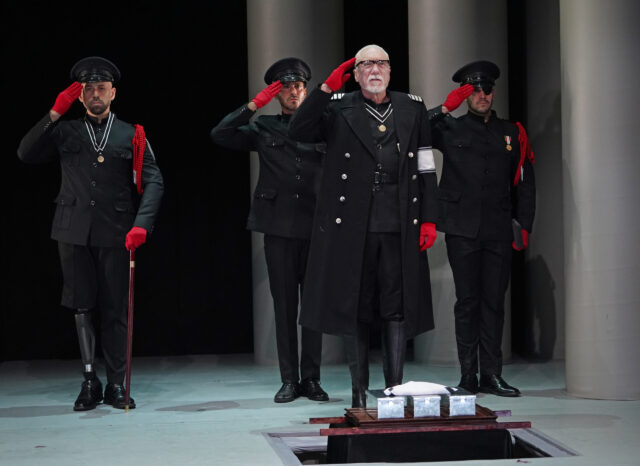
Patrick Page stars as the title war hero in Red Bull’s Titus Andronicus (photo by Carol Rosegg)

TITUS ANDRONICUS
The Pershing Square Signature Center
Alice Griffin Jewel Box Theatre
480 West 42nd St. between Tenth & Eleventh Aves.
Tuesday – Sunday through May 3, $49-$129
www.redbulltheater.com

On my way into the Alice Griffin Jewel Box Theatre at the Signature Center to see Red Bull’s adaptation of William Shakespeare’s rarely performed Roman play Titus Andronicus, I saw the company’s always-smiling founding artistic director, Jesse Berger, who was greeting ticket holders by the doors. I told him how much I had enjoyed the troupe’s 2016 production of Coriolanus at Barrow Street, a bloody and violent retelling of another of the Bard’s seldom-staged plays, and how terrific Patrick Page was in it, portraying the peace-seeking mediator Menenius Agrippa.

I pointed at the poster for Titus Andronicus, which depicts Page, who plays the title character, in a chef’s hat, surrounded by blood.

I said to Jesse, the director of the new show, “Looks like you’re promising sharp knives and lots of blood again.”

He responded, “I don’t think you’ll be disappointed.”

I wasn’t.
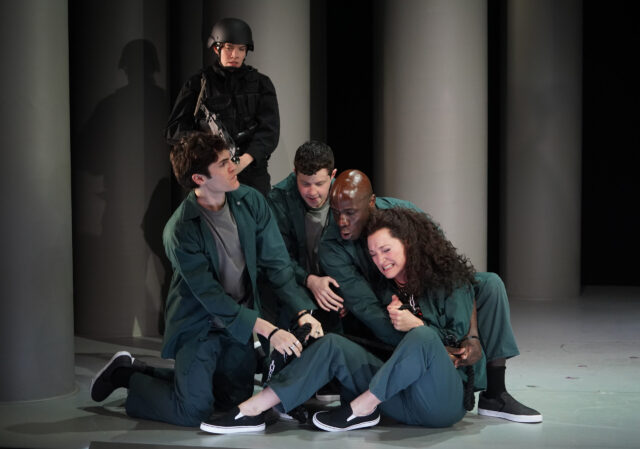
The Goths seek revenge after an execution in bloody Shakespeare adaptation (photo by Carol Rosegg)

Red Bull’s Titus Andronicus is a glorious triumph, a bloody and violent — and hilarious — tale of power and revenge involving two warring sides, the Andronici and the Goths. A handy family tree is included in the program to help identify who’s who, although the narrative makes that clear as well.

The plot unfolds in an indeterminate time; the language is all Shakespeare’s, but there are guns, Budweiser tallboys, wristwatches, military and modern dress, sneakers, a paperback of Ovid’s Metamorphosis, and a hardbound copy of Alexandre Dumas’s 1846 novel The Count of Monte Cristo, one of the most famous revenge tales ever written. Beowulf Boritt’s set features about a dozen rounded pillars; the actors occasionally bring chairs and tables on and off and wander through the aisles and in the balcony, and there is a small trapdoor that serves multiple purposes.

The emperor has died, and his eldest son, Saturninus (Matthew Amendt), declares to the people that he will assume the throne, but his younger brother, Bassianus (Howard W. Overshown), believes that there should be a free and fair election, and the tribune Marcia Andronicus (Enid Graham) makes a case for her brother, Titus, a returning war hero, to become emperor. Bassianus is engaged to Titus’s only daughter, Lavinia (Olivia Reis), and knows that his brother is a vain, childish man unlikely to be a worthy ruler.

Titus then arrives with his three remaining sons, who all fought bravely in the war: Lucius (Anthony Michael Lopez), Mutius Valentine (Anthony Michael Martinez), and Quintus (Zack Lopez Roa). They are followed by five chained prisoners: Tamora (Francesca Faridany), queen of the Goths; her three sons, Alarbus (Blair Baker), Chiron (Jesse Aaronson), and Demetrius (Adam Langdon); and her secret lover, Aaron (McKinley Belcher III), a Moor. Titus announces that Alarbus, the queen’s eldest son, will be sacrificed as punishment for the Goths’ treachery and the death of three of Titus’s sons.

Tamora begs for mercy with a heart-wrenching plea: “Sufficeth not that we are brought to Rome, / To beautify thy triumphs and return / Captive to thee and to thy Roman yoke, / But must my sons be slaughtered in the streets / For valiant doings in their country’s cause? / O, if to fight for king and commonweal / Were piety in thine, it is in these. / Wilt thou draw near the nature of the gods? / Draw near them then in being merciful. / Sweet mercy is nobility’s true badge. / Thrice noble Titus, spare my first-born son.”

Alarbus is then slain, his blood spurting on one of the pillars.

Titus surprises everyone by declining to seek the throne, throwing his support to Saturninus, who immediately accepts and proclaims that Lavinia will be his bride, even though she is betrothed to his brother. Titus agrees to give her to the new emperor, but Lavinia and Bassianus refuse, and Saturninus instead chooses Tamora for his bride, setting in motion a series of brutal, vengeful atrocities, each side trying to outdo the other in violent displays that splatter the pillars and floor with more and more blood.
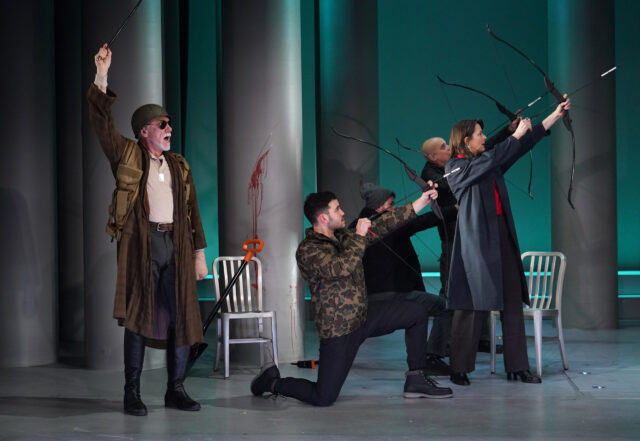
Titus Andronicus (Patrick Page) leads a hunt for the Goths in Jesse Berger’s revelatory adaptation (photo by Carol Rosegg)

Titus Andronicus, which Shakespeare may have cowritten with George Peele and is not based on real history, has been adapted into a major film only once, the 1999 Titus, directed by Julie Taymor and starring Anthony Hopkins as Titus, Jessica Lange as Tamora, Alan Cumming as Saturninus, and Harry Lennix as Aaron. The Public has presented it at the Delacorte as part of its Shakespeare in the Park series only twice, in 1967 and 1989, the former with Jack Hollander, David Birney, Olympia Dukakis, Charles Durning, Moses Gunn, David Clennon, and Raul Julia, the latter with Donald Moffat, Bill Camp, Keith David, Kate Mulgrew, and Rainn Wilson.

Berger (The Government Inspector, Volpone) brings it back to life, directing with a sly hand while mixing a healthy dose of comedy into the fierce carnage, which involves rape and numerous body parts being disconnected from their owners. Amendt (Coriolanus, ‘Tis Pity She’s a Whore) plays Saturninus as a whiny fool; Belcher, who just starred in Coriolanus at TFANA, winks knowingly several times at the audience, eliciting much-needed and unexpected laughter; Page (All the Devils Are Here: How Shakespeare Invented the Villain, Hadestown) imbues Titus’s descent into madness with an occasional Looney Tunes glee; and the spurting of blood and chopped-off limbs are reminiscent of Monty Python’s “Salad Days” sketch, in which a garden party turns into a hilarious massacre as directed by Sam Peckinpah.

But that doesn’t mean that this Titus Andronicus is easy to watch; the rape scene is among the most savage and intense I have ever seen onstage, and no character emerges squeaky clean. Berger has trimmed it down to a lean two hours (plus intermission), and there are a couple of weak links in an otherwise exemplary cast led by the majestic Page, a true New York City treasure, a boldly ferocious Belcher, and a fine Overshown in two roles.

The full design crew deserves kudos, from Boritt’s set, Emily Rebholz’s costumes, and Jiyoun Chang’s lighting to Adam Wernick’s music, Wernick and Shannon Slaton’s sound, and Anya Kutner’s props.

In Taylor Mac’s fun, frenetic 2019 Broadway debut, Gary: A Sequel to Titus Andronicus, Santo Loquasto’s Tony-nominated set was highlighted by a tremendous mound of corpses and body parts. After seeing Red Bull’s Titus Andronicus at the Signature Center, you’ll understand that all the more — and might even be able to identify some of the dead bodies and detached limbs.

[Mark Rifkin is a Brooklyn-born, Manhattan-based writer and editor; you can follow him on Substack here.]

SOUL SEARCHING: THE LIFE AND TIMES OF ARTEMISIA GENTILESCHI AND BABE

The Light and the Dark looks at the life and times of Italian painter Artemisia Gentileschi (photo by James Leynse)

THE LIGHT AND THE DARK (THE LIFE AND TIMES OF ARTEMISIA GENTILESCHI)
Primary Stages, 59E59 Theaters
59 East 59th St, between Park & Madison Aves.
Tuesday – Sunday through December 15, $66-$131
www.59e59.org

After seeing Kate Hamill’s The Light and the Dark (the life and times of Artemisia Gentileschi) and Jessica Goldberg’s Babe on the same day, I was hard-pressed to figure out why every woman doesn’t just go all Judith on their own Holofernes. While both plays explore misogyny, sexism, control of a woman’s body, and the dominant patriarchy in the arts, one does so much better than the other, although neither is ultimately successful.

At 59E59, Primary Stages is presenting The Light and the Dark, about Artemisia Gentileschi, the early Italian Baroque painter whose career was temporarily derailed by sexual assault and gender discrimination. Hamill’s previous feminist-driven works include stirring adaptations of Little Women, Pride and Prejudice, Sense and Sensibility, Vanity Fair, and Dracula. She has portrayed such characters as Becky Sharp, Elizabeth Bennet, Meg March, Renfield, and Marianne Dashwood; in The Light and the Dark she inhabits the title role with a tender ferociousness as Artemisia matures from a precocious seven-year-old girl to one of the most talented and important artists of her era, even as she’s held back by men and social mores every step of the way.

Artemisia knows what she wants from a young age. Her Tuscan-born father, Orazio (Wynn Harmon), is a naturalistic, technically skillful painter who delivers precisely what his patrons desire. Admitting he doesn’t know how to raise a girl on his own, he decides to send her to a nunnery for her education, telling his daughter, “Think, if I build a big enough fortune and you mark the sisters well enough, you may be a fine lady — the wife or the mother of the great artist of tomorrow!” Misia, as he calls her, responds, “I don’t want to be a lady! I am I, your Artemisia. And I want to be a painter!”

When she is nine, Orazio lets Misia begin working in his studio, and six years later she is allowed to start painting alongside Agostino Tassi (Matthew Saldívar) and Cosimo Quorli (Jason O’Connell), which could be considered scandalous, especially when Orazio brings in a nude model, a sex worker named Maria (Joey Parsons). Soon the arrogant Agostino takes a personal interest in Artemisia, who is proving to be an exceptional artist with a unique perspective on traditional biblical scenes, and scandal does indeed ensue, against Artemisia’s will.

Artemisia Gentileschi has been undergoing a renaissance of her own this century, a heroic figure for the current time, spurred on by the 2002 Met exhibit “Orazio and Artemisia Gentileschi: Father and Daughter Painters in Baroque Italy,” such books as Mary D. Garrard’s Artemisia Gentileschi and Feminism in Early Modern Europe and Gina Siciliano’s I Know What I Am: The Life and Times of Artemisia Gentileschi, and such plays as Sara Fellini’s NEC SPE / NEC METU and Howard Barker’s Scenes from an Execution. Artemisia often repeats “I, I, I” when talking about herself, trying to establish an identity that her father and his friends will not allow her to have because she is a woman, and she is prone to cursing like a sailor, dropping F-bombs again and again.

“Before Caravaggio, painters / Started with the light. / Blank canvas, blank fresco, / And painted layers upon that blankness — / But Caravaggio starts in the darkness / And carves his way out from the shadows,” she says in a way that refers to her own situation. She also declares, as if for all women, “Why should I suffer for nothing? / If I cannot undo it — and I cannot undo it. . . . / I can make it right. / I can control it.”

The show is visually beautiful, from Brittany Vasta’s alluring studio set to Jen Caprio’s lovely period costumes, Seth Reiser’s lighting, and Kylee Loera’s projections of such masterworks by Artemisia as Judith and Holofernes, Susanna and the Elders, The Allegory of Inclination, and Madonna and Child. The cast is effective, but Hamill and director Jade King Carroll too often get caught up in overly earnest monologues and preachy explications; Artemesia speaks at the audience instead of to them. Several didactic art lectures could have been cut or shortened — the play is too long at two and a half hours with intermission — in favor of the narrative itself, which can be compelling.

However, Carroll and Hamill do make The Light and the Dark feel relevant to what is happening today, particularly in the wake of the overturning of Roe v. Wade. Both female actors, Hamill as Artemisia and Parsons as Maria, ultimately take ownership of their bodies away from the men while subverting the male gaze; each gets fully nude, standing boldly onstage, not mere naked subjects to be depicted on canvas but real women shouting out their independence. They might not be holding daggers, preparing to cut off a perpetrator’s head, but you can see and feel their weapons nonetheless.

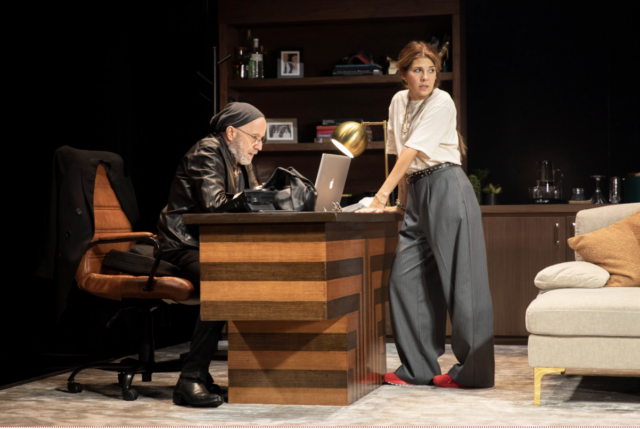
Gus (Arliss Howard) and Abby (Marisa Tomei) wonder about a new employee in Babe (photo by Monique Carboni)

BABE
The New Group at the Pershing Square Signature Center
The Alice Griffin Jewel Box Theatre
480 West 42nd St. between between Ninth & Tenth Aves.
Tuesday – Sunday through December 22, $99-$119
thenewgroup.org

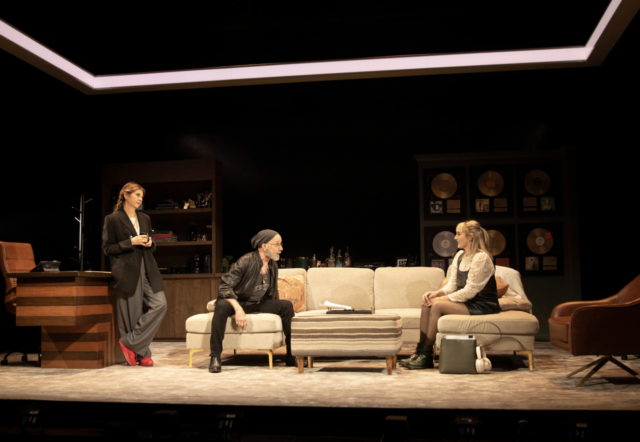
Jessica Goldberg’s Babe has much in common with Kate Hamill’s The Light and the Dark (the life and times of Artemisia Gentileschi); instead of taking place in the world of Baroque painting, it is set in the contemporary music industry, where an old-school record producer, Gus (Arliss Howard), spews sexism and misogyny in his search for artists with a soul. He gives short shrift to his longtime right-hand person, Abby (Marisa Tomei), who discovered 1990s sensation Kat Wonder (Gracie McGraw) but has never received the recognition she deserves.

When a young Gen Z woman, Katherine Becker (McGraw), comes in for a job interview and ultimately gets hired, each character’s flaws become exposed, as well as their strengths, but it is hard to care in this lackluster story searching for its own purpose, never filling in the blank canvas it started with.

Comparisons abound between the two shows. “I don’t want to make people feel great, I want to destroy shit! I want the girls in the front, moshing the fuck out of each other!” Kat declares in a way Gentileschi never would have. Abby, who is gay, explains, “People think if you’re a certain age without a partner, you’re alone. But it’s not true,” evoking Artemisia saying, “I have no interest — in marrying,” but with less conviction. While Hamill empowers Artemisia, having her stand onstage naked, using her body as a model for the self-portrait Allegory of Inclination, Goldberg makes Abby sexless, having had a double mastectomy as a result of cancer. “So it doesn’t really make me feel —” she tells Katherine, implying she lacks physical and emotional desire and confidence. While The Light and the Dark references Caravaggio, Michelangelo, Donatelli, and Botticelli, Babe brings up Liz Phair, Bob Dylan, Joan Jett, and Kathleen Hannah.

At one point in The Light and the Dark, men assume that Artemisia did not actually paint anything, that a woman is incapable of creating high-quality art and that someone else must be behind it all, which is one of the reasons Artemisia signs her name on her canvases “in bold type . . . And wait for my accolades to roll in!” In Babe, a New Group production at the Pershing Square Signature Center, Abby eventually asserts, “I want my NAME. On the record.” As women in fields run by men, neither receives those accolades, but Abby has settled for compromising where Artemisia keeps up the fight.

Marisa Tomei, Arliss Howard, and Gracie McGraw star in the New Group’s Babe
(photo by Monique Carboni)

During the job interview, amid outdated questions that would drive a human resources department to drink, Gus asks Katherine, “Do you have a soul?” Unfortunately, it’s Babe itself that lacks heart and soul. Even at only eighty-five minutes it drags on, like side two of an old record that doesn’t live to up to the flip side.

Derek McLane’s office set is attractive and BETTY’s original music is fine, but the narrative and time shifts are bumpy; director Scott Elliott never gets a handle on the rhythm. Interestingly, although Gus has a disdain for groups, preferring solo artists performing songs written by others, he wears a Killers T-shirt, the Las Vegas band led by lead singer and chief songwriter Brandon Flowers. The costumes, which never change, are by Jeff Mahshie.

Whereas it is obvious why Hamill made The Light and the Dark, celebrating a woman who faced tremendous obstacles in order to express herself through her remarkable art, it is decidedly unclear what points Goldberg (Refuge, Good Thing) is trying to make in Babe; it’s like a concept album without a concept. It purports to be about “the American spirit of individualism,” as Abby says, as well as the resistance to the DEI movement, but it’s as flat as an LP that is not going to go gold or platinum anytime soon, instead gathering dust on a shelf.

[Mark Rifkin is a Brooklyn-born, Manhattan-based writer and editor; you can follow him on Substack here.]
ALL OF ME

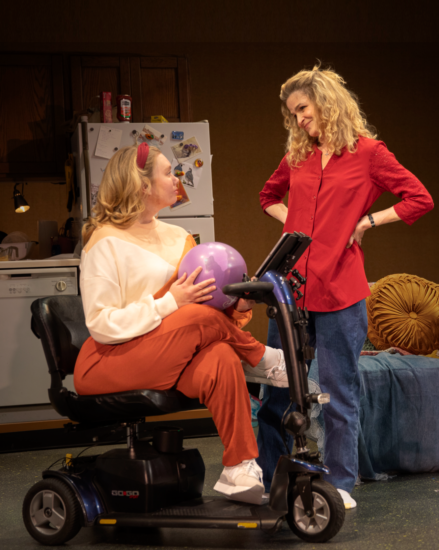
Lucy (Madison Ferris) and Alfonso (Danny J. Gomez) explore a possible relationship in All of Me (photo by Monique Carboni)

ALL OF ME
The New Group at the Pershing Square Signature Center
The Alice Griffin Jewel Box Theatre
480 West 42nd St. between Ninth & Tenth Aves.
Tuesday – Saturday through June 16, $31-$89
thenewgroup.org

Laura Winters’s All of Me is an endearing and moving romantic comedy about two young people who meet-cute at a hospital in Schenectady and explore a potential relationship that is impacted by family and financial issues.

Lucy (Madison Ferris) was a teenage jazz singer who is now considering going to college. Alfonso (Danny J. Gomez) works in data science and modeling and has just relocated from Manhattan to Schenectady. She has a dark sense of humor, always ready with a no-holds-barred joke, while he is a more serious and straightforward person. Lucy lives in a house that is slowly falling apart, with her overprotective, conservative mother, Connie (Kyra Sedgwick); her older sister, Jackie (Lily Mae Harrington); and Jackie’s fiancé, Moose (Brian Morabito), a slacker trying to earn money by playing online poker and via other random methods. Alfonso lives with his overprotective mother, Elena (Florencia Lozano), a defense lawyer, and his unseen father, an investment banker, in a fancy home with a maid and driver.

It’s not quite Romeo and Juliet, West Side Story, or The Notebook, but it has an innate charm; it’s impossible not to root for these two attractive twentysomethings, despite all the impediments in their way.

Oh, and it just so happens that they both are in wheelchairs, communicating via text-to-speech technology that may be light-years beyond Stephen Hawking’s but still is perceptibly machine-created.

“What’s your favorite pre-set on your device?” Alfonso asks. The unpredictable Lucy replies, “‘Polly want a cracker!’ When I want to be disarming. And if some stranger is staring at me I use — ‘Hey dipshit, take a picture, it will last longer, and lasting longer is something your girlfriend told me you should work on.’ What’s yours?” The practical Alfonso answers, “It seems a bit lame now but — ‘To infinity and beyond.’”

Connie (Kyra Sedgwick) has a rare smile for Lucy (Madison Ferris) in New Group show (photo by Monique Carboni)

Lucy had a potential career as a jazz singer cut short when she was diagnosed with muscular dystrophy six years earlier, at sixteen. She is unable to stand on her own and is losing her ability to speak and use her hands as the disease progresses. Alfonso was injured in an accident when he was six months old, is paralyzed from the waist down, and has limited use of his right hand. In real life, Ferris has muscular dystrophy, and Gomez was partially paralyzed in a mountain biking accident in 2016 that almost killed him.

While Alfonso has a support structure in place because of his parents’ wealth — they have a ritzy home specially outfitted for his needs, along with expensive art and furniture — daily existence for Lucy is more problematic. The wooden plank that allows her to get from one side of the house to the other is undependable, the dishwasher is broken, and Connie is working multiple jobs to make ends meet, doing nails at a salon and selling knives to housewives, receiving no help from her ex-husband, an opioid addict. Connie’s jobs fit her personality; she pretties up other women, then pulls out sharp weapons.

As older sister Jackie’s wedding approaches, the conflicts grow, including arguments about Lucy’s text-to-speech program. Connie is not happy with it, complaining, “Excuse me for missing the sound of my daughter’s actual, non-weird-robot voice.” Jackie is hoping that Lucy might be able to sing at the wedding. But Lucy, always quick with a joke, explains, “But I enjoy sounding like futuristic AI that waits until the end of the movie to lock you out of the spaceship.”

Winters (Coronation, Gonzo) is a young, energetic writer who documented the process of making All of Me on TikTok with an infectious enthusiasm that comes through in director Ashley Brooke Monroe’s (Julius Caesar, Tommy’s Girls) spirited production. Ferris (The Glass Menagerie,) is hilarious as Lucy, who refuses to wallow in self-pity but understands her situation all too well, while Gomez, in his theatrical debut, is tender and affable as Alfonso, who is at first shocked by Lucy’s boldness and pointed joking but comes to care for her.

@laurawinters12

Sedgwick (Twelfth Night, Ah, Wilderness!) makes a potent return to theater after an absence of more than two decades as the wine-drinking, cigarette-smoking mother whose life has not turned out as planned as she struggles to get by every day. Although she wants the best for her children, it has to be on her terms, not theirs. In her off-Broadway debut, Harrington sparkles as Jackie, sensitively portraying a sibling in a family dynamic that often makes her second fiddle to her sister, while Morabito (The Panic of ’29, Othello) is appropriately bedraggled as the ne’er-do-well, well-named Moose. Lozano (Brooklyn Laundry, One Wet Brain) is graceful as the fashionable Elena.

All of Me, a New Group production at the Pershing Square Signature Center through June 16, is a classic opposites attract rom-com and dysfunctional family drama, although the class difference gets overdone, emphasized by Brett Banakis and Edward T. Morris’s sets and Sarah LeFeber’s costumes. The show is reminiscent of Cost of Living, Martyna Majok’s 2022 Broadway transfer about a wealthy Harvard-Princeton man with cerebral palsy and a divorced quadriplegic woman, but that successful play bordered on becoming trauma porn, concentrating on the dangers of being disabled and feeling helpless. All of Me is much more focused on characters aiming to be independent.

The 1931 title song, written by Gerald Marks and Seymour Simons and performed by such jazz legends as Paul Whiteman and His Orchestra, Ella Fitzgerald, Louis Armstrong, and Billie Holiday, contains the following lines: “All of me / Why not take all of me / Can’t you see / I’m no good without you / Take my lips / I want to lose them / Take my arms / I’ll never use them.” Those lyrics have never had such resonance as in Winters’s poignant and powerful play.

[Mark Rifkin is a Brooklyn-born, Manhattan-based writer and editor; you can follow him on Substack here.]

LETTERS FROM MAX, a ritual

Letters from Max follows the epistolary relationship between a teacher and her student (photo by Joan Marcus)

LETTERS FROM MAX, a ritual
The Pershing Square Signature Center
The Alice Griffin Jewel Box Theatre
480 West 42nd St. between Tenth & Eleventh Aves.
Tuesday – Sunday through March 26, $49-$139
212-244-7529
www.signaturetheatre.org

As you enter the Alice Griffin Jewel Box Theatre at the Signature to see Sarah Ruhl’s Letters from Max, a ritual, a quote from Max Ritvo in handwritten cursive is projected on the back wall of the stage: “Even present tense has some of the grace of past tense, what with all the present tense left to go.” Unfortunately, there was not a lot of present tense left in Ritvo’s too-short life, but his legacy is preserved in the moving play, which centers around the letters, texts, voicemails, and conversations the young, enthusiastic poet had with Ruhl, the award-winning writer of such plays as In the Next Room (or The Vibrator Play) and The Clean House.

In 2012, Ritvo was accepted into Ruhl’s playwriting class at Yale. That began a four-year friendship in which the two shared an intimate and emotional correspondence as Max faced a recurrence of his pediatric cancer, Ewing’s Sarcoma, but did so with charm, whimsy, and hope. They discuss poetry, soup (“Soup is your religion,” Max tells Sarah), Halloween, various medical treatments, Einstein on the Beach, the streets of New York City, the afterlife, the existence of the soul, and reading and writing, with an enchanting honesty and humor.

The story is not a traditional tale of a mentor and mentee; Sarah and Max bring out the best in each other, both learning as their closeness deepens. “You know, in some ways, you are my teacher, not the other way around,” Ruhl says early on.

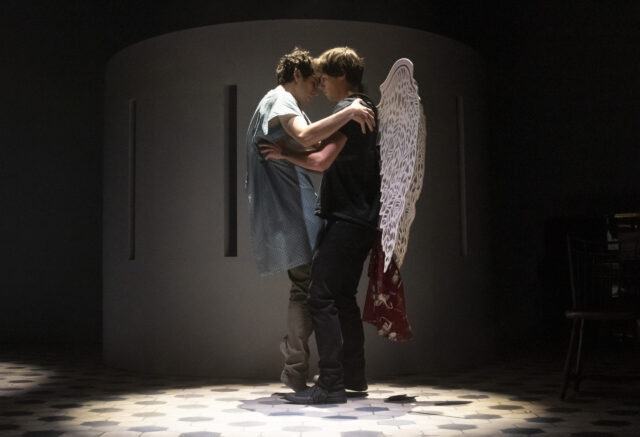
Sarah Ruhl (Jessica Hecht) and Max Ritvo (Zane Pais) explore life and poetry in Signature play (photo by Joan Marcus)

Hecht is terrific as Sarah, who she knows well, having appeared in Ruhl’s Stage Kiss at Playwrights Horizons in 2014 and pandemic microplay What do you Want What do you Want What do you Want for the Homebound Project; she portrays Ruhl with a tender confidence and just the right amount of mothering. A tireless actor who starred with Mikhail Baryshnikov in Arlekin Players Theatre’s hybrid Chekhov reimagining The Orchard last June and will next appear in David Auburn’s Summer, 1976 with Laura Linney on Broadway beginning April 4, Hecht has a quirky and distinct singsong voice that fits the character, especially when she recites poetry.

Ritvo is alternately played by Ben Edelman and Zane Pais; at each performance, whoever is not playing Max appears as Tattoo Artist Angel — based on a short work Max wrote in Ruhl’s class — and plays Ritvo’s songs, Edelman on piano, Pais on guitar. The actors do not attempt to mimic the real-life Sarah and Max but concentrate on bringing their essence to the stage, as related through their correspondence.

Marsha Ginsberg’s set is centered by a large semicircular object that recalls a zoetrope onto which S Katy Tucker projects words and images and opens up to reveal Max in a hospital bed. In a far corner is a piano; the soft lighting is by Amith Chandrashaker, with sound by Sinan Refik Zafar and costumes by Anita Yavich, highlighted by the angel outfit.

Ben Edelman and Zane Pais switch roles every night in Letters from Max (photo by Joan Marcus)

Ruhl first collected the material in the 2018 epistolary book Letters from Max: A Poet, a Teacher, a Friendship, then adapted it for the play, which was not initially planned but developed after Ruhl gave several public readings of the book. Director Kate Whoriskey (Sweat, How I Learned to Drive), who helmed Ruhl’s Dear Elizabeth, based on letters exchanged by poets Elizabeth Bishop and Robert Lowell, keeps the bells and whistles to a minimum; the show could use some trimming, however, as it gets repetitive and, at times, overly reverential. It would probably fare better at a streamlined ninety minutes instead of two hours with intermission.

In the lobby, the audience is encouraged to write a letter of their own to a loved one they think needs to hear from them. “I hope that this play can be an invitation into ritual or catharsis for whatever grief might be ailing you,” two-time Pulitzer finalist Ruhl explains. The Signature provides pen, paper, envelope, and even a haiku and will mail it for you.

Ultimately, the relationship between Max (Four Reincarnations, Aeons) and Sarah is summed up by these words from Max: “We’ll always know one another forever, however long ever is. And that’s all I want — is to know you forever.” Through these letters, the book, and now the play, Max gets his wish.

CAREFULLY TAUGHT: UNDERSTANDING AND INTERRUPTING CYCLES OF OPPRESSION IN TODAY’S CULTURE

CBS Sunday Morning contributor Nancy Giles will host New Group Now panel

CBS News Sunday Morning contributor Nancy Giles will host New Group Now panel on May 20

Who: Alina Das, Tahir Carl Karmali, Dr. Kevin Leo Yabut Nadal, Nancy Giles
What: New Group Now public forum
Where: The Alice Griffin Jewel Box Theatre at the Pershing Square Signature Center, 480 West 42nd St. between between Ninth & Tenth Aves.
When: Monday, May 20, free with advance RSVP, 7:00
Why: In conjunction with Jesse Eisenberg’s latest play for the New Group, Happy Talk, which opens May 16 at the Signature Center with the stellar cast of Marin Ireland, Tedra Millan, Daniel Oreskes, Nico Santos, and Susan Sarandon, the theater company is hosting “Carefully Taught: Understanding and Interrupting Cycles of Oppression in Today’s Culture” on May 20 at 7:00. The free panel discussion explores the oppression experienced by exploited, vulnerable, and underrepresented people in America, specifically immigrants, refugees, and asylum seekers. (In the play, Ireland portrays an undocumented immigrant taking care of a sick elderly woman.) The talk features NYU School of Law professor Alina Davis, New York-based Kenyan visual artist Tahir Carl Karmali, and psychology professor Dr. Kevin Leo Yabut Nadal; writer, actress, and political pundit Nancy Giles moderates.

CLUELESS THE MUSICAL

(photo by Monique Carboni)

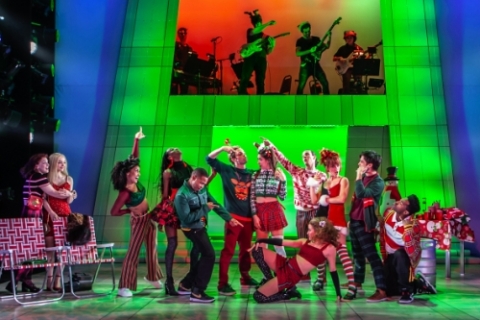
Amy Heckerling has adapted her 1995 hit comedy, Clueless, into an off-Broadway musical (photo by Monique Carboni)

The New Group at the Pershing Square Signature Center
The Alice Griffin Jewel Box Theatre
480 West 42nd St. between between Ninth & Tenth Aves.
Through January 12
www.thenewgroup.org
www.signaturetheatre.org

Amy Heckerling’s eagerly anticipated musical adaptation of her 1995 hit comedy, Clueless, is, well, I hate to say, pretty clueless. The sold-out New Group production, which closes tonight at the Signature Center, tries to recapture the hip success of the film, a contemporary retelling of Jane Austen’s Emma, but instead it is a dreary, cliché-ridden mess that fails to provide the necessary pizzazz that energized, for example, Tina Fey’s Broadway musical version of her 2004 movie, Mean Girls. Heckerling, whose directorial debut was another teen giant, Fast Times at Ridgmont High (she’s also made several films in the Look Who’s Talking series and the 2000 disappointment Loser), brings back the whole gang for the musical, centered around superficial fashion-plate Cher (Dove Cameron), who decides to become a matchmaker at posh Beverly Hills High with her bestie, Dionne (Zurin Villanueva), starting with the seemingly implacable Mr. Hall (Chris Hoch) and the mousey Mrs. Geist (Megan Sikora).

(photo by Monique Carboni)

Cher (Dove Cameron) and Dionne (Zurin Villanueva) hatch out another plan in Clueless (photo by Monique Carboni)

Cher, whose father, Mel (Chris Hoch), is a master litigator and whose former stepbrother, Josh (Dave Thomas Brown), is considering law as a career as well, tries her negotiating skills to get better grades from several teachers while also taking on scruffy new student Tai (Ephie Aardema) as a project. Tai is interested in stoner Travis (Will Connolly), but Cher wants to see her with stud muffin Elton (Brett Thiele). Cher herself falls hard for hot new guy Christian (Justin Mortelliti); Dionne, however, is stuck with her longtime boyfriend, Murray (Gilbert L. Bailey II), who doesn’t exactly treat her right. Also making appearances are such peripheral characters from the film as gym teacher Ms. Stoeger (Sikora), stuck-up plastic surgery lover Amber (Tessa Grady), students Summer (Talya Groves) and Sean (Darius Jordan Lee), an unfortunate driving instructor (Hoch), and Cher’s maid, Lucy (Danielle Marie Gonzalez). Passing references to contemporary political correctness are scattered throughout the ragged narrative, accompanied by uninspired projections. (Did they spell “Goverment” that way on purpose, or is it a mistake they never fixed?)

The cast never comes together to form a cohesive whole the way the film actors did; of course, the movie was spoiled with Alicia Silverstone, Stacey Dash, Brittany Murphy, Paul Rudd, Dan Hedaya, Wallace Shawn, Julie Brown, Donald Faison, Breckin Meyer, and Jeremy Sisto. Heckerling, who wrote the book, and director Kristin Hanggi can’t achieve any flow, while Kelly Devine’s choreography is occasionally fun but mostly unmemorable. Amy Clark’s costumes are fashionably clever, even making their way into Beowulf Boritt’s set design. The real problem, however, lies in the music and lyrics. Heckerling takes ’90s favorites by Ace of Base, the Spin Doctors, TLC, Des’ree, Michael Bolton, and others and rewrites the lyrics to match the story, but the new words fail to ignite, too often coming off as silly and trite or overly gimmicky. For example, MC Hammer’s “U Can’t Touch This” is turned into “She Can’t Hit This,” as the female students struggle to play tennis in gym class. (“I-I-I-I hate P.E. / [It’s] so lame / I’m gonna say I got menstrual pain,” Dionne sings.)

Two songs that were featured in the movie show up, Jill Sobule’s “Supermodel” (with an added reference to Mean Girls) and the Muffs’ version of Kim Wilde’s “Kids in America,” but the latter feels like it came right out of Rock of Ages, which Hanggi directed and Devine choreographed. Reviving Austen’s classic jewel of a story about a matchmaker whose innocent arrogance requires a comeuppance, a young woman who sees all but can’t see herself, is never a bad idea, but in this case the ’90s setting for that gem just seems dated and uninspired. Perhaps that’s what’s just not right about Clueless the Musical; it’s too much of a paint-by-numbers production, with little originality or uniqueness. It’s staged so enthusiastically that you want to love it — Cameron’s nonstop energy is reminiscent of a young Kristin Chenoweth — but it continually lets you down, much like many kids’ high school experience.

THE TRUE

(photo by Monique Carboni)

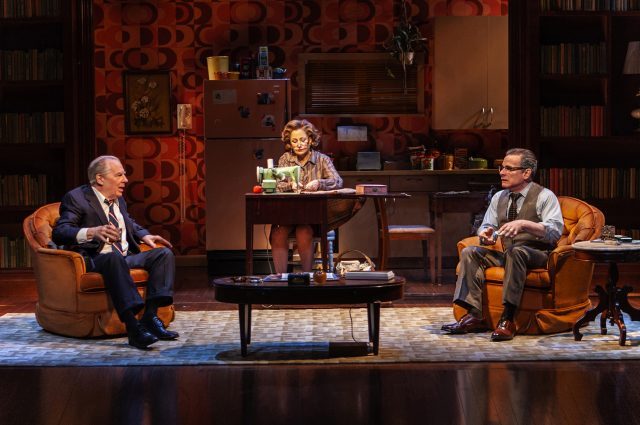
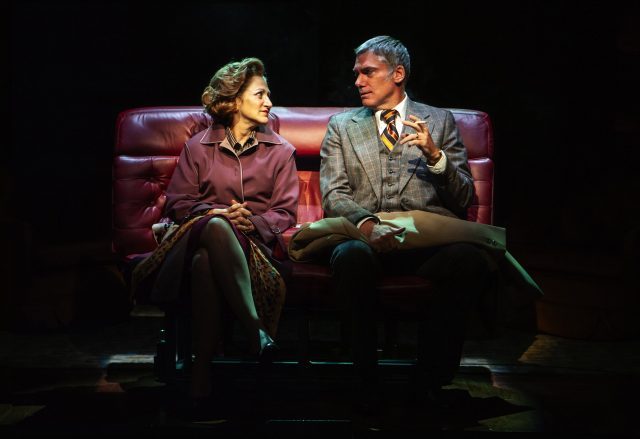
Michael McKean, Edie Falco, and Peter Scolari star in New Group world premiere at the Signature Center (photo by Monique Carboni)

The New Group at the Pershing Square Signature Center
The Alice Griffin Jewel Box Theatre
480 West 42nd St. between between Ninth & Tenth Aves.
Tuesday – Sunday through October 28, $30-$125
www.thenewgroup.org
www.signaturetheatre.org

Obie-winning playwright Sharr White and director Scott Elliott manage to make a story about the 1977 mayoral election in Albany, New York, tense and exciting in The True, a world premiere from the New Group that opened tonight at the Pershing Square Signature Center. A fictionalized version of real events, the vastly entertaining play opens as Erastus Corning II (Michael McKean), who has been mayor of the capital of New York State since 1941, is facing a serious challenge to his long reign following the death of Democratic party leader Dan O’Connell. State senator Howard C. Nolan (Glenn Fitzgerald) is taking on Corning, with the support of Charlie Ryan (John Pankow), who wants to be the new party boss. But tough-talking fixer Dorothea “Polly” Noonan (Edie Falco) isn’t about to let that happen. Noonan, a foul-mouthed firebrand, pulls a lot of strings behind the scenes, and her down-and-dirty, no-holds-barred style gets things done as her calm, easygoing husband, Peter (Peter Scolari), stays out of it all. “I don’t hate politics, by the way. I just want nothing to do with it,” he says, even when confronted with rumors that Erastus, who is married to the mysterious Betty (Tracy Shayne), and Polly are longtime lovers. Desperate for Erastus to beat Nolan, who is leading big in the polls, Polly taps young Bill McCormick (Austin Cauldwell) to be named committeeman and support Erastus within the party machine. “Fuck that fucking Charlie Ryan,” she says. But when Erastus starts questioning whether he still wants Polly on his team, she practically explodes, while also hurting inside, since she has devoted her life to him and the Democrats.

(photo by Monique Carboni)

Dorothea “Polly” Noonan (Edie Falco) has some harsh things to say to Howard C. Nolan (Glenn Fitzgerald) in The True (photo by Monique Carboni)

Falco (Frankie and Johnny in the Clair de Lune, Side Man) is exceptional as Noonan, a kind of cross between Carmela Soprano from The Sopranos and Jackie Peyton from Nurse Jackie, two roles that earned her Emmys. (In fact, much of the cast and creative team have major television ties: Scolari starred on Bosom Buddies, The Bob Newhart Show, and Girls, McKean was on Laverne & Shirley and SNL and is currently on Better Call Saul, Pankow is a veteran of Mad About You and The Days and Nights of Molly Dodd, and White is a writer and producer for The Affair and Sweetbitter.) Falco plays Noonan with a brawling charm, whether she’s sitting at her sewing machine making a culotte or going face-to-face with her political enemies. White (The Other Place, Annapurna) gets right to the heart of the matter, showing how politics has changed over the decades, implying why the Democrats have been losing power in recent years. “Regular people,” Noonan tells Erastus. “They don’t give a shit what you do behind closed doors so long as their lives are working. But their lives aren’t working anymore. Committeeman. Used to know every. Single. Voter. In his district. Every single one. That voter had a problem, they told the committeeman, the committeeman went to the ward leader, the ward leader either solved it? Or went to Dan. And you know what happened at the end of the day? . . . It got taken care of.” Brief but telling references to shifting demographics, race, and women in politics reveal much as Noonan also makes clear that women are not treated the same as men in the political arena. “What I do for Erastus is no different than what you did for Dan. And yet I’m ostracized for it,” she tells Ryan.

(photo by Monique Carboni)

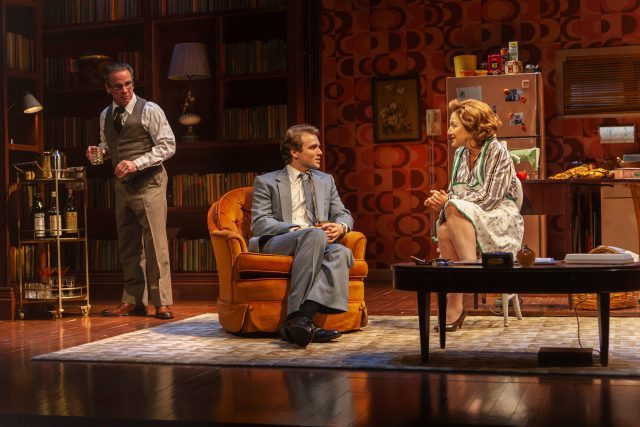
Dorothea “Polly” Noonan (Edie Falco) has plans for Bill McCormick (Austin Cauldwell) as her husband (Peter Scolari) looks on (photo by Monique Carboni)

McKean (The Little Foxes, Accomplice) and Scolari (The Foreigner, Hairspray) are both terrific, portraying best friends who try to keep politics — and Polly — from tearing them apart. New Group artistic director Elliott (Evening at the Talk House, Mercury Fur) expertly balances the humor amid powerful dramatic moments, never letting things go awry on Derek McLane’s elegant set, where small changes make dramatic differences. And watch out for a surprise, hilarious late scene that brings the house down — something that does not appear in the script. Kudos are also due Falco’s hair stylist and costume designer Clint Ramos, who capture 1977 in fabulous ways. Noonan represents a different time in the treatment of women, both personally and professionally; she might cook and sew, but she also curses and never backs down from a challenge, particularly from a man. It’s fascinating to imagine what Noonan, who died in November 2003 at the age of eighty-eight, would think of what’s going on in the political arena today, in Albany and the country itself; she would certainly be proud of her granddaughter, New York senator Kirsten Gillibrand, who calls her “my greatest political hero” and is keeping her grandmother’s legacy alive.