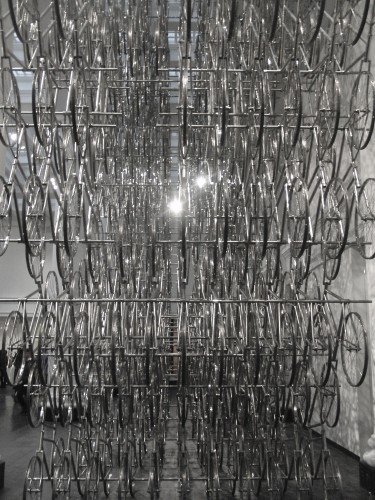
Ai Weiwei, “Stacked,” stainless-steel bicycles, 2014 (photo by twi-ny/mdr)
Brooklyn Museum
Morris A. and Meyer Schapiro Wing, fourth and fifth floors
200 Eastern Parkway at Washington St.
Wednesday – Sunday through August 10, $15
Art Off the Wall: “Ai Weiwei: According to What?,” July 24, $15, 6:00
718-638-5000
www.brooklynmuseum.org
www.aiweiwei.com
Over the last decade, Ai Weiwei has become the most famous, and arguably the most important, artist in the world. The multidisciplinary artist and activist, the son of a poet and activist father, helped design the National Olympic Stadium, aka the Bird’s Nest, for the 2008 Beijing Summer Games, was beaten by police in Chengdu in 2009, had his influential blog shut down by the Chinese government that same year, then was arrested in 2011, his whereabouts unknown for eighty-one days as people around the globe demanded his release. Through it all, Ai, who has been under house arrest since 2011, has remained steadfast in his dedication to challenge belief systems, question the status quo, and explore social issues in his art. All that and more is evident in the impressive “Ai Weiwei: According to What?,” a touring survey that is in the midst of its final stop at the Brooklyn Museum, where it continues through August 10. “Rather than thinking of my projects as art, they attempt to introduce a new condition, a new means of expression, or a new method of communicating,” Ai tells Kerry Brougher in a Q&A in the exhibition catalog, in which he references Ludwig Wittgenstein, Andy Warhol, Confucius, Donald Judd, and Sergei Eisenstein in a few short pages. “If these possibilities didn’t exist, I wouldn’t feel the need to be an artist.”
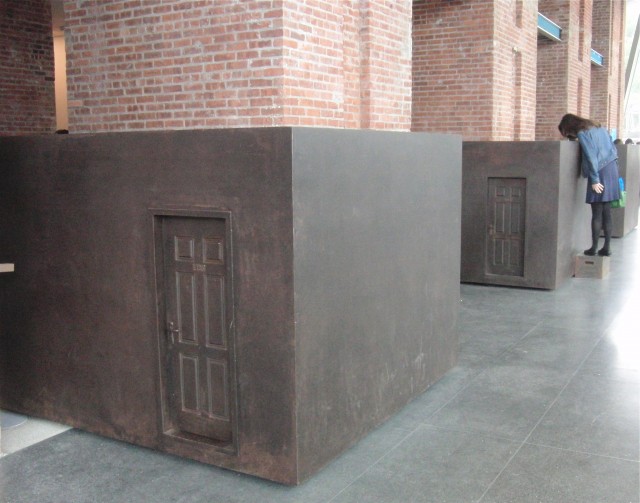
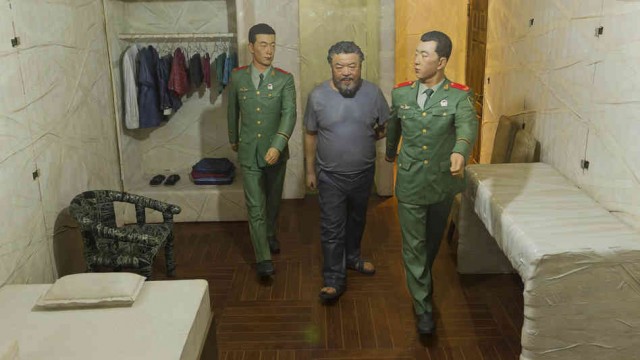
Ai Weiwei’s “S.A.C.R.E.D” invites visitors to see details of his eighty-one-day imprisonment (photo by twi-ny/mdr)
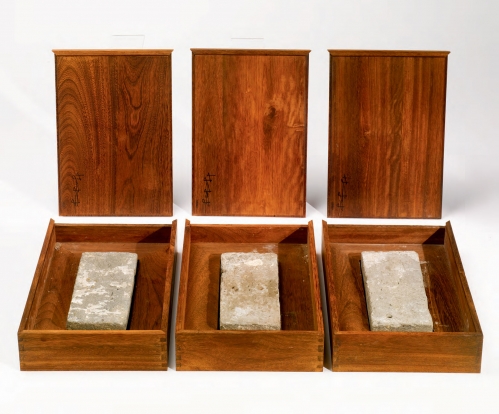
The exhibition began in 2009 at the Mori Art Museum in Tokyo but continued to morph as it made its way through North America toward Brooklyn, where several pieces have been added. Upon entering the Brooklyn Museum’s front lobby, visitors are greeted by “S.A.C.R.E.D.,” six iron boxes that contain detailed re-creations of scenes from Ai’s imprisonment — being led into his small cell by guards, being interrogated, eating, sleeping, using the bathroom, under constant surveillance — instantly turning the Beijing-based artist into a heroic, bigger-than-life figure. The rest of the show, spread across two upper floors, confirms that Ai is indeed a hero, his sculptures, photographs, films, repurposed found objects, and installations all having political, historical, and social relevance, dealing with individual freedom, human rights, and the search for the truth.
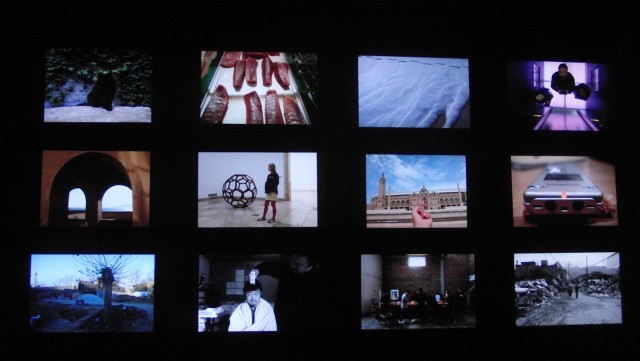
Video installations play a large role in Ai Weiwei exhibition (photo by twi-ny/mdr)
There is critical meaning behind every work, sometimes obvious, as in the marble “Surveillance Camera” and photographs in which Ai shoves his middle finger at Tiananmen and the White House, and often less clear at first, as in “He Xie,” a pile of more than three thousand porcelain crabs gathered at the center of a room. The piece references a dinner of river crabs that Ai, who could not attend because of his house arrest, organized shortly before his Shanghai studio was going to be torn down by the government; the title of the piece sounds like the word “harmonious,” which echoes the communist phrase “a harmonious society.” Ai consistently values people above material objects, mocking monetary worth. In “Dropping a Han Dynasty Urn,” three photographs depict him letting an ancient ceramic vase fall from his hands, smashing at his feet. “Stacked” consists of hundreds of silver bicycles in a dazzling array, not only evoking the popular means of transportation in China but the mass production of consumer goods, in this case made by a company called Forever.
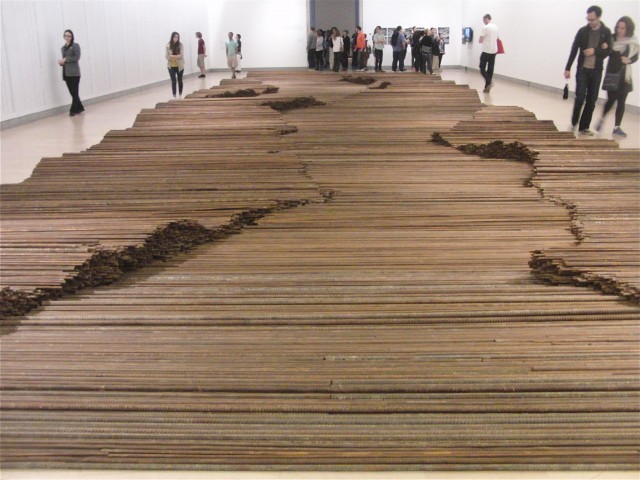
Ai Weiwei, “Straight,” seventy-five tons of steel rebar, 2008-12 (photo by twi-ny/mdr)
Ai has spent much of the last few years investigating the aftereffects of the 2008 Sichuan earthquake, in which poorly constructed buildings, including schools, resulted in approximately ninety thousand missing or dead men, women, and children. For “Straight,” Ai had workers take twisted steel rebar from the sites of the building collapses and pound them back into their original straight form, then laid them out in a vast landscape that appears unfinished, as more bodies need to be found and identified. The victims of the earthquake, who have been mostly ignored by the government, are given back their identities in “Sichuan Namelist,” an inkjet print listing casualties, and “Remembrance,” a nearly four-hour recording on which a voice reads the names of the students who died in the tragedy. The children are also memorialized in “Snake Ceiling,” in which hundreds of children’s backpacks form a serpentine figure lurking above.
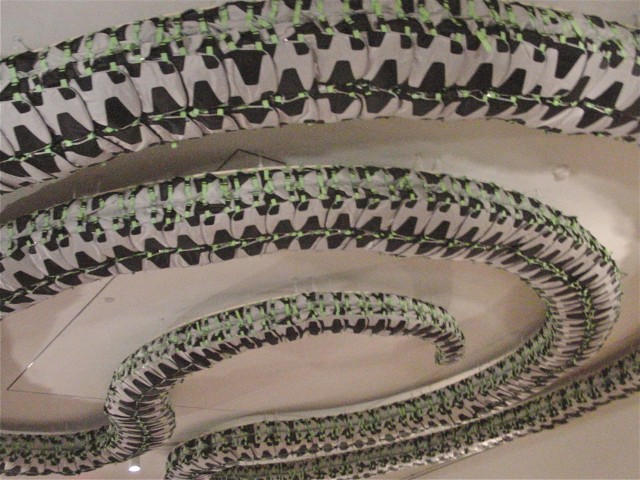
Ai Weiwei, “Snake Ceiling,” backpacks, 2009 (photo by twi-ny/mdr)
“Ai Weiwei: According to What?” also includes dozens of Ai’s photographs from his time in New York City; repurposed furniture that comments on Chinese tradition and the actual map of the country; his film Stay Home!, about a woman who contracted AIDS from a blood transfusion when she was a little girl; the installation “Ye Haiyan,” in which Ai has collected the belongings of a women’s rights activist who keeps getting evicted from her home; a video documenting his “Fairytale” project, in which he brought 1,001 Chinese people, from all classes, to Documenta in Kassel; and works that detail his brain injury suffered at the hands of police. The exhibition is splendidly curated by Sharon Matt Atkins, allowing plenty of space for contemplation of these bold, inspiring works by an artist who is not afraid to speak his mind, fully aware of what the consequences might be. “The relationship between thought and action is the most important source of human wisdom and joy,” Ai says at the end of the catalog interview. “With both, the process of turning art into reality is the path to happiness. It’s like a game. Only through this process can we understand who we are. So the game will continue.” The captivating exhibition — which is positive and delightfully engaging despite the serious nature of so much of its subject matter — makes you want to be part of that game. On Thursday, July 24, there will be a special evening “Art Off the Wall” program, consisting of a talk by Matt Atkins at 6:00, a presentation and workshop by the Asian American Oral History Collective at 6:30, Kelly Zen-Yie Tsai’s multimedia spoken-word piece “Ai Weiwei: The Seed” at 7:30, and a Chinese calligraphy workshop and DJ set at 8:30. (To see Ai answer questions from museum visitors, go here.)
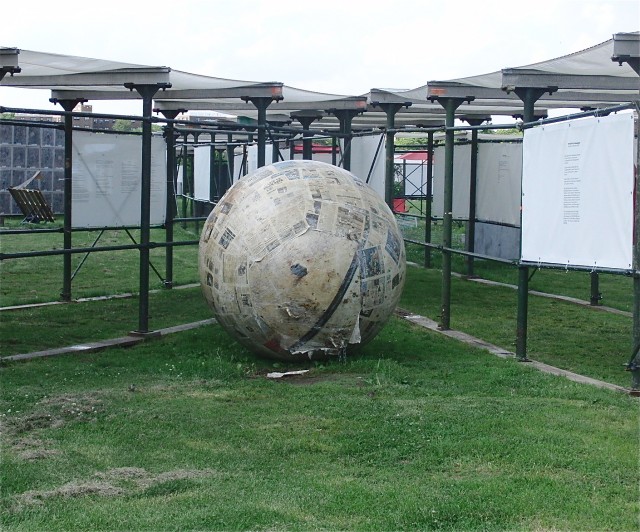
![Grayson Revoir followed Darren Bader instructions to “glue a [rectangular] table to the sky [table top up, somewhere not too close to the sky’s zenith]” (photo by twi-ny/mdr)](https://twi-ny.com/wp-content/uploads/2013/07/do-it-2-e1373117804585.jpg)
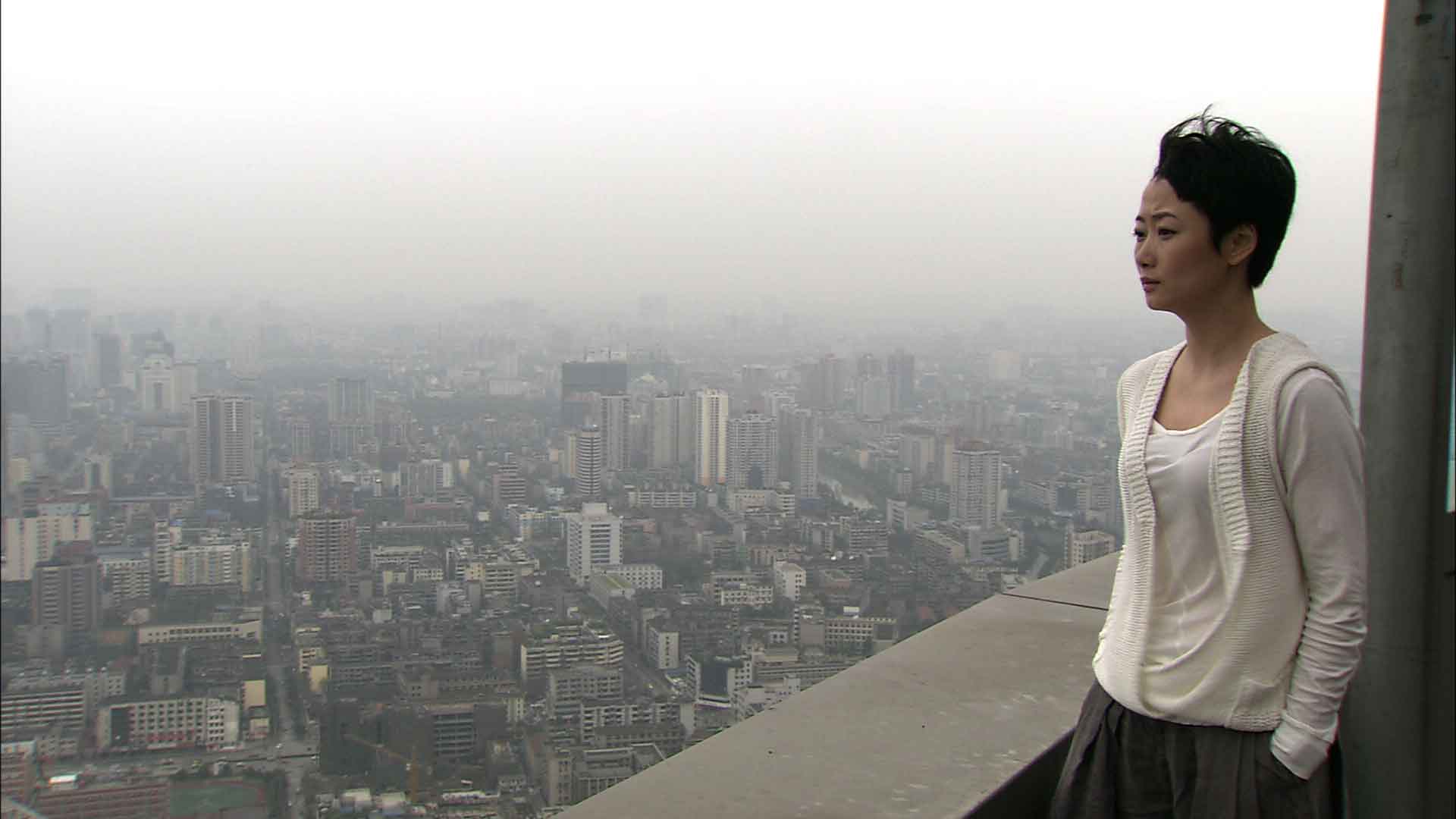
 With the imminent closing of a once-secret munitions plant known as Factory 420 in Chengdu, eight workers relate their unique stories in another fascinating look at capitalism in a changing China by Sixth Generation writer-director Jia Zhang-ke, who has previously investigated the transformations in his native country in such excellent works as Platform, Unknown Pleasures, The World, Useless, and Still Life. While five of the tales are told by actual male workers in their own words, three are fictional stories recited by female actors, including Joan Chen as Little Flower, Lv Liping as Hao Dali, and Jia regular Zhao Tao as Su Na. Jia sees the factory, which is being torn down to make way for a luxury apartment complex called 24 City, as a symbol of contemporary China, as the past is ripped away in favor of capitalist-based technological modernization and the celebration of wealth. By intermingling fact and fiction, as he does in most of his work, Jia creates a fascinating pseudo-documentary that also subtly touches upon women’s changing role in Chinese industry and society. 24 City is screening at MoMA May 22 & 29 as part of “Chinese Realities/Documentary Visions,” which continues through June 1 with such other examinations of contemporary China as Li Ning’s Tape, Ying Liang’s When Night Falls, Wu Wenguang’s Bumming in Beijing: The Last Dreamers, and Ai Weiwei’s Disturbing the Peace.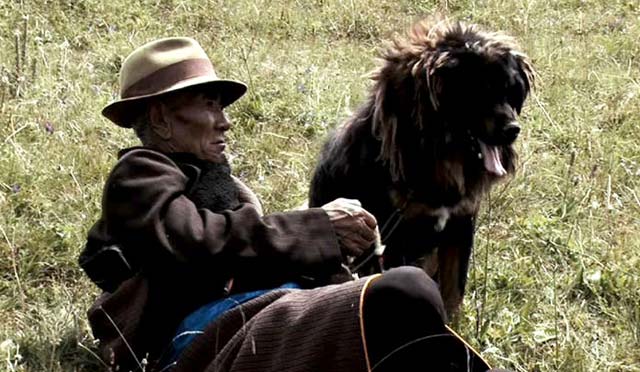
 Pema Tseden’s Old Dog is a beautifully told, slowly paced meditation on Buddhism’s four Noble Truths — “Life means suffering”; The origin of suffering is attachment”; “The cessation of suffering is attainable”; and “There is a path to the cessation of suffering” — that ends with a shocking, manipulative finale that nearly destroys everything that came before it. In order to get a little money and to save the family’s sheep-herding dog from being stolen, Gonpo (Drolma Kyab) sells their Tibetan nomad mastiff to Lao Wang (Yanbum Gyal), a dealer who resells the prized breed to stores in China, where they’re used for protection. When Gonpa’s father (Lochey) finds out what his son has done, he goes back to Lao Wang and demands the return of the dog he’s taken care of for thirteen years. “I’d sell myself before the dog,” he tells his son. And so begins a gentle tale of parents and children, set in a modern-day Tibet that is ruled by China’s heavy hand. Gonpa’s father doesn’t understand why his son, a lazy man who rides around on a motorized bike and never seems to do much of anything, doesn’t yet have any children of his own, so he pays for Gonpa and his wife Rikso, (Tamdrin Tso), to go to the doctor to see what’s wrong. Meanwhile, the old man keeps a close watch on his dog, wary that Lao Wang will to try to steal it again. Writer-director Pema Tseden (The Silent Holy Stones, The Search) explores such themes as materialism, family, and attachment in a lovely little film that sadly is nearly ruined by its extreme final scene. Old Dog is screening at MoMA May 15-20 as part of “Chinese Realities/Documentary Visions,” with Tseden taking part in a discussion with Asia Society film curator La Frances Hui after the 8:00 show on May 16 and with Hui and Chris Berry following the 7:00 show on May 18. The series continues through June 1 with such other films as Zhang Yuan’s Mama, Zhang Yimou’s The Story of Qiu Ju, Jia Zhangke’s 24 City, and Ai Weiwei’s Disturbing the Peace.