Tag Archives: abrons arts center

HERE I AM: A TRANS RABBI SHARES HER STORY IN BECOMING EVE

Tommy Dorfman stars as a trans rabbi trying to come out to her father in Becoming Eve (photo by Matthew Murphy)

BECOMING EVE
Abrons Arts Center Playhouse Theater
466 Grand St. at Pitt St.
Through April 27, $29.88-$130
212-598-0400
www.nytw.org
www.abronsartscenter.org

On the second day of Rosh Hashanah, the Jewish New Year, synagogues around the world read and discuss Genesis 22:1–24, the story of Abraham’s binding of his son Isaac on Mount Sinai, preparing him as a human sacrifice until an angel of G-d intervenes, replacing Isaac with a ram at the last moment. Known as the Akedah, the passage has been hotly debated for millennia by religious leaders, scholars, and laypeople, exploring issues of faith, obedience, familial responsibility, and the value of human life.

One line of thought considers whether Abraham, and perhaps Isaac as well, is aware that it is a test and that Abraham believed that G-d never planned on having him go ahead with the slaughter of the son who was born to him and his wife Sarah in their old age.

In Emil Weinstein’s debut play, the searing Becoming Eve, another interpretation comes to the fore: whether what happened on Mount Sinai was actually a transformation of Isaac’s soul from female to male, as argued by Rabbi Yechiel Michel of Zloczow in the seventeenth century.

Based on Abby Chava Stein’s 2019 memoir, Becoming Eve: My Journey from Ultra-Orthodox Rabbi to Transgender Woman, the lightly fictionalized play, continuing at Abrons Arts Center through April 27, focuses on Chava (Tommy Dorfman), a trans rabbi who has not come out yet to her deeply religious family, whose ancestors include the Baal Shem Tov, the eighteenth-century founder of Hasidism.

Chava has been spotted wearing a dress in midtown Manhattan by a member of her parents’ tight-knit Williamsburg community, and, fearing that the observer will reveal her secret, she decides to tell her father, Tati (Richard Schiff), and mother, Mami (Judy Kuhn), enlisting the support of Jonah (Brandon Uranowitz), a rabbi who has recently started a progressive shul on the Upper West Side.

Chava is afraid her parents won’t understand, explaining to Jonah, “They live in a hermetically sealed nineteenth-century village that happens to be in Brooklyn. They don’t know the Internet. They don’t know Superman.”

Jonah is excited to learn of Reb. Michela’s interpretation, proclaiming, “That story has always confounded me. This essential paradox, at the very start of our religion, G-d telling Abraham to sacrifice Isaac, his beloved son, when G-d has just promised Abraham that Isaac will father generations! How can both be true? But the whole story is about both-ness, right? This essential both-ness that Abraham has to contend with. But it makes so much sense with the Michela commentary. It cracks the whole thing open. The sacrifice is actually a transformation, which is so essentially Jewish. We’re the people of transition. Of exodus, of leaving and starting over, of walking through doorways. And doorways are fundamentally about liminality, right? The in-between space between two extremes! Between borders and genders and sexualities and — This may have cracked open my Rosh Hashanah speech.”
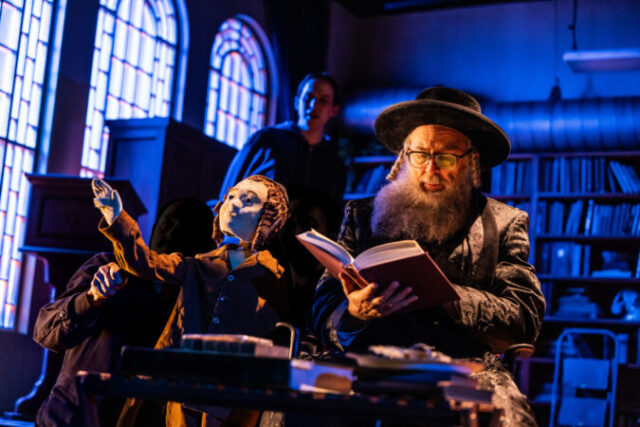
Tati (Richard Schiff) reads Scripture next to a puppet of his son in powerful new play (photo by Matthew Murphy)

Chava is disappointed when only Tati shows up, and she hesitates in sharing her truth. As she delays, the narrative shifts back and forth between the present and the past, depicted in poignant memory scenes from Chava’s childhood in which she is portrayed by a series of Bunraku-style puppets that get bigger and older as Chava does; they’re operated by Justin Perkins and Emma Wiseman, dressed in all black, with Dorfman standing with them, speaking the dialogue in darkness.

The vignettes begin with Chava at the age of two and a half, when Tati, thrilled to finally have a son after five daughters, wants to bring his boy to shul for the first time and Mami disagrees. At six, Chava is asking Tati whether doctors will someday be able to perform full-body transplants. At thirteen, Chava is taught by Tati how to put on tefillin; he explains, “The tefillin binds us, father and son, together to the end of time,” recalling the Akedah. At sixteen, Chava grows close with a curious schoolmate, Chesky (Rad Pereira). And at nineteen, Chava is introduced to Fraidy (Tedra Millan), who has been chosen to be his bride.

Meanwhile, in the present day, Chava, Jonah, and Tati have intriguing conversations about family and the Torah. Tati is confused when Jonah offers, “I left Judaism completely for a few years, actually, and then I found my way back, through transdenominational Renewal Judaism, which takes a lot of inspiration from the Hasidic masters.” Tati doesn’t understand why Chava is refusing to attend her brother’s upcoming wedding. When Jonah mentions that Steven Spielberg helped fund the local Yiddish Book Center, Tati claims to have never heard of him. Chava reminds her father that, as a teenager, he had snuck out of his house to see Jaws, an event that he is ashamed of. “You looked America in the teeth and it scared you back to Williamsburg,” Chava says. Tati replies, “I wasn’t scared. It was clearly a machine.” Jonah adds, “Machines can be scary,” to which Tati concludes, “Only if you let them run your life,” a clever reference to biblical fundamentalists like Tati.

Presented by New York Theatre Workshop, Becoming Eve was initially scheduled for the Connelly Theater but had to be moved after the New York Archdiocese, which runs the venue, canceled the show because of its content. Archdiocese director of communications Joseph Zwilling wrote in a statement, “It is the standard practice of the archdiocese that nothing should take place on Church-owned property that is contrary to the teaching of the Church. That applies to plays, television shows, or movies being shot, music videos being recorded, or other performances.” The Connelly is part of the Cornelia Connelly Center, a nonprofit whose mission is “to champion girls, empowering them to realize their full potential from middle school through college and beyond.”
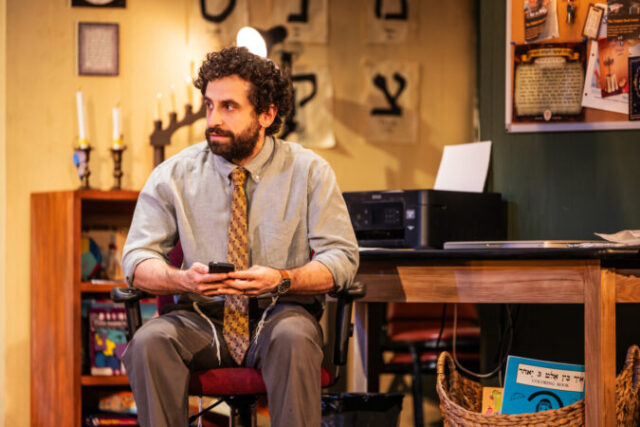
Tony winner Brandon Uranowitz plays an Upper West Side rabbi in Becoming Eve (photo by Matthew Murphy)

The play, which is in English but the characters are actually speaking in Yiddish and Hebrew, feels much more at home at Abrons Arts Center on the Lower East Side, where immigrant Jewish communities have thrived for more than a century. Abrons is part of the Henry Street Settlement, which was established in the late-nineteenth century and whose mission is “to open doors of opportunity for Lower East Side residents and other New Yorkers through social service, arts, and health care programs.”

To signal time shifts, Ben Stanton’s lighting goes dark and UptownWorks’ (Daniela Hart, Noel Nichols, Bailey Trieweiler) sound explodes before Daniel Kluger’s music calms things down. The convincing puppets are by Amanda Villalobos, who has previously worked on such shows as Is This a Room, Wolf Play, and The Old Country.

Becoming Eve unfolds on Arnulfo Maldonado’s exquisitely detailed set, an upstairs office with overstuffed bookcases, a small kitchen, a flyer for a production of The Hamantaschen Monologues, exposed air ducts, Jonah’s cluttered desk, a cabinet with two Torah scrolls, a bemah, and three arched windows. Enver Chakartash’s costumes range from Chava’s sexy dress to Jonah’s casual clothing to Tati’s traditional Hasidic garb.

Weinstein, a trans man who, as a teenager, attended the synagogue that Stein had left, writes incisive dialogue that avoids becoming, well, preachy and didactic, with unexpected twists and turns that are guided with expert precision by director Tyne Rafaeli (Epiphany, The Coast Starlight). Dorfman (Romeo + Juliet, “Daddy”) is heartbreaking as Chava, who is desperate to be accepted by her family; it is wrenching when she changes from her revealing dress to a zipped-up hoodie, terrified at how her father might react. Unrecognizable Emmy winner Schiff (Glengarry Glen Ross, The West Wing) is sensational as the long-bearded Tati, a respectable man stuck in the past, unwilling to face the realities of the modern era.

Tony winner Uranowitz (Falsettos, An American in Paris) is eminently likable as Jonah, a rabbi who understands just how to bridge the gap between Chava and Tati. Three-time Tony nominee Kuhn (Fun Home, Les Misérables) and Millan (On the Shore of the Wide World, The Wolves) excel as the key women in Chava’s life, while Pereira (Take Care, Madonna col Bambino) is touching as Chesky.

One of the best plays of the year, Becoming Eve begins with Chava singing Ariana Grande’s “Break Free,” which includes the lyrics “If you want it, take it / I should have said it before / Tried to hide it, fake it / I can’t pretend anymore,” and ends with SOPHIE’s “Immaterial” (“Im-ma-ma-material, immaterial / Immaterial boys, immaterial girls / Im-ma-ma-material, immaterial / We’re just, im-ma-ma-material [I could be anything I want] / Immaterial, immaterial boys [anyhow, anywhere] / Immaterial girls [any place, anyone that I want] / Im-ma-ma-material, immaterial”).

In Genesis 22:1, G-d calls out to Abraham, who answers, “Hineni” — “Here I am” — which is also the name of one of the most beautiful Rosh Hashanah and Yom Kippur prayers, sung in the shul by the cantor, who is representing the congregation despite their own personal faults and transgressions. The final word of Weinstein’s play is also “hineni,” a defiant conclusion to a complex, thought-provoking work about who we are, how we are seen by others, and everything in between.

[Mark Rifkin is a Brooklyn-born, Manhattan-based writer and editor; you can follow him on Substack here.]
YANIRA CASTRO: EXORCISM = LIBERATION

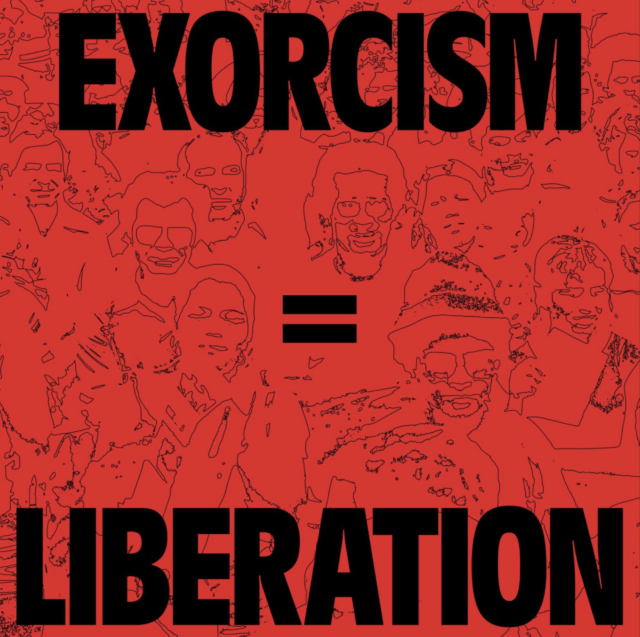
EXORCISM = LIBERATION
Multiple locations
September 6-28, free
www.acanarytorsi.org

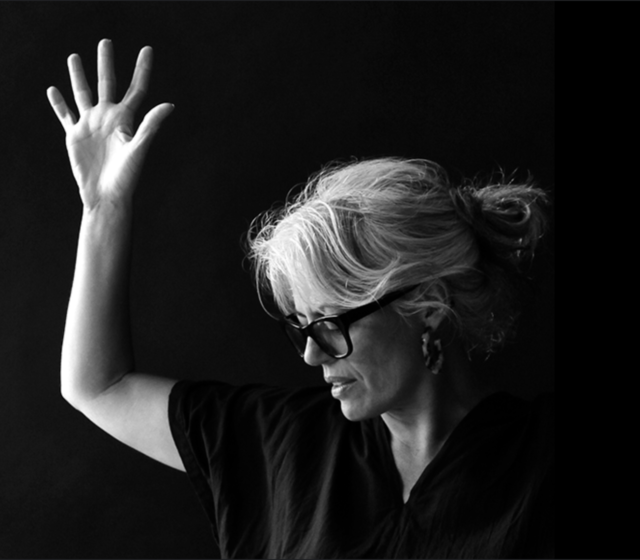
Yanira Castro is a fearless creator always ready to challenge herself and fully engage the audience. Born in Puerto Rico and based in Brooklyn, Castro and her company, a canary torsi (an anagram of her name), have presented such involving, complex, and entertaining multidisciplinary works as Dark Horse/Black Forest, a dance installation for public restrooms; the Jean-Luc Godard–inspired Paradis, a site-specific performance outdoors at twilight at the Brooklyn Botanic Garden; Performance | Portrait, an interactive video installation at the Invisible Dog Art Center; now.here.this, a meditative march of resistance in Prague; and Last Audience, a live communal laboratory at New York Live Arts, a performance manual, and a three-part space-opera podcast.

“Yanira Castro is a structural obsessive. She is an art scientist. She sees the rules and patterns lurking just beneath the surface of things,” Chocolate Factory Theater cofounding artistic director Brian Rogers has written. “The stuff that’s easier not to see . . . chaos staring at itself in the mirror, finding order.”

The Chocolate Factory is one of several venues hosting Castro’s latest project, Exorcism = Liberation, which explores climate change, immigration, land rights, colonialism, and self-determination in activations modeled around political campaigns. Kicking off September 6 and continuing each Saturday this month, the programs, seen through a Puerto Rican lens, include listening sessions, live music, food, and posters, stickers, banners, lawn signs, and pins. (There will also be activations in Chicago, and Western Massachusetts.)

Exorcism = Liberation asks participants to examine three slogans: “I came here to weep,” “Exorcism = Liberation,” and “What is your first memory of dirt?” Conceived, written, and directed by Castro, the project features audio design by Erica Ricketts, graphics by Alejandro Torres Viera and Luis Vázquez O’Neill, voice performances by Melissa DuPrey, josé alejandro rivera, and Steph Reyes, a bomba danced by Michael Rodríguez, and live musical performances by devynn emory and Martita Abril.

In a 2014 twi-ny talk about Court/Garden at Danspace Project, Castro explained, “It is not that I want to challenge the audience. I want to create a scenario for them and to be in conversation with them and I want them to form the picture, craft their experience. Their presence dynamically changes what is occurring. That is what ‘live’ means for me. It is dynamic because of the people in the room.”

In addition to the below events, installations at Abrons Arts Center, the Center for Performance Research (with a November activation date TBD), and the Chocolate Factory will continue into November.

Yanira Castro will present activations of Exorcism = Liberation in multiple locations this month

Friday, September 6, 6:00
I came here to weep: immersive group audio experience with movement score performed by Martita Abril, light refreshments prepared by Castro, stickers and pins available, Abrons Arts Center, 466 Grand St. at Pitt St., Manhattan

Saturday, September 7, 6:00
What is your first memory of dirt?: activation and collective listening session, followed by movement score “Clearing Practice” performed by devynn emory, light refreshments prepared by Castro, stickers and pins available, the Invisible Dog garden, 51 Bergen St., Brooklyn

Saturday, September 14, 7:00
CATCH 76: collective action, followed by a movement score performed by Martita Abril, with ice pops and limbers de coco y limon, the Chocolate Factory Theater (outside), 38-33 24th St., Long Island City

Saturday, September 21, 2:00
I came here to weep: activation and long table discussion with Jeremy Toussaint-Baptiste, Sami Hopkins, and Theodore (ted) Kerr, ISSUE Project Room, 22 Boerum Pl., Brooklyn

Saturday, September 28, 2:00-4:00
Exorcism = Liberation: activation with ice pops, limbers de coco y limon, the Clemente Soto Vélez Cultural & Educational Center, 107 Suffolk St., Manhattan

Friday, October 25, 1:00 – 9:00
OPEN LAB: What is your first memory of dirt? Aural Archiving with Yanira Castro / a canary torsi, advance RSVP required, the Center for Performance Research, 361 Manhattan Ave., Brooklyn

[Mark Rifkin is a Brooklyn-born, Manhattan-based writer and editor; you can follow him on Substack here.]
NEW DANCE ALLIANCE: PERFORMANCE MIX FESTIVAL 2024

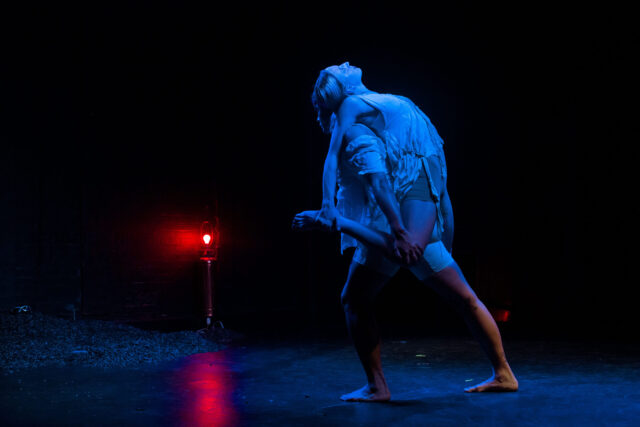
Company [REDACTED] presents My Apocalypse at NDA Performance Mix Festival (photo by Joohee Park)

PERFORMANCE MIX FESTIVAL
Abrons Arts Center
466 Grand St. at Pitt St.
June 6-9, $18.50
newdancealliance.org
www.abronsartscenter.org

The thirty-eighth annual Performance Mix Festival, hosted by New Dance Alliance at Abrons Arts Center, features live and recorded works from thirty-five experimental dance and film artists, including pieces from NDA’s Black Artists Space to Create residency and LiftOff residency. Running June 6-9, the festival features such creators as Mickey Davidson, Carole Arcega, Arantxa Araujo, j. bouey, Beatriz Castro Mauri, Jordan Deal, Tal Halevi, Yolette Yellow-Duke, and Aya Shabu, exploring such issues and subjects as ghost porn, climate change, queer platonic intimacy, Michael Jackson, masculinity, gun violence, gender markers, effeminacy and androgyny, and landscapes of memory. The 2024 event is curated by NDA founder and executive director Karen Bernard and an artist panel comprising Rafael Cañals, Maxi Hawkeye Canion, Jil Guyon, Rebecca Patek, and Stacy Lynn Smith, with films selected in collaboration with Ciné-Corps.

Tickets are $18.50; below is the complete schedule.

Thursday, June 6
j. bouey: A Message from Mx. Black Copper, Shua Group: Over, Frédéric Nauczyciel: A Baroque Ball (Shade), Bob Eisen, 7:00

Nina Laisné and François Chaignaud: Mourn, O Nature!, Flamenco Rosado, ankita sharma: jagaana/Awaken/, Isa Spector: A Larger Body, 8:30

Friday, June 7
Breakfast Mix: virtual dance experience organized by Agora de la danse/Koros, New Dance Alliance Studio, 182 Duane St., free with advance RSVP, 10:00

Panel discussion with Karen Bernard, L’Annexe-A, Virginie Combet, and Vanessa Bousquet of Koros, including two VR dance pieces by Hélène Blackburn and Andrea Peña, 10:30

Thomas Choinacky: Home Is the Body, Smaïl Kanouté: Never Twenty One, Company [REDACTED]: My Apocalypse, Shua Group: Over, 7:00

Saturday, June 8
Audrée Juteau, Zoey Gauld, Catherine Lavoie-Marcus, and Ellen Furey | Mystic-Informatic, followed by a reception, 7:00

Sunday, June 9
Carole Arcega: Hymen, Beatriz Castro Mauri: girl crush, Chloë Engel: Rubber, Johanna Meyer: Suit Hang, noon

Mickey D. & Friends: Visiting the Past to See the Future, Jordan Deal: capeforce, Lo Fi Dance Theory: Move Freely, Aya Shabu: LandED (excerpt), 1:30

Tal Halevi: Hidden in a Closet My Mother Imagined Being Wrapped in Her Father’s Shawl, Mohamad Moe Sabbah and Khansa: Khayef, Yolette Yellow-Duke, 3:00

Arantxa Araujo in collaboration with Mariana Uribe: Breathsculpt: Transformations Unveiled, Lena Engelstein: Stage Direction, Viktor Horváth, 4:30

[Mark Rifkin is a Brooklyn-born, Manhattan-based writer and editor; you can follow him on Substack here.]
QUEER NEW YORK INTERNATIONAL ARTS FESTIVAL

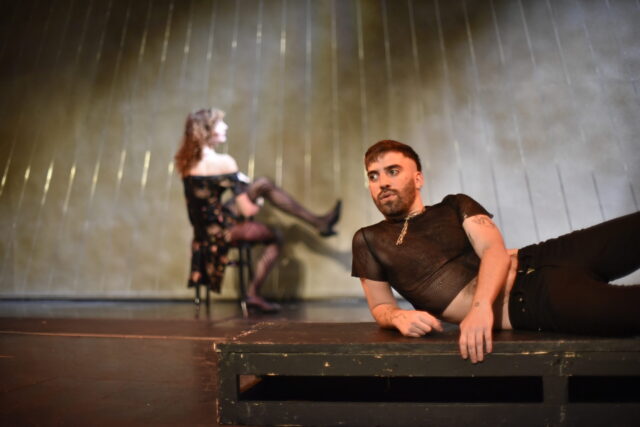
Bruno Isaković and Nataša Rajković’s Yira, yira (Cruising, cruising) is part of QNYIAF (photo by Silvija Dogan)

QUEER NEW YORK INTERNATIONAL ARTS FESTIVAL
NYU Skirball Center for the Performing Arts
566 La Guardia Pl. between Third & Fourth Sts.
February 7 – 17, $25
212-945-2600
nyuskirball.org

After a six-year break, the Queer New York International Arts Festival returns to the city, taking place February 7-17 at NYU Skirball. Started by Queer Zagreb founder Zvonimir Dobrović in 2012 at Abrons Arts Center, the fest consists of works that address queerness in today’s society, this year with presentations from Argentina, Brazil, Canada, Croatia, and Germany, including live performances, installations, and public talks.

The 2024 QNYIAF kicks off February 7 with Croatian artist Arijana Lekić Fridrih’s From5to95, a hybrid video installation and online project in which Croatian women from the ages of five to ninety-five share their personal stories about gender inequality. On February 7 and 8, Croatian artists Bruno Isaković and Nataša Rajković’s Yira, yira (Cruising, cruising), which premiered in Argentina in 2019, is performed by sex workers Juan Ejemplo, Leandra Atenea Levine Hidalgo, Pichón Reyna, and Sofía Tramazaygues, exploring the relationship between client and sex worker.

Bruno Isaković and Mia Zalukar’s Kill B. reimagines the Bride from Quentin Tarantino films (photo by Hrvoje Zalukar)

Isaković collaborates with fellow choreographer and dancer Mia Zalukar on Kill B., inspired by Quentin Tarantino’s Kill Bill. Playing February 9 and 10, the piece focuses on the character of the Bride as well as artistic hierarchical structures and their own professional partnership. On February 13, Toronto-based performance artist Clayton Lee goes through his sexual history in The Goldberg Variations, which mashes up Johann Sebastian Bach with WCW and WWE wrestler and actor Bill Goldberg, host of the 2018-19 competition series Forged in Fire: Knife or Death and a contestant on The Celebrity Apprentice. Some iterations have included smells and live snakes, so be ready.

On February 15, Argentinian interdisciplinary artist Tiziano Cruz will deliver the autobiographical performance lecture Conference, followed by a discussion. His piece Soliloquy — I woke up and hit my head against the wall was about his mother; in Conference he turns his attention to his ancestors and his late sister. On February 16, Brazilian artist Wagner Schwartz’s performance lecture La Bête is an interactive solo in which he activates a plastic replica of one of Lygia Clark’s rearrangeable hinged metal sculptures known as bichos, or “beasts,” and then the audience does the same, except with Schwartz’s naked body.

QNYIAF concludes February 17 with Raimund Hoghe Company members Emmanuel Eggermont and Luca Giacomo Schulte’s An Evening with Raimund, a tribute to German choreographer, dancer, and journalist Raimund Hoghe, who died in 2021 at the age of seventy-two; excerpts from his works will be performed by seven dancers. “To see bodies on stage that do not comply with the norm is important — not only with regard to history but also with regard to present developments, which are leading humans to the status of design objects,” Hoghe said. “On the question of success: It is important to be able to work and to go your own way — with or without success. I simply do what I have to do.”

[Mark Rifkin is a Brooklyn-born, Manhattan-based writer and editor; you can follow him on Substack here.]
Out-FRONT! Festival

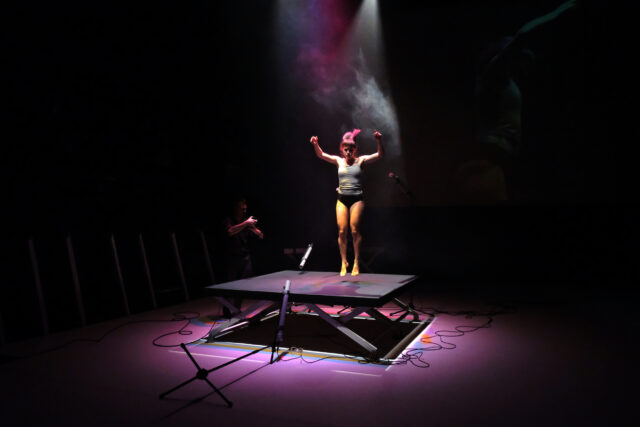
Ogemdi Ude’s Hear is part of Pioneers Go East Collective’s Out-FRONT! Festival (photo by Maria Baranova)

Out-FRONT! FESTIVAL
LGBT Community Center, 208 West Thirteenth St.
Abrons Arts Center, 466 Grand St.
January 10–20, free – $28.52 (suggested donation)
pioneersgoeast.org

Pioneers Go East Collective, which is dedicated to “radical queer performance, dance, and film for social change,” is presenting the 2024 Out-FRONT! Festival, taking place January 10-15 at the LGBT Community Center and January 17-20 at Abrons Arts Center. The bill features live performances by Arthur Aviles and Collaborators, Joey Kipp with Pioneers, Christopher Unpezverde Núñez, Jason Anthony Rodriguez, Paz Tanjuaquio, Ogemdi Ude, and Annie MingHao Wang; workshops with Rodriguez and Magda Kaczmarska; and a film program.

“This year’s festival brings together ten extraordinary multigenerational artists whose socially engaged practices explore issues of race, gender, disability, grief, migration, and our collective humanity in ways that continue to inspire us,” Pioneers artistic director Gian Marco Riccardo Lo Forte said in a statement. “We created Out-FRONT! to both celebrate artists with community-driven approaches to art-making and to offer them a platform to share their work with audiences during the Association of Performing Arts Professionals conference, an opportunity we hope provides new connections and sparks a positive dialogue about creative participation in shared spaces.”

Rodriguez, who played Lemar Wintour on Pose, will stage Take a Good Look with Dominican dancer and actor Gaymer and the solo Meet Me in the Moon. Aviles’s Naked Vanguard series continues with reimaginations of earlier works (Morning Dance, In the End, Let’s Begin, and A Jamaican BattyBwoy in America) in addition to the world premiere of Untitled #5A After Ted Shawn AKA Dansé Mexicaine & Jamaïquaine Américaine, performed by Nikolai McKenzie Ben Rema, Hunter Sturgis, and Aviles. The film screenings consist of a new short by Fana Fraser, And I was recognized by Omega X, Danni Venne, Matt Harvey, and Laura Marie Marciano, and The Personal Things by Tourmaline.

Below is the full schedule; admission to all events is free with RSVP (suggested donation $25).

Wednesday, January 10
Jason Anthony Rodriguez, Take a Good Look / Meet Me in the Moon, LGBT Community Center, Theatre 301, 8:00

Thursday, January 11
Jason Anthony Rodriguez, Take a Good Look / Meet Me in the Moon, LGBT Community Center, Theatre 301, 7:00

Joey Kipp with Pioneers Go East Collective, Tracing Lorraine, LGBT Community Center, Theatre 301, 8:00

Friday, January 12
Voguing for Teens, NEXT! TEEN Workshop with Jason Anthony Rodriguez, LGBT Community Center, Theatre 301, 3:00

Joey Kipp with Pioneers Go East Collective, Tracing Lorraine, LGBT Community Center, Theatre 301, 8:00

Saturday, January 13
Films by Fana Fraser, Omega X & Danni, Matt Harvey, Laura Marie Marciano, and Tourmaline, LGBT Community Center, Gallery 101, 5:00

Ogemdi Ude, Hear, LGBT Community Center, Theatre 301, 7:00

Sunday, January 14
NEXT! Workshop for older adults with Magda Kaczmarska, dance and storytelling, LGBT Community Center, 5:00

Ogemdi Ude, Hear, LGBT Community Center, Theatre 301, 6:00

Christopher Unpezverde Núñez, YO OBSOLETE, LGBT Community Center, Theatre 301, 7:00

Monday, January 15
Christopher Unpezverde Núñez, YO OBSOLETE, LGBT Community Center, Theatre 301, 8:00

Wednesday, January 17
Arthur Aviles and Collaborators, Naked Vanguard, Abrons Arts Center Playhouse, 8:00

Thursday, January 18
Annie MingHao Wang, had my mouth, Abrons Arts Center Playhouse, 8:00

Friday, January 19
Paz Tanjuaquio / TOPAZ ARTS Dance Productions, Silweta, Abrons Arts Center Playhouse, 7:00

Arthur Aviles and Collaborators, Naked Vanguard, Abrons Arts Center Playhouse, 8:00

Saturday, January 20
Annie MingHao Wang, had my mouth, Abrons Arts Center Playhouse, 5:00

Paz Tanjuaquio / TOPAZ ARTS Dance Productions, Silweta, Abrons Arts Center Playhouse, 6:00

[Mark Rifkin is a Brooklyn-born, Manhattan-based writer and editor; you can follow him on Substack here.]
JULIANA F. MAY: FAMILY HAPPINESS

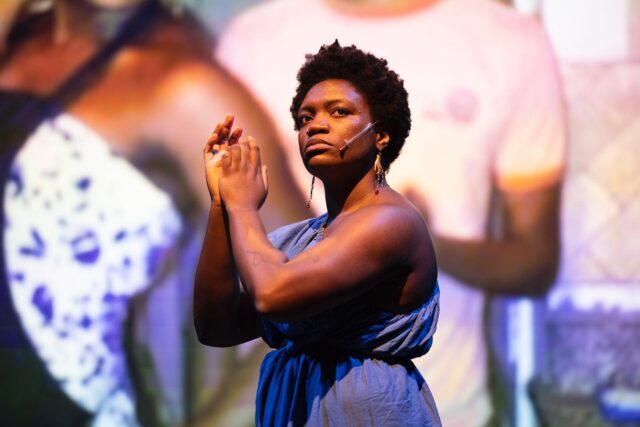
Juliana F. May explores intergenerational trauma and more in new show at Abrons Arts Center (photo by Maria Baranova)

JULIANA F. MAY: FAMILY HAPPINESS
Playhouse at Abrons Arts Center
466 Grand St. at Pitt St.
May 3-13, $25 (benefit May 10)
www.abronsartscenter.org
chocolatefactorytheater.org

“This work examines Jewish violence, victimhood, and intergenerational trauma,” New York–based choreographer Juliana F. May says about her latest piece, Family Happiness, making its world premiere May 3–13 at the Playhouse at Abrons Arts Center. A co-commission with the Chocolate Factory, Family Happiness is part of the twentieth anniversary celebration of May’s company, MAYDANCE, and follows such powerful works as Folk Incest, Commentary=not thing, and Gutter Gate.

The new piece is written, directed, and choreographed by May and features a familiar roster of MAYDANCE favorites: Leslie Cuyjet, Tess Dworman, Lucy Kaminsky, Molly Poerstel, and Kayvon Pourazar, who all collaborated with May on the original songs. The music is by Tatyana Tenenbaum, with lighting by Chloe Z. Brown and costumes by Mariana Valencia. The narrative explores Zionism, the Israel-Palestine conflict, the Holocaust, individual and group communication, grief, and trauma through text, dance, and music.

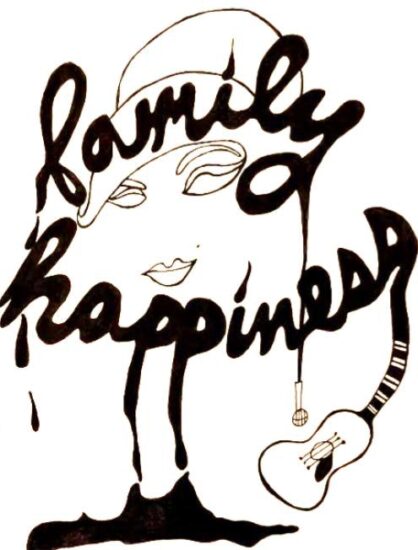
Performer Tess Dworman created a pecial poster for new work by Juliana F. May

“I worked on the beginning ideas of the piece during the pandemic in Tel Aviv, where my partner has family,” Guggenheim Fellow May explained in a statement. “I am a choreographer, but there is a lot of text in my work. I wrote this project ‘treatment’ on the tails of a dream I had about my father committing suicide and Trump losing the election. There’s a figure of a boy who looks like a scarecrow next to a pitchfork, a bird, and a half moon. He passes by the dog beach, the separate beach, the smoking beach, and eventually arrives at the sex beach. There are hundreds of naked people sitting on top of each other with legs intertwined in a series of eights. The dogs migrate over to the sex beach. Peripheral backward strokes follow a lunging and spreading and in an instant, the animals start to bite and peel skin away from bone, prying the upper extremities down towards the sand while the genitals remain connected like a roundabout on a playground. There is a rising smoke from the skinning like Christ being prepped with a soldering iron. The bodies smell like cocaine, synthetic cotton, or some kind of polyblend as they thrash around in the sand trying to free themselves from each locked jaw. They get close to the water and almost break free but realize they don’t know how to surf.”

May promises that Family Happiness “will be a big dance performance.” With that kind of description, how could it be anything else?

CROSSING THE LINE FESTIVAL 2022

Fouad Boussouf’s Näss will be performed at the Joyce as part of FIAF fest (photo © Charlotte Audureau)

CROSSING THE LINE FESTIVAL
FIAF and other locations
55 East 59th St. between Madison & Park Aves.
September 9–October 28, free – $75
212-355-6100
fiaf.org

FIAF’s fifteenth annual Crossing the Line Festival is another journey into exciting, challenging, and experimental music, dance, and theater from the French-speaking world. Running September 9 through October 28, the programs take place at such venues as Abrons Arts Center, New York Live Arts, the Chinese Consolidated Benevolent Association, the Joyce, and BAM in addition to FIAF’s Gallery, Florence Gould Hall, and Skyroom.

“For our first year curating this festival, we wanted to honor its founding principles: presenting compelling multidisciplinary art forms throughout the city, bringing acclaimed cutting-edge French and Francophone productions to our shores, and nurturing dialogue between international and New York-based artists,” curators Mathilde Augé and Florent Masse write in a program note. “The fifteenth edition of the festival features a diverse group of audacious artists engaging with the most pressing issues of our time — including gender, sexuality, human connection, race, and climate change — and exploring new territories in performing arts.”

None of the nine live performances — there were supposed to be ten but Caroline Guiela Nguyen’s FRATERNITY, A Fantastic Tale had to be canceled because of visa problems — has ever been seen before in New York, including several North American, US, and world premieres. The mix of dance, theater, art, music, and literature hails from Senegal, France, South Africa, Rwanda, the United States, and Morocco, examining societal change, Vaslav Nijinsky, science, Cheikh Anta Diop, intergenerational culture, the political views of René Char and Frantz Fanon, and a Detroit rave.

In addition, FIAF is hosting the fall open house celebration Fête de la Rentrée, highlighted by an opening reception for Omar Ba’s “Clin d’oeil” art exhibition on September 9 at 6:00 (free with RSVP) and a Sunset Soirée at Le Bain on October 12 at the Standard Hotel (free with RSVP). Below is the full Crossing the Line schedule.

Helena de Laurens stars in Marion Siéfert’s _ jeanne_dark _ at FIAF’s Crossing the Line Festival (photo © Matthieu Bareyre)

September 9 – October 28
Exhibition: “Clin d’oeil,” by Omar Ba, FIAF Gallery, free

Wednesday, September 14, and Thursday, September 15
Theater: _ jeanne_dark _, by Marion Siéfert, starring Helena de Laurens, North American premiere, FIAF Florence Gould Hall, $40, 7:30

Wednesday, September 21
Theater: Traces – Speech to African Nations, by Felwine Sarr and Étienne Minoungou, with Étienne Minoungou and Simon Winsé, New York premiere, Abrons Arts Center, $25, 8:30

Thursday, September 22, through Saturday, September 24
Dance: And so you see… our honourable blue sky and ever enduring sun… can only be consumed slice by slice…, by Robyn Orlin, performed by Albert Ibokwe Khoza, US premiere, New York Live Arts, $15-$35, 7:30

Saturday, September 24
Theater: Freedom, I’ll have lived your dream until the very last day, by Felwine Sarr and Dorcy Rugamba, featuring Marie-Laure Crochant, Majnun, Felwine Sarr, and T.I.E., North American premiere, Florence Gould Hall, $40, 7:30

Bruno Latour and Frédérique Aït-Touati’s Terrestrial Trilogy closes out FIAF fest (photo © zonecritiquecie)

Thursday, September 29, and Friday, September 30
Performance: Fire in the Head, by Christopher Myers, world premiere, Chinese Consolidated Benevolent Association, $20, 7:30

Thursday, October 6, through Saturday, October 8
Dance: The Encounter, by Kimberly Bartosik, performed by Kimberly Bartosik, Claude “CJ” Johnson, Burr Johnson, Joanna Kotze, Ryan Pliss, Kalub Thompson, Mac Twining, River Bartosik-Murray, Logan Farmer, and Ellington Hurd, world premiere, FIAF Skyroom, $30, 7:30

Thursday, October 13, through Saturday, October 15
Dance: CROWD, by Gisèle Vienne, US premiere, BAM Howard Gilman Opera House, $35-$75, 7:30

Tuesday, October 18, through Sunday, October 23
Dance: Näss, by Fouad Boussouf, New York premiere, the Joyce Theater, $20-$55

Thursday, October 27, and Friday, October 28
Theater: The Terrestrial Trilogy, a Performance in Three Parts: Inside, Moving Earths, and Viral, by Bruno Latour and Frédérique Aït-Touati, with special guest Bruno Latour, North American premiere, FIAF Florence Gould Hall, $40