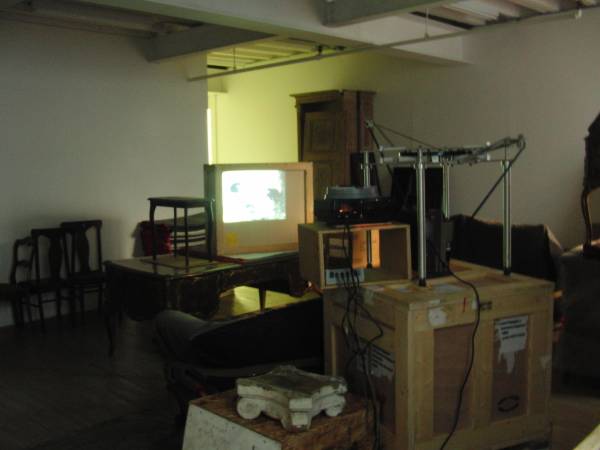
Matthew Buckingham’s “Likeness” is part of a two-room installation at Murray Guy that examines portraiture (photo by twi-ny/mdr)
Murray Guy
453 West 17th St. between Ninth & Tenth Aves.
Tuesday – Saturday through December 23
Admission: free
212-463-7372
www.murrayguy.com
Born in Iowa and based in New York City, multimedia artist Matthew Buckingham creates new ways to look at portraiture in his sixth solo exhibition at Murray Guy, the involving and intriguing “Likeness.” In one room, “Caterina van Hemessen Is 20 Years Old” examines a 1548 self-portrait of van Hemessen working at her easel. A 16mm projector depicts reverse-image details of the painting onto a screen, bounced off a mirror, while a series of texts about the history of the artist and painting surround the walls, each needing to be read using small hand mirrors, placing the viewer in the position of artist, who, in self-portraits, are essentially painting reverse images of themselves, as if the canvas is a mirror. In the second room, a move appears to be under way, with boxes and furniture gathered near the center, but a television is on, showing close-ups of a dog from a 1650 Velazquez painting; the detail focuses on a family member not usually left in storage as a voice-over discusses Prince Felipe Prospero of Austria, the erstwhile primary subject of the work. Taken together, the two installations investigate both how portraits are made as well as how they’re viewed, playing with ways of seeing in addition to the creative process itself.
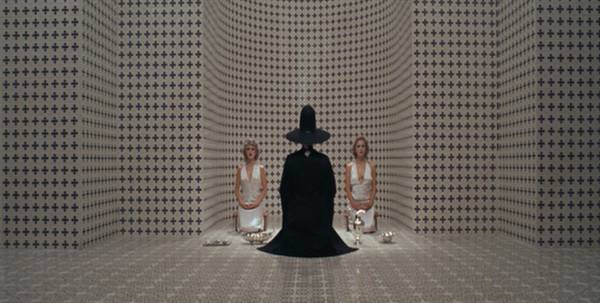
 For the third time in about a month, this rarely screened cult classic is being shown in the city, so you have no excuse to miss it yet again. Inspired by Rene Daumal’s MOUNT ANALOGUE: A NOVEL OF SYMBOLICALLY AUTHENTIC NON-EUCLIDEAN ADVENTURES IN MOUNTAIN CLIMBING, Alejandro Jodorowsky’s THE HOLY MOUNTAIN also involves symbolically non-Euclidean adventures in mountain climbing, funneled through Carlos Castaneda, Stanley Kubrick’s 2001: A SPACE ODYSSEY, and magic mushrooms and LSD galore. What passes for narrative follows a Jesus look-alike thief (Horacio Salinas) and an alchemist with a thing for female nudity (Jodorowsky) on the path to enlightenment; along the way they encounter the mysterious Tarot, stigmata, stoning, eyeballs, frogs, flies, cold-blooded murder, naked young boys, chakra points, life-size plaster casts, Nazi dancers, sex, violence, blood, gambling, turning human waste into gold, death and rebirth, and the search for the secret of immortality via representatives of the planets, each with their own extremely bizarre story to tell. Jodorowsky, who is credited with having invented the midnight movie with the acid Western EL TOPO (1970), literally shatters religious iconography in a kaleidoscopic whirlwind of jaw-droppingly gorgeous and often inexplicable imagery composed from a surreal color palette, set to a score by free jazz trumpeter Don Cherry and Archies keyboardist Ron Frangipane. (Frangipane also worked with John Lennon and Yoko Ono, who produced this film with their business manager, Allen Klein.) THE HOLY MOUNTAIN — which brings a whole new insight to Matthew Barney’s Cremaster Cycle — is filled with psychedelic mysticism centered around the human search for transcendence in a wilderness of the sacred and profane. Jodorowsky’s work can move you deeply, but don’t expect it to make much sense. Sit back and let in pour in and over you — you’ll feel it. You may hate it, but you’ll feel it. Although you’ll definitely hate the very end. This screening at the Rubin Museum of Art concludes the Icons series and will be introduced by multimedia poet Igor Satanovsky.

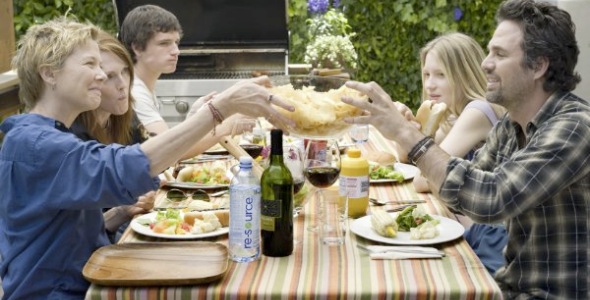
 When half-siblings Joni (Mia Wasikowska) and Laser (Josh Hutcherson) decide to track down their anonymous sperm-donor father, their two moms, Jules (Julianne Moore) and Nic (Annette Bening), are justifiably concerned with how that might affect their close-knit family. And when the donor ends up being a motorcycle-riding, free-spirited hottie (Mark Ruffalo) who would like to become part of the kids’ lives, it doesn’t take long for some major dysfunction to set in. The third feature-length narrative written or cowritten and directed by Lisa Cholodenko, following 1998’s HIGH ART and 2002’s LAUREL CANYON (she directed 2004’s CAVEDWELLER but did not write it), THE KIDS ARE ALL RIGHT is another intimate drama that explores deeply personal relationships with grace and intelligence — along with a little lesbianism. Bening is strong as the man of the house, overly determined to control and protect her family; Moore is beguiling as the other mother, wanting to develop her own business as a landscape architect; and Wasikowka, who was so outstanding in the HBO series IN TREATMENT, impresses again as the prodigal daughter preparing to go to college. Ruffalo, however, is too flat, and the film takes several missteps, including a final scene that is sadly predictable, detracting from an otherwise fresh and original story.