this week in theater

THE AMAZING ADVENTURES OF A WOMAN IN NEED

Naima Mora portrays different versions of herself in The Amazing Adventures of a Woman in Need (photos by Harris Davey)

THE AMAZING ADVENTURES OF A WOMAN IN NEED
Triad Theater
158 West 72nd St. between Amsterdam & Columbus Aves.
Saturday, March 12, April 9, May 14, June 18, $30, 7:00
www.theamazingadventuresofawomaninneed.com
triadnyc.com

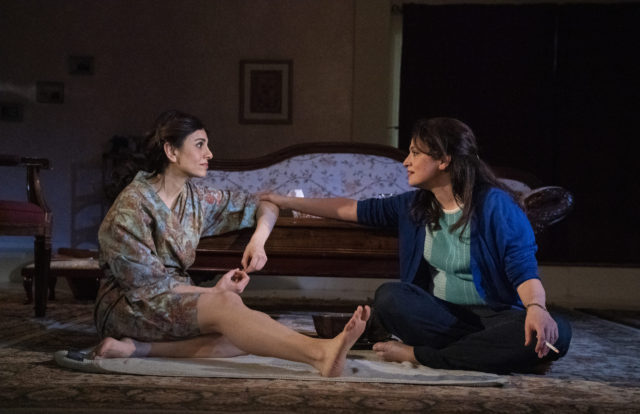
In the prologue to her debut solo show, The Amazing Adventures of a Woman in Need — which streamed during the pandemic and now returns to the Triad for an encore run monthly Saturdays beginning March 12 — Naima Mora, wearing jeans and a tight white tank top, holding a pink rose, describes the day in Harlem in 2002 when she realized she needed to turn her unhappy, unsatisfying life around. “I sit alone in my room, on my bed, wondering how I got here, wondering why I’m in this hell of a city, wondering why I’m killing myself to be here, wondering why my hair is falling out, wondering why I partied all night shoveling drugs up my nose, wondering why I’m sabotaging myself,” she says. “And then, I have to cradle myself, be gentle with myself, fall in love with myself, breathe and try to forget the last eight hours, and then forgive myself: forgive myself for being a drunk, for wanting insatiable fun to fill a void and forget the disappointment that I have with myself. And to myself, in my room, on my bed, guilt having settled in, and a little bit of a panic attack, just a little bit, I think to myself, I forgive you. I forgive you for being a fucking mess.”

Mora then admits, “Now, I’ve lived many lives: a supermodel, a crazy woman, and a gold digger, but I still haven’t really lived. So why not tell my story. I need to tell my story. I need to get this shit out of my body and out of my head. I need to rid myself of this self-inflicted destruction.” For the next seventy-five minutes, Mora portrays each of those characters, Penelope the supermodel, who can’t get a runway job anymore; the quirky Joanne, who suffers miscarriages and spends time in a psychiatric hospital; and Marisol Yanette Arnelis Rodriguez Lopes, a ritualistic woman facing too much solitude, offering such life lessons as “Get Your Hands Off My Peach Fuzz” and “Checkmate the Seduction: Train the Eggplant.” The set features a chair, a table, and a couch, a few props, and a screen on which photographs are projected.

An America’s Next Top Model winner, actress, author, and inspirational speaker, Mora who was born in Detroit in 1984, is barely recognizable in the roles, immersing herself fully into them, each with very different costumes, accents, hair, and movement. Directed and cowritten by Brooklyn native Marishka S. Phillips, The Amazing Adventures of a Woman in Need is a deeply intimate tale that also provides a roadmap for personal introspection; watching Mora deal with her issues so openly is likely to encourage audiences to do the same.

The virtual show I saw was recorded live with an audience at the Triad on October 16, 2021; it will be back at the Upper West Side theater for four performances, March 12, April 9, May 14, and June 18. Mora bravely puts herself out there as she battles her demons in public; she also traced the development of the play on social media. In a Twitter post last fall, she wrote, “My director is pushing me to my limits this week. Asking me to expand and literally stretch my artistic muscle for our show coming up in just 2 days!!! This has truly been a transformative experience.” It should be even more transformative now that it’s back in person.

CELEBRATING MOLIÈRE’S 400th BIRTHDAY

Who: Lisa Gorlitsky, Margaret Ivey, Postell Pringle, Adam Gopnik, Erica Schmidt, Comédie-Française
What: Celebration of Molière’s quadricentennial
Where: FIAF, Florence Gould Hall and Skyroom, 55 East 59th St. between Madison & Park Aves.
When: March 10-12, 24, 30, $20-$45 (three-event package $75)
Why: Jean-Baptiste Poquelin was born into a bourgeois family in early 1622 in Paris. Nicknamed “le Nez” because of his relatively large proboscis, he eventually became better known as poet, playwright, and actor Molière. In celebration of the four hundredth anniversary of his birth, the French Institute Alliance Française is hosting a trio of special events. Taking place March 10-12 at 7:30 ($45) at FIAF’s Florence Gould Hall, “Molière Turns 400: 17th Century Paris Meets 21st Century New York” consists of staged excerpts, complete with sets, costumes, and live music, from The Misanthrope, The School for Wives, and Tartuffe, with Lisa Gorlitsky, Margaret Ivey, and Postell Pringle and directed by Lucie Tiberghien, the founding artistic director of Molière in the Park, which performed livestreamed adaptations of all three works during the pandemic lockdown. The March 10 presentation will be followed by a reception.

Ivo van Hove’s adaptation of Molière’s uncensored Tartuffe screens at FIAF March 24

On March 24 at 7:00 ($25), New Yorker staff writer Adam Gopnik and director Erica Schmidt will be at the FIAF Skyroom for the talk “Modernizing Molière,” available in person and via livestream. Gopnik contributed the foreword to Molière: The Complete Richard Wilbur Translations, while Schmidt directed Molière’s The Imaginary Invalid at Bard SummerScape in 2012, starring her husband, Peter Dinklage. The fête concludes March 30 at 7:00 ($35) in Florence Gould Hall with a screening of Molière’s uncensored Tartuffe or the Hypocrite by Comédie-Française, directed by Ivo van Hove from the original script, which was censored by Louis XIV in 1664; the filmed version stars Christophe Montenez and features a score by Oscar-winning composer Alexandre Desplat.

THIS BITTER EARTH

Jesse (Damian Jermaine Thompson) and Neil (Tom Holcomb) face several crises in This Bitter Earth (photo by Mike Marques)

THIS BITTER EARTH
TheaterWorks Hartford online (and in person)
March 7-20, $20 virtual, $25 – $65 in person
twhartford.org

“This bitter earth / Well, what a fruit it bears / What good is love / Mmh, that no one shares? / And if my life is like the dust / Ooh, that hides the glow of a rose / What good am I? / Heaven only knows,” Dinah Washington sings in her 1960 number one hit, “This Bitter Earth.” The song plays at the end of TheaterWorks Hartford’s production of Harrison David Rivers’s This Bitter Earth, being performed onstage and streamed on demand through March 20.

The tender and moving, if earnest, play stars Damian Jermaine Thompson and Tom Holcomb as a mixed-race thirtyish couple facing different kinds of trauma in New York City and St. Paul, Minnesota, between March 2012 and December 2015. The serious Jesse Howard (Thompson) is a Black playwright with a burgeoning career; the more outgoing Neil Finley-Darden (Tom Holcomb) is a white Black Lives Matter activist from a wealthy family. While Neil feels grounded in his life and confident in his purpose, Jesse is much more on edge; in fact, he has a troubled relationship with gravity.

“Sometimes — and scientists may refute this, but fuck them — sometimes I can feel the Earth move. And not like tremors or earthquakes, tornados or hurricanes. This is not a matter of wind or tectonic plates but rather a matter of chemistry. Body chemistry. My body chemistry,” Jesse says in one of numerous short monologues he delivers directly to the audience. “I find it strange that others can’t feel it — the rotation. Strange and a bit lonely.”

The play takes place in their spacious Harlem bedroom, with large windows that often show snow falling, a coldness hovering over everything. (The attractive set is by Riw Rakkulchon.) “It’s the way that history isn’t history at all. Or, at least, the way that it doesn’t stay in the past. The way that the past fucks the present,” Neil tells us. The narrative goes back and forth in time, from when Jesse and Neil first meet and fall for each other, to the current day, amid several tragedies. Each flashback adds a bit more to the story, further developing the characters and certain key aspects of the story, which revolve around the murders of innocent Black men at the hands of white police officers and other citizens, from Trayvon Martin and Michael Brown to Jamar Clark and the Charleston church shooting.

Tom Holcomb and Damian Jermaine Thompson star as lovers who look at the world differently in TheaterWorks Hartford production (photo by Mike Marques)

But Rivers offers a neat twist on expectations, as Neil seems more intent on doing something about it than Jesse does. “You know, you accuse me of my white guilt, but what about yr apathy?” Neil declares as he prepares to take a van to a protest in Ferguson, Missouri. Jesse explains that he can’t go because he has rehearsals. “You know, yr not the center of the universe, Jesse. No one has that kind of gravitational pull. Not even you,” Neil says before leaving.

Their fights, which are no different from those of straight couples of the same race, often end in loving embraces, with clothes coming off as they roll around on the bed; their passion is evident throughout, even with their distractions. (There’s plenty for fight and intimacy director Rocío Mendez to do, as well as costume designer Devario D. Simmons.) But a common theme keeps arising, that of Jesse’s desire to live life like a regular person, whatever that is these days. “Yr a fucking double minority, Jesse,” Neil says, to which Jesse responds, “What does that have to do with anything?” Be sure to bring tissues for the conclusion.

Affectionately directed by David Mendizábal (Tell Hector I Miss Him, On the Grounds of Belonging) with almost too much thoughtful understanding, This Bitter Earth is a sensitive story of love in difficult times. The stream is well shot with multiple cameras in front of an audience, feeling like a theatrical work and not a film. The show, which premiered in 2017 at San Francisco’s New Conservatory Theatre Center, is even more cogent today, with the murders of Elijah McClain, Ahmaud Arbery, Breonna Taylor, George Floyd, and so many others occurring since the play’s debut. Rivers (Broadbend, Arkansas; When We Last Flew) has Jesse quote extensively from gay Black poet and activist Essex Hemphill, a hero of Jesse’s and, apparently, the playwright’s; the story works much better when Jesse speaks for himself.

Thompson (Fly, The Brother/Sister Plays) and Holcomb (London Assurance, Transport) have a sweet chemistry; you can’t help but root for Jesse and Neil through their hardships, trying to survive, as individuals and as a couple, in a world that needs to be seen as more than just black or white, straight or gay, male or female. As Washington sings, “Oh, this bitter earth / Yes, can it be so cold? / Today you’re young / Too soon you’re old / But while a voice / Within me cries / I’m sure someone / May answer my call / And this bitter earth, ooh / May not, oh, be so bitter after all.”

RED BULL THEATER CELEBRATES MARGARET CAVENDISH

Who: Red Bull Theater company
What: Livestreamed Zoom conversation, benefit reading, and Bull Session surrounding Margaret Cavendish’s The Convent of Pleasure
Where: Red Bull Theater website, Facebook Live, and YouTube
When: Conversation Monday, March 7, suggested donation $25, 7:30; benefit reading Monday, March 14, suggested donation $25, 7:30; Bull Session Thursday, March 17, free on YouTube with live chat, 7:30
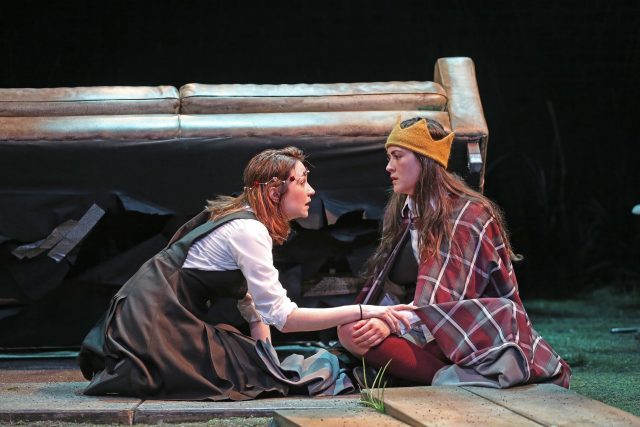
Why: “Nature is material, or corporeal, and so are all her Creatures, and whatsoever is not material is no part of Nature, neither doth it belong any ways to Nature,” wrote duchess of Newcastle-upon-Tyne and polymath Lady Margaret Lucas Cavendish. Red Bull Theater is turning to the seventeenth-century poet, philosopher, aristocrat, scientist, fiction author, and playwright for Women’s History Month, presenting an online reading and discussions about her 1668 comedy, The Convent of Pleasure. The play, a closet drama not intended to be performed onstage and dealing with women who believe they can live a fulfilling life without men, features wealthy noblewoman Lady Happy, her friend the widow Madam Mediator, the anti-convent Monsieur Take-Pleasure, the married Lady Amorous and Lady Vertue, Mimick the fool, and a cross-dressing prince/princess suitor.

Lady Margaret Cavendish’s The Convent of Pleasure will be explored extensively by Red Bull

“Let me tell you, that Riches ought to be bestowed on such as are poor, and want means to maintain themselves; and Youth, on those that are old; Beauty, on those that are ill-favoured; and Virtue, on those that are vicious: So that if I should place my gifts rightly, I must Marry one that’s poor, old, ill-favoured, and debauch’d,” Lady Happy says early in the play. “Put the case I should Marry the best of Men, if any best there be; yet would a Marry’d life have more crosses and sorrows then pleasure, freedom, or hapiness: nay Marriage to those that are virtuous is a greater restraint then a Monastery. Or, should I take delight in Admirers? they might gaze on my Beauty, and praise my Wit, and I receive nothing from their eyes, nor lips; for Words vanish as soon as spoken, and Sights are not substantial. Besides, I should lose more of my Reputation by their Visits, then gain by their Praises. Or, should I quit Reputation and turn Courtizan, there would be more lost in my Health, then gained by my Lovers, I should find more pain then Pleasure; besides, the troubles and frights I should be put to, with the Quarrels and Brouilleries that Jealous Rivals make, would be a torment to me; and ’tis only for the sake of Men, when Women retire not: And since there is so much folly, vanity and falshood in Men, why should Women trouble and vex themselves for their sake; for retiredness bars the life from nothing else but Men.”

On March 7, Red Bull will host the Zoom discussion “The Closet or the Stage? A Conversation about Margaret Cavendish’s The Convent of Pleasure,” with University of Tennessee professor and author Misty G. Anderson; University of Toronto associate professor Liza Blake, editor of Margaret Cavendish’s Poems and Fancies: A Digital Critical Edition; Columbia University professor Julie Crawford, author of the upcoming Margaret Cavendish’s Political Career; and Carnegie Mellon professor emeritus, curator, and author Kristina Straub.

The reading, directed by Kim Weild (American Moor, Paradise Now), will be held the following Monday at 7:30, in association with the R/18 Collective, which “believes the theatrical repertoire from the 1660s to the 1830s provides insights into the deep histories of race, gender, sexuality, ability, nation, and capital that continue to shape anglophone culture and the world.” The cast includes Heidi Armbruster, Becca Ayers, Talley Gale, Cloteal Horne, Rami Margron, Anthony Michael Martinez, Maria-Christina Oliveras, and Josh Tyson. And then, on March 17, a free Bull Session with Weild, cast members, and scholars will take place on YouTube, with a live chat.

THE MERCHANT OF VENICE

John Douglas Thompson is extraordinary as Shylock in TFANA production of The Merchant of Venice (photo by Henry Grossman)

THE MERCHANT OF VENICE
Theatre for a New Audience, Polonsky Shakespeare Center
262 Ashland Pl. between Lafayette Ave. & Fulton St.
Through March 6, $75-$85
866-811-4111
www.tfana.org

Arin Arbus reimagines a Merchant of Venice for this moment in time in her ingenious adaptation of the Bard’s challenging tragedy, continuing through March 6 at TFANA’s Polonsky Shakespeare Center. A coproduction with DC’s Shakespeare Theatre Company, the play is Arbus’s fourth collaboration with classical treasure John Douglas Thompson, following Macbeth, Othello, Ibsen’s A Doll’s House, and Strindberg’s The Father. Thompson is heart-wrenching as Shylock, the first professional Black actor to play the role in New York City since Ira Aldridge in the 1820s.

When the lights go out, the full ensemble comes out in regular dress, signaling they are performers, not the characters they are about to portray. A moment later the show begins, with the cast in contemporary costumes by Emily Rebholz — blazers, jeans, sneakers, gym clothes, suits. Riccardo Hernandez’s set is an imposing faux marble wall and steps, with a large black hole in the upper center, as if the sun and moon are both gone. The characters enter and leave through two doors, the wings, or the aisles, almost as if they’re part of the audience.

In order to woo the wealthy, beautiful heiress Portia (Isabel Arraiza), the noble Bassanio (Sanjit De Silva) asks his close friend, Venetian merchant Antonio (Alfredo Narciso), to borrow three thousand ducats from respectable Jewish moneylender Shylock. Shylock is tired of being mocked because of his religion, and he lets Antonio know it. He tells the brash Antonio, “Many a time and oft / In the Rialto you have rated me / About my moneys and my usances: / Still have I borne it with a patient shrug, / For sufferance is the badge of all our tribe. / You call me misbeliever, cut-throat dog, / And spit upon my Jewish gaberdine, / And all for use of that which is mine own. / Well then, it now appears you need my help: / Go to, then; you come to me, and you say / ‘Shylock, we would have moneys:’ you say so; / You, that did void your rheum upon my beard / And foot me as you spurn a stranger cur / Over your threshold: moneys is your suit / What should I say to you? Should I not say / ‘Hath a dog money? is it possible / A cur can lend three thousand ducats?’ Or / Shall I bend low and in a bondman’s key, / With bated breath and whispering humbleness, Say this; / ‘Fair sir, you spit on me on Wednesday last; / You spurn’d me such a day; another time / You call’d me dog; and for these courtesies / I’ll lend you thus much moneys’?”

Portia (Isabel Arraiza) works out with her servant Balthazar (Jeff Biehl) in The Merchant of Venice (photo © Gerry Goodstein)

It’s a powerful speech that sets the stage for the relationship between Shylock and the others; he is clearly well educated and eloquent, but despite his passionate entreaty, the Christians treat him with scorn and disdain. Antonio needs to obtain the money for Bassanio, but he cannot help but still belittle Shylock.

“I am as like to call thee so again, / To spit on thee again, to spurn thee too,” he tells him. “If thou wilt lend this money, lend it not / As to thy friends; for when did friendship take / A breed for barren metal of his friend? / But lend it rather to thine enemy, / Who, if he break, thou mayst with better face / Exact the penalty.”

The penalty is a harsh one: Instead of charging Antonio interest, Shylock says he will take a pound of Antonio’s flesh if he doesn’t return the three thousand ducats in three months’ time. Certain that his merchant ships will come back successfully a month before the agreement ends, Antonio signs the contract.

Antonio and Bassiano are often accompanied by their sycophantic bros: snarky, sunglasses-wearing, cocktail-swilling yuppie Gratiano (Haynes Thigpen), who is funny until he isn’t; Solanio (Yonatan Gebeyehu) and Salerio (Graham Winton); and Lorenzo (David Lee Huynh), who wants to elope with Shylock’s daughter, Jessica (Danaya Esperanza), and convert her to Christianity to further her father’s shame. In addition, Shylock’s servant, the goofy Lancelot Gobbo (Nate Miller), who wears his jeans very low, quits his job with the moneylender and moves on to Bassiano. “For I am a Jew, if I serve the Jew any longer,” Lancelot says.

Meanwhile, two suitors beat Bassanio to try to win Portia’s hand. First Prince Morocco (Maurice Jones), then Prince of Aragon (Varín Ayala), must choose wisely among three caskets, one of which holds the key to Portia’s heart — and fortune. On the gold one is inscribed, “Who chooseth me shall gain what many men desire,” on the silver “Who chooseth me shall get as much as he deserves,” and on the lead “’Who chooseth me must give and hazard all he hath.”

Portia is attended by her servant Balthazar (Jeff Biehl) and her maid, Nerissa (Shirine Babb); the latter is supremely efficient, while the former offers comic relief, flirting hysterically with many of the men he meets and, when Portia asks for music, uses his iPhone. (The sound and original music is by Justin Ellington.)

Shylock (John Douglas Thompson) demands a pound of flesh from Antonio (Alfredo Narciso) in Shakespeare tragedy (photo © Gerry Goodstein)

It all leads up to one of the great trial scenes in all of theater, a brutal battle of wits in which Shylock, who is suing Antonio for his pound of flesh, represents not only Jews and Blacks, both of whom have histories of being enslaved and discriminated against up to the present day, but, in essence, all of humanity who have suffered hatred and oppression at the hands of tyrants and bigots.

Throughout its four-century existence, The Merchant of Venice has likely been performed by troupes that glorified anti-Semitism and was cheered on by audiences that agreed with Antonio and his friends’ views of Jews, as well as by companies and audiences that had deep sympathy for Shylock’s plight. But Arbus achieves something different.

The casting is diverse but not random; by having Shylock and Jessica portrayed by Black actors, Arbus is making a powerful statement, particularly in the socioeconomic reckoning that has taken hold in the wake of the police murder of George Floyd. With his gentle cracked whisper of a hoarse voice that comes from deep in his soul, the British-born Thompson (Jitney, The Iceman Cometh) is unforgettable as Shylock, not merely following in the footsteps of Laurence Olivier, F. Murray Abraham, George C. Scott, Al Pacino, Jonathan Pryce, and Patrick Stewart but making the role his own.

When Shylock, who is repeatedly referred to as a dog, a villain, a cur, and the devil, asks, “If you prick us, do we not bleed? / If you tickle us, do we not laugh? / If you poison us, do we not die? / And if you wrong us, shall we not revenge?” Thompson is speaking for all the downtrodden; Shakespeare’s words echo down the ages: Sojourner Truth’s “Ain’t I a Woman?” speech leaps to mind as well. When Shylock tells the court, “Proceed to judgment: by my soul I swear / There is no power in the tongue of man / To alter me: I stay here on my bond,” Thompson speaks for all who resist injustice.

Arraiza shines as Portia, whether working out, dressed in an elegant gown with stiletto heels, or disguised as a learned doctor. Arbus ratchets up the homoeroticism by having Bassanio and Antonio be very good friends, while Biehl practically waves the Gay Pride flag as Balthazar. As serious as the subject matter is, Arbus includes plenty of fun and good humor; Biehl and Miller in particular often make vocal and gestural asides that are hilarious and certainly not in the original script.

“The quality of mercy is not strained, / It droppeth as the gentle rain from heaven / Upon the place beneath. It is twice blest: / It blesseth him that gives and him that takes,” Portia says in Act 4. We are blessed to have such a thrilling production of this dark tragedy; if only all were blessed equally with mercy in these dark times.

OUT OF TIME

A documentary filmmaker (Page Leong) looks back at her life in Anna Ouyang Moench’s My Documentary (photo by Joan Marcus)

OUT OF TIME
Martinson Theater, the Public Theater
425 Lafayette St. at Astor Pl.
Tuesday through Sunday through March 13, $60
212-539-8500
publictheater.org
www.naatco.org

In Sam Chanse’s Disturbance Specialist, the last of five monologues comprising Out of Time, author Leonie Z. (Natsuko Ohama) says, “You know nothing of what it is to live when you haven’t yet understood that you will die. And none of you really understands that. You get the concept maybe but you don’t actually believe it.”

Out of Time, which opened last night at the Public’s Martinson Theater, is an extraordinary concept: Five Asian American playwrights have written monologues for five Asian American actors over the age of sixty, directed by Les Waters, who is also over sixty. The five stories don’t always focus on aging, although getting older, with fewer years ahead than behind, is an inherent theme throughout the works, as is the call for respect for the elderly from family, friends, colleagues, and strangers. Isolation, loss, and loneliness abound, along with deep pockets of hope and defiance.

Speaking about her longtime producer, the unnamed documentary filmmaker (Page Leong) in Anna Ouyang Moench’s My Documentary explains, “Neil, who hugged me hello and then listened to my carefully crafted pitch about my just-dead husband and passed and hugged me goodbye as though he hadn’t just told a widow in no uncertain terms to go fuck herself because she’s old and no one cares when old people grieve other old people.”

Ena (Mia Katigbak) knows getting older is no mere game in Mia Chung’s Ball in the Air (photo by Joan Marcus)

In Mia Chung’s Ball in the Air, Ena (Mia Katigbak) walks onto the stage playing with a kids’ paddle ball, bouncing a little red ball against a wooden paddle, the two held together tenuously by a thin rubber band. She displays a childlike desire to succeed at the game shortly before describing a horrible accident she was involved in. She worries about feeling confused as different stories merge together in her mind. “Time is no guarantee,” she says. “These moments — when someone sees red when you see blue — well, it can be a stunner. It can seem as if something has vanished. In an instant.”

Glenn Kubota is the only male in the cast, portraying Taki in Naomi Iizuka’s Japanese Folk Song. The Scotch- and cigar-loving, jazz-hating Taki details how he nearly died in every decade from his teens to his seventies — “I must be pretty tough,” he acknowledges. “And lucky. I must be lucky.” — before telling a version of the Japanese ghost story “Yuki-onna,” which was famously retold in Masaki Kobayashi’s classic film Kwaidan. Taki is straightforward and practical even as he ventures into the realm of the fantastic.

Carla (Rita Wolf) is a voice from the past discussing the history of cancer among the women in her family in Jaclyn Backhaus’s Black Market Caviar. The piece is structured as a video the character made on December 31, 2019, offering advice to a descendant watching decades later. “Time is moving more quickly than I’d like,” she says. Carla is sitting behind a translucent curtain; we watch her on a video monitor at the corner of the stage. Ena, Taki, and the documentarian all sit in chairs front and center, evoking Waters’s direction of Lucas Hnath’s Dana H., in which Deirdre Connell performs the play sitting down (and lip-syncing the dialogue). Leonie Z. stands at a podium, delivering a fiery lecture to students who have already canceled her. (The spare scenic design is by dots.)

Leonie Z. (Natsuko Ohama) fights back in Sam Chanse’s Disturbance Specialist (photo by Joan Marcus)

Commissioned and produced by NAATCO, Out of Time is a play for the ages. Inspired by Anne Teresa De Keersmaeker’s Mitten wir im Leben sind/Bach6Cellosuiten, a piece choreographed for older dancers (including De Keersmaeker herself, who is in her early sixties), Waters (Big Love, The Thin Place) gives agency to each of the actors, and each of the characters, who look back at their lives in personal ways that are poignant and gripping, especially amid a rise in anti-Asian hate crimes and during a pandemic in which nursing home deaths related to Covid-19 were seen by many as the cost of doing business as a society.

The basic conceit of the play itself is a bold act of resistance, proving that actors over sixty are fully able to present long monologues and inhabit complex characters who are a lot more than elderly grandparents ready to be put out to pasture. Each of these characters is imbued with an inner strength and purpose even as they recognize their approaching fate — and we know the same is in store for the rest of us.

“Think about death, but remember life: our long lineage,” Carla says. “Because of you, our mother, our grandmother, I am here. Today. Today I am alive. I revel in all of it.” The titular “disturbance specialist” in Leonie Z.’s lecture is a volcano mouse “that flourishes, revels, in ruined environments.” The canceled author sternly proclaims, “And in all this, what you have to tell me is that I’m not welcome. I, Leonie Z., am not welcome here, that I should go home. Delete my account. Shut up and erase myself. Roll over and quietly die?” In Out of Time, none of those are acceptable options.

ARDEN — BUT, NOT WITHOUT YOU

Flea artistic director Niegel Smith faces a reckoning with Jack Fuller in return to live performances in front of an audience (photo © Hunter Canning)

ARDEN — BUT, NOT WITHOUT YOU
Flea Theater, the Sam
20 Thomas St. between Broadway & Church St.
Wednesday – Sunday through March 6, $17-$37
theflea.org

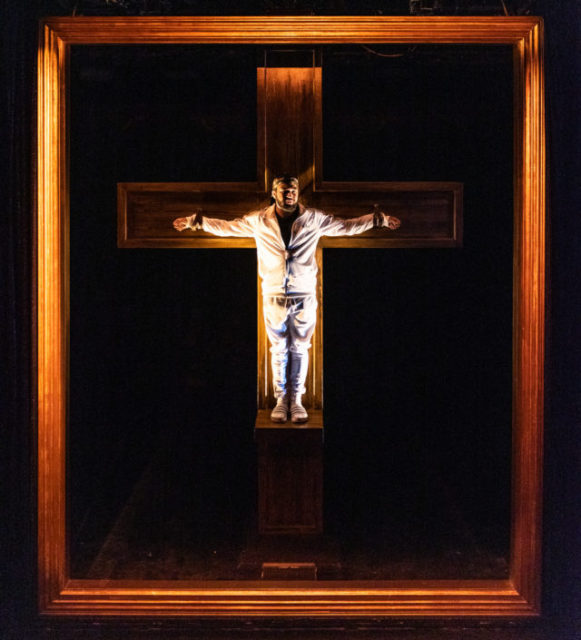
Arden — But, Not Without You is a ritual cleansing of the Flea, a messy, scattershot baptism looking toward a new era. Named for the forest in Shakespeare’s comedy As You Like It, which itself was named for the Bard’s mother-in-law, the show is described by standout performer Diana Oh in the program as “Four Generations of Deeply Intimately Bound All-Kinds-of-Doing-Shit Artists sharing of themselves in a Tender-Ass Room full of Queer Femme Shamanic Energy who Genuinely and Gently Welcome You: Social Anxieties, Yummy Freakiness, and All.”

In June 2020, Flea performer Bryn Carter had a public exchange with the theater’s artistic director, Niegel Smith, and producing director, Carol Ostrow, accusing the Flea of racism, sexism, nonpayment of actors, BIPOC and LGBTQIA+ ignorance, bullying, and body shaming. Ostrow left the company, and the resident troupe, the Bats, was eliminated. Smith and the Flea have pledged a “new path forward,” promising “a dedicated focus on Black, brown, and queer artists in experimental theater [that] comes at a moment in which a national spotlight is shining widespread — and longstanding — on the inherent value of BIPOC voices.”

Founded in a Tribeca storefront in 1996 by Jim Simpson and Sigourney Weaver, the Flea moved first to White St. and now Thomas, where it has several theater spaces. Its inaugural production following the pandemic lockdown and its new guidelines and mission is Arden, a slapdash collaboration, codirected by Smith and Nia Witherspoon, that boasts all-star talent while also serving as a communal acknowledgment and mass healing. While the beginning and ending are moving and powerful, most of what comes in between feels dogmatic and exhortative, as if we’re listening in on the Flea making confession, something that needs to be done in private.

When you check in, you are given a card to fill out with two prompts: “1. Describe the last time someone touched you. 2. What is a question that you want to find the answer to?” As you approach the upstairs Sam, you can first stop at “Journey to the Clearing,” an empty chair with fluorescent lighting and a tree branch seemingly floating, and an altar featuring items and offerings from the company. Once inside the theater, you bring your card to a table where the masked Peter Born and Okwui Okpokwasili turn the comments into song as audience members find their seats, which surround the central floor space except for the far corner, where a band will later play. It’s an engaging way to form everyone into a kind of collective, which is further enhanced by Born’s sparse set that features four hanging light fixtures, bulbs surrounded by family photos and mirrors.

Diana Oh steals the show in Arden — But, Not Without You (photo © Hunter Canning)

The singing morphs into “Do Not Let Go,” in which Born and Okpokwasili, who are married and have previously worked together on such projects as Pent Up: A Revenge Dance, Poor People’s TV Room, and Bronx Gothic, proclaim, “I want to know / Who stands beside me / When I tell you / this house is in ruins. / total collapse / is looming. / The storm is surging / The walls are caving in. . . . Will you / Welcome the storm? / Will you / Praise the bones / wrested from the wreckage / And build anew?”

Smith and Harlem MC, composer, and musician Jack Fuller next take a backward “spirit walk” following a rectangular chalk outline. “This place is fraught,” Smith declares. “This place has celebrated a vision of Black and brown folks / dependent on white saviors. / This house is in ruins. . . . I choose to fight / I fight for this artistic home.” This section proves flat and didactic, overemphasizing the theme of the rededication of the Flea.

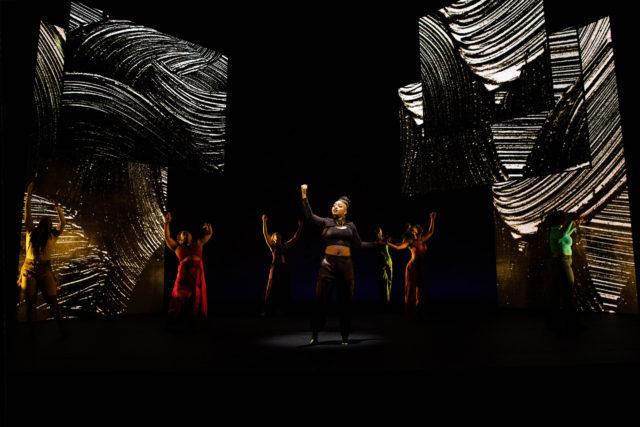
Other company members join in the walk as the soundtrack turns to a captivating story by multidisciplinary artist Carrie Mae Weems detailing a powerful childhood memory, accompanied by footage of her mother giving a speech. It’s a gripping story about secrets and deception, love and betrayal. Following a trance dance, Diana Oh takes over, becoming our host while blasting out a few raucous, energetic songs, joined by guitarist Viva Deconcini, percussionist Bernice “Boom Boom” Brooks, bassist and cellist Serena Ebony Miller, and Fuller on keyboards. Linda Cho dresses them all in flowing white costumes that harken back to Greek statuary.

Oh, a multidisciplinary artist, takes hold of the room, getting the audience to hum along with her, improvising a recommendation letter supporting a creator of color, and singing like she’s leading a revival meeting. She seemed to be genuinely shocked when one person in the audience essentially professed their love for Oh; otherwise, she was firmly in command. The show would have benefited from more Oh and less Smith.

In As You Like It, Touchstone the fool tells Rosalind and Celia, “Ay, now am I in Arden; the more fool I; when I was at home, I was in a better place: but travellers must be content.” In the Flea’s Arden — But, Not Without You, not everyone can see the forest through the trees.