this week in theater

ON SUGARLAND

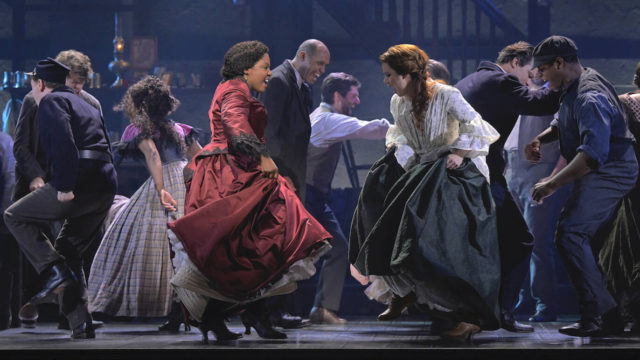
Aleshea Harris’s On Sugarland takes place in a southern cul-de-sac amid wartime (photo by Joan Marcus)

ON SUGARLAND
New York Theatre Workshop
79 East Fourth St. between Second & Third Aves.
Tuesday – Sunday through March 20, $55-$75
www.nytw.org

“We got to holler,” Staff Sergeant Saul Greenwood (Billy Eugene Jones) declares in Aleshea Harris’s electrifying On Sugarland, continuing at New York Theatre Workshop through March 20. He and the Sugarland cul-de-sac of mobile homes, a poor neighborhood trapped inside circular train tracks that promise to take them nowhere, holler in unison to mourn lost members of their community and to honor their ancestors, but the screams resound against generations of socioeconomic injustice and systemic racism emanating from the military industrial complex and its reliance on a fervent nationalism above all else.

Brilliantly filtering Sophocles’s Philoctetes through a bit of Tennessee Williams, Harris tells the vivid, haunting story of the four-hundred-year war fought by Blacks in America for their humanity. The play opens as the people of Sugarland gather to holler for Sergeant Iola Marie Eagle Eye, who the army has finally declared Presumed Killed in Action after her body had gone missing for years. Her fourteen-year-old daughter, Sadie (Kiki Layne), hasn’t spoken in all that time, her voice as well as her mother taken from her, but the narrative is punctuated with her long, poignant monologues to the audience about the matriarchs of her family, generation by generation, back to her great-great-great-grandmother, a freed slave who carried messages to Union soldiers during the Civil War. Each of her stories ends with bloodshed.

Evelyn (Stephanie Berry) and Tisha (Lizan Mitchell) are elderly sisters who can’t stop squawking at each other. Evelyn is like Blanche DuBois, living in a fantasy world; she takes her time overdressing for Iola Marie’s funeral, hoping to attract a suitor. Tisha tends to an outdoor shrine where she collects items from the men, women, and children who have died, paying special attention to her late son’s belongings, which she talks to as if he were there. “It’s time. You’re gonna make us late,” Tisha complains. “The only ‘late’ a lady ever needs to worry about is when her monthly hasn’t shown itself. And since your basement is sealed shut, you good,” Evelyn responds. “When they send you to hell, Ima be in Heaven waiting,” Tisha says.

Saul leads the service in honor of Iola Marie, proclaiming, “We got to holler / They ain’t sent her body home / ’Cause there ain’t nothin left to send / The War has taken the flesh of our dear sister / but the soul is intact / And we are gathered here to reach into / the next world / the world that now holds Iola / We are gathered here to knock on that world’s door / with a singing and a praise / We are gathered here to holler so she can hear us from where she’s at and know that she was loved.” It’s a powerful memorial for all fallen Black people, not just one lost soldier.

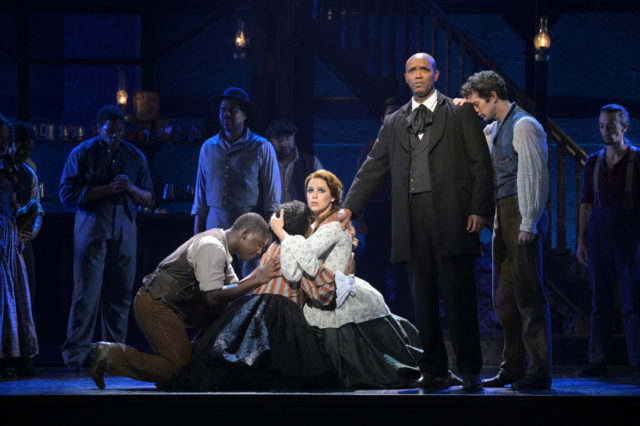
Addis (Caleb Eberhardt) and his father, Saul (Billy Eugene Jones), face different kinds of battles in searing new play (photo by Joan Marcus)

But Evelyn is having none of it. “That War can kiss the black off my ass. Fuck that War. Fuck burying boxes. Fuck hollering,” she tells her sister. “I am not cursing the doing of things. I am cursing their necessity. I am cursing the conditions which have led to what have become our customs. Little girls burying boxes for their dead mothers. Our front yard looking like some kind of horrifying carnival graveyard. Calling it Sugarland don’t make it sweet.”

Saul’s seventeen-year-old son, Addis (Caleb Eberhardt), wants to be a warrior like his father; too young and addled for the military, he guards Sugarland as if he were a soldier. He’s in love with Iola Marie’s sister, Odella (Adeola Role), a woman his father’s age. He tells Sadie, “Uh huh Busy being a soldier if you must know I’m already in Junior Cadets Almost Cadet First Sergeant If The War come to this cul-de-sac Ima show out Gon be the last one standing Ima carry the flag and plant that mug on a hilltop They gon make a statue of ya boy Ima be a hero They gon call my name.” Addis regularly shaves his father with a straight razor and helps tend to Saul’s damaged, foul-smelling foot, which oozes blood. Addis wants to join the army, while Saul wants to return to duty, despite his mental and physical injuries.

Meanwhile, the Rowdy (Thomas Walter Booker, Xavier Scott Evans, Mister Fitzgerald, Josh Fulton, Charisma Glasper, Kai Heath, Shemar Yanick Jonas, and Mariyea), a group of eight male, female, and nonbinary teenagers, serve as the Greek chorus, wandering around on the periphery, parading through the space, blasting music, harassing Addis, and commenting on what they’re seeing and occasionally interacting with the others as the biggest holler of all is to come.

On Sugarland is a brilliant, Pulitzer-worthy play deserving of a Broadway transfer and a wide audience. Harris (Is God Is, What to Send Up When It Goes Down), a former spoken-word performer whose mother is a Trinidadian immigrant who spent twenty years in the army, captures the heart and soul of a community too long unheard and unseen. Sadie talks often in her monologues of how her female ancestors were invisible. “White men ain’t in the business of seeing little black girls / you know / we invisible,” she says. Saul says a similar thing about Iola Marie. Their hollers echo through the theater until you can feel it in your bones. Harris makes it clear that a reckoning is coming, so everyone better start opening their eyes and ears. “It was a goddamn beautiful massacre,” Sadie says of an ancestor’s act of vengeance.

Obie-winning director Whitney White (Our Dear Dead Drug Lord, Semblance), who previously collaborated with Harris on the ritualistic healing production What to Send Up When It Goes Down, maintains a furious pace, a relentless assault on the senses that is superbly choreographed by Raja Feather Kelly (Hurricane Diane, The House That Will Not Stand); there is nary a wasted word or movement during the play’s intense and passionate 160 minutes (with intermission).

Evelyn (Stephanie Berry) remembers the past as Sadie (Kiki Layne) listens intently (photo by Joan Marcus)

The play is set in what the German-born, Kentucky-raised Harris describes as “a time of war. yesterday, today, and, unfortunately, tomorrow.” Adam Rigg’s confining set tempts the characters with a potential freedom that seems to always be just out of reach. Qween Jean’s costumes run from elegant to street-savvy, while Mikaal Sulaiman’s sound design and his and Starr Busby’s original music pound and pulsate.

At several points, the recording of a bugle can be heard. The onstage characters stop what they’re doing and salute a nonexistent flag. Despite how this country has treated them and their ancestors over the last four centuries, they still believe in what it has to offer. “Iss all kinda massacres, ain’t it?” Sadie says after a bugle plays the anthem. “All kinds. They got all kinds.”

ROUND DANCE

Arthur Schnitzler’s controversial La Ronde gets a new adaptation at the IRT Theater (photo by Adrian Viruet)

ROUND DANCE
IRT Theater
154 Christopher St. between Washington & Greenwich Sts.
Thursday – Sunday through March 27, $30
irttheater.org

Arthur Schnitzler’s controversial 1897 play, Reigen, better known as La Ronde, took more than two decades to reach the stage in a professional production, then was banned. The Vienna-born writer was brought up on immorality charges, laced with anti-Semitism, in Berlin and, though cleared, refused to allow the play to be performed in German-speaking countries; it wasn’t until 1982 that his son gave permission for productions in Germany and Austria.

La Ronde is a circular tale of five men and five women rotating in scenes of sex and love in 1890s Vienna; in each episode, one of the characters moves on to another person in the next scene, then that second person continues to a third person, and so on until the story revolves back to the first. The play has been adapted into a glorious 1950 film by Max Ophüls, narrated by Anton Walbrook and featuring a lively merry-go-round; Roger Vadim made a raunchier version in 1964 set in 1914 Paris, the script adapted by Jean Anouilh.

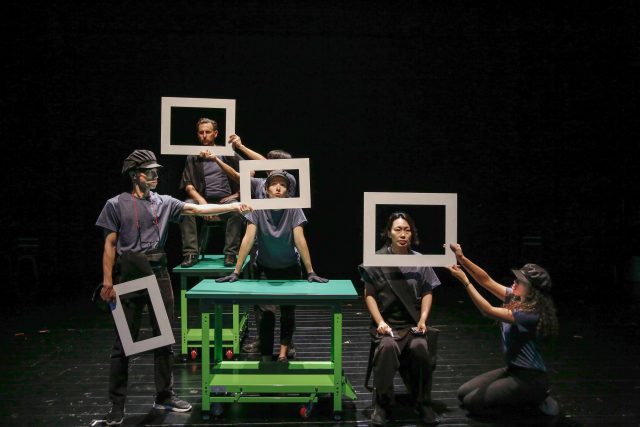
Oldest Boys Productions and Accidental Repertory Theater are now presenting the play, with the English title Round Dance, at the IRT Theater on Christopher St., directed by H. Clark Kee from his own translation. Part of the 3B Development Series, the show takes place in a small, intimate space. All ten actors — who portray men and women from different classes, from a hooker, a count, a poet, and a young wife to a soldier, a sweet girl, a gentleman, and a chambermaid — are always onstage. The eight actors who aren’t in the scene are lined up on the right and left, sitting in folding chairs, and they leap up to rearrange the set (tables, chairs, beds) in between each encounter. The success of the play depends on the subtle chemistry among the cast and the smooth transition between scenes, but Kee can’t quite reach those goals.

The acting is uneven, and the pace is unsteady, particularly over the course of two hours without an intermission. It has its moments but cannot sustain enough intensity, and the attempts to make the tale more relevant in the #metoo era amid the much-needed reevaluation of sexual consent, power dynamics, and conventional gender roles don’t ring true, nor does the incidental and interstitial music, which includes Haddaway’s “What Is Love (Baby Don’t Hurt Me).”

In the twenty-first century, Round Dance, which is set in an unidentified recent past, should look more forward; for example, in 2019, Cutting Ball Theater staged a version of La Ronde performed by two women, one Black, one white, that challenged old-fashioned perceptions and stereotypes from multiple perspectives, and Canada’s Soulpepper Theatre Company went all-out in a bold, sexy adaptation by Jason Sherman in 2013.

At the end of the play the night I went, the cast beckoned to Kee (Yellow Sound, Leonce and Lena) to join them onstage and accept a bouquet of roses; he declined, perhaps out of shyness, or maybe because he knew that the play still could use some further development.

LET THERE BE THEATRE — A CALL TO ACTION: WHITE RABBIT RED RABBIT

Who: Et Alia Theater
What: One-night-only performance of White Rabbit Red Rabbit
Where: Theater for the New City, Johnson Theater, 155 First Ave. between Ninth & Tenth Sts.
When: Sunday, March 13, $10-$18, 8:00
Why: On Friday, March 13, 2020, theaters across New York City were shuttered because of Covid-19. On March 13, 2022, at 8:00, to mark the two-year anniversary and to celebrate the reopening of venues around the globe, international companies will be performing Berlin-based Iranian playwright Nassim Soleimanpour’s 2011 autobiographical hit White Rabbit Red Rabbit as part of Let There Be Theatre — A Call to Action. The event is organized by Berlin-based Aurora Nova founder Wolfgang Hoffmann, who explains: “Ten years ago, almost to the day, I performed in a show at the Fadjr Festival in Tehran. At the festival hotel I was introduced to a young unpublished playwright who did not have a passport because he had refused to do military service. In order to get his work in front of an audience, he had devised a play that had to be performed as a cold read, without the need of a director, set, or rehearsals. All it needed was for a brave performer to agree to read a text in front of a live audience, without first knowing what the play was about. I liked this young man and loved his idea and spontaneously agreed to help produce his show at the Edinburgh Fringe later that year. When I finally saw the show performed live, I realised what this playwright had achieved. Through the power of his words alone he had written himself to freedom.”

Here in New York, Et Alia Theater, a company founded and led by international women, will be staging White Rabbit Red Rabbit at Theater for the New City, performed by co-artistic director Maria Müller (On How to Be a Monster, Where Are You from Again?). During the pandemic, Et Alia made the indie film This Is Me Eating___, then performed it live at the Alchemical Studios for one day last October. Tickets are only $10–$18 to see the sixty-to-ninety-minute show, which is always just as surprising for the actor as it is for the audience. I saw Obie winner Linda Emond in Soleimanpour’s autobiographical Nassim in 2018, which also involved no rehearsals and no prior access to the script, and it was a joy from start to finish. Among those who have previously performed White Rabbit Red Rabbit are John Hurt, Whoopi Goldberg, Nathan Lane, Stephen Rea, Sinead Cusack, Dominic West, Wayne Brady, Darren Criss, Kathy Najimy, Cynthia Nixon, Bobby Cannavale, Michael Urie, and Ken Loach.

Et Alia Theater will perform White Rabbit Red Rabbit on March 13 at Theater for the New City

“It is a one-time experience because the performer will have its opening and closing night of this play at the same time,” Hoffmann continues. “At 8 pm in every time zone there will be a multitude of shows starting at the same time for twenty-four hours, thus creating a massive theatrical community. On March 13 hundreds of courageous performers will face the same daring task to read a text they have not seen before to a live audience and everybody will be present at the same moment. The thought of all of us together, making theater once again — gives me boundless hope and energy.” Yes indeed, it’s great to be back.

THE AMAZING ADVENTURES OF A WOMAN IN NEED

Naima Mora portrays different versions of herself in The Amazing Adventures of a Woman in Need (photos by Harris Davey)

THE AMAZING ADVENTURES OF A WOMAN IN NEED
Triad Theater
158 West 72nd St. between Amsterdam & Columbus Aves.
Saturday, March 12, April 9, May 14, June 18, $30, 7:00
www.theamazingadventuresofawomaninneed.com
triadnyc.com

In the prologue to her debut solo show, The Amazing Adventures of a Woman in Need — which streamed during the pandemic and now returns to the Triad for an encore run monthly Saturdays beginning March 12 — Naima Mora, wearing jeans and a tight white tank top, holding a pink rose, describes the day in Harlem in 2002 when she realized she needed to turn her unhappy, unsatisfying life around. “I sit alone in my room, on my bed, wondering how I got here, wondering why I’m in this hell of a city, wondering why I’m killing myself to be here, wondering why my hair is falling out, wondering why I partied all night shoveling drugs up my nose, wondering why I’m sabotaging myself,” she says. “And then, I have to cradle myself, be gentle with myself, fall in love with myself, breathe and try to forget the last eight hours, and then forgive myself: forgive myself for being a drunk, for wanting insatiable fun to fill a void and forget the disappointment that I have with myself. And to myself, in my room, on my bed, guilt having settled in, and a little bit of a panic attack, just a little bit, I think to myself, I forgive you. I forgive you for being a fucking mess.”

Mora then admits, “Now, I’ve lived many lives: a supermodel, a crazy woman, and a gold digger, but I still haven’t really lived. So why not tell my story. I need to tell my story. I need to get this shit out of my body and out of my head. I need to rid myself of this self-inflicted destruction.” For the next seventy-five minutes, Mora portrays each of those characters, Penelope the supermodel, who can’t get a runway job anymore; the quirky Joanne, who suffers miscarriages and spends time in a psychiatric hospital; and Marisol Yanette Arnelis Rodriguez Lopes, a ritualistic woman facing too much solitude, offering such life lessons as “Get Your Hands Off My Peach Fuzz” and “Checkmate the Seduction: Train the Eggplant.” The set features a chair, a table, and a couch, a few props, and a screen on which photographs are projected.

An America’s Next Top Model winner, actress, author, and inspirational speaker, Mora who was born in Detroit in 1984, is barely recognizable in the roles, immersing herself fully into them, each with very different costumes, accents, hair, and movement. Directed and cowritten by Brooklyn native Marishka S. Phillips, The Amazing Adventures of a Woman in Need is a deeply intimate tale that also provides a roadmap for personal introspection; watching Mora deal with her issues so openly is likely to encourage audiences to do the same.

The virtual show I saw was recorded live with an audience at the Triad on October 16, 2021; it will be back at the Upper West Side theater for four performances, March 12, April 9, May 14, and June 18. Mora bravely puts herself out there as she battles her demons in public; she also traced the development of the play on social media. In a Twitter post last fall, she wrote, “My director is pushing me to my limits this week. Asking me to expand and literally stretch my artistic muscle for our show coming up in just 2 days!!! This has truly been a transformative experience.” It should be even more transformative now that it’s back in person.

CELEBRATING MOLIÈRE’S 400th BIRTHDAY

Who: Lisa Gorlitsky, Margaret Ivey, Postell Pringle, Adam Gopnik, Erica Schmidt, Comédie-Française
What: Celebration of Molière’s quadricentennial
Where: FIAF, Florence Gould Hall and Skyroom, 55 East 59th St. between Madison & Park Aves.
When: March 10-12, 24, 30, $20-$45 (three-event package $75)
Why: Jean-Baptiste Poquelin was born into a bourgeois family in early 1622 in Paris. Nicknamed “le Nez” because of his relatively large proboscis, he eventually became better known as poet, playwright, and actor Molière. In celebration of the four hundredth anniversary of his birth, the French Institute Alliance Française is hosting a trio of special events. Taking place March 10-12 at 7:30 ($45) at FIAF’s Florence Gould Hall, “Molière Turns 400: 17th Century Paris Meets 21st Century New York” consists of staged excerpts, complete with sets, costumes, and live music, from The Misanthrope, The School for Wives, and Tartuffe, with Lisa Gorlitsky, Margaret Ivey, and Postell Pringle and directed by Lucie Tiberghien, the founding artistic director of Molière in the Park, which performed livestreamed adaptations of all three works during the pandemic lockdown. The March 10 presentation will be followed by a reception.

Ivo van Hove’s adaptation of Molière’s uncensored Tartuffe screens at FIAF March 24

On March 24 at 7:00 ($25), New Yorker staff writer Adam Gopnik and director Erica Schmidt will be at the FIAF Skyroom for the talk “Modernizing Molière,” available in person and via livestream. Gopnik contributed the foreword to Molière: The Complete Richard Wilbur Translations, while Schmidt directed Molière’s The Imaginary Invalid at Bard SummerScape in 2012, starring her husband, Peter Dinklage. The fête concludes March 30 at 7:00 ($35) in Florence Gould Hall with a screening of Molière’s uncensored Tartuffe or the Hypocrite by Comédie-Française, directed by Ivo van Hove from the original script, which was censored by Louis XIV in 1664; the filmed version stars Christophe Montenez and features a score by Oscar-winning composer Alexandre Desplat.

THIS BITTER EARTH

Jesse (Damian Jermaine Thompson) and Neil (Tom Holcomb) face several crises in This Bitter Earth (photo by Mike Marques)

THIS BITTER EARTH
TheaterWorks Hartford online (and in person)
March 7-20, $20 virtual, $25 – $65 in person
twhartford.org

“This bitter earth / Well, what a fruit it bears / What good is love / Mmh, that no one shares? / And if my life is like the dust / Ooh, that hides the glow of a rose / What good am I? / Heaven only knows,” Dinah Washington sings in her 1960 number one hit, “This Bitter Earth.” The song plays at the end of TheaterWorks Hartford’s production of Harrison David Rivers’s This Bitter Earth, being performed onstage and streamed on demand through March 20.

The tender and moving, if earnest, play stars Damian Jermaine Thompson and Tom Holcomb as a mixed-race thirtyish couple facing different kinds of trauma in New York City and St. Paul, Minnesota, between March 2012 and December 2015. The serious Jesse Howard (Thompson) is a Black playwright with a burgeoning career; the more outgoing Neil Finley-Darden (Tom Holcomb) is a white Black Lives Matter activist from a wealthy family. While Neil feels grounded in his life and confident in his purpose, Jesse is much more on edge; in fact, he has a troubled relationship with gravity.

“Sometimes — and scientists may refute this, but fuck them — sometimes I can feel the Earth move. And not like tremors or earthquakes, tornados or hurricanes. This is not a matter of wind or tectonic plates but rather a matter of chemistry. Body chemistry. My body chemistry,” Jesse says in one of numerous short monologues he delivers directly to the audience. “I find it strange that others can’t feel it — the rotation. Strange and a bit lonely.”

The play takes place in their spacious Harlem bedroom, with large windows that often show snow falling, a coldness hovering over everything. (The attractive set is by Riw Rakkulchon.) “It’s the way that history isn’t history at all. Or, at least, the way that it doesn’t stay in the past. The way that the past fucks the present,” Neil tells us. The narrative goes back and forth in time, from when Jesse and Neil first meet and fall for each other, to the current day, amid several tragedies. Each flashback adds a bit more to the story, further developing the characters and certain key aspects of the story, which revolve around the murders of innocent Black men at the hands of white police officers and other citizens, from Trayvon Martin and Michael Brown to Jamar Clark and the Charleston church shooting.

Tom Holcomb and Damian Jermaine Thompson star as lovers who look at the world differently in TheaterWorks Hartford production (photo by Mike Marques)

But Rivers offers a neat twist on expectations, as Neil seems more intent on doing something about it than Jesse does. “You know, you accuse me of my white guilt, but what about yr apathy?” Neil declares as he prepares to take a van to a protest in Ferguson, Missouri. Jesse explains that he can’t go because he has rehearsals. “You know, yr not the center of the universe, Jesse. No one has that kind of gravitational pull. Not even you,” Neil says before leaving.

Their fights, which are no different from those of straight couples of the same race, often end in loving embraces, with clothes coming off as they roll around on the bed; their passion is evident throughout, even with their distractions. (There’s plenty for fight and intimacy director Rocío Mendez to do, as well as costume designer Devario D. Simmons.) But a common theme keeps arising, that of Jesse’s desire to live life like a regular person, whatever that is these days. “Yr a fucking double minority, Jesse,” Neil says, to which Jesse responds, “What does that have to do with anything?” Be sure to bring tissues for the conclusion.

Affectionately directed by David Mendizábal (Tell Hector I Miss Him, On the Grounds of Belonging) with almost too much thoughtful understanding, This Bitter Earth is a sensitive story of love in difficult times. The stream is well shot with multiple cameras in front of an audience, feeling like a theatrical work and not a film. The show, which premiered in 2017 at San Francisco’s New Conservatory Theatre Center, is even more cogent today, with the murders of Elijah McClain, Ahmaud Arbery, Breonna Taylor, George Floyd, and so many others occurring since the play’s debut. Rivers (Broadbend, Arkansas; When We Last Flew) has Jesse quote extensively from gay Black poet and activist Essex Hemphill, a hero of Jesse’s and, apparently, the playwright’s; the story works much better when Jesse speaks for himself.

Thompson (Fly, The Brother/Sister Plays) and Holcomb (London Assurance, Transport) have a sweet chemistry; you can’t help but root for Jesse and Neil through their hardships, trying to survive, as individuals and as a couple, in a world that needs to be seen as more than just black or white, straight or gay, male or female. As Washington sings, “Oh, this bitter earth / Yes, can it be so cold? / Today you’re young / Too soon you’re old / But while a voice / Within me cries / I’m sure someone / May answer my call / And this bitter earth, ooh / May not, oh, be so bitter after all.”

RED BULL THEATER CELEBRATES MARGARET CAVENDISH

Who: Red Bull Theater company
What: Livestreamed Zoom conversation, benefit reading, and Bull Session surrounding Margaret Cavendish’s The Convent of Pleasure
Where: Red Bull Theater website, Facebook Live, and YouTube
When: Conversation Monday, March 7, suggested donation $25, 7:30; benefit reading Monday, March 14, suggested donation $25, 7:30; Bull Session Thursday, March 17, free on YouTube with live chat, 7:30
Why: “Nature is material, or corporeal, and so are all her Creatures, and whatsoever is not material is no part of Nature, neither doth it belong any ways to Nature,” wrote duchess of Newcastle-upon-Tyne and polymath Lady Margaret Lucas Cavendish. Red Bull Theater is turning to the seventeenth-century poet, philosopher, aristocrat, scientist, fiction author, and playwright for Women’s History Month, presenting an online reading and discussions about her 1668 comedy, The Convent of Pleasure. The play, a closet drama not intended to be performed onstage and dealing with women who believe they can live a fulfilling life without men, features wealthy noblewoman Lady Happy, her friend the widow Madam Mediator, the anti-convent Monsieur Take-Pleasure, the married Lady Amorous and Lady Vertue, Mimick the fool, and a cross-dressing prince/princess suitor.

Lady Margaret Cavendish’s The Convent of Pleasure will be explored extensively by Red Bull

“Let me tell you, that Riches ought to be bestowed on such as are poor, and want means to maintain themselves; and Youth, on those that are old; Beauty, on those that are ill-favoured; and Virtue, on those that are vicious: So that if I should place my gifts rightly, I must Marry one that’s poor, old, ill-favoured, and debauch’d,” Lady Happy says early in the play. “Put the case I should Marry the best of Men, if any best there be; yet would a Marry’d life have more crosses and sorrows then pleasure, freedom, or hapiness: nay Marriage to those that are virtuous is a greater restraint then a Monastery. Or, should I take delight in Admirers? they might gaze on my Beauty, and praise my Wit, and I receive nothing from their eyes, nor lips; for Words vanish as soon as spoken, and Sights are not substantial. Besides, I should lose more of my Reputation by their Visits, then gain by their Praises. Or, should I quit Reputation and turn Courtizan, there would be more lost in my Health, then gained by my Lovers, I should find more pain then Pleasure; besides, the troubles and frights I should be put to, with the Quarrels and Brouilleries that Jealous Rivals make, would be a torment to me; and ’tis only for the sake of Men, when Women retire not: And since there is so much folly, vanity and falshood in Men, why should Women trouble and vex themselves for their sake; for retiredness bars the life from nothing else but Men.”

On March 7, Red Bull will host the Zoom discussion “The Closet or the Stage? A Conversation about Margaret Cavendish’s The Convent of Pleasure,” with University of Tennessee professor and author Misty G. Anderson; University of Toronto associate professor Liza Blake, editor of Margaret Cavendish’s Poems and Fancies: A Digital Critical Edition; Columbia University professor Julie Crawford, author of the upcoming Margaret Cavendish’s Political Career; and Carnegie Mellon professor emeritus, curator, and author Kristina Straub.

The reading, directed by Kim Weild (American Moor, Paradise Now), will be held the following Monday at 7:30, in association with the R/18 Collective, which “believes the theatrical repertoire from the 1660s to the 1830s provides insights into the deep histories of race, gender, sexuality, ability, nation, and capital that continue to shape anglophone culture and the world.” The cast includes Heidi Armbruster, Becca Ayers, Talley Gale, Cloteal Horne, Rami Margron, Anthony Michael Martinez, Maria-Christina Oliveras, and Josh Tyson. And then, on March 17, a free Bull Session with Weild, cast members, and scholars will take place on YouTube, with a live chat.