this week in theater

ONCE UPON A (korean) TIME

Once Upon a (korean) Time offers a remarkable theatrical experience at La MaMa (photo by Richard Termine)

ONCE UPON A (korean) TIME
La MaMa Experimental Theatre Club
The Ellen Stewart Theatre
66 East Fourth St. between Second Ave. & Bowery
Tuesday – Sunday through September 18, $60-$80
212-475-7710
ma-yitheatre.org
www.lamama.org

“Fairy and folk tale tropes offer modern authors . . . ideal frameworks and well-known terms of reference through which to explore the meanings and mythologies of war, both real and imagined. They do so for children and adults alike,” editors Sara Buttsworth and Maartje Abbenhuis write in the introduction to their 2016 book, War, Myths, and Fairy Tales (Palgrave Macmillan). Playwright and actor Daniel K. Isaac and director Ralph B. Peña take that approach to the next level in Ma-Yi Theater Company’s explosive yet intimate Once Upon a (korean) Time, running at La MaMa through September 18.

The ninety-five-minute show was inspired by Isaac’s biological family as well as his chosen family — in a moving program note he explains, “I am an only child of a Korean immigrant single parent [who fled south during the Korean War]. I do not know my biological father or his side of the family or their history. My maternal grandparents passed before I was born. . . . I have been disowned multiple times for being gay. . . . So the notion of ‘family’ is complicated for me.”

The notion of family is central to the play, which unfurls across a series of interrelated vignettes in which different kinds of battles provide opportunities to tell Korean folk tales as both distraction and metaphor in the midst of heated conflict. The first chapter, “Earth,” takes place in a trench in the 1930s, where two soldiers are under brutal attack. “We gotta get outta here / How do we get outta here / Should we make a run for it / Let’s make a run for it / I don’t wanna die / I’m too young to die / I don’t wanna be here / Get me out of here get me out of here get me out,” one of the soldiers cries out. He demands that the other soldier retell him the legend of brothers Heung-bu and Nol-bu: After their parents die, one sibling inherits everything and banishes the other and his pregnant wife and child. But a single seed from a previously injured baby jeh-bee (swallow) results in magic calabashes that just might right the wrongs.

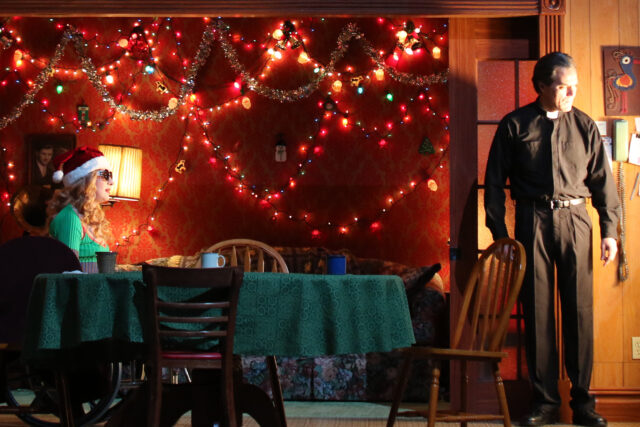
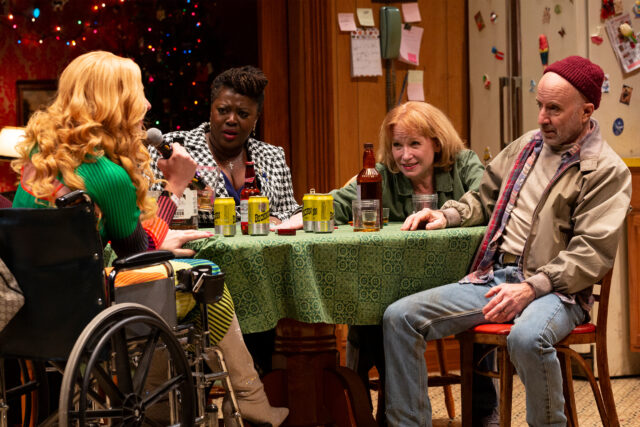
Two women (Sonnie Brown and Jillian Sun) meet during the 1992 LA riots in Once Upon a (korean) Time (photo by Richard Termine)

The scene is brilliantly directed by Peña on Se Hyun Oh’s bold set, which is highlighted by two massive vertical boulders that rotate throughout the play to form a variety of walls, blockades, caves, and other barriers. As the soldiers hide behind rocks, bullets fly past and bombs explode ever closer; the audience is seated on the same side of the trench as the soldiers, immersing everyone in the dire situation. Oliver Wason’s lighting and Fabian Obispo’s sound, along with projections by Yee Eun Nam and Phuong Nguyen’s costumes, make us feel like we are all in harm’s way. It’s about as powerful an opening scene as I’ve experienced in a long time.

The involving depiction of the horrors of war continues with “Water,” set in a WWII comfort station where three Korean women, one a virgin, are being sexually, physically, and psychologically abused by viciously hostile Japanese soldiers. To distract the virgin from what is soon to happen to her, the other two women share the story of Shim-Cheong, a woman who sacrifices herself in order to save the life of her blind father.

A through line begins to develop as the action moves to a cave during the Korean War (“Heaven”) where the story of the Tiger and the Bear is told, a convenience store (“Fire”) amid the 1992 LA riots supplemented with the tale of the Grandma and the Tiger, and a contemporary gathering where three couples meet at a Korean BBQ restaurant and put it all in context as they await the future.

The stories within the stories offer compelling Korean myths to accompany the central narrative, especially since the outstanding cast goes back and forth between portraying the mythological figures and the “real” characters, sometimes as plays within the play. In “Water,” for example, one of the comfort women tells the virgin that she will be Shim-Cheong, then lays out the plot, gives her her motivation, and even makes a key alteration to her costume.

A Korean BBQ restaurant is the setting for the poignant conclusion of Daniel K. Isaac play (photo by Richard Termine)

Obie-winning Ma-Yi founding member and producing artistic director Peña and Isaac, who previously worked together on Lloyd Suh’s The Chinese Lady — Isaac is best known as an actor, appearing in numerous plays as well as in Billions and other television shows and films and will next be seen in You Will Get Sick at Roundabout next month — also zeroes in on the ideas of legacy, tradition, and belonging, from defending one’s homeland to emigrating overseas. As soon as the young woman walks into the convenience store, the older woman says, “I telling you story.” The young woman asks, “Like once upon a time?” The older woman replies, “No / That American thing.”

At the BBQ restaurant, the six people discuss such fairy tales as Cinderella and Beauty and the Beast as well as their family histories. “Korean stories are so funny,” Jon says. “And usually way more gruesome,” Sasha adds.

Once Upon a (korean) Time is both funny and gruesome, an expertly told tale that excites the eyes and the ears and keeps the heart pumping. There are no lags; something is always happening onstage, and constant movement and projections keep the audience entranced. The seven actors are extraordinary, with Sonnie Brown, Sasha Diamond, David Lee Huynh, Teresa Avia Lim, Jon Norman Schneider, David Shih, and Jillian Sun playing multiple roles. A jubilant scene in which the Sea Dragon bursts into a musical number could have felt out of place but instead is a welcome break from all the solemnity, even as he eagerly declares, “I hear we have a virgin in the house!”

Once Upon a (korean) Time is a gripping, all-too-real story of intergenerational trauma. Peña has called it “insane,” and insane it is, in only the best way. Isaac has dedicated the play to his mother, who will not be able to see it because she refuses to get vaccinated. And that’s a genuine shame, because her son has given the rest of us a remarkable theatrical experience.

ON THAT DAY IN AMSTERDAM

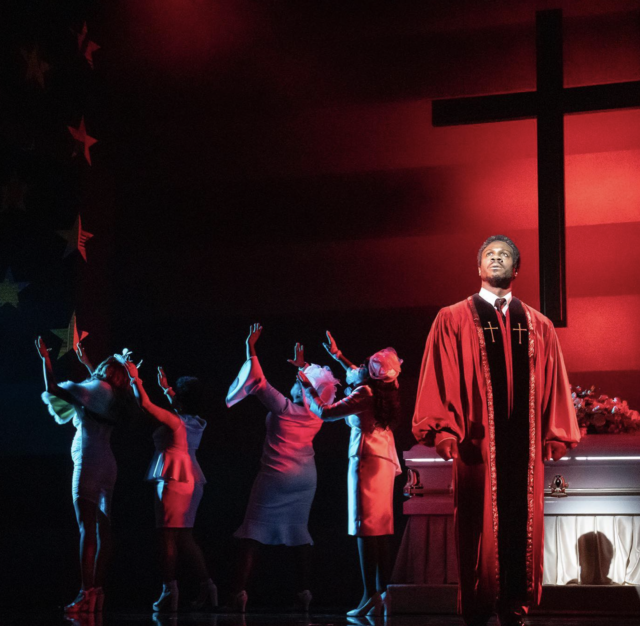
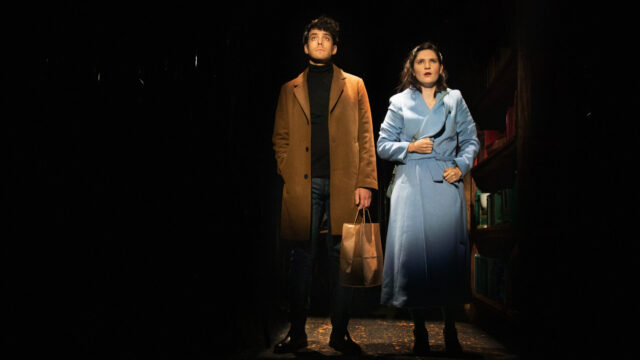
A one-night stand turns into a treatise on love, art, and immigrations in On That Day in Amsterdam (photo by Carol Rosegg)

ON THAT DAY IN AMSTERDAM
Primary Stages at 59E59 Theaters
59 East 59th St. between Park & Madison Aves.
Tuesday – Sunday through September 4, $60-$125
212-279-4200
www.59e59.org
primarystages.org

Immediately after graduating college, I backpacked across Europe with my best friend. We had planned to spend a day or two in Amsterdam, but we were having such a great time, sleeping on a botel and enjoying the vast culture, that we ended up staying a week. The protagonists of Clarence Coo’s poignant if overly earnest On That Day in Amsterdam have no such option.

The ninety-minute play is told in flashback through the somewhat unreliable memories of Kevin (Glenn Morizio), who spends years trying to write the story of what happened “on that day in Amsterdam,” a phrase that begins many of the scenes. Kevin and Sammy (Ahmad Maksoud) hook up at a club and spend the night together on a houseboat. The next morning, Kevin, who is American, claims he has to take off to catch a plane back home, while the smitten Sammy, whose ancestry is less clear, wants to hang out all day with him before he is supposed to secretly leave that evening for the Netherlands and meet up with his brother to find a better life in England.

Sammy wants to get food and visit all the museums they can and eventually loosens up Kevin enough that they begin to do just that, their tale enhanced by third-person narration spoken by Rembrandt (the Romantic One) van Rijn (Brandon Mendez Homer), Anne (the Empathetic One) Frank (Elizabeth Ramos), and Vincent (the Perfectionist One) van Gogh (Jonathan Raviv).

“On that day in Amsterdam, two young men were in a bed and looked at each other in the morning light,” Anne says. “One of them was thinking about the present moment,” Rembrandt adds. “And the other was not,” Vincent concludes.

As they continue on their sadly brief adventure, Sammy and Kevin try to break down each other’s walls as well as those inside themselves.

“Can you relax?” Sammy asks, attempting to take a photo of Kevin, who responds, “I’m trying.” “Smile? No. Don’t smile. Actually, don’t listen to me. Just be yourself,” Sammy advises. “What does that even mean? Be myself?” Kevin wonders.

After learning that they have far more in common than they originally thought, they both prepare to head off to their very different destinations.

“One year from now, one of these two young men will try to write a book,” Anne tells us. “— will begin to write a book,” Rembrandt corrects. “— will write a book,” Vincent says. “And the other will not,” Rembrandt affirms.

Most of On That Day in Amsterdam takes place behind a giant translucent scrim; Kevin occasionally exits through a door at the front and goes to a table with a computer monitor, where he attempts to write his book as the years go by, but he is haunted by what he fears might have happened to Sammy. Much of the action occurs on a platform in the middle of the stage, reminiscent of Martyna Majok’s 2017 NYTW production of Sanctuary City at the Lucille Lortel, which also dealt with family and immigration issues, and Nick Payne’s 2015 Constellations, in which a man and a woman keep replaying scenes from an intermingling past, present, and future. (The Amsterdam set is by Jason Sherwood, with lighting by Cha See, sound by Fan Zhang, and costumes by Lux Haac.)

Sammy (Ahmad Maksoud) and Kevin (Glenn Morizio) wonder what’s next for them in On That Day in Amsterdam (photo by Carol Rosegg)

Morizio and Maksoud form an endearingly tentative couple as Kevin and Sammy, dancing, kissing, shopping, and waiting on line at museums. Coo (Beautiful Province [Belle Province)], The Birds of Empathy) and director Zi Alikhan (The Great Leap, Lady Apsara) repeatedly reference the importance of art, as represented by Rembrandt, Vincent, and Frank, but the emphasis sometimes feels heavy-handed.

“Maybe everyone’s an artist at heart,” Kevin offers. “You think so? Not everyone can be Anne Frank,” Sammy says. “No,” Kevin agrees. Sammy: “She was a great writer. That’s why people remember her.” Kevin: “Sure.” Sammy: “Not everyone can be a great writer.” Kevin: “What I mean is — the instinct to be an artist. The potential? Maybe that’s in everyone. And if people don’t live up to that potential? That’s a waste.”

The show features projections by Nicholas Hussong on the scrim and in the back, from live shots of Sammy considering his fate to colorful images of paintings that resemble works by Rembrandt and Vincent but are clearly not, sticking out like sore thumbs; if the producers couldn’t get rights to the pieces, it might have been better to not include these abstractions at all.

Meanwhile, Kevin declares Sammy is an artist as well, based on one cellphone photo of a swan soaring in the air, later comparing it to Jan Asselijn’s The Threatened Swan, the first work to enter the collection of the Nationale Kunstgaleri, later to become the Rijksmuseum, a canvas that represents the protection of the country from its enemies. Such obvious metaphors fly throughout the play, which succeeds much better when it is goes for a more subtle approach.

It also brought back fond personal memories of that week in Amsterdam I spent once upon a time, where I was privileged to not be in the same situation as Kevin or Sammy.

LAVENDER MEN

Pete Ploszek, Alex Esola, and Roger Q. Mason star in Lavender Men (photo by Jenny Graham)

LAVENDER MEN
Streaming from Skylight Theatre in Los Angeles
August 27, 28, 29, September 3, 4, $25-$38
skylighttheatre.org

The Civil War might be known as the battle between the Blue and the Gray, but Black Filipinx playwright and actor Roger Q. Mason turns to a different color in the world premiere of Lavender Men, continuing at the Skylight Theatre in Los Angeles and streaming online through September 4, in conjunction with Playwrights’ Arena.

During the pandemic, I watched virtual presentations of Mason’s The Duat, about a Black man (Gregg Daniel) searching for his place in a world of racial injustice, and Age Sex Location, part of the omnibus Matriarch: She’s Wide Awake Shining Light . . . , in which Ramy El-Etreby dances onstage in glittery drag and proclaims, “Fat bitch / Black queen / Mixed breed mishap / Round nosed fag ho / That’s what you think of me / As I walk down the street / My wide hips waddling / My fleshy neck obscuring a too-soft jawline.”

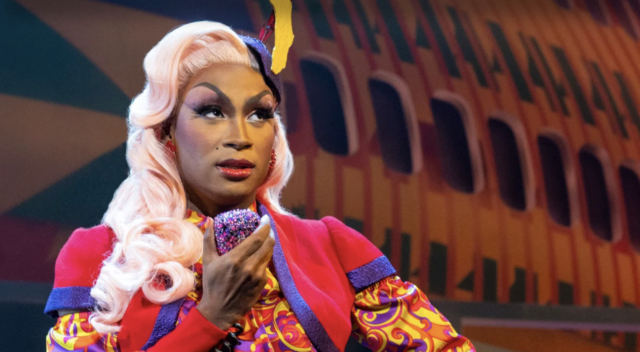
In the prologue of Lavender Men, Taffeta (Mason) says those same words, adding, “No fats, no fems, no blacks. / Well, kiss my black, fat, fem ass to the red! / I am more than that.” Taffeta, identified in the script as a “biracial, male assigned gender nonconforming fabulous queer creation of color,” is both narrator and participant in a reimagining of the relationship between Abe Lincoln (Pete Ploszek), who has just lost his 1858 Senate campaign to unseat Stephen A. Douglas and has returned to his law practice, and Elmer E. Ellsworth (Alex Esola), a soldier who has left the army — after being deemed too short to gain the promotions he thought he deserved — to work as Lincoln’s clerk.

Lincoln’s friend John Hay, later secretary of state for both William McKinley and Theodore Roosevelt, wrote that Lincoln “loved [Ellsworth] like a younger brother,” but Mason reinterprets that intimacy as a magnetic sexual attraction. Lavender Men doesn’t merely hint at their homosexuality but digs into it full force. Taffeta speaks with Lincoln and Ellsworth as if she is a kind of spirit from the future, offering them a second chance, while they understand that they are in a play being performed in front of an audience. “This is a fantasia, honey!” she declares.

Taffeta (Roger Q. Mason) watches intently as Elmer E. Ellsworth (Alex Esola) and Abe Lincoln (Pete Ploszek) grow close in streaming play (photo by Jenny Graham)

As Lincoln considers running for office and Ellsworth wants to reenlist, they explore their feelings for each other. Taffeta also shows up as Lincoln’s wife, Mary Todd; his servant, Sadie; as well as a cadet, an officer, a lamppost, a chandelier, and a tree. Mason avoids putting Lincoln on a pedestal. At one point Abe asks Ellsworth, “What do you think of Negroes? . . . What should we do with them?” Ellsworth responds, “I haven’t really formulated an opinion, to be honest.” Lincoln says, “Well, they are the taste on everybody’s tongue — and it ain’t sweet. I’ll tell you that.” Ellsworth asks, “What about you, sir?” Lincoln answers, “We oughta send them back.”

Taffeta gives them multiple chances to change their fate, but they’re not sure if they want to. “It could be different this time. We can make it whatever we want,” Taffeta explains early on. “Can we change the ending?” Lincoln asks. “Sure, start wherever you like. We can even make it up — they’ll believe it,” Taffeta promises, speaking about the audience. But changing history doesn’t come easily.

Stephen Gifford’s set is filled with archival photographs and documents on the walls, along with an analog-pixelated image of Lincoln hovering over it all in the back. A wardrobe serves as an entrance and exit for Lincoln and Ellsworth, but it’s not quite Narnia awaiting them on the other side. The sharp lighting is by Dan Weingarten, with original music by David Gonzalez and sound by Erin Bednarz that includes whispered voices that occasionally taunt Taffeta. Wendell Carmichael’s costumes range from the men’s straightforward attire to Taffeta’s far more fabulous looks.

The show is smartly directed by Lovell Holder, who helmed Mason’s 2020 virtual performance piece The Pride of Lions for Dixon Place and cohosts the podcast Sister Roger’s Gayborhood with Mason; the stream is filmed with multiple cameras from different angles, but there are a few noticeably shaky moments.

Lavender Men is an intimate tale that touches on such issues as slavery, racism, trans hate, white saviors, and, primarily, being who one truly is inside. “We all have voices — goddamnit, let’s use them!” Taffeta proclaims, talking not only to Abe and Elmer but to Mason and everyone watching, in the theater and at home.

INTO THE WOODS

Into the Woods features a dazzling all-star cast with superstar understudies (photo by Matthew Murphy and Evan Zimmerman)

INTO THE WOODS
St. James Theatre
246 West Forty-Fourth St.
Tuesday – Sunday through January 8, $69-$159
intothewoodsbway.com

At intermission of the spectacular revival of Into the Woods, I was heading outside for a breath of fresh air when I saw a notice posted on the doors that the show was not yet over, that there was a second act. At first I wondered who would leave the theater at this point, but then I thought about how nearly perfect the first act was, how everything seemed to be wrapped up in a neat little package, with everybody onstage and in the audience elated and satisfied.

But in James Lapine and Stephen Sondheim’s devilishly clever show, “happily ever after” is a misnomer, more of a warning than a coda. As the Narrator (David Patrick Kelly) had ominously just informed us, “To. Be. Continued.” Everyone’s jubilation is about to come tumbling down, like a giant falling from the sky — although one can find plenty of exhilaration in the dark side as well.

Inspired by Bruno Bettelheim’s 1976 Freudian book The Uses of Enchantment: The Meaning and Importance of Fairy Tales, Lapine and Sondheim’s musical debuted at San Diego’s Old Globe in 1986 and moved to Broadway the following year, earning ten Tony nominations and winning three, losing the Best Musical award to The Phantom of the Opera. This new version, which premiered at New York City Center’s “Encores!” series in May, has made a super-smooth transition to the St. James, maintaining its brilliant streamlined adaptation.

The nearly-three-hour show, which has been extended through October 16, is a mashup of fairytale favorites with some added central characters. The stage is dominated by a fifteen-piece orchestra conducted by Rob Berman, who leads the musicians through Sondheim’s complicated, unpredictable score. The actors spend most of the show on a narrow, horizontal section at the front of the stage, with minimal props, highlighted by miniature versions of their forest homes dangling from the ceiling, teasingly just out of reach. In addition, they occasionally wander through the orchestra, running around and hiding behind white birch trees that have come down from above.

The story is built around three wishes. Cinderella (Phillipa Soo) is suffering through a miserable existence, terrorized by her stepmother (Nancy Opel) and stepsisters, Florinda (Brooke Ishibashi) and Lucinda (Ta’Nika Gibson), while her father (Albert Guerzon) offers her no support. “I wish to go to the festival — and the ball . . . more than anything,” Cinderella sings, referring to a grand party being thrown by the handsome prince (Gavin Creel).

Jack (Cole Thompson, although I saw Alex Joseph Grayson) and his mother (Aymee Garcia) are worried that they might lose their farm, so the mother sends Jack off to sell his beloved old and ragged cow, Milky White (Kennedy Kanagawa). “I wish my cow would give us some milk, more than anything,” Jack croons.

And the Baker (Brian D’Arcy James; I saw Jason Forbach) and his wife (Sara Bareilles) are desperate to have a baby. “I wish . . . more than the moon . . . more than life . . . I wish we might have a child,” the couple, invented for the show, opine.

Milky White (Kennedy Kanagawa) sits in the back as the Baker (Brian D’Arcy James) and his wife (Sara Bareilles) come up with a plan (photo by Matthew Murphy and Evan Zimmerman)

Other familiar and new characters also show up in the threatening forest. Little Red Ridinghood (Julia Lester; I saw Delphi Borich) stops at the bakery to bring some treats to her granny (Annie Golden) but better be aware of the hungry Wolf (Creel). “Into the woods / to bring some bread / to Granny who / is sick in bed. / Never can tell / what lies ahead. / For all I know, she’s already dead,” Red declares. Rapunzel (Alysia Velez) has been locked up in a tower, where another handsome prince (Joshua Henry) seeks to rescue her. A Mysterious Man (Kelly) pops up from time to time, telling riddles and positing, “When first I appear, I seem delirious. But when explained, I am nothing serious.”

Everything is set in motion by the Witch (Patina Miller), who lives next door to the Baker and his wife. She had cursed the Baker’s family — which includes the sister he never knew he had, named Rapunzel — deeming it impossible for them to have children, but she now offers to reverse it in exchange for “the cow as white as milk,” “the cape as red as blood,” “the hair as yellow as corn,” and “the slipper as pure as gold.” She promises, “Bring me these / before the chime / of midnight / in three days’ time, / and you shall have, / I guarantee, / a child as perfect / as child can be. / Go to the wood!”

And off they go, into the woods, where they have to determine how far to compromise their morals in order to acquire the four elements that will allow them to finally have a baby. These decisions ring true with audience members, who, in our own lives, regularly face ethical decisions. “Into the woods / without regret, / the choice is made, / the task is set,” the Baker, his wife, Cinderella, Jack, and Jack’s mother sing in unison. “Into the woods / to get my (our) wish, / I don’t care how, / the time is now.”

But when a widowed Giant (voiced by Golden) comes down from her haven in the sky to avenge her husband’s death, everyone’s future is destined to not be so happy after all.

In the last ten years, I’ve seen two previous adaptations of Into the Woods, from the Public Theater at the Delacorte in 2012 and Fiasco Theater for Roundabout at the Laura Pels in 2015. Both were lovely, memorable productions that were very different from each other but thoroughly satisfying in their unique approaches to a beloved musical.

First-time Broadway director Lear deBessonet (Pump Boys and Dinettes, transFigures), the head of Encores! and the founder of Public Works, and choreographer Lorin Latarro (Fiasco’s Merrily We Roll Along, Assassins for Encores!), expertly guide the actors across the stage, up and down the handful of steps, and through the trees, making the most of the tight quarters; the charming scenic design is by David Rockwell, with lighting by Tyler Micoleau, sound by Scott Lehrer and Alex Neumann, and lovely music direction by Rob Berman. The tasty costumes are by Andrea Hood, with hair, wig, and makeup design by the extraordinary Cookie Jordan.

The Wolf (Gavin Creel) has an evil plan in store for Little Red Ridinghood (Julia Lester) (photo by Matthew Murphy and Evan Zimmerman)

The cast is a true ensemble; several friends and colleagues saw different actors in key roles than I did, and everyone raved about them all, whether the understudy or the award-winning star. But two performers do stand out.

Miller brings down the house when she belts out “Last Midnight,” driving the crowd into a frenzy as she cries out, “It’s the last midnight, / it’s the last verse. / Now, before it’s past midnight, / I’m leaving you my last curse: / I’m leaving you alone.” Miller won a Tony as Leading Player in Diane Paulus’s 2013 Broadway revival of Pippin, but I missed her when I went; I instead saw the wonderful Stephanie Pope, who has had quite a career of her own.

But Kanagawa nearly steals the show as Milky White. Puppet designer James Ortiz (2022 Drama Desk Award winner for Best Puppet Design for The Skin of Our Teeth) has created a tender and fragile cow out of cardboard — part Slinky, part accordion — operated by Kanagawa, who had never worked with puppets before. He masterfully moves Milky White as the cow’s destiny is threatened, making sure we feel every emotion in her static foam eyes, from joy to sadness, as if it were a living creature in front of us. It’s a bravura performance that is receiving Tony buzz.

“If we hope to live not just from moment to moment, but in true consciousness of our existence, then our greatest need and most difficult achievement is to find meaning in our lives,” Bettelheim writes in the introduction of The Uses of Enchantment. “Our positive feelings give us the strength to develop our rationality; only hope for the future can sustain us in the adversities we unavoidably encounter.”

This latest adaptation of Into the Woods zeroes in on how Lapine’s book and Sondheim’s music and lyrics form a fairy tale for both kids and adults, about human beings’ instinctual desires, alongside their darkest fears. And don’t worry about the second act; it turns out that happily ever after is always within reach.

HYPROV: IMPROV UNDER HYPNOSIS

Volunteers fall under the spell of master hypnotist Asad Mecci in HYPROV (photo by Carol Rosegg)

HYPROV
Daryl Roth Theatre
103 East 15th St. between Irving Pl. & Park Ave.
Wednesday – Sunday through October 30, $55-$195
www.hyprov.com

There’s a curious aspect to ticket prices for HYPROV: Improv Under Hypnosis, which opened tonight at the Daryl Roth Theatre. The highest-priced tickets are in the first row and on the aisle in the lower rows, nearly double the price in the second row center. After seeing the hilarious show, I understand why.

HYPROV, a combination of hypnosis and improvisational comedy, has been traveling across the US and Canada, along with stops in England and Scotland, since 2016. Canadian master hypnotist and motivational life and performance coach Asad Mecci contacted Scottish-Canadian improv legend Colin Mochrie via an email he sent through the comedian’s website. Mochrie’s manager, Jeff Andrews, discussed the idea with Mochrie and HYPROV was born.

The evening begins with Mecci describing to the audience what they’re in for. Twenty volunteers will come onstage and be hypnotized, locking out their brain’s penchant for self-reflection and embarrassment so the participants will be much less inhibited and able to invest themselves fully in improv comedy sketches. No one will be made to do anything they don’t want to do; instead, they’re so relaxed that they can release their inner performer. Mecci whittles down the twenty volunteers to about five who will then be part of the main show.

So, back to the ticket prices. When Mecci announces that anyone interested in being hypnotized should come to the stage, there’s a mad dash from all over the theater. Thus, if you are sitting in the front row or the lower aisle seats, you have a much better chance of making the twenty-person cutoff than someone sitting, say, in the middle of the twentieth row. My guess is that those paying the premium price are determined to make it to the stage; a woman in the center of my row hesitated just enough to miss the cut by a few people. But no worries; like the rest of us, she was about to have a rousing good time nevertheless.

Asad Mecci and Colin Mochrie set up the next scene in hypnotic improv show at the Daryl Roth (photo by Carol Rosegg)

Part of the fun is watching the muscle-bound Mecci, who studied under hypnotist Mike Mandel and life and business strategist Tony Robbins, do his thing as you try to predict who he will ultimately select. He tests how relaxed and hypnotized the volunteers are by putting them in a few unusual situations; he doesn’t make anyone bark like a dog or act like a chicken, but he does have them search for one of their missing body parts. The night I went, he asked one of the volunteers why he needed it. “Because my mother gave it to me,” he responded, as if it were a family heirloom. He made the cut.

After Mecci chooses that evening’s cast, Mochrie, who has been a regular on several iterations of Whose Line Is It Anyway? for more than twenty-five years, working with Ryan Stiles, Wayne Brady, Greg Hoops, and Brad Sherwood (as well as hosts Drew Carey and Aisha Tyler), takes over. For the next hour or so, Mochrie selects a series of scenes — there are about ten standard setups in the repertoire, with more to be added — and asks the audience to call out prompts, from locations and professions to animals and props. Mecci throws in an extra twist by deciding which of the hypnotized cast will play what role.

Then the sketches unfurl, with Mochrie ready to pick up any pauses and Mecci holding the mic for the volunteers while making sure they don’t snap out of their trancelike state and, even more important, don’t cross any barriers, either psychological or physical. For example, when one young man began a surprisingly entertaining dance, mixing contemporary with ballet, Mecci watched closely to make sure he wasn’t going to whack anyone in the head or take an unintentional dive off the stage. In another scene, two characters were in the midst of a romantic moment when Mecci jumped between them right before they were about to kiss. “That was a close one,” Mochrie acknowledged. Mecci, who has to be careful not to become too much of an audience member himself — he tries his best to contain his own outbursts of laughter — heartily agreed.

Mochrie, who was one of the first popular social media gifs, appears to be having a ball through it all, though he admits that it is scary for him too; he’s used to working with trained professionals, so his instincts have to be even quicker here with the amateur comedians. He also had to sing, quickly noting that music is not his forte, but the hypnotized woman he duetted with knocked it out of the park.

Speaking of music, Rufus Wainwright, who was born in New York but raised in Montreal, has composed an original score for the induction scene, a steady, breathy drone that is heard as the volunteers are being hypnotized. (Mecci had helped Wainwright’s husband quit smoking through hypnosis.) Meanwhile, music director John Hilsen sits off to stage left, improvising at the keyboards as the scenes play out.

Just about anything can happen in HYPROV, with a few important exceptions (photo by Carol Rosegg)

The line of the night didn’t come from Mecci or Mochrie but instead from one of the volunteers who, while portraying a sound effects engineer for an old-time radio show who gets each noise wrong, called out in a high-pitched voice when he was cued for an owl: “owwwwwwwwlllllllll noooooooooooiiiiiiiiiiiise!”

Jo Winiarski’s set features a giant circle on the back wall, right behind a curved bench where the volunteers sit when not part of the show. The colors on the circle change ever so slowly, with a calming effect; the lighting designer is Jeff Croiter, with sound by Walter Trarbach. Longtime television writer and producer Stan Zimmerman (The Gilmore Girls, A Very Brady Sequel) is left with the near-impossible task of directing a production that thrives when it veers toward a certain amount of chaos.

While there are sure to be skeptics who think that at least some of the volunteers have to be plants, Mecci and Mochrie declare that they have never before met any of the people who have made it onstage, and I spoke with two of the participants after the show who both assured me that it was all legit, that they were aware all the time exactly what they were doing but free of any lack of self-esteem or worry that they would embarrass themselves in public.

HYPROV can be a little ragged at times, and there are occasional hiccups and lapses as the improv sketches get under way, but the show is a tribute to what we are all capable of, persuading each of us that maybe we should get on the stage next time and give it a go. Maybe you’ll come home having delivered the line of the night — but you’ll probably need to splurge for those more expensive seats.

LIMITLESS AI / FLIGHT / SÉANCE

Limitless AI immerses audiences in a barrage of digital imagery (photo by twi-ny/mdr)

LIMITLESS AI
ArtsDistrict Brooklyn (AD/BK)
25 Franklin St., Brooklyn
Thursday – Sunday through November 20, $44.50 – $49.50
artsdistrict.live
online slideshow

There’s a big-time new artist in town, but it’s not a human being.

Apps such as DALL-E 2, Craiyon, Artbreeder, and Deep Dream offer anyone the opportunity to create a virtual masterpiece by feeding descriptive text into an artificial intelligence generator that then uses an algorithm to output a digital image. The app Midjourney recently found itself in the news when a user named #postpoopzoomies made a series of works in which Emmy-winning Last Week Tonight host John Oliver married a cabbage.

Meanwhile, immersive art experiences have taken off around the world, large-scale, Instagram-friendly installations in which canvases come to life, filling massive rooms with pieces by van Gogh, Magritte, Klimt, and other international favorites.

Turkish artists Ferdi Alici and Eylul Alici of Istanbul’s Ouchhh Studio take both to the next level with Limitless AI, the centerpiece of the new ArtsDistrict Brooklyn (AD/BK) in Greenpoint. The twenty-five-thousand-square-foot space on Franklin St. features three immersive experiences along with a café and an outdoor bar; the cofounders and executive producers of the NYC destination are the Toronto-based David Galpern and Charles Roy.

Limitless AI is a sixty-minute experience divided into five sections; visitors can sit on benches or movable chairs or wander around the ten-thousand-square-foot room, where an ever-changing panoply of spectacular images are splashed onto walls, pillars, and the floor by more than sixty 4K laser projectors. There’s also a mezzanine with a nifty view. Be sure to walk to the various corners to enjoy different perspectives, but be warned that if you look down at the floor as you proceed, you might get a little dizzy, but in a good way.

The show begins with “Poetic AI,” consisting of a barrage of words, letters, and phrases from Galileo, Sir Isaac Newton, Albert Einstein, Stephen Hawking, and others, in black-and-white. “Data is the paint. Algorithm is the brush. Architecture is the canvas,” a robotic voice announces. “Twenty million lines of visionary text, unspooled into data, processed by a mechanical mind.”

“Leonardo da Vinci: Wisdom of AI Light,” set to an original score by beloved Italian composer Ludovico Einaudi and multidisciplinary Turkish-Canadian musician, composer, and DJ Mercan Dede, celebrates the genius of Leonardo and such other Renaissance artists as Michelangelo and Caravaggio with digital re-creations, using billions of pieces of data from the paintings, of some of their most famous works, from the Mona Lisa to the Pietà to the ceiling of the Sistine Chapel; here, Michelangelo’s Creation of Adam, in which the fingers of God and the first man nearly touch, evoke the future of artificial intelligence, as if the Supreme Being is passing the torch.

Classic Renaissance paintings are re-created through AI algorithms for immersive Brooklyn installation (photo by twi-ny/mdr)

“Data Gate” repurposes millions of images taken by NASA’s Kepler space telescope, while “Dark Machine” uses data compiled by the CERN Large Hadron Collider. The voice asks, “What goes through the mind of an atom when it explodes? Maybe this.”

Limitless AI concludes with “Superstrings,” which adds a human component. A wide column opens up to reveal a three-piece band performing live; one of the instrumentalists is wearing a headset that monitors her real-time EEG brainwaves, while the algorithm is also picking up information from the people in the crowd, resulting in what the voice describes as “the flickering waves of human consciousness, transformed into light.” The finale is unique for every show.

As with the dueling immersive van Gogh presentations, I find it a strange way to experience classic art; even in the age of Instagram and TikTok, there’s still nothing quite like seeing the originals up close and personal in museums and churches. But the non-art sections of Limitless AI don’t have the same restrictions, letting loose with the unexpected.

It’s sort of like the old days of Laser Floyd and Laser Zeppelin, psychedelically grooving out at planetariums, but replacing rock and roll with visual and mathematical data as the baseline for the imagery. It can be ultracool and beautiful as well as repetitive and head-scratchingly bizarre; it’s best not to get too caught up in taking photos and videos and let the sound and images waft over you, literally.

There are two other immersive installations at AD/BK, set in a pair of side-by-side forty-foot-long white shipping containers in the outdoor back patio. Created by London’s Darkfield, Flight and Séance each takes place in complete darkness, with the audience wearing binaural headphones that make it seem like characters and events are actually present in the real space around you. The twenty-five-minute Flight is reminiscent of Martín Bondone’s Odd Man Out, in which the seated, blindfolded audience goes on a mock plane trip narrated by an Argentine guitarist returning home from America, as well as Simon Stephens’s Blindness, a postapocalyptic tale about strangers trying to survive after an epidemic robs most people of their sight.

Digital images flash on walls and floors in Limitless AI (photo by twi-ny/mdr)

Flight involves a meticulously constructed replica of a plane interior. The setup is definitely economy class, right down to the uncomfortably small distance between seats, but the production values are first class, with a series of sounds and videos that all-too-convincingly simulate a sketchy airline and life-changing outcome. Musings about Schrödinger’s cat and the nature of reality make for an enjoyable if puzzling ride.

For the twenty-minute Séance, the audience is arranged on two sides of a long, narrow table, with chandeliers hanging from above and lots of red velvet. Everyone has gathered to attempt to contact spirits; a medium guides the Victorian story as creepy things start to occur, and not just through your headphones. Be sure to sit near the end of the room if you think you might need to suddenly run out.

So, what’s the future of AI art? In 2019, the US Copyright Office ruled that AI art cannot be copyrighted because it “lacks the human authorship necessary to support a copyright claim.” Attorney Ryan Abbott, representing AI pioneer and Imagination Engines president and CEO Stephen L. Thaler in his request for a new hearing, recently told Artnet News, “We disagree with the Copyright Office’s decision and plan to appeal. . . . AI is able to make functionally creative output in the absence of a traditional human author, and protecting AI-generated works with copyright is vital to promoting the production of socially valuable content.”

If the flurry of immersive art presentations have proved anything, it’s that these experiences are all about socially valuable content, particularly when it comes to marrying a Brassica oleracea or other species of wild vegetable.

STRANGER THINGS: THE EXPERIENCE

Interactive experience immerses fans into the creepy world of Stranger Things (photo courtesy Netflix)

STRANGER THINGS: THE EXPERIENCE
Duggal Greenhouse
63 Flushing Ave., Building 268, Brooklyn
Wednesday – Sunday through September 4, children $64 – $96.80, adults $84.90 – $129
strangerthings-experience.com

If you’ve been watching or are up to date with Stranger Things on Netflix, you might have found yourself occasionally having trouble sleeping, especially after certain particularly frightening episodes of the sci-fi horror hit, set in the fictional town of Hawkins, Indiana, in the 1980s. Unsurprisingly, the citizens of Hawkins are having their own slumber issues, which is the premise behind Stranger Things: The Experience, an immersive adventure that continues at the Duggal Greenhouse at the Brooklyn Navy Yard through September 4.

The Hawkins National Laboratory (HNL), part of the US Department of Energy, is conducting a sleep study to find out just what is going on in “the Best Small Town in America” — as if they didn’t already know that it has to do with killer creatures and the Upside Down, an alternate dimension where evil, unexplainable events are happening, brought about by the lab itself.

Subjects — er, ticket holders — are led through a series of rooms that begins as a scientific research study into paranormal powers, testing various skills, but quickly turns dangerous. Suddenly the soothing, instructive words of Dept. of Energy executive Sam Owens (Paul Reiser) and HNL head Dr. Martin Brenner (Matthew Modine), affectionately known to his patients as Papa, seem disingenuous as new perils await around each corner.

Beware the demogorgon at Stranger Things experience (photo by twi-ny/mdr)

Meanwhile, a group of kids are trying to help, consisting of the goofy but determined Dustin Henderson (Gaten Matarazzo); the always serious Lucas Sinclair (Caleb McLaughlin); the fiercely independent Max Mayfield (Sadie Sink); the deeply sensitive Will Byers (Noah Schnapp), who went missing in season one; Mike Wheeler (Finn Wolfhard), who undergoes the biggest coming-of-age changes over the course of the show; and, at the center of it all, Eleven (Millie Bobby Brown), a mysterious young girl with special powers who appears virtually out of nowhere in the first episode. Just as an fyi, you won’t encounter Joyce Byers (Winona Ryder), Sheriff Jim Hopper (David Harbour), Nancy Wheeler (Natalia Dyer), Jonathan Byers (Charlie Heaton), Steve Harrington (Joe Keery), Eddie Munson (Joseph Quinn), Erica Sinclair (Priah Ferguson), or Murray Bauman (Brett Gelman) during the journey, but to say any more would venture into spoiler territory.

Stranger Things: The Experience is like a series of escape rooms, except there is always a way out. The show, created by the Duffer Brothers, has presented thirty-four episodes over four seasons since its premiere on July 15, 2016; each of the uniquely detailed spaces in Duggal Greenhouse is like a new episode, with its own storyline as well as prompts to make sure participants make it through safely.

Although children as young as five are allowed to enter, there are four-letter words, and several of the cool special effects can be legitimately scary for some people of any age, so be prepared. Netflix clearly went all-in on this sixty-minute production, which includes a 3D room that, like the show, makes you question reality. Everything is original to the experience; it does not repurpose existing material. It also knows exactly what fans want, so arrive with an investigative spirit that can lead to a few little bonuses that others might miss. But you won’t be lost if you haven’t finished season four yet. (The fifth and final season is not scheduled to air until 2024 or 2025.)

The experience concludes with a re-creation of the Starcourt Mall, complete with the Scoops Ahoy Ice Cream Parlor, Surfer Boy Pizza, the Time-Out Arcade, a video store, a 1980s-style telephone booth (alas, there’s a dial tone but you can’t make a call), the Hellfire Club merch shop, Rink-O-Mania, the Byers living room (with fab details that need to be seen up close), and the Upside bar, where you can order such drinks as the Demogorgon, the Upside Down, Friends Don’t Lie, the Hopper, and Yuri Gonna Love This and check out a few original costumes and props. There’s also a bonus photo opp room.

Tickets are expensive — $64-$84.90 for standard admission, $96.80-$129 for VIP skip-the-line access, which includes a free drink, a tote bag, and a discount on merchandise — so it’s really meant for the true Stranger Things fan. But for those loyal devotees, some of whom come dressed as characters — everyone is encouraged to dress like it’s the ’80s — it’s wicked fun, a bitchin’, righteously gnarly good time.

To keep up the strangeness, Stranger Sings! The Parody Musical returns to New York City in an updated, immersive, in-the-round production starting September 12 at Playhouse 46 at St. Luke’s. Directed by Nick Flatto and with book, music, and lyrics by Jonathan Hogue, the hundred-minute show features such songs as “Welcome to Hawkins,” “The Dad I Never Had,” “Getting Closer,” “In These Woods,” and “Where There’s a Will.”