this week in theater

BOOK LAUNCH: TRANSFORMING SPACE OVER TIME

Who: Beowulf Boritt, James Lapine, Susan Stroman, Elliott Forrest
What: Book launch
Where: The Drama Book Shop, 266 West Thirty-Ninth St. between Eighth & Ninth Aves.
When: Tuesday, October 11, $35 (includes copy of book), 7:00
Why: “My goal is to couple thematically evocative visuals with a considered transformation of the physical space as the story plays out. Set design is a kinetic sculpture that is constantly being manipulated to enhance the emotions and narrative of the story: transforming space over time. Thematic evocation and spatial transformation are my tools to create an intellectual concept to guide the scenery and support the story. Once that concept is clear in my mind, I can envision the style of the set: literally, what it will look like. When the process goes well, the frosting really does enhance the cake.”

So writes Tony- and Obie-winning set designer extraordinaire Beowulf Boritt in his new book, Transforming Space Over Time: Set Design and Visual Storytelling with Broadway’s Legendary Directors (Globe Pequot / Applause, August 2022, $34.95). The tome features conversations between Boritt (Act One, The Scottsboro Boys, The Last Five Years) and six theater greats he has worked with either on Broadway or off: James Lapine, Kenny Leon, Hal Prince, Susan Stroman, Jerry Zaks, and Stephen Sondheim. The book is a celebration of the art of creation and collaboration; it will have its launch October 11 at 7:00 at the Drama Book Shop, where Boritt will be joined by Lapine, Stroman, and Peabody-winning moderator Elliott Forrest. Tickets are limited and include a copy of the book.

american (tele)visions

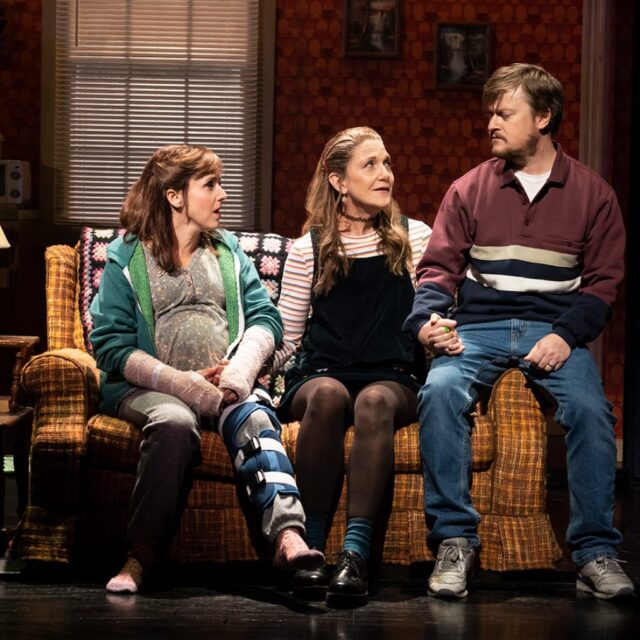
Victor I. Cazares’s american (tele)visions takes place in a Wal-Mart that represents the United States (photo by Joan Marcus)

american (tele)visions
New York Theatre Workshop
79 East Fourth St. between Second & Third Aves.
Tuesday – Sunday through October 16, $65-$75
www.nytw.org

Sitting at home watching television, you can always change the channel if you’re not enjoying a program; the same is not true when sitting in a dark theater experiencing a live play. I would have liked having a remote during Victor I. Cazares’s american (tele)visions, making its world premiere at New York Theatre Workshop through October 16.

The hundred-minute nonlinear play explores a family of illegal Mexican immigrants unable to attain the American dream. Their home base is Wal-Mart, where they are tempted by the ogre of “perpetual consumption.” When young daughter Erica (Bianca “b” Norwood), who is awaiting the rapture, admits, “I want to not want . . . to not want. I want. I don’t want to want,” it is like blasphemy.

Erica’s mother, Maria Ximena (Elia Monte-Brown), who ran away with a trucker named Stanley, explains, “We don’t watch television together anymore. And we stopped shopping together even when we were together. Yes, we would all be in the same store . . . but in different aisles, worlds apart.”

Maria’s husband, Octavio (Raúl Castillo), arrived in America first, working hard to save money to bring over the rest of his family, but he is not on a path to success. When his dead son, Alejandro (Clew), begins filming him and asks him how work is, Octavio plainly replies, “It’s fine.” Alejandro says, “Dad, that isn’t good television, you have to tell me more — something juicy.” Ocatavio offers, “I cut my hand at work today. I’m severely depressed. And I can’t stop watching television. And I think about your mom, with that fucking truck driver. And I keep thinking about you. And how I miss you.”

Projections about in world premiere at New York Theatre Workshop (photo by Joan Marcus)

Erica’s best friend and next-door neighbor is Jeremy (Ryan J. Haddad), a young gay man who spends a lot of time choosing which Barbie doll to add to his collection. Erica has promised to get him one, but she can’t afford it, so it is languishing in “Layaway Land.” Jeremy complains, “That’s no way to treat a goddess.”

Meanwhile, it is becoming apparent that Alejandro and his best friend, Jesse (Clew), were closer than just buddies, as evidenced by a VHS tape they made of themselves — a tape that Octavio wanted to destroy but the eject button on the VCR was broken and the remote control was out of batteries, overt metaphors for the father’s deteriorating life.

Directed by Rubén Polendo (remnant), american (tele)visions features a complex set by Bretta Gerecke that features two large rusted boxes on top of one another on either side of the stage, evoking the sculpture of Richard Serra. The boxes, on which live and prerecorded video is sometimes projected, are occasionally opened by various characters to reveal Octavio’s man cave, the Barbie section of Wal-Mart, the front of Stanley’s truck, and [.] The two angled side walls also serve as screens, showing a barrage of consumer items or the characters making confessions, which also happens in the back.

The initial wonder of the set fades, especially if you’re not near the center of the audience; various projected images and the interiors of the boxes are not fully visible to much of the audience, which was annoying. In addition, the use of the projections and boxes, as well as the dialogue and plot, grow repetitive and disappointing, as it seems like they could have done so much more with them. (The technology design is by Theater Mitu, a copresenter of the production.)

Cazares (Pinching Pennies with Penny Marshall, Ramses contra los monstruos) throws in a kitchen sink’s worth of issues, from illegal immigration, religious faith, and capitalism to queer culture, disabilities, infidelity, depression, and workplace safety, but it’s too much all at once. We watch television series because of the characters; every week the plots change, but it’s the regulars who keep us coming back, season after season. In american (tele)visions, the characters are just not compelling enough; I found myself wanting to appreciate and care about them, but they remain stagnant. And the vast array of plot points were dizzying.

By the time Maria emerged in a bizarre costume (by Mondo Guerra) as Wal-Martina, I had had enough. “Look, if they don’t like it, they can change the channel,” Maria had said earlier. But that choice was not open to me.

BALDWIN AND BUCKLEY AT CAMBRIDGE

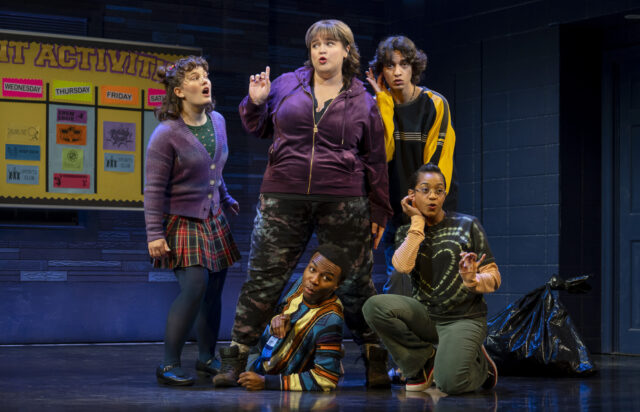
James Baldwin (Greig Sargeant) and William F. Buckley (Ben Jalosa Williams) face off about the American dream at the Public (photo by Joan Marcus)

BALDWIN AND BUCKLEY AT CAMBRIDGE
Anspacher Theater, the Public Theater
425 Lafayette St. at Astor Pl.
Tuesday through Sunday through October 23, $60-$70
212-539-8500
publictheater.org

During the pandemic lockdown, I watched the american vicarious’s virtual Debate: Baldwin vs Buckley, a sharp re-creation of the famous debate between liberal Black author James Baldwin and conservative white author William F. Buckley that was held at the University of Cambridge in England on February 18, 1965, addressing the question “Has the American Dream been achieved at the expense of the American Negro?” Presented in collaboration with BRIC, the show premiered in person at the Great Room at A.R.T./New York in March 2022 and continues its five-borough tour October 10 at the Old Stone House and November 11 at the Queens Theater. The online performances took place on a dark, spare stage with Baldwin (Teagle F. Bougere) and Buckley (Eric T. Miller) on either side of a small table; the in-person play moved the proceedings to a wood-paneled conference room with a black-and-white television occasionally showing clips of the original debate.

I also watched that original debate, which can be found on YouTube. It is a thrilling event, as mostly white male students in suits and ties pack the Cambridge Union; there’s barely room for the two main competitors to walk to their places at their opposing lecterns. The multiple cameras cut between the crowd and close-ups of Baldwin, in a narrow tie, and Buckley, in a bowtie, as they state their cases and react to each other’s points.

When I heard that Elevator Repair Service, one of the city’s most adventurous and daring companies for more than thirty years, was doing its own version, titled Baldwin and Buckley at Cambridge, at the Public’s Anspacher Theater, I was excited by the possibilities; ERS has previously staged unique interpretations of such classics as The Sound and the Fury, The Seagull, Ulysses, Measure for Measure, and The Great Gatsby (the eight-hour Gatz). Alas, perhaps I was expecting too much.

James Baldwin (Greig Sargeant) and Lorraine Hansberry (Daphne Gaines) have a drink while discussing racism in Baldwin and Buckley at Cambridge (photo by Joan Marcus)

Directed by ERS founding artistic director John Collins, Baldwin and Buckley at Cambridge turns out to be, more or less, a straightforward adaptation of the debate, with small little touches. The introductions by Cambridge students David Heycock (Gavin Price) and Jeremy Burford (Christopher-Rashee Stevenson) are delivered in contemporary dress (the costumes are by Jessica Jahn) and include a land acknowledgment and references to the Public, which opened on Lafayette St. in 1967. Heycock quotes Martin Luther King Jr. and shares frightening numbers about voting and prison that immediately bring to mind current attempts at voter suppression and the Black Lives Matter movement. Burford argues that “the American dream has been very important indeed in furthering civil rights and in furthering freedom for the American Negro,” a controversial statement, especially as delivered by Stevenson, who is Black. (Price is white.)

The bulk of the show are the two long monologues by Baldwin and Buckley, portrayed by Greig Sargeant and Ben Jalosa Williams, respectively; neither actor tries to fully embody their character, although Williams throws in a few lines doing a mock impression of the erudite Buckley’s upper-class accent. Although the words resonate with what is happening today, I wasn’t grabbed by the proceedings. Perhaps it was because I was too familiar with it all, having so recently seen the american vicarious version and the original. It also felt distant; the 1965 debate was filled to the gills with students, shoulder to shoulder in chairs and on the floor, while at the Anspacher we were sitting quietly in our seats, experiencing a fictionalized play, not actual history.

The play did not end with the conclusion of the debate; ERS adds a coda that initially stirred me but eventually left me confused. The brief scene takes place in a living room (the sets are by dots), where Baldwin is joined by his good friend, playwright Lorraine Hansberry (Daphne Gaines), as they discuss four hundred years of racism and the need for societal change. “We’ve got to sit down and rebuild this house,” Baldwin says. “The charge of impatience is simply unbearable,” Hansberry explains.

Mixing past and present, they then turn into Sargeant (who conceived the project) and Gaines, the actors, who recall working together at the Public in ERS’s The Sound and the Fury and discuss white and Black casting. While they make interesting points, reminding us how far we still have to go, it felt tacked on to score sociopolitical points; it also made me think about how Hansberry’s A Raisin in the Sun, which deals with a Black family in 1959 trying to find the American dream, is playing now in the Public’s Newman Theater.

THEATER TALKS — DEATH OF A SALESMAN: A CONVERSATION WITH WENDELL PIERCE, SHARON D. CLARKE, ANDRÉ DE SHIELDS, AND MIRANDA CROMWELL

Who: Wendell Pierce, Sharon D. Clarke, André De Shields, Miranda Cromwell, Salamishah Tillet
What: Panel discussion on new Death of a Salesman revival
Where: Schomburg Center for Research in Black Culture (NYPL), 515 Malcolm X Blvd., and online
When: Monday, October 3, free with RSVP, 7:00
Why: Lee J. Cobb, George C. Scott, Dustin Hoffman, Brian Dennehy, and Philip Seymour Hoffman have all starred as Willy Loman in Broadway productions of Arthur Miller’s Pulitzer Prize–winning 1949 American classic, Death of a Salesman. You can now add to that prestigious list Wendell Pierce, in the latest Broadway revival, now in previews for an October 9 opening at the Hudson Theatre. The cast features Pierce and Sharon D. Clarke as Willy’s wife, Linda — both won Oliviers for their performances in the West End production — along with André De Shields as Ben, Khris Davis as Biff, and McKinley Belcher III as Happy, the first all-Black Loman family on the Great White Way.

On October 3 at 7:00, Pierce (The Wire, The Piano Lesson), Clarke (Holby City, Caroline, or Change), and Tony and Emmy winner De Shields (Hadestown, The Full Monty) will be joined by director Miranda Cromwell (Magic Elves, Pigeon English) and moderator and Pulitzer Prize winner Salamishah Tillet for a discussion at the NYPL’s Schomburg Center for Research in Black Culture; presented in conjunction with the 92nd St. Y’s Unterberg Poetry Center, the free event is being held in person and online, and advance registration is required. “So many of the elements of the play are fundamentally questioning of the American dream, and when you put that through the perspective of the Black experience, that enriches it,” Cromwell said in a statement. “The obstacles are harder, the stakes become higher.”

ARCHER ELAND: TEXTPLAY

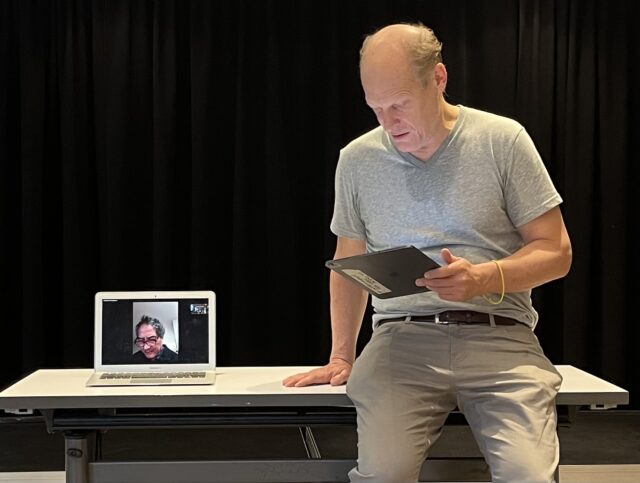
Textplay imagines a digital conversation between Samuel Beckett and Tom Stoppard

TEXTPLAY: TOM STOPPARD AND SAMUEL BECKETT IN CONVERSATION
NYU Skirball digital
Through December 3, $20
nyuskirball.org

During the pandemic lockdown, when companies did not have access to theaters, I experienced numerous cutting-edge live presentations made for laptop, desktop computer, telephone, and smartphone, over Zoom, Instagram, and various new interactive digital platforms, many of which were eye-opening, ingenious ways for creators to connect with one audience member at a time. The latest attempt at this solo virtual magic is Archer Eland’s Textplay, an NYU Skirball production that takes place on your smartphone or desktop device, a real-time imagined, prerecorded texting conversation between absurd theater masters Samuel Beckett and Tom Stoppard. Unfortunately, it is not virtual magic, although it borders on the absurd.

In a 2019 article in the Guardian about Beckett, Robert McCrum writes of a late-1960s gathering at which Stoppard, a young journalist, encounters the Irish playwright for the first time. Stoppard confides, “I was at that time in a strange state of [Beckett] worship, and it hadn’t occurred to me that you could actually meet him. To me, he was a kind of spiritual presence. So I was incapacitated. I was at this party, feeling like a yokel from Bristol. . . . Someone said ‘Would you like to meet Sam?’ ‘Sam?’ ‘Samuel Beckett.’ Apparently, ‘Sam’ was in the kitchen. So I was led off and introduced to ‘Sam.’ Of course I hadn’t the faintest equipment to exploit this meeting. I have no idea what I should have said, and what he might have said in reply, and after a few minutes I backed away.”

While Beckett was a major influence on Stoppard, I can’t find evidence that they were close friends, close enough to, were Beckett still alive (he died in 1989 at the age of eighty-three), be chatting buddies. I also don’t know if the eighty-five-year-old Stoppard is a digital gossiper. But in Textplay, which in the Urban Dictionary is defined as “simulated foreplay,” Beckett and Stoppard engage in a thirty-five-minute nonsexual chat about art and theater (and hair), goading and chiding each other, complete with emojis and typos.

“We made great discoveries, landed on the moon, cured disease, defeated injutice [sic],” Stoppard claims. Beckett rebuffs, “NO! No we didn’t . . . nice try. We wrote nothing and tricked people into thinkng [sic] it meant everything. All we did was tart up a hole and claim it was an abyss . . .”

Upset that Harold Pinter gets Pinteresque but they get Beckettian and Stoppardian, Tom writes, “Stoppardian sounds like a train station in Wales,” while Sam complains, “Beckettian sounds like a disease.”

Alas, those are among the only memorable exchanges in the play, which, once it begins, can’t be paused or rewound without starting again from the very beginning. The viewer watches the conversation from the point of view of Stoppard; we see his posts as he types them, including much rewriting as his thought process is revealed. That is interesting at first but quickly becomes tedious, especially one long message about the meaning of art in which Stoppard types several responses but deletes them (argh, letter by letter) before deciding on what to send to Beckett. The pacing is also off in Beckett’s replies, which are instantaneous and appear to know exactly when Stoppard’s are done; there is just no way he could have physically written many of them in the time it takes for him to post them.

When I sit in the theater, I never check the time, but I found myself doing so on my smartphone over and over to see how close to the end we were. The idea of making the phone the primary vehicle that delivers this story is a good one, since the object itself is anathema in theaters, where people are told over and over to power their phones down — yet invariably someone’s phone goes off at just the wrong dramatic moment. In addition, the phone constantly begs for our attention no matter what else we are doing; it seems like some people just can’t sit in a theater for two hours without obsessively checking it. But with Textplay, that pull is even stronger, since you won’t be bothering anyone around you if you sneak a peek at social media or your email while Beckett and Stoppard chatter on. And you won’t miss a thing.

LUNDAHL & SEITL: SYMPHONY OF A MISSING ROOM PERFORMANCE AND DISCUSSION

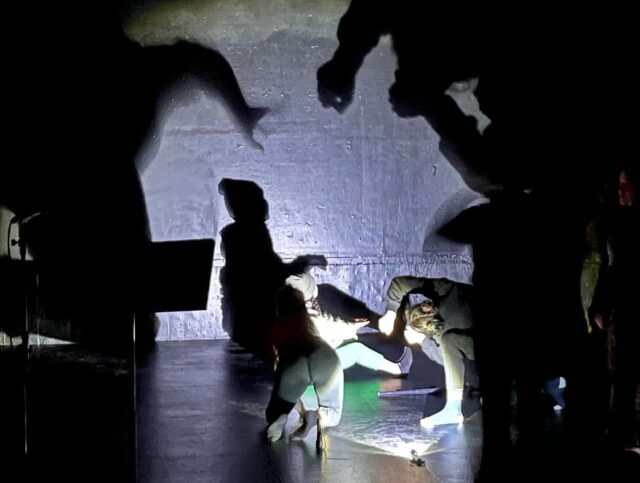
Lundahl & Seitl, Symphony — Tunnel Vision, performed in 2015 at Momentum 8 (photo courtesy of the artists)

Who: Lundahl & Seitl, Barbara London
What: Performance and discussion
Where: Scandinavia House, 58 Park Ave. at 38th St.
When: Sunday, October 2, free with advance RSVP, performances 11:30 am – 1:30 pm and 4:00 – 5:30, discussion at 1:30
Why: “In times of challenge, how to find a good balance between resilience and resistance when adapting to a changing environment? How can we stay sensible for subtle yet powerful shifts in our being together? What is an acceptable level of reality, and for who/what do we make the sacrifice?” So ask immersive art duo Lundahl & Seitl in regard to their 2009 piece, Symphony of a Missing Room, which they reimagined as an app during the pandemic. On Sunday, October 2, Christer Lundahl and Martina Seitl will be at Scandinavia House to perform the work, in half-hour increments between 11:30 and 1:30 and 4:00 to 5:30; in addition, there will be a discussion at 1:30 moderated by curator and writer Barbara London, host of the Barbara London Calling podcast.

The free event is being held in partnership with the Consulate General of Sweden in New York; Lundahl & Seitl have previously performed Symphony of a Missing Room at the Swedish National Museum in Stockholm, the Akropolis Museum in Greece, the Kochi-Muziris Biennale in India, and the Temple of Alternative Histories at Staatstheater Kassel in Germany, among other venues. The ever-evolving work involves white goggles as participants must reconsider their inner and outer relationships with the environment and the space they are in. Admission is free with advance RSVP.

FC BERGMAN: 300 el x 50 el x 30 el

FC Bergman makes its US debut with 300 el x 50 el x 30 el at BAM (photo © Kurt Van der Elst)

300 EL x 50 EL x 30 EL
Harvey Theater at the BAM Strong
651 Fulton St.
September 28 — October 1, $44-$120, 7:30
www.bam.org
www.fcbergman.be/en

Belgian theater collective FC Bergman is making its US debut at BAM with its imaginative 2011 work, 300 el x 50 el x 30 el, which opens BAM’s 2022 Next Wave festival. Running September 28 to October 1, the seventy-five-minute wordless multimedia piece transforms the Harvey stage into a village with six shacks in the woods to bring to life a biblical-inspired anarchic tale of animals, nature, humanity, and technology as a flood approaches. Created by Stef Aerts, Joé Agemans, Bart Hollanders, Matteo Simoni, Thomas Verstraeten, and Marie Vinck, the widely hailed 2011 work, which has toured the world, features sets by FC Bergman and Matthijs Kuyer, camera direction by Thomas Verstraeten, and costumes by Judith Van Herck and is performed by Aerts, Agemans, Simoni, Verstraeten, and Vinck along with Gert Portael, Herwig Ilegems, Shana Van Looveren, Evelien Bosmans, Ramona Verkerk, Arne Focketeyn, Oscar Van Rompay, Ruud Gielens, Gregory Frateur, Mattis Devoldere Contesse, Karen Vanparys, Yorrith de Bakker, and Jeroen Perceval.

Founded in 2008, the Antwerp-based company, which has been associate artists with the Toneelhuis in Antwerp since 2013, has a repertoire that includes the modern parable The Sheep Song; an adaptation of William Gaddis’s National Book Award–winning 1975 novel JR; the wordless monologue Terminator Trilogy; and the descriptively titled Walking down the Champs-Elysées with a tortoise to get a better view of the world, but it is hard to drink tea on an ice floe when everyone is drunk. The troupe is known for its unique approach to storytelling and its immersive environments that should feel right at home at the Harvey, where there will be a celebration with members of the cast and crew following the opening-night performance.