this week in theater

KPOP

The flashy KPOP is closing early on Broadway (photo by Matthew Murphy & Evan Zimmerman)

KPOP
Circle in the Square Theatre
1633 Broadway at 50th St.
Through December 11
kpopbroadway.com

On Saturday night, December 3, I was at Circle in the Square, watching KPOP. I had loved Ars Nova’s 2017 immersive production at A.R.T./New York and was looking forward to the Broadway incarnation. Alas, lightning did not strike twice.

I was supremely disappointed in the revised book, which eschewed most of the behind-the-scenes drama and the progression of the plot — in the original, small groups of audience members were led through a series of rooms in which the action played out, exploring how K-pop stars are made through vocal and dance lessons, press training, makeup, and costumes, following along as a South Korean record company prepares for its major introduction to the US market. Instead, the new version concentrates on big, glittering production numbers centered around a white filmmaker documenting the rehearsals. The central creative team has not changed — the book is by Jason Kim, with music and lyrics by Helen Park and Max Vernon, music production and arrangements by Park, choreography by Jennifer Weber, and direction by Teddy Bergman. But the feeling has.

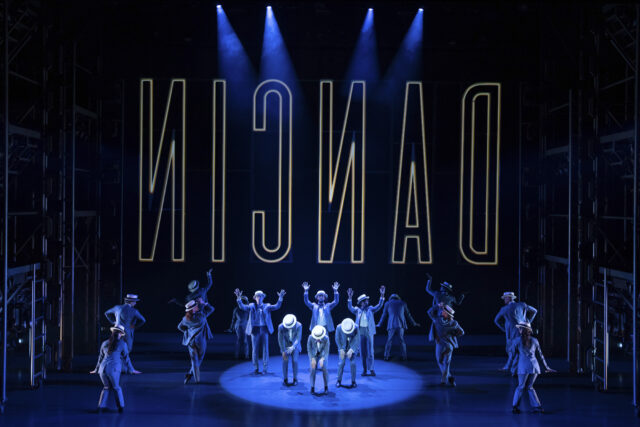
While I sat in my seat, missing all the nuance of the original story, the soul of which has been sucked dry, I looked around at the Saturday night crowd, nearly all of whom were having a great time. At Circle in the Square, the audience sits on three sides of the thrust stage, and the lighting is so bright that you can see everyone in the theater. Aside from a few pockets of empty seats in the upper corners, the house was packed, and nearly everyone was eating up every minute of the show; a colleague of mine had a huge smile on his face throughout the two hours and ten minutes (with intermission); he emailed me afterward to say that he “fucking loved” it. (Another colleague of mine said that the night he went, there was an embarrassing amount of empty seats.) People were dancing in their seats, clapping along, eyes sparkling wide at Clint Ramos and Sophia Choi’s dazzling costumes, Jiyoun Chang’s flashy, colorful lighting, Peter Fitzgerald and Andrew Keister’s propulsive sound design, and Peter Nigrini’s constant barrage of cool projections on Gabriel Hainer Evansohn’s set, which includes a mobile platform, video monitors with live footage from multiple angles, and a stage lift with a trap door where a character’s past is explored.

So the last thing I expected was, a few days later, to find out that the show was closing extremely early, on December 11, a mere three weeks after opening, having played forty-four previews and only seventeen performances.

KPOP found itself mired in controversy when Jesse Green used some highly questionable language in his negative New York Times review, leading to the producers of the show and several cast members to take to social media, demanding an apology.

Real-life K-pop star Luna takes center stage at Circle in the Square (photo by Matthew Murphy & Evan Zimmerman)

But was that enough to lead to the surprising closing notice? Plenty of Broadway musicals survive bad reviews and thrive, sometimes for years. Was there not enough interest in K-pop, the music phenomenon that has given rise to such groups as BTS, Blackpink, and Monsta X, who play well-attended concerts around the country? KPOP tries to capitalize on that success, following the fictional girl group RTMIS (pronounced like “Artemis,” featuring its young female stars often posing as if shooting a bow and arrow) and the boy band F8 (“Fate”), a mixed bunch of young men dealing with a new member hogging the spotlight and accused of not being Korean enough. The fictional label’s star, MwE, wants to move away from her highly stylized image and be more real — maybe even become a singer-songwriter (gasp!) — and is portrayed by Luna, an actual Korean pop star who was in the hugely popular troupe f(x).

Even though it’s my job to critique theater, I don’t take pleasure when poorly reviewed shows close, even one that has spurred such nicknames as OKpop, KPOOP, and KFLOP. It might not be to my taste, but a whole lotta people were having a great time the night I was at Circle in the Square, and the audience was far more varied than the usual Broadway crowd, which is a good thing.

I just hope this experience doesn’t sour producers from taking chances on shows that bring a more wide-ranging diversity onstage and in the seats.

I called the original “an awesome journey into music making, promotion, assimilation, the desire for fame, and more,” pointing out, “Early on, Jerry [a marketing expert not in the Broadway production] explains that the mission of his agency ‘is to launch rockets into American markets.’”

Unfortunately, this rocket barely lifted off the ground.

THE RAT TRAP

Sheila Brandreth (Sarin Monae West) and Keld Maxwell (James Evans) toast to their upcoming marriage in Mint production of Noël Coward’s The Rat Trap (photo © Todd Cerveris)

THE RAT TRAP
New York City Center Stage II
131 West 55th St. between Sixth & Seventh Aves.
Tuesday – Sunday through December 10, $45-$90
minttheater.org
nycitycenter.org

There’s a reason why Noël Coward’s first “serious play,” The Rat Trap, has never before been performed in the United States: It’s not all that good. In fact, not even the Mint, the finest purveyors of lost and forgotten theater, can save the drawing-room comedy of manners in its sharp production running at City Center’s Stage II through December 10.

“For years I have mourned the fact that The Rat Trap never saw the light of day,” Coward wrote in 1924’s Three Plays, consisting of The Rat Trap and the more successful Fallen Angels and The Vortex. “But now the time for it is past, the sterling merits I saw in it when it was first written in 1920 have faded.” Coward wrote the play when he was eighteen, reportedly for Meggie Albanesi, who died in December 1923 from the aftereffects of a botched abortion.

Coward didn’t attend the play’s 1926 debut in London; he wrote in his 1937 autobiography, Present Indicative, “In spite of the effulgence of the cast, the play fizzled out at the end of its regulation two weeks. I was not particularly depressed about this; The Rat Trap was a dead love.” He particularly called out the big scene in the last act, which “made me shudder, nostalgically, but with definite embarrassment. It was neither good enough nor bad enough to merit a West-End run, and it was perhaps a mistake to have allowed it to be produced at all; however no harm was done, and I am sure that it was admirable exercise for the actors.”

It is indeed admirable exercise for the splendid Mint actors and director Alexander Lass, but the story grows quickly tedious. It begins in Olive Lloyd-Kennedy’s (Elisabeth Gray) apartment in West Kensington, where she lives with young writer Sheila Brandreth (Sarin Monae West), who is about to marry burgeoning playwright Keld Maxwell (James Evans). Olive is not a fan of the wedding ritual; she tells Sheila and Keld, “Marriage nowadays is nothing but a temporary refuge for those who are uncomfortable at home.”

Olive has invited over another couple, the decadent author Naomi Frith-Bassington (Heloise Lowenthal) and the would-be poet Edmund Crowe (Ramzi Khalaf), Bohemian lovers who refuse to get married because that would be too conventional. “Miss Brandreth, how courageous it is of you to marry! I should never dare,” Naomi says. “Edmund and I realise the value of love, perhaps better than anyone; it seems sacrilege to fetter it down with chains of matrimony.”

Naomi (Heloise Lowenthal) and Ruby (Claire Saunders) share a moment as Edmund (Ramzi Khalaf) looks on in The Rat Trap (photo © Todd Cerveris)

Six months after their marriage, Sheila and Keld are living in their house in Belgravia, she working on her next book in her bedroom, he on his play in the far more comfortable study. There are already signs of strain as they argue over a pencil and the value of their ornery maid, Burrage (Cynthia Mace). Sheila tells Keld, “I mean to discover what the trouble is; it’s getting on my nerves terribly, so it is on yours. We’re not being happy together, Keld, we’re not being happy together. Don’t you realise it — isn’t it awful?” He unconvincingly tries to push it aside and declare it’s all “trivialities,” but when his play is an instant hit and he is spending more time with one of the stars, the ambitious ingénue Ruby Raymond (Claire Saunders), trouble is not far off.

The Rat Trap is impeccably rendered by director Alexander Lass (in his New York debut) on Vicki Davis’s ever-changing set, as stagehands move around furniture between scenes and a yellow semicircular curtain occasionally opens in the back to introduce a larger space. Hunter Kaczorowski’s period costumes capture the era, and the lighting, by Christian DeAngelis, and the sound, by Bill Toles, are meticulous and precise, as always with the Mint. And the cast is excellent, particularly West (The Skin of Our Teeth, Merry Wives) as Sheila, her initially dreamy eyes turning sour over time; Khalaf as Edmund, who makes what he believes to be profound statements that get no reaction from the others; and Mace as Burrage, whose displeasure with her life is apparent in her every word and move.

The problem is that The Rat Trap is very much an early play by a writer still sowing his oats; Coward would go on to pen Private Lives, Cavalcade, Design for Living, Present Laughter, and Blithe Spirit, all within a spectacular twelve-year span from 1929 to 1941. While impressive for a teenager, The Rat Trap ultimately falls apart as Coward drifts into melodrama with soap-opera twists and turns. A late revelation actually made my jaw drop and my face wince.

Sharing yet another rave review of his aptly titled play Stress, Coward’s protagonist Keld, a kind of stand-in for the author himself, reads: “‘There was none of that forced appreciation one generally sees at first nights nowadays; the debonair author made a witty speech in response to the ecstatic calls for him. He should indeed be proud of a really great achievement. . . .” In this case, Coward’s own really great achievements lay in the future, with at least one clunker to help pave the way.

THE GETT

Ball (Ben Edelman) and Ida’s (Liba Vaynberg) relationship kicks off in an elevator in The Gett (photo by Bronwen Sharp)

THE GETT
Rattlestick Playwrights Theater
224 Waverly Pl.
Wednesday – Monday through December 11, $45
www.rattlestick.org

When was the last time you saw a new show that was accompanied by a sixty-three-page dramaturgy packet? You’ll find one for The Gett, an offbeat, extremely clever — almost too much so for its own good — and ultimately satisfying play in which a young woman imagines her relationship with men through the lens of the creation of the world.

The ninety-minute work, written by and starring the charming Liba Vaynberg and continuing at the Rattlestick through December 11, is divided into seven sections that essentially follow the biblical seven-day creation story. Vaynberg, in a modest wedding dress, takes the stage, holding up a sheet of parchment, explaining what a gett is. “The gett is technically just an old religious document of divorce,” she says. “An old text on a piece of paper / That needs a rewrite — / Revision / Re-creation.”

Vaynberg is Ida — pronounced EE-dah, not eye-dah like my own grandmother, who had unique, freethinking views about a woman’s sexuality. Ida tells us, “Six thousand years ago I fell in love with a man. / I mean, sometimes it feels like a week ago. / Depends on when you ask me. And how.” She also sets up one of the play’s key themes when she says, “None of this is real. Or true. / It’s just what I believe.” The Gett is about faith — in G-d and religion, in family, in love, and, perhaps most important, in oneself.

On her way to a Christmas party at her friend Lilah’s apartment on the twenty-third floor, Ida, a poet who works in a library, gets stuck in an elevator with Baal (Ben Edelman), a tall, lanky man who is also going to the fête, bringing Chinese food. Vaynberg has painstakingly made nearly every single detail of the play relevant, every name, every prop, every number, nearly all of which are pointed out in the dramaturgy packet.

Ida means “witness” in Hebrew and has a numerological value of two; a gett would make a couple into a pair of ones. Baal means “husband,” “owner,” “false, violent god,” or “slavemaster” in Hebrew, is the name of the Canaanite god of fertility, and evokes the Baal Shem Tov, the eighteenth-century Ukrainian rabbi, mystic, and healer who founded Hasidic Judaism and whose name means “Master of the Good Name”; just as human beings cannot know or pronounce the full name of G-d, Baal, who is a magician and inventor, says to Ida, “I have a weird name no one can pronounce.” The floor number conjures Psalm 23, which includes the lines “The Lord is my shepherd; I shall not want. . . . He leads me in paths of righteousness for his name’s sake.” Lilah, derived from Delilah, the Philistine beauty who betrayed Samson, has been interpreted to be the angel of conception and the opposite of Lilith, Adam’s first wife (and Baal’s second wife in the play). And Baal and Ida meet on Christmas Day, celebrated as the day Jesus Christ was born.

Ida’s mother (Jennifer Westfeldt) chats away on the phone throughout new play (photo by Bronwen Sharp)

As Ida meets with a divorce attorney and starts dating other men (all unnamed, all played by Luis Vega with different accents), Baal occasionally watches from the corners, an all-seeing figure hovering over her life. During one of her dates, Baal appears in her mind, magically pulling a condom for her out of thin air, then making it disappear. (Alexander Boyce serves as magic consultant.) Baal later shows up for real, asking Ida to give him a gett.

Meanwhile, Ida’s mother (Jennifer Westfeldt) incessantly calls her daughter, leaving long, gossipy messages when Ida doesn’t pick up, going on and on about Ida’s future, how friends’ kids are doing, and how her father has taken up kabbalah, the esoteric discipline involving mysticism. In a script note, Vaynberg explains about Mama, “No Jewish woman is complete without her.” We never see the father, as Judaism is a matriarchal religion, passed through the mother. “It’s never too early to procreate. No one thinks produce is going bad in the fridge,” Mama says. “I can say these things; I’m your mother.” Ida is petrified when her mother tells her to go to a sex store and find out where her G-spot is, then discusses some of the sexual role-playing she and Ida’s father engage in, things no child should know about their parents. But Jewish mothers have no boundaries.

Vaynberg (Scheiss Book, The Oxford Comma) has no boundaries as well, and that’s one of the elements that makes The Gett so successful. She is immediately likable as Ida; it’s impossible not to root for her even when she goes off track. Director Daniella Topol (Novenas for a Lost Hospital, Ironbound) smooths out some of the rough edges, but the narrative is still too choppy. The set, anchored by a screen of what looks like vertical filmstrips that open up to reveal other spaces (an elevator, a living room, a lawyer’s office), is by Misha Kachman, with costumes by Johanna Pan, lighting by Paul Whitaker, and extensive sound effects by Megumi Katayama.

Edelman (The Chosen, Admissions) is a fine foil as Baal, Vega (The Underlying Chris, Change Agent) effectively portrays a series of non-Jews, and Tony nominee Westfeldt (Wonderful Town, Kissing Jessica Stein) has a field day as Ida’s mother, who I can practically still hear chatting away on the phone.

Like Ida’s mother’s phone messages, Vaynberg can get caught up in trivialities, but the majority of the story is delightfully appealing and relatable whether you’re Jewish or not, exploring universal truths about family, faith, and love. You might not believe in religion, and rituals might not be your thing, but you will leave the theater believing in Vaynberg.

THE PATIENT GLORIA

Gina Moxley makes a phallic point in The Patient Gloria (photo by Teddy Wolff)

THE PATIENT GLORIA
St. Ann’s Warehouse
45 Water St.
Through December 4, $49-$59
718-254-8779
stannswarehouse.org
www.panpantheatre.com

I never want to end up on Gina Moxley’s shitlist.

In 1964, a thirty-one-year-old chain-smoking divorced mother of a young girl sat down with three distinguished psychotherapists to discuss various aspects of her personal life. The sessions were filmed; the woman, Gloria Szymanski, was told that the recordings were to be used for educational purposes — astonishly, they ended up being shown in theaters. Three Approaches to Psychotherapy, which became more familiarly known as The Gloria Films, documented Gloria speaking with Dr. Carl Rogers, whose specialty was client-centered therapy; Dr. Frederick Perls, founder of Gestalt therapy; and Dr. Albert Ellis, whose discipline was rational-emotive therapy.

Dublin-based actor and playwright Moxley shares Gloria’s story in The Patient Gloria, a stirring seventy-five-minute work making its US premiere at St. Ann’s Warehouse. Focusing on the misogyny inherent in the field of psychology and society at large, it may have taken place more than half a century ago, but the attitudes remain all too contemporary.

As the audience enters the theater, Moxley is sitting at a small table at the front of the stage to the right. Behind her, Gloria (Liv O’Donoghue), in a pouffy hairdo and an elegant white dress that shows off her long legs, tries to relax on a couch. She might look like the wife straight out of an early 1960s sitcom, except she is about to talk about sexual desire in a way that Donna Reed (The Donna Reed Show) and June Cleaver (Leave It to Beaver) never dreamed of.

As the play begins, Moxley, in tight-fitting men’s pants, a white button-down shirt, and awesome gold shoes (the costumes are by Sarah Bacon), asks the audience if they can hear her. She then gets up and says, “Can you see me? That any better? Can you see me now? You can? Wow. Yes. Miraculous. You should not be able to see me at all. Seriously, I’ve been fading for years and am technically invisible by now.” She reveals the item that she was sewing to be a fabric phallus, which she gleefully swings around. “I’m about to play three men — yeah, because I want to — so I felt I needed to get a true feeling for the apparent sense of authority and entitlement that comes with this lump of meat, of manhood,” she says, offering an alternate interpretation of Sigmund Freud’s theory of penis envy. “Since I’ve always been good with my hands I thought I’d make myself a nice, muscular dick to help me get into character.” The male member is a humorous motif that continues throughout the play.

Gloria (Liv O’Donoghue) and one of her psychotherapists (Gina Moxley) are exasperated in US premiere at St. Ann’s (photo by Teddy Wolff)

Moxley proceeds to portray each of the three doctors, with slight adjustments to her costume, accent, and demeanor, as Gloria explains that her major concern is how to tell her nine-year-old daughter, Pammy, that since the divorce she has been having sex with men other than Pammy’s father. She tells Dr. Rogers, “The other day she asked, ‘Mommy, did you ever go to bed with anyone besides Daddy?’ And I lied to her. I looked straight into her eyes and lied, ‘No, honey.’ I mean, what was I meant to say? ‘Sure, honey, everyone does.’ Oh shit. It keeps coming into my mind. I feel so guilty having lied to her. I never lie, I hate liars. I want — I can’t help wanting . . . I remember when I was a little girl and found out my parents made love, oh, it was dirty, terrible. I was particularly disgusted by my mom.”

The idea of a woman, no less a mother, admitting to having and enjoying sex for pleasure has always been frowned upon by much of America, yesterday and today, and the psychotherapists aren’t hesitant to demean Gloria by displaying their own sexual desires for her, thinking with their dicks. Just as Moxley announced at the beginning that she assumed she couldn’t be heard or seen, Gloria is not truly being listened to by the doctors.

To assert themselves and celebrate their quest for individuality and freedom, Gloria and Moxley occasionally break out into joyous dancing (O’Donoghue is also the choreographer), sometimes joined by experimental Irish bassist Jane Deasy, who participates in several dialogues. Feeling like a devil, Gloria says, “I want to get rid of my guilt. But I don’t want to put it on Pammy. Guilt kills.” “Guilt kills,” Moxley agrees. “Guilt kills. Ain’t that the truth,” Deasy adds. A few minutes earlier, Deasy had come to the front of the stage, stood at a microphone, and performed a version of the all-female rock band L7’s “Shitlist,” declaring, “For all the ones / Who bum me out / Shitlist / For all the ones / Who fill my head with doubt / Shitlist / For all the squares who get me pissed / Shitlist / You’ve made my shitlist.”

Presented by Beckett experts Pan Pan (Cascando, Embers), The Patient Gloria is directed by John McIlduff (The Scorched Earth Trilogy, Fatal System Error) with a mix of chaos, absurdity, and exhilaration. Andrew Clancy’s open set counters the claustrophobic design of The Gloria Films, where the subject was mostly seen in the shadow of the supposedly brilliant, much more powerful men. Adam Welsh’s sound and Sinéad Wallace’s lighting maintain the overarching welcoming atmosphere, which often has more of a feel of a party than conversations with a shrink. Projections of photos from the original sessions, words, drawings of phalluses, and other imagery appear on the folded red curtain in the back, not always clear, contributing to the at-times disorienting atmosphere.

O’Donoghue (Good Sex, Lippy) portrays Gloria with a subtle fierceness; the character might be nervous and off balance speaking with the psychotherapists, but she also is not ashamed of the choices she has made. Moxley (Danti-Dan, Endgame), here a dynamic sprite who, dressed as a man, resembles a cross between Mike Pence, Jeff Sessions, and Lindsey Graham, is bursting with an infectious, confident energy that fills St. Ann’s. And the tall, thin Deasy adds just the right flourishes, including a rousing finale. Together they don’t just take the power back but revel in it. It’s the kind of play that needs to be performed for the US Congress and at psychiatric conferences around the world.

The real Gloria Szymanski got married and divorced again before dying from leukemia in 1979 at the age of forty-six. In 2008, her daughter, Pamela J. Burry, wrote the book Living with ‘The Gloria Films,’ sharing the effects Three Approaches to Psychotherapy had on her and her mother, who essentially starred in one of the first reality shows. Nearly sixty years after the events of The Patient Gloria, the rights of women to control their bodies are under siege, an undercurrent of the play, which, in its extremely entertaining way, demands that things must change, yet again, as more people make Moxley’s shitlist.

KEEN ON NEW WORK: 2022 KEEN PLAYWRIGHTS LAB READINGS

Who: Keen Company
What: Free readings of three new plays
Where: ART/NY Conference Room, 520 Eighth Ave. at Thirty-Sixth St., third floor
When: Friday, December 2, free with RSVP, 3:00; Monday, December 12, free with RSVP, 3:00; Monday, January 9, free with RSVP, 3:00
Why: Started in October 2013, Keen Company’s “Keen on New York” features readings of works-in-progress by three midcareer playwrights, with impressive casts. The 2022 edition begins on December 2 with Anna Ziegler’s (Photograph 51, Boy) Antigones, a contemporary reimagining of Sophocles’s family and political drama, directed by Tyne Rafaeli and read by Santino Fontana, Celia Keenan-Bolger, Maria-Christina Oliveras, Marianne Rendón, and Armando Riesco. On December 12, Things with Friends, written and directed by Kristoffer Diaz (Hercules, The Elaborate Entrance of Chad Deity), invites guests into a fateful dinner party. And on January 9, Sarah Schulman’s (Manic Flight Reaction, The Lady Hamlet) Free Ali! Free Bob! takes on political hierarchies surrounding a gay art clique.

“I am thrilled to announce the details for this year’s Playwrights Lab readings, the first in-person sharing from our lab since the pandemic,” Keen artistic director Jonathan Silverstein said in a statement. “It has been an honor to be in the room with these three exceptional and seasoned artists throughout the year, under the leadership of Keen’s director of new work, Jeremy Stoller. Anna, Kris, and Sarah are all unique voices, yet they share a common sense of compassion and a deep understanding of the world we live in while also reveling in the joy of the human condition.” The readings take place in the ART/NY Conference Room in the Garment District and are free with advance registration.

JACK WAS KIND / SANDRA

Mary (Tracy Thorne) explains why she chose to just sit there in Jack Was Kind (photo by Carol Rosegg)

JACK WAS KIND
Irish Repertory Theatre, W. Scott McLucas Studio Theatre
132 West 22nd St. between Sixth & Seventh Aves.
Wednesday – Sunday through December 18, $50
212-727-2737
irishrep.org

“How could I just sit there?” Mary asks at the beginning of Jack Was Kind, a one-woman show at the Irish Rep written by and starring Tracy Thorne. Thorne spends the entire seventy-minute show seated in a chair at a small table, relating critical choices she made to maintain the life she has; in fact, as the audience enters the downstairs W. Scott McLucas Studio Theatre, she’s already in place, deep in contemplation.

Meanwhile, over at the Vineyard Theatre, Marjan Neshat spends most of the eighty-minute, one-woman Sandra in a comfy easy chair, relating critical choices she made to get back at least part of the life she had. Both characters construct their own reality concerning a close male figure, with very different results, as one remains seated and the other takes to the road.

“Some people want me to stop . . . telling stories . . . to cease and desist,” Mary explains. “I don’t think those people will like this very much.” Married with two children, Mary is speaking into an iPhone, delivering a kind of public confession, or at least an explanation, of why she did what she did involving her husband, Jack, a famous, or, perhaps, infamous, public figure. On the table is a pile of photo albums, a reminder of their family life. Behind the table is a long, horizontal window that marks the passage of time as leaves blow gently in the wind. (The spare but effective set is by David Esler.)

Mary shares details of Jack’s life, as well as her own; her “beat up childhood” included sexual, psychological, and emotional abuse. She and Jack want only the best for their kids, Eli and Flo, but Flo in particular has issues with what her parents have done.

Tracy Thorne wrote and stars in one-woman show at the Irish Rep (photo by Carol Rosegg)

Mary tentatively admits, “Nearly two years of a nonsensically overpriced education results in our daughter having no observable intellectual curiosity, then boom, the match ignites, when it’s personal it ignites, and now she wants to know, but I don’t want her to know, I don’t know, though sometimes I wonder if I do, that’s a thing, right? ‘Really, Mom, you don’t know how you could just sit there?’ That’s what she says to me. So I guess this is how it starts for my daughter, maybe for me too, funny it starts at the end. But then I don’t know if it’s the end, or do I know if it’s the end, I don’t know what I know and now I’m threatening myself. ‘Don’t you think you should know, Mom.’ Frankly I’m appalled you don’t.’ She says that, too.”

The truth of what Jack did, and Mary’s complicity, slowly emerges; even if you guess it early on, the revelation is poignant, and timely. Thorne (Here We Are, Quick Bright Things), who was inspired by actual events and the writings of Elena Ferrante, delivers the monologue in a consistently even-paced manner, save for one loud moment; she’s trying to convince herself as much as her fictional virtual audience that she really couldn’t have done anything else, taking full advantage of her white privilege. Director Nicholas A. Cotz (My Name Is Gideon, rogerandtom) ensures that the play never gets boring; Thorne shifts in her seat, pauses, twiddles nearly incessantly with her hands, displaying how uncomfortable this whole situation is for her.

Jack Was Kind was first performed live on Zoom for several weeks during the pandemic, with each show followed by a discussion with a special guest. Essentially, home viewers were seeing Mary in her house, looking directly into her smartphone. At the Irish Rep, there’s a different kind of intimacy, as we watch Mary talking to the anonymous rabble on the other side of the camera. Physically, we are on her side, in the same space, but that doesn’t necessarily mean we are on her ethical side, especially as we discover who her husband is and what he did.

Marjan Neshat remains seated for much of one-woman Sandra at the Vineyard (photo by Carol Rosegg)

SANDRA
Vineyard Theatre
Gertrude and Irving Dimson Theatre
108 East 15th St. between Union Square East & Irving Pl.
Tuesday – Sunday through December 18, $37-$85
vineyardtheatre.org

Marjan Neshat caps off quite a year with Sandra, a one-woman show in which she spends most of the eighty-five minutes seated, telling her story directly to the audience. Last December, Neshat appeared in Sylvia Khoury’s Selling Kabul at Playwrights Horizons, followed by Sanaz Toossi’s English at the Atlantic and Wish You Were Here at Playwrights, a trio of unique and moving performances in which she displayed her range and proved herself to be a compelling stage presence.

David Cale’s world premiere at the Vineyard further solidifies Neshat’s standing as a rising star, even if she towers over the material. Wearing an attractive knee-length red dress and supremely unflattering sandals, Sandra Jones shares a Lifetime-worthy neo-noir about her best friend, Ethan, who has gone missing. (The costume is by Linda Cho.) Rachel Hauck’s imposing set features large standing walls on either side of Sandra’s chair, each with a big glassless window that she occasionally approaches, as if offering a way out. Behind her is a somewhat dilapidated wall with a grid of hundreds of fading small squares. It’s as if Sandra is trapped, both physically and psychologically, but egress is within reach.

A burgeoning pianist who works behind the counter at Sandra’s café in Crown Heights, Ethan has dinner with Sandra the night before going on vacation to Puerto Vallarta. She remembers, “At the door, I hugged him goodbye and he said, ‘I feel like disappearing from my life. Part of me just isn’t in the world. I’m at a remove.’ I said, ‘Even from me?’ ‘No, not you,’ he said, ‘But you and I are so simpatico, if I vanish you’d probably disappear from your life too. I love you, Sandra. I love you so much.’ I said, ‘I love you too, Ethan. Have fun in Mexico.’ We hugged again and he left.”

Their relationship is purely platonic, as Ethan is gay and Sandra is married, although she is separated from her husband. Two and a half weeks later, two detectives visit her, as Ethan has indeed disappeared and Sandra is his emergency contact. Determined to find him herself, she quickly packs up and flies south to investigate. She considers, “The first day in Puerto Vallarta my thoughts run the gamut . . . to thinking, maybe he’d planned this. And becoming furious with him. To stopping on the street and thinking, what the hell am I doing here?”

Marjan Neshat caps off quite a year with David Cale’s Sandra (photo by Carol Rosegg)

The audience might ask the same, as Sandra immerses herself in an ever-more-absurd plot involving a couple that frequents her café, bottles with messages being thrown into the ocean, a wild and sexy Italian named Luca Messina, a federal agent named Stephen McCourt who dismisses Sandra’s ideas, and various other characters, all of whom Sandra portrays with different accents. Even as the evidence mounts, Sandra feels in her gut that he’s still alive, so she continues playing Nancy Drew.

While watching Neshat makes the play worth seeing all by itself, the narrative, accompanied by music by Matthew Dean Marsh, careens downhill. After learning of some very dangerous doings in Cozumel, Sandra announces that she flew down there, and the audience groaned in unison. But it was not the kind of groan audiences make when a person decides to go down into the basement or up to the attic in a horror movie; this was a you-gotta-be-kidding-me scolding. However, even as we lose faith in Cale and Sandra, we just can’t give up on Neshat, especially when she finally takes off those terrible shoes.

As she did with Cale’s 2017 one-man Harry Clarke, in which an often-seated Billy Crudup excelled as the title character in a thrilling yarn, director Leigh Silverman (Grand Horizons, Chinglish) keeps us actively engaged despite the script’s ludicrousness. Obie winner Silverman knows her way around solo shows; she has also helmed the harrowing On the Exhale with Marin Ireland and the charming The Search for Signs of Intelligent Life in the Universe with Cecily Strong.

At times you’re likely to ask yourself, “How could I just sit there?” But with such talented actors as Thorne and Neshat, the answer is simple.

LEOPOLDSTADT

You might experience déjà vu when watching Sir Tom Stoppard’s Leopoldstadt on Broadway (photo by Joan Marcus)

LEOPOLDSTADT
Longacre Theatre
220 West 48th St. between Broadway & Eighth Aves.
Tuesday – Sunday through March 12, $74-$318
leopoldstadtplay.com

The Broadway premiere of Sir Tom Stoppard’s Olivier Award–winning Leopoldstadt has just about everything going for it: The exquisite production features a terrific cast of more than thirty actors, stunning sets by Richard Hudson, elegant costumes by Brigitte Reiffenstuel, superb lighting by Neil Austin, strong sound and original music by Adam Cork, and powerful direction by Patrick Marber. So why is it ultimately unsatisfying?

Named for the second municipal district of Vienna where a tight-knit community of Jews lived, the play is based on real events that Stoppard’s family experienced. Yet it was not until 1993 that Stoppard, born Tomáš Sträussler in the Czech Republic in 1937, learned that he had several Jewish relatives who had been killed in concentration camps during the Holocaust. The play’s narrative runs from December 1899 to January 1890, the spring of 1924, November 1938, to 1955 as the Merz-Jakobovicz clan goes from prosperity to persecution.

The story begins with family and servants readying for Christmas, including decorating the tree. Prophetically, the first lines uttered are “That’s mine!” by young Rosa (Pearl Scarlett Gold), followed by young Pauli (Drew Squire) declaring, “And that’s mine!” In a span of a few decades, the family will lose nearly everything.

The men discuss Freud, religion, and marrying out of the faith. Assimiliation is clearly the theme. Eva Merz Jakobovicz (Caissie Levy) says, “We’re Jews. Bad Jews but pure-blood sons of Abraham, and Ludwig’s parents would have nothing to do with us if their grandson didn’t look Jewish in his bath. In fact, if I’d had myself Christianised like my brother, Ludwig wouldn’t have married me, would you, be honest.” Erudite mathematician Ludwig (Brandon Uranowitz), Eva’s husband, responds, “I would when they were dead.” Eva asks, “Is that a compliment?”

The Jewish Merz-Jakobovicz family decorates their Christmas tree in Leopoldstadt (photo by Joan Marcus)

A moment later, Hermann Merz (David Krumholtz), Wilma Jakobovicz Kloster (Jenna Augen) and Ludwig’s brother, married to the Christian Gretl, (Faye Castelow), tells Ludwig, “You seem to think becoming a Catholic is like joining the Jockey Club.” Ludwig quickly retorts, “It’s not unlike, except that anyone can become a Catholic.”

To fill in the family’s background further, Stoppard has Wilma accuse Hermann of disdaining Grannie and Grandpa Jakobovicz. “You’re snobby about their accent and using Yiddish words, and dressing like immigrants from some village in Galicia,” she proclaims. “There’s too much of the shtetl about them for you.”

As the years pass by, there are affairs and betrayals, the birth of new generations, key business decisions, such Jewish rituals as a Passover Seder and a bris, the coming of the Nazis, and a gathering of Holocaust survivors.

While the discovery of his Jewish heritage deeply affected Stoppard (Rosencrantz and Guildenstern Are Dead, The Invention of Love, The Coast of Utopia), who has won four Tonys, three Oliviers, and an Oscar, Leopoldstadt adds nothing new to the genre of Holocaust-related dramas. Most of the scenes are nobly rendered, but I felt like I had seen too many of them before, especially when Umzugshauptmannsleiter Schmidt (Corey Brill) invades the family home and, dare I say, a word entered my mind that it rarely does in Stoppard’s work: cliché.

From Claude Lanzmann’s Shoah, Ken Burns’s The U.S. and the Holocaust, and the 1978 Holocaust television miniseries to Steven Spielberg’s Schindler’s List, Roberto Benigni’s Life Is Beautiful, Arthur Miller’s Incident at Vichy, and Jane Campion’s The Pianist, the oppression of the Jews by the Third Reich has been explored from multiple angles and emotions, each adding fresh insight, which is disappointingly lacking in Leopoldstadt.

In 1938, Ernst (Aaron Neil), who is married to Wilma, discusses a trio of paintings by Gustav Klimt (one of which the family owns): “A dream is the fulfilment in disguise of a suppressed wish. The rational is at the mercy of the irrational. Barbarism will not be eradicated by culture. The last time I saw Freud, the most profound man I know, I asked him, ‘Yes, but why the Jews?’ He said, ‘I don’t know, Ernst. I wasn’t going to ask you, but — why the Jews?’” It’s a question that’s been asked over and over, and answered; I was expecting more from Stoppard.

While technically a marvel and certainly worth seeing, the widely hailed Leopoldstadt does not reach the pantheon of its predecessors, neither in its genre nor its author’s oeuvre. Even midlevel Stoppard is an event to be treasured, but don’t be surprised when you have déjà vu at the Longacre Theatre.