this week in theater

THE COAST STARLIGHT

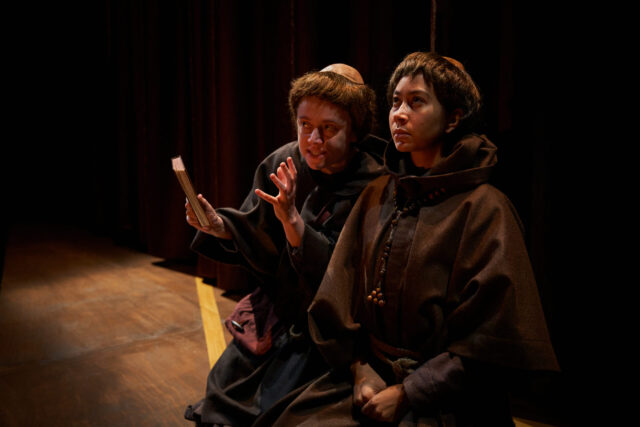
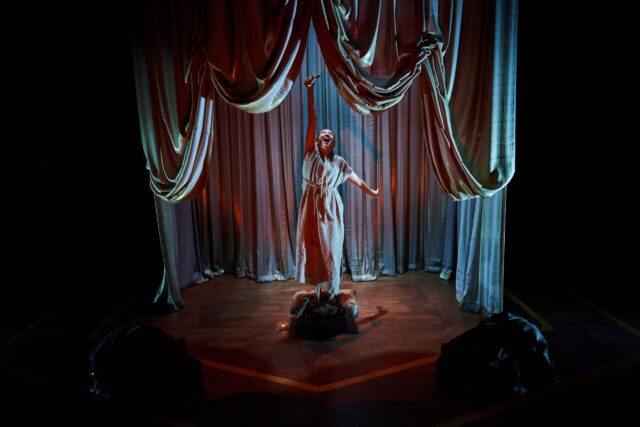
TJ (Will Harrison) and Jane (Camila Canó-Flaviá) consider what might be in The Coast Starlight (photo by T. Charles Erickson)

THE COAST STARLIGHT
Lincoln Center Theater at the Mitzi E. Newhouse
150 West 65th St. between Broadway & Amsterdam Ave.
Through April 16, $103
212-362-7600
www.lct.org

Sliding Doors meets Pirandello’s Six Characters in Search of an Author and the Twilight Zone episode “Five Characters in Search of an Exit” in Keith Bunin’s The Coast Starlight, making its New York City debut through April 16 at Lincoln Center’s Mitzi E. Newhouse Theater.

The ninety-five-minute play takes place on board the Coast Starlight, a real Amtrak train that travels from Los Angeles to Seattle in thirty-six hours. The premise is wholly relatable: Various individuals get on the train and sit in the same car, where they wonder about the identity of their fellow travelers and consider what might happen if they engaged one another in conversation. Who hasn’t been on a train, bus, or plane and thought about who was sitting nearby, thinking about who they might be and maybe even saying hello.

“One day, back in 1896, I was crossing over to Jersey on the ferry, and as we pulled out, there was another ferry pulling in, and on it there was a girl waiting to get off,” Mr. Bernstein (Everett Sloane) says in Citizen Kane. “A white dress she had on. She was carrying a white parasol. I only saw her for one second. She didn’t see me at all, but I’ll bet a month hasn’t gone by since that I haven’t thought of that girl.” There’s an inherent sadness in every fleeting glimpse we humans have of each other, that maybe life would have turned out differently if we had made a different choice in that instant.

For years, Missed Connections listings have appeared, first in newspapers and magazines, now online, from people who saw a stranger somewhere, regret not having introduced themselves, and are now trying to find that person. It was captured beautifully in Adrian Tomine’s November 8, 2004, New Yorker cover depicting a young man and a young woman in aligning subway trains, both reading the same book, looking at each other as if they understand they were meant to be together but might never get the chance.

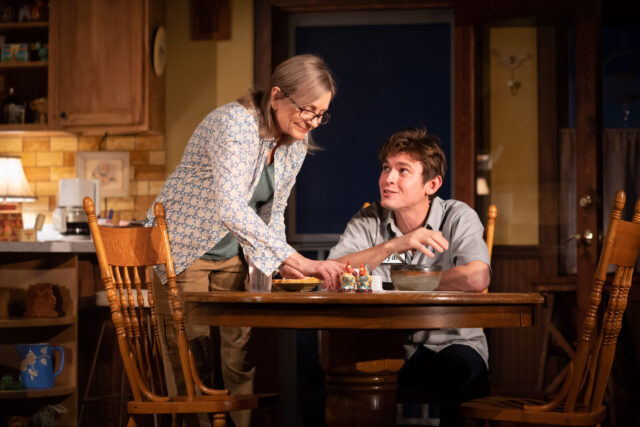
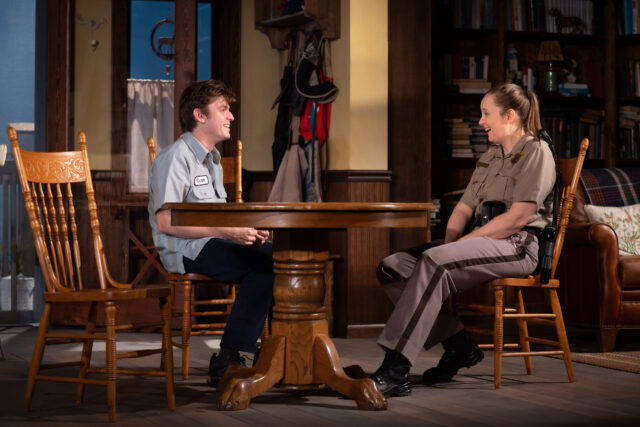
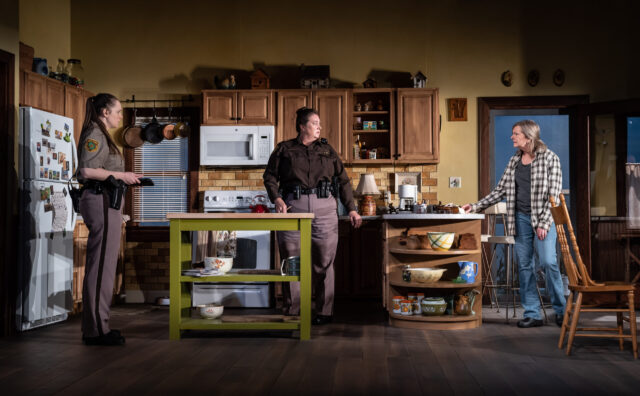
Characters engage in imaginary conversations in moving play at Lincoln Center (photo by T. Charles Erickson)

In The Coast Starlight, the half dozen characters are all heading somewhere, but it’s not necessarily where they want to be going, and their inner and outer journeys could potentially be changed if only they had said something. “It’s an awful thing to feel like you don’t have a home,” Jane (Camila Canó-Flaviá) says about halfway through.

TJ (Will Harrison) is a navy medic about to go AWOL to avoid being sent back to Afghanistan. Jane is an aspiring animator visiting her boyfriend who she may not love anymore. Noah (Rhys Coiro) is a veteran and a drifter caring for his ailing mother. Liz (Mia Barron) is a loud, lively woman who has just ditched her lover at an Extraordinary Couples Workshop. Ed (Jon Norman Schneider) is a harried, drunk traveling salesman working for a questionable invention company. And Anna (Michelle Wilson) is a married mother who has just had to identify the body of her dead brother.

The play is primarily a series of imaginary conversations, as if the characters decided to speak to one another, sharing intimate details of who they are and what they want out of their daily existence.

“I wanted to lean across the aisle and say to her: I have no idea where I’m headed today — I just decided I’d get on a train and head north,” TJ says about Jane, who responds to the audience, “If he’d told me that, I’m not sure what I would’ve said. TJ: “Then I wanted to tell her: I’ve lived in California for a year and till this morning I’ve never been north of San Diego.” Jane: “And then I probably would’ve said: Well, I’ve never been to San Diego.” TJ: “You should definitely go sometime. It’s totally weird.”

“I wanted to tell all of you: Obviously I’m nowhere near the person I intended to be,” Ed says. “But I’m the only person I can be under the circumstances. I know how shitty today was and I hold no illusions about tomorrow.”

These six diverse people are not having their best day, and they have no idea what the future has in store for them. They are lost souls contemplating what happens next, not necessarily looking forward to it. Worried that he’s going to be caught and brought back to face justice for military desertion, TJ says, “Then I remembered nobody could be looking for me because I wasn’t missing yet.”

A whirlwind conclusion brings it all into perspective, focusing on the concept of “What if?”

Arnulfo Maldonado’s set is a rotating platform with six movable train seats. Daniel Kluger’s sound, Lap Chi Chu’s lighting, and Ben Pearcy’s projections (for 59 Productions) makes the audience feel that they’re also on the train, motoring north through gorgeous scenery, although only flashes of light and color stream by. Ásta Bennie Hostetter’s everyday-dress costumes help give identity to the characters.

Directed by Tyne Rafaeli (Epiphany, I Was Most Alive with You), the play occasionally gets lost itself, the dialogue running off the rails; it’s not clear why the stage spins or why the actors continually rearrange their seats, and Kluger’s interstitial music is too standard.

Harrison (Daisy Jones and the Six) is affecting in his off Broadway debut, speaking in a manner that emphasizes how unanchored TJ is. Canó-Flaviá (Dance Nation, Mac Beth) is warm and gentle as Jane, Coiro (Dinner at Eight, Boy’s Life) is compelling as the unpredictable Noah, and Barron (Dying for It, Domesticated) nearly rips the roof off the Newhouse in her entrance scene, screaming into her cellphone as if no one else is around. Wilson (Confederates, Sweat) is touching as Anna, while Schneider (Once Upon a [korean] Time, Awake and Sing!) does his best with a character who is more tangential, not as deeply nuanced.

At one point Jane imagines telling TJ about James Turrell’s Dividing the Light Skyspace at Pomona College. She explains, “The artist who made it, he believes that the sky is way too enormous for us to really comprehend it. So he builds these little rooms all over the world with holes cut in their ceilings so you can look up at the sky like it’s a picture in a frame. It’s so much cooler than I’m making it sound. I promise you’ll never look at the sky the same way again.”

It’s an apt metaphor for the Coast Starlight, both the train and the play. (Notably, Pearcy was an assistant to Turrell for ten years.) I’ve been on long train rides, and I’ve sat several times in Turrell’s first US Skyspace, Meeting, which is on permanent view at MoMA PS1. I’m not sure that, having seen Bunin’s show, I will be more amenable to engage strangers in conversation, but I’m likely to wonder a whole lot more about who they might be.

PARADE

Lucille (Micaela Diamond) and Leo Frank (Ben Platt) fight for justice in Parade (photo by Joan Marcus)

PARADE
Bernard B. Jacobs Theatre
242 West 45th St. between Broadway & Eighth Ave.
Tuesday – Sunday through August 6, $84-$288
paradebroadway.com

At intermission of the first Broadway revival of Parade, based on a true story of anti-Semitism, racism, and a terrible miscarriage of justice, several colleagues and I asked the same question: “Why is this a musical?” We found out in the far superior second act.

The show, directed by Harold Prince, with music and lyrics by Jason Robert Brown and a book by Oscar and Pulitzer Prize winner Alfred Uhry (Driving Miss Daisy), debuted at the Vivian Beaumont in 1998, running for thirty-nine previews and eighty-four regular performances, earning nine Tony nominations and winning for Best Book and Best Original Score. It is now playing at the Bernard B. Jacobs Theatre, in a version directed by Tony winner Michael Arden that transferred from Encores! at City Center and uses the 2007 Donmar Warehouse production, which included a few different songs from the original.

Parade begins with a prologue set in Marietta, Georgia, in 1862, as a young Confederate soldier (Charlie Webb) sings goodbye to his love and prepares to fight “for these old hills behind me / these old red hills of home. . . . in the land where honor lives and breathes.” The action then shifts to Atlanta in 1913, where the soldier (Howard McGillin), who lost a leg in the Civil War, is determined to help the South rise again, “honor” be damned.

It’s Confederate Memorial Day, and Lucille Frank (Micaela Diamond) wants to go on a picnic with her husband, Leo (Ben Platt), but he instead decides to go to work at the National Pencil Company, her father’s factory where Leo is superintendent. Thirteen-year-old Mary Phagan (Erin Rose Doyle) arrives to collect her pay and is later found murdered in the basement. The police arrest Leo for the crime, but he doesn’t take them very seriously, since he is innocent — but when power-hungry district attorney Hugh Dorsey (Paul Alexander Nolan) starts building a strong case against him, constructed on a series of lies, Leo suddenly faces reality as Lucille seeks to uncover the truth and reveal the conspiracy to railroad her husband.

Mary Phagan (Erin Rose Doyle) enjoys one final moment of life with Frankie Epps (Jake Pedersen) in based-on-fact musical (photo by Joan Marcus)

Among those participating in the frame-up led by Dorsey are National Pencil night watchman Newt Lee (Eddie Cooper), janitor Jim Conley (Alex Joseph Grayson), and Frank family maid Minnie McKnight (Danielle Lee Greaves), all of whom are Black and manipulated because of the color of their skin; Governor Jack Slaton (Sean Allan Krill), who is more concerned with his upcoming reelection campaign than the fate of one perhaps innocent man; Mary’s friend Frankie Epps (Jake Pedersen), who wants to see the murderer “burn in the ragin’ fires of hell forevermore”; right-wing newspaper editor and publisher Tom Watson (Manoel Felciano), who calls out, “Who’s gonna stop the Jew from killin’? Who’s gonna swing that hammer?”; Judge Roan (McGillin), who’d rather be fishing than in court; and Britt Craig (Jay Armstrong Johnson), an ambitious reporter who declares, “Take this superstitious city / Add one little Jew from Brooklyn / Plus a college education and a mousy little wife / And big news! Real big news! / That poor sucker saved my life!” Mary’s distraught mother (Kelli Barrett) is the only one considering forgiveness.

The focus of the show shifts dramatically after intermission, during which Leo remains onstage, in his jail cell, contemplating his fate; while the first act was all over the place, squeezing in too much information alongside oversized production numbers, the second act zeroes in on the touching relationship between Lucille and Leo as they desperately try to prove his innocence. It’s a beautiful, romantic love story, highlighted by a prison picnic Lucille brings to Leo in which she first chastises him for not accepting her assistance. “Do it alone, Leo — do it all by yourself. / You’re the only one who matters after all. / Do it alone, Leo — why should it bother me? / I’m just good for standing in the shadows / And staring at the walls, Leo,” she sings. Later they duet on “This Is Not Over Yet,” as Leo proclaims, “Hail the resurrection of / the south’s least fav’rite son! / It means I made a vow for better! / Two is better than one! / It means the journey ahead might get shorter. / I might reach the end of my rope! / But suddenly, loud as a mortar, there is hope!”

Parade features archival projections throughout (photo by Joan Marcus)

Dane Laffrey’s set is centered by a large wooden platform on which most of the action takes place, evoking a gallows as well as a coffin. There are scattered chairs and pews on either side, where many of the characters sit when they’re not in the scene, which can get confusing, especially for actors who play multiple roles. Susan Hilferty’s period costumes put us right in the 1910s, while Sven Ortel’s projections feature archival photographs of the real people and locations involved in the story, along with newspaper articles and a memorial plaque, a constant, and effective, reminder that this really happened — along with a final shot providing one last shock. Lauren Yalango-Grant and Christopher Cree Grant’s choreography thankfully calms down in the second half. Heather Gilbert’s lighting and Jon Weston’s sound maintains the dark mood surrounding the events. Music director and conductor Tom Murray handles three-time Tony winner Brown’s (The Last Five Years, Mr. Saturday Night) compelling score with a rousing touch, while director Michael Arden (Spring Awakening, Once on This Island) ably navigates through Uhry’s (Driving Miss Daisy, The Last Night of Ballyhoo) busy book. (Notably, Atlanta native Uhry’s great-uncle owned the National Pencil Company at the time of the killing.)

Tony winner Platt (Dear Evan Hansen, The Book of Mormon) and Diamond (The Cher Show, A Play Is a Poem) are wonderful together, portraying a Jewish couple in the Deep South facing bigotry; Platt captures Leo’s unrealistic belief that justice will triumph in the end, while Diamond embodies Lucille’s growth as she confronts what is happening in her beloved hometown. Grayson (Into the Woods, Girl from the North Country) brings down the house with “Feel the Rain Fall,” although, in 2023, it teeters on the edge of appropriation. Courtnee Carter (Once on This Island, Sing Street) as Angela and Douglas Lyons (Chicken & Biscuits, Beautiful) as Riley provide necessary perspective in their duet, “A Rumblin’ and a Rollin’,” in which they assert, “I can tell you this, as a matter of fact, / that the local hotels wouldn’t be so packed / if a little black girl had gotten attacked.” Also providing strong support are Cooper (Assassins, The Cradle Will Rock), Tony nominee Krill (Jagged Little Pill, Honeymoon in Vegas), and Greaves (Hairspray, Rent).

The final projection as the musical ends is a potent reminder that this country still has a long way to go when it comes to entrenched racism, misogyny, and anti-Semitism, in states such as Georgia and too many others that appear determined to continue a legacy of bigotry and hatred, although there is hope with such political stalwarts as Georgia senator Raphael Warnock, the reverend who tells us, before the show starts, to silence our cellphones but, implicitly, not our voices.

ASI WIND’S INNER CIRCLE

Asi Wind’s Inner Circle continues dazzling audiences at Judson Theatre through May 28

ASI WIND’S INNER CIRCLE
Judson Theatre
243 Thompson St.
Thursday – Sunday through September 3, $59.14 – $265.35
www.asiwind.com

“My goal is to create a moment that has no explanation,” magician and corporate mentalist Asi Wind told Penn Jillette and Raymond Teller in a 2019 episode of Penn & Teller: Fool Us. The Israeli-born, New York-based Wind creates seventy-five minutes that have no explanation in his masterful Inner Circle, which is wowing audiences at the Judson Theatre by Washington Square Park.

Wind might be a magician’s magician, but Inner Circle is more than just a magic show; it’s an investigation into identity and individuality, exploring multiple aspects of the human condition in unique and entertaining ways. And don’t bother trying to figure out how he does what he does; instead, just go with the flow.

Asi Wind uses a special deck for card tricks in magic show

“I’m going to lie to you . . . a lot,” the engaging Wind says near the beginning of his seventy-five-minute performance, centering around a deck of original, red- or black-bordered cards on which each of the one hundred audience members has written their name and initials. Wind and the thirteen people sitting around the table with him cut, shuffle, and examine the cards as Wind makes them (the cards, not the people) appear and disappear in surprising places and gets into personal conversations with several of the men and women whose cards were selected. We learn about their jobs, their families, their romantic partners, but they represent the audience as a whole; we are not anonymous in the semidark theater, which was constructed specifically for this event, nearly full circle except for a small curtained area behind Wind. (The set is by Adam Blumenthal.)

We also find out a bit about Wind himself, including a section devoted to some of his heroes and mentors, whose portraits, painted by Wind, hang in the lobby, from Juan Tamariz, Cardini, and Tommy Wonder to Ricky Jay, Harry Houdini, and David Blaine, who is presenting Inner Circle. Wind, who was born Asi Betesh in Tel Aviv, served as chief consultant for Blaine for ten years.

Wind, whose Concert of the Mind: Exceeding Human Limits played at the Axis Theatre in 2013, is an expert at drawing out the mystery; just when you think the trick is over, he adds another element or two. “We do need to build up the drama,” he says. The night I went, just about everything clicked, with every participant doing their part, leading to gasping, laughing, and even a few tears.

Asi Wind performs his jaw-dropping magic from central round table

Director John Lovick maintains an easygoing approach, keeping everyone involved whether their name is called or not. The set, consisting of four rising rows, is a little steep at the top, and if you’re sitting in a corner it might be hard to see some of the action. Occasionally a camera projects the cards onto the table so they are magnified but not always in focus, so you may still have to strain to see what is happening. But those are minor quibbles in what is otherwise a fun night of magic and observation.

“It’s about connecting people,” Wind, who knows how to play his audience, says at one point.

And that’s the best magic trick of all.

DRINKING IN AMERICA

Andre Royo plays multiple addicts in revival of Eric Bogosian’s Drinking in America (photo by Jeremy Daniel)

DRINKING IN AMERICA
Audible Theater’s Minetta Lane Theatre
18 Minetta Lane between Sixth Ave. and MacDougal St.
Monday – Saturday through April 13, $53-$98
drinkinginamericaplay.com
www.audible.com

In “Fried-Egg Deal,” the last of twelve monologues that comprise Eric Bogosian’s Drinking in America, a loaded man says to the audience, “I’m a good-for-nothin’ drunken bum, you shouldn’t even look at me.”

Written and first performed by Bogosian in 1986 when he was eighteen months sober, having kicked alcohol and hard drugs, Drinking in America examines different forms of addiction as a variety of characters attempt to be seen, on city streets, in hotel rooms, at work, and in theater itself.

The play is now being revived by Audible at the Minetta Lane, starring Bronx-born Andre Royo and directed by Mark Armstrong. Royo, who played Reginald “Bubbles” Cousins on The Wire, Mayor Robert “Bobo” Boston on Hand of God, and Thirsty Rawlings on Empire, originally wanted to do Bogosian’s Talk Radio, but rights issues led him instead to Drinking in America, which has a personal connection, as he is currently about eighteen months sober himself.

I did not see the original 1986 production at the American Place Theater, which earned Bogosian an Obie for Best Play and a Drama Desk Award for Outstanding Solo Performance. But this past January, I attended a benefit for the Chain Theatre at which Bogosian presented several pieces from the play as part of “An Evening with Eric Bogosian: Monologues, Digressions, and Air Guitar.” In addition, on Bogosian’s “100 Monologues” website, I’ve watched such actors as Bill Irwin, Sam Rockwell, Brian d’Arcy James, Dylan Baker, Anson Mount, Michael Shannon, and Marin Ireland perform scenes from the show.

Royo makes the play his own from the opening moment, when he introduces himself to the audience and ad-libs about who he is and where he is from. After a few minutes of personal banter, he segues into the narrative, which begins with “Journal,” reading the April 11, 1987, entry. “Today I began to understand one of the immutable truths with regard to my own existence,” he shares. “Today I discovered that I am not a being surrounded by walls and barriers but part of a continuum with all other things, those living and even those inanimate. I feel a new surge of desire for life, for living now, for getting out and becoming part of everything around me. I want to change the world and I know I can do it. I’m like a newborn baby taking his first steps. I was blind before to my inner self, my true desires, my own special powers and the universe itself. So many people live lives of pointless desperation, unable to appreciate that life is life to be lived for today, in every flower, in a cloud . . . in a smile.”

Andre Royo stars in Audible revival of Eric Bogosian’s 1986 solo show (photo by Jeremy Daniel)

While it sounds like it could be the memories of a man who has cleaned himself up and has a new lease on life, it quickly descends into a drug-fueled tale in which the man reconsiders his own importance. “I was literally on top of the world. I felt like GOD,” he declares. What follows are the stories of eleven more men addicted to drugs, alcohol, power, prestige, money, and sex, each with a tenuous grasp on reality. Royo fluently shifts from character to character, with changes in speech, body movement, and, minimally, costumes, as each man makes his case. They stumble across the stage, swing bottles around, and get into confrontations, lost in the haze of addiction. Kristen Robinson’s set features a few chairs, a table, a lamp, and a dark back wall with a doorway that beckons to another state of mind, a proverbial light at the end of the tunnel (or an entrance to hell?). The costumes are by Sarita Fellows, with sound by John Gromada and lighting by Jeff Croiter.

In “American Dreamer,” a street drunk yells out that he has a bevy of fancy cars and lovely ladies. In “Wired,” a Hollywood player snorts coke and swizzles booze in the morning as he talks on the phone about the availability of Lee Marvin or Richard Chamberlain for an upcoming film. (Although Bogosian has made small tweaks for Audible, which will be releasing an audio version of the show, he has left in the original references.)

In “Commercial,” a voice-over actor is pitching an upscale beer, narrating, “You’ve worked hard to get where you are today and you’ve still got a long way to go before you get to the top . . . You want your life to be good . . . so you surround yourself with the best . . . the very best . . . in clothes, in food, in people . . . You know you’re going to get there someday . . . and when you do, you’ll say ‘good-bye’ to your companions of a less prosperous time. But there is one thing you will never leave behind . . . And that’s your beer: Krönenbräu . . . The beer of kings.” Beer commercials make all kinds of promises, but as the characters in Drinking in America reveal to us, what booze often delivers is something else.

In “No Problems,” the character tries to assure us, and himself, “I have no problems. I’m happy with life. Things are fine as far as I’m concerned. I know some people have problems, some people have quite a few. I, fortunately, have none.” The monologue implicates the audience, speaking to all those in the theater who believe they are not like anyone they have seen onstage, that none of that could happen to them, since they’re satisfied with their existence.

Not only has Royo struggled with addiction but his Wire costar Michael K. Williams, despite all his professional success, died of an overdose in September 2021 at the age of fifty-four. No one is invulnerable. In “Godhead,” a tough-talking man claims, “I just wanna live my life. I don’t hurt nobody.” But addiction affects more than just the addict.

Andre Royo pauses to examine addiction and demons in Drinking in America at the Minetta Lane (photo by Jeremy Daniel)

Nearly forty years after its debut, Drinking in America still feels fresh and relevant. The toll of alcoholism and drug addiction grew even greater during the recent pandemic and its concurrent isolation, and there’s no end in sight. It hurts families, destroys relationships, impacts careers, and keeps men and women from reaching their potentials. Each vignette is straightforward and direct, with Royo skillfully depicting the characters, giving them unique idiosyncrasies and attributes, but in many ways they are similar as well. And, as Bogosian (subUrbia, Pounding Nails in the Floor with My Forehead) and Royo make clear, they are us, and we are them.

In “The Law,” a preacher asks, “What has happened to our country? Will somebody answer that question for me, please? We are in trouble. We are in serious trouble. Look around you, what do you see?” We might not be seeing the same world the preacher does — he rails against “crime, perversion, decay, apathy,” and abortion, proclaiming that “we are living in a nightmare” — but we are asking the same questions.

The eighty-minute play is adroitly directed by Armstrong (The Angel in the Trees, The Most Damaging Wound) and wonderfully performed by Royo, who fully inhabits each of the characters he portrays, some of whom he, as a recovering alcoholic, can specifically relate to. In addition, because he’s Black, the show has an additional edge as it tackles toxic masculinity and male fragility, terms that were not household words in 1986, although race has taken on an expanded meaning in recent years.

Unfortunately, many of the same sociopolitical issues are still affecting America, from racial inequality and injustice to immigration reform and religious hatred. It’s always too easy to just look away, saying to ourselves, “I have no problems. None. I’m happy. I’m healthy. I love my wife, I love my kid . . . good job . . . no problems. That’s what it’s all about . . . I guess.”

THE HARDER THEY COME

Ivan (Natey Jones, far left) arrives in the city seeking fame and fortune in The Harder They Come (photo by Joan Marcus)

THE HARDER THEY COME
Newman Theater, the Public Theater
425 Lafayette St. at Astor Pl.
Tuesday – Sunday through April 9, $105
publictheater.org

There’s a big difference between a show or movie with music and a fully fledged musical, in which original songs help propel the narrative. That divergence is one of the central flaws in the world premiere of The Harder They Come, at the Public’s Newman Theater through April 9.

The 1972 movie is a Jamaican cult favorite that recently celebrated its fiftieth anniversary; it follows a country boy named Ivanhoe Martin, portrayed by reggae legend Jimmy Cliff in his first and only starring role as an actor, who arrives in Kingston with little more than a guitar and the dream of making a hit record. The soundtrack is one of the all-time greats, consisting of genre-defining tunes by the Maytals (“Sweet and Dandy,” “Pressure Drop”), the Slickers (“Johnny Too Bad”), Desmond Dekker (“007 [Shanty Town]”), the Melodians (“Rivers of Babylon”), Scotty (“Draw Your Brakes”), and Cliff himself, who contributed six songs, including the title track, the only one written specifically for the film.

In her book, Public writer-in-residence and Tony and Pulitzer Prize winner Suzan-Lori Parks, who has written such hard-hitting plays as Topdog/Underdog, Fucking A, and Father Comes Home from the Wars . . . , squeezes too many songs that were background and incidental in the film into the show’s narrative, forcing them into the plot.

An accomplished singer-songwriter, as evidenced by her terrific Plays for the Plague Year, a three-hour intimate performance piece about the pandemic that reopens at Joe’s Pub on April 5, Parks adds several new songs to The Harder They Come, including “Hero Don’t Never Die,” “Please Tell Me Why,” and “Better Days,” expanding, and sometimes changing, the motivations of various characters as Parks attempts to smooth out the bumps and choppiness of the film.

Alas, that is part of its charm. And I’m still trying to understand why the second act opens with Johnny Nash’s “I Can See Clearly Now,” which Cliff recorded in 1993 for the film Cool Runnings about the 1988 Jamaican Olympic bobsled team. The song was part of Reggae Hit the Town: Crucial Reggae 1968-1972, a bonus disc added to the soundtrack album years later; Dekker’s “Israelites” also is in the show from the same collection.

Preacher (J. Bernard Calloway) has a tight hold on his congregation in world premiere at the Public (photo by Joan Marcus)

The story is a rough and violent drama that begins with Ivan traveling to the big city to give his mother, Daisy (Jeannette Bayardelle), her pittance of an inheritance. She wants him to return to the country, but Ivan (Natey Jones) is determined to stay and become a star. With no place to go, he hooks up with the Holy Redeemer Church after meeting and instantly falling for the young and innocent Elsa (Meecah), the orphan ward of the church’s well-connected Preacher (J. Bernard Calloway).

Desperate to make a record, Ivan ultimately signs a terrible contract with local music mogul Hilton (Ken Robinson), a wealthy man who controls what gets played when and where. With no money, Ivan starts working for ganja dealer Jose (Dominique Johnson), who is in cahoots with a plainclothes cop named Ray (Dudney Joseph Jr). Everywhere he goes, Ivan creates conflict with the avaricious men of Kingston, battling religion, drug lords, law enforcement, and corporate greed in his determination to get what he believes he deserves. “You can get it if you really want it / But you must try, try and try, try and try,” he sings.

Instead of laying low like his best friend, Pedro (Jacob Ming-Trent), who also sells for Jose, Ivan can’t stop speaking his mind. After an altercation with a policeman, Ivan is on the run, attempting to hold things together while also reveling in his newfound fame.

Directed by Tony Taccone (Bridge & Tunnel, Wishful Drinking) with codirector Sergio Trujillo, who is best known for his choreography for jukebox bio-musicals (Summer: The Donna Summer Musical, A Bronx Tale), The Harder They Come contains numerous wonderful scenes with fabulous music, performed by a strong cast (Ming-Trent stands out, his character providing comic relief and an honest perspective) and an excellent six-piece band; Kenny Seymour’s orchestrations and arrangements do justice to the originals, although some snippets are too much of a tease and a few of Parks’s new songs are overly melodramatic. In addition, you never get to hear the title track in full; as a kind of encore, it is performed at the very end, but one stanza is curiously left out.

Local music mogul Hilton (Ken Robinson) offers Ivan (Natey Jones) a bad deal in The Harder They Come (photo by Joan Marcus)

Choreographer Edgar Godineaux makes sure the movement never gets out of hand on Clint Ramos and Diggle’s two-level shanty town set, strewn with garbage drums, used tires, multiple old TV sets and speakers on the walls, bamboo, palm leaves, and muted greens and yellows inspired by the Jamaican flag (found also on the railings near the stage), along with earth-toned colors that are also prominent in Emilio Sosa’s costumes. The sound is by Walter Trarbach, with lighting by Japhy Weideman.

In the film, directed by Perry Henzell and cowritten with Trevor Rhone, Cliff’s Ivan already had a hard edge, a willingness to become an outlaw to fight for what he thinks is fair. But in Parks’s version, Jones (Get Up Stand Up, Tina: The Tina Turner Musical) portrays a far more naive and good-natured Ivan, more sensitive to Elsa’s needs and not as inherently dangerous. Cliff’s Ivan is proud of what he did to the policeman and glories in becoming a hero-villain who cheats on his wife and smokes big spleefs, while Jones’s Ivan claims the incident was accidental and never fully inhabits the character’s bad side.

The show has been stripped of its nuance, too easily pitting good vs. evil amid hierarchical, colonialist power structures. While a lot has changed since the film came out half a century ago, a lot hasn’t. This theatrical iteration — Henzell oversaw the script for a 2005 British adaptation — ends up caught somewhere in between.

[Note: The Public is hosting the “Wheel & Come Again” art auction on the mezzanine level, with more than a dozen works available, from $300 to $1000, inspired by the film and musical, raising funds to benefit scholarships at the Edna Manley College of the Visual and Performing Arts in Kingston.]

BAD CINDERELLA

Bad Cinderella (Linedy Genao) rises up in Andrew Lloyd Webber Broadway musical (photo by Matthew Murphy and Evan Zimmerman)

BAD CINDERELLA
Imperial Theatre
249 West 45th St. between Broadway & Eighth Ave.
Tuesday – Sunday through June 4, $48-$298
badcinderellabroadway.com

At last Friday night’s performance of Bad Cinderella at the Imperial, a boisterous trio of big men sat behind us, their belly laughs and rousing cheers shaking our row throughout the first act. During intermission, I turned to my friend and said, “I want to watch what they’re watching.”

Indeed, what show were they watching?

I am not going to jump on the bandwagon and take advantage of the American retitling of Andrew Lloyd Webber’s Cinderella, which has added the word Bad, but it’s hard not to. I found the two-and-a-half-hour musical more insulting and embarrassing than downright bad; I knew we were in trouble when my musical-loving friend wasn’t giving even perfunctory applause after songs. “You’ve ruined theater for me forever,” she told me outside at intermission, as if it was my fault for taking her. “I might never see another show.”

Bad Cinderella is everything you’ve heard and worse.

Lloyd Webber, whose composer son Nick tragically died from gastric cancer on March 25 at the age of forty-three, has some fierce competition in the alt-fairy-tale Broadway musical realm. Stephen Schwartz and Winnie Holzman’s Wicked has been packing them in on the Great White Way since 2003. The recent limited-run revival of Stephen Sondheim’s Into the Woods was spectacular. And musical minions are still kvelling over Douglas Carter Beane’s 2013 family-friendly adaptation of Rodgers + Hammerstein’s more traditional Cinderella.

Bad Cinderella is ostensibly about being proud of one’s personal identity and defying the populist adherence to conventional ideas of beauty and success. But in its attempts to be clever, unpredictable, and, dare I say, woke, it steps all over itself, fumbling its themes and confusing its basic principles.

The Queen (Grace McLean) and the Stepmother (Carolee Carmello) do battle in Bad Cinderella (photo by Matthew Murphy and Evan Zimmerman)

The show opens with the innocuous “Buns ’n’ Roses / Beauty Is Our Duty,” in which random characters at the Belleville Market revel in their hotness amid garish sexual innuendo. “Hot buns! Check out my hot buns!” the hunky baker declares. “True, there are not buns / Equal to mine.”

Various townspeople blast out, “Our town Belleville is a place so picturesque, / Makes every other town jealous. / So exquisite, every other seems grotesque. . . . Every single citizen’s a cut and chiseled god, / Beauty is our duty. / Everyone among us has a ripped and rockin’ bod. . . . We’re quite shallow, / We’re obsessed with how we look. / It’s quite OK if you’re dumb here. / Every lawn is manicured / As well as every hand.”

“Wrinkles are not tolerated, torsos must be tanned. / Acne is a misdemeanor, / Cellulite is banned. . . . So what if we’re a bit snooty” is about as sophisticated as Tony winner David Zippel’s lyrics gets.

The book, by Oscar winner Emerald Fennell and adapted by playwright Alexis Scheer for the Broadway run, is a “hot mess,” which is what the townspeople call Cinderella. Cinderella is ripe for interpretation; the Brothers Grimm and Rodgers & Hammerstein are only two of thousands who have told a similar tale going back two millennia. The most famous version was written in 1697 by Charles Perrault, the basis for the 1950 animated film by Walt Disney, a rags-to-riches story of magic, abuse, discrimination, misogyny, and outmoded ideals of what makes a person attractive and desired.

Director Laurence Connor and choreographer JoAnn M. Hunter hit a brick wall just a few minutes in, after the unveiling of a statue in honor of the missing Prince Charming (Cameron Loyal) reveals that Cinderella (Linedy Genao) has defaced it with a graffiti-esque banner declaring, “Beauty Sucks.” The townspeople call her a “psychopath” who “should be arrested,” but a moment later the hunky men are lifting her up as if she’s a hero, not a villain, and she proudly proclaims, “I’m a loner, I’m a freak, a rebel. . . . a girl from the gutter, unpleasant peasant, no one, a nutter, unwelcome present.”

Cinderella is badly mistreated by her stepmother (Carolee Carmello) and two gorgeous but hollow and dimwitted stepsisters, Adele (Sami Gayle) and Marie (Morgan Higgins). Her only friend is Prince Sebastian (Jordan Dobson), now heir to the throne, a shy young man with no kingly aspirations who the women in the town deride, complaining, “What a disappointment is this prince! / Look at him! My heart can’t help but wince! / He’s not the type on which girls set their sights.”

It doesn’t help that Sebastian is handsome, even in his militaristic outfit, even if he is dour, unhappy to be thrust into the limelight, while Cinderella, in her long black leather jacket, tight-fitting shirt, and maroon pants, is not only cool but hot, at least to the audience if not to the vain citizens of Belleville. “I’m the opposite of ev’rthing you are!” she sings. So why, about halfway through the show, does she go to Godmother (Christina Acosta Robinson), a nasty plastic surgeon, wanting her to transform her into a beauty, to be just like everyone else so the prince will choose her for his bride at the ball?

“The damsel wants to save the prince in distress. How very modern
of you,” Godmother says, but there’s nothing modern about it. No longer a fairy, Godmother doesn’t work magic, so her assertion that Cinderella’s makeover will last only until midnight is absurd, as is Sebastian’s inability to recognize Cinderella at the dance.

Bad Cinderella is laden with huge plot holes and incongruities galore; while there’s no need to stick close to any of the familiar versions, it feels like Connor (Les Misérables, School of Rock), Lloyd Webber (Jesus Christ Superstar, Cats, The Phantom of the Opera), Fennell (Promising Young Woman, Killing Eve), Scheer (Our Dear Dead Drug Lord, Laughs in Spanish), and Zippel (City of Angels, The Woman in White) choose the least reasonable turn at each crossroad as they teeter back and forth between old-fashioned values and contemporary mores.

Gabriela Tylesova’s sets, dominated by the forest’s ominous tree branches, serve their purpose, although her costumes leave something to be desired, specifically, men’s shirts, as several male dancers are bare-chested every step of the way. Luc Verschueren’s hair and wigs are fun, Bruno Poet’s lights are bright, and Gareth Owen’s sound is loud. The title song might stick with you for a while, but you’ll try hard to get it out of your head; the British show earned a Grammy nomination for Best Musical Theater Album, naming Andrew, Nick, and Greg Wells as producers.

Carmello (Scandalous, Lestat) and McLean (Cyrano, Natasha, Pierre & the Great Comet of 1812) go too far over the top, especially in what should have been a classic duet in which they battle each other (“I Know You”). Dobson (Hadestown, West Side Story) lacks style and energy as Sebastian but is still likable, while Genao (On Your Feet, Dear Evan Hansen) fares well as Cinderella despite the inconsistencies built into the character.

Ultimately, Bad Cinderella is unable to figure out what story it wants to tell and who its audience is. The creative team should talk to those three men sitting behind me, even if they did quiet down significantly in the second act.

black odyssey

Ulysses Lincoln (Sean Boyce Johnson) searches for a way back to Harlem in black odyssey (photo by Julieta Cervantes)

black odyssey
Classic Stage Company, Lynn F. Angelson Theater
136 East 13th St. between Third & Fourth Aves.
Through March 26, $77
classicstage.org

Marcus Gardley’s black odyssey is one of those genius ideas you hope will pay off. It turns out to be a mixed bag, as poet, playwright, assistant professor, actor, and screenwriter Gardley and director Stevie Walker-Webb have so many takes on the story that it sometimes feels like they’ve thrown everything but the kitchen sink at the audience, and the message feels clogged in the end.

A reimagining of Homer’s epic poem The Odyssey through the lens of African American history, the play premiered in Denver in 2014 and was revised three years later for the California Shakespeare Theater. Revised again for its New York premiere, it is now completing a run at Classic Stage, taking place on David Goldstein’s minimalist set, a glossy black rectangular platform, the only props two halves of a wooden boat.

The 150-minute show (with intermission) opens with a chorus, representing chess pieces, delivering a fourth-wall-breaking prologue.

“Let us begin at the beginning so we may end at the end / Shake off the cares of this day, my friend. Close your eyes / Breathe in the perfume of mother nature: her still waters run deep / As do her blue skies. There is no griot greater. / And like her, we have come to sow and season and play/ But don’t get too excited, this part here is just . . . foreplay,” they announce with a Shakespearean touch.

“You are the true star in our galaxy. / Only you can guide our ship through this tale we call ‘black odyssey.’ / It is by the light of your smile, the sparkle in your eyes / That we compass our way to the end. So, hold on tight, my friend. / Yet get loose: let the music move you some. Sing if you feel like singing / And if you can’t hold a tune then baby hold a hum. Sway. / Dance if your feet can’t stand you. Clap or stomp even if it scares you. / Shout out when the spirit gets in your bones. But please, for the love of the gods turn off your beeping cellphones.”

Harriett D. Foy brings the house down as Aunt Tee in black odyssey at Classic Stage (photo by Julieta Cervantes)

Deus (James T. Alfred), the god of the sky, and Paw Sidin (Jimonn Cole), the god of the sea, are playing chess with mortals’ bodies. Paw Sidin is determined to exact revenge on Ulysses Lincoln (Sean Boyce Johnson), who killed Paw Sidin’s son, Poly’famous (Marcus Gladney Jr.), in battle. Aunt Tee (Harriett D. Foy), the goddess of war who is Deus’s daughter and Ulysses’s aunt, is ready to do whatever is necessary to protect her nephew.

In Homer’s Odyssey, Odysseus endures many trials as he attempts to return to his wife, Penelope, and son, Telemachus, in Ithaca after the Trojan War; here, Ulysses is struggling to get home to his wife, Nella P. (D. Woods), and son, Malachai (Gladney Jr.), in Harlem after fighting overseas. “I went to war to make a better life for myself,” he explains. “I wasn’t supposed to serve. I signed up during peacetime but then 9/11 happened, the World Trade Center came down, and before I knew it . . . I was in Afghanistan.”

When Ulysses joined the navy, Nella P. was eight months pregnant. Sixteen years later, Nella refuses to believe that her still-missing husband is dead while she raises Malachai and is beguiled by a suitor (Cole). Over the years, Paw Sidin has put on disguises to trick Nella, punishing her and Malachai. “Revenge is a meal best served raw,” the sea god declares with relish.

The story goes back and forth between the present and flashbacks of Ulysses’s adventures, in which he encounters characters revamped from Homer’s original, including sea creatures Scylla (Foy) and Carib’diss (Adrienne C. Moore), Ulysses’s grandmother Calypso (Foy), the Soul Siren (Lance Coadie Williams), Circe (Moore), Benevolence Nausicca Sabine (Tẹmídayọ Amay), and shagadelic prophet Super Fly Tireseas (Alfred).

A Black family fights for survival in New York premiere at Classic Stage (photo by Julieta Cervantes)

Ulysses’s adventures range from a powerful section in which he joins a Black family floating on their roof in the aftermath of Hurricane Katrina to being serenaded by Carib’diss, Scylla, and the Soul Siren channeling some of the greatest Black stars of the 1960s and ’70s.

Although the show has several fine performances and terrific individual scenes, Gardley overstuffs the narrative with too many historical and contemporary references, from comical to serious, dating between 1619 and 2017, as Ulysses battles four hundred years of racial injustice. Among the kaleidoscopic references are Sylvia’s Restaurant, Rosa Parks, the Studio Museum in Harlem, James Baldwin, the Schomburg Center, Jay Z, the Hamptons, the subway, Langston Hughes, Famous Fish Market, Malcolm X, JFK, MLK Jr., and The Color Purple.

The play works best when it focuses on the undying love between Ulysses and Nella and Ulysses’s desperate attempts to rejoin his family. Otherwise, it’s all over the place, as are the performances. The standouts are Woods, who gives heart to Nella; Cole as the ever-evil Paw Sidin; Foy as the scene-stealing Aunt Tee; and Johnson, who is marvelous as Ulysses, who represents four centuries of continuing suffering and oppression as well as the unconquerable spirit of Blacks in America.

Gardley (The House That Will Not Stand) and Walker-Webb (one in two, Ain’t No Mo’) try too hard to make black odyssey epic; the whole is not greater than the sum of its parts, as captivating and powerful as some of those parts are.