this week in theater

PAY THE WRITER

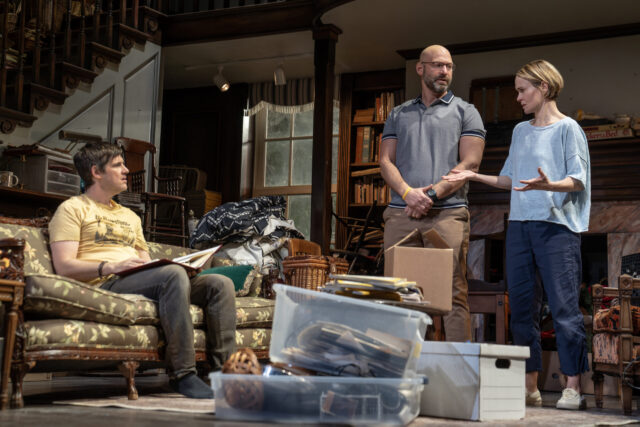
Marcia Cross, Bryan Batt, and Ron Canada star in world premiere of Pay the Writer (photo by Jeremy Daniel)

PAY THE WRITER
The Pershing Square Signature Center
The Alice Griffin Jewel Box Theatre
480 West 42nd St. between Tenth & Eleventh Aves.
Tuesday-Sunday through September 30, $40-$149.50
www.paythewriterplay.com
www.signaturetheatre.org

Tawni O’Dell’s Pay the Writer doesn’t do itself any favors. The title of the world premiere play, which opened August 21 at the Pershing Square Signature Center, is both elusive — after having seen it, I cannot figure out why it’s named for one minor line of dialogue — and, unfortunately, misleading through no fault of its own, as it has nothing to do with the current Writers Guild of America strike, which has shut down film and television production. The script is overstuffed with clichés, and the pace is choppy, with slow, awkward set changes. At two hours without a break, it is desperately in need of significant cutting or at least a brief intermission.

So why then am I still recommending it?

Despite all of the above, I had a good time at the show, as did the entire audience the night I went, erupting in a well-deserved standing ovation at the conclusion, cheering on the three excellent leads, Ron Canada, Marcia Cross, and Bryan Batt. While standing ovations have long been de rigueur on Broadway, they are not nearly as obligatory off the Great White Way.

The show is structured as a series of two-character scenes — save for one involving the three leads — that go back and forth in time over forty-five years, from present-day New York City to 2000s Los Angeles, 1990s Paris, and late 1970s Manhattan. It traces the long relationship between gay white literary agent Bruston Fischer (Bryan Batt) and his most famous client, the award-winning Black writer Cyrus Holt (Ron Canada), from their initial meeting outside a bar to Cyrus’s most recent novel. Cyrus has always let Bruston — who serves as narrator, regularly speaking directly to the audience — read his work before anyone else, but he has given his latest manuscript first to his French translator, Jean Luc (Steven Hauck), which has upset Bruston greatly. Bruston is hurt by what he considers a deep affront by a man he calls his friend, while Cyrus seems more concerned that neither of them can find Jean Luc and find out what he thinks of the book.

“You’re still mad at me,” Cyrus says. Bruston replies, “I’m always the first person to read your work. I don’t understand why you chose to send it to someone else before me.” Cyrus curtly says, “I have my reasons.” Bruston responds, “And to send it to that . . . that . . . ridiculous, arrogant, narcissistic . . .” To which Cyrus explains, “He can’t help any of that; he’s French.”

One night Cyrus, a Vietnam veteran who has won two National Book Awards and a Pulitzer Prize for a novel about racism in the military during the war, accidentally calls his first wife, the white Lana (Cross), with whom he has two children, Leo (Garrett Turner, who also plays the young Cyrus) and Gigi (Danielle J. Summons). Lana, who he hasn’t seen in two decades, shows up unexpectedly at a restaurant where Cyrus and Bruston are having dinner, and she and Cyrus go at it, arguing over their parental skills, Lana giving up her dreams to raise the kids, and Cyrus’s drinking and philandering. But underneath it all is an obvious connection that cannot be broken.

“Believe it or not, those crazy kids were in love once. I think, on some level, they still are,” Bruston tells us. “Cyrus continues to sit blazing in the center of Lana’s orbit while she struggles to break free from his gravitational pull. She’s his Venus; the most beautiful of planets but not necessarily the easiest one to inhabit.”

Cyrus (Garrett Turner) and Bruston (Miles G. Jackson) meet outside a club in Pay the Writer (photo by Jeremy Daniel)

Cyrus is ill, but he doesn’t want to make a big deal about it, keeping it from Lana and their kids, who he thinks don’t care about him. But he’s soon face-to-face with each one of them, confronting harsh realities about his legacy as a husband and a father.

Canada (The Invested, Lights Up on the Fade Out) is terrific as a tough-minded, unapologetic man with a big ego who shifts between his serious ethics as a writer and his loose morals as a human being; it’s a hard character to make likable, but Canada pulls it off. Emmy nominee Cross (Desperate Housewives, Melrose Place), a Juilliard graduate making her return to the stage, shines as Lana, rising above some tepid dialogue to portray a strong woman who has overcome the mistakes of her past. And Batt (Mad Men, Jeffrey) is charming as Bruston, who shares his own personal problems while managing those of others. “Divorces. People have to pick sides,” Lana says to Bruston, who responds, “You got custody of Leo and Gigi, and I got custody of Cy.”

Director Karen Carpenter (Harry Townsend’s Last Stand; Love, Loss, and What I Wore) strains to find a flow to O’Dell’s (When It Happens to You, Coal Run) narrative, which can resemble a Lifetime movie made from a melodramatic novel while taking on homophobia and racism. In fact, O’Dell has written six novels including Back Roads, which was an Oprah Book Club selection that O’Dell adapted into a film.

David Gallo’s sets and David C. Woolard’s costumes are functional (although Lana’s dresses are divine), as are the lighting by Christopher Akerlind and sound by Bill Toles. The supporting cast, including Turner, Summons, Hauck, Miles G. Jackson as the young Bruston, and Stephen Payne as a homeless man in a completely unnecessary scene, is inconsistent, unable to keep up with the leads.

Meanwhile, I’m still trying to figure out the title of the play, which is essentially about a writer who has to pay for what he has wrought in the end.

[Mark Rifkin is a Brooklyn-born, Manhattan-based writer and editor; you can follow him on Substack here.]

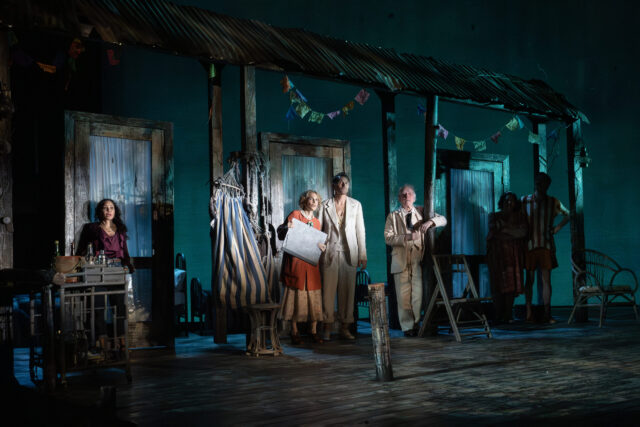
PUBLIC WORKS: THE TEMPEST

Renée Elise Goldsberry is sensational as Prospero in Public Works musical adaptation of The Tempest (photo by Joan Marcus)

THE TEMPEST
Central Park, Delacorte Theater
Through September 3, free, 8:00
publictheater.org

In 2013, the Public Theater inaugurated its Public Works program, which partners with community organizations throughout the five boroughs, with a musical adaptation of William Shakespeare’s The Tempest, featuring music and lyrics by Todd Almond, who played Ariel alongside Laura Benanti as the Goddess, Norm Lewis as Prospero, Carson Elrod as Caliban, and some two hundred nonprofessional actors from such local groups as the Fortune Society, the Brownsville Recreation Center, the Children’s Aid Society, DreamYard, and Domestic Workers United.

In 2015, Michael Greif directed a nonmusical Shakespeare in the Park version with Sam Waterston as Prospero, followed in 2019 by Laurie Woolery’s streamlined Mobile Unit adaptation with Myra Lucretia Taylor as the sorcerer.

Woolery is back in charge for the latest iteration, a brand-new lighthearted Public Works interpretation with music and lyrics by Miami native and Columbia grad Benjamin Velez in his full-fledged New York debut. Public Theater artistic director Oskar Eustis promised in his introduction we will all be able to boast, “I was there” as Velez’s career takes flight.

Ariel (Jo Lampert) orchestrates drama with the help of her minions in The Tempest (photo by Joan Marcus)

Tony winner Renée Elise Goldsberry (Hamilton, As You Like It) is sensational as Prospero, the rightful duke of Milan who has fled to a remote island after her brother, Antonio (Anthony Chatmon II), usurped her crown with the help of his friend Alonso, the king of Naples (Joel Frost), twelve years earlier. Living with her sixteen-year-old daughter, Miranda (Naomi Pierre), she now rules over dozens and dozens of spirits in addition to her slave, the deformed Caliban (Theo Stockman), and her indentured servant, the sprite Ariel (Jo Lampert).

In the thrilling opening number, a vengeful Prospero declares, “I call upon the skies, the eyes of justice watching over / There sail my enemies, I send the breeze their way / I summon every cloud to be a shroud on those who wronged me / They took my life so now I vow to make them pay! . . . I’ll finally be free / of the tempest in me.”

The shipwreck brings Antonio and Alonso to the island, along with Sebastian (Tristan André), Alonso’s brother; Ferdinand (Jordan Best), Alonso’s son; Gonzalo (Susan Lin), Alonso’s councilor; and the comic relief of Stephano (Joel Perez), the king’s butler, and Trinculo (Sabrina Cedeño), the king’s fool. Prospero sends out Ariel, who can make herself invisible, to create mayhem with her trusted spirits; meanwhile, Miranda and Ferdinand fall in love.

Velez’s songs, with playful orchestrations by Mike Brun, range from the bouncy “Vibin’ on to You,” in which Miranda and Ferdinand proclaim their affection for each other, to “A Crown Upon Your Head,” a chance for Sebastian and Alonso to scheme to take over, although the number is hampered by overpreening choreography (by Tiffany Rea-Fisher) at the end; from the fun but too long “A Fool Can Be a King,” in which the Three Stooges–like trio of Stephano, Trinculo, and Caliban imagine Stephano ruling the island, to Caliban’s mostly unnecessary “The Isle Is Full of Noises.” Goldsberry brings down the house with the rollicking, hilarious “Log Man,” in which Prospero considers the love between Miranda and Ferdinand, singing, “Innocence flies like the last gasp of summer / Childhood dies in the arms of a lover / Nobody tries to hold on like a mother / But one day you have to let go / When she meets her log man.”

Alexis Distler’s set repurposes Beowulf Boritt’s design for this summer’s earlier Hamlet, with the six-piece band playing in part of a house that is sinking into the ground, next to the gutted main section. Wilberth Gonzalez’s costumes are based in water and earth colors and textures, with unique headpieces for most characters; Ariel’s transformation is a highlight, as are Caliban’s ratty, chainlike vestment and Prospero’s goth steampunk dress. David Weiner’s lighting and Jessica Paz’s sound expertly incorporate the large cast, with as many as eighty-eight performers onstage at once.

Sone classic lines get cut and plot points get condensed across one hundred minutes, and the finale is anticlimactic, but the spirit of the show is intoxicating. It’s a joy to see established actors working with first-timers and regulars from the Brownsville Recreation Center, the Casita Maria Center for Arts & Education, the Center for Family Life, the Children’s Aid Society, DreamYard, Domestic Workers United, the Fortune Society, and the Military Resilience Foundation, including Brianna Cabrera, Patrick O’Hare, Vivian Jett Brown, and Edwin Rivera as Spirit Ancestor lead singers.

This Tempest bids a fond farewell to the Delacorte as we know it, as the sixty-one-year-old theater begins a two-year renovation after the show ends its one-week run September 3. As Antonio usually says, but not in this version, “What’s past is prologue.”

[Mark Rifkin is a Brooklyn-born, Manhattan-based writer and editor; you can follow him on Substack here.]

THE SHARK IS BROKEN

Richard Dreyfuss (Alex Brightman), Robert Shaw (Ian Shaw), and Roy Scheider (Colin Donnell) find plenty of downtime in The Shark Is Broken (photo by Matthew Murphy)

THE SHARK IS BROKEN
Golden Theatre
252 West Forty-Fifth St. between Broadway & Eighth Aves.
Tuesday – Sunday through November 19, $58-$215.50
thesharkisbroken.com

The first two adult books I read were Ernest Hemingway’s The Old Man and the Sea and Herman Melville’s Moby-Dick, when I was in fourth grade. (I discovered only when I was in college that the latter was actually the Reader’s Digest Condensed version; I should have realized that by the opening sentence, which was “Call me Ish.”) A few years later, I devoured Peter Benchley’s Jaws, at least in part because the novel took place on Long Island, where I had spent most of my childhood. Not yet a teenager, I then saw the movie, which was actually filmed on Martha’s Vineyard, when it was released in the summer of 1975. It scared the hell out of me, and I loved every second of it.

I might not have loved every second of The Shark Is Broken, the Broadway play that goes behind the scenes of the making of the film, but I enjoyed enough of it to make it more than seaworthy.

English actor Ian Shaw was four years old when his father, Oscar-nominated actor, novelist, and playwright Robert Shaw (From Russia with Love, A Man for All Seasons) was on set alongside eventual two-time Oscar nominee Roy Scheider (The French Connection, All That Jazz) and soon-to-be Oscar winner Richard Dreyfuss (American Graffiti, The Goodbye Girl). Robert died in 1978 at the age of fifty-one, when Ian was only eight. In 2017, Ian read his father’s drinking diary, which, he explains in an online letter, he found “painful and very brave.” That was the impetus for The Shark Is Broken, which he cowrote with Joseph Nixon and premiered at the 2019 Edinburgh Fringe.

There is no curtain at the Golden Theatre, where the play opened August 21. Onstage is a cross-section of the Orca, the ramshackle lobster boat owned by salty shark hunter and WWII veteran Quint, Shaw’s character. Scheider (Colin Donnell) is playing new police chief Martin Brody, a former New York City cop who has moved to the supposedly much quieter beach community with his family. And Dreyfuss (Alex Brightman) is portraying oceanographer Matt Hooper, who has been brought in for his expert advice.

The three men sling testosterone around for ninety-five minutes as they wait for Bruce, the mechanical shark, to be repaired yet again; it keeps breaking down, giving the actors time to talk about their careers and for Shaw and Dreyfuss to lace into each other, with the cool and calm Scheider as referee.

The Shark Is Broken goes behind the scenes of the making of Jaws, storms and all (photo by Matthew Murphy)

The neurotic, Jewish Dreyfuss, who is from Queens, declares, “What a god-almighty fucking waste of time! This whole thing is a disaster.” New Jersey native Scheider, who spends most of the downtime reading the newspaper and catching rays, closely following the Nixon-Watergate story, says, “Well . . . it’s not the time it takes to take the take that takes the time. . . . It’s the time it takes between the takes that takes the time to take the take.” Dreyfuss responds, “How much time did that take you?”

Complaining about the way Steven Spielberg is directing the film, shooting on the ocean and constantly making changes to the script, Dreyfuss argues, “Jews should stay away from water. Nothing good ever happened to any Jew on the water.” Scheider asks, “Didn’t Jesus walk on water?” Dreyfuss concludes, “Yeah! Look what happened to him!”

Meanwhile, Shaw preys on Dreyfuss’s lack of worldly knowledge. “You’re a philistine, boy!” he declares. When Dreyfuss admits he has never heard of Damon Runyon, saying “You can’t expect me to know everything,” Shaw barks back, “I think our mistake is expecting you to know anything.” A few minutes later, Dreyfuss asks, “What, you think I’m an idiot?” to which Shaw replies, “I presume that’s a rhetorical question.”

The interplay among the three is like the scar scene in the film, when the three men show off their scars and share other intimacies, including discussing their relationships with their fathers, ultimately bonding if not exactly becoming best buds. Shaw has hidden bottles all over the boat, Scheider can’t get enough of the blazing sun, and Dreyfuss is a young, highly ambitious nervous wreck. Certain that he was a failure in American Graffiti and that his lead role in The Apprenticeship of Duddy Kravitz will not get him the respect he craves, Dreyfuss yearns to do Shakespeare and Pinter, just like the grizzled Shaw has done, all the while both seeking Shaw’s approval and desperately wanting to best him.

The structure of the play, directed with a loose hand by Guy Masterson (Morecambe, One Flew Over the Cuckoo’s Nest), is as rickety as the Orca; the narrative centers around the most poignant moment in the film, Quint’s speech about having survived the July 1945 sinking of the USS Indianapolis, the ship that delivered components for Little Boy, the atomic bomb dropped on Hiroshima. But the scene doesn’t involve Bruce at all, so it is never quite clear why they are waiting around for the mechanical shark to be fixed before proceeding with the shooting. Jaws is essentially a character study constructed around greed, from the Amity mayor’s refusal to close the beaches as the great white attacks continue during the profitable July 4 weekend to humans’ belief that they have any power at all over the natural world. The Shark Is Broken is a vastly entertaining character study as well, but there’s not a whole lot more meat on its bones. In the play, Dreyfuss asks, “What do you think it’s about?”; he’s referring to the movie, but the same can be said of the show.

Ian Shaw cowrote and stars as his father, Robert Shaw, in The Shark Is Broken (photo by Matthew Murphy)

In addition, the dialogue is filled with bons mots that wink at what happened after the film; some of them are funny, but others are too obvious. “One thing’s for certain — if there is a sequel, I will not be in it,” Scheider says; he was back for Jaws 2. Reading the paper, Scheider remarks, “Christ! There will never be a more immoral president than Tricky Dicky,” a cheap laugh no matter what you think of 45. And when the three men talk about their families, Scheider asks Shaw about his children (the English actor had ten with three wives), “Do any of yours want to be actors?” Shaw replies, “Christ, I hope not! It’s a shrivelling profession, isn’t it?,” a sly reference to Ian.

Duncan Henderson’s set and costumes put the audience right on board the cutaway Orca, surrounded by Nina Dunn’s effective projections of the sea and storms, enhanced by Jon Clark’s lighting and Adam Cork’s sound and interstitial music.

Donnell (Anything Goes, Love’s Labour’s Lost) is steadfast and hunky as Scheider, who is a calming influence among the three actors. Brightman (Beetlejuice, School of Rock) is uncanny as Dreyfuss, looking and sounding so much like him that you will sometimes forget it isn’t Dreyfuss himself. And in his Broadway debut, Ian Shaw (War Horse, Common) pays wonderful tribute to his father, capturing his essence in every word and move while depicting his virtues and his flaws.

“There is no folly of the beast of the earth which is not infinitely outdone by the madness of men,” Ishmael says in Moby-Dick. It’s a line that also relates to a trio of actors portraying three very different men, each with his own unique form of madness, hunting a mechanical shark in a make-believe Hollywood movie.

[Mark Rifkin is a Brooklyn-born, Manhattan-based writer and editor; you can follow him on Substack here.]
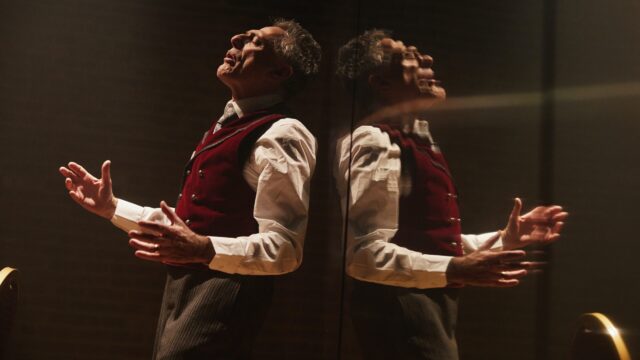
HOOP DREAMS: FLEX / THE HALF-GOD OF RAINFALL

Starra Jones (Erica Matthews) and Sidney Brown (Tamera Tomakili) face off against each other in Candrice Jones’s Flex (photo by Marc J. Franklin)

FLEX
Lincoln Center Theater at the Mitzi E. Newhouse
150 West 65th St. between Broadway & Amsterdam Ave.
Through August 20
www.lct.org/shows/flex

“Being a fan is like having a religion,” Matt says in Rajiv Joseph’s King James, a play that ran this spring at MTC at New York City Center about two Cleveland men who bond over their mutual love of hoops star LeBron James, perhaps the greatest player of all time.

Here in New York, basketball itself is a religion. Fans continue to worship the Knicks and pack Madison Square Garden even though the team has won only one playoff series in ten years and has not taken home a championship in half a century; the city went into mourning when former All-Star MVP center Willis Reed died this past March at the age of eighty. Across the East River, the Nets have been in turmoil since they moved to Brooklyn in 2012, going through superstars at the Barclays Center like Halloween candy, with nothing to show for it.

Meanwhile, for those paying attention, the other team at Barclays, the New York Liberty, is having its best season since the Women’s National Basketball Association started in 1997, in serious contention for its first league title.

Basketball lies at the heart of two current dramas in Manhattan, one worthy of a championship, the other, well, in need of significant rebuilding; both conclude their seasons on August 20.

At Lincoln Center’s Mitzi E. Newhouse, Candrice Jones’s Flex is a fast-paced and exciting play set in rural Arkansas in 1998, where five seventeen-year-old Black women on the team known as the Lady Train are preparing for their next big game. Shooting guard Sidney Brown (Tamera Tomakili) is being scouted by major colleges. Point guard Starra Jones (Erica Matthews) is a ball hog jealous of the attention Sidney is getting. Power forward Cherise Howard (Ciara Monique) believes they all need to be cleansed and offers to baptize everyone. Center Donna Cunningham (Renita Lewis) is the most grounded and caring of the tight-knit group. And shooting guard April Jenkins (Brittany Bellizeare) is pregnant but wants to keep playing, despite the strong objections of coach Francine Pace (Christiana Clark).

Matt Saunders’s primary set consists of half a court, with the rim affixed on the top of a barn garage. The floor is actually parquet but we’re told it’s dirt. At the beginning, all five players appear to be with child, but following practice, four of them take out fake pregnant belly prosthetics. It’s a funny moment that instantly shows their camaraderie and support for one another.

The narrative is divided into four quarters, just like a basketball game. The cast displays its skills right from the opening tip-off, getting into a rhythm. “My first buzzer beater ever! / I finally know I’m just as good as you! / No more Plainnole, Arkansas, dirt courts for me, Mama! / No more dust in my eyes, my ankles, my fingernails. / I’m gonna win regionals, then state,” Starra says to her late mother, who gave up bball for the army. “Ain’t no way you gonna believe this. / But, scouts are coming here, to Plainnole. / You said by the time I got older. / There’d be a girls’ NBA. / You were right. / I’m going to the WNBA.”

Starra’s selfishness leads to major problems when the teammates hang out one night at Sidney’s house, discussing Michael Jordan, sexual abuse, abortion, condoms, and boxers vs. briefs. Soon they’re in an ingeniously designed car, singing Aaliyah’s “Are You That Somebody,” each of them highlighting individual lines that are particularly meaningful, which include “I’ve been holdin’ back this secret from you / I probably shouldn’t tell it, but / But if I, if I let you know / You can’t tell nobody, I’m talkin’ ’bout nobody.” Secrets keep coming out — or teeter around the rim — as the state tournament approaches and the game plan might involve benching several starting players.

Tony-nominated director Lileana Blain-Cruz (Fefu and Her Friends, Anatomy of a Suicide) guides the action like a masterful basketball coach, smoothly transitioning between offense and defense, knowing exactly who should have the ball at any given moment. The play is in constant motion, leaving no time for slacking. In a brilliant move, the stage crew dress like referees, adding humor and referencing how the players are too often being judged.

While it’s about a lot more than just basketball, Jones doesn’t overplay the metaphors, keeping her eyes on the rock as the action heats up. Mika Eubanks’s costumes range from sweats, shorts, and T-shirts to snazzy uniforms, with Adam Honoré’s lighting and Palmer Hefferan’s sound contributing to the overall tension.

The title refers specifically to a play run by the five players on the court, but it also evokes the Brooklyn street dance known as flexing, a word used for boasting or expressing oneself, and the standard dictionary meaning, to bend, intimating that the teammates have to be flexible if they want to succeed.

The cast, which also features Eboni Edwards as the sixth member of the Lady Train, comes together like a successful team with a legitimate shot at the crown. They face serious issues at school and at home, with boyfriends, girlfriends, and relatives, and with race and religion, but the more they work together, the more their goals are within reach, but it’s going to take more than a buzzer-beating three-pointer for them to win in the game of life.

Demi (Mister Fitzgerald) leads his team on the Battle Field in Inua Ellams’s The Half-God of Rainfall (photo by Joan Marcus)

THE HALF-GOD OF RAINFALL
New York Theatre Workshop
79 East Fourth St. between Second & Third Aves.
Through August 20
www.nytw.org

Over at New York Theatre Workshop, Inua Ellams’s The Half-God of Rainfall features seven characters on a floor of dirt and mulch, constructed around the game of basketball while being about much more, although precisely what gets garbled like a stalled offense and a defense with too many holes.

The ninety-minute play, a melding of Greek and Yoruba mythology told as an epic poem in chapters, opens with the fine cast introducing themselves, a dose of reality that immediately blurs the fantasy that follows. At the center is Demi (Mister Fitzgerald), a demigod born to Zeus (Michael Laurence) and the mortal Modúpé (Jennifer Mogbock). Observing the proceedings are the River Goddess Osún (Patrice Johnson Chevannes), Sàngó, an Orisha God of Thunder (Jason Bowen), Hera, the Goddess of Marriage, Women, and Family (Kelley Curran), the Orisha Gods Òrúnmilà and Elégba (Lizan Mitchell), and other mythical figures. Because his father is Zeus, the young Demi, called the Town Crier because of his propensity to rain down tears, is banned from playing basketball, which in this world represents war.

Mortals play on a makeshift court known as the Battle Field — “where generals were honored and mere soldiers crushed” — built with telephone poles, tires, fishing nets, and charcoal. “Basketball was more than sport; the boys were obsessed,” Elégba says. “They played with a righteous thirst,” Hera adds. Sàngó: “There were parries, thrusts . . .” Elégba: “shields and shots . . .” Zeus: “strategies and tactics . . .” Osún: “land won and lost . . .” Modúpé: “duels fought . . .” Hera: “ball like a missile . . .” Zeus: “targets locked.”

When Demi surprisingly reveals a remarkable shooting acumen, everyone begins to view him differently. But Demi’s prowess leads to both an NBA contract as well as disagreements among the Gods and a war that takes place with weapons, not a round ball.

Similarly to the young women in Flex, the young men in Rainfall engage in trash-talking and worship Michael Jordan; among the same issues that are brought up are sexual assault, prayer, and competition that extends beyond the court. Whereas the women see basketball as a way to improve their lot in life and form a close group, in Rainfall “Hera rolled her eyes at how mortal Gods could be, how like men to reduce disputes down to sporting feats, but it was done: the stakes, awful, the route to run.”

Characters in Rainfall shift between dialogue and narration, often in the same speech, so it can become confusing whether they’re talking to the audience or the other Gods and mortals. Too much of the action is described instead of playing out on the court, turning the show into a kind of staged reading. Riccardo Hernández’s set contains scrims on three sides where Tal Yarden projects abstract and concrete images that only add to the perplexity. Linda Cho’s costumes and the props at times feel more like cosplay than serious theater.

The thirty-eight-year-old Ellams, who was born in Nigeria and raised there and in England and Ireland, has been playing basketball since he was twelve; he is also a Marvel Comics enthusiast and has written books and performed solo shows. He stuffs too much into The Half-God of Rainfall, which also has problems with its timeline as it ventures between the ancient and the present, particularly when Sàngó mentions which other real-life all-stars are demigods. (How many people in the audience are likely to know who Clyde Drexler is?)

From start to finish, Flex shows that it’s got game, effectively executing its strategy with an expert balance of humor and sincerity as it sets its sights on its championship goals. The Half-God of Rainfall is all over the place, in desperate need of a tactical blueprint if it wants to have a shot at possibly making the playoffs.

[Mark Rifkin is a Brooklyn-born, Manhattan-based writer and editor; you can follow him on Substack here.]
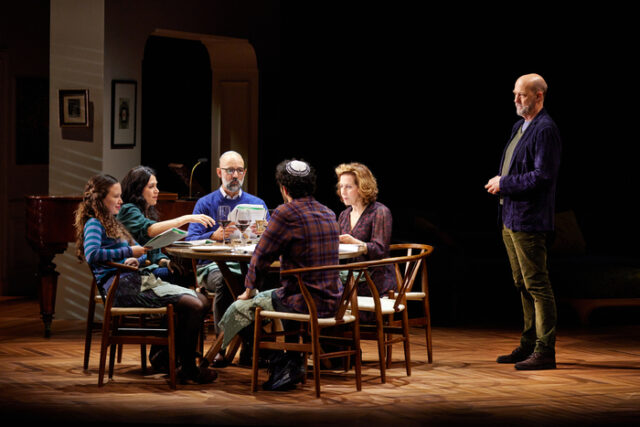
UPTOWN SERIES: TOROS

Frank Wood plays an ailing golden retriever in Danny Tejera’s Toros (photo by Joan Marcus)

TOROS
Second Stage Theater Uptown, McGinn/Cazale Theater
2162 Broadway at Seventy-Sixth St.
Through August 13, $60-$75
2st.com/shows/toros

Three twentysomething friends who attended the same international grade school in Madrid reconnect in Danny Tejera’s beguilingly quirky and unpredictable Toros. Juan (Juan Castano) is a wannabe DJ who works on his music in the garage. Toro (Abubakr Ali) has just returned from an unhappy stint in New York City. And the free-spirited Andrea (b) teaches kindergarten when she’s not rolling joints. All three live at home as they try to figure out what they want to do with their lives, spending their evenings drinking, smoking, going to clubs, and hoping there is something better out there.

All the while, Juan’s ailing, elderly golden retriever, Tica (Frank Wood), is curled up in her bed at the front corner of the stage. Throughout the show, she adjusts her positions, lets out small snores, howls, and barks, and moves awkwardly across the floor, her ancient bones wasting away. The dog soldiers on but is a constant reminder that everyone is eventually going to die, and it might be ugly and painful.

The bullheaded Juan — “toro” means bull in Spanish — is a nasty guy who is mean to Toro, unable to say anything kind. Toro is a lost soul who can’t decide whether he wants to be with his friends or be alone. Andrea is the only one of the trio who has a firm grasp of who she is, although the recent tragic death of her sister has her reevaluating her future. Another death impacts the way they interact with themselves and the world.

Tejera (Scary Faces Happy Faces) and director Gaye Taylor Upchurch (Wish You Were Here, Animal) don’t make it easy for the audience at Second Stage’s McGinn/Cazale Theater, but only in the best ways. Each of the characters has serious flaws and does things that they can’t take back even if they wanted to. The dialogue, which is mostly in English with occasional Spanish, crackles with unexpected lines.

Toro (Abubakr Ali) scratches Tica (Frank Wood) while Juan (Juan Castano) tends to his music in Toros (photo by Joan Marcus)

Set designer Arnulfo Maldonado has crafted an intricate and realistic garage, complete with a fancy car under a white sheet, gardening equipment, and a bathroom that continually overflows. Curiously, there is a wall of plants and trees right outside the garage, which would prevent the car from pulling out into the driveway; perhaps it’s meant to imply that the characters are trapped. (Juan and Toro work for Juan’s father’s real estate company, finding houses for others as they are still stuck living with their parents.)

On the subway home, we heard a few people who had been at the show questioning that scenic choice as well — the designer achieved a thought-provoking response, as do the unique writing, acting, and direction. I’ve seldom been on a train coming home from the theater with as many lively discussions going on.

Castano (A Parallelogram, Transfers), b (American (Tele)Visions, Unprincess Non-Bride), and Ali (We Live in Cairo, Kiss) are terrific as childhood friends who don’t necessarily have much in common anymore, but Wood steals the show as Tica, who is onstage nearly the entire smoothly paced ninety minutes. “Tica” can be translated as ethics, which is something that Juan can learn a lot about.

“All the things people usually want: money, or fame, or — raising a family or doing social work — I was just like, none of that seems that great or useful anyway, you know?” Toro says. “And — I just sort of like, stopped believing in reality. . . . Like, it just seemed like, no matter what I saw in front of me, it was all so obviously performed.”

There’s nothing obvious about the wonderfully performed Toros.

[Mark Rifkin is a Brooklyn-born, Manhattan-based writer and editor; you can follow him on Substack here.]
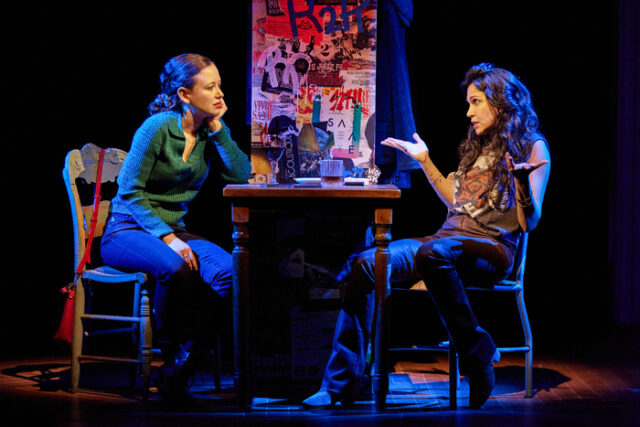
HERE LIES LOVE

Imelda (Arielle Jacobs) and Ferdinand Marcos (Jose Llana) dance their way to power in Here Lies Love (photo by Billy Bustamante, Matthew Murphy, and Evan Zimmerman)

HERE LIES LOVE
Broadway Theatre
1681 Broadway at 53rd St.
Tuesday – Sunday through September 3, $49 – $299
herelieslovebroadway.com

“Why don’t you love me?” Imelda Marcos (Arielle Jacobs) asks in Here Lies Love, the fast-paced extravaganza thrilling audiences at the reconfigured Broadway Theatre. Obviously, she hasn’t been paying attention, too obsessed with greed, corruption, and power.

Here Lies Love started out as a 2010 concept album about Marcos by former Talking Heads leader David Byrne and musician and DJ Fatboy Slim, featuring Tori Amos, Steve Earle, Martha Wainwright, Natalie Merchant, Florence Welch, Cyndi Lauper, Nellie McKay, and others. The full-on show opened at the Public’s LuEsther Hall in 2013, when I called it “a spectacular, must-see event, an immersive, endlessly creative theatrical experience.” It’s still all that and more.

Set designer David Korins has ripped out most of the seats in the theater, so hundreds of people gather on the floor, where large rectangular platforms (nearly four feet high) are pushed around by stagehands while other crew members guide the audience like airplane safety ground handlers so revelers don’t get smushed. There are a few mezzanine rows on two sides of the theater; at one end there are two dozen rows of more traditional balcony seating, while at the other is the main stage. In the center of the room is a giant disco ball, evoking Marcos’s New York City penthouse, where she had one installed over a dance floor, and Studio 54, where she liked to party with celebrities.

Throughout the ninety-minute show, Peter Nigrini projects archival news footage, sociopolitical information, images of Johanna Poethig, Vicente Clemente, and Presco Tabios’s 1986 Lakas Samabayanan (“People’s Power”) mural, and live action, documenting Imelda’s determined rise from a poor childhood by winning a local beauty contest and moving to Manila, meeting and falling in love with the ambitious Ferdinand Marcos (Jose Llana), a military veteran and lawyer with major political aspirations.

Soon she’s swept into a life of position and wealth, although her public statements seem touchingly ingenuous. “The most important things are love and beauty. / It doesn’t matter if you’re rich or poor. / To prosper and to fly — / a basic human right. / The feeling in your heart that you’re secure,” she sings in the opening title number. “Is it a sin to love too much? Is it a sin to care? / I do it all for you. / How can it be unfair?” Most of the lyrics are taken directly from interviews, films, and public statements made by the characters; “here lies love,” for example, is the phrase Imelda wants engraved on her tombstone.

The Marcoses’ rise to power is being challenged by reformer Ninoy Aquino (Conrad Ricamora), a provincial mayor and governor who briefly dated Imelda before becoming a senator who correctly predicted what she and Ferdinand would do to the Philippines. “Out ev’ry night in New York and Paris / Champagne and dancing — while back here at home / People barely surviving — they’re living in shanties! / Our country’s in trouble — but the party goes on!” he declares, earning himself the top spot on their long list of enemies.

Here Lies Love follows the story of Imelda Marcos (Arielle Jacobs) through music and dance (photo by Billy Bustamante, Matthew Murphy, and Evan Zimmerman)

Another sad observer of Imelda’s transformation into an egotistical despot is her childhood friend Estrella Cumpas (Melody Butiu), who in some ways represents both the audience and the people of the Philippines. Once wealth and power come her way, Imelda quickly dumps Estrella. In one of the most touching scenes in the show, Estrella watches Imelda on her wedding day, but she is kept on the other side of a gate. Estrella is intent on standing by her friend as long as she can, explaining, “I know that you are in there somewhere / Letters get misplaced in the mail / Guess that there was some confusion / Amidst those throngs and swells / Did you see me outside? / Did you see me wave? / When you passed in your car / Ah, well, that’s okay — / How she looked when she passed by / How she looked when she passed by.” But Imelda has moved on, trying to erase her poverty-stricken past from her official story.

In 1965, Ferdinand became the tenth president of the Philippines, and for more than twenty years he ruled with an iron fist, having his rivals jailed and murdered, cheating on Imelda, silencing the media, establishing martial law, and lying to the populace as he grew ridiculously rich.

Shortly after the wedding, a press attaché (Jeigh Madjus) announces, “And the whole world can see / They’re our Jackie and John . . . What a picture they make / I’m so proud for us all.” But that’s not at all the way things turned out.

Tony-winning director Alex Timbers (Bloody Bloody Andrew Jackson, Moulin Rouge!) infuses Here Lies Love with nonstop energy spreading across the theater; while the central action follows Ferdinand, Imelda, and Ninoy, the ensemble moves and grooves to Olivier nominee Annie-B Parson’s electric choreography on podiums in the balcony, as if featured dancers in a nightclub. A ladder is occasionally wheeled to the balcony so the main characters can interact with the audience there.

The staging works on multiple levels, but, most important, it helps attendees experience some of what the Filipino people felt during the Marcoses’ ascent. At first, the crowd on the floor is sucked into Ferdinand’s populist campaign, cheering, shaking hands with him and Imelda, and eagerly posing with them for photos and videos. But soon after, they are at an Aquino rally, joining in the rage against the Marcoses’ rampant corruption.

Justin Townsend’s lighting is flashy and bold, splashing flickering colors everywhere. Clint Ramos’s colorful costumes are inspired by such traditional Filipino styles as the terno and the barong. M. L. Dogg and Cody Spencer’s pumping sound shakes the house, led by a fast-talking DJ (Moses Villarama) who keeps the party going even after the show is over. Music director J. Oconer Navarro guides the band across tender ballads and splashy disco and pop, with Joe Cruz on guitar, Derek Nievergelt on bass, and Jacqueline Acevedo, Gustavo Di Dalva, Brandon Ilaw, Paula Winter, and Yuri Yamashita on percussion.

Broadway’s first all-Filipino cast has Llana (The King and I, The 25th Annual Putnam Country Spelling Bee), Ricamora (The King and I, Soft Power), and Butiu (Doctor Zhivago, South Pacific) reprising their roles from the Public Theater production, and all three embody their characters with skill and confidence; Butiu is particularly touching as the friend left behind, essentially representing all the people the Marcoses steamrolled. Jacobs (In the Heights, Between the Lines) is almost too likable as Imelda, although you run out of sympathy for the woman known as the Iron Butterfly by the end. Jasmine Forsberg (Broadway Bounty Hunter, A Grand Night for Singing) is Maria Luisa and Imelda’s inner voice.

Through August 13, Tony winner Lea Salonga (Miss Saigon, Once on This Island) brings down the house as Aurora Aquino, Ninoy’s mother, singing the heartfelt “Just Ask the Flowers” dressed in all black, surrounded by black umbrellas. Kristina Doucette plays Ninoy’s wife, Cory; Timothy Matthew Flores is their son.

Oscar, Grammy, and Tony winner Byrne (Joan of Arc: Into the Fire, American Utopia) and Grammy winner Fatboy Slim (“Praise You,” “The Rockafeller Skank”) have ingeniously transformed the story of despicable despots into a cautionary tale and all-out dance celebration — and with only one mention of shoes.

Ferdinand died in 1986 at the age of seventy-two; Imelda, who concluded a nine-year run in the Philippine House of Representatives in 2019, is still alive, now ninety-four, and their son Bongbong, aka Ferdinand Marcos Jr., was elected president of the country in a landslide in 2022.

“Don’t let them look down on us,” Imelda calls out in “Please Don’t.” It seems she has little to worry about.

[Mark Rifkin is a Brooklyn-born, Manhattan-based writer and editor; you can follow him on Substack here.]
TICKET ALERT: THE MUSIC CRITIC

John Malkovich, Hyung-ki Joo, and Aleksey Igudesman star in The Music Critic, coming to the Beacon for one night only

Who: John Malkovich, Aleksey Igudesman, Hyung-ki Joo
What: The Music Critic, play with live classical music and opera
Where: Beacon Theatre, Broadway at 74th St.
When: Saturday, October 28, $66-$257, 7:30
Why: In such films as Being John Malkovich and cable series as The New Pope, two-time Oscar nominee and Emmy winner John Malkovich (Places in the Heart, In the Line of Fire) has shown that he has a wickedly clever sense of humor, especially when it comes to himself. Since appearing on Broadway four times from 1984 to 1987 (Death of a Salesman, Arms and the Man, The Caretaker, Burn This), his stage work in New York has been limited. In 2011, he starred as the title murderer in The Infernal Comedy: Confessions of a Serial Killer at BAM, and two years later he portrayed Giacomo Casanova at City Center in The Giacomo Variations; both traveling productions combined classical music, opera, and theater.

On October 28, Malkovich will return to the city for one night only with his latest traveling show, The Music Critic, in which he plays a cynical expositor who argues that Antonín Dvořák “indulges in ugly, unnatural music,” calls Johannes Brahms a “giftless bastard,” and claims that “the music of Debussy has the attractiveness of a pretty, tubercular maiden.” It was created and conceived by Russian violinist, poet, author, director, composer, and conductor Aleksey Igudesman, who performs in the international hit with his longtime comedy partner, Korean-British pianist, composer, and educator Hyung-ki Joo; both trained at the prestigious Yehudi Menuhin School. The irreverent comic duo of Igudesman & Joo has previously staged such productions as And Now Rachmaninoff, And Now Mozart, and BIG Nightmare Music.

“We are all happy to be back on the road, and for the first time also in the USA, participating in an evening which consists of some of the greatest compositions in the history of classical music, paired with the perhaps rather unexpected initial reactions those compositions elicited from some of the world’s renowned music critics, along with some other surprises,” Malkovich said in a statement. Igudesman added, “The Music Critic is a project very close to my heart, and bringing it to the USA is something I dreamed of from its inception. My dear friend John Malkovich in the role of the evil critic is despicable and lovable at the same time and evokes the critic in every one of us.”

The score of The Music Critic features Bach, Mozart, Beethoven, Chopin, Brahms, Schumann, Debussy, Prokofiev, Eugène Ysaÿe, Giya Kancheli, Astor Piazzolla, and Igudesman; Igudesman and Joo will be joined by cellist Antonio Lysy, violist Hsin-Yun Huang, and violinist Claire Wells. Be prepared for an unpredictable evening of fab music and comic high jinks.

[Mark Rifkin is a Brooklyn-born, Manhattan-based writer and editor; you can follow him on Substack here.]