this week in theater

EDGAR OLIVER: RIP TIDE

Edgar Oliver returns to his early days at the Pyramid Club in Rip Tide (photo by Regina Betancourt)

RIP TIDE
Axis Theatre Company
One Sheridan Sq. between West Fourth & Washington Sts.
Wednesday – Saturday through October 28, $10-$40, 8:00
866-811-4111
www.axiscompany.org

Master storyteller Edgar Oliver returns to the beginning of his oratory skills in Rip Tide, the latest of his deeply personal solo shows to be presented by Axis Theatre Company, directed by Randall Sharp.

In such previous Axis works as In the Park, East 10th Street, and Attorney Street, in addition to Helen and Edgar and London Paris, Edgar explores key moments from his past, from his upbringing in Savannah, Georgia, to his move to New York City with his sister, painter Helen Oliver Adelson, and his development as a beloved downtown playwright, poet, and raconteur.

Rip Tide begins humbly enough. “I want to tell you something that happened to me. When it happened it was so simple and unexpected — so simple yet so magical — I almost didn’t realize it was happening,” he says at the start. Dressed in all black, he walks across a black platform with a step on two sides, where he sometimes takes a seat or meanders onto the main floor. He moves slowly, using his hands to express himself with unusual motions, and speaks in his trademark tone: affected yet elegant and luxurious, enchantingly otherworldly, part Shakespeare thespian, part late-night horror-film host; you’ll be entranced just by the way he pronounces “ar.”

What happened was that Edgar and Helen had been swept past the velvet rope and into the Pyramid Club, the hot nightspot for alternative performers (John Kelly, Penny Arcade, Kembra Pfahler), drag queens (RuPaul, Lady Bunny), punk bands (Butthole Surfers, Flaming Lips), and cultural icons (Andy Warhol, Debbie Harry) that opened in 1979 at 101 Ave. A between Sixth and Seventh Sts. Oliver was twenty-three and Helen twenty-four, on the brink of their artistic careers and bohemian lifestyle.

“The Pyramid became our world. We realized there were others like us,” he says. “There was a world of drag queens and lost souls sitting on the lip of a stage in the back of an old bar full of lunatics at night on Ave. A.”

Edgar Oliver shares deeply intimate stories in latest monologue at Axis (photo by Regina Betancourt)

Oliver was shocked when Pyramid cofounder Bobby Bradley asked him to perform, something Edgar had never done before. But he immediately says “OK!” — a running gag in the play is how quickly Edgar agrees to just about anything — and performs his poem “Rip Tide” onstage, accompanied by two dancers and music from Nino Rota’s score for Fellini’s La Dolce Vita. “The disgorged jaws of petrified sharks are / yanked up by rip tides / from the smooth graveyard forever below ebb / and harry the coast,” Oliver remembers, with Rota’s music played live by Paul Carbonara on guitar, Samuel Quiggins on cello, and Yonatan Gutfeld on piano. Sitting in a far corner, the trio also plays original music throughout the show.

Soon Oliver is performing regularly at the Pyramid, including a horror play called Motel Blue 19, part of which he acts out. He introduces us to Brian Butterick, aka Hattie Hathaway, who ran the Pyramid after Bradley disappeared, and Brian Damage, an artist and designer who made a wild costume for Oliver to wear in the Final Fashion Solution contest and was working on a large painting titled Dreamland Burns when he died, a canvas about the fire that destroyed Coney Island in 1911 and serves as a metaphor for Oliver’s memories, particularly of the AIDS crisis, which was just breaking out.

Despite some verbal repetition, Rip Tide is another gripping monologue from the eccentric Oliver. Carbonara’s sound design and David Zeffren’s lighting give the show a haunted quality, which fits not only with this specific story but with Oliver’s life; per previous tales, his mother might have been a witch, and at one point he was the only person left living in his building in the East Village. Sharp, who has directed numerous Oliver shows and cast him as an erudite oddball in Worlds Fair Inn, expertly gets the most out of the sparse, dark proceedings, eschewing pure nostalgia in favor of a pervasive gothic eeriness.

The narrative focuses not only on the creation of art but on innocence and loneliness. Oliver shares two potential sexual encounters with men that are absolutely heart-wrenching. “I felt I was a failure as a gay person. . . . I just thought my destiny was to be solitary,” he admits with more than a touch of shame.

“I think I set out onstage to explain the beauty and sorrow of my solitude,” he says just past the halfway mark. “And even if I was unable to do that back then — I hope that somehow I will be able to do that now. I guess that’s what I’m trying to do in this show.”

Mission accomplished, And that’s nothing to be ashamed of.

[Mark Rifkin is a Brooklyn-born, Manhattan-based writer and editor; you can follow him on Substack here.]

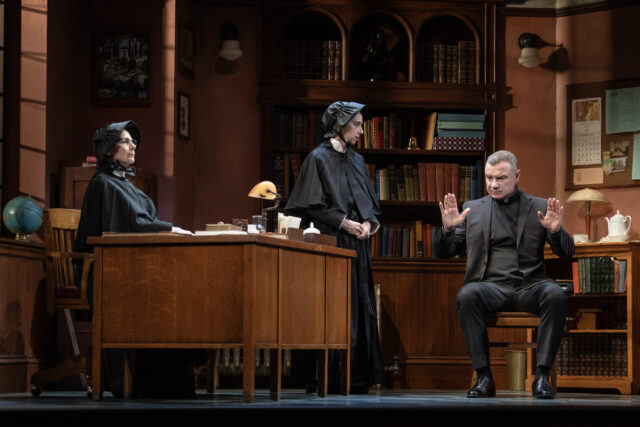
JOB

A therapist (Peter Friedman) and his new patient (Sydney Lemmon) fight for survival in Max Wolf Friedlich’s Job (photo by Danielle Perelman)

JOB
SoHo Playhouse
15 Vandam St. between Varick St. & Sixth Ave.
Tuesday – Sunday through October 29
www.sohoplayhouse.com

The title of Max Wolf Friedlich’s intense generational thriller, Job, can be pronounced either with a soft o, meaning the type of work someone does, or with a hard o, referring to the biblical figure. Both characters in the world premiere at SoHo Playhouse will have to display patience and an innate understanding of their employment if they are going to survive this intense tale.

The show takes place in January 2020 in the San Francisco office of a therapist named Loyd (Peter Friedman), a sort of 1960s throwback who has to determine whether Jane (Sydney Lemmon) can return to her position in the tech world after having suffered a terrible psychological meltdown that went viral. As the play opens, Jane is holding a gun on Loyd.

“Thanks for squeezing me in,” she says plaintively, sitting down. “My pleasure. In general, do Wednesdays at this time work?” he asks, trying to ignore that his life appears to be in grave danger. For the next eighty minutes, Jane and Loyd play a kind of verbal cat-and-mouse game as facts slowly emerge explaining how it came to this.

Jane insists she is not a gun person but that her mental state is on the edge. She tells him, “I can’t imagine how scary that was for you — it was scary for me too — but I promise, I swear like . . . I will do whatever you need me to do just . . . I can’t be outside right now, I — I haven’t slept in a couple days, I haven’t — I can’t be outside, I just need to get back to work.”

Jane (Sydney Lemmon) believes she desperately needs to get back to work in Job (photo by Danielle Perelman)

Meanwhile, Loyd, responding to the shame Jane says she feels for having the gun, explains, “I’m not an especially spiritual person — at least not in the traditional sense — but I will contend that the people who wrote the Bible down were some very very clever people. We’re told that Adam and Eve eat the sort of magical wisdom apple, right? They eat the apple, realize they’re naked, and then . . . they feel shame. So shame is the very first feeling mentioned in the Bible — wisdom and shame are connected.”

Those two elements also arise in the Book of Job. “But where can wisdom be found? And where is the place of understanding? Man does not know its value, nor is it found in the land of the living,“ Job says to his friends. Shortly after, God says to Job, “Your enemies will be clothed in shame, and the tents of the wicked will be no more.”

As the two protagonists continue to battle it out, an underlying theme begins to emerge, one of the young fighting against the old. Jane is in her twenties, working in the tech profession in a role that didn’t exist a mere ten years before, while Loyd, in his sixties, is a laid-back Berkeley grad with outdated sensibilities.

“It’s the field that’s the problem,” Jane tells him. “Because people with your job come into work wanting to connect trauma A to trauma D, so they always do — it’s a self-fulfilling prophecy or whatever.” When Jane explains how a creepy guy on a train both hit on her and insulted her at the same time, Loyd defends it as “a misguided attempt at being friendly — generational miscommunication.” She also asks Loyd, “Like why are you so terrified of progress?”

Loyd delves into Jane’s upbringing, looking for clues regarding her meltdown, but keeps coming up empty. “It was a perfectly nice granola middle class existence — nothing to cry about,” she insists. Jane, however, often turns the tables on Loyd, asking him personal questions that he does answer, perhaps out of fear knowing that there’s still that gun in her bag. But once he’s said enough, a major twist leads to an intense finale.

Loyd (Peter Friedman) is the arbiter of Jane’s fate in world premiere at SoHo Playhouse (photo by Danielle Perelman)

No matter how you pronounce it, Job is a nail-biter about patience, wisdom, and, primarily, responsibility, about people being accountable for their actions and living up to their obligations. Both Jane, who works in “user care,” and Loyd have jobs in which they help people, though in different ways, through a kind of protection.

In his off-Broadway debut, director Michael Herwitz keeps the drama at high-boil, making good use of Scott Penner’s basic set, a few chairs facing each other atop a rectangular, carpeted platform, with two small tables, an ottoman, and a lamp. Mextly Couzin’s lighting features several eerie blackouts, accompanied by Jessie Char and Maxwell Neely-Cohen’s effective sound. The costumes by Michelle Li consist of casual pants and an unbuttoned shirt for Loyd and green pants and a belly-revealing striped shirt for Jane.

Ever-reliable Tony nominee Friedman (The Nether, Ragtime) is phenomenal as an easygoing therapist who suddenly find his life on the line, while Lemmon (Tár, Helstrom) — the daughter of Chris Lemmon and granddaughter of Jack Lemmon — is exceptional in her off-Broadway debut, stretching her long body, clasping her hands, and holding tight to her gun as she slowly reveals some hidden truths. (Friedman played series regular Frank on Succession, while Lemmon appeared in three episodes as Jennifer, who’s starring in Willa’s play.)

The twist is a biggie and will turn some people off, as will the open-ended finale. But everything up to those points is taut and nerve-racking. It’s not going to hurt any of the participants to have this Job on their resume.

[Mark Rifkin is a Brooklyn-born, Manhattan-based writer and editor; you can follow him on Substack here.]
BIG TRIP: THREE LOVE STORIES NEAR THE RAILROAD

Krymov Lab NYC makes big debut with the two-part Big Trip at La MaMa

BIG TRIP
La MaMa Experimental Theatre Club
The Ellen Stewart Theatre
66 East Fourth St. between Second Ave. & Bowery
September 24 – October 15, $45
212-475-7710
www.lamama.org
www.krymovlabnyc.com

Moscow-born director, designer, and visual artist Dmitry Krymov makes a smashing debut with his new company, Krymov Lab NYC, in Big Trip, two shows running in repertory at La MaMa through October 15.

Krymov was preparing a production of The Cherry Orchard in Philadelphia in February 2022 when Russia invaded Ukraine. Condemning Putin’s actions, he became an exile and moved to New York City with his wife, Inna, where he started Krymov Lab NYC. The first part of Big Trip is Pushkin “Eugene Onegin” in our own words, an absurdist adaptation of Alexander Pushkin’s classic serial novel in verse, following the adventures of four Russian émigrés in downtown Manhattan.

You don’t need to have seen the first part to fall in love with the second, Three Love Stories Near the Railroad, Krymov’s wild and woolly, wholly unpredictable retellings of Ernest Hemingway’s four-pages-each “Hills Like White Elephants” and “A Canary for One,” followed by act two, scenes two and three of Eugene O’Neill’s Desire under the Elms.

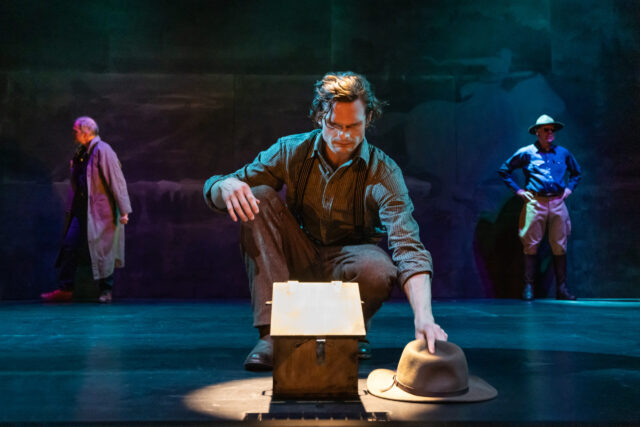
With a dash of Brecht here and a dollop of Ionesco there, Krymov brings a circusike atmosphere to La MaMa, where most of the audience sits in rising rafters but some in semicircular rows on the stage. Emona Stoykova’s set is anchored by a dilapidated wall of cardboard splashed with white paint, with random objects on the floor buried in the rubble.

Host and guitar player Jackson Scott introduces the show. He constructs a table and chairs from the detritus. He tells clarinetist Erich Rausch that he’s not supposed to be here tonight and that the union will not allow him to get paid if he stays. The cast of nine sits stage right and makes costume changes in front of the audience because, as Jackson explains, “The dressing rooms at La MaMa are incredibly far away, and the last time we did this show, sometimes the actors didn’t manage to get here in time for their entrances. So that’s why they are all going to sit here, alright?”

Props are casually tossed around in Dmitry Krymov’s unpredictable Big Trip

Jackson orders the audience not to clap until all three works have concluded. “It is one single piece, like a symphony,” he says. Jackson also unveils the train, a model that putt-putts across the stage in the back.

Thus, right from the start, we are aware that this evening will be as much about the art of making theater as it will be about the art of performance itself.

In “Hills Like White Elephants,” a young couple (Tim Eliot and Shelby Flannery) is on a train going from Madrid to Barcelona. Although they never say the word abortion — echoing O’Neill’s 1914 one-act, Abortion, in which the title word is never uttered — it appears that they are on their way to end the woman’s pregnancy. “I know lots of people who have done it and it’s really very simple,” the man assures the woman. “And things will be like they were and you’ll love me again?” the woman asks. They order two Budweisers in a café and the bartender (Jeremy Radin) brings them two cups of shaving cream. A tall, bare-chested man (Kwesiu Jones) representing the unborn child dances around the woman and lays his head in her lap.

In “A Canary for One,” the bartender has taken over the narration, complaining about his disintegrating underwear. A man and a woman (Eliot and Flannery) are on their way to Paris to end their marriage. In their compartment is an older American woman (Annie Hägg) traveling with a shedding yellow canary. The scenery unfolds behind them from a scroll pulled open by an assistant named Shlomo (Anya Zicer) consisting primarily of black-and-white drawings of houses, people, and landscapes, as the host relates the tale, with limited spoken dialogue. Inventive things are done with luggage, cigarettes, and bread as the train continues on its way.

Big Trip concludes with scenes from Desire under the Elms

The evening finishes with a farcical reinvention of two scenes from Desire under the Elms involving the elderly Ephraim Cabot (Jones); his young wife, Abby (Flannery); and Ephraim’s ne’er-do-well son, Eben (Eliot). Cabot berates his son, calling him “a waste of my seed.” Abby loves Eben, who only has eyes for his dead mother. Ephraim and Eben walk around on long metal stilts, making movement comically difficult and ridiculous as they tower over Abby. Beneath all the pain and anguish, Abby has hope. “I hate you. I don’t need anything from you,” Eben tells Abby, who replies, “Don’t lie to me. I could feel the tenderness in your hands.”

The ninety-minute Big Trip is fun and frantic, filled with delightful non sequiturs, playfully silly song and dance, and hilarious self-referential nonsense. Each member of the crew deserves kudos: The choreography is by Baye&Asa and Rachel McMullin, with costumes and puppets by Luna Gomberg, sound by Kate Marvin, lighting by Krista Smith, and projections by Yana Biryukova.

The play also has a serious edge, with a dark take on relationships, whether between husband and wife or parent and child. Both Hemingway stories are drawn from his seminal 1927 collection, Men without Women, published just as Hemingway was gaining success as a writer, during the three-year period that included The Torrents of Spring, The Sun Also Rises, and A Farewell to Arms as well as his divorce from Hadley Richardson and marriage to Pauline Pfeiffer, the second of his four wives. Desire debuted in 1924, while O’Neill was married to the second of his three wives, Agnes Boulton.

“They never know what they want, these directors,” the host tells a stagehand. But writer, director, and adaptor Krymov knows precisely what he wants, even amid improvisation, building a unique kind of theater by exposing and transforming its conventions. As the script notes about “A Canary for One”: “This is a small scene. It doesn’t even pretend to be a play. It’s an idiotic, very small scene. But it is honest about what it is.”

[Mark Rifkin is a Brooklyn-born, Manhattan-based writer and editor; you can follow him on Substack here.]

MARY GETS HERS

A young girl (Haley Wong) seeks out her true path in Mary Gets Hers (photo by Daniel J Vasquez)

MARY GETS HERS
MCC Theater, Susan & Ronald Frankel Theater
511 West Fifty-Second St. between Tenth & Eleventh Aves.
Tuesday – Saturday through October 14
mcctheater.org
playwrightsrealm.org

Inspired by tenth-century German feminist playwright and poet Hrosvitha of Gandersheim’s Abraham, or the Rise and Repentance of Mary, Emma Horwitz’s Mary Gets Hers at MCC Theater is a satirical take on sin and salvation that unfortunately fizzles out too soon.

It’s around 950 AD, and eight-year-old Mary (Haley Wong) has just lost her parents to a plague that turns its victims into foam. She is found by the hermit monk Abraham (Susannah Perkins), who brings her back to the monastery so he can protect her with the help of the other monks, including the ultraserious Ephraim (Octavia Chavez-Richmond), who is dedicated to prayer and wears a hairshirt she continually scratches at. Abraham prepares a cell for Mary within his own cell, where he teaches her about God’s love.

“We sing to God / to whom i am betrothed / which means we are Together Forever / even though we’ve never met,” Mary and Abraham sing. “We are all so in love with God / he’s our father and our husband / that’s what all these songs are about.”

Hermits Abraham (Susannah Perkins) and Ephraim (Octavia Chavez-Richmond) are determined to protect Mary from sin (photo by Daniel J Vasquez)

Mary does not believe in God with the conviction that Abraham and Ephraim have and yearns for something more. The morning after Abraham has a horrific dream about a dragon and a dove, Mary is gone. At first, Abraham thinks that Mary was devoured by the dragon from his nightmare, but then reconsiders and enlists his friend, a soldier (Kai Heath) covered in chainmail, to rescue her from the harsh, godless world.

Meanwhile, Mary has found a new life at a nearby inn run by a shady man (Claire Siebers) who offers her room and board, but not exactly for free. One of her many male visitors declares, “When I was younger everyone called me / little man / little man, they called me / climbing up that tree / look at our little man, they said! / but i’m not so little now, huh? / i’m a gigantic man! / the size of a mountain! / or a church! / or a monster!” As the soldier continues his search, the hermits worry about Mary, who is not necessarily sad about her current condition.

You-Shin Chen’s set is sparse and haunting, with numerous drapes and curtains, items that once upon a time were treated as women’s work. Cha See’s stark lighting and Kathy Ruvuna’s mysterious sound are appropriately creepy, especially at the monastery, while Camilla Dely’s costumes are cute and playful.

There are parts of Mary Gets Hers — which is a production of the Playwrights Realm, not MCC Theater — that soar, funny, cynical, and clever scenes that question gender roles from the birth of Jesus and humanity’s connection to God and interpretations of sin and purity. Wong’s face is wonderfully malleable as she considers Mary’s life, while Perkins is adorable as the wide-eyed hermit who wants only the best for her. All five actors either identify as women or are trans or nonbinary, adding to the feminist bent, but Siebers struggles to juggle too many hats as multiple male characters.

The world premiere, directed by Josiah Davis, is unable to sustain its wry sense of humor and poignant narrative as things flail out of control, relying on physical slapstick where smart wordplay and staging previously worked. Initially, comparisons between the Middle Ages and today, the plague and Covid-19, felt timely, but Horwitz and Davis dull their blades through too much repetition over the course of ninety minutes. Mary might get hers in the second half, but we in the audience do not get ours.

[Mark Rifkin is a Brooklyn-born, Manhattan-based writer and editor; you can follow him on Substack here.]
SWING STATE

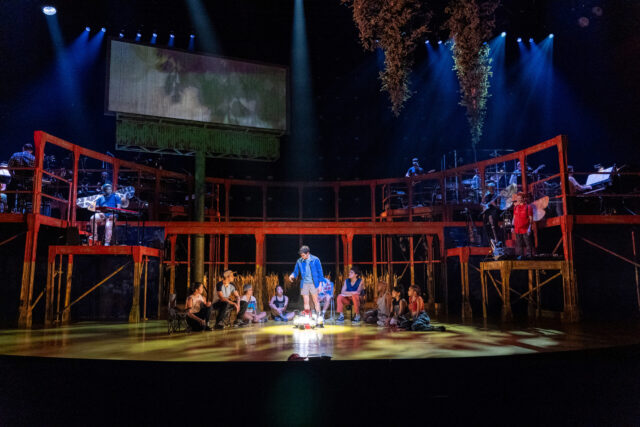
Peg (Mary Beth Fisher) and Ryan (Bubba Weiler) share a rare sweet moment in Swing State (photo by Liz Lauren)

SWING STATE
Audible Theater’s Minetta Lane Theatre
18 Minetta Lane between Sixth Ave. and MacDougal St.
Monday – Saturday through October 28, $47-$106
www.audible.com

Since at least 2006, white-nose syndrome (WNS), caused by a fungus known as Pseudogymnoascus destructans, or Pd, has been infecting and killing hibernating bats by the millions in North America. It was introduced from Europe, perhaps on the shoes of a traveler. According to the National Park Service, although there are no known cases of bat-to-human transmission, “Bats infected with either WNS or rabies may exhibit unusual behavior (e.g. erratic flying), which increases the risk for bat-human contact and exposure. Additionally, declines in bat populations can impact human health indirectly since humans depend on bats for important ecosystem services such as controlling pest insects.”

In Rebecca Gilman’s superb Swing State, extended at Audible’s Minetta Lane Theatre through October 28, the Pulitzer Prize finalist uses the bat disease as a metaphor for what’s ailing America. “The theory is that [WNS] stops their breathing so they’re startled awake from their torpid state and they start flying around, burning up calories that they can’t afford to lose,” sixty-five-year-old widow Peg Smith (Mary Beth Fisher) tells twenty-six-year-old Ryan Severson (Bubba Weiler), who does odd jobs for her on her forty-acre prairie farm. “You’ll see them flying around outside caves in the middle of the day, in the dead of winter, looking for food. But there’s nothing to eat — it’s winter, there aren’t any bugs — and eventually they burn up all their stored fat and they starve to death.”

Although the title refers to a battleground or purple state — as well as our state of mind as individuals and a country — Swing State avoids debating specific political issues, instead allowing them to arise organically as the plot develops. Among the topics that come up without being directly debated are gun control, the prison system, religion, the environment, alcoholism, health care, climate change, education, law enforcement, corporate control, and Covid-19, which some link to bats from China.

The 105-minute play is set in the summer of 2021 in the fictional Cardiff Township in the part of western Wisconsin known as the Driftless Area, which experienced no glacial drift during the last glaciation period. The show opens with Peg in her kitchen making zucchini bread. She takes the knife, brings it to her wrist, then drops it and says, “I don’t know. I don’t know what to do.” It’s a feeling many Americans have every day. A moment later, she adds, “As a species, we suck.”

Former convict Ryan (Bubba Weiler) takes a liking to deputy sheriff Dani (Anne E. Thompson) in latest Audible play at the Minetta Lane (photo by Liz Lauren)

Peg is a recent widow, childless, alone except for their dog, Walleye, and Ryan, a hired man and former convict. Peg has decided to leave her land to the Prairie Protectors (Gilman herself volunteers for the Prairie Enthusiasts) and the house and barn to Ryan.

A week later, Peg has notified the local authorities of the theft of her late husband Jim’s antique tool collection as well as Jim’s father’s classic Winchester 94 rifle. Sheriff Kris Callahan Wisnefski (Kirsten Fitzgerald) arrives with Deputy Dani Wisnefski (Anne E. Thompson), her niece, new to the force. Old tensions surface: The Callahan family owns thousands of acres around Peg’s farm, but Peg has vowed never to sell her property to them. “No Callahan is ever going to own an inch of my land,” Peg declares. Dani, who does not seem to be the law-enforcement type, likes and respects Peg, who taught her health sciences in high school, “how to be healthy in mind and body.”

The sheriff is certain that Ryan pulled off the heist and is eager to arrest him. Peg refuses to believe that he is responsible, and Ryan adamantly denies it. Dani, a sweet, innocent young woman, is bullied by her aunt into withholding her opinion, which is usually the most centrist, humanistic view, neither ultra conservative nor radically liberal. As the investigation continues, the plot twists and turns, revealing both the good and the bad that are so prevalent in contemporary America.

Gilman (The Glory of Living, Spinning into Butter) was born in Alabama, lived and worked for a long time in Chicago, and moved to rural Wisconsin about four years ago. Cardiff Township and Peg’s farm are a microcosm of society, representing a purple state with a wide variety of people as well as flora and fauna. At several points in the play, Peg brings in seeds from Shooting Star wildflowers that have been on the prairie for ten thousand years; she is trying to save and protect them, prevent them from going extinct. On the kitchen counter behind her is a box that contains Jim’s ashes. Life here, death there.

Rebecca Gilman takes a hard look at America in Swing State (photo by Liz Lauren)

Todd Rosenthal’s homey kitchen/dining room set is relatably old-fashioned, with a microwave, birdhouses atop a shelf, various pots, bowls, and jars, and books overflowing a bookcase. Evelyn M. Danner’s costumes have a timeless quality as well, Kris and Dani in brown uniforms, Ryan wearing a work shirt with a name badge, and Peg dressed primarily in pants and an unbuttoned shirt over a dark tee. Peg is not attached to her cell phone, which she regularly leaves on the table when she goes out. Kris is not fond of the tablet she now has to use while on the job. “I hate this fucking thing,” the ever-angry sheriff complains. There is never talk of modern-day equipment, only outmoded hand tools and an ancient tractor.

It could be 1971 instead of 2021. One of the only present-day references occurs when Peg explains why she no longer reads the local newspaper. “I canceled my subscription when they endorsed Trump,” she tells Kris and Dani. Peg might be clearly blue and Kris obviously red, but Dani and Ryan, the future, are more purple, not caught up in identity politics as much as struggling to make it through every day.

Each of the characters has suffered a loss of some kind, and they each have reacted differently to the sadness in their lives. Gilman’s dialogue has a poetic flavor to it, no matter what side of the fence you might be on; none of the characters are purely black and white but filled with complexity.

Gilman’s longtime collaborator, Tony winner Robert Falls (The Iceman Cometh, Shining City), directs his Goodman Theatre production with a constant tension buzzing just below the surface, ready to explode at any moment, just like America. Fisher (Frank’s Home, Boy Gets Girl) is mesmerizing as Peg; you feel her anguish in her every move as she strives to save a damaged planet while caring little about her own existence. Fitzgerald (Clybourne Park, A Moon for the Misbegotten) is staunch as the blunt sheriff, a role that could have been a stereotypical villain but is more than that here. Thompson (Gilman’s Twilight Bowl, Boy Gets Girl, and Spinning into Butter) makes a strong off-Broadway debut as Dani, an ingénue who grows up fast. And Weiler is arresting as Ryan, an enraged and exasperated young man who doubts that he will be given a second chance.

Besides bats, another flying creature that figures prominently in Swing State is the Henslow’s Sparrow, which All About Birds describes as “an easy-to-overlook bird with an almost nonexistent song,” which is also true of too many people in today’s America, beautifully captured in this heart-tugging, deeply affecting play.

[Mark Rifkin is a Brooklyn-born, Manhattan-based writer and editor; you can follow him on Substack here.]
PROMETHEUS FIREBRINGER

Annie Dorsen pits herself against ChatGPT in Prometheus Firebringer (photo by Maria Baranova)

PROMETHEUS FIREBRINGER
Theatre for a New Audience, Polonsky Shakespeare Center
262 Ashland Pl. between Lafayette Ave. & Fulton St.
Through October 1, $50
866-811-4111
www.tfana.org

As the audience enters Theatre for a New Audience’s Polonsky Shakespeare Center for Annie Dorsen’s Prometheus Firebringer, text is being projected one letter at a time on a white screen above the stage. Below are five AI-generated mask faces on poles, while a more menacing mask hovers at the top of a wall at the center of the stage, perhaps suggesting the traditional comedy and tragedy masks that decorate so many prosceniums.

The text of the paragraph appears over and over again, each time with significant differences, but they all tell the same story, summarizing the plot of Aeschylus’s unfinished Prometheia trilogy, which began with Prometheus Bound and continued with Prometheus Unbound and Prometheus the Fire-bringer; only eleven fragments of Unbound exist, and only one line of the finale.

The recaps are being generated live by ChatGPT-3.5, scanning the internet and regurgitating the tale of Prometheus’s battle with Zeus in language that repositions key words, plot points, and themes, reminding us how many ways there are to say the same thing.

Writer-director Dorsen enters stage left and sits at a plain wooden desk with paper, a water bottle, and a microphone. When GPT-3.5 is done, she begins a unique kind of lecture. “I am going to try to talk to you about the individual in the contemporary age,” she says. “I suppose this piece is an essay, maybe, a think piece. It doesn’t really matter what it is, I call it an ‘essay’ because it is not anything more.”

A Greek chorus of masks shares the story of Prometheus in TFANA production (photo by Maria Baranova)

From this point on, the lecture-performance alternates between Dorsen’s “essay” and the masks performing parts of Aeschylus’s conclusion to the Prometheus trilogy, in which the five masks — a chorus of orphaned children — sing and the larger mask narrates the tale. The fight between Zeus and Prometheus over power and control mimics that between AI and human writers and philosophers.

As with GPT-3.5, nothing Dorsen is saying is original; every single word and phrase has come from sources she carefully researched. As she speaks, those sources are cited via projections on a screen behind her. The sources range from Bernard Stiegler’s Symbolic Misery Vol. I: The Hyperindustrial Epoch, Ted Berrigan’s On the Level Everyday: Selected Talks on Poetry and the Art of Living, The Twilight Zone, Jakob Norberg’s Tragedy of the Commonplace, Gregg Lambert’s The Elements of Foucault, and Simon Critchley’s Tragedy, the Greeks, and Us to Susan Sontag’s Regarding the Pain of Others, Mark Grabowski and Eric P. Robinson’s Cyber Law and Ethics: Regulation of the Connected, E. A. Havelock’s The Crucifixion of Intellectual Man, Virginia Woolf’s To the Lighthouse, Ted Chiang’s “ChatGPT Is a Blurry JPEG of the Web” in the New Yorker, and Noam Chomsky’s “The False Promise of ChatGPT” in the New York Times.

Whereas GPT-3.5 produces comprehensible strings of words by searching archives and databases for expected patterns, Dorsen works in the opposite direction; she knows what she wants to say and then finds the word strings through her research. She pulls both important phrases and more mundane thoughts and sentences from books and articles that don’t always have anything to do with her topic. For example, when she greets the audience, saying, “Hi. Thanks for coming,” she cites R. H. Wood’s Lightning Crashes. When she notes, “We are together in time,” her source is Christina Baldwin’s Our Turn Our Time: Women Truly Coming of Age. GPT-3.5 seems to act more randomly, while Dorsen is building a coherent argument.

Talking about language, Dorsen explains, “It is a shared resource, it belongs to us all, and words are never consumed, no matter how often we use them. I chose these words carefully. I chose these words carefully, because they resonate with my experiences. But what do I mean by experience? And whose??? Mine or theirs? In other words, who is speaking?”

Artificial intelligence investigates Aeschylus’s unfinished play in Prometheus Firebringer (photo by Maria Baranova)

Dorsen and the play-within-a-play explore tragedy, choices, coding, fate, recombining, and the past. The most effective section is when Dorsen describes how Irish artist Matt Loughrey used AI to colorize black-and-white photos of victims of the Khmer Rouge, but he also gave them all smiles. “If these photos are part of current AI models that’ll represent a total rewrite of history, in an absolutely frightening way,” Dorsen points out. “How can you change hell to happiness?”

Prometheus Firebringer concludes Dorsen’s algorithmic theater trilogy, which began with 2010’s Hello Hi There, followed by last year’s A Piece of Work. As clever as it is, there is also an overwhelming dryness to it. The interplay between the AI and Dorsen never, well, ignites. The excerpts “performed” by the masks, whose eyes are like video screens, are dull and lifeless; Dorsen’s lecture is much more fun and interesting, but there is not enough of it. The entire production, previously seen at the Chocolate Factory in Queens, is extremely slight at a mere forty-five minutes.

Earlier this month I saw Tjaša Ferme’s Bioadapted at CultureLab LIC, which was more successful in dramatizing a narrative involving AI and GPT-3. Of course, Dorsen (The Great Outdoors, Magical) is showing us that human activity is more viable and entertaining than that created by AI, but the proceedings lag too much. Prometheus needs to bring some fire.

[Mark Rifkin is a Brooklyn-born, Manhattan-based writer and editor; you can follow him on Substack here.]
JOHN CAGE’S JAPAN

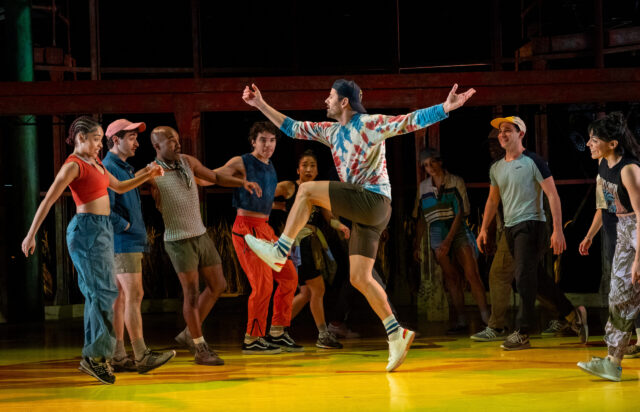
John Cage’s unique relationship with Japan and Japanese culture will be celebrated in Japan Society series (photo by Yasuhiro Yoshioka / courtesy of Sogetsu Foundation)

JOHN CAGE’S JAPAN
Japan Society
333 East 47th St. at First Ave.
Thursday, September 28, and Friday, September 29, $28-$35, 7:30
Saturday, October 21, Thursday, November 16, Thursday, December 7, $32-$40
212-715-1258
www.japansociety.org

“If John Cage had not encountered Japanese culture, there would have been no John Cage!” Japan Society artistic director Yoko Shioya recently declared.

In 1989, experimental composer John Cage was awarded the Kyoto Prize in the category of Creative Arts and Moral Sciences; the citation, presented in Kyoto, Japan, noted that he was “a rebel against Western music. . . . His creative activities and philosophy of art have truly constituted a revolution in culture. . . . Mr. John Cage has stood in the vanguard of change in the postwar Western musical world, and has continually demonstrated his leadership among the most avant-garde group of composers.” Cage, who was born in Los Angeles in 1912, first visited Japan in 1962; he returned in 1964, 1976, and several times in the 1980s. Not only was Cage impacted by Japanese art and culture — he was particularly interested in Zen Buddhism — but he was a major influence on such Japanese composers as Tōru Takemitsu, Toshiro Mayuzumi, Yoko Ono, and Yuji Takahashi, in what was called “Jon Kēji shokku,” or John Cage Shock.

Japan Society pays tribute to the relationship between Cage and Japan in the series “John Cage’s Japan,” which kicks off September 28-29 with Paul Lazar’s Cage Shuffle. From 1958 to 1960, Cage wrote and recorded a series of sixty-second real-life anecdotes called Indeterminacy. At Japan Society, Lazar, the cofounder of Big Dance Theater, will perform pieces related to Japan and the East; using an iPhone — “a device that John Cage invented,” Lazar jokes in the above video — Lazar will have Cage’s recordings of the stories piped into his earbuds and will repeat them out loud, along with quotes from such Cage contemporaries as D. T. Suzuki, Isamu Noguchi, and Hidekazu Yoshida. Meanwhile, Lazar will be moving to choreography by BDT cofounder and Tony winner Annie-B Parson. The movement is fixed but the text is random, creating the kind of chance Cage was celebrated for. The September 29 show will be followed by an artist Q&A.

On October 21, “John Cage’s Ryoanji” features the composer’s 1983 work, inspired by the Zen rock garden at Kyoto’s Ryoanji Temple. Directed by Tomomi Adachi, it will be performed by International Contemporary Ensemble in New York City (with Michael Lormand on trombone, Lizzie Burns on double bass, and Clara Warnaar on percussion), joined virtually from a teahouse in Kanazawa City by Hitomi Nakamura on the ancient hichiriki woodwind and Maki Ota on vocals. The multimedia concert, with 3D projections by Dr. Tsutomu Fujinami, will be preceded by a lecture from Cage scholar James Pritchett at 7:30.

Adachi’s “Noh-opera / Noh-tation: Decoding John Cage’s Unrealized Project” takes place on November 16 at 7:30, for which Adachi used AI to compose music and lyrics based on Buddhist koans for Cage’s unrealized Noh-opera: Or the Complete Musical Works of Marcel Duchamp. The work will be performed by vocalist Gelsey Bell, noh actor Wakako Matsuda, and Adachi with ICE’s Alice Teyssier on flute, James Austin Smith on oboe, Campbell MacDonald on clarinet, Rebekah Heller on bassoon, and Lormand on trombone and will be followed by an artist Q&A.

The series concludes on December 7 with “Cage Shock: Homage to His First Japan Visit,” consisting of a lecture by Dr. Pritchett, live performances of 1951’s Haiku, 1958’s Aria and Solo for Piano with Fontana Mix, and 1962’s 0’00” by Cage, Toshi Ichiyanagi’s 1962 Sapporo, which Cage conducted, and soundscapes by Tania Caroline Chen and Victoria Shen, with ICE’s Kyle Armburst on viola, Wendy Richman on viola, and Katinka Kleijn and Michael Nicolason on cello.

“I must express my deep and sincere gratitude to John Cage,” Takemitsu wrote. “The reason for this is that in my own life, in my own development, for a long period I struggled to avoid being ‘Japanese,’ to avoid ‘Japanese’ qualities. It was largely through my contact with John Cage that I came to recognize the value of my own tradition.” At Japan Society this fall, we can all express our deep and sincere gratitude to John Cage.