this week in theater

HARLEM WEEK 50: CELEBRATE THE JOURNEY

HARLEM WEEK
Multiple locations in Harlem
August 7-18, free
harlemweek.com

Fifty years ago, actor and activist Ossie Davis cut a ribbon at 138th St. and the newly renamed Adam Clayton Powell Jr. Blvd. (formerly Seventh Ave.), opening what was supposed to be a one-day, one-time-only event known as Harlem Day; Davis called it “the beginning of the second Harlem Renaissance.” Among the cofounders were Davis, his wife, Ruby Dee, Maya Angelou, James Baldwin, Harry Belafonte, Ornette Coleman, Lloyd E. Dickens, David Dinkins, Basil Paterson, Tito Puente, Charles Rangel, Max Roach, Vivian Robinson, “Sugar Ray” Robinson, Hope R. Stevens, Bill Tatum, Barbara Ann Teer, and Rev. Wyatt T. Walker.

The festival has blossomed over the last half century into the annual favorite Harlem Week, a summer gathering packed full of live performances, film screenings, local vendors, panel discussions, a job fair, fashion shows, health screenings, exhibits, and more. This year’s theme is “Celebrate the Journey”; among the highlights are the Uptown Night Market, the Percy Sutton Harlem 5K Run & Health Walk, Great Jazz on the Great Hill, Harlem on My Mind Conversations, a Jobs & Career Fair, the Children’s Festival, the Concert Under the Stars, and the centerpiece, “A Great Day in Harlem.” Below is the full schedule; everything is free.

Wednesday, August 7
Climate Change Conference, Adam Clayton Powell Jr. State Office Building, West 125th St., 6:00

Thursday, August 8
Uptown Night Market, 133rd St. & 12th Ave., 4:00 – 10:00

Harlem Summerstage, Adam Clayton Powell Jr. State Office Building, 5:30

HW 50 Indoor/Outdoor Film Festival, 7:00

Friday, August 9
Senior Citizens Day, with health demonstrations and testing, live performances, exhibits, panel discussions, the Senior Hat Fashion Show, and more, Adam Clayton Powell Jr. State Office Building, 10:00 am – 3:00 pm

Saturday, August 10
NYC Summer Streets Celebrating Harlem Week’s 50th Anniversary, 7:00 am – 3:00 pm

The Percy Sutton Harlem 5K Run & Health Walk, West 135th St., 8:00 am

Choose Healthy Life Service of Renewal and Healing, noon

Great Jazz on the Great Hill, Central Park Great Hill, 4:00

Harlem Week/Imagenation Outdoor Film Festival: Black Nativity (Kasi Lemmons, 2013), 7:00

Sunday, August 11
A Great Day in Harlem, with Artz, Rootz & Rhythm, the Gospel Caravan, AFRIBEMBE, and Concert Under the Stars featuring the Harlem Music Festival All-Star Band, music director to the stars Ray Chew, and special guests, General Grant National Memorial, Riverside Dr., noon – 7:00

Monday, August 12
Youth Conference & Hackathon, 10:00 am – 3:00 pm

Children’s Corner — Books on the Move: “Mommy Moment,” 10:00 am

Tuesday, August 13
Economic Development Day, noon – 3:00

Arts & Culture/Broadway Summit, 3:00

Harlem on My Mind Conversations, 7:30

Wednesday, August 14
NYC Jobs & Career Fair, CCNY, 160 Convent Ave., 10:00 am – 4:00 pm

Harlem on My Mind Conversations, 7:00

Thursday, August 15
Black Health Matters/HARLEM WEEK Summer Health Summit & Expo, with free health screenings, prizes, breakfast, and lunch, the Alhambra Ballroom, 2116 Adam Clayton Powell Jr. Blvd., 9:00 am – 3:00 pm

Harlem Summerstage, Adam Clayton Powell Jr. State Office Building Plaza, 5:00

Banking & Finance for Small Business & Entrepreneurs, Chase Community Banking Center, 55 West 125th St., 6:00 – 9:45

Harlem on My Mind Conversations, 8:45

Saturday, August 17
NYC Summer Streets Celebrating HARLEM WEEK’s 50th Anniversary, 109th St. & Park Ave. – 125th St. & Adam Clayton Powell Jr. Blvd., 7:00 am – 3:00 pm

NYC Children’s Festival, with storytelling, live performances, dance, hip hop, theater, poetry, arts & crafts, double dutch competitions, face painting, technology information, health services, and more, Howard Bennett Playground, West 135th St., noon – 5:00

Summer in the City, with live performances, fashion shows, and more, West 135th St., 1:00 – 6:00

Alex Trebek Harlem Children’s Spelling Bee, Schomburg Center for Research in Black Culture, 515 Malcolm X Blvd., 2:00

Harlem Week/Imagenation Outdoor Film Festival, Great Lawn at St. Nicholas Park, West 135th St. 6:00

Sunday, August 18
NYC Health Fair, West 135th St., noon – 5:00

NYC Children’s Festival, with storytelling, live performances, dance, hip hop, theater, poetry, arts & crafts, double dutch competitions, face painting, technology information, health services, and more, Howard Bennett Playground, West 135th St., noon – 5:00

Harlem Day, with live performances, food vendors, arts & crafts, jewelry, hats, sculptors, corporate exhibitors, games, a tribute to Harry Belafonte, and more, West 135th St., 1:00 – 7:00

[Mark Rifkin is a Brooklyn-born, Manhattan-based writer and editor; you can follow him on Substack here.]
THE MEETING: THE INTERPRETER

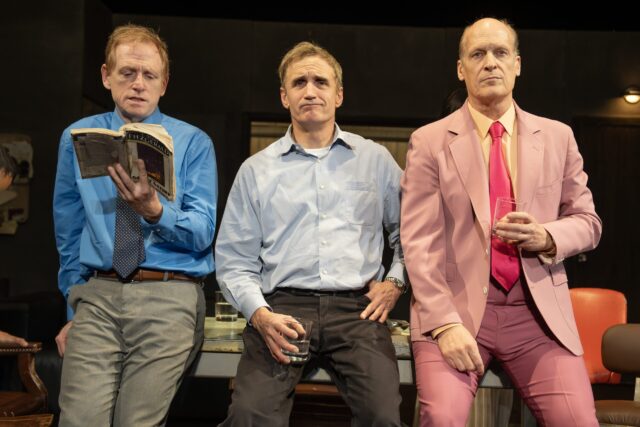
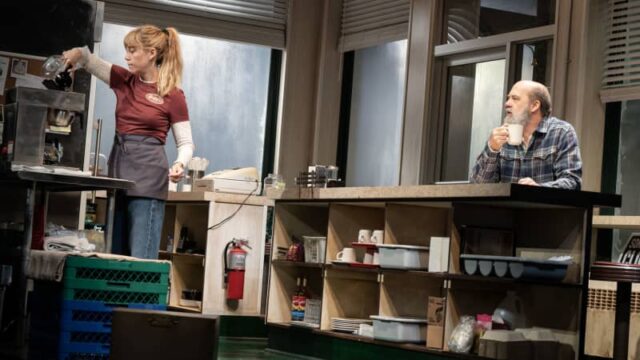
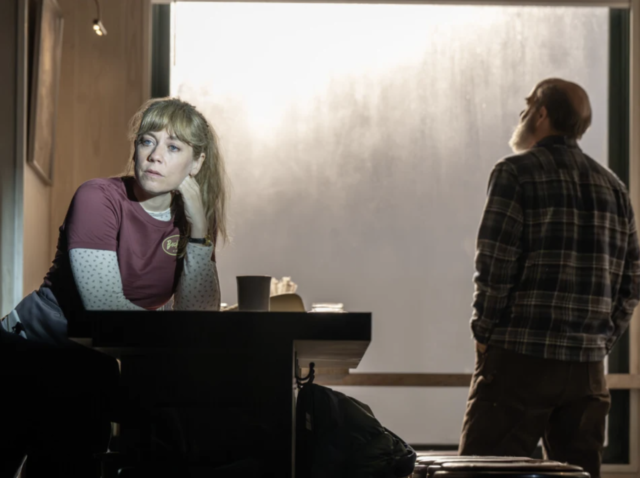
Frank Wood and Kelley Curran appear onstage and onscreen in The Meeting: The Interpreter (photo by Carol Rosegg)

THE MEETING: THE INTERPRETER
Theatre at St. Clement’s
423 West 46th St. between Ninth & Tenth Aves.
Wednesday – Sunday through August 25, $39-$135
meetinginterpreterplay.com
www.stclementsnyc.org

Frank Wood and Kelley Curran are terrific in the world premiere of The Meeting: The Interpreter. However, I’m completely flummoxed by the play, which explores the June 9, 2016, Trump Tower meeting from multiple angles, literally and figuratively.

On that day, Donald Trump Jr., Ivanka Trump, Jared Kushner, Trump campaign manager Paul Manafort, Russian lawyer Natalia Veselnitskaya, Russian-American lobbyist Rinat Akhmetshin, publicist Rob Goldstone, and Russian-American businessman Ike Kaveladze met at the Fifth Ave. building to discuss the Magnitsky Act, gathering dirt on Hillary Clinton, and/or the adoption of Russian children by Americans; the meeting figured prominently in special counsel Robert Mueller’s report on possible Russian interference and collusion in the 2016 presidential election.

Also present was a Russian-born interpreter (Wood) who had worked for the UN, the US government, and private individuals for more than twenty years and had what is known as public trust clearance. The name of the interpreter is never revealed in the play and critics have been asked not to use it in any articles about the show, even though it is listed in the Wikipedia entry about the meeting and the interpreter has his own LinkedIn page.

In the program, it points out, “This is a work of dramatic interpretation, and any resemblance to actual people and events is strictly coincidental”; however, nearly every other character is mentioned by name, including Congressman Mike Quigley, Congressman Eric Swalwell, Congressman Mike Conaway, Sen. Charles Grassley aide Samantha Brennan, Sen. Dianne Feinstein general counsel Heather Sawyer, and the interpreter’s lawyer, Larry H. Krantz, who take part in a Senate Judiciary Committee interview of the interpreter on November 8, 2017, with dialogue taken directly from the transcripts. In a tour de force with numerous comic moments, Curran plays every role other than the interpreter.

Writer Catherine Gropper, who met the interpreter by chance in the winter of 2020, and director Brian Mertes seem to go out of their way to make every scene unnecessarily complicated; although some work, most are head-scratchingly bizarre. The play begins with the credits rolling on a screen at the front of the stage, as if we are watching a movie, followed by a shot of Wood and Curran sitting at a long desk like newscasters. Brennan begins the November 8 hearing, but after a few minutes, the screen shifts over to stage left — where it remains the entire time — and the two actors, seated with their backs to us, look behind them, acknowledging the audience as the cluttered desk they are sitting at is turned around.

Throughout the ninety-minute show, a camera operated by three people slowly circles the stage. Live projections from that camera appear on the screen, giving the audience different perspectives on the actors, each wearing a white shirt, dark pants, and a blazer. One of the camera operators wears an Awolnation T-shirt, for the LA band that has released such albums as Back from Earth, Megalithic Symphony, and The Phantom Five and whose name refers to a country that has gone “absent without leave.” There’s confusion about where to look as the actors move from the main table, to small seats, to a recording booth, and to a makeup cabinet. Wood sifts through a bucket of sand. Curran staples a tie to a box. The actors break out into a dance. They snap their fingers and drum on the table. The video feed turns to abstract animation. Wood peels a plastic sheet off the studio glass. Part of the meeting is re-created with creepy dolls. (The cramped set is by Jim Findlay, with costumes by Olivera Gajic, lighting by Barbara Samuels, sound and music by Dan Baker & Co., projections by Yana Biryukova, puppets and animation by Julian Crouch, and camera by Tatiana Stolporskaya.)

World premiere production uses unique ways to tell its story (photo by Carol Rosegg)

It’s as if Gropper (Embers, Miss Crandall’s Classes) and Mertes (The Myopia, Massacre) approached each scene with the question: What can we do to complicate the action and confuse the audience this time? If that were their intention, they have succeeded marvelously.

The Meeting: The Interpreter might have worked much better at a small, experimental theater like La MaMa, the Wooster Group’s Performing Garage, or BAM’s Fishman Space. It gets lost at Theatre at St. Clement’s, where it is playing to a more traditional crowd. For me, it’s a cursed venue; of the dozen or so shows I’ve seen there, I’ve only been able to recommend two.

Tony winner Wood (Toros, The Red Letter Plays: In the Blood, The Iceman Cometh) once again reveals himself to be New York City’s best deadpan actor; he commits to his underwritten character in a way that makes the interpreter endearing even when doing something utterly nonsensical. Curran (Mother of the Maid, ‘Tis Pity She’s a Whore, BAD NEWS! I was there . . .) delivers another fine performance, fully investing herself in her responsibilities as a political shape shifter. It’s a shame there isn’t more cohesiveness to the narrative; the plot doesn’t have to be spelled out to the letter, but then it is, in a text-only finale that tells us what we already knew about the Trump Tower meeting, the Mueller Report, and the presidential election of 2016 before we entered the theater.

“I left part of myself there, at Trump Tower. Normally, I wouldn’t care. Unless something shakes me to my core,” the interpreter says in a rare moment of poignant insight. “I don’t open up so easily. Maybe it’s why I interpret for others. Actually, I’m a private man.”

The play itself could use an interpreter, but maybe that’s the point?

[Mark Rifkin is a Brooklyn-born, Manhattan-based writer and editor; you can follow him on Substack here.]
THE LITTLE SHAKESPEARE FESTIVAL: CAMARADERIE AND COMMUNITY

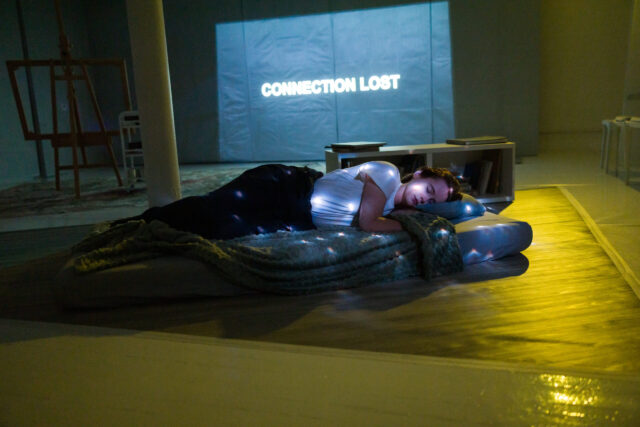
The Lark and the Nightingale explores friendship between Juliet and Desdemona

THE LITTLE SHAKESPEARE FESTIVAL
UNDER St. Marks
94 St. Marks Pl.
August 1-17, $20 streaming, $27.50 in person
www.frigid.nyc

One of the most important aspects of William Shakespeare’s canon is how open each play is to interpretation and adaptation. The Bard’s works are regularly retold with changes in time and location, race and gender, style and genre. It’s gotten so that it is rarer to see a traditional production than one involving significant alterations, incorporating such elements as contemporary pop music, modern-day political issues, the rise of a minor character, and zombies.

Presented by FRIGID New York, the 2024 Little Shakespeare Festival offers Willy fans the opportunity to see seven shows that take unique looks at different aspects of Shakespeare’s genius. Running August 1-17 at UNDER St. Marks in the East Village, the fourth annual fest, the theme of which is “Camaraderie and Community,” can be experienced in person or via livestreaming, with most shows clocking in at around sixty minutes.

As You Will is one of seven productions in 2024 Little Shakespeare Festival

Hamlet Isn’t Dead’s When My Cue Comes (August 1, 3, 11, 15, 17) is set in a waiting room filled with forgotten characters, including Reynaldo from Hamlet, Jaques de Boys from As You Like It, the boatswain from The Tempest, and a messenger, from multiple plays; the Bard himself works the front desk. Justin Hay’s solo My Own Private Shakespeare (August 1, 2, 3, 4) follows a Shakespearean actor on the edge. Conor D Mullen, David Brummer, and George Hider return with their unscripted, unpredictable As You Will (August 2, 4, 10, 17). In Ladies & Fools’ Fools in the Forest (August 3, 8, 16), writer Natalie Kane reimagines what happens at the end of As You Like It. Sean Gordon delivers a senior thesis in the one-person show Walter Schlinger’s Romeo and Juliet (August 4, 8, 16). Juliet and Desdemona search for happiness outside of their usual stories in Mindy Mawhirter and Alyssa Cokinis’s The Lark and the Nightingale (August 9, 10, 11, 15, 17). And Megan Lummus proffers a unique interpretation of Much Ado About Nothing (August 9, 10, 11), tinkering with character motivations over ninety minutes.

[Mark Rifkin is a Brooklyn-born, Manhattan-based writer and editor; you can follow him on Substack here.]
DOGTEAM THEATRE PROJECT: LA VIUDA

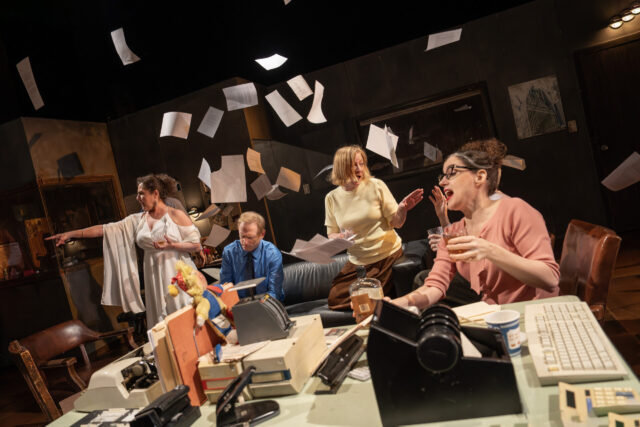
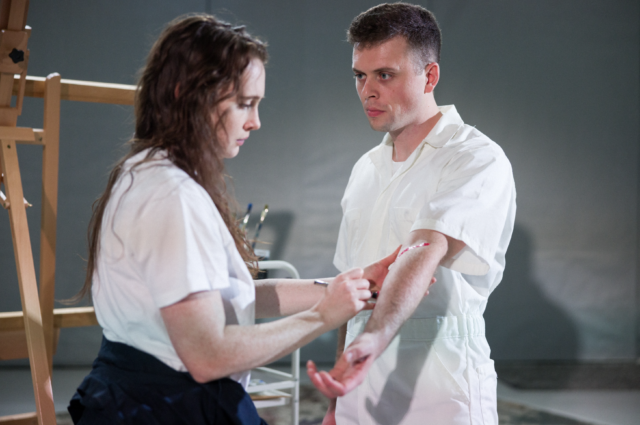
Dogteam Theatre Project is presenting La Viuda in repertory with A Hundred Circling Camps (photo by Clinton Brandhagen)

LA VIUDA
Dogteam Theatre Project
Atlantic Stage 2
330 West Sixteenth St. between Eighth & Ninth Aves.
Tuesday – Sunday through August 4, $23.18-$33.85
www.dogteam.org

For many recent summers, I looked forward to the Potomac Theatre Project’s (PTP/NYC) annual residency at Atlantic Stage 2, where it presented works by such playwrights as Tom Stoppard, Caryl Churchill, Howard Barker, Robert Chesley, Vaclav Havel, and Steven Berkoff. Founded in 1987 by co-artistic directors Cheryl Faraone, Richard Romagnoli, and Jim Petosa at Middlebury College, PTP/NYC has now morphed into the Dogteam Theatre Project (DTP), under the leadership of cofounders Olga Sanchez Saltveit, Courtney Smith, and PTP/NYC veterans Alex Draper and Mark Evancho.

Its inaugural season is under way at Atlantic Stage 2, with Sam Collier’s A Hundred Circling Camps, about a 1932 protest by veterans over a promised bonus, running in repertory with the English-language US debut of María Irene Fornés’s 1961 epistolary play, La Viuda (“The Widow”). Havana-born Fornés’s first work, La Viuda was adapted from letters that a cousin of hers wrote from Seville, Spain, to her great-grandfather in Cuba. (Fornés’s final play, 2000’s Letters from Cuba, was also based on family correspondence.)

La Viuda takes place from 1899 to 1902, after the Spanish-American War in which Cuba sought its independence from Spain, as Angela Martin (Jay Romero) dictates a series of letters to a clerk (Zeph Santiago) in her Spanish home. Although there is a lovely writing desk in the room, the clerk sits on an uncomfortable stool at a music stand as Angela essentially narrates her life story upon learning that her long-estranged husband, Francisco de Arenal (Jesse Muñoz), known as Paco, has had a serious stroke and “has lost all rational capacity.” She is particularly concerned that she might be erased from Paco’s official documents in favor of his supposed wife in Cuba, even though he and Angela, who lived in separate countries for decades, never divorced.

“I believe it is the illness of a remorseful conscience for having lived like a libertine in free love with that . . . thing,” she says to her cousin David. “My marriage has never been dissolved. However, my loyal friend, Casimiro Paz, has sent me a newspaper clipping that says: ‘Seen among the attendees was the illustrious writer Francisco de Arenal and his distinguished wife, Mrs. . . . F . . . F . . . David, the name written in that space is not mine!’”

Soon scenes from her past play out as she discusses them in the letters. She explains to Father Cravet (Fidel Vicioso) how Paco, a journalist, made enemies of such men as Don Modesto (Vicioso) and Angela’s father. Paco and Angela have a son, Salvador (Jacob Joseph Medina at five, Zack Maluccio at twenty-one), who believes he is “meant to save,” but that doesn’t prevent Paco from leaving them and beginning a second life in Cuba and then New York (following the Ten Years’ War between Cuba and Spain). Angela’s friend Moncita (Bri Beach), shares unsubstantiated gossip about Paco’s time in New York and his desperate attempts to gain respect, but he appears to have been a ne’er-do-well cad. In the middle of a hilarious monologue, Moncita explains, “Well, it’s none of my business and I don’t meddle in other people’s affairs,” before continuing with more news about other people’s affairs.

No longer a mother or a wife, Angela seeks to reestablish her dignity and identity, but it seems that the world has already passed judgment on her.

Scenes from Angela’s (Jay Romero, back right) past play out before her eyes (photo by Clinton Brandhagen)

Directed and translated by Saltveit, La Viuda is a bumpy ride, feeling long even at a mere seventy-five minutes, but it has many poignant moments. Furthering the idea of Angela searching for her identity, she is sternly portrayed by a man, Romero, in a black dress, as if mourning a life lost. Romero acts out punctuation while flitting around Evancho’s set, which also features a couch, an end table, a period chair, doors at the back right and left, curtained windows, a Hans Memling–like portrait of the young Salvador, an empty birdcage, and an old gramophone. Angela is not the most generous of people; not only will she not allow the clerk to sit at her desk, she is extremely careful when considering offering him a piece of candy.

The cast includes several Middlebury students and recent grads as well as nine-year-old Medina, who studies acting at the Triple Promise Academy for the Performing Arts in Bay Ridge. Santiago, class of 2026, has the most unusual perspective; he is onstage the entire time, taking Angela’s dictation while barely speaking as the action plays out behind him. Every so often he shakes a ratchet noisemaker, which gets annoying quickly.

Summer Lee Jack’s costumes range from persnickety to playful; both the younger and older Salvadors wear the same sailor outfit, and near the end several characters are identified by hand-drawn boards around their neck. One of the best bits involves widow’s wigs arriving in a most unexpected way.

Nine-time Obie winner Fornés, who died in 2018 at the age of eighty-eight, went on to become a well-known experimental playwright, with such credits as Tango Palace, Mud, Fefu and Her Friends, Drowning, and Evelyn Brown (A Diary). She wrote La Viuda while in a relationship with Susan Sontag, who was suffering from writer’s block at the time. At an early rehearsal of a scene from La Viuda at the Actors Studio, where Fornés was a member, she jumped up and tried to direct one of the actors but was told by the actual director that she should not do that; the experience led her to direct the inaugural production of more than fifty of her works.

Fornés, an important influence on such playwrights as Nilo Cruz, Paula Vogel, Lanford Wilson, Sam Shepard, Edward Albee, Tony Kushner, Eduardo Machado, and others, deserves to be more well known; DTP has done us all a noteworthy service by presenting this first-ever English version of the show that started it all.

[Mark Rifkin is a Brooklyn-born, Manhattan-based writer and editor; you can follow him on Substack here.]
OPEN CALL 2024: NEW ART FOR NEW YORK

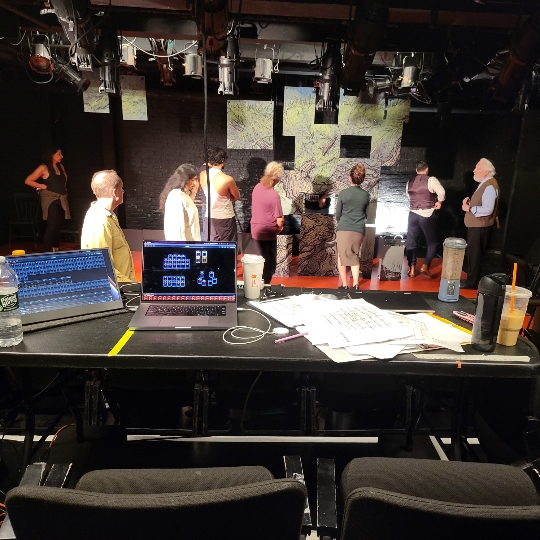
Asia Stewart, work-in-progress showing of Fabric Softener, presented by Amanda + James, Coffey Street Studio, Red Hook, Brooklyn, June 11, 2022 (photo by Elyse Mertz / courtesy the artist)

OPEN CALL
The Shed
545 West 30th St. at Eleventh Ave.
Thursday – Saturday through August 17, free with advance RSVP
646-455-3494
theshed.org

The Shed’s free summer performance series, Open Call, kicked off in June with Yaa Samar! Dance Theatre’s Gathering: New York City and has included such other presentations as Cain Coleman’s New Information, Kyle Dacuyan’s Dad Rock, and Garrett Zuercher’s Inside/Look. It continues July 25–27 with Asia Stewart’s Fabric Softener, a ritualistic response to Toni Morrison’s 1977 novel, Song of Solomon, that introduces the audience to the Laundress (Stewart), the Celebrant (Dominica Greene), and the Witness (Candice Hoyes), joined by the Narrator (Shala Miller) and violinist and composer Yaz Lancaster.

The next weekend, NIC Kay’s must have character features a mascot and a drag performer (Kay and Gabriele Christian) wandering through the Shed and the surrounding area from noon to 8:00 on August 1 and 1:00 to 3:00 on August 2, followed by the public program “Building Characters Through Theater and Photography” on August 3 at 1:00. On August 9 and 10 at 7:30 in the Griffin Theater, Nile Harris investigates jazz cornetist Buddy Bolden, mental illness, containment, and black box theaters in a workshop production of minor b, starring Harris, Jim Fletcher, Tony Jenkins, Ley(sis), and Jonah Rollins. Open Call concludes August 15–17 with Kayla Hamilton’s immersive dance performance How to Bend Down/How to Pick It Up, which honors lineages of Black disabled imagination.

Although many of the performances are sold out, these are free events, so there are always no-shows; in-person waitlists will be available fifteen minutes before curtain.

[Mark Rifkin is a Brooklyn-born, Manhattan-based writer and editor; you can follow him on Substack here.]
FREE UPTOWN SHAKESPEARE IN THE PARK: A MIDSUMMER NIGHT’S DREAM

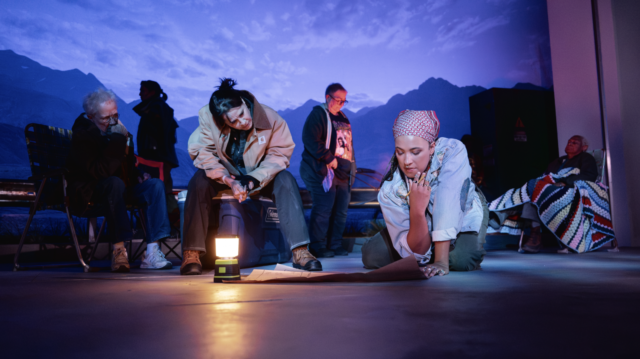
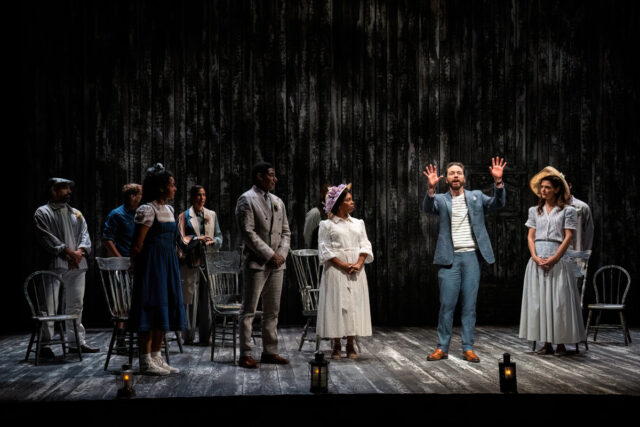
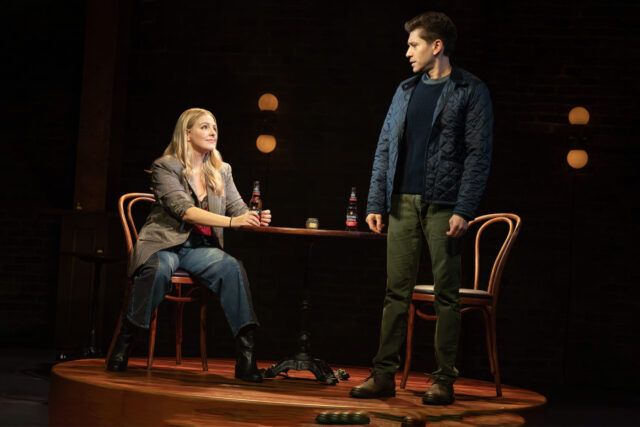
Classical Theatre of Harlem’s A Midsummer Night’s Dream is set during the Harlem Renaissance (photo © 2024 by Richard Termine)

A MIDSUMMER NIGHT’S DREAM
Classical Theatre of Harlem
Richard Rodgers Amphitheater, Marcus Garvey Park
18 Mt. Morris Park W.
Tuesday – Sunday through July 28, free (advance RSVP recommended), 8:30
www.cthnyc.org

The Classical Theatre of Harlem (CTH) celebrates its twenty-fifth anniversary with a rip-roaring adaptation of William Shakespeare’s A Midsummer Night’s Dream, at the Richard Rodgers Amphitheater in Marcus Garvey Park through July 28.

The action shifts between a glitzy two-level club during the Harlem Renaissance and a fairy woodland that feels right at home in the park, amid the setting sun, the wind blowing through the trees, the sounds of the birds and insects, and, the evening I went, a few minutes of light rain that felt like fairy dust.

In the club setting, Theseus (Victor Williams), the duke of Athens, is preparing to wed Hippolyta (Jesmille Darbouze), the queen of the Amazons. He is approached by a nobleman, Egeus (Allen Gilmore), who has promised his daughter, Hermia (Ra’Mya Latiah Aikens), to Demetrius (Brandon Carter), but Hermia is in love with Lysander (Hiram Delgado); at the same time, Helena (Noah Michal) pines for Demetrius, who spurns her. Egeus invokes an ancient law in which Hermia either marries Demetrius or is put to death; Theseus attempts to circumvent that potential fate, with no success.

“Relent, sweet Hermia: and, Lysander, yield / Thy crazed title to my certain right,” Demetrius declares, but Lysander, taking the argument lightly, responds, “You have her father’s love, Demetrius; / Let me have Hermia’s: why not marry him?”

Ultimately, Theseus, against his personal preference, rules in favor of Egeus, giving Hermia three options: accept Demetrius’s hand, be exiled as a nun, or suffer execution. “Then I will die if these are my choices, / But I will never consent to marry a man I love not,” she concludes.

The rude mechanicals rehearse for their play-within-a-play in the fairy woods (photo © 2024 by Richard Termine)

Hermia and Lysander decide to run away together; they share their plan with Helena, who betrays them, believing, “My love for Demetrius is so strong it makes me weak! / And in the woods my true love I will seek!”

In those very woods, a troupe of amateur actors known as the rude mechanicals are rehearsing a play they will be putting on for the duke and queen’s wedding, the tale of doomed lovers Pyramus and Thisbe from Ovid’s Metamorphoses. The cast features weaver Nick Bottom (Jaylen D. Eashmond) as Pyramus, bellows-mender Francis Flute (León Tak) as Thisbe, joiner Snug (Olivia London) as the lion, tinker Tom Snout (Carson Elrod) as the wall, and tailor Robin Starveling (Deidre Staples) as Moonshine, directed by carpenter Peter Quince (Allen Gilmore). All serve as comic relief, as their rehearsals do not go very smoothly.

Meanwhile, Oberon (Williams) and Titania (Darbouze), the king and the queen of the fairies, are looking forward to attending the wedding but they are in the middle of a fight over a young boy (Langston Cofield) they have taken in.

Oberon has his hobgoblin, the sprite Puck (Mykal Gilmore), fetch a purple flower whose juices, when dripped on a sleeping creature’s eyes, make them fall in love with the first living thing they see when they awaken. To prank his wife, Oberon does so with Titania and orders Puck to drizzle the juice on the eyes of Demetrius so he will love Helena, but Puck makes a mistake, and soon Lysander is mad for Helena, Titania is cuddling with a donkey-headed Bottom, and there is chaos everywhere.

CTH’s Shakespeare adaptation is a glittery enchantment (photo © 2024 by Richard Termine)

A Midsummer Night’s Dream was previously performed by CTH at the Richard Rodgers Amphitheater in 2013; this new production sparkles under the direction of Carl Cofield. The club scenes include fanciful dancing expertly choreographed by Dell Howlett, using both levels of Christopher and Justin Swader’s glittering set, lit with excitement by Alan C. Edwards; a large ensemble, dressed in Mika Eubanks’s colorful period costumes, shakes and bakes to the Jazz Age score. (The hot sound and music are by Frederick Kennedy, with projections of the moon, forest, and other elements by Brittany Bland.)

Cofield focuses on the importance of eyes in Shakespeare’s romantic comedy. Early on, Hermia says, “I would my father looked but with my eyes,” to which Theseus replies, “Rather your eyes must see things as your father sees them!” Helena opines, “Love looks not with the eyes, but with the mind; / And therefore is winged Cupid painted blind.” In the play-within-the-play, Pyramus, upon encountering something that does not please him, cries, “What dreadful sorrow is here! / Eyes, do you see?” And Bottom, waiting for a cue, says, “The eye of man hath not heard, the ear of man hath not seen, man’s hand is not able to taste, his tongue to conceive, nor his heart to report, what my dream was.” When Oberon and Puck use the flower juice, there are giant projections of eyes.

The nightclub scenes burst with life, and everything involving the four lovers is spirited fun. Aikens, Delgado, Michal, and Carter are a formidable quartet, Gilmore is a delightful Puck (and revels master Philostrate), and Williams and Darbouze bring a regal posture to the proceedings. However, the rude mechanicals cannot maintain the pace, occasionally dragging down the momentum. Several scenes go on too long, and the acting is more scattershot, led by an over-the-top, repetitive performance by Eashmond, who alternates as Bottom with comedian Russell Peters. But there is more than enough merriment to make that a minor quibble.

This Midsummer Night’s Dream is just the right play to set your eyes upon to make an already lovely midsummer night that much more dreamy.

[Mark Rifkin is a Brooklyn-born, Manhattan-based writer and editor; you can follow him on Substack here.]

LEGENDS & LEGACIES: ELEVENTH ANNUAL STooPS BED-STUY ART CRAWL AND BLOCK PARTY

STooPS 2024 SUMMER FESTIVAL
Stuyvesant Ave. & Decatur St., Brooklyn
Saturday, July 27, free (advance registration recommended), 1:00 – 7:00
www.stoopsbedstuy.org
www.eventbrite.com

The eleventh annual STooPS Arts Crawl and Block Party takes place July 27 from 1:00 to 7:00, with live music and dance, spoken word, workshops, theater, and visual art on the stoops and shared spaces of Bedford–Stuyvesant. This year’s theme is “Legends & Legacies,” honoring the history of the community. Among the legacies participants are textile artist Aaliyah Maya, singer-songwriters Amma Whatt and YahZarah, poets Carmin Wong, Kai Diata Giovanni, and Keys Will, storyteller Christine Sloan Stoddard, musicians BSTFRND, DJ Toni B, and Zardon Za’, dancer-choreographer Kendra J. Bostock, healer Renee Kimberly Smith, and artists Ladie Ovila Lemon (Mūt’ Sun) and Shanna Sabio. Representing the legends are Black Girl Magic Row; Monique Greenwood of Akwaaba Mansion; Sincerely, Tommy founders Kai Avent-deLeon, Mama Jelani deLeon, and Ms. Doreen deLeon; Chief Baba Neil Clarke; Ms. Cathy Suarez of the Decatur St. Block Association; and organizer and educator Lumumba Akinwole-Bandele of the East.

“STooPS is a living legacy — the bridge that connects the artists, movements, organizations, and neighbors who transformed Bed-Stuy into a Black Cultural Hub with the new artists, residents, and visitors in order to forge the future of this neighborhood and Black culture,” STooPS founding director Bostock said in a statement. “For our 2024 annual summer festival we honor the national and hyperlocal hero/sheros and imagine and inspire their posterity with our theme, Bed-Stuy: Legends and Legacies.“

The festivities begin at 1:00 with a block party lasting all afternoon, including a Kiddie Korner; there will be art crawls at 1:30 and 4:30, led by playwright and poet Wong. All events are free but advance registration is recommended.

[Mark Rifkin is a Brooklyn-born, Manhattan-based writer and editor; you can follow him on Substack here.]