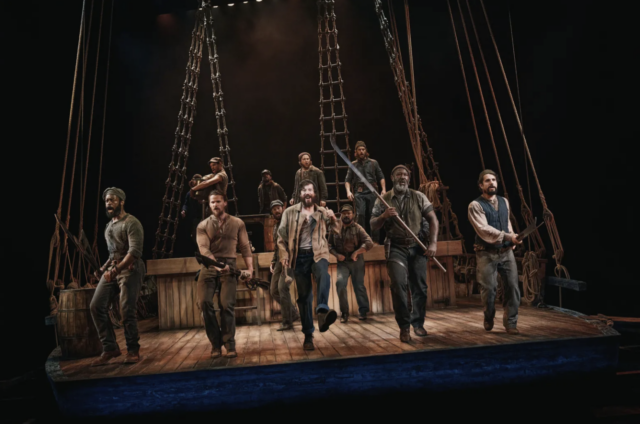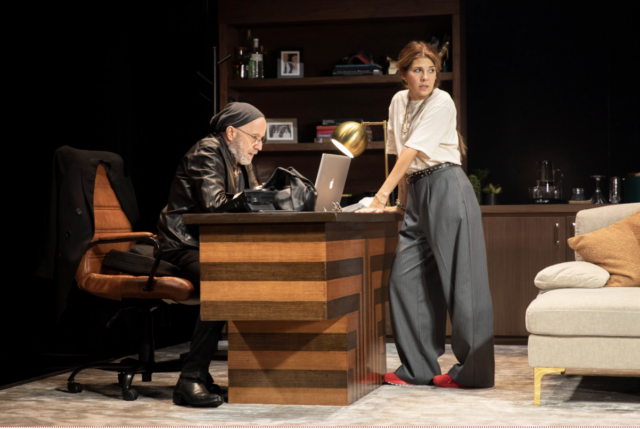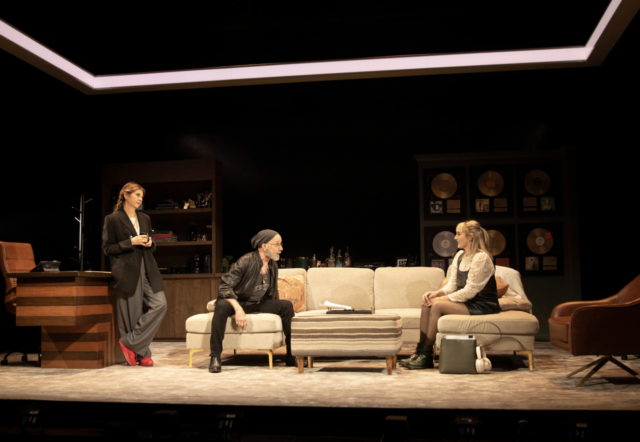
this week in theater

NY CLASSICAL: HENRY IV

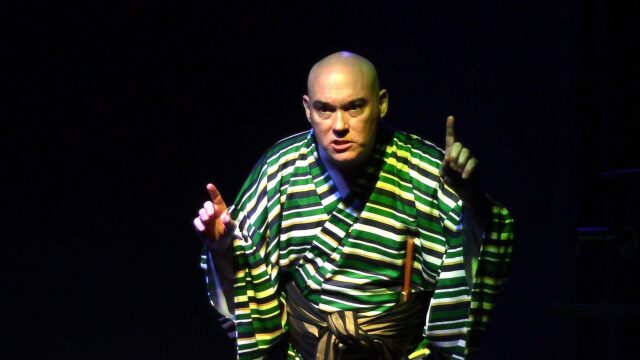
New York Classical Theatre’s Henry IV moves from Central Park to Carl Schurz Park and Castle Clinton this summer (photo © Sarah Antal)

HENRY IV
Through June 30: Central Park, Central Park West & 103rd St.
July 2-7: Carl Schurz Park, East 87th St. & East End Ave.
July 9-14, Castle Clinton, Battery Park
nyclassical.org

New York Classical Theatre is celebrating its twenty-fifth anniversary of presenting free Shakespeare in the parks and other public spaces throughout the city — along with works by Chekhov, Schiller, Shaw, Molière, and more — with another fun and fanciful frolic, a streamlined adaptation of the Bard’s Henry IV. The play, which falls between Richard II and Henry V in the Henriad, just finished its run in Central Park, where the action took place in seven locations around 103rd St. on the West Side, and next moves first to Carl Schurz Park, then to Castle Clinton in Battery Park.

Combining the two parts into one two-hour version, NYCT founding artistic director Stephen Burdman focuses on the relationship between Prince Hal (Ian Antal), who is the son of Henry IV (Nick Salamone), and the jovial bloviator Sir John Falstaff (John Michalski). The king’s reign is being threatened by a group of rebels led by Hotspur (Damian Jermaine Thompson), Northumberland (Juan Luis Acevedo), Countess Worcester (Carine Montbertrand), Countess Mortimer (Anique Clements), Lady Percy (Briana Gibson Reeves), and Welsh rebel Owen Glendower (Ian Gould). Supporting the king are Westmoreland (Gould), Sir Walter Blount (Nuah Ozryel), and, ostensibly, Prince Hal, aka Harry, who is spending all his time carousing with Falstaff and his merry band of drunken thieves: Poins (Anique Clements), Pistol (Ozryel), and Bardolph (Reeves), who hang around the Boar’s Head Tavern run by Mistress Quickly (Montbertrand).

Henry IV, formerly Henry Bolingbroke, usurped the throne from his cousin, Richard II, and now is in a face-off with Harry Percy, called Hotspur, who has defied the king’s orders by taking hostages following a war with the Scots and will only release them if the king pays a ransom to Glendower for Edmund Mortimer, Hotspur’s brother-in-law.

Meanwhile, the rotund braggart Falstaff conspires with Pistol and Bardolph to rob passing strangers, only to then be robbed themselves by the masked Hal and Poins, who have done so just to hear Falstaff regale them with a tale of how he had to fight off a hundred men with his skill and daring. Later, Falstaff embellishes his actions during the Battle of Shrewsbury, as Henry IV attempts to defend the realm against Hotspur and Glendower.

Sir John Falstaff (John Michalski) entertains the audience as well as Mistress Quickly (Montbertrand) and Prince Hal (Ian Antal) in NYCT’s Henry IV in Central Park (photo © Sarah Antal)

Burdman leads the audience through his trademark Panoramic Theatre, combining Environmental Theatre and Promenade Theatre as the crowd follows him and the actors to each new location, picking up passersby along the way as other parkgoers wonder what is going on. Part of the fun is watching this interaction between the actors, the grass and trees, the setting sun, and random strangers.

Production designer Kindall Almond keeps it simple; the period costumes are right on target, and there is no furniture and few props, primarily swords and Mistress Quickly’s utility belt of a bottle and cups. The performers are not mic’d, so the dialogue is front and center. The exchanges between the sly Prince Hal and the bawdy Falstaff lie at the heart of the play:

Prince Hal: Now, Harry, the complaints I hear of thee are grievous.
Falstaff: ’Sblood, my lord, they are false.
Prince Hal: Swearest thou, ungracious boy? Henceforth ne’er look on me. There is a devil haunts thee in the likeness of an old fat man. Why dost thou converse with that trunk of humours, that bolting-hutch of beastliness, that swollen parcel of dropsies, that stuffed cloak-bag of guts, that father ruffian?
Falstaff: Whom means your grace?
Prince Hal: That villainous abominable misleader of youth, Falstaff.
Falstaff: My lord, the man I know.
Prince Hal: I know thou dost.
Falstaff: But to say I know more harm in him than in myself were to say more than I know. That he is old — the more the pity. If sack and sugar be a fault, God help the wicked! If to be fat be to be a sin, then many an old host is damned. No, my good lord, banish Pistol, banish Bardolph, banish Poins, but for sweet Jack Falstaff, kind Jack Falstaff, valiant Jack Falstaff, banish not him thy Harry’s company, banish plump Jack and banish all the world.
Prince Hal: I do, I will.

King Henry IV (Nick Salamone) fights off his enemies in swordfight in Central Park (photo © Sarah Antal)

The cast, a mix of NYCT veterans and first-timers, is solid up and down; six actors play two roles apiece, while three actors remain in one role: Salamone is a worthy King Henry IV, Antal makes a fine Prince Hal, but Michalski steals the show, as he should, as Falstaff, a meaty, mighty character made famous by Orson Welles in the 1965 film Chimes at Midnight. In his thirteenth NYCT show, Michalski, who has previously played Lady Bracknell, Prospero, Scrooge, and Sir Toby Belch for the troupe, immediately connects with the audience, making sure we never leave his (portly) side. His bellowing voice and unyielding demeanor are intoxicating, both hilarious and sad, as Falstaff stumbles across the hilly grass and embellishes his endless tales with a bold effrontery. “There lives not three good men unhanged in England and one of them is fat and grows old,” he declares.

Later, marching through the middle of the crowd, Michalski/Falstaff murmurs, “Where did all these people come from?” Burdman expects upwards of 7500 people to experience his superb adaptation this summer; you should do your best to be one of them.

[Mark Rifkin is a Brooklyn-born, Manhattan-based writer and editor; you can follow him on Substack here.]
N/A

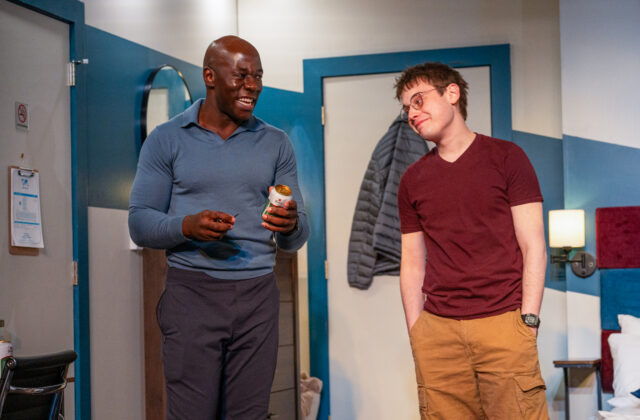
Ana Villafañe and Holland Taylor portray familiar but unnamed characters in Mario Correa’s N/A (photo by Daniel Rader)

N/A
Mitzi E. Newhouse Theater
150 West 65th St. between Broadway & Amsterdam Ave.
Tuesday – Sunday through September 1, $72-$200
www.lct.org
natheplay.com

Holland Taylor for president!

On June 27, I saw Mario Correa’s potent N/A, making its world premiere at the Mitzi E. Newhouse Theater at Lincoln Center through August 4. The eighty-minute play is a series of fictionalized conversations, based on actual text and dialogue, between two unnamed but obvious political figures: two-time Speaker of the House Nancy Pelosi, splendidly portrayed by Taylor, and Alexandria Ocasio-Cortez, fully embodied by Ana Villafañe.

When I got home, I watched the debacle of a debate between former president Donald J. Trump and the incumbent, Joseph R. Biden. Afterward, I decided to cast my vote for Taylor.

N/A begins with A, having just won the Democratic primary for a House seat representing parts of Queens and her home borough, the Bronx, livestreaming from the office of the minority leader, N. Referring to her opponent as “a total corporate shill,” she says, “So you look in the mirror and you say to yourself, be the change you wanna see in the world, right? Also, fuck those motherfuckers!

N then enters the room and asks if she’s interrupting.

Where did you come from?” a shocked A says. “Baltimore. Where did you come from?” N responds seriously. “Were you there the whole time?” A wants to know. N replies, “In my office, you mean?”

Thus, the generational battle lines are immediately drawn, the old guard against the new. Over several talks, N explains how things happen in the House, that it’s not so simple to get a bill passed there, then in the Senate, and finally signed into law by the president. A Baltimore native, she is a pragmatist with decades of experience — she was first elected to serve in the House in 1987, two years before A was born, and became the first woman Speaker in 2007.

The newly elected A wants to effect change instantly, ready to implement her Green New Deal, end the militarization of the border, provide affordable, universal health care and free college tuition, and other plans. When A says that N is “on record against most of this agenda,” N answers, “Agenda? That’s an Amazon wish list. Load it up!”

N also points out that her favorite number is 218 — the number of Democrats needed to have a majority in the House. She states that without that, they essentially cannot get anything done, no matter now necessary it appears. Many of their discussions follow this kind of trajectory:

N: I’m going to say something to you, and I don’t want you to take it the wrong way. This isn’t college. I’m not Plato, you’re not Aristotle, and we’re not here to contemplate the Republic. We have real work to do, urgent work — right now. You can be a part of it.
A: We should contemplate the state of the Republic. It’s dire.
N: And I’m happy to do that. After we win back the House.
A: Our country’s problems are systemic. Not by accident — by design. Foundational inequities built into the organizing principles of this nation. And until we reckon with them head-on, it doesn’t matter how many elections we win. We will never fill a leaky bucket.
N: And yet that is our work, for it’s the only bucket we’ve got.
A: Or . . . we get a new bucket.

What becomes clear as they continue to hold these mini-debates is that their goals are not very different; what separates them is the method of getting there.

N: We have much in common, you and I . . . Relentless, persistent, dissatisfied. That is our nature; we are outsiders —
A: You’re an “outsider”?
N: If the Framers walked through that door right now and saw me sitting here, how happy do you think they’d be?
A: A lot happier than if they saw me.
N: Nah. They’d see a woman and keel over. That’s it.
A: Well . . . A white woman of wealth. With a few smelling salts, I bet they’d come around.
N: And soon, they’d learn she didn’t come from wealth.
A: But then they’d remember that she came from whiteness.
N: And then someone would remind them of the concept of a wop. A dago.
A: And someone else would inform them that this lady’s father had been a Member of Congress.
N: To which one of them would undoubtedly ask, “What does that matter?”
A: To which another would answer, “The most common route to privilege in this country is generational transfer.”

Ultimately, N tells A that the key is, “Know your friends. Know your enemies. Know the difference,” whereas A’s motto is “Más que menos . . . Literally, ‘more than less.’ In essence . . . ‘Leave it better than you found it.’”

Alexandria Ocasio-Cortez (Ana Villafañe) and Nancy Pelosi (Holland Taylor) get down to business in world premiere play (photo by Daniel Rader)

In addition to “N/A” referring to Nancy Pelosi and Alexandria Ocasio-Cortez, it can mean “not applicable,” “not available,” “no account,” and “no answer,” all of which relate to Correa’s well-written play, astutely directed by Tony winner Diane Paulus (Little Jagged Pill, The Gershwins’ Porgy and Bess), who is a much better “moderator” than most debate hosts, allowing each side to speak their peace and support their claims.

Myung Hee Cho’s set features Lucite furniture, including a case with a Speaker’s gavel in it, echoing A’s declaration that public officials must be transparent; meanwhile, Cho’s costumes capture the characters to a T, N in a white blouse, buttoned pink jacket and knee-length skirt, and high heels, A in a white shirt, unbuttoned black jacket, black pants, and black flats that later become heels. Possible and Lisa Renkel’s red, white, and blue projections focus on the evolving makeup of the House as it shifts between Democratic and Republican control. Mextly Couzin’s lighting effectively indicates the passage of time between scenes, although the interstitial music is cloying. (The sound design is by Sun Hee Kil and Germán Martínez.)

Villafañe (On Your Feet, Collective Rage: A Play in 5 Betties), who is the same age as AOC, more than holds her own with Taylor, capturing her character’s determination, aggressiveness, and refusal to compromise. Villafañe stands tall as AOC is not afraid to hit back and say what’s on her mind.

But Taylor shines as Pelosi; it’s as if she has a glow as she tries to educate the younger congresswoman in the ways of politics, and the world itself. She exhibits Pelosi’s confidence, intelligence, and understanding of the tactics of negotiation in her every movement.

Pelosi might have stepped down from her position as minority leader in January 2023, but, at the age of eighty-four, she is still ably representing her California district. Philly native Taylor (The Morning Show, Two and a Half Men), at eighty-one — born two months after President Biden — is still at the top of her game, regularly appearing onstage, on film, and on television. I have no doubt that she could stand behind a podium and lay any political opponent to waste; she certainly has my vote.

In 2013, Taylor starred as Texas governor Ann Richards in her one-woman show Ann at Lincoln Center’s Vivian Beaumont Theater. When Taylor-as-Richards stood at the podium, discussing her battle with cancer and her hope for the future of America, it was easy to see why Richards was considered a possible vice presidential running mate for John Kerry — or a presidential candidate herself.

In 2015, Taylor put on the boxing gloves in Pulitzer Prize winner David Lindsay-Abaire’s Ripcord at City Center, a hilarious battle of wits between two elderly roommates in a suburban New Jersey nursing home. Abby Binder (Taylor) is a nasty, mean-spirited, and spiteful woman filled with vitriol that she pours on everyone and everything, while Marilyn Dunne (Marylouise Burke) is a kind, sweet-natured soul who loves life and wants only happiness for all.

Sound familiar?

[Mark Rifkin is a Brooklyn-born, Manhattan-based writer and editor; you can follow him on Substack here.]
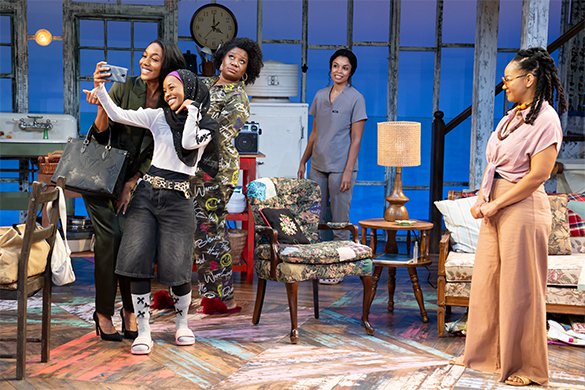
CATS: “THE JELLICLE BALL”

André De Shields makes the grandest of grand entrances as Old Deuteronomy in Cats: The Jellicle Ball (photo by Matthew Murphy)

CATS: “THE JELLICLE BALL”
Perelman Performing Arts Center (PAC NYC)
251 Fulton St.
Tuesday – Sunday through September 8, $68-$309
pacnyc.org

The Pride celebration of the summer and, hopefully, beyond is happening seven times a week at PAC NYC, where Zhailon Levingston and Bill Rauch’s electrifying reimagining of Andrew Lloyd Webber’s Cats — yes, that Cats — is running now through September 8, not quite forever, but not bad.

I have never before seen Cats, in any version — not the original 1982–2000 musical (which won seven Tonys and a Grammy), the 1998 film version, the 2016 Broadway revival, or the 2019 movie that not even Taylor Swift could save (and earned six Golden Raspberries). I haven’t read T. S. Eliot’s 1939 source book, Old Possum’s Book of Practical Cats, either. When I told two friends of mine, longtime Cats haters, that I was going to The Jellicle Ball, they looked at me like they’d rather watch paint dry. Which is unfortunate for them, because Cats: “The Jellicle Ball” is an absolute blast.

Rachel Hauck has transformed the John E. Zuccotti Theater into a fashionable immersive ball, with a central catwalk, the audience sitting on three sides, and cabaret tables along the runway. A DJ (Capital Kaos) finds a dusty copy of the Cats soundtrack and puts it on, a clever nod to the original. Munkustrap (Dudney Joseph Jr.), the master of ceremonies, keeps things moving at a fast pace. The crowd is encouraged to be loud, and they hoot and holler as a cast of nearly two dozen parade up and down and all around the space, looking fabulous in Qween Jean’s spectacular costumes, which range from fluffy and colorful to raw and raunchy, from playful and funny to sexy and scary, topped off by Nikiya Mathis’s outrageous hair and wigs. Adam Honoré sprays colored spotlights across the room and incorporates a disco ball, while sound designer Kai Harada turns up the volume. Brittany Bland’s projections take us from day to night with cool visuals and pay tribute to early BIPOC LGBTQIA+ heroes.

Arturo Lyons and Omari Wiles meld hip-hop and queer Ballroom culture into their vibrant choreography, with touches of traditional musical theater, since, of course, this is still Cats, following the same structure as the original and making very few tweaks to the story and lyrics; there are nods to Jennie Livingston’s 1990 documentary Paris Is Burning, the television series Pose and RuPaul’s Drag Race, The Wiz, and a dash of Hair in its throwback counterculture vibe.

Cats: The Jellicle Ball is an intoxicating mélange of music and movement (photo by Matthew Murphy)

At the Jellicle Ball, dancers compete for trophies in such categories as Old Way vs. New Way, Voguing, Opulence, Hair Affair, and Butch Queen Realness. The preliminaries are judged by two people selected from the audience — and clearly chosen because of their wild outfits. (A few brought handheld fans, knowing just when to snap them open to match what was happening onstage.)

But it’s Old Deuteronomy (André De Shields) who will decide which furry feline will ascend to the Heaviside Layer. Among those making their case for top cat are Victoria (Baby), cat burglars Mungojerrie (Jonathan Burke) and Rumpleteazer (Dava Huesca), the curious Rum Tum Tugger (Sydney James Harcourt), virgin voguer Electra (Kendall Grayson Stroud), the mysterious Macavity (Antwayn Hopper), and housemother Jennyanydots (Xavier Reyes).

Emma Sofia stands out as Cassandra and Skimbleshanks, shaking the joint as an MTA conductor in “The Railway Cat.” Robert “Silk” Mason is in full glory mode as the conjurer Magical Mister Mistoffelees. Ballroom icon “Tempress” Chasity Moore brings heart and soul to Grizabella, the formerly glamorous gata who now lives off the street, delivering a powerful “Memory.” And Ballroom legend and Paris Is Burning emcee Junior LaBeija — the inspiration for Billy Porter’s Pose character, Pray Tell — gets duly honored as Gus the theater cat, carried out in a makeshift throne as he sings his eponymous song. LaBeija is one of numerous Trailblazers whose brief bios can be found on panels in the hall surrounding the theater, including Dorian Carey, Pepper LaBeija, Octavia St. Laurent, and Rauch.

But this is André De Shields’s world; we only live in it. The Tony, Obie, and Grammy winner (Hadestown, Ain’t Misbehavin’) makes the grandest of grand entrances, emerging from behind a glittering doorway and suddenly appearing before us in a plush purple suit and a lionlike cloud of silver, purple, and white hair, marking him as King of Pride. He floats slowly down the catwalk, basking in the tremendous adoration and adulation, then takes his royal seat at the end, a uniquely supreme being who is the ultimate judge of us all.

The music is performed by a crack eight-piece band: conductor Sujin Kim–Ramsey, Lindsay Noel Miller, and Eric Kang on keyboards, Justin Vance and Amy Griffiths on reeds, Andrew Zinsmeister on guitars, Calvin Jones on electric bass, and Clayton Craddock on drums, bringing funk and plenty of ’70s synth pop to the score, under William Waldrop’s direction.

Of course, this is still Cats, so not everything makes sense — what does “jellicle” even mean? — a few elements are repeated, and utter mayhem threatens at any second in this ferocious production, which is as unpredictable and entertaining as, well, cats.

[Mark Rifkin is a Brooklyn-born, Manhattan-based writer and editor; you can follow him on Substack here.]
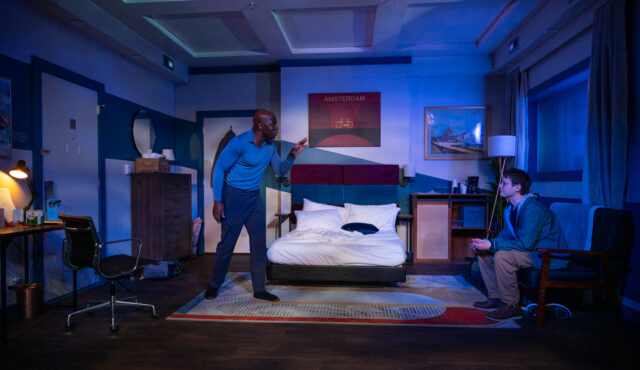
THE EMPLOYEES: A WORKPLACE NOVEL OF THE 22nd CENTURY

The Employees is set aboard a spaceship with strange objects in tow (Pelenguino Photo)

THE EMPLOYEES
Theaterlab Gallery
357 West Thirty-Sixth St., between Eighth & Ninth Aves., third floor
Through June 30, $25-$50
www.themilltheatre.org

“I don’t think we as a category are going to survive,” one of the characters says in Jaclyn Biskup and Lauren Holmes’s fantastical adaptation of Danish poet and author Olga Ravn’s futuristic 2020 book, The Employees: A Workplace Novel of the 22nd Century. It’s not clear whether she is talking about humans or humanoids.

The play consists of statements made by four members of the crew of the Six Thousand Ship, comprising humans and humanoids who have collected mysterious objects from the planet New Discovery. Paul Budraitis, Molly Leland, Christopher McLinden, and Aurea Tomeski, wearing white space uniforms, sit on chairs in the four corners of a small, white room; behind each of them hovers a ghostly, floating sheet, while in front of them is a narrow fluorescent light, as if they’re under investigation. The audience of no more than twenty sit along three walls in the same white chairs, equating everyone; at the front, production stage manager Sam Kersnick operates the light and sound, bathing the room in soft, glowing colors and sonic tones. The four crew members occasionally get up and switch seats while a strange object gleams in the middle, radiating like a beating heart.

The narrative unfolds in abstruse, nonlinear testimony that is not always easy to decipher but builds a cryptic, provocative environment as the characters discuss dreams, crying, memories, the unconscious, and death.

“I don’t like to go in there. The three on the floor seem especially hostile. I can’t understand why I feel I’ve got to touch them,” Chris admits. “Two of them are always cold, one is warm. You never know which is going to be the warm one.”

“I hope the work is progressing. I hope you’re doing it well, the work you have to do. I hope he’s not going to die, even if I do know it’s likely,” Molly says.

Aurea reports, “Do you think of me as an offender? I like to be in the room. I find it very erotic. The suspended object, I recognize my gender in it. Or at least the gender I have on the Six Thousand Ship. Every time I look at the object, I can feel my sex between my legs and between my lips. Maybe that’s why you think of me as an offender. Half human. Flesh and technology. Too living.”

“You can still save yourselves. I don’t know if I’m human anymore. Am I human? Does it say in your files what I am?” Paul asks.

These are thoughts we all have at one point or another, even if we don’t use those exact words as we try to find and establish our place in a quickly changing world dominated by big corporations, one in which continued technological advancement and the prospect of ever-more-pervasive AI fill us with both hope and fear.

Four characters share their thoughts on their mission in futuristic play (Pelenguino Photo)

Nora Marlow Smith’s brilliantly white set traps the actors and audience together in the room; when the door is closed, there is no way out, as if we are all on the space ship with no egress. Kristy Hall’s costumes add to the antiseptic atmosphere as Jackie Fox’s lighting and Sabina Mariam Ali’s sound enhance the sci-fi feel.

The worthy ensemble does a convincing job of walking the fine line between human and humanoid; although they are more realistic than Data from Star Trek: The Next Generation, just as Data searches for his godlike creator, Dr. Noonien Soong, the four crew members aboard the Six Thousand Ship refer several times to Dr. Lund and his “children.” Molly, who met Dr. Lund before the ship departed, explains, “I didn’t know who I belonged to in his view. Whether I was human or just something that was animate. Even though I was born and brought up and my documents all said human, there was something about his behavior that made me think he didn’t consider me to be an equal, and for a few brief and terrifying seconds I felt I was artificial, made, nothing but a humanoid machine of flesh and blood.”

Seamlessly directed by Biskup (Venus, The Private of Lives of Eskimos [Or 16 Words for Snow]), The Employees is an intimate and intriguing look at where we might be heading a hundred years from now; whether escape will be possible has yet to be decided.

[Mark Rifkin is a Brooklyn-born, Manhattan-based writer and editor; you can follow him on Substack here.]
BREAKING THE STORY

Bear (Louis Ozawa) and Marina (Maggie Siff) risk their lives to get to the truth in Breaking the Story (photo by Joan Marcus)

BREAKING THE STORY
Second Stage Theater
Tony Kiser Theater
305 West 43rd St. between Eighth & Ninth Aves.
Tuesday – Sunday through June 23, $42-$82
2st.com/shows

“If it bleeds, it leads,” William Randolph Hearst purportedly said in the 1890s, during the golden age of yellow journalism.

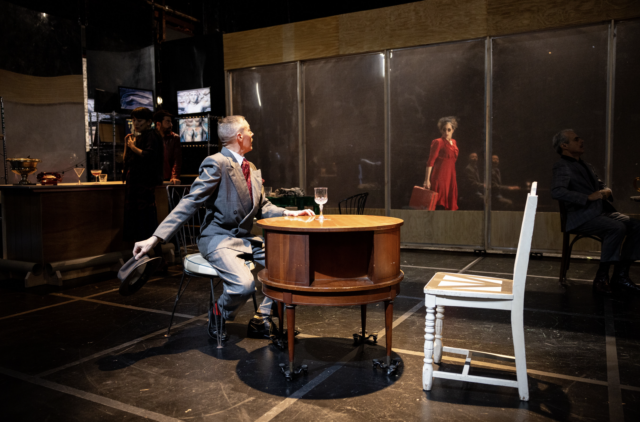
Foreign correspondent Marina Reyes (Maggie Siff) uses that phrase early on in the hard-hitting Breaking the Story, but in this case, the blood is her own. “I’m bleeding. I’m bleeding,” she says repeatedly throughout the eighty-five-minute play.

Marina is a popular television reporter who has suddenly decided to retire and announce her decision in her speech accepting the Distinguished Achievement in Conflict Journalism award. She has recently returned to the United States after nearly getting blown up covering a dangerous story in an undisclosed country; the headlines initially proclaimed, “American Journalist Missing, Presumed Dead.” She tells Bear (Louis Ozawa), her longtime cameraman, “Distinguished Achievement. It’s like they wanna give me a Lifetime Achievement Award in case I die out there next time, but they don’t want to be obvious about it. Anyway, joke’s on them ’cause there won’t be a next time.”

Her return begins a series of life-altering decisions: She buys a big house in an expensive suburb of Boston near her daughter Cruz’s (Gabrielle Policano) new college, Wellesley, and decides to marry Bear that weekend, at the new house, which is more of a vacation home.

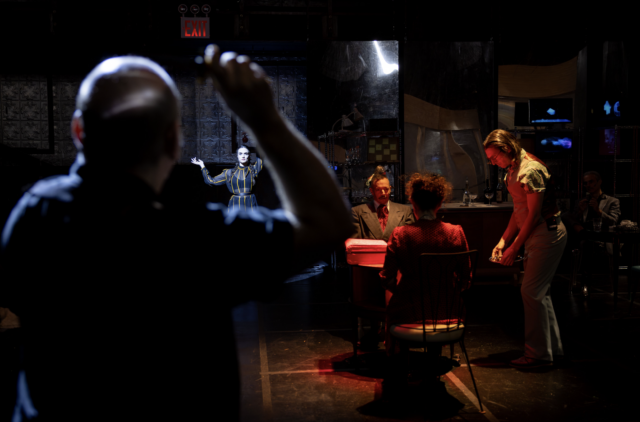
Alexis Scheer’s Breaking the Story features a talented ensemble (photo by Joan Marcus)

The wedding brings together Marina’s best friend, socialite and philanthropist Sonia (Geneva Carr), who takes charge and designs a more elaborate affair than anyone seems to want; Marina’s freewheeling mother, Gummy (Julie Halston); Cruz, an aspiring pop star whose most recent song, “Yesterday’s Revolution,” has just gone viral; and Nikki (Tala Ashe), a young, Peabody-winning ladder climber who wants to interview Marina for her podcast even though Marina considers her to be her archenemy. Showing up later is her ex-husband, Fed (Matthew Saldívar), a reporter who now anchors his own show and wants to win Marina back.

New journalism and established reporting face off in Nikki and Marina’s exchanges: At one point Nikki accuses Marina of giving a platform to fascists and dictators, and Marina argues, “It’s our job to tell the whole story, Nikki! Not just the part of the story we agree with! . . .” Nikki responds, “Objectivity is a myth.” A perturbed Marina answers, “Of course it is! Objectivity has never been the point! We’re here to represent facts and ask questions so that people can make up their own mind. Balance. Fairness. Accuracy. All perspectives. The whole story.”

But even as she prepares for this new life, Marina is haunted by PTSD nightmares and the whole story of what happened at the Sapphire Hotel.

Bear (Louis Ozawa) and Marina (Maggie Siff) discuss their past and future in Breaking the Story (photo by Joan Marcus)

Myung Hee Cho’s set is an expanse of grass with miniature hills and a pair of silhouetted houses that serve as doorways; Elaine J. McCarthy’s projections of news reports and peaceful flowers fill several screens in the back. Darron L West’s sound shifts suddenly from conversation to explosions to live music written by Dan Ryan and performed by Policano, although it is difficult to make out all the lyrics.

Written by Alexis Scheer, whose previous works include Our Dear Dead Drug Lord, Christina, and the Broadway adaptation of the book of Andrew Lloyd Webber’s Bad Cinderella, and astutely directed by Obie winner Jo Bonney (Cost of Living Fucking A), Breaking the Story has some shaky scenes, including a surreal cake tasting, but they’re countered by touching moments of connection, highlighted by a moving heart-to-heart between Marina and Gummy, who makes a surprising confession.

Theater gem Halston (Hairspray, You Can’t Take It with You) sparkles as she quickly morphs from a troubled refugee who is looking for her daughter into the hilarious Gummy. Ozawa (The Tutors, Warrior Class) is cool and calm as Bear, eminently likable even when he considers working with Nikki.

But the show belongs to Siff (Curse of the Starving Class, The Ruby Sunrise). Whether out in the field in the middle of a bombing or walking around barefoot on the green grass of her new home, she is magnetic as Marina tries to balance and make sense of the disparate parts of her life. The choices she faces are ones we all must deal with in our relationships with parents and children, colleagues and rivals, friends and lovers, and career and retirement, except, in Marina’s situation, danger is front and center, a violent and bloody death an imminent possibility.

“You’re like this sacred artifact I’ve stolen from the temple and now this ancient monster curse has been unleashed until I put you back,” Bear tells Marina, who replies, “And you only have ’til the stroke of midnight until I disintegrate and the whole world turns to ash.” It’s not exactly a Cinderella story.

[Mark Rifkin is a Brooklyn-born, Manhattan-based writer and editor; you can follow him on Substack here.]
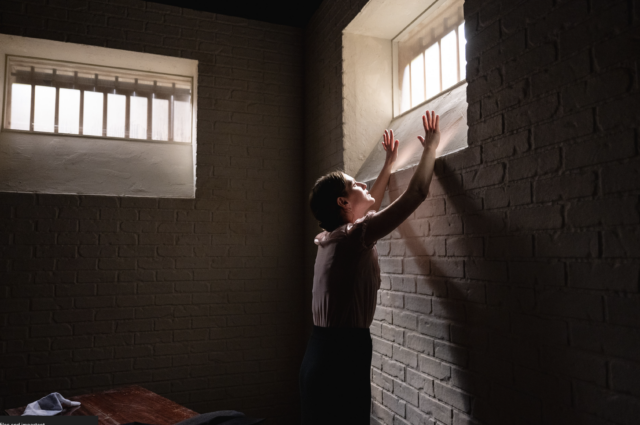
HOW LONG BLUES

Whirling dervishes light up Little Island in Twyla Tharp’s How Long Blues (photo by Nina Westervelt)

HOW LONG BLUES
The Amph, Little Island
Pier 55, Hudson River Park at West Thirteenth St.
Wednesday – Sunday through June 23, $25
www.littleislandtickets.com
www.twylatharp.org

On opening night of Twyla Tharp’s How Long Blues at the 680-seat outdoor Amph on Little Island, a storm threatened. At one point, as rain began to fall, a dancer slipped on the stage, and project funder Barry Diller looked over at Tharp and wondered if they should stop the performance. Tharp shook her head, and the show went on, the weather adding a touch of magic and menace.

Little Island has hosted live music, dance, and storytelling the past several summers, but How Long Blues is the first work specifically commissioned for the sculpted oasis on the Hudson River, near the Whitney, kicking off a season of such pieces. The eighty-two-year-old Tharp incorporates her signature melding of contemporary movement and classical ballet into a rough-hewn narrative inspired by Albert Camus’s 1947 novel The Plague, a parable about fascism set against an epidemic. The book begins, “The unusual events described in this chronicle occurred in 194– at Oran. Everyone agreed that, considering their somewhat extraordinary character, they were out of place there.” How Long Blues might be a bumpy ride, but it feels like it belongs in the space, particularly as the wind swept through and the percussion was mistaken for thunder.

The sixty-minute premiere features two-time Tony winner Michael Cerveris (Fun Home, Assassins) as Nobel Prize–winning French philosopher and playwright Jean-Paul Sartre (Being and Nothingness, Existentialism and Humanism) and longtime ABT and Tharp dancer and choreographer John Selya as Camus (The Stranger, The Rebel); the two were close friends — Camus at one point was going to star in and/or direct Sartre’s play No Exit — until ideological differences over communism and freedom led to a public falling out. None of that is apparent in How Long Blues.

Cerveris spends most of the show walking around Santo Loquasto’s set with a copy of Le Figaro, smoking a pipe, wearing a headset, and watching the action, occasionally sitting on one of the audience benches. Selya, in a dapper suit, wanders back and forth across the stage, pursuing nearly every woman after one of his lovers jumps into the Hudson. Camus was a well-known philanderer who cheated on his wives; his second spouse, pianist and mathematician Francine Faure, was hospitalized with depression and attempted suicide.

How Long Blues features surprising props and set changes (photo by Nina Westervelt)

The score, by thirteen-time Grammy-winning singer-songwriter, guitarist, and producer T Bone Burnett and composer, musician, and violinist David Mansfield, who were both part of Bob Dylan’s Rolling Thunder Revue in the mid-’70s, is a curious thing. Much of it is prerecorded even though there is a seven-piece band (John Bailey on trumpet and fugelhorn, Justin Goldner on guitar, tenor banjo, and bass, Wayne Goodman on trombone, Mark Lopeman on sax and clarinet, Jay Rattman on saxophone, George Rush on bass and tuba, and Paul Wells on percussion) in addition to underutilized vocalist Andromeda Turre, all of whom are placed in two balconies at the west corners of the space. The song selections are also not particularly illuminating.

An unhoused man plays “My Way” on a trumpet. There’s an excerpt of the Sound of Feeling’s cover of Donovan’s “Hurdy Gurdy Man,” along with Mardi Gras Indian group the Wild Tchoupitoulas’s “Meet de Boys on the Battlefront” and “Brother John” and music by Jelly Roll Morton, Muddy Waters, Cab Calloway, and Count Basie. Cerveris eventually puts the headset to good use, delivering beautiful versions of the blues classic “St. James Infirmary” and Leonard Cohen’s ubiquitous “Hallelujah.”

Dancers Piper Dye, Jourdan Epstein, Oliver Greene-Cramer, Kyle Halford, Colin Heininger, Daisy Jacobson, Claude CJ Johnson, Pomme Koch, Skye Mattox, Nicole Ashley Morris, Hugo Pizano Orozco, Ryan Redmond, Victoria Sames, Frances Lorraine Samson, and Reed Tankersley bound about the stage in Loquasto’s ever-changing costumes as the choreography moves from the turn of the twentieth century to the turn of the twenty-first, from lavish, glittering parties and vaudevillian shtick to whirling dervishes and working-class drama at the docks. Props include a piano, a Sisyphus-like rock (Camus wrote The Myth of Sisyphus in 1942), a trio of doors, and a soccer ball (Camus loved European football and was a goalie in his younger days). Adding to the bizarreness is a group of cartoonish characters in oversized costumes with giant heads.

It might not be Pina Bausch, but Tharp’s How Long Blues is an entertaining start to Little Island’s summer of commissions, which continues with such presentations as Davóne Tines in Robeson, Henry Hoke’s Open Throat, Pam Tanowitz’s Day for Night, and Anthony Roth Costanzo in The Marriage of Figaro.

[Mark Rifkin is a Brooklyn-born, Manhattan-based writer and editor; you can follow him on Substack here.]
PRE-EXISTING CONDITION

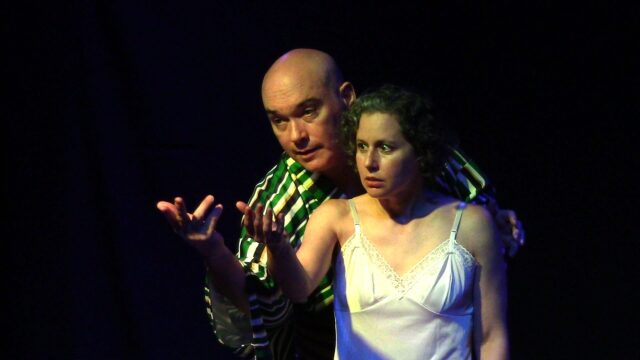
C (Sarah Steele) and A (Tatiana Maslany) discuss a difficult situation in Pre-Existing Condition (photo by Emilio Madrid)

PRE-EXISTING CONDITION
Connelly Theater Upstairs
220 East Fourth St. between Aves. A & B
Monday – Saturday through August 3, $49-$125
preexistingconditionplay.com
www.connellytheater.org

Don’t worry that the protagonist in Marin Ireland’s gripping and powerful major playwriting debut, Pre-Existing Condition, holds what appears to be a spiral-bound copy of the script throughout the play’s sleek and steady seventy-five minutes, sometimes glancing at the words, other times clutching it to her chest like Linus’s blanket in Peanuts. Known only as A, the character never lets go of the script, not because the actor has not yet learned all of the lines, but because it’s a constant reminder of a horrific, life-altering event in the character’s recent past. Over the show’s two-month run, A will be played by Emmy winner Tatiana Maslany (who I saw), Tony nominee and director Maria Dizzia, Tavi Gevinson, Tony winner Deirdre O’Connell, and Julia Chan — and each will hold that script.

It’s been seven months since A was brutally struck by her partner. No longer with the man, she speaks with an attorney, a psychiatrist, a few close friends, her parents, an old acquaintance, her parents, and others, but no one is able to help, instead only adding to her torment and confusion by subtly blaming her for first provoking the attack and then refusing to take her lover back.

She tries to date, but she’s clearly not ready, especially when the men she meets cannot, or will not, understand her situation. (All the men and A’s mother are played by Greg Keller, although I saw his understudy, Gregory Connors; the rest of the women are portrayed by Sarah Steele and Dael Orlandersmith.)

A finds some respite in group therapy run by two caring women who have developed a support program; during those sessions, the two facilitators talk directly to the audience, as if we are all part of this community, because when it comes down to it, we are; domestic violence can occur at any moment, in any family.

In one exchange with B, A questions her own responsibility.

B: do you still feel like it’s your fault?
A: yeah.
B: it’s not.
A: well.
B: you couldn’t have known.
A: but . . . couldn’t I? I mean, I’m not that stupid, right? I mean. I guess I’m realizing something kind of horrible about myself which is that I always thought that like women who got hit by their boyfriends were like . . . they were like . . .
B: (long pause) they were like what?
A: trash. They were like trash. (pause)
B: mmhm.
A: and the thing is that’s exactly what I felt like. Feel like. (pause) Trash. (pause) (pause) And there are days when I feel like maybe I always was trash and this experience just made me see that finally. Clearly. And it has really nothing to do with the, like, huge shame or guilt or any of that, anything even directly relating to this incident, it just starts to feel like a very very deep truth. That I’m trash. And I always was.
B: you believe that still? Right now at this moment?
A: Oh yeah yeah, of course. Sure. No, that hasn’t ever gone away since it started. It’s almost a peaceful thought, which I guess is what makes it feel like it must be true?

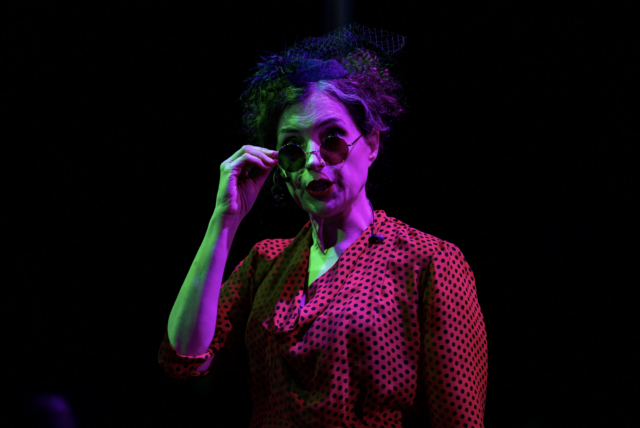
Dael Orlandersmith plays multiple roles in new play by Marin Ireland (photo by Emilio Madrid)

Later, A explores another aspect of her feelings that no one seems to get. “I’m so fucking exhausted by all of this. All of this. All of the taking it seriously and the. All of it,” she tells B. “I don’t — okay. I don’t want the big task of my life now to be ‘dealing with this.’ It’s fucking eating up everything.”

When a friend (C) mentions the possibility of her offering forgiveness, A states, “I don’t want to. Forgive. I don’t want to forget it. . . . I don’t want to also be guilty of forgetting it.”

As the healing process — whatever it encompasses — continues, the audience empathizes more and more with A, realizing that her pain and trauma could be anyone’s pain and trauma, that any one of us could be sitting in that chair in the middle of the room, being consumed by some type of tragedy.

The California-born, Obie-winning Ireland is one of New York’s finest actors, having appeared in such powerful plays as On the Exhale, Ironbound, Marie Antoinette, the intimate Uncle Vanya that took place in a Flatiron loft, and reasons to be pretty, which earned her a Tony nomination.

She was busy during the pandemic, acting in short virtual works for charity and conceiving “Lessons in Survival” at the Vineyard Theatre with Peter Mark Kendall, Tyler Thomas, and Reggie D. White, in which a company known as the Commissary reenacted historic speeches, interviews, and conversations by activists and artists from revolutionary times (including James Baldwin, Nina Simone, Angela Davis, Maya Angelou, Nikki Giovanni, Bobby Seale, and Muhammad Ali). Pre-Existing Condition is its own kind of lesson in survival, a deeply personal one.

Julia Chan, seen here with Greg Keller, is one of five rotating actors portraying the protagonist in gripping play (photo by Emilio Madrid)

In 2012, Ireland and her boyfriend at the time, Scott Shepherd, were in London, starring as the leads in the Wooster Group’s Cry, Trojans!, an adaptation of Shakespeare’s Troilus & Cressida. One day she came to rehearsal with a black eye after Shepherd viciously hit her; he did not deny doing it. How Ireland was treated by the company and others following the event led her to lobby for systemic change in the theater.

“I continue to wonder where responsibility and accountability should be for what happened,” Ireland told the New York Times in 2015. “Many actors don’t know what to do when behavior — physical, sexual, harassment, bullying — crosses a line.”

Pre-Existing Condition is not a revenge drama, nor is it a self-help guide. It’s a brutally honest and provocative look at the psychological and bodily wounds that humans inflict and receive. Director Dizzia, an actor who has appeared in more than seventy movies and TV shows and theatrical productions, earning a Tony nomination for Best Performance by a Featured Actress for In the Next Room (or The Vibrator Play), allows Ireland’s story to unfold at a modest pace, luring the audience at the Connelly’s tiny upstairs theater into its many intricacies. Louisa Thompson’s spare set consists of a handful of chairs that match those the people in the first row sit in, implicating all of us; the actors switch chairs, but some are left empty, evoking ghosts who cannot be there. In the back are piles of more chairs, representing other survivors to come.

Drama Desk winner Steele (The Humans, I Can Get It for You Wholesale) is charming in multiple roles, wearing a Patti Smith T-shirt and jeans as she engages with A from multiple points of view. Solo specialist Orlandersmith (Spiritus/Virgil’s Dance, Forever) is wonderfully gentle as various therapists. Understudy Connors (The Poisoner, The Sign in Sidney Brustein’s Window), taking over this night for the always terrific Keller (Dig, Shhhh), is stalwart as the men in A’s life, the good and the bad.

Maslany (Grey House, Mary Page Marlowe) is sensational as the tormented A, searching for a way out of her lonely predicament. The Canadian actor’s expressive facial gestures and meticulous body movements, filled with uncomfortable pauses, are mesmerizing, daring us to try to find the way forward for A; in fact, it is not until the closing moments that Maslany makes any eye contact with the audience, bringing us further into her world, and concluding with an extraordinary coda.

A’s personal answers may not be in the pages she’s clinging to as if some kind of life line, but Ireland’s play does offer a fascinating blueprint of what we all should be paying a lot more attention to.

[Mark Rifkin is a Brooklyn-born, Manhattan-based writer and editor; you can follow him on Substack here.]