this week in theater

THE CARETAKER

Jonathan Pryce, Alex Hassell, and Alan Cox star in THE CARETAKER at BAM (photo by Richard Termine)

Brooklyn Academy of Music
BAM Harvey Theater
651 Fulton St. between Ashland & Rockwell Pl.
Through June 17, $25-$100
718-636-4100
www.bam.org

Jonathan Pryce gives a whirlwind tour-de-force performance in the latest revival of Harold Pinter’s The Caretaker, running at BAM’s Harvey Theater through June 17. In the Liverpool Everyman and Playhouse/Theatre Royal Bath production, Pryce (Miss Saigon, Comedians) stars as the tramp Davies, a homeless man in tatters who is just looking for a good pair of shoes and a place to rest his weary bones. He is offered both by Aston (Alan Cox), a friendly sort of chap Davies met in a pub who takes Davies to his apartment, a ramshackle space overloaded with dusty, moldy black-and-white and gray objects, the only color a brightly painted ceramic Buddha. Davies is soon being harassed by a strange man who turns out to be Aston’s younger brother, Mick (Alex Hassell), who enjoys teasing the elderly Davies. Over the course of several weeks, the trio engages in existential philosophical discussions à la Beckett’s Waiting for Godot, speaking about nothing and everything as both brothers separately ask him to serve as the apartment building’s caretaker, leading to confusion over who’s really in charge. Meanwhile, Davies keeps talking about having to get to Sidcup to reclaim his identity papers, as his real name is not actually Davies. Directed by Christopher Morahan, The Caretaker is worth seeing just for Pryce’s extraordinary performance as the title character, an endearingly eccentric figure who likes things his own extremely particular way. The first half is filled with eclectic humor and slapstick, but the second half gets bogged down in repetition and plot twists that come out of left field, not really going anywhere ― even though that’s part of the point. “I can take nothing you say at face value,” Mick says to Davies. “Every word you speak is open to any number of different interpretations.” And so it is with the play and Pinter himself. The Caretaker was his breakthrough, premiering in London in 1960 with Donald Pleasence as Davies, Alan Bates as Mick, and Peter Woodthorpe as Aston; Robert Shaw took over the role of Aston on Broadway and in Clive Donner’s 1963 film. Pryce will participate in an Artist Talk following the May 24 performance, speaking with Pinter scholar Austin E. Quigley.

BIG DANCE THEATER: COMME TOUJOURS HERE I STAND

Big Dance Theater reinvents Varda classic onstage in multimedia production

New York Live Arts
219 West 19th St. between Seventh & Eighth Aves.
May 16-19, $15-$30, 7:30
212-691-6500
www.newyorklivearts.org
www.bigdancetheater.org

Agnès Varda’s 1961 Nouvelle Vague classic, Cléo from 5 to 7, is as much about filmmaking as it is about its subject, a small-time chanteuse wandering the streets of Paris as she fearfully awaits the results of a biopsy. New York-based Big Dance Theater, under the artistic direction of husband-and-wife team Annie-B Parson and Paul Lazar, reinvents the seminal real-time film onstage in the vastly entertaining Comme Toujours Here I Stand. Turning the process itself into the narrative, BDT creates a multimedia mix of dance, music, and video centered around the making of the film, with a diva star playing the diva star. Parson and Lazar, who based the production on Varda’s screenplay — they didn’t watch the movie itself until things were well under way — brilliantly incorporate a wonderful set featuring three vertical multipurpose screens and a rolling staircase, along with original songs by Robyn Hitchcock. Evoking New Wave master Jean-Luc Godard, much of the action takes place in between shots, “off camera,” involving the cast and crew, focusing on Cléo’s ever-more-frustrated costars, one of whom is in a continuing phone drama with her boyfriend. Fans of the film won’t be disappointed — BDT includes all the familiar scenes, from visits to a fortune-teller and a hat shop to a musical interlude with Cléo’s pianist and a walk in the park with a poetic soldier. Refreshingly, Comme Toujours Here I Stand, which was first presented at the Kitchen in October 2009 and will now be performed May 16-19 at New York Live Arts, also maintains Varda’s focus on women’s experience and interaction with each other. (There will be a preshow talk on May 16 with Brian Rogers and a postshow talk May 18 with Cathy Edwards.)

AN EARLY HISTORY OF FIRE

Danny (Theo Stockman) and Karen (Claire van der Boom) are in for a long night in David Rabe’s AN EARLY HISTORY OF FIRE (photo by Monique Carboni)

The Acorn Theatre at Theatre Row
410 West 42nd St. between Ninth & Tenth Aves.
Monday – Saturday through May 26, $61.25
212-560-2183
www.thenewgroup.org
www.theatrerow.org

Despite all the talk of burning hilltops and yearning young passion, award-winning playwright David Rabe’s An Early History of Fire never quite ignites at the Acorn Theatre at Theatre Row. Lightning doesn’t strike twice for the New Group, which staged a popular revival of Rabe’s Tony-nominated Hurlyburly in 2005, featuring the all-star cast of Bobby Cannavale, Josh Hamilton, Ethan Hawke, Parker Posey, and Wallace Shawn. Rabe, who has penned such other works as Sticks and Bones, The Basic Training of Pavlo Hummel, and In the Boom Boom Room, goes back to 1962 in his first new play since 2001’s The Dog Problem, but it turns out to be a rather mundane time-capsule drama. Theo Stockman stars as Danny, a serious young man living with his immigrant father, Emil (Gordon Clapp), in a working-class town in Middle America. When Danny begins dating Karen (Claire van der Boom), the daughter of a wealthy family in a nearby ritzy neighborhood, his best friend, Terry (Jonny Orsini), is insulted, claiming that Danny is turning his back on his roots. But Danny is enlightened by Karen’s discussions of literature and politics, although he starts finding out a lot more about her on one very long night. An Early History of Fire is a coming-of-age drama that never comes of age itself, instead emerging flat and old-fashioned. When Karen waxes poetic about Salinger and Kerouac, or when the play comes to an uncomfortable stop as everyone pauses to listen to an Elvis Presley song on the hi-fi, it feels like Rabe is forcing his own personal heroes into the story, resulting in moments that are unnatural and inorganic. An Early History of Fire does have the air of autobiography about it ― Rabe was born and raised in Dubuque, Iowa, in a working-class family, and he would have been twenty-two in 1962 ― but it has trouble escaping its own insecurities, much as Danny has trouble escaping his.

DON’T DRESS FOR DINNER

Highly anticipated DON’T DRESS FOR DINNER disappoints on Broadway (photo by Joan Marcus)

American Airlines Theatre
227 West 42nd St. between Broadway & Eighth Ave.
Through June 17, $67-$117
212-719-1300
www.roundabouttheatre.org

In April 2008, Marco Camoletti’s 1962 French farce, Boeing-Boeing, flew onto Broadway, eventually landing six Tony nominations and earning statuettes for Best Revival of a Play and Best Leading Actor (Mark Rylance). Capitalizing on that success, the Roundabout has brought back Camoletti’s Don’t Dress for Dinner, but there’s little appetizing about this supposed comedy. This tepid follow-up features several characters from Boeing-Boeing, once again caught up in romantic shenanigans. In a lovely chateau two hours outside of Paris, Bernard (Adam James) has planned to have his mistress, Suzanne (Jennifer Tilly), spend the weekend since his wife, Jacqueline (Tony nominee Patricia Kalember), will be visiting her mother. But when Jacqueline discovers that her lover, Robert (Ben Daniels), who also happens to be Bernard’s best friend, will be coming by as well, she cancels with her mother and instead decides to stay home, sending Bernard into a frenzy. When Suzette (Spencer Kayden), a cook Bernard hired for the evening, shows up, Robert mistakes her for his friend’s mistress, and soon everyone is caught up in an endless — indeed, it feels like it will never end — game of mistaken identity, overt and covert deception, and overblown slapstick. There are barely a few chuckles in Robin Hawdon’s adaptation, repetitively directed by John Tillinger. Don’t Dress for Dinner feels more like an extended episode of Three’s Company than a legitimate Broadway show, although the actors do try their darnedest with the ridiculously convoluted plot and drastically overcooked script.

THE LYONS

Black comedy about family dysfunction roars onto Broadway (photo by Carol Rosegg)

Cort Theatre
138 West 48th St. between Sixth & Seventh Aves.
Through July 31, $31.50 – $176.50
www.thelyonsbroadway.com

The Vineyard Theatre production of The Lyons has made a splendid transition to Broadway, where the severely dysfunctional Jewish family has settled comfortably into the Cort Theatre. Linda Lavin stars as matriarch Rita Lyons, a brash, direct woman who sits at the side of her husband Ben’s (Dick Latessa) hospital bed casually leafing through magazines as he faces impending death, his terminal cancer about to claim him. While she seems more concerned with redoing the living room, he spits out a hysterical barrage of extreme curses at her; it’s hard at first to tell whether the two of them really love or hate each other, but the truth eventually comes out in playwright Nicky Silver’s (Pterodactyls, The Altruists) wild and woolly Broadway debut. Rita and Ben are soon joined by their extremely troubled children: Curtis (Michael Esper), a gay short story writer who’d rather be with his lover than his family, which isn’t hard to understand, and Lisa (Kate Jennings Grant), an alcoholic mother experiencing serious marital woes. The more time the four of them spend together, the more secrets are revealed, each one more brutal and darkly funny than the last. The first act of The Lyons is a laugh-out-loud riot as Latessa keeps shouting out invectives and Lavin adds just the right spin, from cynical and ironic to guilt-building and nonchalant, to every line. Even the way she sits down and crosses her legs is loaded with emotion. The second act loses a little steam as Silver and director Mark Brokaw (Cry-Baby, The Constant Wife) shift their attentions more on Curtis and his innate problems, but the show picks up again when his mother returns to share the bizarre turn her life has taken. Nominated for a pair of Drama Desk Awards for Outstanding Play and Outstanding Actress in a Play (Lavin, who also received a Tony nod), The Lyons reveals just how much fun family dysfunction can be.

THE COLUMNIST

The Alsop brothers (John Lithgow and Boyd Gaines) toast to happier times in THE COLUMNIST (photo by Joan Marcus)

Manhattan Theatre Club at the Samuel J. Friedman Theatre
261 West 47th St. between Broadway & Eighth Aves.
Through June 24, $67-$121
thecolumnistbroadway.com

Based on the real life of American journalist Joseph Alsop, David Auburn’s The Columnist is a rather sterile exercise in twentieth-century historical fiction. Multitalented Tony and Emmy winner and Oscar nominee John Lithgow, a Rochester-born Harvard grad who in recent years has played a serial killer on Dexter, published a series of popular children’s books, and penned his autobiography (An Actor’s Education), gives a wonderful performance as the erudite Alsop, an acerbic columnist who believes he is more powerful than the president. A staunch conservative, he is surprisingly delighted with JFK’s victory, celebrating with his wife, Mary (Margaret Colin), stepdaughter, Abigail (Grace Gummer), and brother and sometime writing partner, Stewart (Boyd Gaines), convinced that the new president will show up at his house on the night of the inauguration. But Alsop’s power and influence begin to wane as he very publicly pushes for greater U.S. involvement in Vietnam, directly challenged by such up-and-coming journalists as David Halberstam (Stephen Kunken), while Stewart tries to protect his brother from a potential scandal surrounding a sexual fling Joe had with a young Russian man (Brian J. Smith) several years before, depicted in a very strong scene that opens the play. Auburn, who won the Pulitzer Prize for his 2000 play, Proof, never quite gets below the surface in The Columnist, resulting in a series of predictable, clichéd moments that feel stale and unnecessary, particularly when delving into the Vietnam war, something in interviews he claimed to know very little about, which shows. He does somewhat better handling the practical marriage between Alsop, a closeted homosexual, and Mary, a respected DC party hostess, although he changes several important facts about their relationship, including its length, and turns Mary’s two daughters into one. Directed by Shakespeare veteran Daniel Sullivan, The Columnist, despite a terrific lede and a Tony-nominated lead actor, is still in need of significant editing.

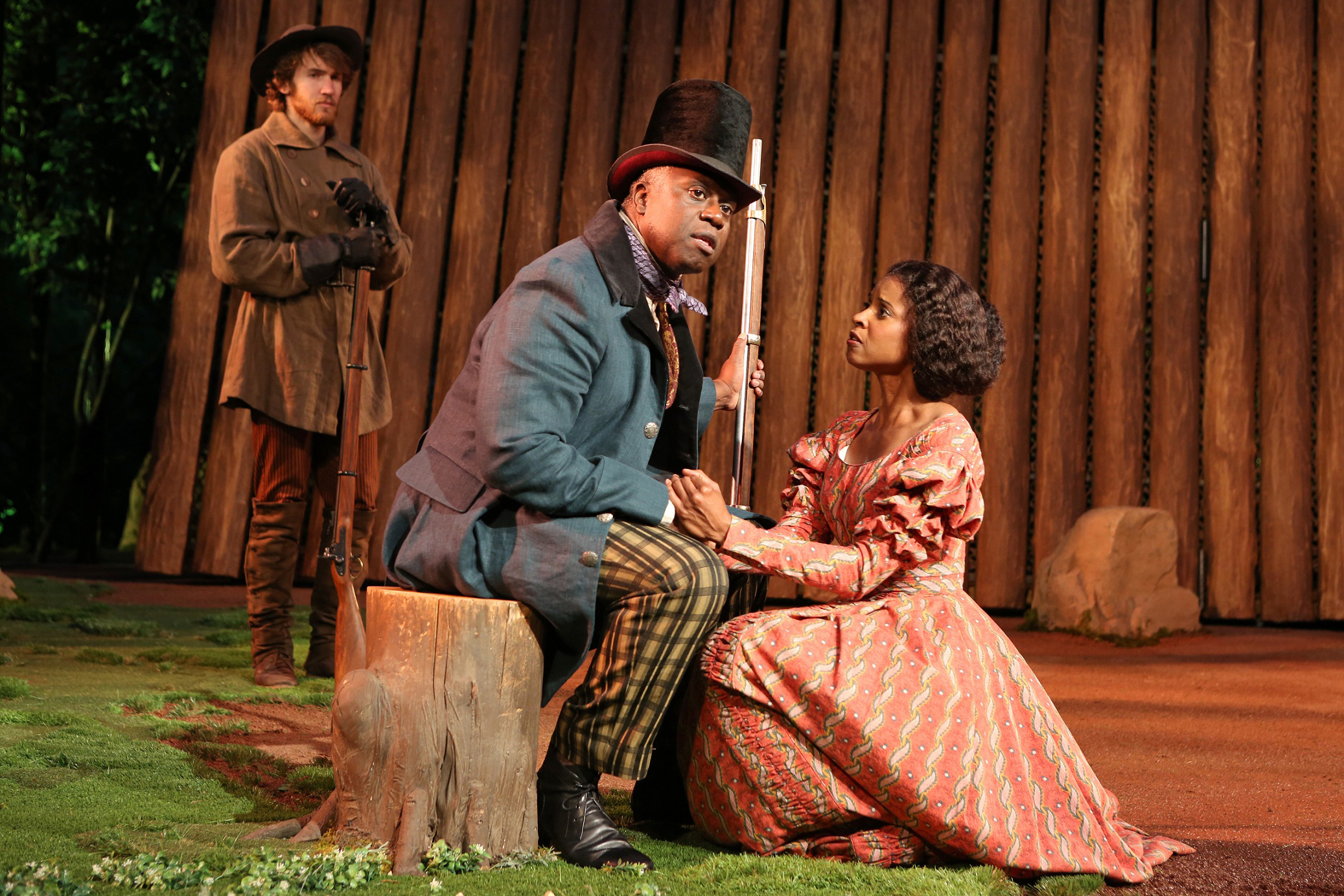
A STREETCAR NAMED DESIRE

New STREETCAR pulls into Broadway lacking the necessary desire

Broadhurst Theatre
235 West 44th St. between Broadway & Eighth Ave.
Through July 22, $49.50 – $199
www.streetcaronbroadway.com

Tennessee Williams’s steamy Pulitzer Prize-winning classic, A Streetcar Named Desire, has had a long, storied history on Broadway and on film. Unfortunately, this latest production, directed by Emily Mann at the Broadhurst Theatre, is unlikely to add to that legacy. A buff Blair Underwood stars as Stanley (the usual last name of Kowalski is dispensed with here), a raw, brutish man married to Stella (the always dependable Daphne Rubin-Vega), who loves her husband despite his animalistic nature. When Stella’s sister, Blanche Du Bois (Nicole Ari Parker), arrives to stay with them in their small, ramshackle home in New Orleans’s Elysian Fields, things begin to get complicated as Blanche tells Stella that the family’s country home has been lost and it soon becomes apparent that Blanche is having trouble living in reality. Streetcar needs to be played with fierce passion and careful nuance, but Mann’s version feels flat and uninspired. The two main couples — Stanley and Stella, and Blanche and Mitch (Wood Harris) — lack chemistry, so the fire never ignites, even when Stanley ultimately grabs Blanche. Everything about the production is admirable, including Terence Blanchard’s score and Eugene Lee’s set, but there’s an overwhelming straightforwardness from which it can’t escape — and one that has nothing to do with comparisons to previous Streetcars, featuring such leading foursomes as Marlon Brando, Jessica Tandy, Kim Hunter, and Karl Malden (1947), Aidan Quinn, Blythe Danner, Frances McDormand, and Frank Converse (1988), Alec Baldwin, Jessica Lange, Amy Madigan, and Timothy Carhart (1992), and John C. Reilly, Amy Ryan, Natasha Richardson, and Chris Bauer (2005). And the production’s primary conceit, that it is the first Broadway version to boast a multiracial cast, adds little to the proceedings.