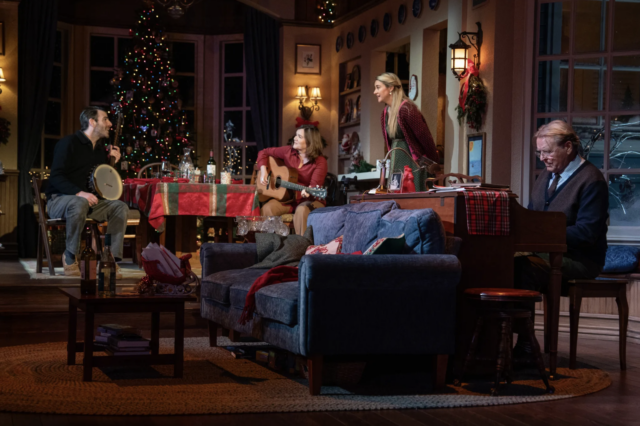
this week in theater

ASKING FOR MORE: THE ASK at the wild project

Greta (Betsy Aidem) and Tanner (Colleen Litchfield) face off in Matthew Freeman’s The Ask (photo by Kent Mesiter)

THE ASK
the wild project
195 East Third St. between Aves. A & B
Wednesday – Sunday through September 28, $58.59
thewildproject.com

In a two-minute television commercial for the American Civil Liberties Union that has been running since the fall of 2022, comedian, author, and actor W. Kamau Bell explains, “As Americans, there’s one thing we can all agree on: the promise of our Constitution — and the hope that liberty and justice is for all people.” In the ad, Bell, an ACLU ambassador, asks viewers to become members of the civil rights organization for $19 a month, a fee also requested to join No Kid Hungry, the World Wildlife Fund, St. Jude’s, the ASPCA, and other charitable institutions. (The amount is both for tax purposes and perception, keeping it under $20.)

In Matthew Freeman’s stimulating new play, The Ask, making its world premiere through September 28 at the wild project, an ACLU fundraiser is asking for a whole lot more from a longtime donor who is on the fence about her future support of the nonprofit that started in 1920 and “is committed to fight for freedom and the protection of constitutional rights for generations to come.”

Greta (Betsy Aidem) is a wealthy seventysomething widow and lifelong feminist, a successful photographer who lives in Florida and the Upper West Side (and just sold her home in Maine). Tanner (Colleen Litchfield) is an adopted nonbinary millennial who resides in Bushwick and is a gift planning officer for the ACLU.

It’s set in December 2022, five months before the World Health Organization declared the Covid-19 pandemic no longer a public health emergency. The characters’ first discussion is about Tanner’s presence; they’ve replaced Greta’s longtime ACLU contact, Carol, under unclear circumstances. Greta is unhappy that she wasn’t notified of Carol’s departure, nor has she been told the reason, although she suspects Carol was part of recent layoffs, which the ACLU executive director referred to as “right-sizing.”

Tanner dances around the answer, which annoys Greta. It’s a theme that runs throughout the play: Greta feels free to share anything about herself and her views, while Tanner is stiff and reserved, careful what they say about the ACLU and, more critically, about themself as they delve into the First Amendment, hate speech, student debt, the Founding Fathers and slavery, the Supreme Court, hunger, high-speed internet for underserved communities, and reproductive rights. Greta is upset by the number of emails she gets from the ACLU and some members’ references to the Constitution as a white-supremacist document, while Tanner keeps trying to convince Greta that the ACLU’s purpose is as consequential and necessary as ever.

“You do plenty of good in the world,” Tanner says. Greta replies, “Thank you, you’re the one who does good. I just write proverbial checks.” Tanner encourages her, “Well, they matter.” To which Greta shoots back, “Yes yes, you have to say that.”

But the tide turns on Tanner’s inability to say one word, the very term that is most important to Greta.

Tanner (Colleen Litchfield) has an impossible mission on their hands in world premiere at the wild project (photo by Kent Mesiter)

At its core, The Ask is about personal and professional identity. Greta not only speaks her mind but makes her living as a photographer, taking pictures of other people and places that shape her view of the world. Her apartment is cluttered with books piled on and under tables, including art tomes on Vincent van Gogh, Alice Neel, Paul Gauguin, and Ninth Street Women in addition to such feminist and left-leaning literature as Gloria Steinem’s Revolution from Within; Diane di Prima’s Recollections of My Life as a Woman: The New York Years; Amy Goodman and David Goodman’s Standing Up to the Madness: Ordinary Heroes in Extraordinary Times, about what one can do to fight for what they believe in; and Jodie Patterson’s The Bold World: A Memoir of Family and Transformation, about a mother whose toddler tells her that she is not a girl but a boy.

Greta’s cozy, intimate apartment is filled with photographs hung on black-and-white scallop-shell wallpaper, both her own and several taken by Pictures Generation artist Cindy Sherman, who reimagines herself as different personae in cinematic self-portraits that explore gender and identity. Tanner, who is clearly uncomfortable sharing certain personal information with Greta, expresses their admiration of Sherman. “I love her too; I think she’s a scream,” Greta says. Tanner responds, “I think she’s terrifying.”

Tanner is also enamored with a photograph of a dinosaur, which Greta refers to as her self-portrait, an ancient creature surrounded by real life. Tanner points out, “Except for Cindy Sherman. She’s not real life.” Greta, keeping their cat-and-mouse game going, counters, “She’s a little more real than a Brontosaurus.”

The play is intricately directed by Jessi D. Hill (Small, Ushuaia Blue), who makes the most of Craig Napoliello’s almost claustrophobic set, which has a small hallway in the back that leads to the unseen kitchen and bathroom, bringing some kind of respite to the tense proceedings occurring in the study, where Greta, in black pants, a loose-fitting purple blouse, and clogs, sits comfortably in a chair while Tanner, in brown pants, a V-neck sweater, a dark blazer, and sneakers, is rigid and uneasy in an opposite chair. (The costumes are by Nicole Wee, with sharp sound by Cody Hom and bright lighting by Daisy Long.)

Freeman (Silver Spring, Why We Left Brooklyn) writes with a refreshing assuredness, creating dialogue that could have become pedantic and self-serving but instead is through-provoking and, often, very funny even as it deals with serious situations. Tony nominee Aidem (Prayer for the French Republic, All the Way) is energetic and appealing as Greta, a wholly believable feminist who doesn’t want to see everything her generation accomplished just slip away, while Litchfield (The Summoning, The Heart of Robin Hood) stands firm as a much younger individual who has their own vision of the future but cannot say it out loud. (Both actors were in the original Broadway cast of Leopoldstadt, Aidem as Grandma Emilia, Litchfield as Hanna.)

Even at eighty minutes, the play is a bit too long, repeating several points and including one gratuitous monologue, but otherwise it expertly captures the changes that are evolving primarily on the left in today’s society. Greta and Tanner are battling each other instead of the other side, unwilling to compromise their values.

“I imagine in your life. Your individuality is important to you. Asserting your identity, your uniqueness, that’s been important to you. It might have even been a struggle. I don’t want to assume anything, but I imagine that’s true for you?” Greta says, adding, “But you see, I also want to be treated as an individual. As a woman, I mean, as a woman I’ve had to fight against the perception that I am a certain way, that I am defined by all these stereotypes about women.”

Tanner wants to change the subject, understanding that Greta might not like what they have to say — and it’s about a lot more than a charitable donation, whether $19 a month or a much higher figure.

[Mark Rifkin is a Brooklyn-born, Manhattan-based writer and editor; you can follow him on Substack here.]

RICHARD TOPOL ON ABRAM, SHYLOCK, AND ANTISEMITISM: OUR CLASS / THE MERCHANT OF VENICE

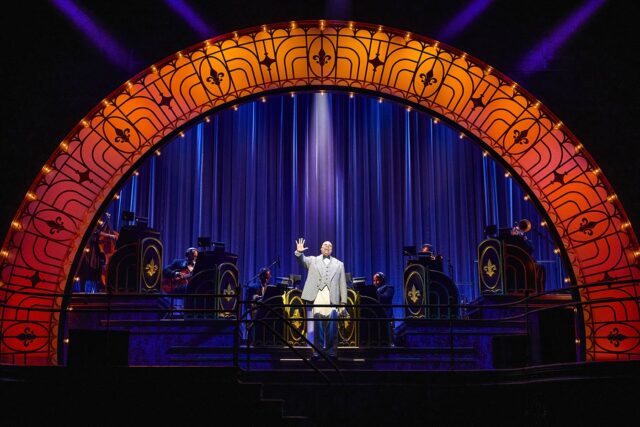
Rich Topol first played Abram Baker in Our Class at BAM this past January (photo by Pavel Antonov)

OUR CLASS / THE MERCHANT OF VENICE
Classic Stage Company, Lynn F. Angelson Theater
136 East Thirteenth St. between Third & Fourth Aves.
Our Class: Tuesday – Sunday, September 12 – November 3, $89-$139
The Merchant of Venice: Tuesday – Sunday, November 22 – December 22, $59-$129
www.classicstage.org
www.arlekinplayers.com

Earlier this year, Arlekin Players Theatre and MART Foundation’s timely new adaptation of Polish playwright Tadeusz Słobodzianek’s 2008 drama, Our Class, sold out a three-week run at the BAM Fisher as part of the Under the Radar festival. Inspired by actual events that occurred in the small village of Jedwabne, Poland, the three-hour play, directed by the endlessly inventive Igor Golyak, focuses on antisemitism among a group of ten Polish students, five Jewish, five Catholic, all born in 1919–20, from childhood to young adulthood to old age, although several don’t make it through a horrific 1941 pogrom.

In my January 30 review, I wrote, “The cast and crew, who hail from Russia, Ukraine, Poland, Israel, Germany, and the US, are superb. . . . Perhaps the best thing about Our Class is that it doesn’t preach at the audience; it has a message and a point of view but is not teaching us about good and evil.”

The show, which was nominated for Drama League, Outer Critics Circle, and Drama Desk Awards, is back for a return engagement September 12 – November 3 at Classic Stage, with the same cast and crew. One thing that will be at least somewhat different is the staging, as Classic Stage is smaller and more intimate than the Fisher (199 seats vs. 250), and the audience sits on three sides of the action. Arlekin’s residency continues there November 22 – December 22 with the New York debut of its unique and unusual production of Shakespeare’s The most excellent historie of the Merchant of Venice with the exxtreame cruelitie of Shylocke the Jewe, featuring much of the same team as Our Class, including director Golyak and actors Richard Topol, Gus Birney, José Espinosa, Tess Goldwyn, Stephen Ochsner, and Alexandra Silber.

Topol, who has starred as Jewish characters on and off Broadway in such works as Indecent, The Chosen, Awake & Sing, Prayer for the French Republic, and King of the Jews, plays Abram Baker in Our Class, a student who leaves Poland and becomes a rabbi in America. In The Merchant of Venice, he will play Shylock, the Jewish moneylender previously portrayed by Edmund Kean, Edwin Booth, Jacob Adler, Orson Welles, Al Pacino, Laurence Olivier, John Douglas Thompson, Andrew Scott, and many others.

In my January 8 Substack post “‘class consciousness’: we are not safe. again.,” exploring Our Class and antisemitism in relation to Hamas’s brutal attack on Israel on October 7 and the aftermath, Topol explained, “Certainly the violence that is occurring in both Ukraine and Israel/Gaza is impacting my relationship and understanding of the play. And it’s making Our Class a story that feels even more important to tell. Because it’s based on true events that occurred not far from Ukraine. And because it’s about cycles of hate. And the violence that can come from that hate.”

As the company began rehearsals for the Classic Stage transfer, I asked Topol several questions about the two plays and his characters.

twi-ny: What similarities do you see between Abram and Shylock?

rt: Well, for starters, they are both Jews living through perilous times filled with antisemitism. They are both fathers who love their children deeply. They are both connected to their religion fully. And they both face moments where they struggle with how to respond to people who treat them with indignity.

twi-ny: What are their main differences?

rt: I think their main difference is how they respond to being treated with indignity. Shylock seeks revenge. He can’t see straight once he’s been broken. Abram is treated less harshly but he also is a kinder man who tries to come to terms with the world as it is in a way that allows for forgiveness or redemption or understanding. And I think that is because Abram is a rabbi who feels the blessings of his G-d around him, even as he suffers harm. Shylock is a businessman, a moneylender, and though he is connected to his Jewish faith, he isn’t as grounded in its teachings as Abram is. Abram creates this gigantic family, these generations of descendants whom he loves and cherishes. Shylock feels like he’s alone in the world, with only his one daughter as his ally. And once she’s gone he has nobody he can lean on, live for, or help him see straight.

Also, because of Abram’s inherent kindness, he sees the best in people, the hope for the world, the possibilities for the future. Maybe Shylock had some kindness in him somewhere but we certainly don’t see much if any of it during the course of the play. Maybe it was snuffed out when his wife died. But bottom line there is a hardness in Shylock’s soul as opposed to a kind of softness in Abram’s.

twi-ny: How might Abram have fared as the Venetian moneylender in Merchant, and how might Shylock have done as the rabbi in Our Class?

rt: That’s a great question and a fun thing to try to imagine. Abram seems like a pretty smart guy, so maybe he would have figured out how to make a successful go of it as a Venetian moneylender. He’s good with languages, he’s a hard worker, and he has a kind of can-do attitude that would have stood him in good stead. I like his chances.

Shylock as a rabbi . . . hmm . . . I’m thinking no way. At least not the kind of rabbi I’d like to hear at synagogue! He definitely feels strongly about his tribe, his people, his religion. But I don’t see him as having the right temperament to be a leader to his fellow Jews.

twi-ny: What would they think about the state of the world if they were alive today, with the same jobs?

rt: Shylock as a modern-day moneylender — a banker in this world of global capitalism — he might be just fine. I think most of the Jews of this time live with greater freedoms, respect, and opportunity than during Shylock’s time in Venice. He’d certainly recognize the antisemitism of our time, but if he were a banker in Venice now I think he might be thriving and might feel like a true equal to his Christian counterparts.

Abram, well, he was alive not that long ago. But I think he’d be heartbroken to see the rise of antisemitism in this country. My sense of him is of someone who loved and seized on the promise and opportunity of America, symbolized by the Statue of Liberty. An immigrant who was always thankful for the chance to make a new and full life here. And he would be as disturbed by the hate and divisiveness of our time right now as many of us are.

[Mark Rifkin is a Brooklyn-born, Manhattan-based writer and editor; you can follow him on Substack here.]

TICKET ALERT: THE VOICES IN YOUR HEAD ENCORE ENGAGEMENT

The Voices in Your Head is back for an encore run in a storefront Brooklyn church (photo by HanJie Chow)

THE VOICES IN YOUR HEAD
St. Lydia’s Dinner Church
304 Bond St., Brooklyn
September 9 – October 11, $39.72-$55.20
stlydias.org/events
www.eggandspoontheatre.org

In January, The Voices in Your Head offered a unique view of grief counseling, taking place at St. Lydia’s Dinner Church in Brooklyn. The sixty-minute play sold out quickly, extending its run and adding seats. It’s now back for a return engagement September 9 – October 11, and some nights are already fully booked. For other nights, there are either $39.72 or $55.20 Pay It Forward tickets available, but not both. Christian Caro, Marcia DeBonis, Tom Mezger, Daphne Overbeck, Erin Treadway, and Jehan O. Young reprise their roles in this Egg & Spoon remount, with Alex Gibson, Jamila Sabares–Klemm, and Molly Samson joining the cast.

Below is my original review of the January 2024 edition of this thoroughly involving and entertaining experience.

————————————

Lately I’ve been thinking more than ever about grief and death. I’m not a support group kinda guy, but when I heard about The Voices in Your Head, I knew I had to go.

I found solace — and nearly nonstop laughter — in Those Guilty Creatures’ immersive, site-specific group therapy black comedy, which continues at St. Lydia’s storefront dinner church in Brooklyn through January 29.

The space has been renamed St. Lidwina’s, after the Dutch patron saint of chronic pain and ice skating. The church has a large front window and door, looking more like a cozy shop than a place of worship. When you arrive, you are asked to check off your name on a sign-in sheet; to protect your anonymity, there are no last names, although people passing by outside can peek in and see you.

In the center of the room are more than two dozen unmatched chairs arranged in a large oval. In the back is a working kitchen where the facilitator, Gwen (Vanessa Kai), greets everyone while making tea and cookies. Several attendees engage in friendly conversation and chitchat. Shortly after Gwen calls the meeting to order, it becomes apparent that a handful of the participants are in the cast.

“It’s funny, when I was at my lowest, I was going to all these different meetings; it felt like dating, trying to find the right match, and they were all so . . . maudlin? I thought, there has to be another way. So, I started this group,” Gwen says. “Evidently, there was a need. So, we’re all here, we’ve met the criteria, but, broadly, I like to think of this as a place to share a sensibility. Laughter comes easier for me in here than out there. Everyone has their own relationship to grief; I’ve been considering mine, but what about anti-grief? We seek that through shared stories, activities, and discussions. . . . We aim to hear three stories each week, which, hopefully, helps us exchange some weird-ass joy.”

The audience becomes immersed in the grief of others in The Voices in Your Head (photo by HanJie Chow)

Sharing their sensibilities are the vivacious and outgoing Regina (Daphne Overbeck); Vivian (Marcia DeBonis), who believes in “Death, Embarrassment, Trauma”; Caleb (Christian Caro), who doesn’t want to be sad in college and can’t stop texting; the ultraserious Sandra (Erin Treadway); and the practical Hadiya (Jehan O. Young), who loves “the morbid stuff.”

They are eventually joined by first-timer Blake (Patrick Foley), who is determined to turn his story of loss into a Netflix special, and Ted (Tom Mezger), who actually attends the church and saw a flier.

Over the course of sixty fun, lively minutes, the group discusses Kelly Clarkson, hot cater waiters, self-care, vacuuming, exfoliating, sand, and other items and issues as they explore their personal misfortunes. A role-playing session that puts some of the group members in specific social situations doesn’t go quite as expected. During a break, the characters gossip, revealing more about who they are.

At the center of it all is the arbitrariness of death and Gwen’s assertion that we should “just approach the nature of the loss with a sense of humor. It helps us hold a certain space.”

The Voices in Your Head takes place in the storefront of a Brooklyn dinner church (photo by HanJie Chow)

The cast is uniformly excellent, led by Kai (The Pain of My Belligerence, KPOP) as the not-necessarily-so-stable Gwen, the always terrific DeBonis (Mary Page Marlowe, Small Mouth Sounds) as the chatty but caring Vivian, Treadway (Spaceman, War Dreamer) as the dour Sandra, Young (Speech, The Johnsons) as the purposeful Hadiya, Overbeck (Typed Out: A Princess Cabaret, Nightgowns) as the wonderfully over-the-top Regina, and Caro making his off-Broadway debut as the inattentive Caleb, but Foley (Circle Jerk, The Seagull/Woodstock, NY) nearly steals the show with his unforgettable Christmas story.

Created by Grier Mathiot and Billy McEntee and gleefully directed by Ryan Dobrin, The Voices in Your Head is as smart as it is hilarious. It’s not so much about how we deal with death than how we deal with life. Everyone reacts differently to tragedy and loss, but, as Gwen points out, “We need to hear each other’s laughter.”

The Voices in Your Head is not interactive — the audience should leave the talking to the actors — but feel free to mingle afterward and share your own thoughts about this engaging and involving experience.

[Mark Rifkin is a Brooklyn-born, Manhattan-based writer and editor; you can follow him on Substack here.]
CELLINO V. BARNES

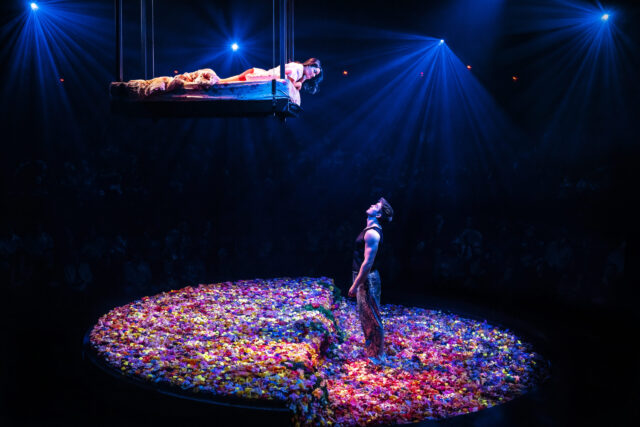
Steve Barnes (Noah Weisberg) and Ross Cellino (Eric William Morris) have quite a bromance in hilarious satire (photo by Marc J. Franklin)

CELLINO V. BARNES
Asylum NYC
123 East Twenty-Fourth St. between Lexington & Park Aves.
Tuesday – Sunday through March 30, $59 – $129
www.cellino-v-barnes.com
asylumnyc.com

“It’s funny, when I look back, it all feels like a dream. Hard to tell what was real and what wasn’t,” Steve Barnes (Noah Weisberg) says near the end of the hilarious farce Cellino V. Barnes.

Ross Cellino (Eric William Morris) adds, “But a lot of it was real. Like, if someone in the future looked us up on Wikipedia, they’d see a lot of this was pretty . . . dead on.”

Don’t bother checking Wikipedia, because I already have, and it turns out that only the barest of bones of Cellino V. Barnes corresponds with reality. But that actually makes it all even more ridiculous and entertaining.

In the late 1990s and early 2000s, Cellino and Barnes gained fame and fortune as a Buffalo law firm that advertised on television, the sides of buses, billboards, subways, and benches. They took unique, often highly questionable approaches to cases and became legal (or is that illegal?) loan sharks. Ross’s father had started Cellino and Likoudis in 1958; Barnes was a marine and military lawyer before hooking up with Cellino. Cellino had his healthy head of hair parted on the right side; Barnes was mostly bald except for hair behind and above his ears.

But most important, they had that jingle, which dramatically escalated their cultish popularity when they changed to a toll-free number:

“Cellino and Barnes / Injury attorneys / Call 800-888-8888.”

Running through January 26 at the Asylum NYC comedy club, the current iteration of the show — the play debuted at Union Hall in July 2018 and has undergone various changes over the years — is an intimate and fun experience. The walls leading to the theater are papered with advertisements for personal injury lawyers. Next to a urinal in the men’s room is an ad for Saul Goodman, the law-breaking lawyer character Bob Odenkirk played on Better Call Saul and Breaking Bad.

Riw Rakkulchon’s small set features a desk with a laptop, a small filing cabinet, a phone with a cord, and high stacks of storage boxes. There are several rows of chairs for audience members on three sides of the stage in addition to traditional seats in the back. Cellino and Barnes are practically on top of each other throughout the show’s eighty minutes as their bromance blossoms, then falls apart.

Writers Mike B. Breen and David Rafieledes, who originated the roles back in 2018, have made Cellino a ne’er-do-well son who is not very bright when it comes to the law or life in general — he has a particular problem with fax machines — while Barnes is a know-it-all attorney with at least some kind of a conscience, until the money starts pouring in.

They first meet when Barnes is interviewing for a position at Cellino and Likoudis and Cellino catches him riffling through paperwork.

“Did you arrive to the interview twenty minutes early to infiltrate my office, steal my interview questions, and prepare answers ahead of time?” Cellino asks.

A humbled Barnes answers, “Umm. Yes. I can head out. I’m really sorry. Nice almost meeting you.”

But Cellino stops him, saying, “No. I love it. Stay. You don’t want to play by the rules? Let’s shake things up.”

That’s precisely what they do for more than twenty years as they grow rich, Cellino finds himself behind bars, and they have a very public breakup that ends up in court.

Cellino (Eric William Morris) gets serious with Barnes (Noah Weisberg) in comic romp at Asylum NYC (photo by Marc J. Franklin)

Codirectors Wesley Taylor, who has starred in such Broadway musicals as Rock of Ages, The Addams Family, and SpongeBob SquarePants, and Alex Wyse, who has appeared in such Great White Way productions as Lysistrata Jones, Spring Awakening, and Good Night, Oscar, gleefully let the narrative go way over the top, occasionally too far, as the silliness reaches near-epic proportions. The show works best when the protagonists are in their suits and ties, scraping up the very bottom of the law for any money they can acquire. (The costumes are by Ricky Curie, with sound by UptownWorks, original music by Max Mueller, and lighting by Aiden Bezark.)

Morris (White Girl in Danger, The Perplexed) is terrific as Cellino, a buffoonish fraudster desperate to hear from his father, or Barnes, that he has done a “good legal job,” while Weisberg (Charlie and the Chocolate Factory, Elf) is quirky as Barnes, who you are sure must have more ethics and morals than he displays, but maybe not. They are like an absurdist Abbott and Costello or Holmes and Yoyo, getting laughs by letting their characters hold nothing back.

Regardless of how much of Cellino V. Barnes is true, it will leave you humming that jingle — and thinking twice the next time you or a loved one might need an injury attorney.

[Mark Rifkin is a Brooklyn-born, Manhattan-based writer and editor; you can follow him on Substack here.]
someone spectacular

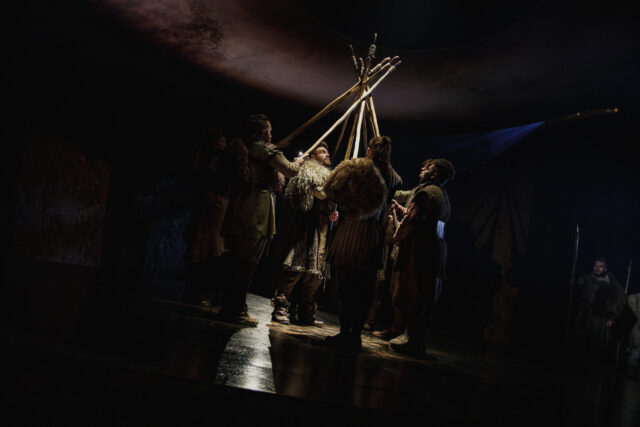
New play takes place at a grief counseling session (photo by Julieta Cervantes)

someone spectacular
The Pershing Square Signature Center
The Romulus Linney Courtyard Theatre
480 West 42nd St. between Tenth & Eleventh Aves.
Through September 7, $39 – $240
someonespectacularplay.com

Pardon me if I enter a theater and am instantly downtrodden upon seeing a bunch of folding chairs, a table with coffee and snacks, and characters slowly and quietly entering the room and taking their seat, apparently preparing to share.

In the past year, New York City been inundated with plays set at least partially in therapy sessions dealing with grief and trauma, both group and one-on-one. Immediately coming to mind are Emma Sheanshang’s The Fears, Those Guilty Creatures’ The Voices in Your Head, Ruby Thomas’s The Animal Kingdom, Marin Ireland’s Pre-Existing Condition, John J. Caswell Jr.’s Scene Partners, and Liza Birkenmeir’s Grief Hotel.

“This is a waste of time,” one character says near the beginning of Doménica Feraud’s someone spectacular.

“We’re not allowed to have fun?” another responds.

The ninety-minute play, continuing at the Pershing Square Signature Center’s Romulus Linney Courtyard Theatre through September 7, has plenty of laughs amid the darkness. It takes place in a cold office space under industrial lighting (designed by the collective dots) where a small group of people meet every Thursday night to talk about “someone spectacular” they’ve recently lost. Fifty-six-year-old Thom’s (Damian Young) wife died of cancer. Forty-seven-year-old Nelle (Alison Cimmet) feels lost since her sister passed. Twenty-six-year-old Julian (Shakur Tolliver) is having trouble dealing with the death of his beloved aunt. Twenty-two-year-old Jude (Delia Cunningham) is new to the group, having suffered a miscarriage. And fifty-one-year-old Evelyn (Gamze Ceylan) is there because she doesn’t understand why she is so sad at the loss of her mother, with whom she did not have a good relationship, while thirty-year-old Lily (Ana Cruz Kayne) is suicidal over her mother’s death, having seemingly lost the only person in the world who cared about her.

When group facilitator Beth is late, the six characters are not sure what to do, whether to wait for Beth to arrive, start the meeting without her, or go home.

“I’m sure she’ll be here soon,” Evelyn says.

“Beth wouldn’t abandon us,” Julian adds.

“People leave you halfway through the wood a lot more often than you think,” Lily asserts.

As time goes on and Beth doesn’t even check in via text, they vote to go on with the session, leading to the breaking of numerous rules as they evaluate and compare one another’s pain and priorities in both comic and mean-spirited ways. Thom is cool and calm but won’t stop taking business calls. Evelyn is caring and understanding. Lily is angry and selfish. Julian is relaxed and easygoing. Jude is sad and defensive. And Nelle is nasty and condescending.

They discuss pasta, Joe Rogan, vaping, shoes, banana bread, plants, and cults as they contemplate their personal situations and who should be the replacement Beth.

“Do you think Beth’s dead? I think Beth’s dead,” Lily declares.

“That would be kind of funny,” Julian says.

“How would that be funny?” Thom asks.

“I don’t know. We lost people we weren’t supposed to lose. I just think it would be funny if our grief counselor up and died on us,” Julian responds.

Nelle (Alison Cimmet) often finds herself in the middle in Doménica Feraud’s someone spectacular (photo by Julieta Cervantes)

The one-act play is adroitly directed by Tatiana Pandiani (Bodas; Field, Awakening), avoiding stasis and boredom as the characters’ movements, both subtle and overt, help define who they are, from Nelle’s quiet insistence of placing an empty chair next to her to Julian’s enjoyment of the banana bread and Lily’s disregard for what’s in her bag. Siena Zoë Allen’s naturalistic costumes further establish their identities, from Julian’s shorts and T-shirt to Evelyn’s high heels and Lily’s hoodie and sneakers.

Feraud’s (Rinse, Repeat) dialogue can be sharp and incisive but then go off on a tangent, like when the group engages in the adult game Fuck, Marry, Kill. There are also red herrings involving an occasional beeping and flickering lights. (The sound is by Mikaal Sulaiman, lighting by Oona Curley.)

The ensemble is compelling, led by Cimmet’s (Party Face, The Mystery of Edwin Drood) aggressive performance as the disagreeable Nelle, Ceylan’s (Noura; Field, Awakening) steadiness as the ever-practical Evelyn, and Young’s (Sacrilege, The Waiting Room) easygoing nature as the forward-thinking Thom, the only one ready to move on with his life.

Be sure to get there several minutes before curtain and pay attention to the set; as the audience enters, so do the actors, one at a time, getting coffee, checking their phones, or staring into space. It’s almost as if they could take a seat in the audience and we could settle onstage, but while we watch them, the actors never make eye contact with the audience until their bows at the end. No one goes through life without suffering some kind of loss, some kind of tragedy, and we all have unique ways to deal with it, rules be damned. No one wants to feel abandoned, and no one wants to be judged.

Yes, someone spectacular is yet another show about grief counseling, but it also accomplishes what theater does best, bringing us all together, encouraging us to look at our own choices while watching those of others.

[Mark Rifkin is a Brooklyn-born, Manhattan-based writer and editor; you can follow him on Substack here.]
HOT TICKET ALERT: BASIL TWIST’S DOGUGAESHI

Basil Twist’s Dogugaeshi returns to Japan Society for a twentieth-anniversary encore presentation (photo © Richard Termine)

DOGUGAESHI
Japan Society
333 East 47th St. at First Ave.
September 11–19, $44-$58
212-715-1258
www.japansociety.org
basiltwist.com

Only seventy-five tickets are available to each of the twelve encore performances of Basil Twist’s Dogugaeshi at Japan Society; six shows are already sold out, so you better hurry if you want to see the special twentieth anniversary revival of the award-winning phenomenon.

Originally presented at Japan Society in 2004 in honor of the 150th anniversary of the US-Japan Treaty of Kanagawa, the sixty-minute work is part of the cultural institution’s fall 2024 series “Ningyo! A Parade of Puppetry.” Dogugaeshi (“doh-goo-guy-ih-shee”) follows the tradition of a stage mechanic developed in Japan’s Awa region using multiple painted fusuma screens and tableaux. “When I heard from several sources of a legendary eighty-eight-screen dogugaeshi, I knew that I had to do this piece with at least eighty-eight screens to bridge this all but vanished art form into the twenty-first century,” Twist, a third-generation puppeteer from San Francisco, explained in a statement.

Performed by four puppeteers including Twist, Dogugaeshi features video projections by Peter Flaherty, lighting by Andrew Hill, and sound by Greg Duffin; the score, composed by shamisen master Yumiko Tanaka, will be played live by Tanaka at the evening shows and by Yoko Reikano Kimura at the matinees. In the narrative, a white fox guides the audience through a tale of Japan’s past and present.

In the above 2014 Japan Society promotional video, Twist says that he sees Dogugaeshi, which has traveled around the globe, as a “sort of meditation into into into into into into this Japanese world. . . . The piece was created for this stage and so it really looks the best on this stage.”

“Ningyo! A Parade of Puppetry” continues October 3–5 with National Bunraku Theater, November 7–9 with “Shinnai Meets Puppetry: One Night in Winter & The Peony Lantern,” and December 12 and 13 with “The Benshi Tradition and the Silver Screen: A Japanese Puppetry Spin-off,” in which star movie talker Ichiro Kataoka and shamisen player Sumie Kaneko accompany screenings of two silent films, Daisuke Ito’s 1927 A Diary of Chuji’s Travels the first night and Shozo Makino’s 1910-17 Chushingura the second evening.

[Mark Rifkin is a Brooklyn-born, Manhattan-based writer and editor; you can follow him on Substack here.]
THE STORY OF LOT’S WIFE

The Story of Lot’s Wife celebrates a never-named but key biblical character (photo by twi-ny/mdr)

THE STORY OF LOT’S WIFE
The Cell Theatre
338 Twenty-Third St. between Eighth & Ninth Aves.
Thursday – Sunday through August 25, $10-$35, 11:00 am – 7:00 pm
www.thecelltheatre.org
www.ofotheater.com

Dan Daly reimagines a mysterious figure from the Bible in the immersive, performerless theater installation The Story of Lot’s Wife, extended at the Cell through August 25.

Described as “a recentering through text, object, and action,” the fifteen-minute ritualistic but not religious experience gives agency and identity to Lot’s wife, who is never named in the Bible, neither in the Old Testament nor in the New Testament, where Jesus declares as a warning, “Remember Lot’s wife.”

The narrative is divided into ten sections, beginning with a prologue that relates the tale of Lot, his wife, and their daughters as two angels descend from heaven to save them from the rampant sin occurring in Sodom and Gomorrah. As they leave the burning city, Lot’s wife looks back at the devastation and becomes a pillar of salt.

After reading the account, one audience member at a time then enters a small, narrow winding structure, walking through a beaded curtain and along a tiled path lined by fragile blue velvet, stopping at nine stations to read from a handout and examine a related object on a plinth. (Daly conceived the project during the pandemic, when theaters were closed and people were not interacting with one another.) Among the items are Himalayan salt, a bar napkin, a piece of brimstone, and a framed icon, accompanied in the booklet by a brief description and a photo of a related object from the real world. An atmospheric soundscape by Julian Singer-Corbin echoes through the space, which is dimly lit by Zoe Griffith.

Daly, who wrote the text and designed and constructed the installation, seizes on the word “became.” At the second stop, the narrative explains: “The story says, / ‘and she became a pillar of salt.’ / You were not turned, you became. / It follows that a choice was made to become, / To preserve, / To remember the people you love. / When you ‘become’ you have a will, / To become is not forced upon you, it is an action.”

Daly proposes that it was not divine intervention but her own tears that changed Lot’s wife’s body into salt. He also sees her as a gay icon, suggesting that what she was looking back at was, at least in part, a homosexual community that was not involved in debasement but in same-sex love; he acknowledges that queerness never factored specifically in the biblical tale, but he writes, “We welcome the name ‘Sodomites’ with honor.” As of late 2023, twelve states still had laws against consensual sodomy, or gay sex. The play concludes with a communal call for renewal.

The Story of Lot’s Wife is presented through the new company Other Forms of Theater (Ofo), which seeks to “create and support performances that do not fit neatly into the definition of ‘theatre’ and exist below what is deemed commercially viable. We experiment with the theatrical form and rethink what performance is, not just artistically but also structurally.”

Daly, who has designed such shows as the immersive Tammany Hall at SoHo Playhouse and Third Rail Project’s site-specific Oasis at Brookfield Place, has accomplished just that with The Story of Lot’s Wife, which is about a lot more than a biblical yarn. On your way out, be sure to say hello to the person behind the desk and share your thoughts; it’s likely to be Daly himself.

[Mark Rifkin is a Brooklyn-born, Manhattan-based writer and editor; you can follow him on Substack here.]