this week in theater

HELLMAN v. McCARTHY

(photo by Kim T. Sharp)

Mary McCarthy (Marcia Rodd) shares her blunt opinions with Dick Cavett in HELLMAN v. McCARTHY (photo by Kim T. Sharp)

June Havoc Theatre
Abingdon Theatre Arts Complex
312 West 36th St. between Eighth & Ninth Aves.
Wednesday – Sunday through April 13, $25
www.abingdontheatre.org

On October 18, 1979, one of the most dramatic literary feuds of the twentieth century kicked off on The Dick Cavett Show when writer and critic Mary McCarthy called Lillian Hellman a “dishonest writer,” explaining that “I said once in some interview that every word she writes is a lie, including ‘and’ and ‘the.’” An irate Hellman sued McCarthy, Cavett, and PBS for more than two million dollars, leading to a vitriolic back-and-forth between the writer of such works as The Children’s Hour, The Little Foxes, and Watch on the Rhine and the author of such books as The Company She Keeps, Memories of a Catholic Girlhood, and The Group — the last of which was made into a film starring, among others, Cavett’s wife, Carrie Nye. Various versions of the famous story have already been told onstage, by Nora Ephron in her musical, Imaginary Friends, Ben Pleasants in Contentious Minds: The Mary McCarthy, Lillian Hellman Affair, and William Wright in The Julia Wars. Now Brian Richard Mori is taking on this battle of literary bigs with a unique twist: The character of Dick Cavett is being played by, well, Dick Cavett himself, and Cavett is by far the best thing about the Abingdon Theatre’s otherwise doleful Hellman v. McCarthy. The proverbial gloves come off as soon as McCarthy (Marcia Rodd) calls Hellman (Roberta Maxwell) a liar; as it turns out, when the recorded show aired, Hellman was watching with her nurse, Ryan Hobbs (Rowan Michael Meyer), and she did not react well to McCarthy’s statement, immediately calling her attorney.

Lillian Hellman’s nurse jumps for joy upon meeting Dick Cavett (photo by Kim T. Sharp)

Lillian Hellman’s (Roberta Maxwell) nurse (Rowan Michael Meyer) jumps for joy upon meeting Dick Cavett (photo by Kim T. Sharp)

Hellman’s lawyer, Lester Marshall (Peter Brouwer), and McCarthy’s, Burt Fielding (Jeff Woodman), can’t get their clients to reach an agreement as the nasty words keep flying. “I’d rather eat my own vomit,” Hellman says when told by Marshall that they can read everything they want about McCarthy as part of discovery. “I refuse to make it easy for her,” McCarthy tells Fielding upon deciding to appeal. Ultimately, Mori has the two women go face-to-face at a meeting that never actually took place, continuing the nearly constant drone of unpleasantness at an even higher pitch as these two extremely unlikable women have it out. The only respite is the occasional appearance of Cavett to fill in some of the details and share his own thoughts on the matter; he is, as ever, witty, charming, and intellectual, although he does too many Woody Allen references. Abingdon artistic director Jan Buttram cuts between two primary sets designed by Andrew Lu: on the left side of the stage is a room in Hellman’s home on Martha’s Vineyard, while to the right is a room in McCarthy’s house in Castine, Maine. Virtually all the furniture is white, with empty picture frames, as if implying that neither of the women has any friends or family. Travis McHale’s lighting design turns the back walls various pastel shades of pink, green, and other colors, offering just about the only amiable visuals aside from Cavett’s appearances. Hellman v. McCarthy sheds no new light on the feud, instead letting two nasty souls blather on in nasty ways; the production probably would have been much better if it was simply a one-man show featuring Cavett.

APPROPRIATE

(photo by Joan Marcus)

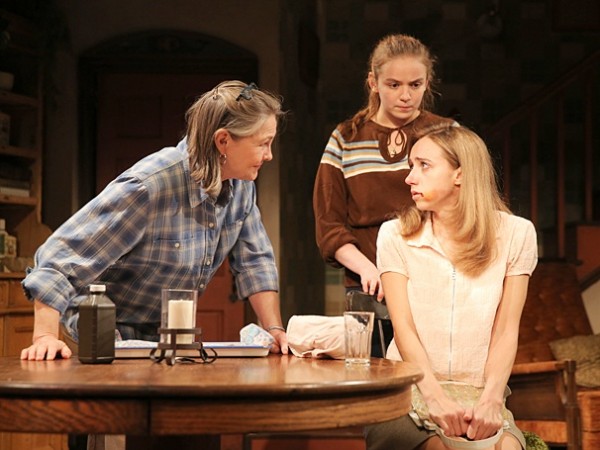
A dysfunctional family is forced to reassess the past — and the future — in New York premiere of APPROPRIATE (photo by Joan Marcus)

The Pershing Square Signature Center
The Alice Griffin Jewel Box Theatre
480 West 42nd St. between Tenth & Eleventh Aves.
Extended through April 13, $75
212-244-7529
www.signaturetheatre.org

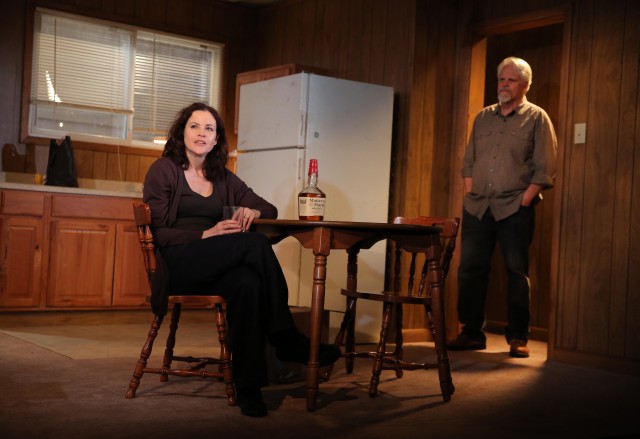
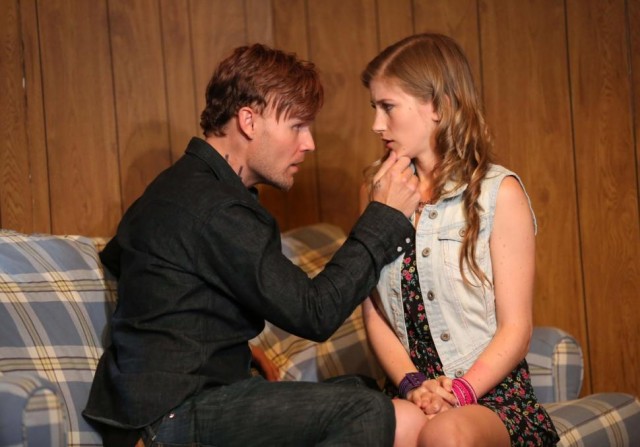
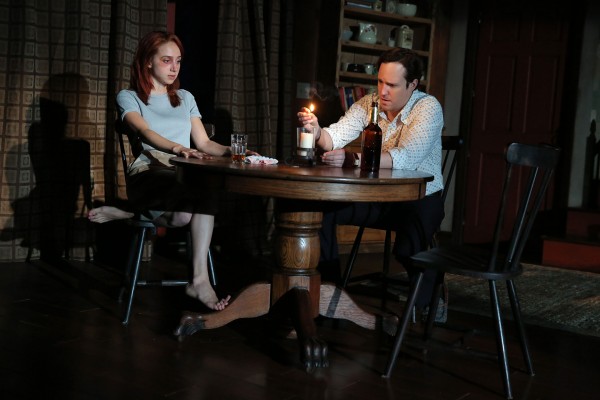
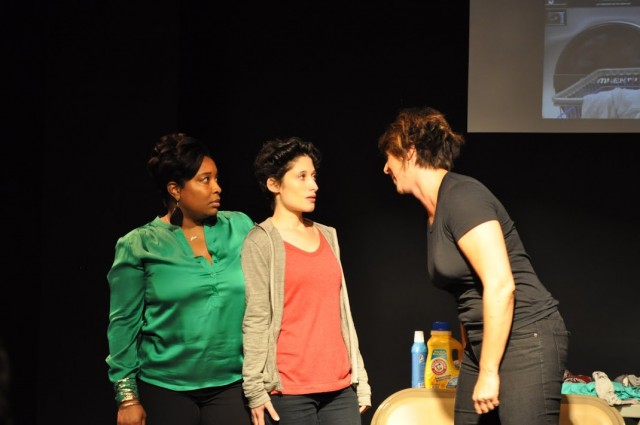
In working on Appropriate, his first production as part of the Signature Theatre Residency Five program, Branden Jacobs-Jenkins was inspired by specific family dramas by such previous Signature residency playwrights as Sam Shepard, Arthur Miller, and Horton Foote in addition to Tennessee Williams, Eugene O’Neill, and Anton Chekhov. He was also influenced by Hilton Als’s “GWTW” essay for the 2000 New-York Historical Society exhibition “Without Sanctuary: Lynching Photography in America,” in which the art critic wrote about being asked to contribute to the catalog, surmising that it was primarily because he was black. “A black writer,” Als wrote, “is someone who can simplify what is endemic to him or her as a human being — race — and blow it up, to cartoon proportions, hereby making the coon situation ‘clear’ to a white audience.” That is precisely what Jacobs-Jenkins has done with Appropriate, the story of three white siblings who have returned to the family’s dilapidated southern plantation to sell it to pay off debts. Franz (Patch Darragh), the black sheep who disappeared shortly after a serious indiscretion with a minor, arrives with his easygoing, crunchy, and much younger girlfriend, River (Sonya Harum). Bo (Michael Laurence) shows up with his Jewish wife, Rachael (Maddie Corman), and their two kids, Ainsley (Alex Dreier) and Cassidy (Izzy Hanson-Johnston). And the divorced Toni (Johanna Day) brings her troubled teenager, Rhys (Mike Faist). As they brutally argue over money, the past, responsibility, and the Lafayette family legacy, they find a home-made book of photographs of lynched black men, forcing them to take a closer, far more painful look at who their father might have been as well as at themselves.

Branden Jacobs-Jenkins meets with the cast of APPROPRIATE (photo by Gregory Costanzo)

Branden Jacobs-Jenkins meets with the cast of APPROPRIATE (photo by Gregory Costanzo)

Although it’s very much about the African American experience, there are no living black characters in Appropriate, a title that refers to both pronunciations and meanings of the word: “to take or make use of without authority or right” and “especially suitable or compatible.” In the Lafayette clan’s world, blacks exist only in the nearby slave cemetery and in the lynching photographs. They refuse to acknowledge that their father could have been a racist bigot (or worse), even as evidence keeps piling up. Meanwhile, they try to protect the younger generation from seeing the pictures, as if the past can just be buried, but, of course, it’s not that easy. Directed by Liesl Tommy (The Good Negro, A Stone’s Throw), Appropriate begins with solid character development while raising intriguing social and moral issues without getting didactic. But the story goes off the rails in the second act as various secrets emerge and the vitriol reaches even higher levels. Perhaps most unfortunate, there’s a moment that seems like the perfect ending; the lights go out, and just as the audience is ready to applaud, the play continues through a disappointing, unnecessary coda. In Appropriate, Jacobs-Jenkins (Neighbors, An Octoroon) clutters what is a fascinating premise with too many disparate elements. In an interview in Signature Stories, the theater’s free magazine, Jacobs-Jenkins says, “I ended up deciding I would steal something from every play that I liked, and put those things in a play and cook the pot to see what happens.” Although made up of some very fine ingredients, Appropriate is overstuffed, its subtle complexities gone well past the boiling point.

VISIONS AND VOICES — CHINA: RICHARD III

RICHARD III

National Theatre of China makes its U.S. company debut with RICHARD III at Skirball Center (photo by Liu Weilen)

NATIONAL THEATRE OF CHINA: RICHARD III
NYU Skirball Center for the Performing Arts
566 La Guardia Pl. between Third & Fourth Sts.
March 26-30, $39-$65
212-992-8484
nyuskirball.org

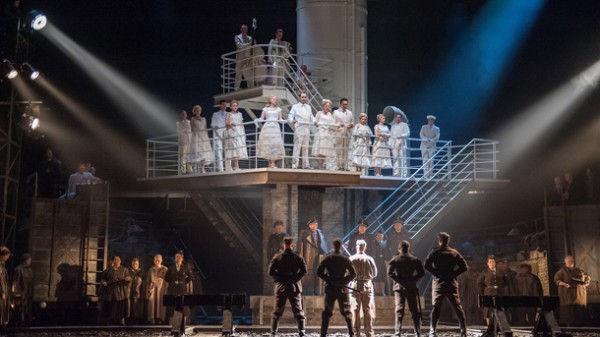
In just the last two years, New York has seen numerous productions of Richard III, from Mark Rylance in the throwback Globe version on Broadway to Kevin Spacey’s star turn as part of the Bridge Project at BAM, from Ron Cephas Jones’s multiborough performance in the Public Theater’s Mobile Shakespeare Unit to Alessandro Colla in a suit and tie for Shakespeare in the Parking Lot’s outdoor production on the Lower East Side. Each of those shows had its own unique take on the Bard’s exploration of power, desire, and corruption, but perhaps the most unusual rendition is the National Theatre of China’s presentation, which comes to NYU’s Skirball Center March 26-30 as part of the second annual “Visions + Voices” festival. Streamlined to a mere hundred minutes, this Richard III will feature Chinese costumes, martial arts, acrobatics, music, and other elements of traditional Eastern staging by the National Theatre of China, in its U.S. company debut. The March 27 performance will be followed by a talk with director and National Theatre vice president Wang Xiaoying and script editor and dramaturge Luo Dajun, and the March 28 and 30 shows will be followed by conversations with Wang and actors Zhang Donglei and Zhang Xin; in addition, the panel discussion and audience Q&A “Beyond Puck: Performing Shakespeare in Asian America” will take place March 28 at 5:30 (free with advance registration) with Farah Bala, Ruy Iskander, Ching Valdes-Aran, Danielle Ma, Vandit Bhatt, Tisa Chang, and Ariel Estrada. “Visions + Voices: China” continues April 12 with a screening of Zhang Meng’s The Piano in a Factory and May 12 with Tan Dun’s “The Map” and “Concerto for String Orchestra and Pipa,” performed by the NYU Symphony Orchestra, featuring conductor Andrew Cyr, pipa virtuoso Zhou Yi, and cellist Wendy Sutter.

Chinese production of RICHARD III leaves a lot to the imagination (photo by Liu Weilen)

Chinese production of RICHARD III leaves a lot to the imagination (photo by Liu Weilen)

Update: The National Theatre of China’s American debut ended up being a rather curious affair. What was advertised as a one-hundred-minute Chinese production of Shakespeare’s Richard III with English surtitles ended up being around two and a half hours, with extremely limited descriptive sentences (that often worked improperly) instead of a full translation. The action, which includes acrobatics and martial arts, takes place on Liu Kedong’s spare but elegant set, featuring two carved columns and an ornate throne behind which hangs a series of calligraphy banners displaying such words as “Truth,” “Blood,” and “Conspiracy.” Zhang Dongyu portrays the title character with a sexy bravado, hunching and limping only when he’s delivering his scheming monologues; otherwise, he stands tall and proud as he woos Lady Anne (Zhang Xin) and kills off all possible challengers; following each death, blood drips down the banners, almost as if keeping score. Shakespeare’s story of the power struggles within and between the Yorks and the Lancasters, rival dynasties fighting for the English crown, moves easily across cultures, settling smoothly into an imperial Chinese milieu. But even for those who are very familiar with the details of Shakespeare’s tale, the decision to not translate any of the dialogue left many in the dark; it was particularly disconcerting when those members of the audience who understood Mandarin would laugh at a line, making everyone else feel left out — and resulting in dozens of people not returning after intermission. It also made it difficult to figure out why three witches seemed to have come over from Macbeth. But the costumes are colorfully grand, and percussionist Wang Jianan virtually steals the show, as no translation is needed for his thrilling, evocative live score.

WAITING FOR GODOT / NO MAN’S LAND

(photo by Joan Marcus)

Didi (Patrick Stewart) and Gogo (Ian McKellen) joke around while waiting for Godot in Samuel Beckett masterpiece (photo by Joan Marcus)

Cort Theatre
138 West 48th St. between Sixth & Seventh Aves.
Extended through March 30, $40 – $147
www.twoplaysinrep.com

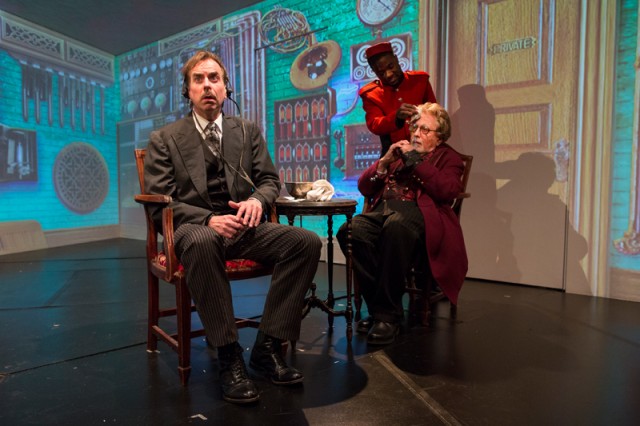
For the past five months, British thespians Patrick Stewart and Ian McKellen have been having a blast in New York, as they perform two existential masterpieces in repertory on Broadway and travel all over the city in their bowler hats, posting fabulous pictures on their twitter sites. Sir Ian and Sir Pat are now entering the last week of two marvelous productions, Samuel Beckett’s Waiting for Godot and Harold Pinter’s No Man’s Land, running at the Cort Theatre through March 30. The two men, who have previously starred opposite each other as frenemies in the X-Men movies, first teamed up for Godot in London in 2009; they had such a good time, they decided to bring it to Broadway. It was director Sean Mathias’s idea to add Pinter’s 1975 drawing-room romp, and the two plays work extremely well together, like a pair of old friends enjoying each other’s company. In Waiting for Godot — the last word of which you will forever pronounce with the accent on the second syllable after seeing this show — McKellen is Estragon (Gogo) and Stewart is Vladimir (Didi), two homeless men who are expecting a man named Godot to arrive. In between Gogo’s concern for his boots and Didi’s frequent trips to relieve himself, the drifters engage in such surreal dialogue as E: “He should be here.” V: “He didn’t say for sure he’d come.” E: “And if he doesn’t come?” V: “We’ll come back tomorrow.” E: “And then the day after tomorrow.” V: “Possibly.” E: “And so on.” V: “The point is —” E: “Until he comes.” V: “You’re merciless.” E: “We came here yesterday.” V: “Ah no, there you’re mistaken.” E: “What did we do yesterday?” V: “What did we do yesterday?” E: “Yes.” V: “Why . . . Nothing is certain when you’re about.” Indeed, nothing is certain in the two-and-a-half-hour, two-act play, even when the pompous Pozzo (Shuler Hensley) arrives, led by his apparent human slave, Lucky (Billy Crudup). What’s it all about? That’s something that theatergoers and critics have been contemplating and arguing about for some fifty years, getting little help from Beckett himself. The beauty of Godot is that it is about everything and nothing, perhaps the most entertaining and perplexing Rorschach test ever conceived. It’s really about whatever you want it to be, including, very simply, exceptional theater.

(photo by Joan Marcus)

Spooner (Ian McKellen) and Hirst (Patrick Stewart) rehash the past in Harold Pinter classic (photo by Joan Marcus)

Much is left up to the audience to figure out in the absurdist black comedy No Man’s Land as well. After meeting in a pub, the wealthy, impeccably dressed Hirst (Stewart, wearing a wonderful pair of bright blue socks and a fashionable toupee) brings home the somewhat less erudite but scholarly Spooner (McKellen) for further conversation and top-shelf liquor. The two men discuss life and love, aging and infidelity, poetry and memory, occasionally joined by Foster (Crudup) and Briggs (Hensley), who may or may not be Hirst’s sons or servants. (The four characters are named after great cricketers — not that that lends insight into who they are or what they actually represent, other than that Pinter is playing yet more games with his story.) Stewart and McKellen, in roles originated by a pair of other sirs, Ralph Richardson and John Gielgud, respectively, are utterly delightful as the two gents. Are they old college friends? Romantic competitors? Two halves of the same person? As in Waiting for Godot, the significantly more acerbic No Man’s Land is open for vast interpretation as well, although it provides far more clues. Both plays are splendidly directed by Mathias (Bent), who honors the spirit of each play without getting overly fancy or dramatic, and feature exemplary sets and costumes designed by Stephen Brimson Lewis that evoke heaven, hell, and the way station in between. Over the past dozen years or so, McKellen (King Lear, Dance of Death) and Stewart (A Christmas Carol, Macbeth) have appeared on the New York stage separately, but there’s nothing quite like seeing them together on Broadway, in a pair of stellar productions that allow them to have just as much fun as the audience.

NOTHING ON EARTH CAN HOLD HOUDINI

(photo by Dixie Sheridan)

George Demas plays master prestidigitator Harry Houdini in Axis Company world premiere (photo by Dixie Sheridan)

Axis Company
One Sheridan Sq. between West Fourth & Washington Sts.
Thursday – Saturday through April 5, $30-$0, 8:00
212-352-3101
www.axiscompany.org

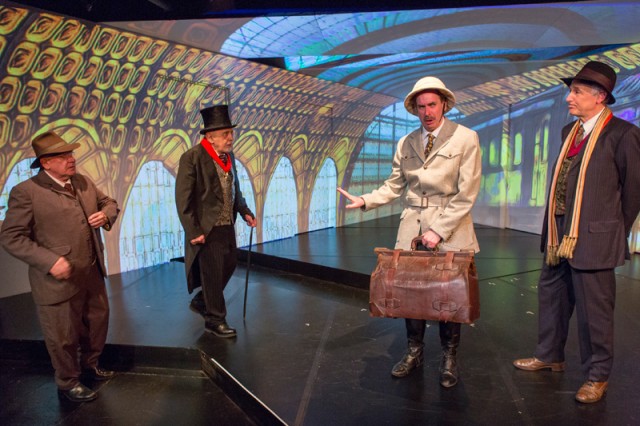
In 1930, Sir Arthur Conan Doyle wrote of his short-term friend and colleague, “Who was the greatest medium-baiter of modern times? Undoubtedly Houdini. Who was the greatest physical medium of modern times? There are some who would be inclined to give the same answer.” That dichotomy lies at the heart of Nothing on Earth Can Hold Houdini, in which Axis Company artistic director Randy Sharp examines the unusual relationship between magician and mysticism debunker Harry Houdini and spiritualism believer and Sherlock Holmes creator Doyle, brought together by a 1922 contest sponsored by Scientific American to find a true clairvoyant. In the eighty-five-minute one-act play, running at Axis’s home stage at One Sheridan Square through April 5, Doyle (Spencer Aste) and Houdini (George Demas) are essentially seeking the same thing; both men want to contact a dead relative through a medium, Doyle desperate to converse with his beloved son Kingsley, Houdini determined to speak again with his dear mother. But while Doyle is convinced that there is no death, that there is an afterlife, Houdini aggressively seeks to discredit potential fakes, such as Ralph Grimshaw (Brian Linden), who appear to be in the spirit game only for the money and fame. Doyle also believes that Houdini himself has special powers, telling him, “Let us see if you are able to ‘self-liberate’ from the ironclad manacles of disbelief,” while Houdini insists that there is no otherworldly magic to what he does: “I am not a shape shifter, medium spirit contactor, automatic writer, ghost fairy photographer, or anything of that nature,” he tells his mechanist, Jim Collins (David Crabb). To settle their differences, Doyle and Houdini participate in a demonstration in which popular medium Margery “Mina” Crandon (Lynn Mancinelli), with the help of her husband, Leroi (Brian Barnhart), will attempt to prove once and for all that the spirit world exists. “You are a shining example of an enlightened conduit to the beyond,” Doyle pronounces, while Houdini explains, “We shall expose her to the Scientific American League of Shills and Collaborators for all the good it’ll do me.”

(photo by Dixie Sheridan)

Mina Crandon (Lynn Mancinelli) gets in the Margery Box while attempting to contact the great beyond (photo by Dixie Sheridan)

Demas has a ball as Houdini, the pompous, conflicted mama’s boy in a ratty old jacket and pathetic shoes, sporting a hairstyle that is nearly a character unto itself, and Aste is solid as the dapper Doyle. But Sharp, who created an intoxicating atmosphere for her previous Axis production, the postapocalyptic Last Man Club, never achieves much of a flow with Nothing on Earth, which is constrained by a disjointed narrative and sudden, confusing plot jumps. Too many elements get lost in the dark, leaving the audience to fill in the gaps. But individual scenes excel, making Nothing on Earth a mixed bag of tricks.

(The March 29 performance will be followed by a Q&A with members of the cast and crew and historical consultant William Kalush, author of The Secret Life of Houdini and executive director of the Conjuring Arts Research Center on West Thirtieth St.)

THE OPEN HOUSE

(photo by Joan Marcus)

A severely dysfunctional family is stuck in its ways in Will Eno’s black comedy at the Signature (photo by Joan Marcus)

The Pershing Square Signature Center
The Romulus Linney Courtyard Theatre
480 West 42nd St. between Tenth & Eleventh Aves.
Extended through March 30, $25 through March 23, $75 after
212-244-7529
www.signaturetheatre.org

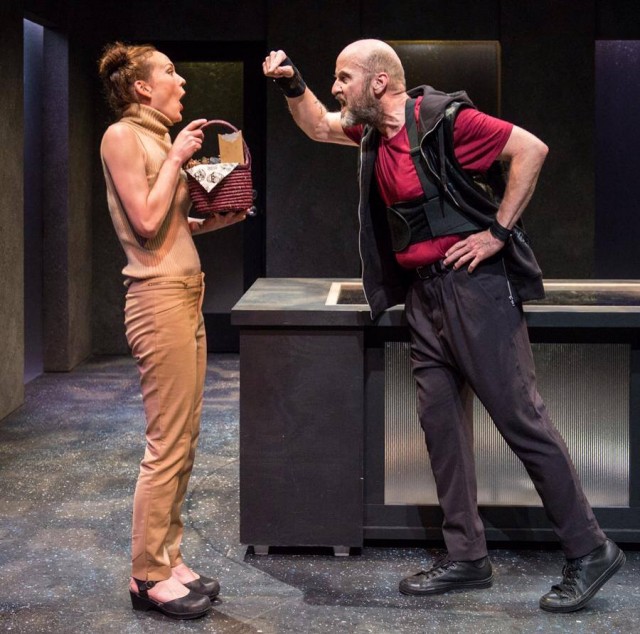
In Title and Deed, the first of his three plays as part of the Signature Theatre’s Residency Five program, Will Eno explored the concept of home and finding one’s place in a community. In his follow-up, The Open House, it appears that home might not be all it’s cracked up to be. Or is it? “Why are we like this?” the daughter (Hannah Bos) calls out as an unnamed family bickers over just about everything. The wheelchair-bound father (Peter Friedman) is a brutally vicious man, aiming acerbic and mean-spirited barbs at his grown daughter and son (Danny McCarthy), mild-mannered brother (Michael Countryman), and ditzy wife (Carolyn McCormick). It’s so acrimonious and loveless that the beloved family dog has run away. But with a sly nod to Bruce Norris’s Clybourne Park, the play takes a major turn in the second half, one that builds to an unexpectedly satisfying climax. Directed by Oliver Butler (Cape Disappointment, You’re Welcome), Eno’s story takes place on Antje Ellermann’s family room set, the front of which has been torn away, welcoming the audience to the vitriol and strangeness that reside within — but which shifts dramatically in the second half of the eighty-minute play, when it becomes the kind of open house potential buyers stop by to consider whether this might be the next step on their personal journey toward finding home and happiness. Eno (Middletown, Broadway’s new The Realistic Joneses) has a firm grasp of the bathos and pathos of this hysterically dysfunctional family, employing razor-sharp dialogue to quickly establish the characters and lay the groundwork for their pending fate. The Open House is another savvy, perceptive work from an extremely clever and creative playwright, a true rising star.

TICKET GIVEAWAY: MY MOTHER HAS 4 NOSES

Jonatha Brooke gets personal in poignant one-woman show, MY MOTHER HAS 4 NOSES

Jonatha Brooke gets personal in poignant one-woman show, MY MOTHER HAS 4 NOSES

MY MOTHER HAS 4 NOSES
The Duke on 42nd St.
229 West 42nd St. between Seventh & Eighth Aves.
Thursday – Sunday through May 4, $55 – $75
646-223-3010
www.4noses.org
www.dukeon42.org

Three and a half years ago, singer-songwriter Jonatha Brooke put her career on hold as she cared for her mother, a poet and clown who had contracted Alzheimer’s. She has turned that experience into an album and a poignant new one-woman show, My Mother Has 4 Noses, which her failing mother encouraged her to write. “Almost daily she would say, ‘Boolie [my nickname], that’s good!’” Brooke explains on the show’s website. “‘Are you getting this down? We should make a play out of it!!’” Brooke, who has released such records as 10 Cent Wings, Steady Pull, and Careful What You Wish For, adds, “My Mother Has 4 Noses is my story, but it’s everyone’s story.” Among the songs Brooke wrote for the show are “My Misery,” “Superhero,” “Scars,” “Time,” “How Far You’d Go for Love,” and “What Was I Thinking?” all of which you can sample here.

TICKET GIVEAWAY: Directed by Jeremy Cohen, My Mother Has 4 Noses is running at the Duke on 42nd St. through May 4, and twi-ny has four pairs of tickets to give away for free for performances through March 30. (Saturday matinees in March will be followed by a talk back with Brooke and various specialists on dementia and caregiving.) Just send your name, daytime phone number, and all-time-favorite play or movie about a mother and daughter to contest@twi-ny.com by Monday, March 17, at 12 noon to be eligible. All entrants must be twenty-one years of age or older; four winners will be selected at random.