this week in theater

HOLLER IF YA HEAR ME: AN ORIGINAL MUSICAL

(photo by Joan Marcus)

New musical uses Tupac Shakur’s lyrics to tell contemporary tale of hard life (photo by Joan Marcus)

Palace Theatre
1654 Broadway at West 47th St.
Thursday – Tuesday through January 4, $67.75 – $184.25
www.hollerifyahearme.com

The new musical Holler If Ya Hear Me might be based on the songs of Tupac Shakur, but it does not tell the life story of the controversial West Coast rapper who was shot and killed in a Las Vegas drive-by in 1996 at the age of twenty-five. Instead, book writer Todd Kreidler — introduced to Shakur’s music by friend and mentor August Wilson — uses Shakur’s lyrics to share a contemporary tale about life in a ghetto in an unnamed Midwestern industrial city. As the play opens, John (Slam star Saul Williams) descends from the heavens in a jail cell, evoking Shakur’s several stints in prison, while delivering the East Harlem native’s “My Block,” soon joined by the company, setting the mood with the posthumously released song about guns, crack, black-on-black crime, unemployment, economic hardship, and racism. After his innocent brother, Benny (Donald Webber Jr.), is shot and killed, Vertus (Christopher Jackson) is determined to get even with the members of the 4-5 gang who took out Benny, angering his mother (Tonya Weston), alienating his girlfriend, Corinne (Saycon Sengbloh), and energizing young Anthony (Dyllon Burnside), who wants revenge as well. Meanwhile, the moody, humorless John is looking to go straight, getting a job working in Griffy’s (Ben Thompson) car-salvage business, where Benny used to work, planning with the white Griffy to get out of the neighborhood together. Through it all, a decrepit old man (John Earl Jelks) calls for peace by writing on walls and preaching through a megaphone.

John (Saul Williams) and Darius (Joshua Boone) get down to serious business as Anthony (Dyllon Burnside) looks on in HOLLER IF YA HEAR ME (photo by Joan Marcus)

John (Saul Williams) and Darius (Joshua Boone) get down to serious business as Anthony (Dyllon Burnside) looks on in HOLLER IF YA HEAR ME (photo by Joan Marcus)

The first act of Holler If Ya Hear Me is a mess, with a confusing narrative and point of view, a kind of mishmash of West Side Story and In the Heights, but director Kenny Leon (A Raisin in the Sun, Stick Fly) brings things together in act two, focusing more on the individual stories of John, Griffy, and especially Vertus, with stand-out performances by Williams, Thompson, and Jackson. Daryl Waters’s orchestrations too often emphasize Shakur’s background use of R&B elements, Broadway-fying such songs as “I Ain’t Mad at Cha,” “Me Against the World,” “Dear Mama,” and “Unconditional Love”; Wayne Cilento’s (Wicked, Jersey Girls) choreography is almost nonexistent; and Edward Pierce’s set design is essentially a bare stage with stoops and a fenced-in salvage show occasionally, sometimes randomly, wheeled in, but Leon and the company still manage to pull it all off in the end while setting a new high for the use of the N-bomb on the Great White Way. The Palace Theatre itself has been transformed for the show, with stadium seating in the front of the tiny orchestra, while the rear has been turned into an interactive exhibition curated by the National Museum of Hip-Hop.

WHEN WE WERE YOUNG AND UNAFRAID

WHEN WE WERE YOUNG AND UNAFRAID

Cherry Jones, Morgan Saylor, and Zoe Kazan shine in world premiere by Sarah Treem (photo by Joan Marcus)

Manhattan Theatre Club
New York City Center Stage 1
Tuesday – Sunday through August 10, $89
212-581-1212
www.whenwewereyoungandunafraid.com
www.nycitycenter.org

Five-time Tony nominee Cherry Jones follows up her breathtaking performance as Amanda Wingfield in the Broadway revival of The Glass Menagerie with another powerful turn in Sarah Treem’s When We Were Young and Unafraid, but the two-time Tony winner (Doubt, The Heiress) ends up being much better than the play itself. Jones stars as Agnes, a determined woman running a bed and breakfast in 1972 on a small island off the coast of Seattle. In addition to serving vacationing guests, Agnes and her teenage daughter, Penny (Morgan Saylor), also secretly house and help battered women, protecting them from their abusers while nursing them back to physical and mental health. One day a terrified Mary Anne (Zoe Kazan) knocks on the door, her face beaten to a bloody pulp. Agnes offers her temporary asylum as long as she promises not to contact her husband, and soon Mary Anne and Penny, a bookish girl who wants to go to the prom with the captain of the football team, are bonding, discussing life and love. That part of the play works extremely well, treating a difficult subject with tenderness and humor.

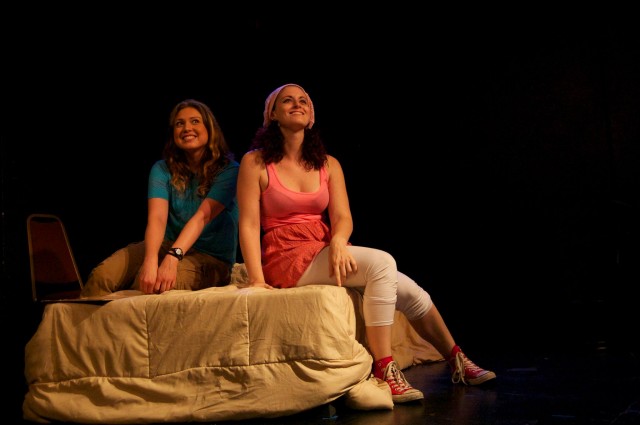
Too many hard-to-believe twists leave WHEN WE WERE YOUNG AND UNAFRAID in the dark (photo by Joan Marcus)

Too many hard-to-believe twists leave WHEN WE WERE YOUNG AND UNAFRAID in the dark (photo by Joan Marcus)

However, Treem, who has written such previous plays as A Feminine Ending and The How and the Why and for such television series as House of Cards and In Treatment, tries to do too much, losing focus, particularly by introducing the wholly unbelievable characters of Hannah (Cherise Boothe), a brash black lesbian spouting revolutionary platitudes, and Paul (Patch Darragh), a wimpy white singer-songwriter who is instantly attracted to Mary Anne. The Manhattan Theatre Club production, more than ably directed by Pam MacKinnon (Clybourne Park, Who’s Afraid of Virginia Woolf?), ultimately fails in attempting to examine the women’s rights movement from too many sides, getting lost in heavy didacticism and moralizing and losing its initial firm footing in reality. But Jones is still a marvel to watch, her every movement filled with nuance, eliciting solid support from Kazan (A Behanding in Spokane, The Exploding Girl) and Homeland regular Saylor in her affecting stage debut.

THE UNCHAINED THEATRE FESTIVAL 2014

LAUNDRY

David Bellantoni’s LAUNDRY is looking to clean up at the Chain Theatre on Saturday night (photo by Grace Wissler)

Chain Theatre
21-28 45th Rd., Long Island City
Saturday, June 28, $15, 7:00
www.variationstheatregroup.com

For the last several weeks, more than a dozen entrants have been fighting it out, and now the stakes are even higher as the four finalists are ready to do battle this weekend to crown a new champion. No, we’re not talking about the World Cup — which has more than its fair share of histrionics — but the second annual Unchained Theatre Festival, organized by the Variations Theatre Group. On Saturday night, June 28, the four surviving one-act plays will be performed at the small, intimate Chain Theatre around the corner from MoMA PS1 in Long Island City, competing for the Best Play Award. The finalists are Eugenie Carabatsos’s Stalled, Marc Castle’s What Would Jesus Do?, Jon Spano’s The Sweat, and David Bellantoni’s Laundry. “We are excited about the success and audience response to this year’s festival,” VTG co-artistic director Rich Ferraioli told twi-ny. “Each of the pieces this year was both engaging and relevant for our audiences. The final group, specifically, range from comedic Laundromat thrillers to religious blind dates and even to an ensemble-based piece set entirely in a car.” For the other awards, the Best Actor category features Curtain Call’s Ryan Barry, The Sweat’s Aaron Matteson, and Laundry’s Joe Wissler, while The XXX Scholar’s Jenni Graham, What Would Jesus Do?’s Cari McHugh, and Laundry’s Malika Nzinga are up for Best Actress. Duking it out for Best Director are Stalled’s Andrew Wells Ryder, The Sweat’s Reginald L. Douglas, and WWJD? writer Castle. The casts of Stalled, The History of the Donner Party: A Country Musical!, and The XXX Scholar are up for Best Ensemble. “This is sure to be a night of laughs, smiles, and good quality theater in LIC,” Ferraioli added. Based on the preliminaries we saw earlier this week, we heartily agree, but you better act fast, as seating is limited.

DONOGOO: A COMEDY

(photo by Richard Termine)

Lamendin (James Riordan) visits Dr. Rufisque (George Morfogen) to try to find purpose in his life in Mint revival of DONOGOO (photo by Richard Termine)

Mint Theater
311 West 43rd St. between Eighth & Ninth Aves.
Tuesday – Sunday through July 27, $27.50-$65
866-811-4111
www.minttheater.org

Perhaps the Mint Theater, usually so adept at digging up long-forgotten works and bringing them wonderfully to life (Katie Roche, London Wall), subtitled its latest unearthing, Jules Romains’s Donogoo, “A Comedy” to tell the audience that it is supposed to be funny. Unfortunately, there are few genuine laughs to be had in the disappointing farce, which has been performed in America only once before, in a 1961 production by the Greenwich Mews Theatre. In 1920, French writer Romains, author of the twenty-seven-volume Men of Good Will, published Donogoo-Tonka or the Miracles of Science: A Cinematographic Tale, and the satire about commercialism and colonialism was turned into a play ten years later. Newly translated and directed by Gus Kaikkonen, who did the same with the Mint’s 2010 revival of Romains’s Dr. Knock, or the Triumph of Medicine, the play, which the program describes as “A Comedy in 23 Tableaux,” follows the suicidal Jacques-Patrice Lamendin (James Riordan), who is saved from jumping off the Moselle Bridge by his friend Benin (Mitch Greenberg), who recommends that Lamendin see Dr. Miguel Rufisque (George Morfogen), a biometric psychotherapist who specializes in giving a reason to live to people considering ending it all. After putting Lamendin’s information into his computerlike apparatus — ingeniously concocted via live projections and real doors by set designer Roger Hanna and lighting designer Price Johnston — Dr. Rufisque gives him his prescription for life, which involves Lamendin’s having to serve a nose-blowing stranger.

Stage projections are only highlight of flat Mint revival (photo by Richard Termine)

Stage projections are only highlight of flat Mint revival (photo by Richard Termine)

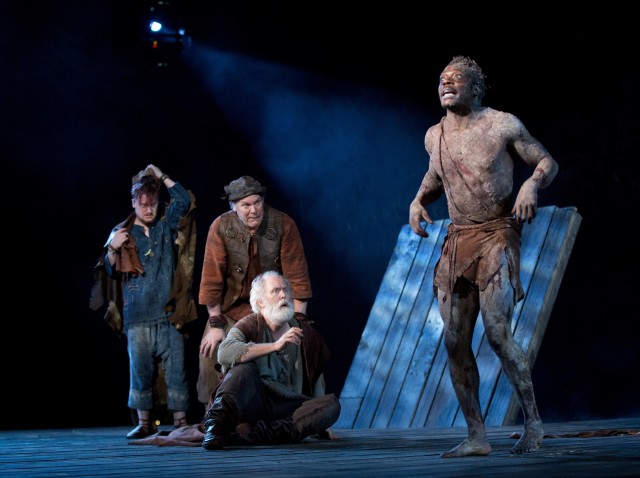
Soon Lamendin dedicates himself to reestablishing the reputation of geographer Yves Le Trouhadec (Morfogen), who has been denied election to the Academy of Sciences because of a study he published about Donogoo-Tonka, a South American village that he made up. With the help of banker Margajat (Ross Bickell), Lamendin heads off to make Donogoo-Tonka a reality in order to get Le Trouhadec into the academy while also bringing purpose to his own renewed life. Donogoo evokes Monty Python’s adventure sketches, but there are more laughs to be found in five minutes of the latter as compared to the 140 minutes of the former. The intentionally broad overacting is actually too broad, and the jokes are old and flat. Magajat sort of sums things up when he tells Lamendin, “It’s a little lame. . . . No — no jokes!” However, Hanna and Johnston’s projections are phenomenal, as the actors magically spin globes, pull books off shelves, and open and close doors by interacting with film. But even those go away in the second act, as various prospectors head to Donogoo-Tonka to change their fortunes, a journey that is not worth joining.

MACBETH

(photo by John Persson)

Kenneth Branagh makes his rousing New York City stage debut in immersive production of MACBETH (photo by Johan Persson)

Park Avenue Armory
Wade Thompson Drill Hall
643 Park Ave. between 66th & 67th Sts.
May 31 – June 22
www.armoryonpark.org

Kenneth Branagh took care of a lot of firsts in the thrilling immersive production of Macbeth that just concluded its sold-out run at the Park Avenue Armory. Branagh makes his New York stage debut with the Scottish Play; it is also the first time he has appeared in Macbeth and marks his return to Shakespeare after a ten-year absence. Commissioned by the armory and the Manchester International Festival, this Macbeth was first presented in England in a deconsecrated church, but its impressive scope was further expanded for the armory production. Upon picking up tickets, each audience member also receives a wristband and clan designation, gathering in one of the rooms in the armory, then marching in unison into the Wade Thompson Drill Hall, which has been transformed into a dark and mysterious heath littered with tumbleweeds, rocks, and slowly moving figures in brown cloaks. The audience is seated by clan in two sets of bleachers separated by a narrow path of dirt: At one end of the path is an altar decorated with numerous candles and altarpieces of the adult and baby Jesus, Mary, and a saint, while on the other end is a Stonehenge-like arrangement of large stones.

MACBETH

Audience members are immediately put into the mood in thrilling version of the Scottish Play at the Park Ave. Armory (photo by Stephanie Berger)

The play, directed by Branagh and eight-time Tony nominee Rob Ashford (Thoroughly Modern Millie, How to Succeed in Business without Really Trying), begins with a breathtaking battle scene in the rain, which turns the dirt into mud as Macbeth and Banquo (Jimmy Yuill) lead King Duncan’s (John Shrapnel) army to victory. Following the fight, the Weird Sisters (Charlie Cameron, Laura Elsworthy, and Anjana Vasan), seemingly floating in the rock formation, make their prediction of Macbeth’s rise to the throne, and soon he and Lady Macbeth (Alex Kingston, in her New York City stage debut) are plotting their way to the top, with only Macduff (Richard Coyle) and Malcolm (Alexander Vlahos) in their way. A thoroughly convincing Branagh digs deep into Macbeth’s psyche, pulling out a wide range of intense emotions that give added depth to a familiar character, while Kingston plays Lady Macbeth with a mature, thoughtful vulnerability. The supporting cast, particularly Yuill, Shrapnel, Coyle, and Tom Godwin as the wretched porter, is outstanding as well, but they almost get swallowed up in the awe-inspiring stagecraft, highlighted by Christopher Oram’s terrific set — which often evokes a hellish pit of doom — Neil Austin’s divine lighting, and Christopher Shutt’s haunting sound design. The gripping two-hour intermissionless show feels right at home at the armory, which has its own military history, one that Branagh’s Macbeth is now a part of in its own unique way.

BROADWAY IN HD: THE NANCE

(photo by Joan Marcus)

Stagecast of THE NANCE starring Nathan Lane comes to Symphony Space as part of Broadway in HD series (photo by Joan Marcus)

Symphony Space, Leonard Nimoy Thalia
2537 Broadway at 95th St.
June 25 & 30, July 14 & 20, $23, 7:00
212-864-5400
www.symphonyspace.org
www.screenvision.com

Miss a big show because tickets were too expensive or too hard to get or the production took place overseas? Screenvision is now offering a second chance to check out select Broadway, Canadian, and British plays by showing them in movie theaters across the country. Earlier this month, the company, which specializes in movie-theater advertising, presented a filmed version of the Australian production of Alfred Uhry’s Driving Miss Daisy, starring Angela Lansbury and James Earl Jones. Now, in conjunction with Gay Pride Week, Screenvision and Broadway on Screen have teamed up with Lincoln Center Theater to present a stagecast of last year’s Broadway hit The Nance, Douglas Carter Beane’s poignant and engaging tale of a police clampdown on gay subculture in 1930s New York City. In the play, directed by Jack O’Brien (The Coast of Utopia, Much Ado About Nothing), Tony nominee Nathan Lane stars as Chauncey, a closeted burlesque performer who is trying to avoid getting arrested while picking up younger men in specific meeting points. The show also stars Andréa Burns, Jenni Barber, and Cady Huffman as a trio of strippers, Lewis J. Stadlen as Chauncey’s onstage partner, and Jonny Orsini as a one-night stand who turns into something more. The Nance will be screening June 25 & 30 and July 14 & 20 at 7:00 at Symphony Space as part of the Broadway in HD series, which also includes a June 24 showing of Christopher Plummer and Nikki M. James (The Book of Mormon, Les Misérables) in the 2008 Stratford Festival production of George Bernard Shaw’s Caesar & Cleopatra. In addition, Symphony Space will be screening the current revival of Alan Ayckbourn’s A Small Family Business on June 26 & 29 and July 9 & 17 as part of its ongoing National Theatre Live series.

VENUS IN FUR

VENUS IN FUR

The relationship between actor and director becomes an intense psychosexual battle in Roman Polanski’s VENUS IN FUR

VENUS IN FUR (Roman Polanski, 2013)
IFC Center, 323 Sixth Ave. at Third St., 212-924-7771
Lincoln Plaza Cinema, 1886 Broadway between 62nd & 63rd Sts., 212-757-2280
Opens Friday, June 20
www.ifcfilms.com

For his third stage adaptation in ten years, following 1994’s Death and the Maiden and 2011’s Carnage, Roman Polanski has created a marvelous, multilayered examination of the intricate nature of storytelling, consumed with aspects of doubling. David Ives’s Tony-nominated play, Venus in Fur, is about a cynical theater director, Thomas Novachek, who is auditioning actresses for the lead in his next production, a theatrical version of Leopold von Sacher-Masoch’s psychosexual novella Venus in Furs (which led to the term “sado-masochism”), itself a man’s retelling of his enslavement by a woman. In the film, as he is packing up and about to head home, Thomas (Matthieu Amalric) is interrupted by Vanda (Emmanuelle Seigner), a tall blond who at first appears ditzy and unprepared, practically begging him to let her audition even though she isn’t on the casting sheet, then slowly taking charge as she reveals an intimate knowledge not only of his script but of stagecraft as well. An at-first flummoxed Thomas becomes more and more intrigued as Vanda performs the role of Wanda von Dunayev and he reads the part of Severin von Kushemski, their actor-director relationship intertwining with that of the characters’ dangerous and erotic attraction.

Roman Polanski directs wife Emmanuelle Seigner in thrilling stage adaptation of Tony-winning play

Roman Polanski directs wife Emmanuelle Seigner in thrilling stage adaptation of Tony-nominated play

Ives’s English-language play, which earned Nina Arianda a Tony for Best Actress, was set in an office, but Polanski, who cowrote the screenplay with Ives, has moved this French version to an old theater (the Théâtre Récamier in Paris, rebuilt by designer Jean Rabasse) where a musical production of John Ford’s Stagecoach has recently taken place, with some of the props still onstage, including a rather phallic (and prickly) cactus. Polanski has masterfully used the machinations of cinema to expand on the play while also remaining true to its single setting. One of the world’s finest actors, Amalric, who looks more than a little like a younger Polanski, is spectacular as the pretentious Thomas, his expression-filled eyes and herky-jerky motion defining the evolution of his character’s fascination with Vanda, while Seigner, who is Polanski’s wife, is a dynamo of breathless erotic power and energy, seamlessly weaving in and out of different aspects of Vanda. Venus in Fur was shot in chronological order with one camera by cinematographer Paweł Edelman, who has photographed Polanski’s last five feature films, making it feel like the viewer is onstage, experiencing the events in real time. Alexandre Desplat’s complex, gorgeous score is a character unto itself, beginning with the outdoor establishing shot of the theater. The film also contains elements that recall such previous Polanski works as The Tenant, Bitter Moon, Tess, and The Fearless Vampire Killers, placing it firmly within his impressive canon. Polanski was handed Ives’s script at Cannes in 2012, and this screen version was then shown at Cannes for the 2013 festival, a whirlwind production that is echoed in Seigner’s performance; perhaps what’s most amazing is that it is only now finally getting its official U.S. theatrical release, beginning June 20 at the IFC Center and Lincoln Plaza.