this week in theater

TALKING RICE COOKERS EXPLORE TWENTY YEARS OF KOREAN HISTORY

Jaha Koo teams up with Hana, Duri, and Seri in Cuckoo (photo by Radovan Dranga)

CUCKOO
Perelman Performing Arts Center (PAC NYC)
251 Fulton St.
January 16-18, $78-$82
pacnyc.org
utrfest.org

On its website, the Korean appliance and electronics company known as Cuckoo explains that it “hopes to continue to reach diverse audiences and captivate them with products that make life simpler.”

For nearly eight years, South Korean artist Jaha Koo has been reaching diverse audiences and captivating them with his inventive play Cuckoo, in which he traces the last twenty years of Korean history with the help of three talkative Cuckoo rice cookers, Hana, Duri, and Seri, who speak to him in the isolation, or golibmuwon, that he is experiencing.

Cuckoo, which debuted in 2017, is the middle section of Koo’s Hamartia Trilogy, which began with Lolling and Rolling in 2015 and concluded with The History of Korean Western Theatre in 2020.

“Conceptually, it focuses on how the inescapable past tragically affects our lives today,” the forty-year-old Koo says about the three works in total.

Koo is now bringing the fifty-five-minute Cuckoo to PAC NYC for four shows January 16–18 as part of the Under the Radar festival; the 7:00 performance on January 17 will be followed by a discussion moderated by South Korean playwright Hansol Jung, whose daring works include Wolf Play and Merry Me.

Koo is responsible for the concept, direction, music, text, and video and performs with the cookers; the Cuckoo hacking is by Idella Craddock, with scenography and media operation by Eunkyung Jeong.

In case Cuckoo makes you hungry, Cuckoo the company promises, “Whether you enjoy sticky rice, soft grains, or the ability to whip up an array of dishes with minimal effort — we’ve got a rice cooker to meet any need!”

Update: Jaha Koo’s Cuckoo is an intimate, deeply personal investigation of grief and loss, as seen through the lens of colonialist capitalism. Divided into four sections, “Cuckoo,” “Jerry,” “Robert Rubin,” and “Screen,” the fifty-five-minute multimedia performance focuses on the $55 billion bailout of South Korea by the International Monetary Fund (IMF) in 1997, orchestrated in part by Clinton Treasury Secretary Robert Rubin. In a press release at the time, Rubin wrote, “South Korea and the IMF reached an agreement today on an economic reform program that commits Korea to important policy adjustments aimed at restoring stability.”

It didn’t turn out quite as planned.

Jaha Koo links rice cookers, the financial crisis, isolation, and suicide in Cuckoo (photo by Radovan Dranga)

One of the results of the bailout was the success of the Cuckoo brand rice cooker, as well as a rising suicide rate. After video of social and political unrest is projected on a large screen, Koo sits down at a table with three Cuckoo rice cookers: Hana, Duri, and Seri, which have been hacked so they can play music and, in the cases of Duri and Seri, talk to Koo and each other, including hilarious insults, complete with four-letter words.

Switching between English and Korean, Koo discusses the tragic death of his best friend, Jerry; “The Happiness Project” espoused by Robert Rubin’s daughter-in-law, Gretchen Rubin; a solitary worker responsible for fixing broken protective screens in the Seoul Metropolitan Subway; his relationship with his father, who asks, “Hello, my son, did you have a good meal?”; and the vast number of suicides in South Korea, with graphic footage of actual attempts.

He also shares the term “golibmuwon,” which essentially means helpless isolation.

It’s a bittersweet tale that blends in a strong dose of humor until a haunting darkness prevails, sadly as relevant today as it was when Koo first performed it in 2017, with South Korea currently experiencing economic and political distress, its highest suicide rates ever, and even, for a moment, martial law.

The best rice cooker in the world might be able to provide a consistent, dependable base for a good meal, but it can’t build a strong-enough foundation to guarantee a solid future for a nation in turmoil.

[Mark Rifkin is a Brooklyn-born, Manhattan-based writer and editor; you can follow him on Substack here.]
SAILING UNDER THE RADAR: BLUEBEARD AT JAPAN SOCIETY

Sujin Kim reimagines Shūji Terayama’s Duke Bluebeard’s Castle at Japan Society (photo by Yoji Ishizawa)

DUKE BLUEBEARD’S CASTLE
Japan Society
333 East 47th St. at First Ave.
January 15-18, $36-$48
www.japansociety.org
utrfest.org

In his 1697 book Histoires ou contes du temps passé, French author Charles Perrault adapted such famous folktales as “Little Red Riding Hood,” “Cinderella,” “Puss in Boots,” and “Sleeping Beauty.” Though not quite as well known, particularly when it comes to children, Perrault’s “Bluebeard,” about a duke who has a penchant for moving on from wife to wife in not the most legal of ways, has been turned into plays, short stories, novels, ballets, operas, and movies.

Multidisciplinary Japanese artist Shūji Terayama, who died in 1983 at the age of forty-seven, was obsessed with the story of Bluebeard. “The Japanese countercultural icon Terayama Shūji produced three projects in the years 1961–1979 that rework the legend of Bluebeard, often intermixing the folkloric narrative with contemporary lived reality,” Steven C. Ridgely wrote in Marvels & Tales in 2013. “This was a countervailing tendency to the tide of texts emerging at the time that demythologize Bluebeard by means of historical figures such as Gilles de Rais. Terayama’s work on Bluebeard might best be understood as an effort to frustrate the mapping of folklore and legend to practices of the past and to insist on the liberational potential of taking possession of narratives in the folkloric mode.”

Adding a macabre Harajuku burlesque touch to the proceedings, which take place backstage at a Japanese theater, Korean-Japanese director Sujin Kim has reimagined Terayama’s version in Duke Bluebeard’s Castle, running January 15–18 at Japan Society as part of the Under the Radar festival. The North American premiere of this new production is performed by Project Nyx, an all-female avant-garde ensemble led by Kanna Mizushima; avant-garde cabaret duo Kokusyoku Sumire; and magician Syun Shibuya.

There will be a reception following the January 15 show, an artist Q&A after the January 16 performance, and a preshow lecture on Terayama by UCLA professor emerita Carol Fisher Sorgenfrei at 6:30 on January 17. Ticket holders on January 16, 17, and 18 are invited to see the current exhibit, “Bunraku Backstage,” in the Japan Society Gallery; there is also a display of rare Terayama artifacts on view, including scripts, letters, photos, and more from the La MaMa Archive.

[Mark Rifkin is a Brooklyn-born, Manhattan-based writer and editor; you can follow him on Substack here.]
BLIND JUSTICE: RUNNING FOR LIBERATION AT ST. ANN’S

A woman (Ainaz Azarhoush) and her husband (Mohammad Reza Hosseinzadeh) contemplate freedom in Blind Runner (photo by Amir Hamja)

BLIND RUNNER
St. Ann’s Warehouse
45 Water St.
Tuesday – Sunday through January 24, $49-$69
stannswarehouse.org
utrfest.org

In September 2022, Iranian journalist Niloofar Hamedi was incarcerated for reporting on the controversial death of Mahsa Amini, a twenty-two-year-old Kurdish-Iranian woman who died in a hospital shortly after being arrested for not wearing a hijab; the case was followed around the world. While in prison, Hamedi began running while her husband, Mohamad Hosein Ajoroloo, ran outside the building, preparing for a marathon. In June 2023, he told the New York Times, “Niloofar believes that enduring prison is like training for a marathon. Daily suffering. But imagining the joy of the finish line cancels out all the pain.”

That story, and others involving political imprisonments, served as inspiration for Iranian writer-director Amir Reza Koohestani’s haunting Blind Runner, continuing at St. Ann’s Warehouse through January 24 as part of the Under the Radar festival.

Éric Soyer’s set is a deep, dark area with two long, horizontal lines of light. At either side is a small camera, the projections of which appear on the large screen in back. The sublime video design is by Yasi Moradi and Benjamin Krieg, with stark lighting by Soyer, tense music by Phillip Hohenwarter and Matthias Peyker, and contemporary costumes by Negar Nobakht Foghani.

As the audience enters the space, actors Ainaz Azarhoush and Mohammad Reza Hosseinzadeh are already onstage, standing in concerned poses. Soon they each approach stanchions on opposite sides where they alternately write and erase such morphing phrases as “Based on a true story,” “Based on an actual story,” “Based on true history,” “Based on an actual history,” “Based on a factual history,” “Based on fiction history,” “Fact,” and “Fiction” before the husband concludes, “This is a theater.” Thus, we are instantly reminded that while what we are about to experience is artifice, it has been born out of fact, but whose facts? The playwright’s? The Iranian government’s? Ours in New York City, in America?

At first, the husband visits the wife once a week and they talk every day on the phone; in between their meetings, they run across the stage, each in a different strip of light, moving in opposing directions that signal the growing gap between them. She points out to him that everything they are saying and doing is being closely watched and recorded, like they are trapped in a spiderweb. While he values the visits and phone calls, she is becoming tired of them, as she has to carefully parse her words so as not to get him — or her — in trouble. This lack of communication frustrates him, since he wants to know the truth about how she is being treated and is adamant that he will get her released. “False hopes are worse than despair,” she admonishes.

Running is at the center of Amir Reza Koohestani’s Blind Runner at St. Ann’s Warehouse (photo by Amir Hamja)

He asks her, “Why don’t you just give me a ring to say that you’re fine?” She quickly answers, “Why should I lie?”

At her request, he meets with a blind marathoner named Parissa (Azarhoush) who lost her sight during a political protest and wants him to be her guide runner for an upcoming competition in Paris. He is apprehensive about it, but his wife thinks it is a good opportunity. “It’s not just running,” he explains. “It’s a matter of rhythm. You need to be in sync together.”

It’s clear he is not just talking about his potential professional relationship with Parissa, especially when his wife is not worried that he his traveling to Europe with another woman as the contentious Illegal Migration Bill is about to be passed in England.

Presented by the Mehr Theatre Group in Persian with English supertitles, the sixty-minute Blind Runner is a bleak, mysterious, and deeply involving play about the physical, psychological, and emotional choices we make as individuals and as a society and the consequences that result. Justice around the world can be blind, but the answer is not running away, or remaining silent, even as the risks grow and private and public freedom is jeopardized.

Koohestani himself started running after the Green Movement in Iran was suppressed, an activity he considered “an alternative to the demonstrations that were no longer being held and the freedom that had left us again for the umpteenth time,” he writes in a program note. His hypnotic play, also inspired by the case of imprisoned student activist Zia Nabavi, captures that feeling, with its hard-hitting dialogue and striking visuals that zoom in on the characters’ faces and merge their bodies when they are running, leading to a powerful conclusion. It is sometimes difficult to know where to look — at the two actors, at their projections on the screen, or at the supertitles above — but Azarhoush and Hosseinzadeh deliver beautifully human performances that ground the narrative.

In conjunction with Blind Runner, St. Ann’s is hosting the exhibition “Unseen Iran: A Celebration of Iranian Art & Culture,” featuring works by Tahmineh Monzavi (street photography), Shirin Neshat (the Villains triptych and Divine Rebellion related to the Arab Spring riots), Bahar Behbahani (Warp and Woof from her “Through a Wave, Darkly” series ), and Safarani Sisters (the video painting Awake) in addition to a Persian Tea Room where you can sip tea and relax before the show.

[Mark Rifkin is a Brooklyn-born, Manhattan-based writer and editor; you can follow him on Substack here.]
SELF-REALIZING PROGNOSES: LOST IN SPACE WHILE STUCK IN A CLOSET

The 7th Voyage of Egon Tichy [Redux] is a dazzling multimedia theatrical experience (photo by Maria Baranova)

THE 7th VOYAGE OF EGON TICHY [REDUX]
New York Theatre Workshop Fourth Street Theatre
83 East Fourth St. between Second & Third Aves.
Through February 2, $30-$50 (Sunday livestreams $19)
utrfest.org
www.nytw.org

During the pandemic, Joshua William Gelb transformed his eight-square-foot closet in the East Village into a pristine white digital stage, where he presented awe-inspiring productions he christened Theater in Quarantine, using cutting-edge digital technology for such livestreamed shows as Heather Christian’s I Am Sending You the Sacred Face: One Brief Musical Act with Mother Teresa, Footnote for the End of Time based on a story by Jorge Luis Borges, and Nosferatu: A 3D Symphony of Horror in addition to smaller works that displayed the wide range of performance he and his collaborators could do with the space.

It was an ingenious concept that captured the feelings so many of us experienced when theaters were closed and many of us started working remotely from home, cut off from seeing friends and relatives for long periods of time. One of the shows, The 7th Voyage of Egon Tichy, adapted from sci-fi author Stanislaw Lem’s The Star Diaries, explored that loneliness in the extreme, introducing the audience to an astronaut on a solo mission who needs to repair his ship’s rudder, a two-person job. Along the way he encounters vortices that result in multiple versions of himself who have to team up if the spacecraft is to be fixed.

Created by director Jonathan Levin, playwright Josh Luxenberg, and actor Gelb, the thirty-six-minute online Tichy has now been reimagined as The 7th Voyage of Egon Tichy [Redux], a staggeringly inventive hourlong multimedia play running through February 2 at New York Theatre Workshop’s intimate Fourth Street Theatre, as part of the Under the Radar festival.

Joshua William Gelb plays multiple versions of an astronaut in technological marvel (photo by Maria Baranova)

Peiyi Wong’s set consists of two large screens on either side of a replica of Gelb’s closet, with various small doors that open and close inside. A smartphone on a tripod focuses on the closet, which has a slit in the back that allows outer space to be visible via a green screen. Marika Kent’s lighting setup and M. Florian Staab’s sound and original music immerses the audience in the action. All of the technical elements may be visible, but that doesn’t mean you’ll have any idea how they pull off their dazzling magic, mastered by video designer Jesse Garrison.

Tichy’s ship has been damaged by a meteor the size of a lima bean, putting him parsecs off course, and he is unable to repair it by himself. Thinking he is having a dream, he encounters a second version of himself, but he has traveled through a time vortex and it is actually him one day in the future. “I need your help,” Tuesday Tichy tells Monday Tichy, who says, “You look so realistic.” Tuesday explains, “I am! This is all real.” Monday: “This room looks just like my room.” Tuesday: “It is! I was you yesterday. And I didn’t listen. But if you do exactly what I —”

The scene is startling for several reasons. First, the real Gelb is in the closet, standing against the wall, his head on a pillow, but on the screens, he is lying down on the floor, as the video has turned the closet horizontal. Second, the real Gelb is interacting with a prerecorded Gelb; while there are two Gelbs in the video closet, only one is live, and it quickly becomes clear that it requires precision timing to make it work, including the use of such props as a wrench, pliers, the spacesuit, a frying pan, and a bloody towel. And third, it echoes the solitary nature of the pandemic, when we often lost track of time and ached to be with others, an emotion that is furthered when the vortex adds more future Tichys and the plot moves from the sleeping quarters and the kitchen to the vestibule, bathroom, and main cabin.

Lem, who also wrote such novels as Solaris, The Invincible, and Fiasco, constructed a fantastical universe for Tichy that spans numerous tales. Gelb is hilarious as multiple Tichys, using the doors to magically disappear, go up and down between floors, and angle his body so it might be awkward in the vertical closet but makes sense in the horizontal video. He never misses a beat as more and more Egons (spelled Igons by Lem) join him in the cramped space. It’s a tour de force for everyone involved, both as it relates to the pandemic and the world finally getting on with life outside and lending insight into how each of us tries to understand and substantiate our identities and our place with others in a forever-changed environment that we cannot survive on our own.

In an introduction to one of the Tichy books, Professor A. S. Tarantoga of the Associated Institutes of Tichology, Tichography, and Tichonomics Descriptive, Comparative, and Prognostic posits, “In conclusion I should like to announce the establishment in our Association of a special futurological section, which, in keeping with the spirit of the times, will make available — using the method of so-called self-realizing prognoses — those star journeys of I. Tichy which as yet he has not undertaken, nor indeed intends to.”

It’s an uncanny way to meld past, present, and future, which forms the core of who we are as humans, in print, online, and in person.

[Mark Rifkin is a Brooklyn-born, Manhattan-based writer and editor; you can follow him on Substack here.]
THE JOY OF YIDDISH THEATER: IN DIM SUM PORTIONS

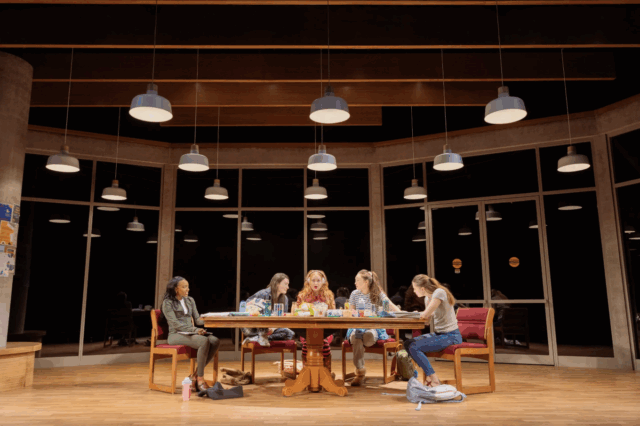
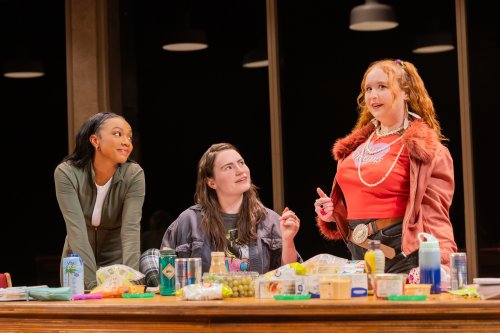
Steve Sterner, Yelena Shmulenson, and Allen Lewis Rickman share the joys of Yiddish in The Essence (photo by Jonathan Melvin Smith)

THE ESSENCE: A YIDDISH THEATRE DIM SUM
Theatre 154
154 Christopher St. between Greenwich & Washington Sts.
January 7-12, $52.37
www.everyonesyiddish.com
www.congressforjewishculture.org

If you believe that everything sounds better in Yiddish — as I do — then The Essence: A Yiddish Theatre Dim Sum is for you.

For more than ten years, this eighty-five-minute presentation has been staged in the northeast and Europe, offering a vaudeville-influenced history of Yiddish theater through comedy sketches, songs, and informational background inspired by Nahma Sandrow’s 1977 book, Vagabond Stars. The play’s subtitle works in multiple ways: dim sum means “touch the heart” in Chinese, and Yiddish certainly touches the heart (as well as the soul and the gut); dim sum is a meal made up of small dishes, like skits; and there is a long connection between Jews and Chinese food.

But most of all, it’s a celebration of a language that goes back a thousand years and has supposedly been on its deathbed time and time again but still keeps going. As Leo Rosten wrote in his introduction to his classic 1968 dictionary, The Joys of Yiddish, this book “illustrates how beautifully a language reflects the variety and vitality of life itself; and how the special culture of the Jews, their distinctive style of thought, their subtleties of feeling, are reflected in Yiddish; and how this in turn has enhanced and enriched the English we use today.”

Originally presented by the New Yiddish Rep and now by the Congress for Jewish Culture (CJC), The Essence, the follow-up to CJC’s Bashevis’s Demons at Theater 154, is a tasty chronological performance lecture starring actor, pianist, silent film accompanist, and cruciverbalist Steve Sterner, a native New Yorker who also serves as musical director; actor, audiobook narrator, and pianist Yelena Shmulenson, who was born in Belarus and raised in Ukraine; and Queens native Allen Lewis Rickman, who also wrote and directed the show. All three have worked with the National Yiddish Theatre Folksbiene, which has dazzled audiences with Yiddish productions of The Golden Bride, The Sorceress, Fiddler on the Roof, and more. Rickman (Relatively speaking, The Big Bupkis! A Complete Gentile’s Guide to Yiddish Vaudeville) and Shmulenson (The Megillah for Itzik Manger, The Golem of Havana) previously teamed up in the CJC’s The Dybbuk and Tevye Served Raw and portrayed the nineteenth-century shtetl couple in the prologue of the Coen brothers’ film A Serious Man.

They take the audience on a rollicking journey through such Yiddish songs as “A Shtetele,” “Nit Bashert,” and “Dona, Dona” and scenes from such early Yiddish shows as Di Kishufmakherin, Moshiakh in Amerike, and Dem Shuster’s Tokhter. Some bits work better than others, but there’s plenty here to make you smile, laugh, and nod in agreement. “Yiddish is an amazing language for expressing emotion, and it’s an incredible language for humor,” Shmulenson says.

Yelena: You see, in Yiddish you can’t just say something, you have to make it interesting. You can’t say —
Steve: “To be or not to be . . . that is the question.”
Yelena: You have to say “Zayn oder nit zayn . . . du ligt der hint bagrubn.”
Steve: “To be or not to be . . . that’s where the dog is buried.”

They gleefully discuss how colorful Yiddish curses are and list the many Yiddish words for son, unfortunately, and imbecile. “When the going gets tough, the Yiddish start cursing,” Rickman explains. “It’s opera, it’s poetry . . . Yiddish cursing is sculpture made from hate.”

The cast tells stories about Avrom Goldfadn, the failed newspaper publisher, failed medical student, failed teacher, failed ladies’ hat shop manager, and successful poet who was the Father of Yiddish Theater; describe how amateur groups put on Yiddish plays in concentration camps during WWII; delve into the German Jews known as the Yekes, who wanted to assimilate in America and actively campaigned against Yiddish theater coming here; and how John Barrymore, Paul Robeson, Orson Welles, Al Capone, Cole Porter, and kings and queens were enthralled with Yiddish theater. “In Paris even antisemites went to Yiddish theater,” Sterner points out. Rickman adds, “None of those people understood Yiddish, but they all went, anyhow.”

You don’t have to know any Yiddish to find the joy in The Essence, as English supertitles are projected on a small, framed horizontal screen above a red curtain, behind which the actors change costumes as they move from shtick to shtick, proving that, as Rickman writes in the program, “Yiddish theater is not any one thing, and it never was. It was naturalistic, expressionistic, melodramatic, and intimate. It was — and is — bombast and nuance, singing and silence, art and trash. It’s been around for a century and a half, and it’s been absolutely everything. The only thing that ties it together is its history of innovation, and, of course, the language.”

And as Rosten writes, “What other language is fraught with such exuberant fraughtage?”

Hobn a groys moltsayt!

[Mark Rifkin is a Brooklyn-born, Manhattan-based writer and editor; you can follow him on Substack here.]
MURIELLE BORST-TARRANT: TELLING TIPI TALES

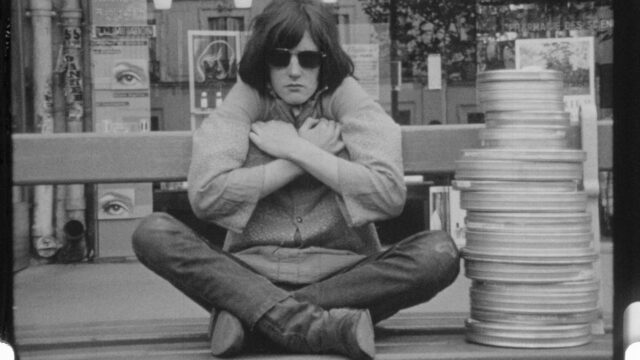
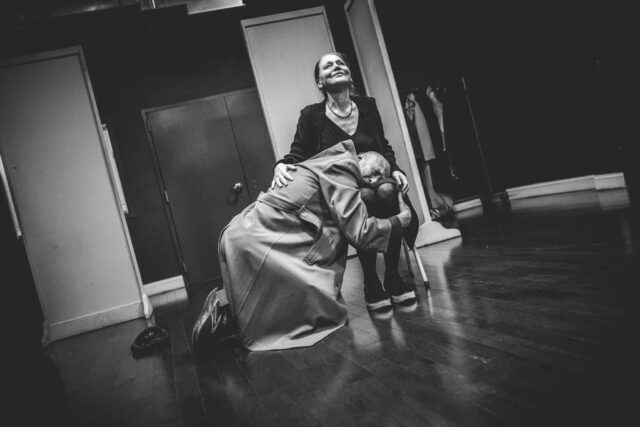
Murielle Borst-Tarrant will perform Tipi Tales from the Stoop at PAC NYC this week (photo by Justin Barbin)

Who: Murielle Borst-Tarrant
What: Tipi Tales from the Stoop
Where: Perelman Performing Arts Center (PAC NYC), 251 Fulton St., Manhattan
When: January 9-11, $20-$40
Why: “New York City has always been a gathering and trading place for many Indigenous peoples, where Native Nations intersected from all four directions since time immemorial. It was a place to gather and sometimes to seek refuge during times of conflict and struggle,” Jersey-based Murielle Borst-Tarrant (Kuna/Rappahannock Nations), who was born and raised in Red Hook, writes about her solo show Tipi Tales from the Stoop, running at PAC NYC from January 9 to 11. “My family first came to New York City in the late 1800s from Virginia and bought a house in Brooklyn and raised four generations. This story is about my family’s blood flow that is here on this land of New York City. How we as a family had to keep tradition alive. The survival of genocide, relocation, the boarding school system, and the outlaw by the United States government that we could not practice our cultural traditions. The story is about my family’s triumph of will, dysfunction, and historical trauma through laughter. My personal tapestry of stories being brought up in Brooklyn in a Mafia-run neighborhood when we were the only Natives on the block. And this is just one Tipi Tale of the city.”

Borst-Tarrant (More than Feathers and Beads, Don’t Feed the Indians — A Divine Comedy Pageant!), an author, playwright, director, producer, cultural artist, educator, and human rights activist, was influenced by such comedians as Richard Pryor, Joan Rivers, and Charlie Hill, who all interspersed sociopolitical issues into their performances. In a talkback following a workshop presentation of Tipi Tales from the Stoop at Brown, where she is the 250th Anniversary Visiting Assistant Professor of the Practice and Visiting Fellow, she explained about audience members who might not like some of the things she brings up: “You’re offended by this, I get it, but Native people spend their whole lives being offended, no matter what. People don’t know we exist.” The sixty-minute piece is directed by Mildred Ruiz-Sapp and Steven Sapp (Purgatory, UniSon) and coproduced with Safe Harbors NYC, where Borst-Tarrant is the founding artistic director, and Spiderwoman Theater, where she started her career. There are five chances to catch the show; Borst-Tarrant will participate in a discussion after the January 9 show.

[Mark Rifkin is a Brooklyn-born, Manhattan-based writer and editor; you can follow him on Substack here.]
THE VIVID UNKNOWN: REIMAGINING KOYAANISQATSI THROUGH INTERACTIVE AI TECHNOLOGY

The Vivid Unknown uses generative AI and immersive sound to reimagine Godfrey Reggio’s Koyaanisqatsi (photo by twi-ny/mdr)

TECHNE: THE VIVID UNKNOWN
Under the Radar Festival / BAM Next Wave
BAM Fishman Space
321 Ashland Pl.
January 4-7, $10
Series continues through January 19
utrfest.org
www.bam.org

“I like people to break things. I’m always interested in how kids interact with things because they’re going to do things that someone else might not do,” artist John Fitzgerald told me at the inaugural presentation of TECHNE: The Vivid Unknown at BAM’s Fishman Space, a multimedia reimagining of Godfrey Reggio’s 1982 documentary Koyaanisqatsi, which means “life out of balance,” “life disintegrating,” and “a state of life that calls for another way of living” in the Hopi language.

Fitzgerald was not referring to the hardware but “the rules of engagement” that he’s designed with an expert team. “Anyone can bring their own story to it. That’s something I learned from Godfrey, who calls it the autodidactic experience of watching Koyaanisqatsi,” he said. “He’s not telling you, ‘technology bad, humans good — the natural world is safe.’ He’s giving you the opportunity to have thoughts about things, to experience things. Everyone will always watch it differently. I’ve seen that movie dozens and dozens of times; there are a lot of different ways that you can interpret it. So I’m excited to see how this evolves and unfolds. People might want to come in here and sit down on the floor, they might want to go out and get some fresh air and come back in; it’s an open experience.”

There are numerous ways to experience The Vivid Unknown, and it’s left up to each individual to decide, mimicking how we approach life. AI-generated images speed across three large screens as immersive AI sound envelops the room. You can sit on the floor right in front, move around, or take a regular seat in the back. If you decide to participate — and I highly recommend you do — you will discover that when you are in an oval of light, the shape of your body will be picked up by sensors behind you and your onscreen silhouette will eventually be filled by an image different from what is already being projected.

For example, amid slow-motion and time-lapse shots of beachgoers, mountains, metropolitan cities, airplanes, waterfalls, clouds, traffic, the demolition of a housing project, and other scenes, a rocket taking off fit into my outline and followed me onscreen as I walked across the room. Meanwhile, a woman stood near the middle, moving like a dancer. Couples posed together. A few kids jumped up and down. Humanity fused together with technology and the environment as some of us participated and others merely watched from the back.

Almost all the young boys and girls chose to become involved with the art, which brought out the child in the adults who got up from their seats and interacted with it as well. Noticing that, Fitzgerald, who has a five-year-old and a four-month-old, said that the older one is “the best product tester out there. He’s the first to be, like, ‘That’s too long,’ or ‘I want to see more of that.’ He speaks without a filter.”

Curated by Onassis ONX, TECHNE consists of four digital installations that are part of BAM’s Next Wave Festival and Under the Radar; it begins January 4-7 with The Vivid Unknown and continues January 8-11 with Marc Da Costa and Matthew Niederhauser’s The Golden Key, January 12-15 with Margarita Athanasiou’s Voices, and January 16-19 with Stephanie Dinkins’s Secret Garden. (Tickets for each is $10; a series pass is $35.) BAM Rose Cinemas will be showing Koyaanisqatsi on January 7 at 7:30, with Fitzgerald and Vivid Unknown codirector Reggio on hand for the conversation “Terra techno firma” afterward.

Onassis ONX NY program director Jazia Hammoudi shared information with me about how it all works, but I opted to discover much of The Vivid Unknown on my own, which was extremely satisfying. In the program, she writes, “The refined interactivity of the work’s music and visuals subverts the source material’s linear minimalism and subtly engages the body in epic vistas from mountainscapes to oil fields. Within The Vivid Unknown’s zone of immersion, the connection between individual and collective action reflects the complex relationships between human agency and planetary outcomes.” In addition to TECHNE, Onassis ONX is presenting Christiana Kosiar’s RUNWAY and Viola He’s A {room} of one’s own January 10-14 at the Olympic Tower on Fifth Ave. as part of Under the Radar’s Under Construction series.

Fitzgerald met Reggio about two years ago, when he went out to Santa Fe to visit the now-eighty-four-year-old filmmaker, who also made the sequels Powaqqatsi in 1988 and Naqoyqatsi in 2002; all three films in the series feature original soundtracks by Philip Glass.

Audience participation enhances experience of multimedia The Vivid Unknown by John Fitzgerald and Godfrey Reggio (photo by twi-ny/mdr)

Since this was the first public presentation of the work at BAM, I asked Fitzgerald what he thought about the audience’s response.

“It’s exceeding expectations on all levels,” he said. “We’ve never had this many people in it. One of the things about making creative technology art is that it’s always half broken until it’s not, until you have to press play and make sure everything comes together. The idea was that Koyaanisqatsi is a depiction of the state of the world in the latter half of the twentieth century as chaos unfolded. So I was just playing around with this idea of how you don’t really control anything but you do have an impact on this.”

That concept is also represented by a video sculpture off to one side, a refurbished slot machine that was transformed into an interactive artwork by the fabrication studio Chateau Brooklyn. When you pull down the S2000 lever, images speed by a trio of small monitors; it offers an additional moment of connection, but it has no effect on the film. It exists on its own, but it offers a sense of power and involvement even though the results are random. One boy was having a blast with it, pulling the lever a few dozen times, too young to consider the metaphor of how we gamble in life, taking or avoiding risk.

At several points, the barrage of images dropped out and the screens went dark; only the shapes of the audience members standing in the oval of light could be seen. “I want people to feel like they’re making an impact on the images,” Fitzgerald said. “That’s why the last state is left this way; the film disappears, and it’s fuel to give a reflection of your presence.”

He was also quick to share credit. “This is a project made by a dozen artists; it’s truly a collaborative effort,” Fitzgerald explained. “Everyone is unified behind Godfrey and his vision to show humans where we are right now. It’s like a mirror into ourselves.”

[Mark Rifkin is a Brooklyn-born, Manhattan-based writer and editor; you can follow him on Substack here.]