this week in theater

THE COUNTRY HOUSE

(photo by Joan Marcus)

An acting family rips into itself in Donald Margulies’s THE COUNTRY HOUSE (photo by Joan Marcus)

Manhattan Theatre Club at the Samuel J. Friedman Theatre
261 West 47th St. between Broadway & Eighth Aves.
Tuesday – Sunday through November 23, $67-$125
www.manhattantheatreclub.com
www.thecountryhousebway.com

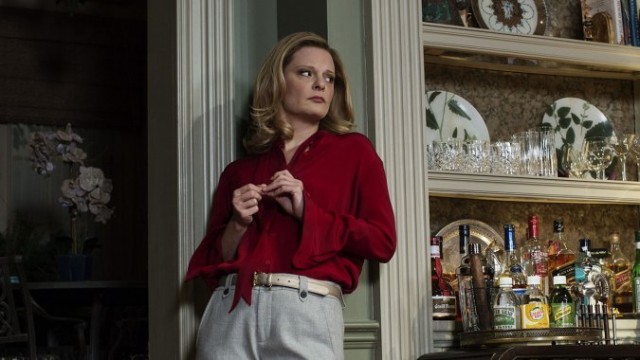
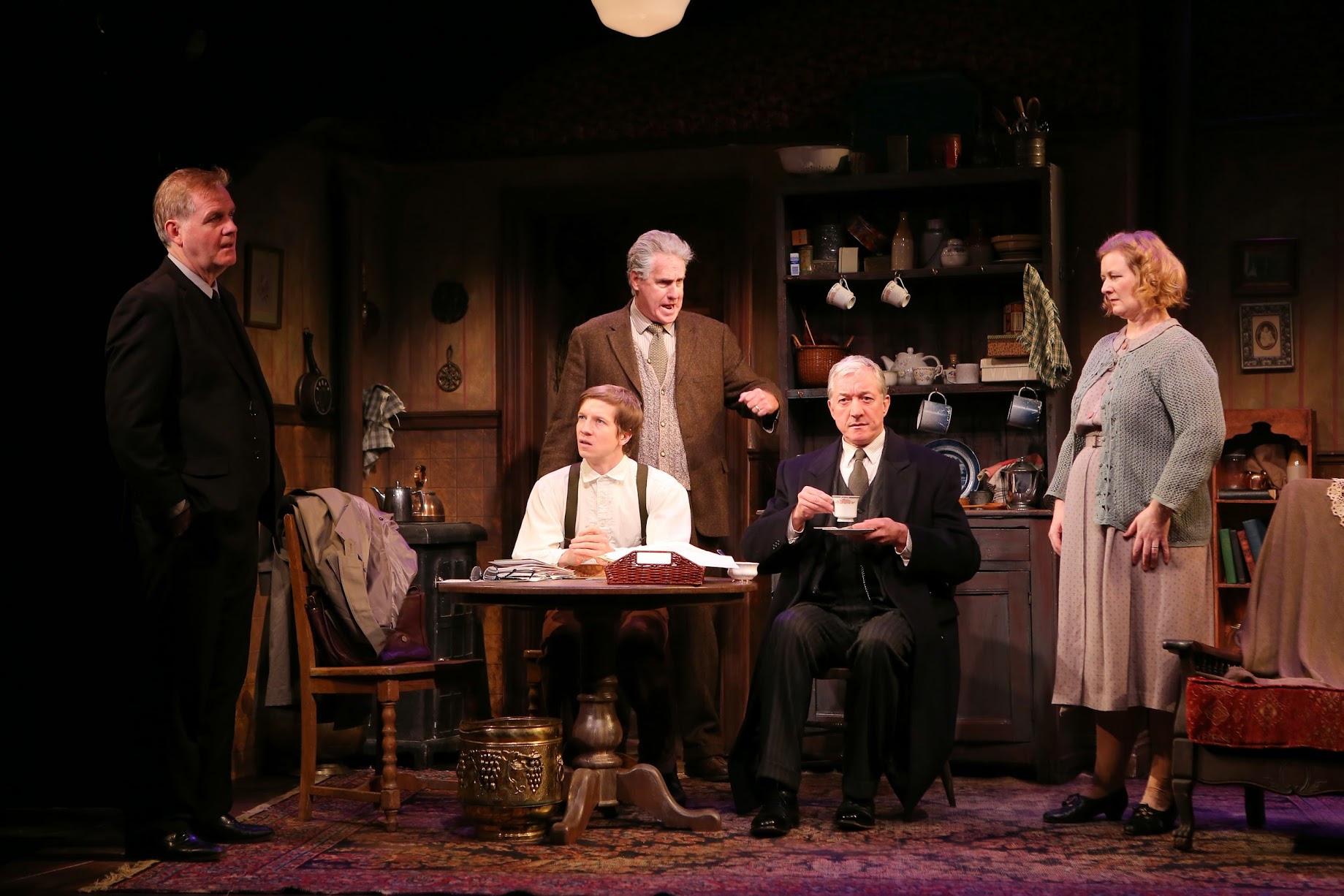
There’s something all too familiar about Pulitzer Prize winner Donald Margulies’s latest play, The Country House, which opened October 2 at the Manhattan Theatre Club’s Broadway home, the Samuel J. Friedman Theatre. The show, which deals with a close-knit group of friends and relatives gathering at a country house during the Williamstown Theatre Festival, resounds with echoes of such recent productions as the Tony-winning Vanya and Sonia and Masha and Spike, the underrated Ten Chimneys, the Public’s Nikolai and the Others, and MTC’s own The Snow Geese. It’s a year after the tragic death of Kathy, a beloved and successful actress and, by all accounts, one of the most amazing women ever to step foot on the planet. Her family is honoring her memory at their country house, led by her mother, stage diva Anna Patterson (Blythe Danner); Anna’s cynical, ne’er-do-well son, Elliot Cooper (Eric Lange); her former son-in-law, schlock director Walter Keegan (David Raasche), who was married to Kathy; and Susie (Sarah Steele), Walter and Kathy’s twentysomething daughter. Walter has arrived with his new fiancée, the much younger and very beautiful — as we are told over and over again — Nell McNally (Kate Jennings Bryant), a struggling actress, and Anna has also invited TV superstar and heartthrob Michael Astor (Daniel Sunjata), a longtime family friend who is slumming by appearing at the festival in Ferenc Molnár’s The Guardsman. Margulies (Time Stands Still, Dinner with Friends) channels Chekhov’s The Cherry Orchard and The Seagull as all the women flirt with Michael, the cynical Susie chooses not to get involved in the family business, and the condescending and contemptuous Elliott takes issue with just about everyone, writing a play that doesn’t exactly endear him to the others.

The Country House might not shed new light on this somewhat tired subject, but the production itself is excellent, fluidly directed by Daniel Sullivan, who has helmed many of Margulies’s previous plays. John Lee Beatty’s living-room set is charming and inviting, enhanced by Peter Kaczorowski’s splendid lighting, which smartly signals each next scene and is especially effective evoking a lightning storm. The acting is exemplary, led by the always engaging Danner (The Commons of Pensacola, Butterflies Are Free) as the still-feisty family matriarch rehearsing for Miss Warren’s Profession, and Steele (Slowgirl, Russian Transport), who is a star on the rise. Rasche (Speed-the-Plow, Sledge Hammer!) is particularly effective as Walter, a character with a lot more depth than originally presented, and TV veteran Lange (Lost, Victorious), in his first play in seven years, will have you wondering why he doesn’t take to the stage more often. Originally produced this past summer at the Geffen Playhouse in L.A. (where Danner, Steele, Rasche, and Lange originated their roles), The Country House has a lot to offer, but it’s a place that’s been visited far too often.

LOVE LETTERS

(© Carol Rosegg)

Mia Farrow and Brian Dennehy are first pair to star in Broadway revival of A. R. Gurney’s Pulitzer Prize finalist LOVE LETTERS (photo © Carol Rosegg)

Brooks Atkinson Theatre
256 West 47th St. between Broadway & Eighth Ave.
Through February 15, $27-$137
877-250-2929
www.lovelettersbroadway.com
www.brooksatkinsontheater.com

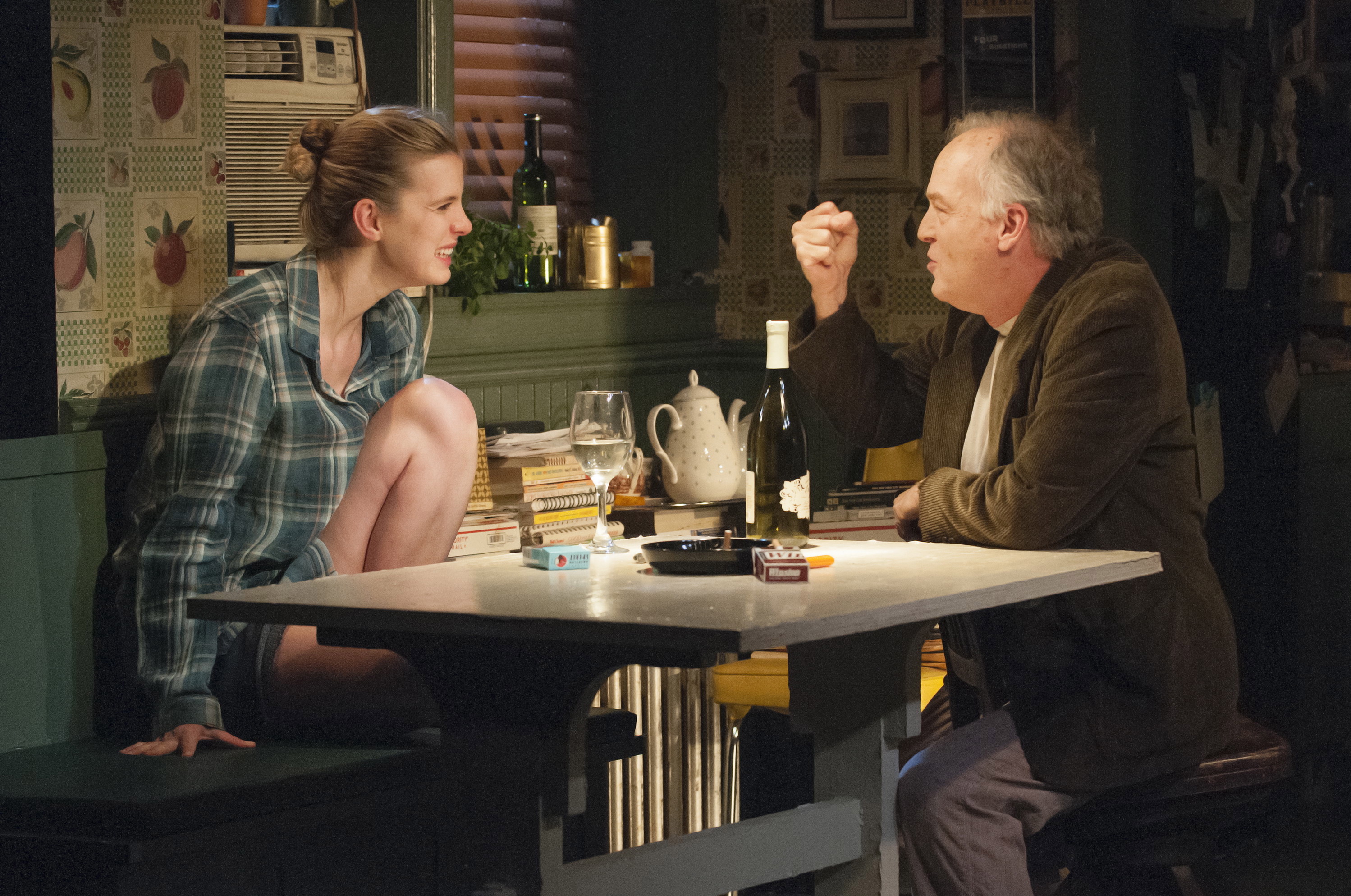
A. R. Gurney’s 1988 play, Love Letters, is a joyous celebration of the written word that might look deceptively simple but is instead a complex and thrilling examination of life and love. A Pulitzer Prize finalist for drama, the ninety-minute show features a pair of actors sitting at a long rectangular table, with no bells or whistles; Tony-winning designer John Lee Beatty’s set is about as basic as can be. The epistolary play is told through decades of letters written between childhood friends Melissa Gardner and Andrew Makepeace Ladd III as they grow up together, head off to boarding school and college, experience romances, and choose very different life and career paths. While the privileged Melissa is a quirky free spirit interested in art, Andrew comes from a slightly less-moneyed family, maturing into a down-to-earth man seeking worldly achievement. Through the letters, they share their hopes and dreams, successes and disappointments, encapsulating two lives that don’t turn out quite as planned.

For more than a quarter century, Love Letters, in which the actors read directly from the script, has been performed around the world, with spectacular pairings as well as productions with stunt casting, including Gurney and Holland Taylor, Sigourney Weaver and Jeff Daniels, Kathleen Turner and John Rubinstein, Larry Hagman and Linda Gray (Dallas), Hagman and Barbara Eden (I Dream of Jeannie), Robert Wagner and Jill St. John, Wagner and Stefanie Powers (Hart to Hart), Jerry Hall and David Soul, Elizabeth Taylor and James Earl Jones, Samantha Bee and Jason Jones (The Daily Show), and, in Stanley Donen’s fleshed-out 1999 TV movie, Laura Linney and Steven Weber. For its current Broadway revival, directed by two-time Tony winner Gregory Mosher, five duos will be playing the roles through February 15. Mia Farrow and Brian Dennehy open the run, and they are mesmerizing. Farrow brings a beguiling eccentricity to the capricious, unpredictable, and often self-defeating Melissa, who travels the world but can’t find happiness. Farrow delivers her lines looking out at the audience, adding emotive physical flourishes, while Dennehy steadfastly reads from the script with appropriate earnestness. Farrow and Dennehy make a wonderful team, particularly when one writes multiple letters to the other without a response, their disappointment and pain palpable. The play stumbles as it approaches the end, with the events that befall each character way too over the top, but Andrew’s soliloquy on the glory of handwritten letters trumps all minor quibbles. And thankfully the play has not been updated; there are no mentions of cell phones or the internet, which have changed forever the way people communicate. Farrow and Dennehy will be followed by Dennehy and Carol Burnett, then Candice Bergen and Alan Alda, Stacy Keach and Diana Rigg, and Anjelica Huston and Martin Sheen, with more pairings to be announced.

DIRT

DIRT

Christopher Domig returns to his award-winning role in new production of DIRT at the 4th Street Theatre

4th Street Theatre
83 East Fourth St. between Second Ave. & Bowery
Wednesday – Sunday through October 12, $20
212-780-9037
www.theplaydirt.com

Christopher Domig gives voice to illegal immigrants in the poignant one-man show Dirt, running through October 12 at the 4th Street Theatre. Domig plays Sad, a thirty-year-old Iraqi rose peddler who lives in a dingy apartment with an unseen Egyptian roommate. Although he is glad to be in America, he can’t forget that he’s not supposed to be there. “I basically love life even though I have no right to live here,” he says, a sentiment that he repeats often throughout the seventy-minute play. He’s like a caged man barely eking out existence in a dungeon, with no past and no future. The first English word he learned was Kodak, and as proof he pulls out a few pictures of his family, his only connection to his previous life. He stays under the radar because, he explains, “Don’t want to attract attention.” He talks about how he is different from the average American — his head is too large and flat in the back, his pores are too big, his skin too dark, his eyes too black. “The longer I observe you, the better I think I understand why you have such a deep-rooted hatred for us,” he acknowledges. But the generally soft-spoken Sad, who harbors a secret about his full name, can get angry as well about a situation that has him lost and lonely, treated without respect and dignity, leading to an unhealthy lack of self-respect in himself. And when he explodes, it’s hard not to wonder what the consequences might be.

Even at a mere seventy minutes, the play does get a bit repetitive, but Domig, who was named Best Actor at the 2007 New York International Fringe Festival for the role, is captivating as he makes nearly constant eye contact with the audience in the small, intimate theater. He moves around Edward K. Ross’s dreary apartment set with great care, waiting for that knock on the door that could take him away. Directed by Mary Catherine Burke, the director of programming for the New York Musical Theatre Festival, and translated from the German by Paul Dvorak — Austrian Robert Schneider wrote the original play in 1993 — Dirt explores the nature of prejudice and fear as seen by a humble man trapped between two worlds, with no apparent way out. It will leave you thinking about the current controversy over illegal immigration and border control and make you examine your own views about racism the next time you see a man such as Sad on the streets of the city.

TICKET GIVEAWAY: INNER VOICES, A MUSIC THEATER DOUBLE BILL

inner voices

INNER VOICES: GRACE / THE OTHER ROOM
The TBG Theatre
312 West 36th St. between Eighth & Ninth Aves., third Floor
October 4 – November 1 (official opening October 11)
www.premieresnyc.org

In 2008, Premieres NYC expanded its mission to support the expansion of new music theater in New York City by starting the Inner Voices program, in which specially selected teams collaborate on original monologues told through song. Over the last several years, the participants in Premieres NYC projects have included Hunter Foster, Shuler Hensley, Laura Osnes, Jack Cummings III, Nilo Cruz, Michael John LaChiusa, and Arielle Jacobs. The fourth Premieres presentation is another eagerly awaited double bill, beginning October 4 at the TBG Theatre. Grace, written by Tony nominee Charlayne Woodard (Ain’t Misbehavin’, The Night Watcher) with music by Kirsten Childs (Miracle Brothers), stars Andrea Frierson (Once on This Island, Me & Ella) as an award-winning novelist facing a critical moment in her life. The show is directed by Shirley Jo Finney, with music direction by Rona Siddiqui and live bass by Marc Schmied. Grace is paired with The Other Room, written by librettist Mark Campbell (The Inspector, Songs from an Unmade Bed) with music by Marisa Michelson (The Lovers, Tamar of the River), musical direction by Ian Axness, and live cello by Brian Sanders; in the show, directed by Ethan Heard, Phoebe Strole (Spring Awakening, The Madrid) plays Lena, a woman who deals with a crisis in a positive way when learning that a dear friend has AIDS.

TICKET GIVEAWAY: Inner Voices runs Monday through Saturday, October 4 to November 1, at the TBG Theatre, and twi-ny has three pairs of tickets to give away for free. Just send your name and daytime phone number to contest@twi-ny.com by Thursday, October 2, at 5:00 to be eligible. All entrants must be twenty-one years of age or older; three winners will be selected at random.

THE WAYSIDE MOTOR INN

(photo by Joan Marcus)

Ten people reevaluate their lives in a motel room in A. R. Gurney revival at the Signature (photo by Joan Marcus)

The Pershing Square Signature Center
The Alice Griffin Jewel Box Theatre
480 West 42nd St. between Tenth & Eleventh Aves.
Tuesday – Sunday through October 5, $55-$75
212-244-7529
www.signaturetheatre.org

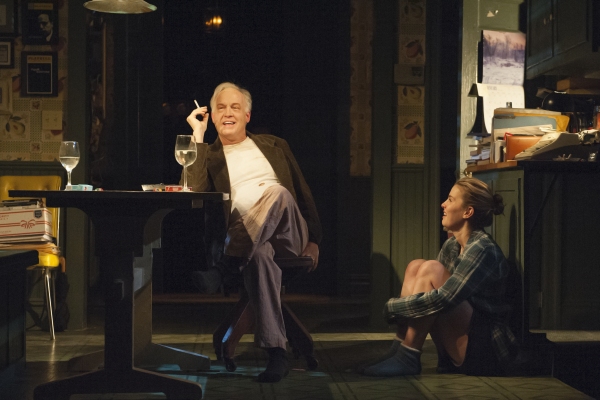
Award-winning playwright A. R. Gurney is currently represented by a pair of New York City revivals of two vastly different works. The Buffalo-born Gurney’s 1988 Love Letters, a Pulitzer Prize finalist, has recently begun a star-studded production at the Brooks Atkinson Theatre, directed by Gregory Mosher and featuring five pairs of big-time actors in succession — Mia Farrow and Brian Dennehy, Carol Burnett and Dennehy, Candice Bergen and Alan Alda, Diana Rigg and Stacy Keach, and Anjelica Huston and Martin Sheen — as a couple examining their long relationship by sitting down and reading letters they wrote to each other. Meanwhile, a bit southwest at the Signature Theatre, five two-character stories are being told simultaneously in a revival of Gurney’s 1977 densely packed drama The Wayside Motor Inn. Set outside Boston in the 1970s, the entire play takes place in a motel room where ten people come and go, as five unique stories occur at the same time in the same space. The set, designed by Andrew Lieberman, is a basic motel room with two queen-size beds in the center, a bathroom on the left, and a glass door with a small balcony at the right; it actually represents five separate rooms, but Gurney and director Lila Neugebauer ably guide the individual, overlapping narratives skillfully. Frank (Jon DeVries) and Jessie (Lizbeth Mackay) are an elderly couple visiting their new grandchild. Vince (Richard Topol filling in for Marc Kudisch the night we went) is an obsessed father determined that his son, Mark (Will Pullen), will get into Harvard, no matter what the moody teen really wants. Ray (Quincy Dunn-Baker) is a slick computer salesman and unfaithful spouse making a play for motel maid Sharon (Jenn Lyon). Andy (Kelly AuCoin) and Ruth (Rebecca Henderson) are in the midst of a contentious divorce. And young Phil (David McElwee) and Sally (Ismenia Mendes) are ready to make love for the first time.

(photo by Joan Marcus)

Five stories overlap in unique ways in THE WAYSIDE MOTOR INN (photo by Joan Marcus)

Over the course of two hours (with intermission), each character is forced to face some hard truths about their future while coming to terms with just what they want, expect, and, perhaps most important, need out of life. They reevaluate what they’ve done and where they’ve been as well as where they’re going. Some of the plots are more mundane and cliché-ridden than others, but Gurney, who was inspired by Verdi’s operas and the biblical parable of the sower and the seed in creating the play, makes them work as a uniform whole, with small elements from some relating to others as the actors from the different tales manage not to bump into one another or step on each other’s lines. In some ways, the five narratives can even be seen as events from a sixth, unseen life as couples first meet, fall in love, fall out of love, stick it out, send a child to college, have grandchildren, then face death. The Wayside Motor Inn might not accomplish all its lofty goals, but it is a compelling and entertaining exercise in formalist structure that always stays on track. The show, which runs through October 5, is part of Gurney’s Signature Residency, which continues in May 2015 with a revival of his 1981 play What I Did Last Summer, followed by the world premiere of a new play in the 2015-16 season.

WORKS & PROCESS AT 30

WORKS & PROCESS AT 30: ARTISTS AT WORK, ARTISTS IN PROCESS
New York Public Library for the Performing Arts, Dorothy and Lewis B. Cullman Center
40 Lincoln Center Plaza
Monday – Saturday through October 25, free
Thursday, September 25, “Three Choreographers Celebrate,” free with advance RSVP, 6:00
917-275-6975
www.nypl.org

WORKS & PROCESS
Solomon R. Guggenheim Museum, Peter B. Lewis Theater
1071 Fifth Ave. at 89th St.
October 5 – December 15, $30-$35
212-423-3500
www.guggenheim.org

For three decades, the Guggenheim has been presenting illuminating performances and discussions in its groundbreaking program Works & Process, in which emerging and established dancers, musicians, composers, and choreographers share their creative inspiration with glimpses at upcoming productions. The New York Public Library is honoring the series with “Works & Process at 30: Artists at Work, Artists in Process,” a collection of photographs, costumes, and printed ephemera from past events featuring some of the greatest directors, choreographers, and performers of the last thirty years. On September 25, the library will host “Three Choreographers Celebrate” in the Bruno Walter Auditorium (free with advance RSVP), bringing together a trio of W&P veterans, Karole Armitage, Larry Keigwin, and Pam Tanowitz, to talk about the importance of the program with Dance Theatre of Harlem artistic director Virginia Johnson; the event will also include footage from the library’s archives of nearly five hundred W&P performances. Meanwhile, tickets are now on sale and going fast for the fall 2014 W&P season, which continues October 5 with “The Kennedy Center: Little Dancer with Susan Stroman” (with Stroman, Boyd Gaines, Rebecca Luker, Tiler Peck, Lynn Ahrens, and Stephen Flaherty) and also includes Brian Brooks Moving Company on October 19-20, “Harlem Stage: Makandal” on October 27 (with Carl Hancock Rux, Yosvany Terry, Edouard Duval-Carrié, and Lars Jan), “In Process with Pam Tanowitz and David Lang” on November 2, and “Jerome Robbins: Fancy Free to On the Town” on November 9-10 (with Robert LaFosse, John Rando, Joshua Bergasse, Phyllis Newman, and Jamie Bernstein, moderated by Amanda Vaill).

THE VALLEY OF ASTONISHMENT

Jared McNeill and Kathryn Hunter explore rather unusual properties of the human brain in THE VALLEY OF ASTONISHMENT (photo by Pascal Victor / ArtComArt)

Jared McNeill and Kathryn Hunter explore rather unusual properties of the human brain in THE VALLEY OF ASTONISHMENT (photo by Pascal Victor / ArtComArt)

Theatre for a New Audience, Polonsky Shakespeare Center
262 Ashland Pl. between Lafayette Ave. & Fulton St.
Tuesday – Sunday through October 5, $60-$75
866-811-4111
www.tfana.org

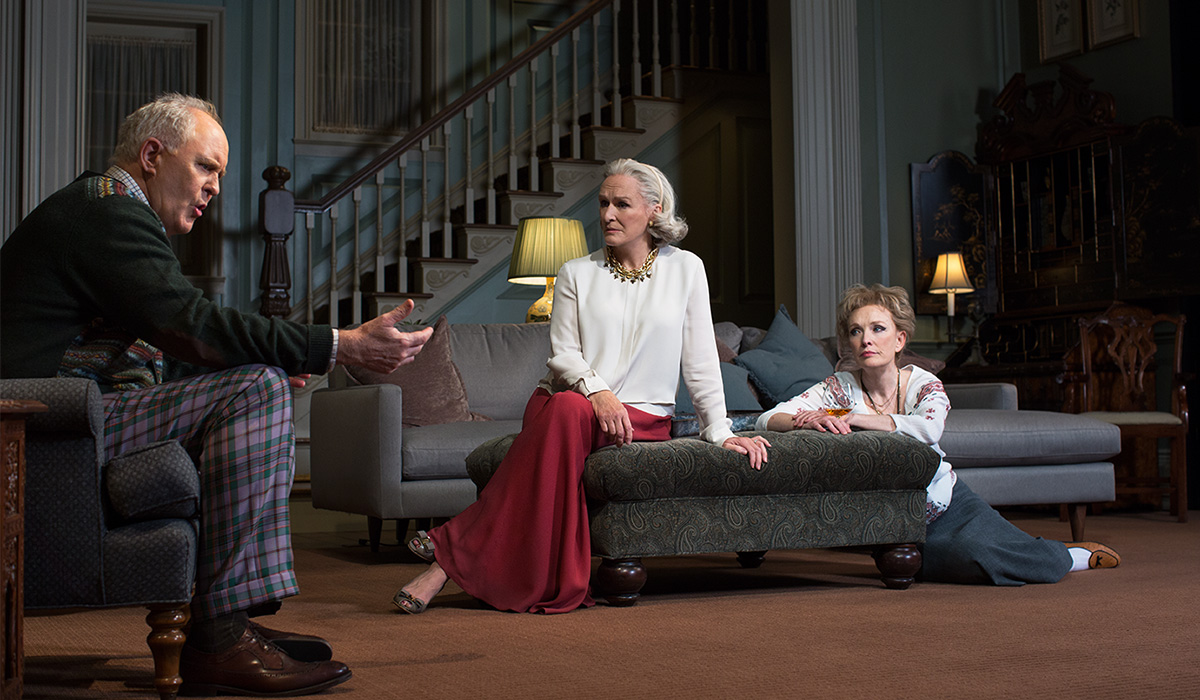
The Valley of Astonishment, a fascinating, often thoroughly entrancing tale that delves into the magical mysteries of the human brain, comes from the endlessly creative minds of Peter Brook and Marie-Hélène Estienne and their C.I.C.T. / Théâtre des Bouffes du Nord company. The spare, eighty-minute production, running at Theatre for a New Audience through October 5, evokes elements of their previous works The Conference of the Birds, based on the twelfth-century poem by Farid ud-Din Attar, and The Man Who, inspired by Oliver Sacks’s The Man Who Mistook His Wife for a Hat, while going to new, exciting places. The great Kathryn Hunter (Brook and Estienne’s Fragments, The Bee) plays Samy Costas, a character inspired by the real-life Russian mnemonist Solomon Shereshevsky; Samy is a rather ordinary woman except that she has an extraordinary memory, able to recall everything that anyone has ever said to her through synesthesia, a process in which she associates words with images. Theatre de Complicité cofounding member Marcello Magni (Fragments with Hunter, The Birds directed by Hunter) portrays one of the scientists who studies Samy; a man with no proprioception who has to use his brain a special way in order to move his otherwise paralyzed body; and a one-armed magician inspired by René Lavand. And Jared McNeill (Brook and Estienne’s The Suit, Life of Galileo) plays a second scientist; a music-hall impresario; and a painter who sees colors when he listens to jazz. The live score is performed by composer and pianist Raphaël Chambouvet and Toshi Tsuchitori on strings and percussion; each man also takes his turn at center stage.

Kathryn Hunter is once again astonishing in Peter Brook / Marie-Hélène Estienne production (photo by Pascal Victor / ArtComArt)

Kathryn Hunter is once again astonishing in Peter Brook / Marie-Hélène Estienne production (photo by Pascal Victor / ArtComArt)

The scenes that explore the blessing/curse of synesthesia are dazzling; Hunter is delightfully mesmerizing, Magni is superb as the man relearning how to walk, and McNeill excels as he imagines painting a canvas on the floor, with the help of lighting designer Philippe Vialatte. (The set includes several unpainted chairs, a rolling desk, and a coatrack, with the musicians off to one side.) One of the scientists refers to Samy’s ability as “tricks,” and soon Brook and Estienne (Je suis un Phénomène, Woza Albert!) give the show over to the one-armed magician, who performs card tricks for some of the other characters as well as a pair of audience members pulled onstage. While the tricks are cool, the scene goes on far too long and appears relevant only in its final moment, by which time the narrative thread has nearly been lost. However, it does come together for a moving finale, especially as Samy grapples with the possibility that her unique powers might be reaching an end. The Valley of Astonishment is, at times, indeed astonishing, an intelligent yet playful exploration of some of the wondrous capabilities of the human brain and how supposed experts react to them, turning them into sideshow attractions rather than using them for a greater purpose. In conjunction with the show, TFANA is hosting “Celebrating Peter Brook,” a two-day film series honoring the eighty-nine-year-old writer, director, and author, consisting of screenings of son Simon Brook’s 2012 documentary Peter Brook: The Tightrope (followed by a Q&A with Simon) and 2002 doc Brook by Brook on September 29 and Peter’s 1968 film Tell Me Lies (introduced by Simon) on September 30.